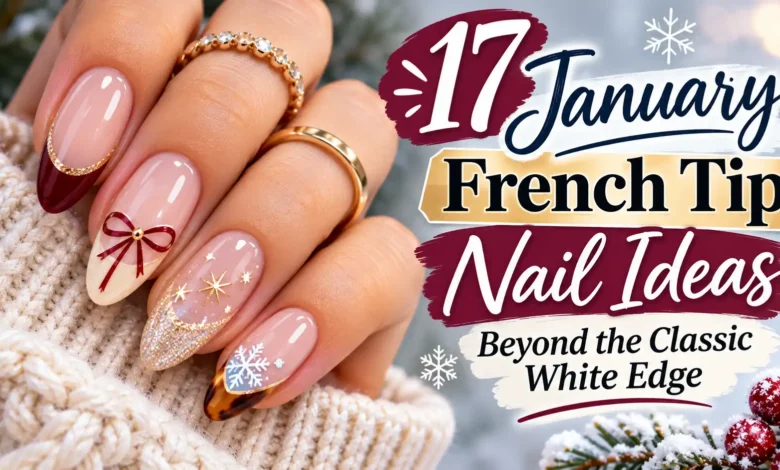
A January French manicure can keep its familiar sheer base while changing everything at the edge: a sliver of blue, an open silver outline, a smoky marble band. Start with the detail you want to notice when you look down at your hands. That makes choosing easier than sorting through dozens of nearly identical colors.
These 17 January French tip nail ideas move from barely-there edges to small patterns and reflective finishes. Each includes a specific placement to show your nail artist, plus ways to adapt the design to the length you actually wear.
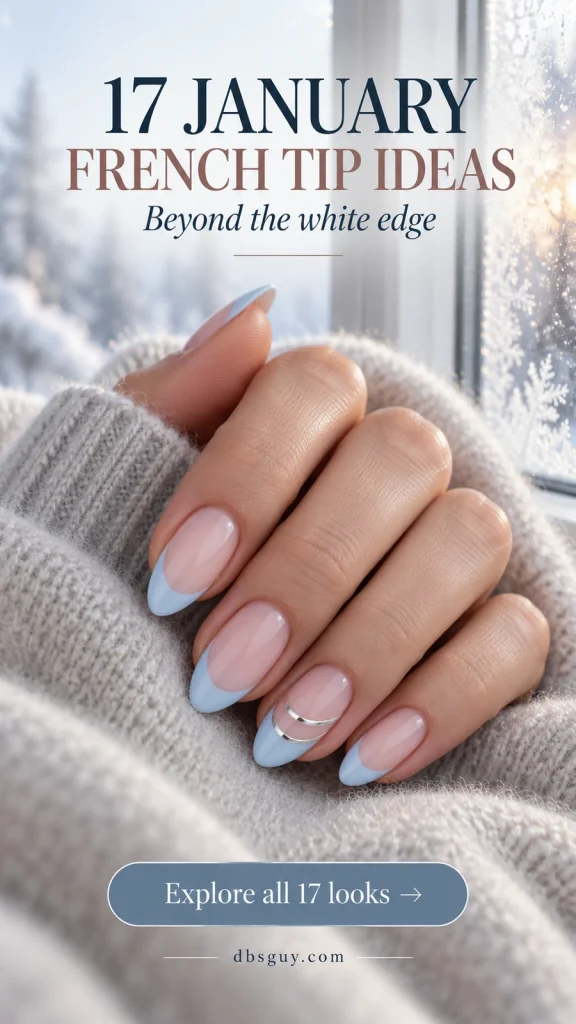
The images are AI-generated design concepts for dbsguy.com. They illustrate colors, shapes, and placement rather than document completed salon work. Your nail artist can help adapt the details to your nails.
Find Your Starting Point
- Very short nails: Begin with powder-blue micro tips in idea 1, the angled gray edge in idea 7, or the muted color set in idea 17.
- Something reflective: Compare the solid silver edge in idea 3, the open outline in idea 10, and the blue magnetic finish in idea 14.
- A little winter artwork: Try one snowflake in idea 11 or a cream cable accent in idea 12.
- A warmer palette: Look at champagne sparkle, espresso, burgundy, and amber tortoiseshell before choosing an icy blue.
For sheer-base designs, choose the base on your own hand rather than trying to copy the model’s exact pink. A translucent rose, peach, caramel, or beige can all work. The goal is enough contrast to make the tip visible without covering more of the nail than you want.
1. Powder-Blue Micro Tips on Short Squoval Nails
A thin powder-blue rim gives short nails a clear winter color without covering the nail bed. The reference keeps the corners softly squared and the blue close to the free edge. Most of what you see is still a glossy, translucent pink base.
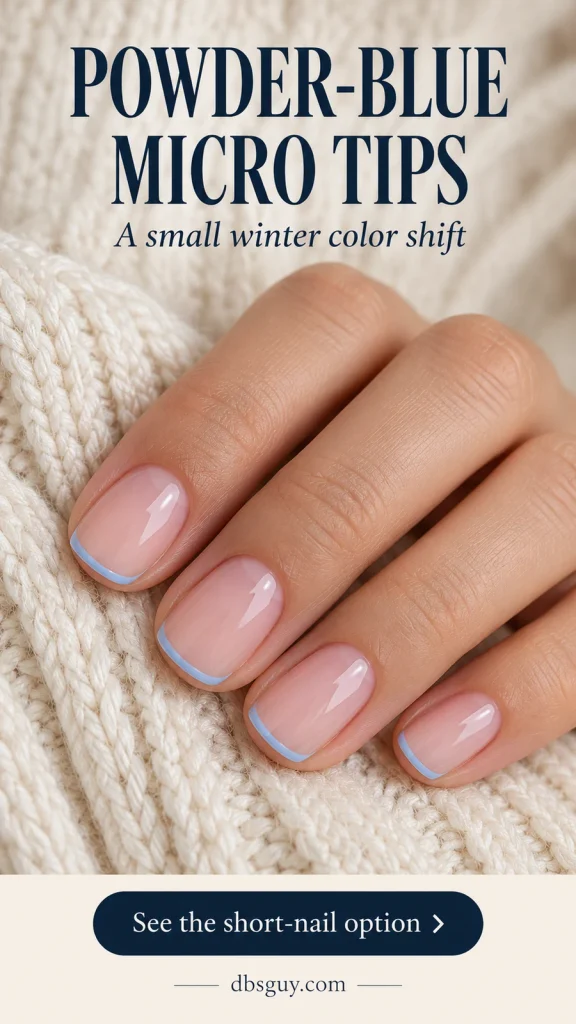
Ask for a narrow line that follows each nail’s edge, with a similar visual weight across the hand. Making every band the same measured depth can look uneven when your nails have different shapes. If a pale blue disappears against your base, choose a slightly dustier blue before widening the band. This is a useful first choice when you like a traditional French manicure but want a visible change.
For more small-scale placement ideas, see 21 Short December Nail Ideas That Make Tiny Details Stand Out.
2. Navy Double French With an Open Gap
Two navy arcs turn a familiar French shape into fine linework. One curve follows the outer edge; another sits below it, with a clean strip of blush between them. The empty space is part of the design, so the tips should not become solid navy bands.
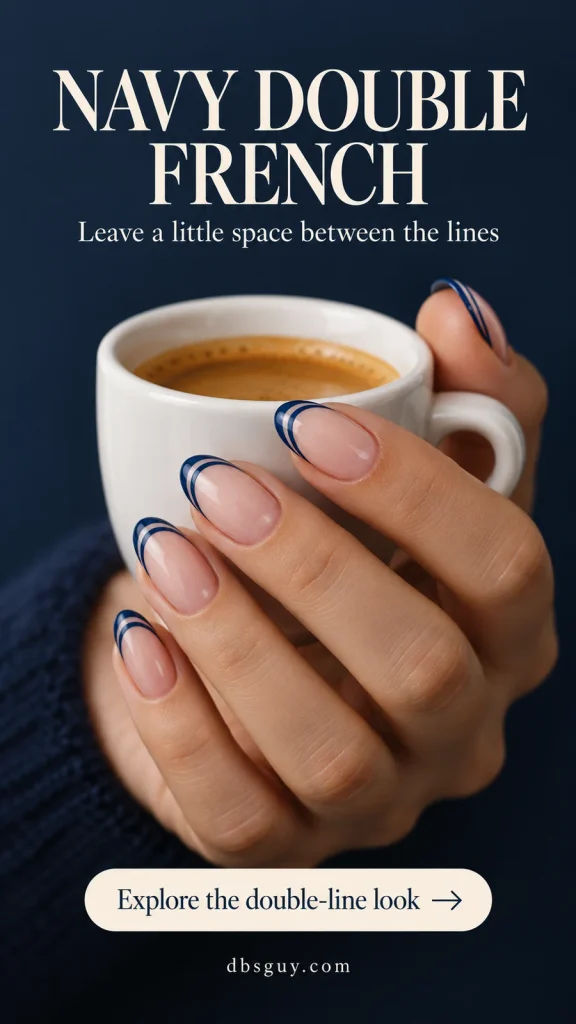
Show your artist the gap as well as the color. On medium almond nails, the two curves have room to stay separate around the tapered sides. If your nails are very short, use the double line on one accent nail and a single navy edge elsewhere. Keep both lines in the same navy so the spacing remains the feature.
3. Silver Mirror Edges on Square Nails
Here, the color change is also a change in reflection. A narrow silver tip looks like a small polished-metal border against a warm beige base. The square shape makes the front edge especially clear, with a gentle curve where the metallic band meets the nail bed.
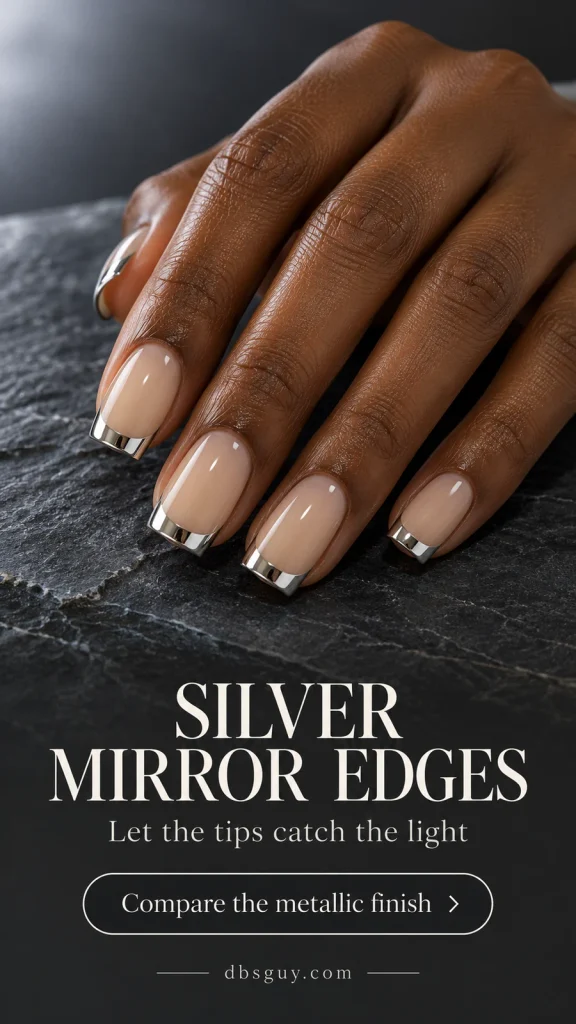
Bring a reference that shows the silver catching light, and ask to compare a finished swatch with a regular metallic polish. A chrome effect and a shimmer lacquer can look quite different. If you shorten the nails, reduce the band instead of letting silver take over the base. This set already has a strong focal point; extra foil or stones would make that clean edge harder to see.
4. Champagne Glitter That Fades Back From the Tip
This is a soft French interpretation rather than a crisp painted stripe. Fine champagne glitter gathers at the free edge, then becomes sparse as it moves toward the middle. The cuticle area stays sheer. It gives you sparkle without a sharp line dividing the nail into two blocks.
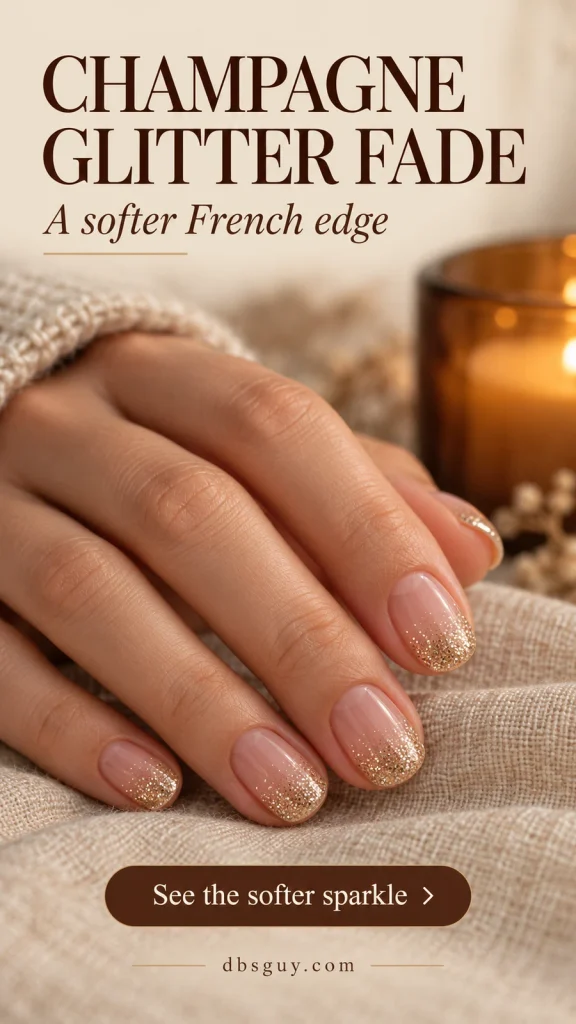
Request fine particles and an airy fade, especially on short oval nails. A dense band of chunky glitter would read as a different design. For a home version, use a fine glitter nail polish and practice building a little more coverage at the tip on a swatch. Let each layer dry as its label directs. The warm champagne tone is a good option if you prefer camel and cream to cool silver.
5. Espresso French Tips Made With Matte and Gloss
Keep the whole nail deep espresso and let the finish draw the French edge. The main surface is matte; the curved tip is glossy. You notice the border when light crosses it, which makes this quieter than pairing brown tips with a pale base.
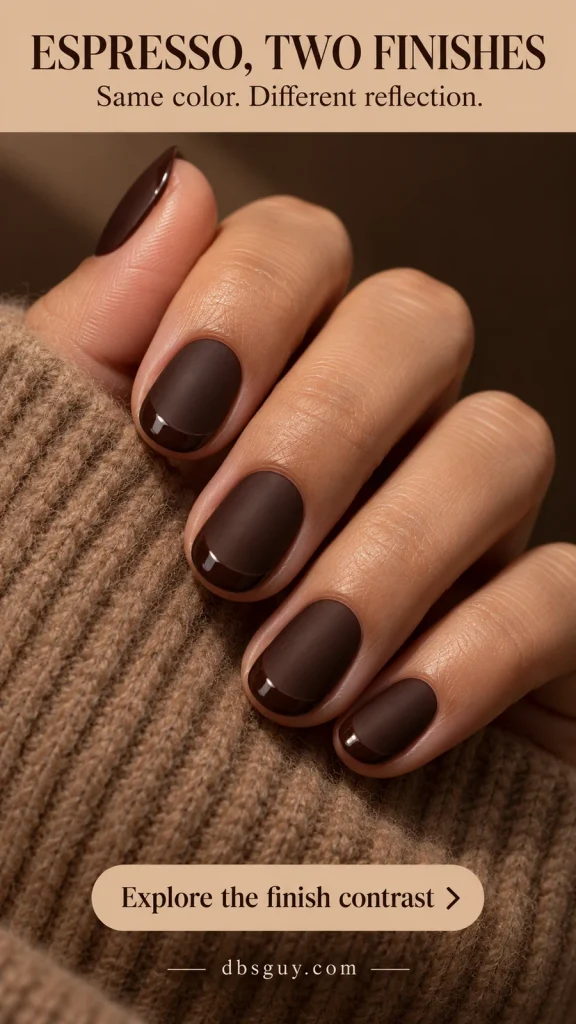
The important request is the same brown in two finishes. Ask to see one completed nail under ordinary light before repeating the design. A very wide glossy band can make the contrast feel heavy on short nails. If you recreate the look with compatible matte and glossy top coats, preserve their separate areas at the final step; an all-over glossy coat would remove the contrast.
6. Burgundy V Tips With a Pointed Center
Deep burgundy wings meet in a V instead of following a rounded smile line. The translucent center stays open, while the pointed tip carries the darkest color. This shape gives a winter red a more graphic direction without adding another pattern.
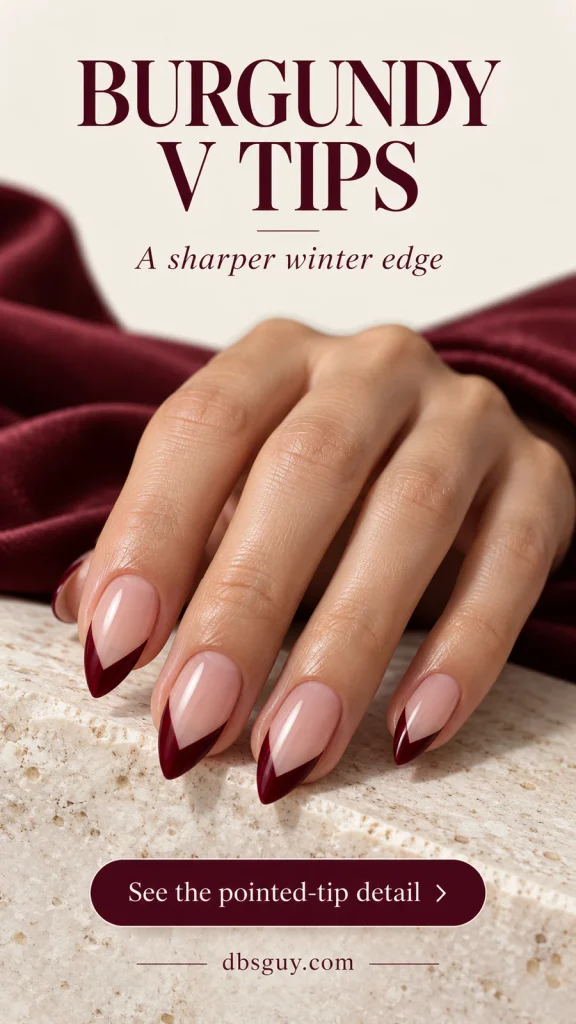
The reference has a distinctly pointed, tapered shape. You can soften it into an almond outline and keep the burgundy V inside that shape; the nail itself does not have to be as sharp. Ask your artist to center the V on each nail rather than aim every point in the same direction across the hand. On shorter nails, a shallow chevron leaves more of the base visible.
7. Slate Side-Sweep French Tips
A slate-gray swoop occupies one corner of each tip, leaving the opposite corner open. That uneven placement changes the French silhouette even though the palette stays simple. Short squoval nails make a particularly clear backdrop because you can see where the gray begins and ends.
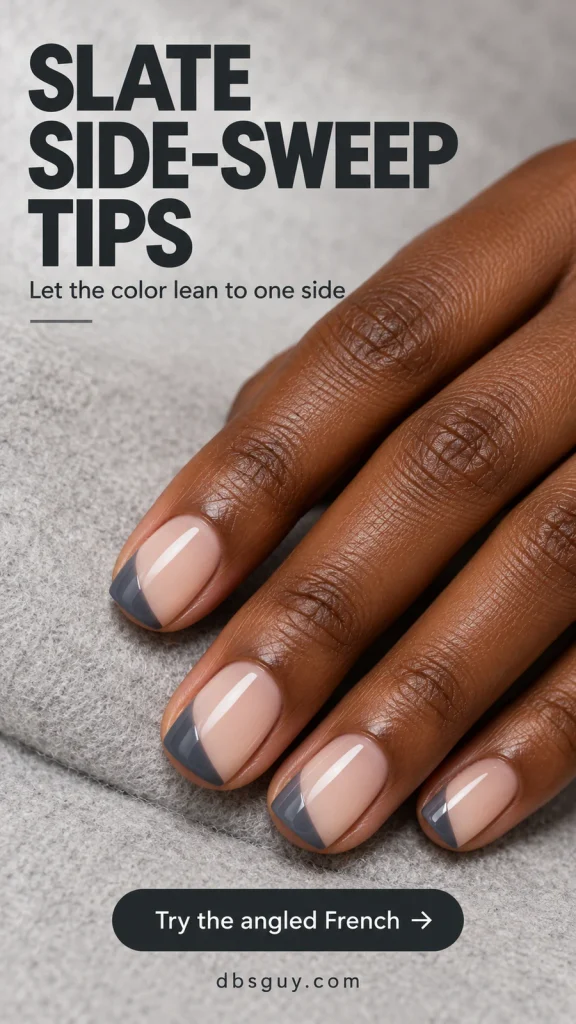
Ask for the sweep to lean consistently across the hand. Before committing, check whether you prefer a small corner accent or a deeper diagonal wedge. If your nails have almost no free edge, keep the gray near one corner rather than extending it far down the side. This design is worth considering when a full dark French band feels like more color than you want.
8. Pearly Lilac Tips With a Scalloped Border
Small rounded scallops interrupt the inner edge of this lilac French. The pearly finish supplies a soft reflection, but the little curves are what distinguish it from a standard pastel tip. Leave the pink base clear so the border remains easy to read.
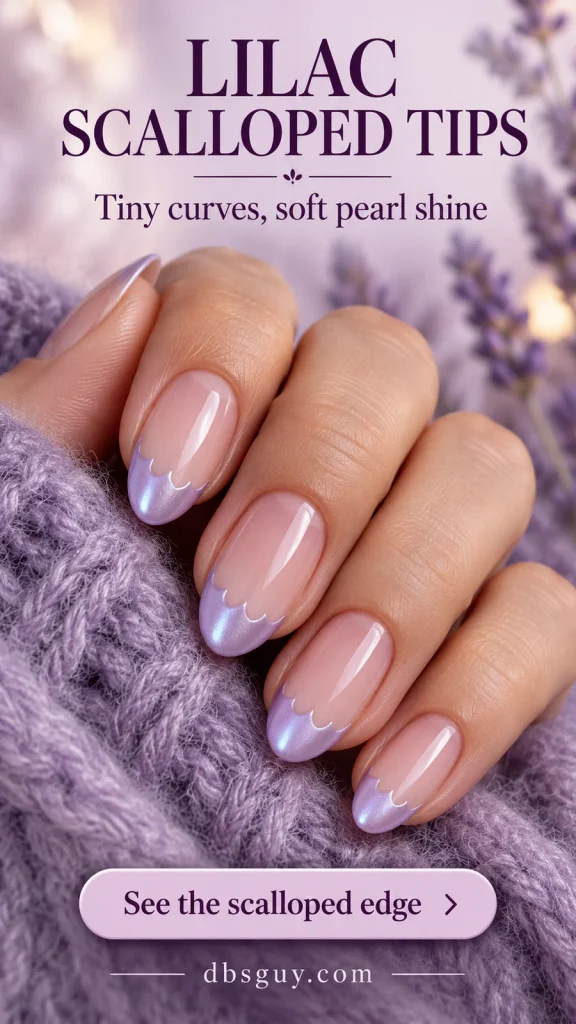
Ask for a few defined curves rather than many tiny bumps. On a smaller nail, reduce the number of scallops instead of shrinking them until they blur together. A flat pearlescent polish can suggest the finish without raised embellishments. Skip added dots along the border; they would compete with the scalloped shape you chose.
If you want to coordinate the sheen with your accessories, browse 15 Elegant January Nail Art Ideas to Pair With Your Winter Jewelry.
9. Forest-Green Checkerboard Tips
Two compact rows of green-and-cream checks give a square French tip a woven-looking rhythm. Keeping the checks inside the tip leaves the rest of the nail quiet. It is a useful way to wear pattern when you do not want an accent nail covered from cuticle to edge.
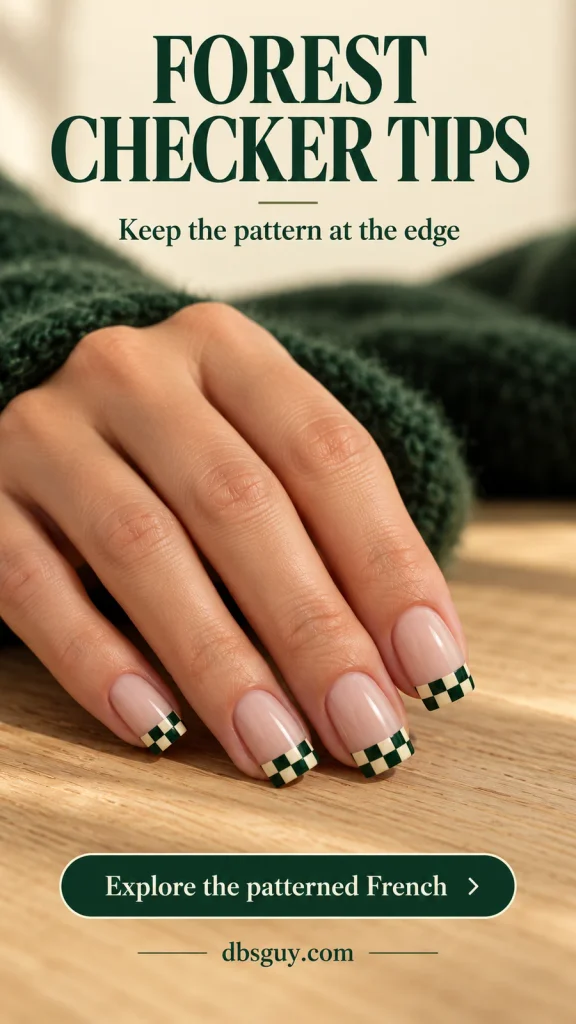
Ask your artist to plan the checks around the available width, with enough cream visible to separate the dark squares. If your preferred length cannot comfortably hold two rows, choose one larger row or reserve the checkerboard for the ring nails. Avoid squeezing in extra rows simply to match a longer reference. The green can stay deep and muted so the checks remain the main detail.
10. Silver Outline French With an Unfilled Center
Unlike the filled metallic tips in idea 3, this design draws around the tip and leaves its center open. One silver curve traces the smile line, and another follows the outer edge. The translucent panel between them gives the manicure its light, almost glassy appearance.
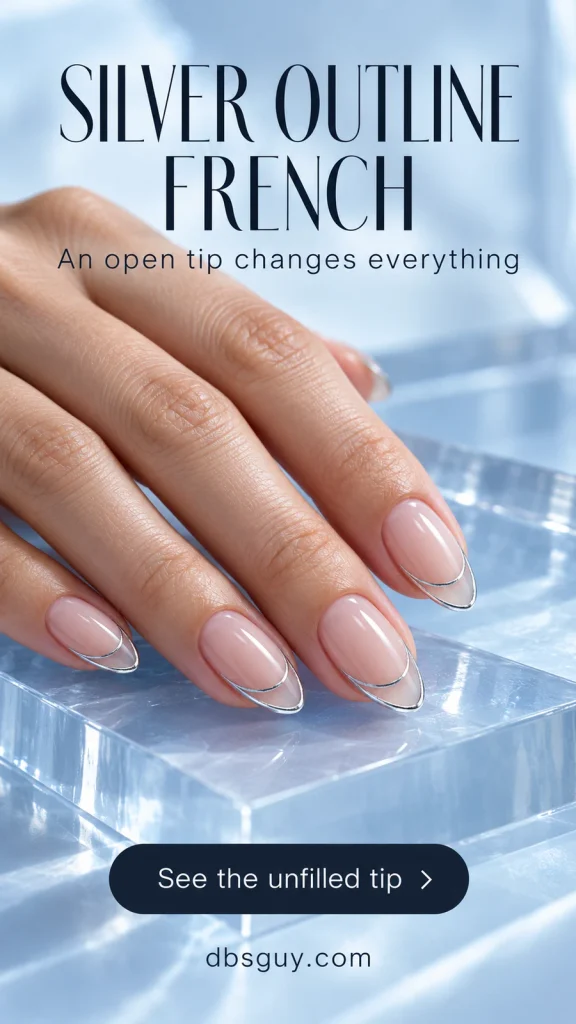
The reference uses enough length for that open panel to be visible. Show your artist where the two silver lines meet at the sides, and specify that the tip should remain unfilled. A more opaque base will change the see-through effect. For short natural nails, the double-line idea in section 2 may be a clearer adaptation than trying to reproduce a transparent extension.
11. Dusty-Mauve Tips With One White Snowflake
Dusty mauve gives a snowflake manicure a warmer starting point than ice blue. Keep the French tips plain across the hand and place one white snowflake on the ring nail’s pink base. The surrounding open space makes the tiny branches easier to see.
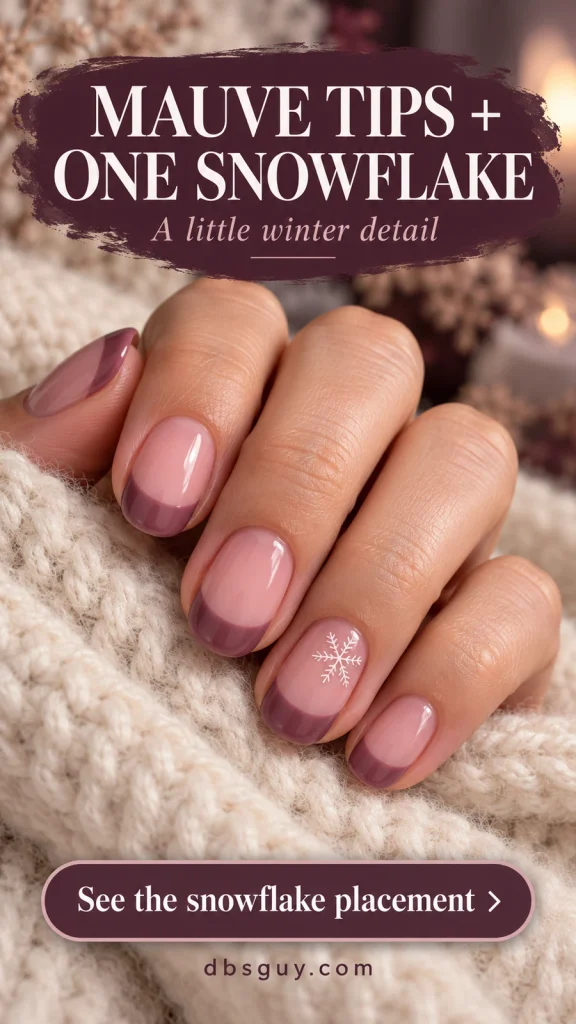
Choose the tip depth first, then fit the snowflake into the remaining base area. On short nails, a simpler six-armed flake will read more clearly than a large design with many fine branches. A flat nail decal is an alternative to hand-painting if you find one that fits without touching the tip or skin. Leave the other fingers undecorated so the single winter accent gets its own space.
For other cold-weather motifs, see 23 Winter Nail Designs: Snowflakes, Chrome and Cozy Knits.
12. Cocoa French With a Cream Cable Accent
Cocoa tips supply the color; one cream cable supplies the sweater reference. In this concept, the cable runs down the center of the ring nail and crosses into the brown tip. The other nails stay simple, which keeps the small linked shapes visible.
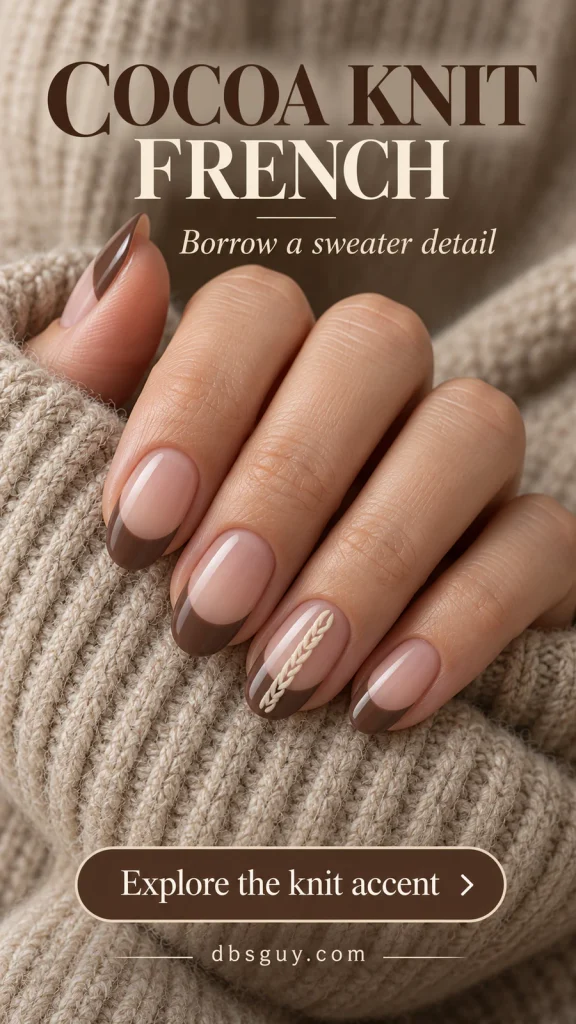
Decide whether you want a dimensional cable like the reference or a smooth painted interpretation. Show the artist that choice rather than asking only for “sweater nails.” On a shorter nail, use a shorter chain of links, or place a small cable only within the tip. You do not need a wider brown band on every finger just to accommodate the artwork on one accent.
13. Amber Tortoiseshell French Tips
Honey amber and irregular espresso patches bring a warmer pattern to the edge. The translucent-looking amber between the darker marks is important: without it, the tip can become a nearly solid brown stripe. The clear-looking nude base keeps the mottled pattern contained.
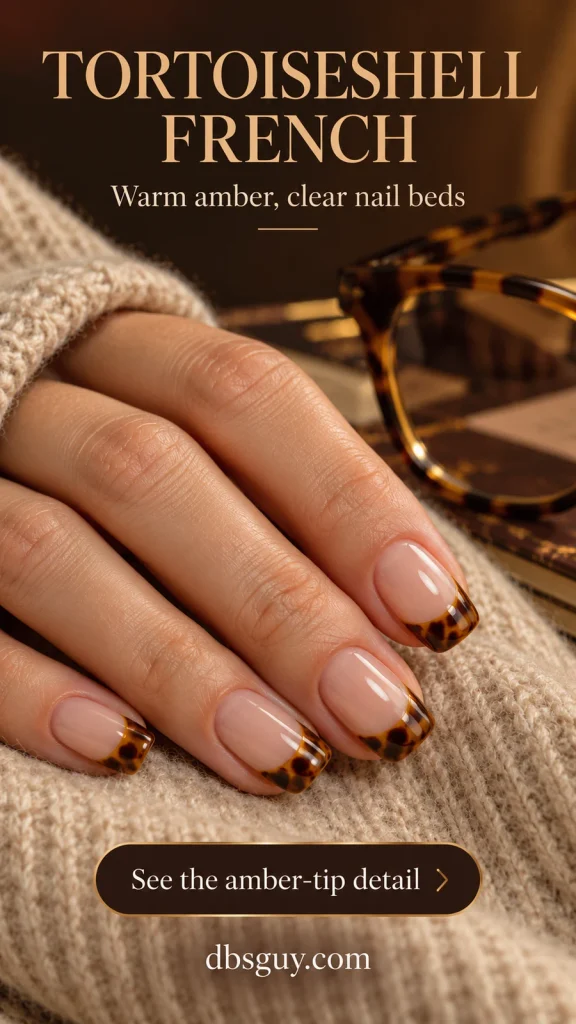
Ask for uneven, softly layered patches rather than identical spots or outlined leopard rosettes. The reference uses squoval nails with enough tip area to show both light and dark. On a shorter set, fewer patches will be easier to distinguish. This is a natural place to start if your winter wardrobe includes brown leather, oatmeal wool, or tortoiseshell frames and you want to repeat those warm tones.
14. Sapphire Magnetic French Tips
A bright reflected band moves through the blue tips in this sapphire concept. The sheer pink base stays plain, giving the glowing edge room to stand out. “Velvet” describes the light effect here, rather than a fuzzy nail surface.
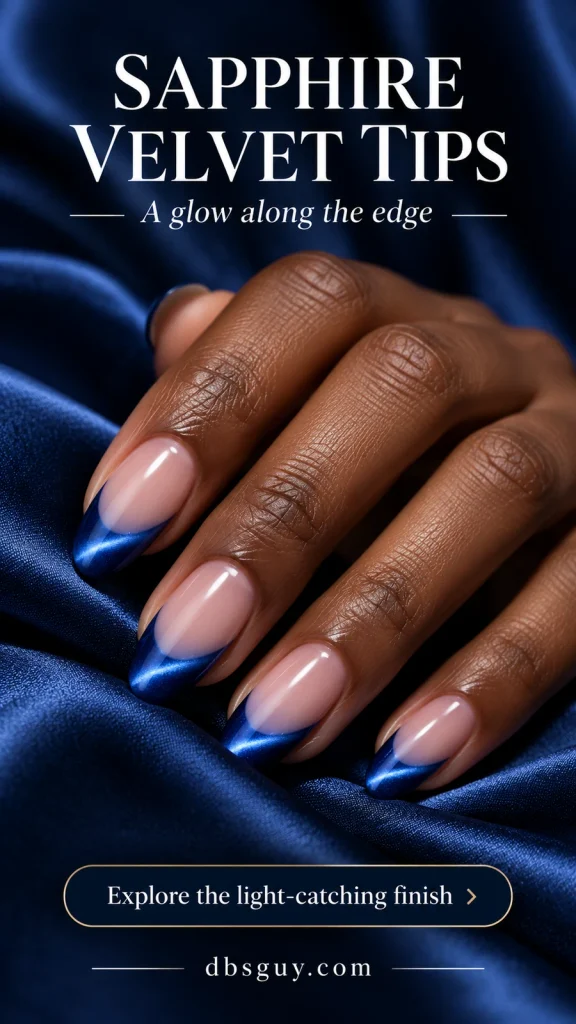
At the salon, ask to see a magnetic sample tilted under the light. A single picture cannot show the entire changing reflection. Keep the magnetic effect within the French band and choose a tip depth that leaves the blue highlight visible. Ordinary blue shimmer can give you a related color story, but its reflection will not behave like a magnetic finish. Product application varies, so use the instructions for the actual system selected.
15. Dusty-Rose Tips With One Tiny Navy Heart
For the later weeks of January, a muted rose French and one navy heart introduce a softer mood without changing the whole set into Valentine nail art. The reference places the heart high on the ring nail’s pink bed, with open space between it and the rose tip.
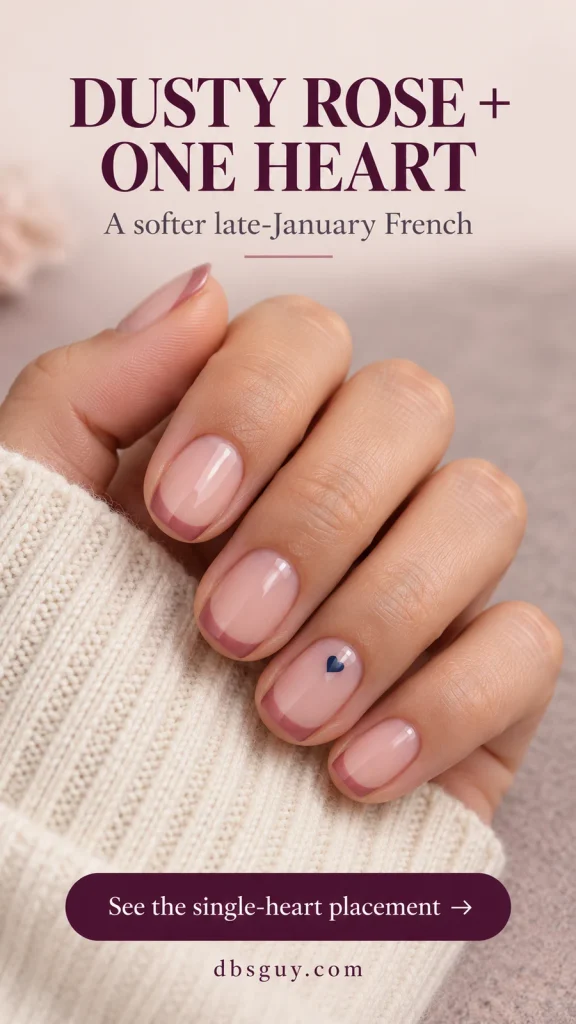
Keep that placement in mind when choosing a decal or asking for hand-painted art. A dark heart needs little size to show against pink, so you can keep it small and flat. Leave the other nails free of motifs. If you want the design to feel more understated, use a slightly grayer rose for the tips while keeping the same single navy accent.
16. Smoky Marble Contained Inside the Tips
Fine charcoal veins run through mist-gray French bands, leaving the pink beds clear. The marble belongs inside the tip rather than wandering over the whole nail. That boundary is what keeps this a patterned French manicure instead of a full marble set.
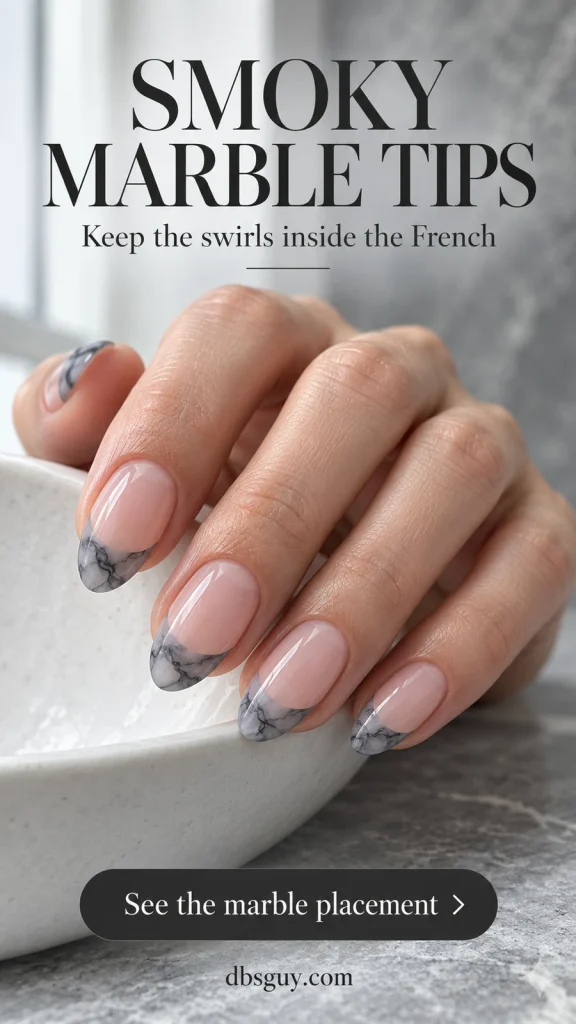
Request a few irregular wisps with pale gray space still showing between them. An evenly striped pattern will not create the same effect. Medium almond nails give the veins room to turn, but the shorter version can use one visible vein per tip. Show your artist the desired balance of light and dark; a heavily charcoal tip can lose the smoky, translucent-looking quality of the reference.
17. Muted Mix-and-Match French Tips
One quiet color per finger makes the palette itself the decoration. The reference uses oatmeal taupe, dusty blue, soft sage, smoky lavender, and slate gray. A shared pink base and matching curved tip shape bring the different shades together.
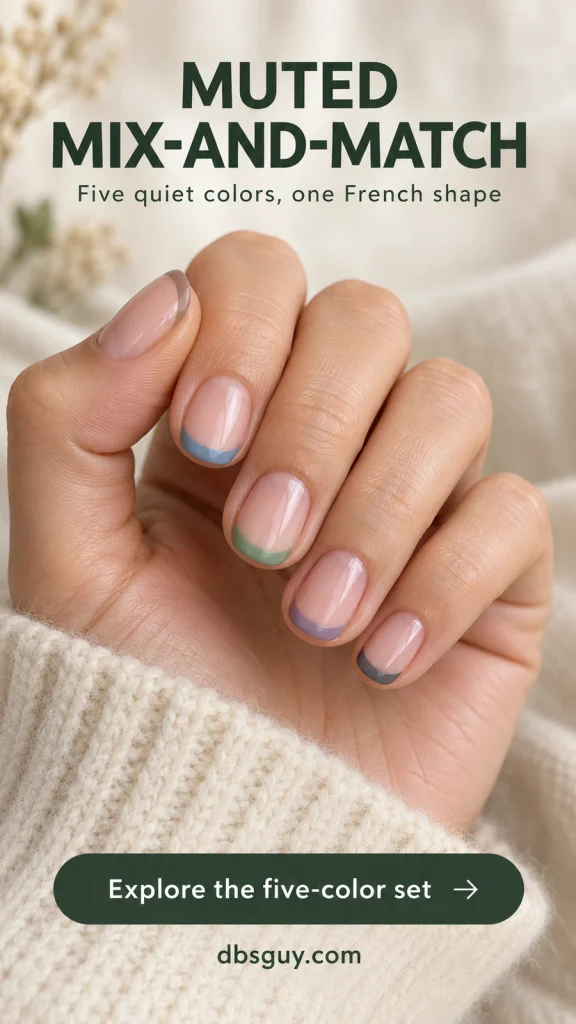
Line up the colors before painting so you can check their depth together. If one shade is much brighter or darker, it will become an accent whether you intended that or not. On short round nails, keep the bands narrow and let each color read as a small rim. Repeat the same color order on both hands for a coordinated set, or reverse it if you prefer a little variation.
How to Turn a Saved Image Into a Clear Salon Request
Pick one reference as your main design. Then explain which parts matter: the shape of the tip, the color, the base coverage, or the finish. Combining the length from one image, the pattern from another, and the sheen from a third can make the request harder to interpret.
- Confirm your everyday length first. Ask how the chosen detail will fit at that length before deciding on extra artwork.
- Approve the base on your hand. Check how sheer you want it and whether your natural free edge shows through.
- Check one tip before repeating it. This is especially helpful for the gap in a double French, the width of a chrome band, or a small patterned area.
- Describe the final surface. Matte, glossy, reflective, and dimensional details create different effects even when the colors match.
If you are painting a simple version at home, Essie’s French manicure guide outlines the basic progression from preparation and a sheer base to the smile line, cleanup, and a finishing coat. Follow the labels for the products you use, including drying or curing instructions; the design reference does not supply a universal product routine.
January French Tip Questions
Which ideas suit very short nails?
Start with the micro edge in idea 1, the corner sweep in idea 7, or the narrow colored rims in idea 17. These do not need a large patterned panel. Keep the visible base generous and ask to see the planned tip width on your shortest nail.
Do January French tips have to be blue or silver?
No. Those colors suggest an icy palette, but espresso, burgundy, cocoa, and amber can feel just as appropriate beside winter clothing. Choose a finish and color you enjoy wearing. January is the inspiration for this collection, not a color rule.
Can I recreate these with regular nail polish?
The plain colored edges, glitter fade, and small painted motifs can be interpreted with regular polish. Fine outlines and miniature patterns require more brush control. Mirror chrome and magnetic looks depend on the products used, so do not expect an ordinary silver or blue lacquer to duplicate every reflection in the concepts.
How do I keep a French tip from looking too heavy?
Check the balance between the tip and the base before adding decoration. Try a narrower band, a lower-contrast color, or a side placement. If you love a complicated pattern, confine it to one accent nail rather than enlarging every tip to fit it.