First Week of College: The Freshman Survival Guide (Orientation to First Friday)


Your first week of college needs a few reliable anchors: access to your accounts, a route to class, a place to eat, and a way to see what is due next. Start with those. You can choose your clubs, settle your room, and get to know people as the week unfolds.
This freshman survival guide takes you from orientation to your first Friday, with a specific job for each stage. The weekday labels are a planning example: if classes begin on Wednesday, start the first-class steps then. Follow your college’s actual calendar, required orientation schedule, and course instructions.

The visuals are AI-generated campus-life concepts. They illustrate the planning steps, rather than document real students or a particular college.
Your first-week priorities at a glance
- Handle immediately: account access, registration problems, required orientation tasks, and any deadline that falls before classes begin.
- Before your first class: check room locations, open each course site, read posted instructions, and pack the materials requested.
- During the week: track assignments, try a workable study routine, make a small social connection, and correct one daily frustration.
- By Friday: know your weekend deadlines and next week’s commitments, then choose an evening you can comfortably afford and get home from.
Optional events and decorating can wait when an enrollment issue or required task needs attention. Check dates now; the day-by-day plan below is not a reason to postpone something urgent.
1. Orientation: Get the access and answers you will actually use
Open the official orientation itinerary and separate required sessions from optional activities. Orientation may happen in the summer, just before classes, or across several dates. If it happened months ago, revisit your new-student checklist now.

Test your accounts before you need them
Sign in to your college email, registration portal, and learning management system—the course website your school uses, such as Canvas, Blackboard, or Brightspace. Complete the school’s authentication setup and try campus Wi-Fi when you arrive. A saved password is only useful if you can actually get in.
Check the official course schedule for enrolled classes, sections, labs, and any registration holds. A course in a shopping cart or on a waitlist is not the same as a confirmed seat. If the status is unclear, ask the registrar or advising office what action is required.
Put the add deadline, drop deadline, payment deadline, and relevant refund dates in your calendar. These may be different dates. Ask your advisor and financial aid office about the consequences before changing your course load; do not assume another student’s situation applies to yours.
Walk one useful route
Try the trip from your residence, bus stop, or parking area to your first classroom, then to the next building. Look for the actual entrance and room number. If you need an accessible route, test that route and identify the appropriate campus contact for any barrier.
Find a nearby meal option and one place where you can sit between classes. Save the contact details for IT, advising, student health, and campus safety. Ask how emergency alerts work at your school and check your contact information.
Ask before leaving orientation: “If my course site or student ID does not work on the first morning, where should I go?” Write down the office, its hours, and the answer.
2. The night before classes: Make the morning easy to start
Set up what you need to leave on time: your bag, an outfit suited to the forecast, breakfast, and a realistic departure time. You can finish organizing a drawer later.
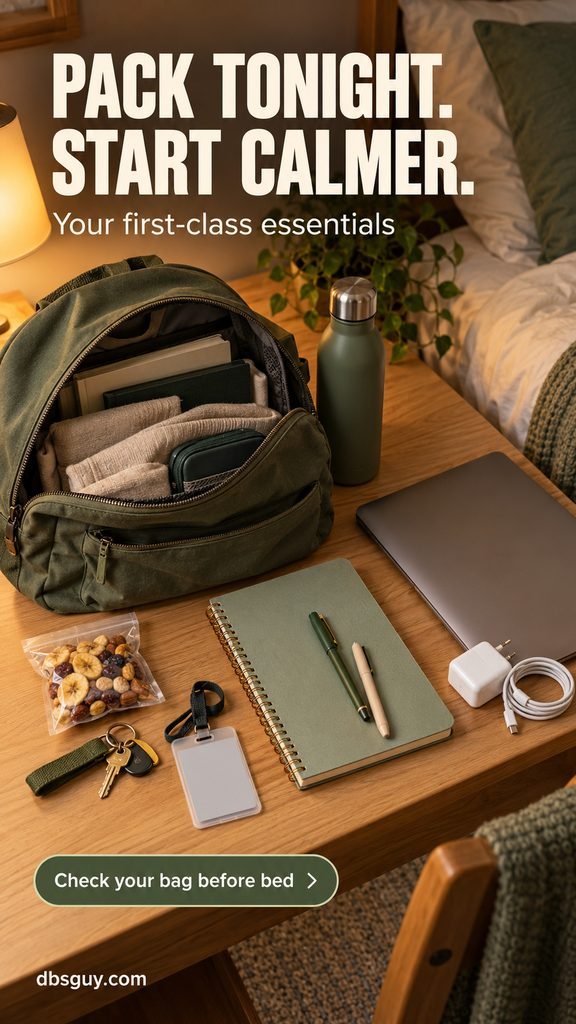
Pack a small first-day bag
- Your student ID, keys, and saved class schedule with building names and room numbers.
- A notebook and pens, plus a charged laptop and charger if the course requests or permits a laptop.
- A water bottle and a snack that suits your needs and any relevant allergy rules.
- Materials specifically requested in the syllabus or instructor’s message, including any lab requirements.
- The transit pass, parking permission, or other access item your route requires.
Recheck your email and schedule for room changes. Save an offline copy of the details so a weak signal does not leave you guessing. Set an alarm and work backward from arrival, allowing for breakfast, travel, and finding the room.
If you live with a roommate
Have a short conversation about tomorrow morning: alarms, lights, bathroom timing, and when each person needs to sleep. Then arrange a longer conversation about guests, borrowing belongings, cleaning, and quiet time. Try: “I leave early tomorrow. What would help me get ready without waking you?”
If you live in a residence hall, learn how to reach the resident assistant or housing staff and what to do if you are locked out. Follow the building’s entry rules.
If you commute
Check parking or transit details for the hours you will actually travel. Identify a backup route and a place to charge your device. Pack for the whole time away from home, including the gap before an evening class or activity.
3. Monday, or your first class day: Find out what counts
Attend every scheduled class meeting unless the instructor has told you otherwise or you cannot attend. The phrase “syllabus week” does not mean a week off. Teaching, attendance requirements, and assignments can begin immediately.

Arrive with enough time to check the course and section. If you get lost, ask someone using the building name and room number. If you arrive late, enter quietly, then check what you missed without interrupting the class.
Read each syllabus for these answers
- What is due first? Include introductory posts, quizzes, readings, and lab preparation—not just the first major paper.
- Where and when do I submit it? Check the exact submission location, deadline time, and course time zone if relevant.
- How is the grade calculated? Find the grading breakdown and the attendance, participation, and late-work rules.
- Which materials are required? Note the edition, access code, software, or equipment requirements.
- How do I get help? Save the instructor’s contact method and office hours.
The University of Nevada, Reno’s syllabus guidance recommends keeping important dates and information easy to find. Use a folder for each course and one calendar for deadlines across all courses.
Also read the course rules on collaboration, AI tools, and outside assistance before your first submission. A tool being available does not establish that it is permitted for an assignment.
Close the loop before dinner
Open the course site after class, locate the first assignment, and record your next action. “Read pages 12–20 before Wednesday” is more useful than “do history.” If the syllabus and course site disagree, ask the instructor which instruction applies.
For an asynchronous class, check the opening module and participation requirements on its start date. Logging in alone may not satisfy the course’s attendance requirement.
If you miss the first meeting: check the posted materials, contact the instructor promptly, and ask what you must do to catch up and confirm your enrollment. Do not assume the absence is excused or that your seat is secure.
4. Tuesday: Turn the timetable into a workable week
A timetable shows when you sit in class. It leaves out reading, writing, travel, meals, paid work, and the minutes spent finding a printer. Add those commitments before filling every free space with plans.

Start with fixed commitments: classes, labs, work shifts, caregiving, and travel. Then reserve time for the assignments you have actually received. Keep some room for work that takes longer than expected.
Try one specific study block
Here is an illustrative plan for a gap after a morning lecture: eat lunch, go to a nearby library seat, and spend 30 minutes turning lecture notes into questions. Use the next 30 minutes to begin the assigned problems. Adjust the length to the task and your available time; this is a starting example, not a complete workload formula.
Give the block an output: “Attempt problems 1–4 and mark where I get stuck.” That gives you something concrete to bring to office hours.
Confirm materials without buying twice
Check required materials before the first class and obtain anything needed immediately. Before paying for additional books or software, confirm the edition, whether a new access code is required, and whether materials are already included in a campus program. Ask the library about course reserves and their checkout limits.
A used book may be unsuitable if the assignment requires a separate, unused code. Compare the complete requirement and return terms, rather than the book price alone. If cost prevents access, tell the instructor and ask the relevant campus office about available support.
Make one dependable workspace with a usable surface, charging access, and the materials for the task. If your room is distracting, try a campus study area during a gap between classes.
Also Read: 15 Bedroom Design With Study Table Ideas for ways to give a study surface a defined place in a small room.
5. Wednesday: Make a connection you can repeat
You do not need a settled friend group by midweek. A more useful first step is one person you can greet again in a class, dining area, club meeting, or commuter lounge.

Use an invitation with a small next step
- Before class: “Have you found where the first assignment is posted?”
- After class: “I’m grabbing lunch before my next lecture. Want to come?”
- At an activity: “Is this your first meeting too?”
- For a study connection: “Want to compare our approaches to the practice questions after we try them?” Follow the course’s collaboration rules.
Choose an optional event that interests you and fits your schedule. Ask when the group next meets; a welcome event does not have to become an immediate membership commitment. If you commute, an activity between classes may be easier to attend again than one requiring a second trip.
Know where to take a problem
For a confusing assignment, start with the instructor or teaching assistant. For degree requirements, contact advising. For room concerns, use housing staff; for access needs, contact the disability or accessibility office to ask about its process. Find the tutoring and writing-center booking pages before you are trying to use them at the last minute.
You can miss home and still want to be at college. Arrange a check-in with someone you trust and leave room for familiar activities. If distress is interfering with daily life, contact campus counseling or another qualified support service. You do not have to wait until the end of this checklist to ask for help.
6. Thursday: Fix the small costs and daily snags
Look at what has repeatedly made the week harder. Maybe the dining hall closes before your lab ends, a short class gap is unusable for the commute home, or buying lunch is using money meant for transportation. Choose one problem and make a specific adjustment.

Check what your meal plan actually covers
Read your own dining plan’s rules: eligible locations, operating hours, meal swipes, dining dollars, guest use, and expiration or rollover terms. A café purchase may use a different balance from a dining-hall meal. Ask dining services if the system is unclear.
Plan a backup for a day when class overlaps meal service. If food access is a problem, ask student support about a campus pantry or other assistance and its eligibility rules.
Also Read: 23 Easy Microwave Recipes for Dorm Rooms: No Kitchen Needed. Check residence-hall appliance rules and your food-storage options before choosing recipes.
Give the remaining money a job
Use money actually available after essential bills and required course costs. For illustration, a $70 weekly allowance might be divided into $25 for food beyond a meal plan, $15 for transportation, $10 for laundry and supplies, $10 for optional plans, and a $10 buffer. Those amounts total $70; they are an example, not a local cost estimate.
Replace each amount with your real expenses. If essentials exceed the money available, contact financial aid or student support to discuss options. Do not count an expected refund as spendable until you know when it will be available.
Resolve any remaining schedule concern with advising now—or earlier if a deadline requires it. Dropping a course requires your college’s official process; stopping attendance is not a dependable way to withdraw.
7. First Friday: Reset the week, then choose your evening
Before switching into weekend mode, check each course site and your email. Friday afternoon is a useful time to discover a Sunday deadline while you still have time to plan for it.
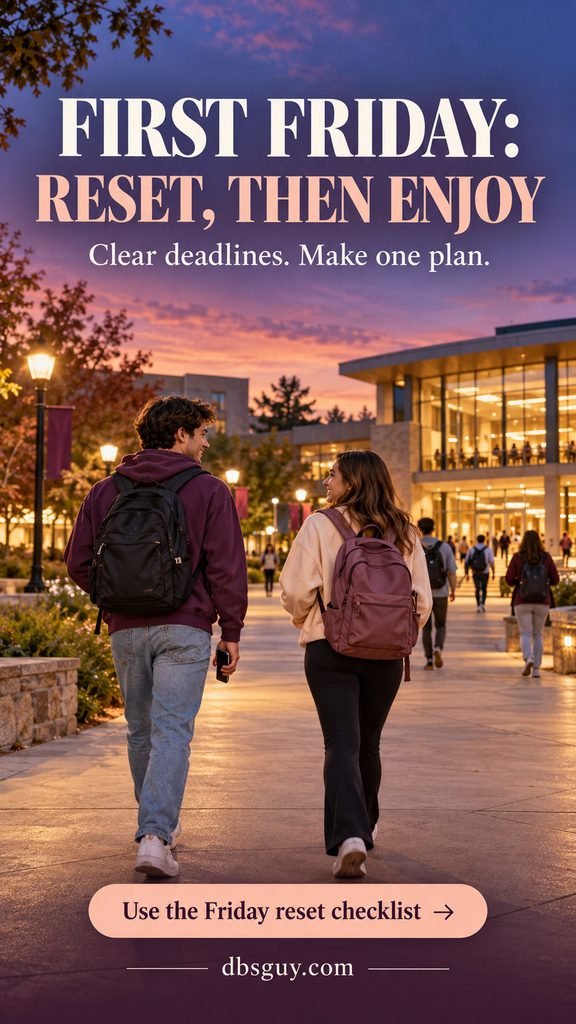
Use this short Friday reset
- Check submissions. Confirm that completed work was submitted successfully and save confirmation when available.
- Find the next deadlines. Put weekend work and next week’s first assignments in your calendar.
- Reserve the work time. Choose a realistic block before each deadline, including time to ask questions when offices are open.
- Prepare daily basics. Check laundry, food, charging, and anything needed for Monday.
- Follow up once. Invite someone to lunch, reply to an activity message, or arrange a study session.
Make an evening plan with a way home
A campus movie, dinner, a game, or a quiet evening can all fit a first Friday. Check the event details, your spending limit, and how you will get home before leaving. For commuters, confirm the last usable bus or train and any parking access restrictions.
Keep your phone charged and save your own campus safety contacts. If your school offers a shuttle or walking escort, check its service area and hours rather than assuming it operates everywhere all night. If plans change or you want to leave, you can leave; you do not owe anyone a longer evening.
Finish the week by identifying one thing that now works and one thing to adjust. Knowing where to go, what is due, and who can help gives you a useful starting point for week two.
First-week questions freshmen actually ask
Do I have to attend every orientation event?
Attend the sessions your school marks as required. Choose optional events around your interests and energy. If work, caregiving, travel, or an access barrier prevents attendance, contact orientation staff about alternatives before the session.
What should I wear to the first day of college?
Choose clothes that suit the weather, comfortable shoes for your route, and a layer if you tend to get cold indoors. Check course instructions for labs, clinical settings, or other activities with specific clothing requirements.
What if I still have not made friends by Friday?
Keep a small, repeatable plan: greet the same classmate, return to an activity you enjoyed, or invite someone to a meal. Marquette’s student-success guidance describes friendship as something built through repeated moments over time. A quiet first week does not decide the rest of your semester.
What if my class website is missing?
Check that you are enrolled in the correct section and that the course has started or been released. Contact the instructor or IT through your school’s official channels. Save the error message and ask how to access any work due while the issue is being resolved.
What if I can only manage the essentials today?
Check today’s class obligations and urgent deadlines, eat, and make time to rest. Send one message about the problem blocking you. Return to optional activities when you have room for them.