For January nail designs that match your winter mood, start with how much contrast you want: milky rose for something barely there, warm taupe for a cozy neutral, or cobalt and silver when you want your manicure to stand out. You can move from soft to statement without changing your usual nail length.
These eight looks build gradually through color, artwork, and reflected light. Each gives you a specific detail to save, a useful salon request, and a way to adjust the design when your nails have less room.
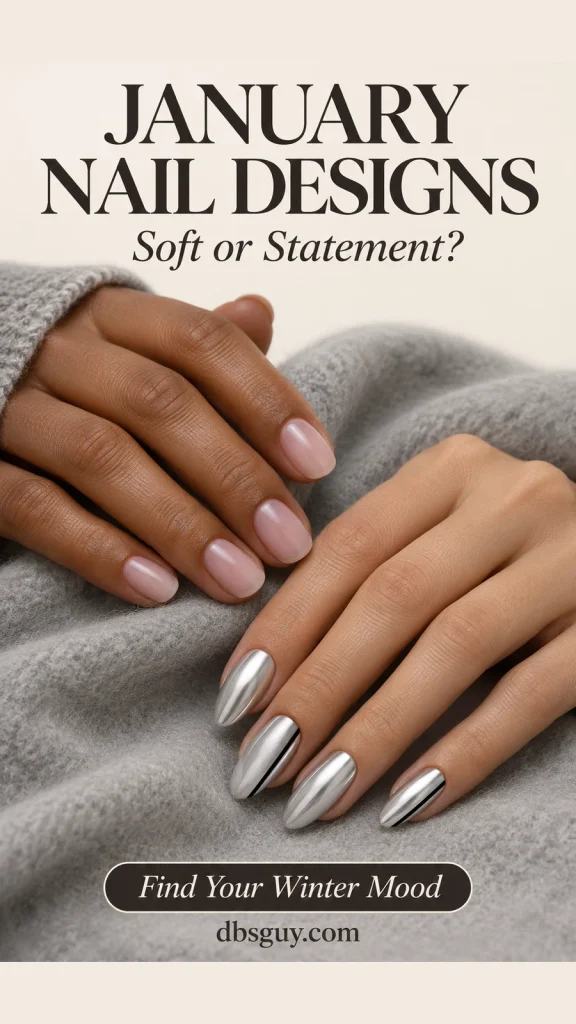
The images are AI-generated manicure concepts created for dbsguy.com. Use them as references for color, finish, and placement; they do not document completed salon work or tested polish results.
Find Your Starting Point
Picture your hand against the sleeve you wear most often. Do you want the manicure to blend into that combination, add a small detail, or become the first thing you notice?
- Barely-there detail: milky rose with one ivory curve.
- Warm and understated: mushroom taupe with oatmeal half-moons.
- Cool and airy: periwinkle with a cloudy ribbon.
- A small playful mark: dusty blush with three oxblood dots.
- Dark and subtle: deep plum with two contrasting finishes.
- Light-catching: charcoal magnetic velvet.
- A clear graphic: cobalt diagonal French tips.
- A metallic statement: uninterrupted mirror-silver chrome.
If you like the color of one look and the quieter placement of another, tell your artist which feature matters most.
1. Milky Rose With One Ivory Curve for a Soft Reset
A sheer rose base keeps a little of the natural nail visible. The small ivory curve on the ring nail gives you something to notice up close without turning the whole set into a French manicure. It is a gentle option after a month of glitter or busy holiday art.

Keep the curve close to one side of the tip, leaving most of the pink untouched. In the reference, it follows the rounded edge for only part of its length. A thick white band across every nail would create a much more defined look.
Compare a warm rose and a cooler pink swatch beside your own hand. Choose the one you enjoy with your skin and jewelry; the base does not need to match the model’s shade. Ask for translucent coverage if you want the natural nail line to remain faintly visible.
Salon request: “Short oval nails, sheer milky rose, and one fine ivory curve near the side of the ring-finger tip. Please keep the other nails plain and glossy.” On extra-short nails, shorten the curve before making it thicker.
2. Taupe Half-Moons for a Cozy Neutral Mood
Mushroom taupe and oatmeal beige borrow their warmth from a winter wardrobe without adding a knitted pattern. Most of the surface stays taupe; the lighter detail sits at the base of the middle and ring nails.
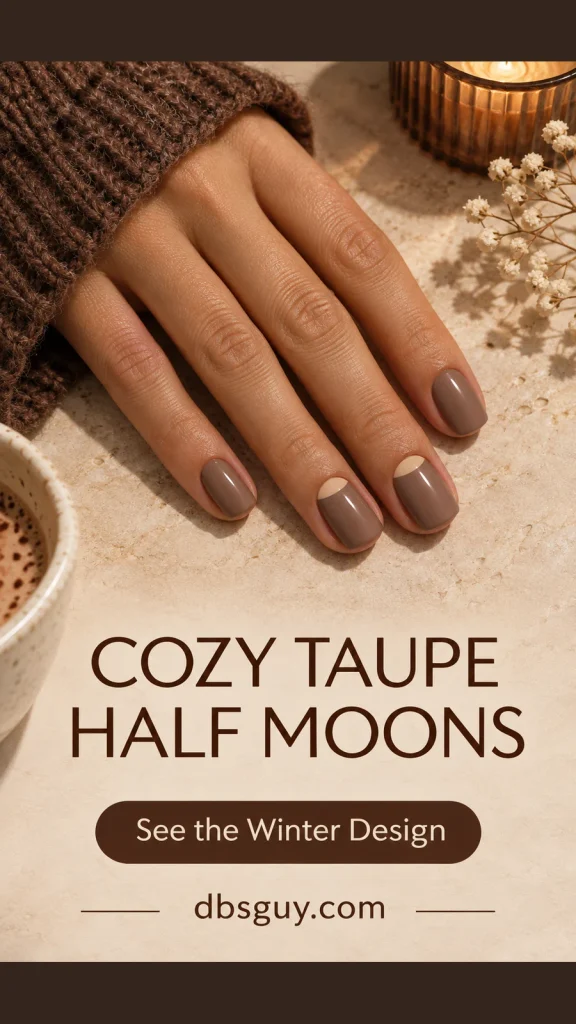
The placement is the important part. A half-moon sits near the cuticle end, while a French tip sits at the free edge. Point to the base of the nail when showing this reference, and ask for a shallow oatmeal crescent with taupe left across the center and tip.
For a softer result, choose two colors that are close in depth. Creamy white against dark brown would produce a stronger graphic than the tonal combination here. Short squoval nails—a softly squared shape with rounded corners—give the little crescent a gentle outline to follow.
If two accents feel busy, keep only the ring nail decorated. For a home interpretation, practice the curved edge with regular lacquer on a spare tip first; a quiet palette can still involve precise brushwork.
3. A Cloudy Periwinkle Ribbon for an Airy Winter Look
This is a cool-color option when you want something wintry without a snowflake. Glossy periwinkle covers the set, and a soft milky ribbon crosses one ring nail. The broad, hazy stripe gives the blue a change in texture without adding several small motifs.
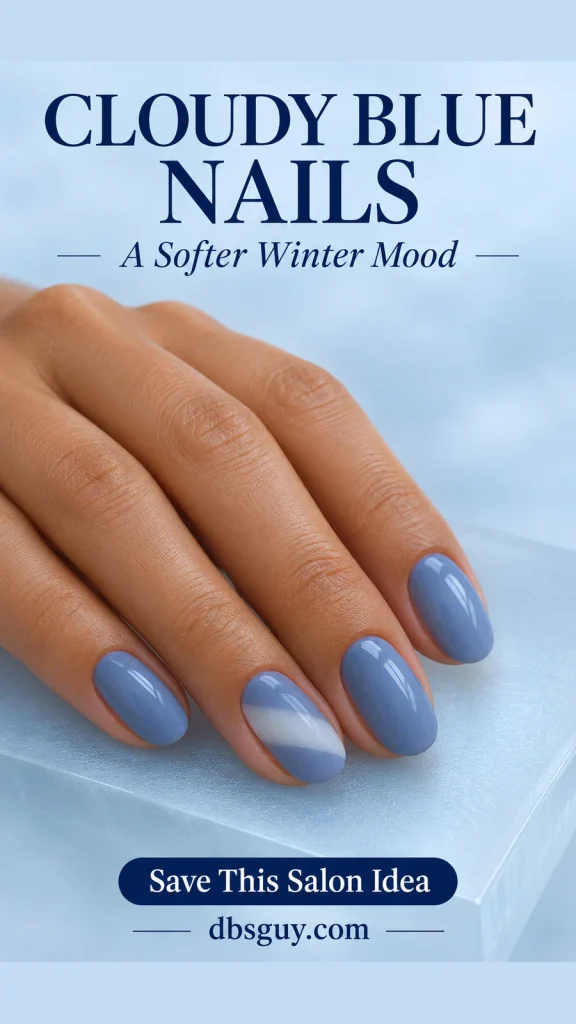
Ask for a diagonal ribbon with softened edges, keeping blue visible on both sides. A crisp opaque white stripe would look more graphic; the reference is closer to a thin cloud passing across the nail. Save a close-up so your artist can see that difference.
For short nails, keep the ribbon on one accent and leave the neighboring nails plain. Adjust its width to preserve some blue at each end rather than adding a second stripe. If you want less contrast, ask the artist to show a sheerer white on a sample tip before doing the accent.
Salon request: “Muted periwinkle on short oval nails, with one soft-edged milky diagonal ribbon on the ring nail. I want a smooth surface and no snowflakes or glitter.”
4. Three Oxblood Dots for a Small Playful Detail
Dusty blush can feel very quiet until you add a few dark marks. Here, three tiny oxblood dots sit in a centered row on the ring nail. The burgundy color gives the pink a deeper winter accent while the rest of the set stays simple.

These are flat painted circles. Ask for dots if that is the look you want; stones or pearls would add a different surface and catch the light differently. Leave blush visible between the dots and around the row so the marks remain separate.
This is a manageable regular-polish design to practice at home. Let the blush base dry as its label directs, then test a small dotting tool on a practice surface. Touch down lightly for each mark rather than repeatedly filling it in. Follow the detail polish’s drying and top-coat instructions to avoid dragging the color.
If three dots crowd your nail, use two or move the row to your roomiest accent nail. For more compact placements, see January Nail Art for Short Nails With Small but Noticeable Details.
5. Deep Plum With Matte Crescents for Quiet Drama
A dark manicure can have detail without adding a second color. This set uses deep aubergine plum with glossy surfaces and low matte crescents on the middle and ring nails. The contrast comes from how the two finishes reflect light.

Choose the plum in ordinary indoor light as well as near a window. If you want the purple to be obvious, avoid a shade that looks completely black in the room where you will usually see it. The near-black reference is a moodier choice.
Ask for a flat finish change at the base, with gloss across most of the nail. A wide matte section would make the contrast more prominent; a shallow crescent keeps it subtle. Medium oval nails show the curve clearly, but a short rounded version can keep the same arrangement.
Booking note: “Deep plum throughout, mostly glossy, with small matte plum half-moons at the bases of the middle and ring nails. No raised texture.” Ask to see the finished accent at an angle, since a straight-on photo may hide the difference in sheen.
6. Charcoal Velvet for a Light-Catching Winter Mood
Charcoal velvet sits between a dark neutral and a more reflective statement. The smoky edges remain visible while a broad silver glow crosses each nail. The finish supplies the detail, so this set does not need linework or a separate accent.
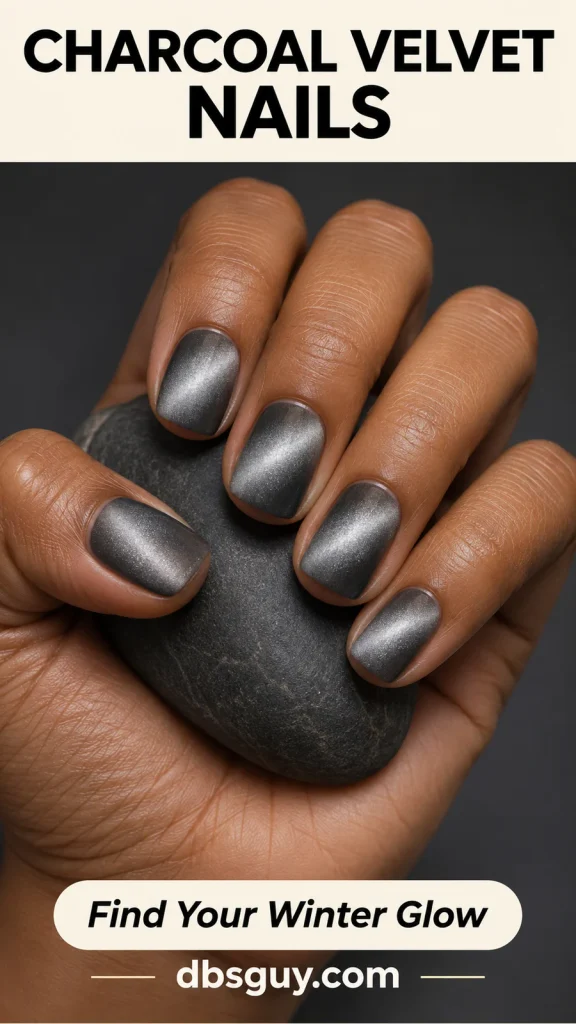
In this look, “velvet” describes a luminous magnetic-polish effect. The nail surface stays smooth. Show your artist the wide, diffused reflection: a narrow cat-eye line, chunky glitter, and mirror chrome would each give a different result.
Ask for charcoal magnetic polish with a soft diagonal halo, then turn a sample under the light before choosing it. The reflection will look different as the lighting and viewing angle change; an AI concept cannot predict the exact result of a particular product.
Short squoval nails work well here because there is no drawn pattern to resize. If painting at home, use a magnetic polish system and follow that manufacturer’s magnet and finishing directions. Ordinary silver shimmer offers a simpler color-and-sparkle interpretation, with a different reflection.
7. Cobalt Diagonal French Tips for a Confident Graphic
Cobalt puts the contrast at the ends of the nails. A sheer pink-beige base leaves the center open, while a sharp diagonal border changes the familiar French tip into an angular block of blue. The shape of that border matters as much as the color.
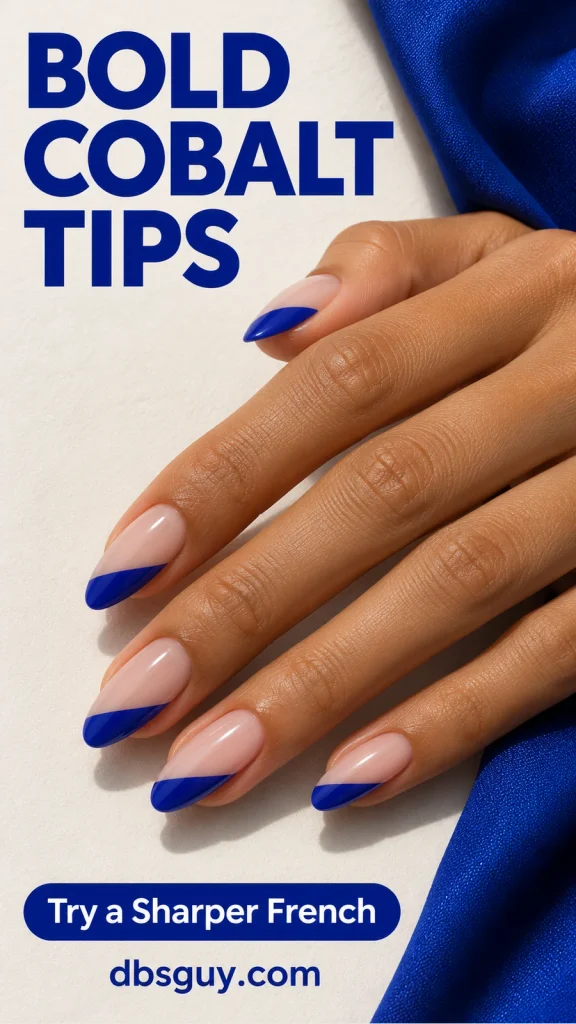
The reference uses medium almond nails with blue taking roughly the outer quarter to third. Treat that as a visual proportion, not a fixed measurement. On a shorter nail, a shallower wedge will leave more of the sheer base visible.
Ask your artist to draw one tip first so you can agree on the angle and depth. Keep the blue strong and the rest of the nail uncluttered if you want the graphic edge to remain the focus. A pale icy blue would soften the contrast considerably.
Salon request: “Sheer pink-beige bases with cobalt French tips and a straight diagonal border, rather than a curved smile line. Please adjust the blue depth to my length.” For other edge treatments, browse 17 January French Tip Nail Ideas Beyond the Classic White Edge.
8. Mirror Silver for a Statement Finish
Full silver chrome makes the finish itself the accessory. The medium almond outline gives the bright metal a tapered edge, with no separate pattern competing for attention. This is the strongest reflection in the group, even without stones or extra-long tips.
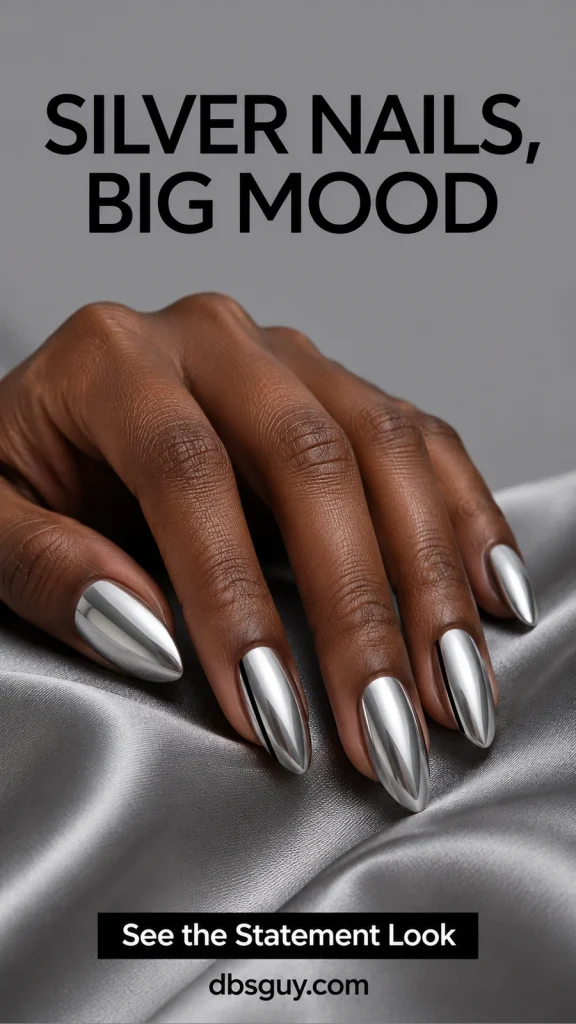
Look at the bright and dark areas in the reference: they suggest reflections across a silver surface. Show your artist that uninterrupted finish and ask for plain chrome if you want the same effect. A black outline or painted stripe would turn it into a different, more graphic design.
Ask to see the intended silver finish on a sample. Mirror chrome has clear reflected highlights; pearl glaze and metallic shimmer look different. A metallic silver lacquer can be a simpler home alternative, but it should not be expected to duplicate the mirror surface.
For a quieter version, keep the silver on one ring nail and use your preferred sheer base on the others, or ask for the full finish on a short rounded shape. For more dramatic silhouettes, see January Baddie Nails for Your Chrome, Rhinestone and Long-Tip Mood Board.
Turn Your Favorite Into a Clear Salon Brief
Save one main reference and identify the part you want to keep: the translucent rose, the low taupe crescent, the cloudy edge, or the mirror reflection. Then specify your actual length. “This silver finish on my short rounded nails” gives your artist a clearer starting point than several unrelated pictures.
Send the image when booking and confirm which service, artwork, and finish the appointment includes. A color name does not tell the salon whether you want regular lacquer, a gel manicure, an overlay, or extensions. Ask about the price before the work begins rather than assuming every finish is included.
If you choose gel, the American Academy of Dermatology’s gel-manicure guidance recommends broad-spectrum, water-resistant SPF 30 or higher on your hands before treatment, or dark opaque gloves with the fingertips removed. It also advises against picking off gel and recommends moisturizing nails and cuticles between manicures.
Questions About January Nail Designs
Which look is easiest to try with regular nail polish?
The blush-and-dot design needs only a base color and small painted marks. The rose-and-ivory look also uses a small amount of artwork, although a smooth curve takes more brush control. Follow your own polish system’s directions; there is no single drying time that fits every formula.
Can a statement manicure work on extra-short nails?
Yes. Strong color and reflected light do not require a long tip. Keep the silver or charcoal finish and reduce the artwork to fit your nail. For placements designed around little or no free edge, browse Extra-Short January Nail Designs With Tiny Details That Fit.
How do I choose between a soft and a statement look?
Compare the references beside your usual coat, sweater, or jewelry. If the brighter version feels like more than you want, reduce one feature: use one silver accent nail, make the cobalt wedge shallower, or keep the plum crescent on one nail. You can keep the detail that caught your eye without copying every proportion.
Do January nails have to be blue, white, or snowy?
No. Taupe, blush, plum, and charcoal all give you winter styling options without a snow motif. The useful choice is the palette and amount of contrast you want to wear through your ordinary January plans.