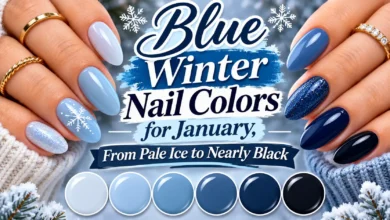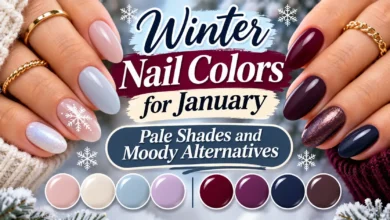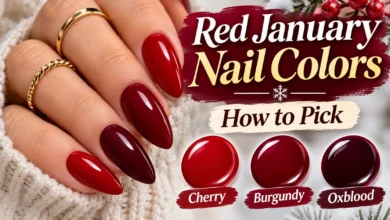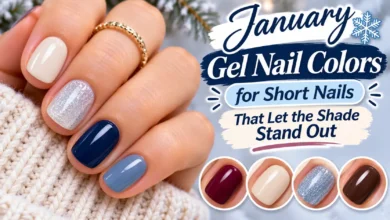
If your saved manicure ideas swing from barely-there neutrals to dark, glossy color, choose the detail you want to notice first: a clean edge, a soft reflection, a small pattern, or a rich shade. These 19 January nail design ideas give each of those moods its own place, with ways to adapt the art to the length you actually wear.
Start with milky nude for something quiet, icy blue micro French tips for a winter edge, or slate-blue velvet for a light-catching finish. If one style still feels too limiting, the final mix-and-match set shows how to combine several ideas with a shared palette.

The images are AI-generated manicure concepts created for dbsguy.com. They illustrate color, shape, and art placement, rather than completed salon work or wear tests. Actual shades and finishes depend on the products, application, and lighting.
Choose the Part You Want to Stand Out
- A small detail: start with the silver dot, a micro French edge, or a few snow dots.
- A changing reflection: compare magnetic velvet, pearl glaze, and a glitter fade. They catch light in different ways.
- A clear pattern: try windowpane lines, polka dots, marble, or tortoiseshell.
- Several ideas together: use the final mix-and-match plan and repeat its limited palette.
Choose your length before the artwork. Small motifs can usually be simplified, but a dense pattern may need fewer elements on a narrow or very short nail. Bring a close reference to the appointment and explain which feature matters most to you.
1. Milky Nude Nails With One Silver Dot
Start here if your saved folder is full of elaborate art but you usually prefer a quiet manicure. A milky beige-pink gives short oval nails a softly clouded finish. One small silver dot on each ring finger adds a point of light without turning the whole set into an embellished look.

Ask to see the base against your hand before committing. The reference leans warm and pink; an ivory version would look brighter. Keep the dot flat, centered near the base, and separated from the cuticle. For an at-home version, use a silver nail-art polish and a small dotting tool over a dry color layer.
2. Icy Blue Micro French Tips
A pale-blue tip gives a familiar French manicure a winter direction. Keep the base translucent rose and the blue band narrow enough that it reads as an outline. Short squoval nails are a useful canvas because the straight center and gently rounded corners give the edge a clear shape.
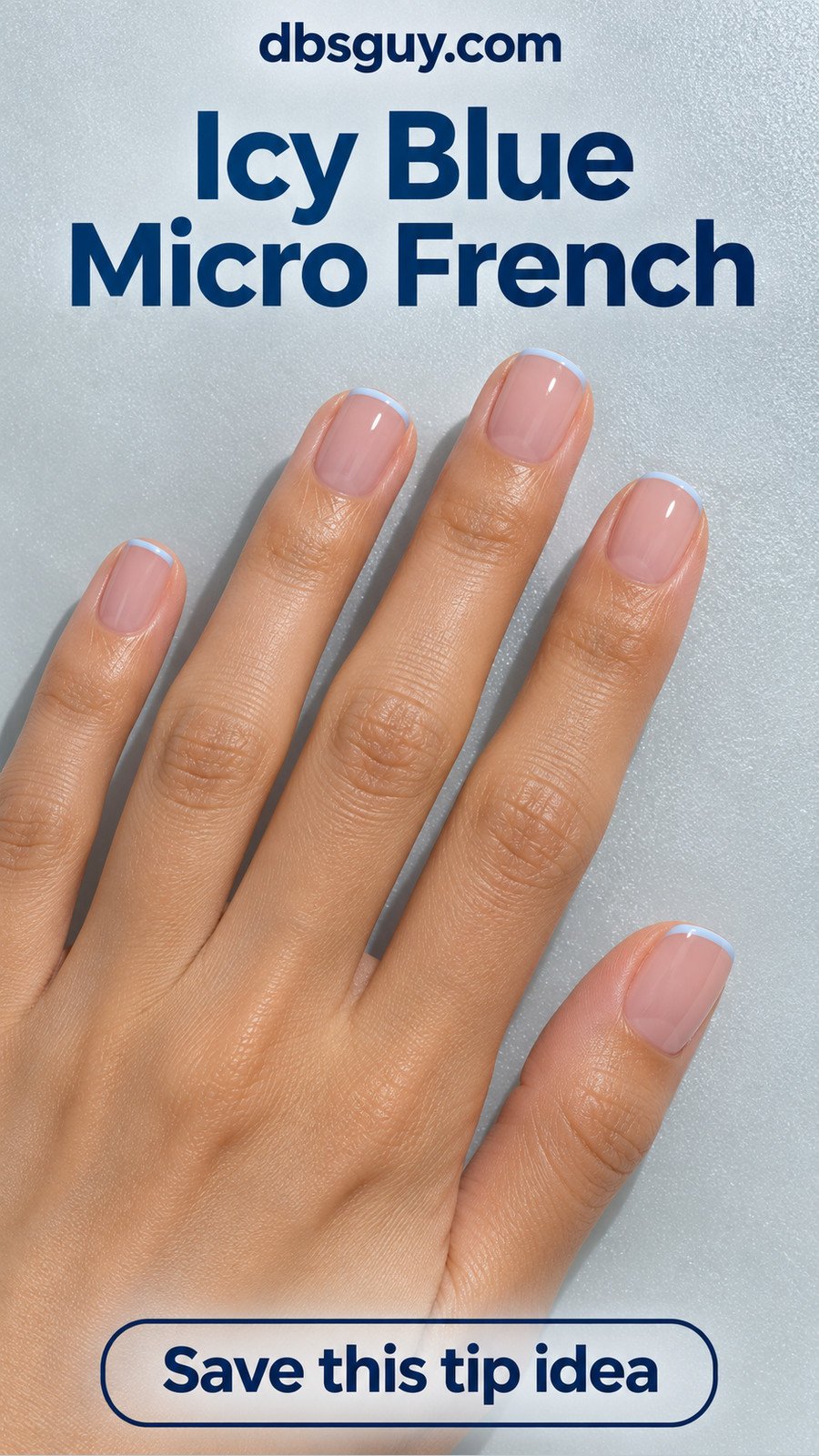
Show your artist the width you want on one nail before repeating it across the hand. If there is almost no free edge, a fine painted blue rim can suggest a tip without adding length. Our January French tip nail ideas offer more ways to change that border.
3. Slate-Blue Magnetic Velvet
Choose this when you want the finish to do the decorating. Slate blue sits between an icy pastel and a deep navy, while a broad magnetic glow gives the surface depth. The elongated almond reference leaves room to see the shimmer spread across the center; the same finish can be worn at a shorter length.

For your appointment, request a diffused velvet effect rather than one narrow, sharply defined cat-eye stripe. The effect needs magnetic polish and a magnet; ordinary blue shimmer will not respond the same way. Ask to see the sample tilted under the light, since a still picture captures only one angle. Application and curing depend on the product system your artist uses.
4. Garnet Jelly on Short Rounded Nails
Deep red does not have to mean opaque burgundy. A garnet-colored jelly has a translucent quality: the center looks rich, while light passing through the edges makes them appear brighter. It is a good option if you want a strong color without added artwork.
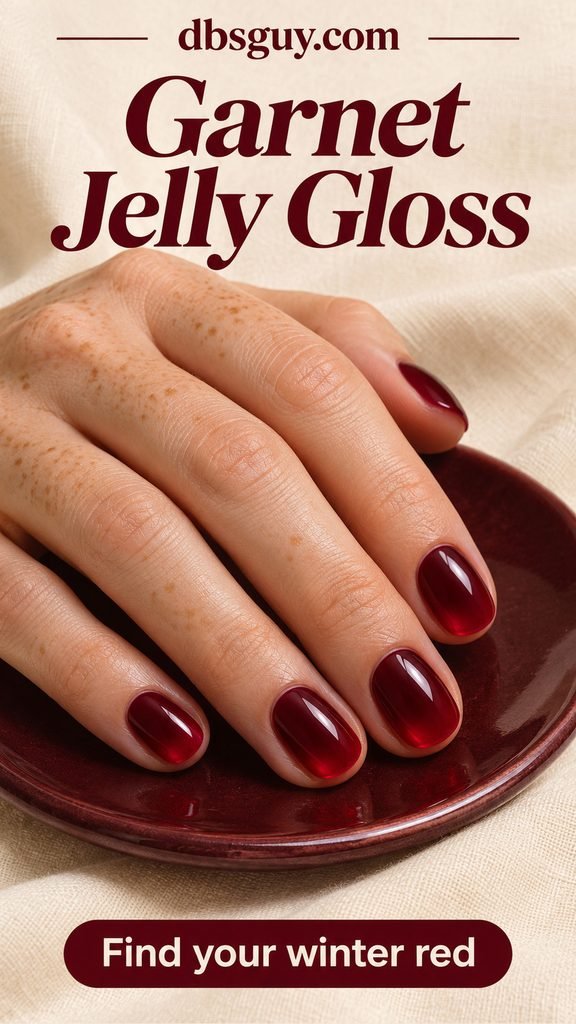
Ask for short rounded nails and a wine-red jelly finish, then decide how much of your natural nail you want visible. Jelly color and full coverage are different goals. Have the artist show the intended layering on one nail. Skip gold foil and holiday motifs if you want the color itself to carry this January manicure.
5. Espresso Nails With Cream Swirl Accents
This is the warm neutral choice for someone who does not want an icy palette. Paint most nails espresso, then use cream on the middle and ring fingers. A single flowing brown curve on each cream nail connects the accents to the rest of the set.

Keep the curves slender and leave open cream around them. Several thick loops would make the pattern much busier. On short nails, reduce the artwork to one gentle bend rather than squeezing in a full swirl. If you are painting with regular polish, let the cream base dry before adding the darker line so the two colors stay distinct.
6. Lilac Nails With a Pearl Glaze
Lilac offers a softer alternative to winter blue. A fine pearl sheen lifts the color without giving it the hard reflection of mirror chrome. Choose this version if you like a light manicure but want more color than milky white.
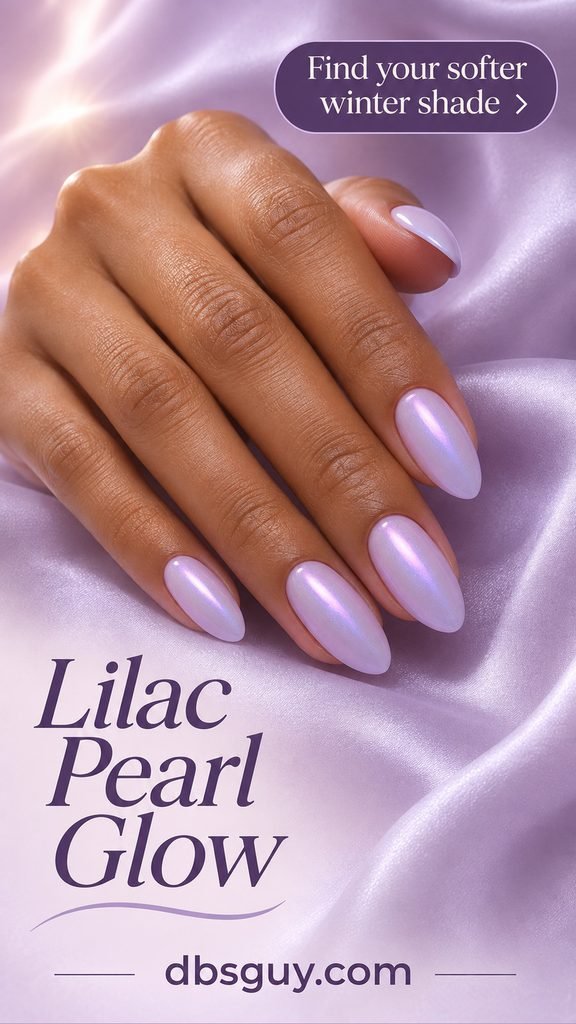
Tell your artist that the lilac should remain visible beneath the glaze. An opaque white topper could hide it. If you use regular polish at home, choose a compatible translucent pearl topcoat rather than loose chrome powder intended for another system. A short oval can carry the same color treatment as the almond reference; the finish does not require extra length.
7. Midnight Navy With Tiny Silver Stars
Navy gives silver stars a clear backdrop. Leave most nails glossy and unadorned, and place a small star on selected accent nails. The result has a nighttime feel without needing a full constellation on every finger.
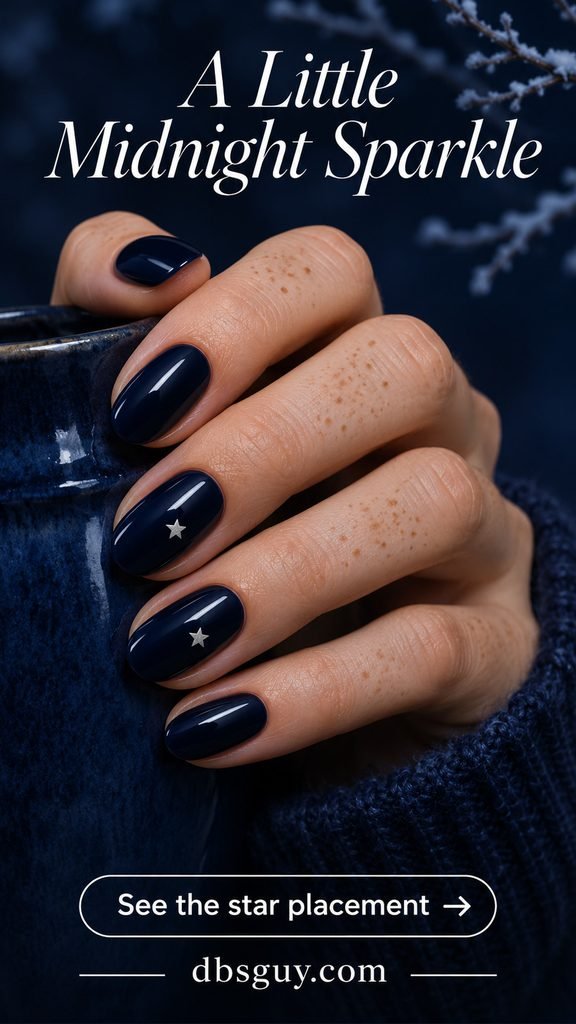
For a flat finish, ask for painted stars or thin nail decals rather than raised charms. Keep the star inside the nail edges with visible navy around it. If a detailed star is hard to fit on your little fingernail, leave that nail plain. One readable accent makes a clearer design than several cramped motifs.
8. Pale-Blue Nails With Snow-Dot Clusters
White dots give a pale-blue manicure a snowy reference without intricate linework. Keep the clusters on the middle and ring fingers, with a little more space between dots as the cluster moves toward the center. The plain blue nails give the small pattern room to register.

A dotting tool is useful for a regular-polish version. Make a few dots larger than the rest instead of repeating identical circles in rows. On very short nails, use fewer dots and keep their edges separate. For more compact placements, browse our extra-short January nail designs.
9. Forest Green With Open Half-Moons
Deep forest green feels graphic when a small half-moon at the base stays translucent. Unlike a French tip, the contrast sits beside the cuticle. Keep the green glossy and skip glitter so the shape of the opening remains the main detail.

Ask for a reverse half-moon design with a clear or sheer base inside the crescent, rather than a pale painted semicircle. The green must stay on the nail and off the surrounding skin. Check that each opening is proportionate to its nail; copying the thumbnail’s size onto the little finger can leave too little green visible.
10. Dove Gray With a Windowpane Accent
A windowpane pattern gives gray polish a little structure. Use dove gray across the set, then add fine white crossing lines to a ring-finger accent. It echoes winter checks while staying simpler than a multicolor tartan.
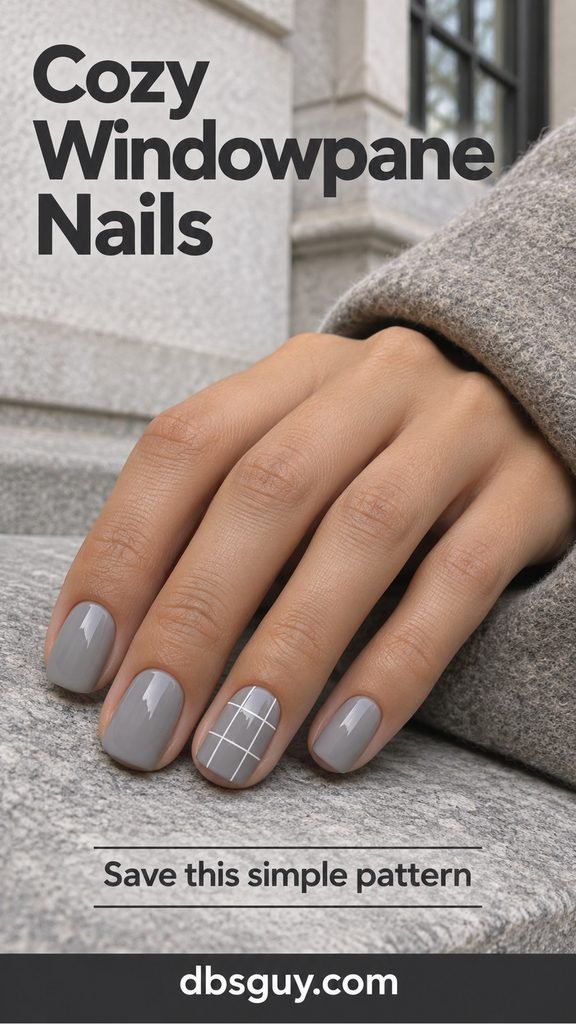
The spaces between lines matter as much as the lines themselves. On a short square nail, a couple of crossings are enough; tightly packed stripes can become a blur. Ask for flat linework and keep the other nails plain. If gray looks too cool against your hand, move the base toward greige while keeping enough contrast for the white pattern to show.
11. Blush Nails With a Silver Glitter Fade
If you still want a little New Year’s sparkle, move it to the edges. A silver glitter fade over sheer blush feels lighter than full glitter coverage because the base remains visible. Choose fine particles for a soft dusting instead of large reflective pieces.

Ask for glitter concentrated at the tips and scattered more sparsely toward the middle. Avoid a hard horizontal border unless you want a glitter French manicure. With regular polish, dab on a small amount first and build the tip gradually; a heavily loaded brush can cover more of the blush than you intended.
12. Matte Taupe With Glossy Diagonal Tips
Use one taupe color in two finishes when you want a neutral design with a small surprise. The base stays matte, while a diagonal section across each tip catches the light. The pattern comes from reflection rather than a second shade.
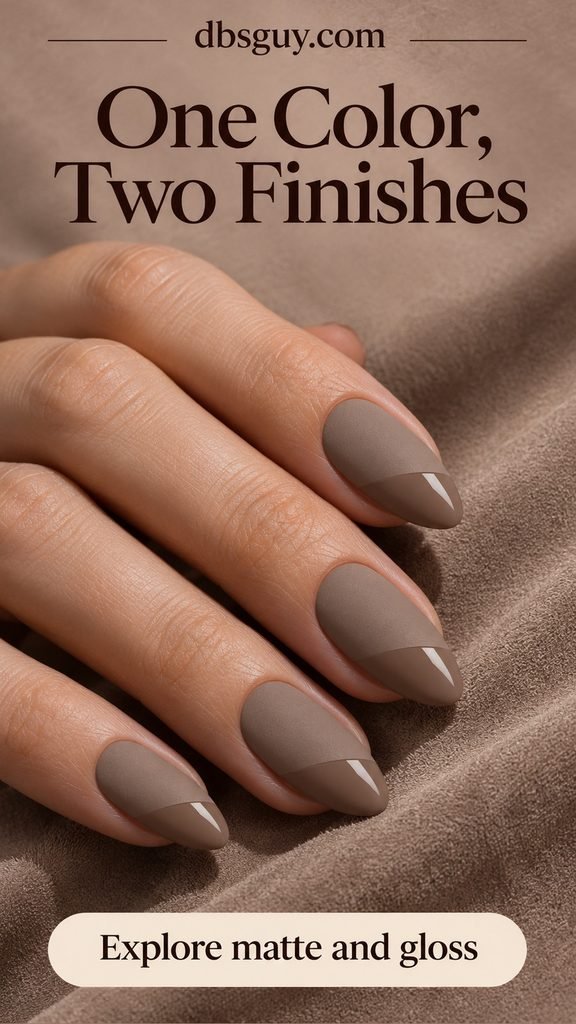
Show your artist the diagonal division and specify that the glossy section should use the same underlying color. A full glossy topcoat at the end would erase the intended contrast. For an at-home version, let the color dry, use a compatible matte topcoat, then add the glossy diagonal with a fine brush once that layer is dry.
13. Cobalt Swoops on a Sheer Base
Cobalt works even if you do not want a full hand of bright blue. Sweep a curved band along one side of a sheer pink nail, letting it widen slightly toward the tip. The uncovered center keeps the design light and makes the blue edge feel intentional.

For short nails, keep the band narrow at the base and let the curve follow the sidewall without touching the skin. Ask your artist to keep the direction consistent across the hand. If the swoop fills most of the nail, you lose the open-space effect that separates this design from solid cobalt polish.
14. Milky White With Black Micro Polka Dots
This black-and-white option gives the collection a playful break from snow and shimmer. Tiny black dots on milky white create a visible pattern with only two colors. A short soft-square shape suits the compact, graphic look.
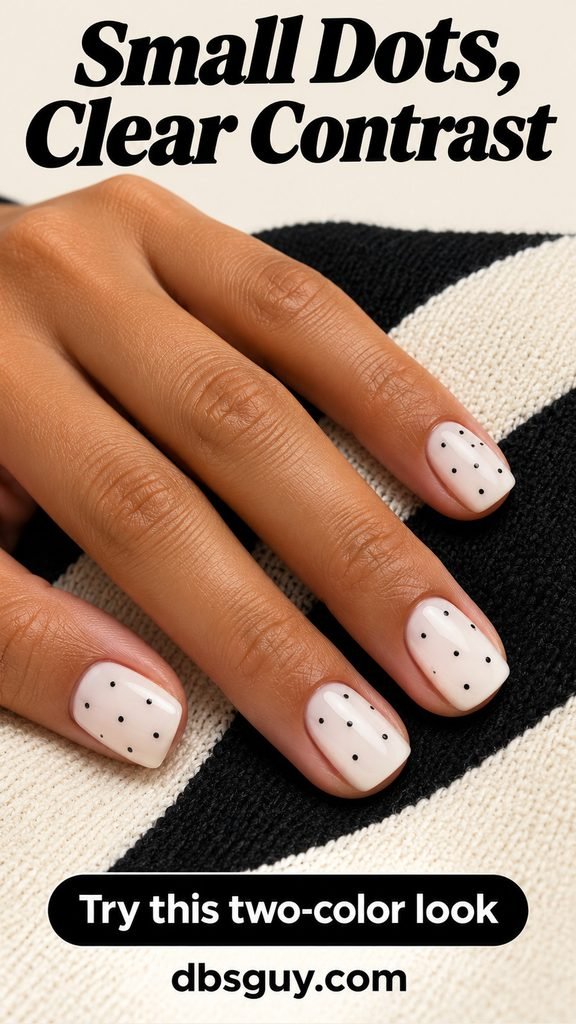
Keep each dot small and leave more white space than black. You do not need the same number on every nail; scale the spacing to the available surface. Try the pattern on a practice tip before doing your dominant hand. If you prefer a quieter result, put the dots on two accent nails and leave the remaining nails milky white.
15. Deep Plum With a Lavender Aura
An aura manicure puts a soft pool of lighter color in the middle of a darker nail. Here, lavender fades into plum around the edges. The contrast gives the design a gentle glow while keeping the overall palette dark enough for a winter mood.
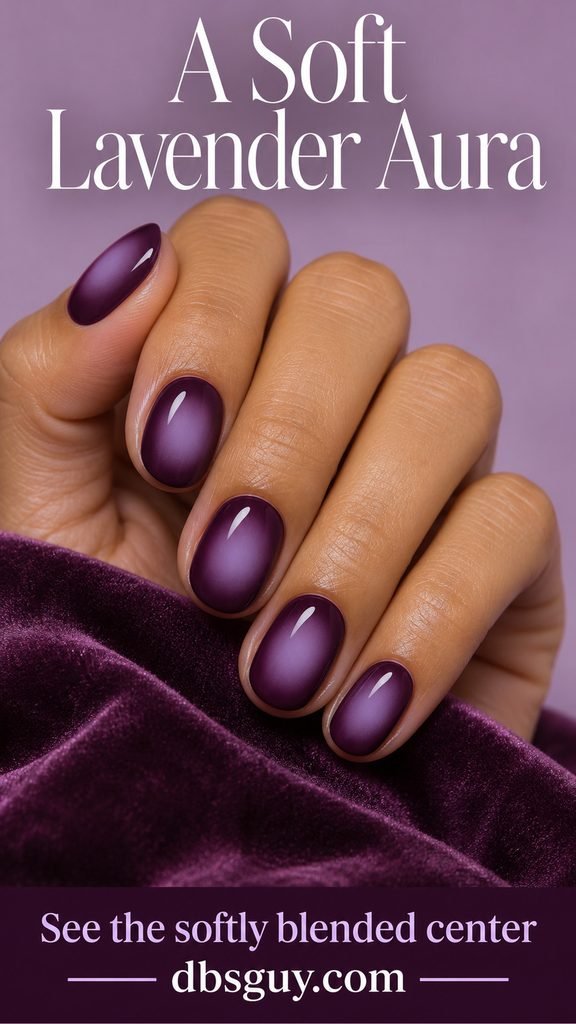
Bring the reference and ask for a diffused center with no hard circular outline. The plum needs to remain visible around it, especially on a short oval. This is a useful salon choice if blending is the part you find difficult at home. An artist may use an airbrush or another nail-art technique; ask which method suits the products they use.
16. Icy Marble With Fine Gray Veins
Think translucent white stone rather than dark, heavily outlined marble. A milky base with a few irregular pale-gray veins gives the nails movement without making them look striped. Medium almond nails show the pattern well, but an accent-only version works at shorter lengths.

Ask for different vein paths on each nail, with plenty of untouched white. Straight parallel lines would read as stripes; repeated branching in exactly the same place would look stamped. If you are unsure about a full marble set, use the pattern on the ring fingers and keep the same milky white elsewhere.
17. Sheer Rose With Rose-Gold Ribbons
Rose gold is a warm alternative to all the silver in winter inspiration. Keep the base sheer rose, then run one fine metallic curve over selected accent nails. The line should look like a narrow ribbon laid across the nail, rather than a filled metallic panel.

Ask for a flat painted or foil-effect curve if you want to avoid raised decoration. Place it away from the cuticle and leave open base on both sides. If you prefer even less artwork, choose one accent per hand. Our sheer January BIAB nail ideas explore other restrained placements; a similar color design does not require that particular builder system.
18. Cranberry Nails With Tortoiseshell Accents
Pair solid cranberry with amber tortoiseshell when you want a warm patterned manicure. Keep the middle and ring nails translucent amber with irregular brown and wine-colored patches. The cranberry nails give that busy pattern a solid color to sit beside.

Ask for soft, uneven mottling rather than outlined animal-print spots. Some amber should remain visible between the dark patches. This is a more involved option than a solid red manicure, so show your artist the accent count when discussing the appointment. For a simpler adaptation, use one tortoiseshell nail per hand and keep all the others cranberry.
19. A Coordinated Winter Mix-and-Match Set
If you still cannot settle on one style, make the variety the plan. Use ivory, slate blue, navy, and silver across the hand: a plain ivory nail, a blue French tip, a navy star accent, an ivory-and-blue diagonal block, and a silver glitter accent. The limited palette gives the different designs a shared thread.
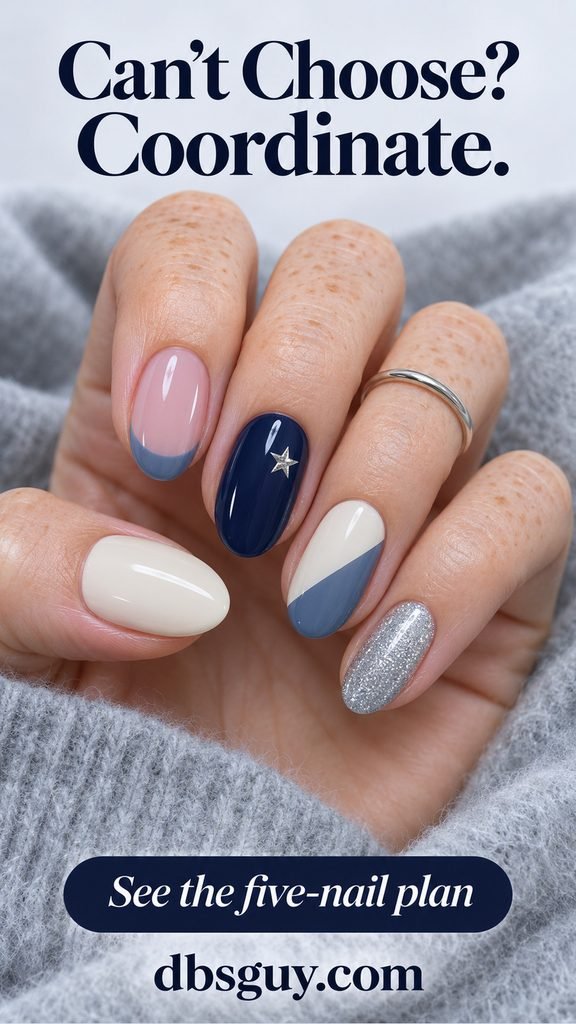
Map the five nails before painting instead of choosing each one independently. Keep the same shape and a consistent gloss, and repeat that plan on the second hand if you want a balanced set. On extra-short nails, simplify the star and narrow the color block rather than adding more tiny artwork. This is the option to choose when you enjoy several details together.
Make Your Reference Easy to Use
Save the design you like, then tell your artist four things: the shape and length, the base color, the finish, and which nails get the art. For example: “Short squoval nails, a translucent rose base, and very narrow icy-blue French tips. No extra glitter.” That gives the appointment a clear starting point while leaving room to adapt the design to your nails.
If you like a finish more than a particular color, say so. Slate-blue velvet could become a deeper blue; the important request is the broad magnetic reflection. A picture can communicate the direction, but it cannot guarantee an exact shade match.
A Few Nail-Care Basics Before You Choose a Service
These are design ideas, not a reason to choose gel or extensions. Many of the colors and flat painted details can be adapted to regular polish. Magnetic, chrome, and layered effects depend on the products used; follow their instructions rather than borrowing a curing time from another system.
The American Academy of Dermatology’s gel-manicure guidance recommends protecting your hands from curing-light UV with broad-spectrum, water-resistant SPF 30 or higher, or dark opaque gloves with the fingertips removed. It also advises against picking off gel and recommends moisturizing nails and cuticles between manicures. Ask your salon about clean tools and leave the cuticles uncut.
Questions That Help Narrow the Choice
Which January nail designs are simplest to try at home?
Start with solid garnet jelly, milky ivory with one dot, or a small snow-dot accent using regular nail polish. Each lets you focus on color or one small mark. Magnetic velvet, aura blending, and layered tortoiseshell involve more technique, so they are useful references to discuss with a nail artist.
Can these designs work on short natural nails?
Yes, many of the placements can be scaled down. Keep a French edge fine, use fewer dots, and give a star or swirl enough empty space around it. If an almond reference needs more length than you want, borrow its color and finish on your existing rounded or squoval shape.
Do January nails have to be blue or snowy?
No. Blue and snow details are visual references to winter, not rules. Espresso, taupe, cranberry, plum, and translucent neutrals all give you other directions. Choose the palette you want to look at all month rather than adding a winter motif you do not enjoy.
How do you mix designs without making the set feel crowded?
Limit the palette, repeat a color across several nails, and keep some nails simpler than others. The final design uses different motifs within ivory, slate blue, navy, and silver. If it still feels busy, replace one patterned nail with a plain color from that same palette.