
A slim Christmas tree can make an overlooked corner feel festive without swallowing the room. The trick is to keep its narrow outline intact: choose decorations that sit close to the branches, let the eye travel upward, and give the base as much thought as the top.
These 18 slim and pencil Christmas tree decorating ideas offer different ways to do that, from burgundy velvet bows to paper stars, colorful retro lights, and a quieter lights-only tree. Each look includes the details that matter when you actually have to fit it beside a sofa, bed, or dining chair.

The images in this article are AI-generated decorating concepts, created to illustrate the looks rather than document real homes. Check the measurements and instructions for your own tree before recreating a display.
Measure the corner before choosing the decorations
Shop by dimensions, not just the word “slim.” Manufacturers use different shape labels. Balsam Hill, for example, distinguishes narrow trees from its more slender slim trees in its artificial tree buying guide. A pencil-style tree from another brand may have a different width.
Measure the usable width and depth of the corner, then compare them with the tree’s widest branch spread, stand, and proposed collar. Mark that footprint on the floor with removable tape. Open nearby doors and drawers, pull out the dining chair, and walk past it as you normally would.
For example, a tree advertised as 26 inches wide needs at least that much clear space across its branches. A 30-inch collar or ribbon loops that extend beyond the foliage can become the real limiting dimension. This is a measuring example, not a universal clearance rule.
Check total height too. Balsam Hill’s sizing guidance suggests reserving about 12 inches below the ceiling for a standard topper and notes that its listed tree height includes the stand. Confirm how your chosen brand measures height, then allow for your actual topper.
Placement comes first: the U.S. Fire Administration advises keeping Christmas trees at least 3 feet from heat sources and keeping exits clear. A corner beside a radiator, fireplace, or heat vent is not a workable spot simply because the tree fits.
1. Let burgundy velvet bows do most of the decorating
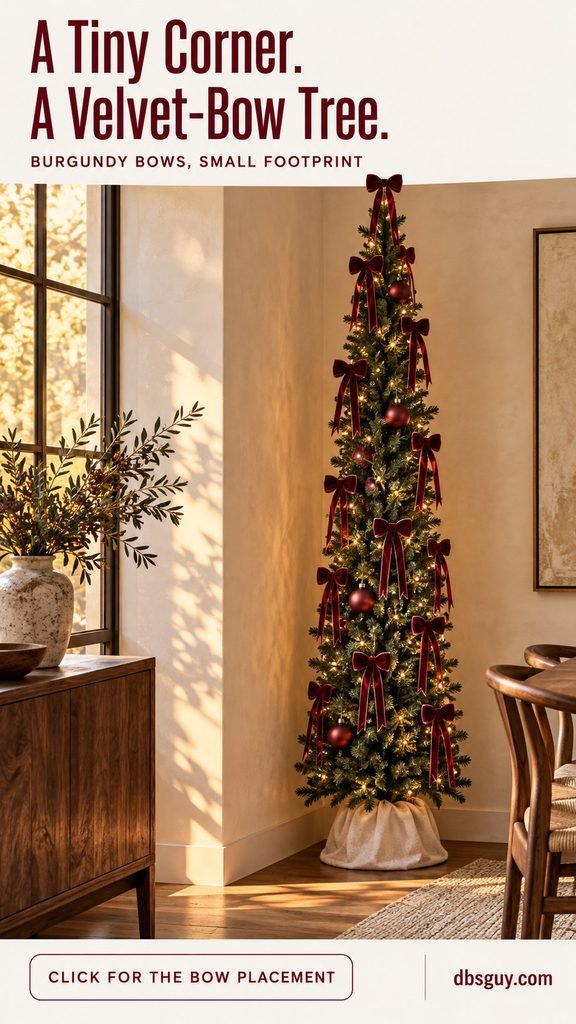
Small velvet bows give a pencil tree richness without needing clusters of large ornaments. Burgundy looks especially warm against dark green foliage, while long, narrow tails emphasize the tree’s height. This is a good fit for a dining corner where a chair still needs room to move.
Start with ribbon about ½ to 1 inch wide as an editorial styling choice. Tie modest bows, attach them to individual branches, and stagger them from side to side rather than forming rigid rows. Let the tails hang within the tree’s outline. Add a handful of matte red baubles only where the greenery needs a little more color.
Use a small matching bow at the top and a fitted fabric stand cover below. If the tree begins to look crowded, remove a few bows before shortening every tail; the downward movement is what makes this look work.
2. Run champagne ribbon vertically in shallow loops
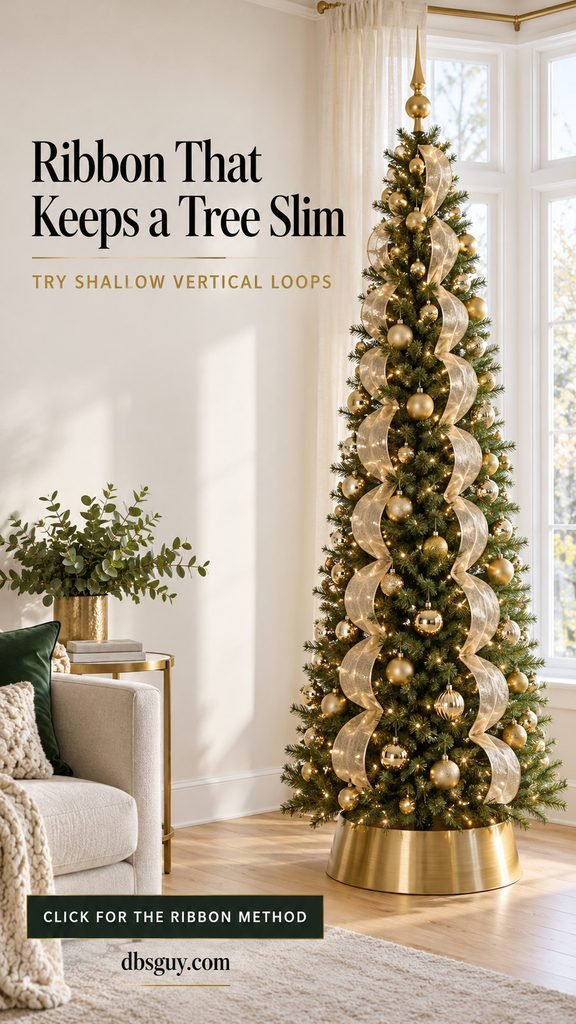
Ribbon can make a narrow tree look polished, but billowy loops can also consume the space you were trying to save. Here, two restrained cascades travel downward, with gold ornaments nestled between them. The result suits a bright living-room corner with brass or warm wood accents.
Try wired ribbon around 1½ to 2½ inches wide, adjusting to your tree’s size. Anchor it near the top, tuck it into the foliage farther down, and bring it forward only enough to make a soft loop. Repeat along a second vertical path. Separate shorter pieces can create the same appearance with less wrestling.
Balsam Hill’s decorating guide notes that wired ribbon holds its shape and wide ribbon adds apparent fullness. For a tight corner, use that shaping ability while keeping the loops shallow. A slim finial and fitted gold collar finish the look.
3. Pair a flocked pencil tree with pearls and short icicles

White branches already supply a strong visual effect, so this winter look needs only pearl-finish ornaments, a few clear icicles, and a small silver star. It is particularly useful in a softly furnished bedroom where you want the tree to feel light rather than dominate the corner.
Choose compact baubles and short icicle shapes that can hang freely between branches. Mix smooth pearl finishes with a few translucent pieces; the difference in texture keeps an all-white tree from becoming a flat white column. Leave patches of flocked foliage visible.
Check the tree’s care instructions before decorating or storing it, and use a floor covering during setup if its flocking sheds. Keep the base simple with a white collar that clears the stand. Long crystal drops and wide mesh ribbon would change both the delicate effect and the footprint.
4. Make a lights-only tree the calmest part of the room

A narrow green tree with warm white lights can be enough. Without a topper, ornaments, or ribbon, the foliage becomes the feature. This approach works well in a studio apartment, a bedroom, or a corner that already sits beside patterned furniture.
Shape the branches before adding lights, following the tree’s setup instructions. On an unlit model, distribute indoor-rated light strands through the depth of the foliage instead of outlining only the outer tips. Step back with the room lights dimmed and look for dark bands or concentrated bright spots.
A fitted charcoal collar makes the base recede. Avoid buying extra strands solely to meet a generic lights-per-foot formula; density and existing lights vary. Inspect wires, follow the manufacturer’s connection limits, and turn tree lights off when leaving home or going to bed.
5. Hang folded paper stars on an airy Scandinavian tree

If your room has light wood, linen, and relatively little decoration, a sparse pencil tree with cream paper stars can look beautifully at home. Small wood discs bring warmth without introducing another bright color. Visible greenery is part of the design.
Use lightweight accordion-folded or dimensional paper ornaments in a few sizes. Spread them through the tree with enough room to see each shape, then add smaller wooden pieces between them. Keep the largest paper star near the upper center rather than at an outer tip where it could widen the silhouette.
A little paper topper and pale wood stand surround complete the handmade look. Make sure that surround accommodates the original stand. If you are crafting the ornaments, keep folded edges neat and hanging loops short enough that neighboring stars do not overlap.
6. Use pinecones and little brass bells for woodland texture
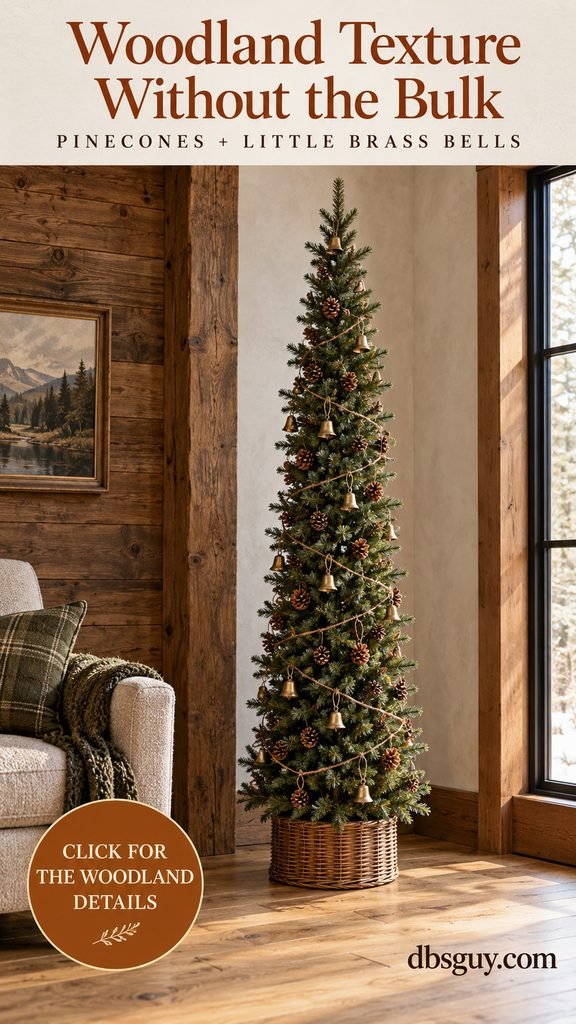
This woodland tree relies on texture rather than glossy baubles. Small pinecones, antique-finish bells, and a thin twine garland look warm against dark foliage, especially beside a reading chair or in a room with wood paneling.
Hang the bells at different heights and nestle pinecones into supported branch junctions. Keep the twine in loose, shallow swags; thick rope would overwhelm a pencil tree. Faux pinecone ornaments are convenient if you want consistent sizes and ready-made hanging loops.
A compact wicker surround can conceal the base, but it is decorative: keep the tree in its proper stand and confirm that the surround fits around it. Skip sprawling branches and oversized woodland sprays. The quiet combination of greenery, small brown shapes, and muted metal is already doing the work.
7. Give a candy-cane tree an open diagonal spiral
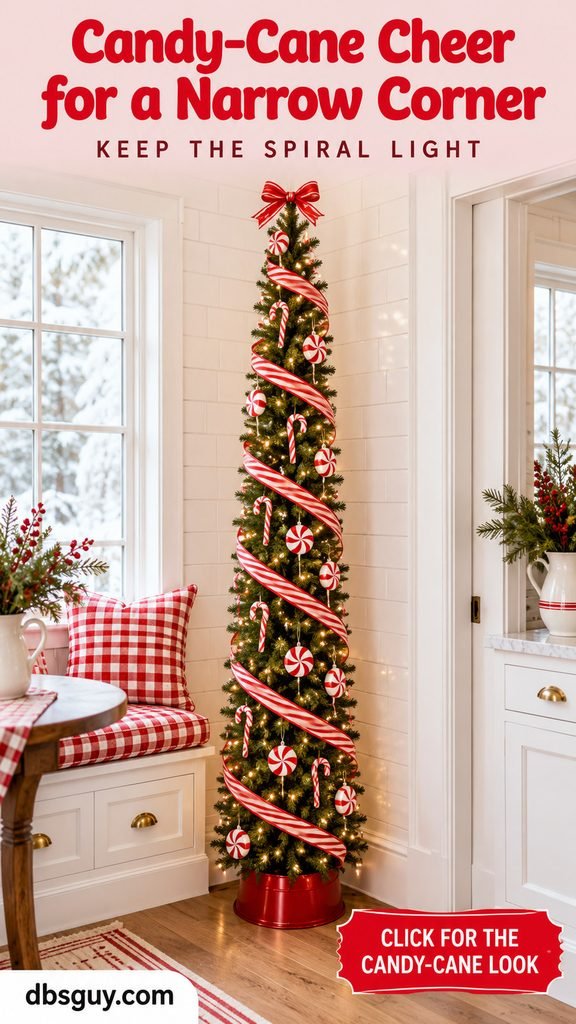
A red-and-white tree can feel cheerful without turning into a bulky candy display. Use a narrow striped ribbon to create an open spiral, then add small peppermint discs and short candy-cane ornaments. A breakfast nook is a natural home for this playful look.
Begin near the top and carry the ribbon diagonally downward. Leave generous gaps between turns so the greenery stays visible. Tuck the ribbon into branches at intervals rather than pulling it tightly around the tree, which can flatten the foliage.
Choose lightweight decorative candy shapes instead of giant picks. Repeat red at the base with a compact collar, and keep the topper to a small bow. If your tree is exceptionally thin, use partial diagonal ribbon sections on the visible sides instead of wrapping a continuous spiral all the way around.
8. Turn small photo ornaments into a family-memory tree
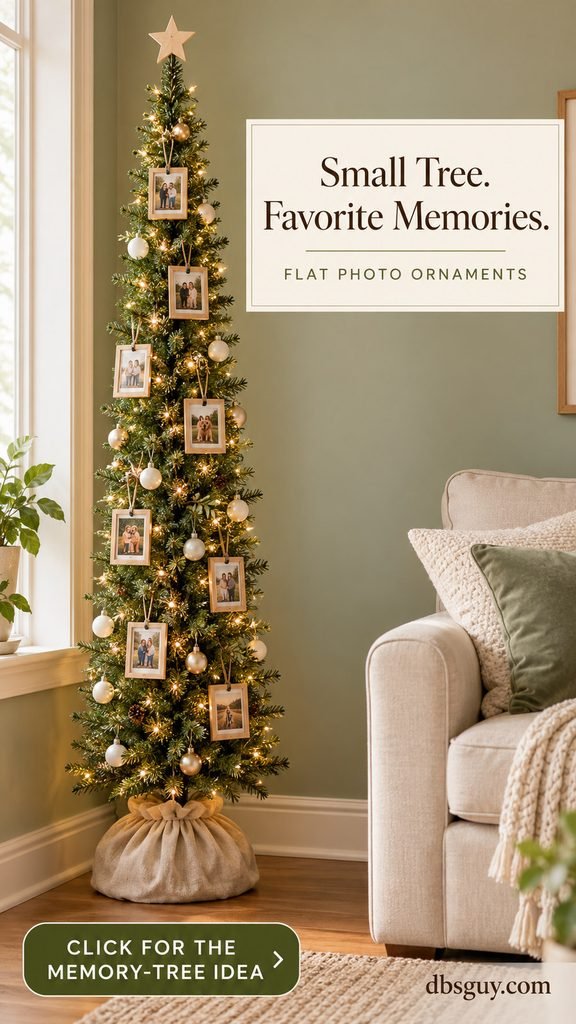
A pencil tree can hold a meaningful collection even when it cannot hold every ornament you own. Small flat photo frames make a personal display without adding the depth of large novelty ornaments. Keep the palette quiet so the pictures remain the focus.
Choose lightweight wood or acrylic frames, insert copies of favorite snapshots, and use secure hanging loops. Stagger them where they can face the room instead of disappearing behind foliage. Add a few cream ornaments and warm white lights to connect the collection visually.
Use a plain topper or leave the top undecorated. If the corner is viewed mainly from the sofa, position the clearest photos at that seated viewing height. Keep irreplaceable originals elsewhere, and resist filling every gap; some breathing room makes individual memories easier to notice.
9. Tuck navy and gold ornaments into a study corner

Deep navy ornaments give a slim tree a tailored feel beside dark shelving or a desk. Gold prevents the palette from becoming too subdued. This is a useful option when you want the tree to connect with an existing office or library rather than introduce a completely separate holiday theme.
Place matte navy baubles toward the outer foliage and smaller reflective gold pieces slightly deeper inside. Mix a few elongated ornaments among the round ones, keeping them short enough to clear the branch below. Warm white lights help reveal the dark blue.
Finish with a compact star and a dark stand cover. Keep the desk chair’s full movement clear, including the space it needs when someone stands up. If the ornaments vanish against the wall, add a little more gold rather than covering the tree in brighter, larger decorations.
10. Combine copper with dried-orange ornaments

Copper baubles and orange-slice ornaments create an earthy tree that works with terracotta, tan leather, or warm oak furniture. Their different surfaces—metallic and translucent—bring interest to a narrow outline without needing broad ribbon.
Alternate small copper spheres with lightweight orange-slice decorations and a few cinnamon-colored fabric bows. Use fully dried slices if making your own, or choose reusable faux versions. Hang them where light can catch their color, while keeping them within the branch perimeter.
A terracotta-colored collar ties the tree to the room. Leave food-derived ornaments out of reach of pets and children; decorative fruit and attached cords are not treats. If you prefer an entirely reusable display, replace the slices with orange acrylic discs and keep the same copper-and-rust palette.
11. Decorate a playful corner with pastel felt shapes

Small felt stars, hearts, and mitten shapes make a tree feel friendly beside a toy shelf or in a family room. Pastel peach, mint, and lilac keep the look softer than a traditional red-and-green display. The flat ornaments are especially suited to a slim tree.
Use stitched or securely assembled ornaments, and repeat each color in several places rather than grouping all the mint pieces on one side. Keep hanging loops short and skip trailing ribbon. A simple fabric base cover can echo one of the felt colors.
Soft decorations do not make a tree childproof. Follow the tree manufacturer’s stability guidance, manage cords, and keep small parts and detachable decorations away from young children. Place the tree where it does not interfere with play or become something to climb toward.
12. Make black-and-white patterns the focal point

Small striped and checked ornaments can give a pencil tree a graphic look in a room with monochrome artwork or black furniture. The contrast is strong, so you do not need many pieces. Warm lights and green foliage soften the overall effect.
Choose one main pattern, such as narrow stripes, and a smaller amount of a second pattern. Add plain white baubles between them. Keep the scale compact: an oversized buffalo-check bow could visually overpower the top of a very thin tree.
A small black bow and fitted white collar are enough to finish it. Look at the tree from the room’s entrance before adding more ornaments. If the black pieces disappear into the foliage, move a few forward or reduce their number instead of compensating with a larger topper.
13. Arrange jewel tones in a gentle color gradient
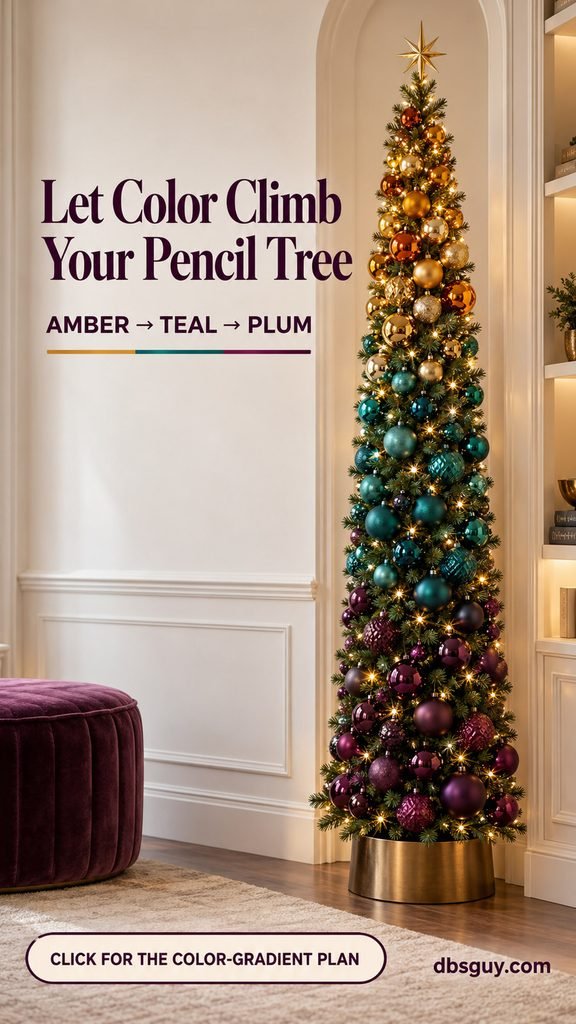
A vertical color gradient uses the pencil tree’s height as the design feature. Amber ornaments near the top, teal through the middle, and plum toward the bottom give the eye a reason to travel along the whole tree. This is a colorful choice for a corner that needs one strong focal point.
Sort ornaments by color before hanging them. Build broad zones, then mix a few neighboring shades where the colors meet so the transitions feel gradual. Keep most ornaments a similar size; huge baubles at the bottom would make the tree look abruptly wider.
Use quiet warm white lights and a small neutral topper. Skip ribbon and garland so the color arrangement stays clear. If you have only a modest ornament collection, make a gradient on the visible front and sides rather than trying to cover every branch.
14. Bring back retro color with lights and small vintage-style ornaments
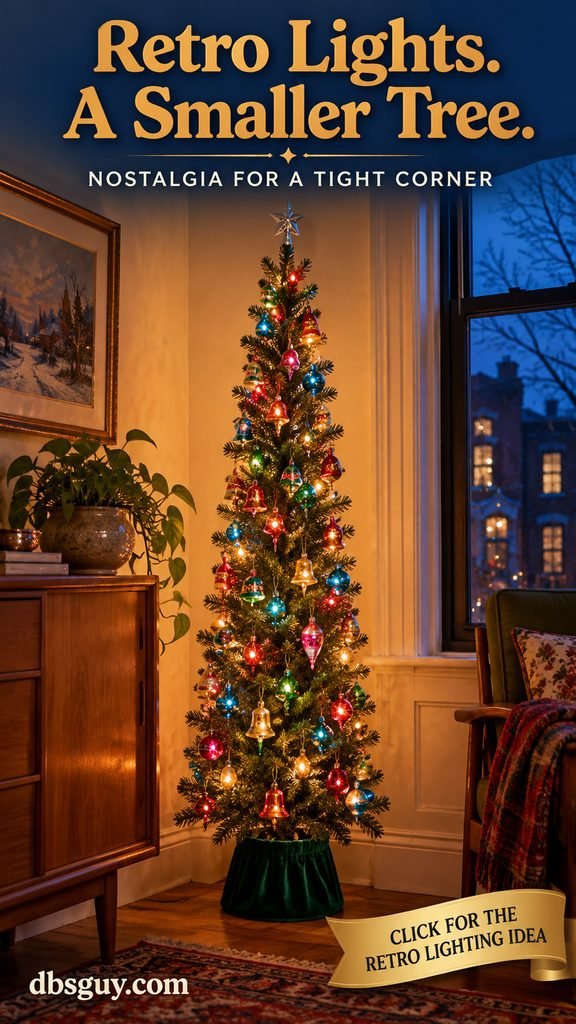
Multicolored lights can deliver the nostalgic mood of a family Christmas tree even in a small apartment. Pair them with compact vintage-style bells, drops, and round ornaments, leaving enough open foliage that each color shows.
For the old-fashioned bulb shape, choose a modern indoor-rated LED strand rather than assuming an old stored set is suitable to use. Arrange lights first, then add ornaments where they will not obscure the bulbs. A little silver star and fitted green base keep the display contained.
Keep this version free of thick tinsel garland; it would compete with the colored lights and fill the narrow gaps. Check strands for damage and follow their instructions. Vintage-style plastic ornaments can provide the nostalgic shapes without relying on delicate heirlooms in a busy corner.
15. Use flat shell shapes for a coastal Christmas tree

A coastal tree works best when it feels connected to your room rather than dressed for a beach party. Small pale blue baubles, flat shell-shaped ornaments, and a little linen ribbon suit whitewashed furniture and sandy neutrals.
Use lightweight faux shells or shell-shaped cutouts in ivory and soft blue. Place them among the branches without creating a large starfish crown or adding long sprays. A few short linen ties supply texture; avoid thick rope wrapped around the entire tree.
Keep the base compact with a pale woven collar that fits over the stand. If the room already has many coastal accessories, reduce the shell count and let the soft colors carry the theme. The useful detail here is the flat ornament shape, which adds interest without taking much depth.
16. Choose a shorter pencil tree for a low ceiling
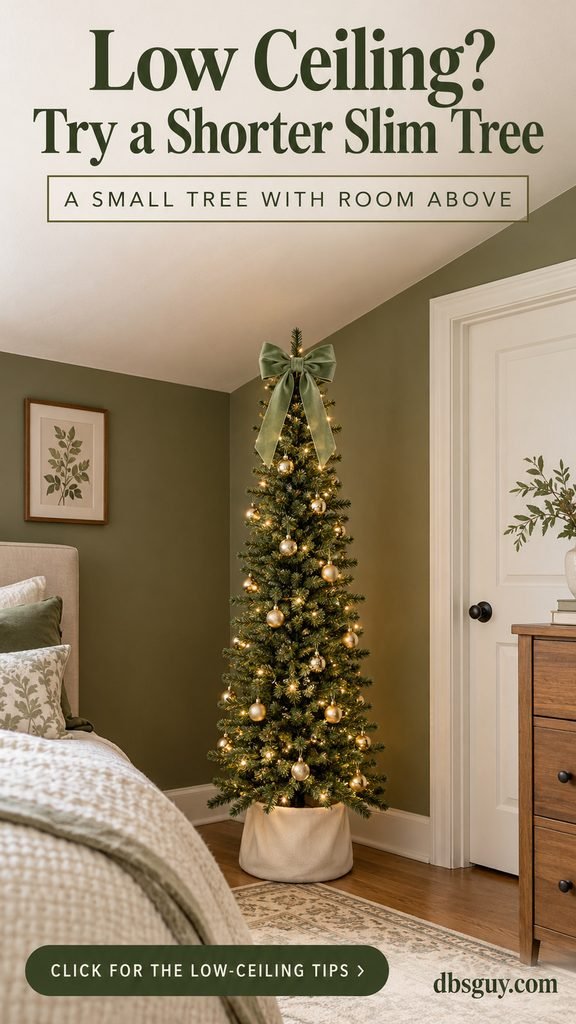
A tall tree is not automatically the best use of a small room. A shorter slim model can look more settled beneath a low ceiling or in a guest room corner. Give it a deliberate finish instead of raising it on an improvised stool.
Choose a height that leaves room for your actual decoration at the top. Use small gold ornaments, a modest sage bow, and warm lights to keep the scale consistent. A gathered fabric stand cover makes a neat base without the spread of a full-size skirt.
Position the tree on the floor in its proper stand and keep furniture clear of its lower branches. The concept shows a roughly 5-foot look, but the right size depends on your measurements. A narrow bow topper can be easier to accommodate than a tall star or spray arrangement.
17. Let a wall mirror reflect a teal-and-silver tree

A mirror can let you enjoy a slim tree from another angle without adding a second tree or widening the display. Teal and silver ornaments are especially effective because the reflective pieces catch light while the teal remains a clear accent.
Use an existing, securely mounted wall mirror rather than balancing a heavy leaning mirror behind the branches. Leave room between the tree and the wall so ornaments do not scrape the frame or glass. Decorate any side that appears in the reflection, not just the front facing the room.
Keep the collar understated and avoid surrounding the mirror with a second layer of garland. Test the placement from the sofa and doorway: the reflection should add a pleasant view, rather than expose cords or simply repeat a cluttered patch of ornaments.
18. Decorate the visible sides and tuck ornaments deeper inside

A corner tree often has one main viewing direction. Use that to your advantage with a front-focused sage-and-gold display: stronger ornaments on the visible sides, lighter decoration on the hidden rear, and a few reflective pieces nestled inside the foliage.
Shape and light the whole tree according to its instructions first. Then hang small and medium ornaments on supported branches, with the hanging loops far enough inward that the baubles stay inside the outline. Turn the tree slightly until its best arrangement faces the seating area.
Do not bend away structural branches or remove stand parts to make it fit. A compact wrapped base finishes this look without a wide skirt, and gifts can live elsewhere in the room. This is the most useful approach when your ornament collection is limited or the walkway is close.
A practical order for decorating a narrow tree
Once you choose a look, assemble the tree in its measured position and check stability before decorating. Shape the branches as directed, test the lights, and settle the stand cover or collar dimensions. It is easier to discover an oversized collar now than after the tree is finished.
Add the main design element next: bows, ribbon, paper stars, or a planned color arrangement. Place ornaments at different depths, then check the view from both the doorway and your usual seat. Attach the topper using the method specified for your tree and topper.
For the final check, measure the decorated outline again. Open the nearby door, move the chair, and inspect the floor for loose cords or fabric. Move gifts to another spot if they crowd the passage. A little empty floor around a pencil tree is part of what makes it feel right for the room.
Questions about decorating slim and pencil Christmas trees
What is the difference between a slim tree and a pencil tree?
“Pencil” commonly describes an especially slender silhouette, while “slim” can cover a broader range of narrow trees. These are shopping descriptions, not reliable universal measurements. Compare the listed branch spread, stand dimensions, and height of the actual models.
How many ornaments does a pencil Christmas tree need?
There is no single useful count for every tree. Height, branch density, ornament size, and the amount of ribbon all change the answer. Start with the main decorations for your chosen look, distribute what you already have, and add only where the composition needs it. A lights-only tree needs none.
What ornament sizes work best?
For many narrow trees, roughly 1½- to 3-inch ornaments are a practical starting range, not a manufacturer requirement. Test their weight and fit on your branches. Keep the upper pieces smaller, use a few medium pieces lower down, and choose flat shapes where space is especially limited.
Can I put ribbon on a pencil tree?
Yes. Small bows, shallow vertical cascades, and separated ribbon sections are useful options. A loose spiral can work too. Check how far the loops project beyond the branches, and avoid pulling continuous ribbon so tightly that it compresses the tree.
Should I use a tree skirt or a collar?
Use whichever fits your measured space and fully accommodates the stand. A collar can look tidy, but some collars are much wider than a pencil tree’s base. A small fitted fabric cover may be easier in the tightest corner. Never trade away a stable stand for a smaller decorative container.
How do I make a skinny tree look fuller without making it wider?
Shape the foliage correctly, distribute lights through its depth, and tuck small reflective ornaments into visible gaps. Shallow ribbon loops can add texture. Avoid compensating with large horizontal sprays or ornaments hanging far beyond the branches; those change the footprint.
Can a pencil tree stand close to a wall or window?
Only when its instructions, stable setup, and the surrounding space allow it. Leave branches and ornaments clear of curtains, account for doors and cords, and keep exits unobstructed. Follow the heat-source clearance noted above. A window with a radiator beneath it needs a different arrangement.
Choose the look that suits both your room and the amount of decorating you enjoy. A few velvet bows, a carefully placed ribbon cascade, or warm lights alone can give a tight corner a complete Christmas moment.