For January winter nails, pair one base color with one clear detail: icy blue with white snow dots, taupe with an espresso curve, or charcoal with a narrow silver tip. Choosing the placement along with the palette gives your nail artist a much clearer starting point than “something wintery.”
These eight color-and-design pairings range from soft neutrals to inky blues. Each includes the feature to keep, an adjustment for smaller nails, and wording you can bring to your next appointment.

The visuals are AI-generated manicure concepts for dbsguy.com. They illustrate suggested colors, shapes, and placement; they do not document salon work or polish wear tests.
Choose by Contrast, Then by Finish
If you like quiet nails, start with taupe and espresso or milky white and champagne. For a small graphic detail, compare the burgundy half-moon with the forest-green corner. Charcoal and silver give the sharpest light-dark edge; navy and slate keep the contrast within one color family.
Before settling on a shade name, hold the salon’s finished swatches beside your hand. Check them in daylight if possible, then in the salon light. Ask to compare the base and accent together: two attractive bottle colors may look almost identical once they are on a small nail. Your preferred contrast matters more than a rule about which undertone you should wear.
1. Icy Blue With White Snow Dots
A powder-blue base and scattered white dots give you a recognizable winter detail without a full snowflake drawing. Put the dots on the ring nail of each hand and leave the rest blue. The plain nails give the accent room to stand out.

The useful distinction is between scattered dots and an all-over polka-dot grid. Vary the spacing and size slightly so the accent reads as falling snow. For an extra-small nail, use fewer dots rather than making a dense pattern of tiny marks. A slightly deeper blue will also make white easier to see.
Tell your artist: “Short rounded nails, glossy icy blue, with small flat white snow dots on the ring nails only. Please leave open blue space between the dots.”
Also Read: 23 Winter Nail Designs: Snowflakes, Chrome and Cozy Knits for more winter motifs to compare.
2. Cashmere Taupe With an Espresso Side Ribbon
Mushroom taupe and espresso bring warmth to a January manicure without glitter. Keep the base a medium gray-brown, then add one flowing dark-brown ribbon along a side of the ring nail. A glossy finish lets the curved boundary remain visible.

Choose this if you wear camel coats, oatmeal knits, or brown leather and want your nails to echo that palette. The ribbon should occupy a small side area rather than divide the nail into two equal halves. On a narrow nail, keep one clean curve and skip extra outlines.
Salon wording: “Mushroom-taupe squoval nails with one flat espresso side ribbon on each ring nail. I want the brown to taper toward the tip, with most of the taupe still showing.” Compare the two brown swatches first; if the curve disappears, choose a darker espresso.
Also Read: January Nail Ideas by Mood: Minimal, Cozy, Playful or Full Glam if you want to compare this warm palette with other January directions.
3. Burgundy With a Soft Rose Half-Moon
Keep the richness of a wine manicure and give it a lighter base detail. Here, burgundy covers most of each nail, while a small rose-colored half-moon sits beside the cuticle. That placement makes it quite different from a pink-and-red French tip.
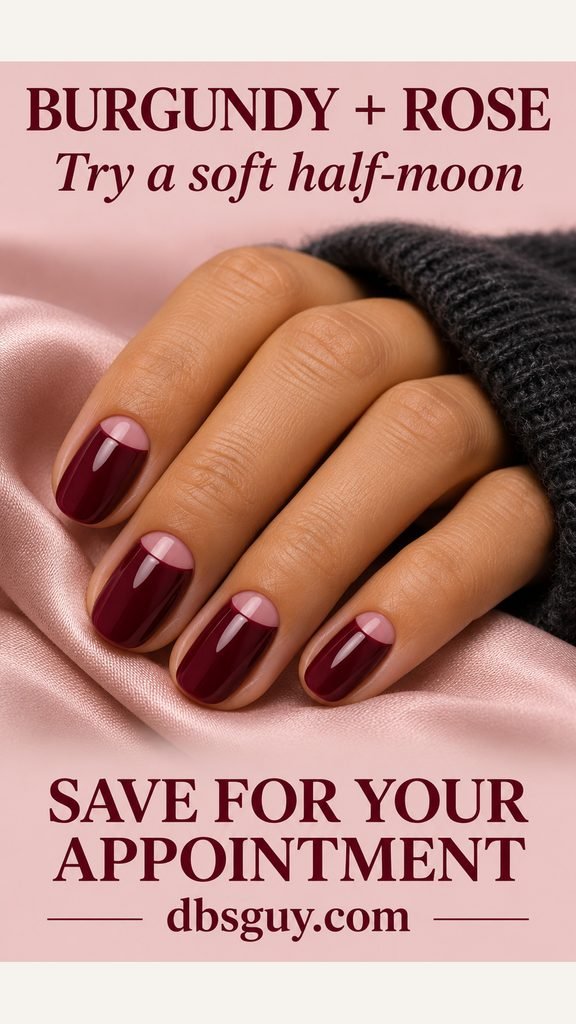
The reference uses a visible soft rose. If you prefer a subtler boundary, ask to compare it with a sheer pink on a sample tip. That will change the look, so make the choice before the full set. A large pale half-moon can dominate a short nail; keep its depth shallow and leave a narrow, clean margin beside the skin.
Ask for: “Short oval burgundy nails with a small soft rose half-moon at the base of every nail. Please keep the burgundy as the main color and show me the crescent size on one nail first.”
Also Read: January Dip Nail Colors for Winter: Soft Neutrals and Rich Jewel Tones for a wider comparison of winter color families.
4. Charcoal With Silver Micro French Tips
A charcoal base makes a fine silver edge visible without turning the whole manicure metallic. Choose a dark gray that still reads as gray in your usual lighting, then trace the free edge—the outer tip—with a slim silver line.

This is the pairing to choose when you want a crisp border rather than scattered sparkle. Specify a smooth metallic line, since a chunky glitter polish would create a different edge. On very short nails, ask how narrow the artist can keep the band while making it continuous. You can retain a rounded shape if that is more comfortable than squoval.
Tell your artist: “Glossy charcoal with a very narrow silver metallic French edge on every nail. No silver outline around the sides or cuticle.” Ask whether the salon would use metallic polish or a chrome product; compare the actual sample rather than assuming both finishes will match.
Also Read: 17 January French Tip Nail Ideas Beyond the Classic White Edge to compare other tip colors and placements.
5. Dusty Mauve With One Pewter Velvet Accent
Dusty mauve keeps the palette soft, while one pewter-gray magnetic accent changes how the set catches light. Leave the other nails a glossy mauve cream color. On the ring nail, ask for a broad, softly luminous reflection rather than a thin, sharply defined cat-eye stripe.

A magnetic velvet effect uses reflective particles arranged with a magnet; it is an optical effect on a smooth surface. Ordinary silver shimmer can echo the colors, but it will not necessarily reproduce the same reflection. Ask the salon to tilt a finished sample so you can judge the glow in motion.
Bring this request: “Short oval dusty-mauve nails, with a pewter-toned magnetic velvet finish on the ring nails only. I prefer a broad soft glow under a glossy top coat.” If the exact effect is unavailable, choose whether the mauve color or the moving reflection matters more before substituting a product.
Also Read: 15 Elegant January Nail Art Ideas to Pair With Your Winter Jewelry for ways to connect a metallic detail with the pieces you wear.
6. Forest Green With an Ivory Corner
Forest green and ivory give you a two-color graphic set without a holiday motif. Keep every nail green, then paint a single ivory triangle across an outer corner of each ring nail. The diagonal meets the free edge; it does not run through the center of the whole nail.
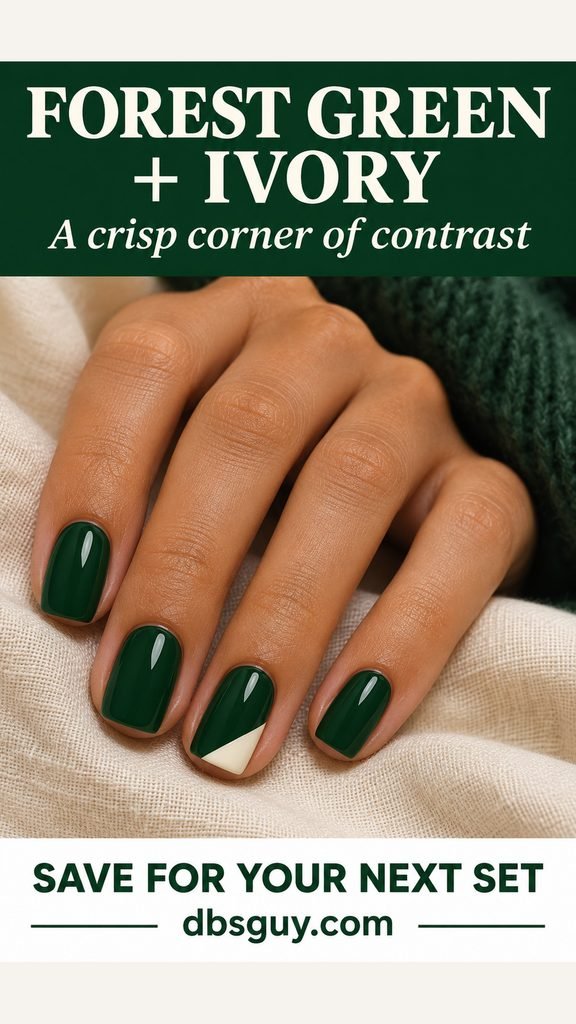
The creamy accent is a softer alternative to bright white. Check that the green stays visibly green indoors, especially if you want something lighter than a nearly black manicure. For smaller nails, move the diagonal outward and reduce the triangle instead of shrinking an elaborate pattern.
Salon note: “Short soft-square forest-green nails, with a flat ivory diagonal corner at the tip of each ring nail. Leave the other nails plain.” If your usual shape is oval, keep it; the corner can follow that curve without requiring extensions.
Also Read: January Nail Art for Short Nails With Small but Noticeable Details for more placement ideas that leave space around the artwork.
7. Milky White With a Champagne Glitter Fade
A milky base with a soft rose cast gives pale champagne sparkle a gentle background. Concentrate fine glitter at the ring nail’s free edge, let it become sparse toward the middle, and leave the base half plain. The other nails stay milky and glossy.
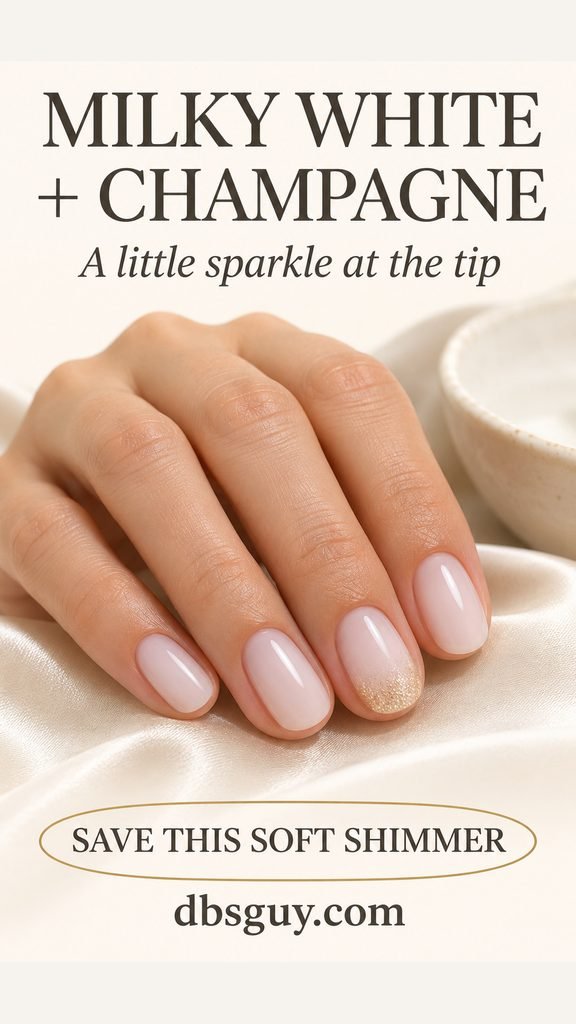
Ask for pale champagne rather than bright yellow gold if you want the quiet reflection shown here. The fade needs separated particles, so a full-coverage gold stripe would change the design. On extra-short nails, keep the glitter close to the edge; you should still see an undecorated area near the cuticle.
What to request: “Short milky-white nails with a soft blush cast, plus a fine champagne glitter fade on the ring nails only. I want scattered sparkle, not a solid gold French tip.” View the milky base on one nail before deciding how much coverage you want.
Also Read: January Nail Art for Beginners: Simple Designs to Practice at Home if you would like to practice a simple glitter fade with regular polish.
8. Ink Navy With Slate-Blue French Tips
Choose navy and slate when you want two colors without a metallic finish. An inky base gives the set depth; a lighter blue-gray band makes the tip visible. Keep both colors glossy so the change in shade carries the design.

The main decision is how much contrast you want. If the sample looks like plain navy at arm’s length, try a lighter slate before widening the band. A very wide tip would become a color block, which has a different balance on a short nail. This pairing works especially well as a color reference beside denim or a gray coat.
Tell your artist: “Short squoval navy nails with slim slate-blue French tips on every nail, all glossy, with no silver or glitter. Please show the two colors together on one sample first.”
Also Read: January Nails: How to Choose Your First Manicure of the Year if you still need to settle your preferred length or service.
Turn Your Favorite Pairing Into an Appointment Plan
Save one main image and send it ahead if your salon accepts references. Add these details so the artist can plan the service and quote the artwork:
- Your length: Say where you want the nail to end relative to your fingertip. If the pictured shape is longer than yours, ask to keep your current length.
- The placement: Specify ring nails only or every nail, and point out whether the detail sits at the base, side, or tip.
- The finish: Name the feature you want—glossy color, smooth metallic edge, scattered glitter, or magnetic glow.
- The service: Ask which available product system suits the look, whether removal and artwork affect the quote, and what aftercare it requires.
For example: “I like the forest-green pairing, but I want my current short oval shape. Keep the ivory corner on the ring nails only. Can you show me a sample and tell me which service you would use?”
A Few Care Details to Settle Before Color
The American Academy of Dermatology’s gel-manicure guidance advises leaving cuticles uncut, checking tool hygiene, moisturizing nails and cuticles between manicures, and avoiding picking off gel. For a gel service, it recommends broad-spectrum, water-resistant SPF 30 or higher on the hands, or dark opaque gloves with the fingertips exposed.
Discuss recurring nail problems before another service, and seek a dermatologist’s advice for persistent problems or unusual changes. Choose the product system separately from the picture; a reference cannot establish what products were used or how your nails will respond.
Questions About January Nail Pairings
Which pairing is easiest to adapt for very short nails?
Start with the snowy-blue accent, the small forest-green corner, or the champagne fade. Each can use less decoration while keeping the same idea. For French tips, ask to see a narrow band on one of your actual nails before repeating it.
Can I request these looks in regular polish?
The painted dots, color blocks, half-moons, curves, and French tips can be discussed as regular-polish designs, along with a compatible glitter topper for the fade. Availability and the artist’s technique matter. The magnetic look needs an appropriate magnetic product; a silver shimmer substitute will create a different finish.
Which January colors feel wintry without looking like Christmas?
Blue-gray, taupe, mauve, charcoal, and milky white are useful starting points. Burgundy and forest green also work when you keep the detail graphic rather than adding holiday symbols. These are styling choices, not a required seasonal palette.
How do I choose between a base accent and a tip accent?
Look at where you want the eye to go. A rose half-moon interrupts the color near the cuticle; a French edge defines the outer silhouette. Hold both samples beside your hand. If either detail takes over a small nail, reduce its depth before changing your preferred length.