Start your January nail inspiration board with a design you can describe in one sentence: a blue checker tucked into a corner, a cranberry manicure with a little sheer space at the base, or one silver loop over pink. A clear placement detail makes a saved image much more useful when you finally sit down at the salon.
These six January nail designs give your 2027 board different directions to explore, from small painted accents to a light-shifting magnetic finish. Choose one as your first manicure reference, then save the notes about length, color, and placement with it. They are ideas for your January plans, not predictions of which look will dominate 2027.

The visuals are AI-generated design concepts for dbsguy.com. Use them to discuss color, placement, and finish; they do not document completed salon work or product testing.
Choose What Your First Saved Design Needs to Do
Before filling a board with almost-identical pictures, decide what would make a manicure worth wearing for you:
- A small pattern on short nails: start with the ink-blue corner checks in design 1.
- Dark color with a visible break: save the cranberry half moons in design 2.
- Warm neutrals with a graphic edge: choose the cocoa diagonals in design 3.
- A finish that changes as your hand moves: look at the smoky plum cat-eye in design 4.
- One metallic detail: try the silver orbit in design 5.
- A winter palette without a holiday symbol: use the olive sprig in design 6.
Keep your usual nail length in mind while browsing. You can change the scale of a motif without changing your entire nail shape to match a reference.
1. Ink-Blue Corner Checks on Milky Ivory
A tiny checker patch gives this ivory manicure a focal point without covering the whole nail. The deep blue is concentrated at one outer corner of the ring nail; the surrounding ivory makes the pattern easy to pick out.

Save this for its placement. The patch is a small two-by-two grid near the tip, with two opposite squares painted navy and the remaining squares ivory. Keep the other nails plain. A full checkerboard across every finger would create a much busier set than this reference.
Short squoval nails suit the compact layout because the corner gives the little squares a clear place to sit. On a narrower nail, reduce the patch before adding more rows. Your artist can check that the two dark squares remain separate at your actual length.
Put in your board note: “Milky ivory, short squoval, one navy checker corner on each ring nail. Keep most of the accent nail plain.” This is precision artwork even though the decorated area is small, so mention the pattern when booking.
Also Read: Extra-Short January Nail Designs With Tiny Details That Fit.
2. Cranberry Half Moons With a Sheer Base
If you still want rich red after the holidays, change the layout instead of adding another decoration. Glossy cranberry covers most of each nail, while a small sheer pink half moon sits at the base beside the cuticle.

The important distinction is that the pale area looks translucent. Ask for a sheer pink base showing through the opening, rather than an opaque white semicircle. Keep the red border crisp and the color on the nail plate, with a clean margin from the skin.
The shallow curve in the short rounded reference leaves enough room for the cranberry to remain the main color. A taller opening would change the balance. Have your artist establish the size on one nail first, then scale it across the set rather than forcing exactly the same width onto every finger.
This earns a place on a board when you like strong color with deliberate empty space. The sheer area may make the base less visually solid, but it does not make the manicure maintenance-free or extend a product’s wear.
Salon wording: “Short rounded cranberry nails, small sheer pink half moons at the base, glossy finish, no French tips.”
Also Read: January Nails: How to Choose Your First Manicure of the Year.
3. Cocoa Diagonal Blocks Over Oat Ivory
Warm ivory and cocoa can feel soft together; a straight diagonal gives them some structure. Here, a tapered brown section runs along one side of each nail, leaving most of the lighter base visible.

Choose this if your board is full of neutral manicures but you keep wishing one had a little more shape. The contrast comes from the edge between the colors. There is no need to add a metallic dividing stripe, a third shade, or a different pattern on the ring finger.
Ask for the same general angle across the set, adjusted to each nail’s width. The cocoa begins near one side of the base and narrows toward the outer end. On shorter nails, a slimmer brown section preserves the ivory area. On a rounder shape, keep the diagonal boundary straight rather than curving it into a conventional French smile line.
For a regular-polish interpretation, use compatible ivory and cocoa lacquers with the recommended base and top coats. Follow their drying directions before layering the second color. Practicing the diagonal on a spare nail tip will help you judge its size; this is a layout reference, not a tested application tutorial.
Save with the image: “Oat ivory plus a tapered cocoa section along one side, flat glossy color, one clean diagonal boundary.”
Also Read: January Nail Art for Beginners: Simple Designs to Practice at Home.
4. Smoky Plum With a Diagonal Cat-Eye Band
This is the reference to save when light matters more to you than painted artwork. A narrow lavender-silver reflection crosses a smoky plum base, with darker color visible on both sides. As the viewing angle changes, the magnetic effect can look different.
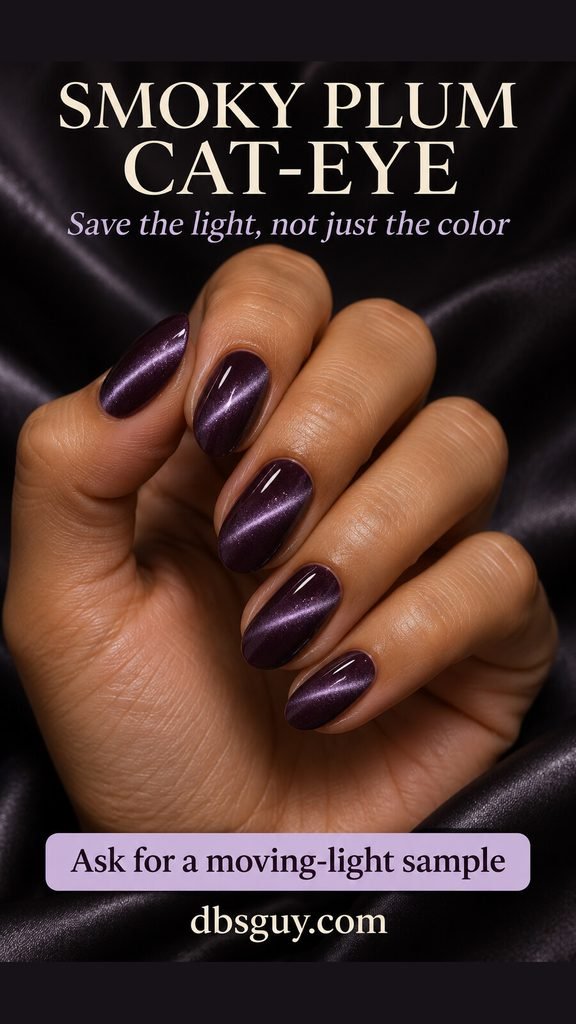
Cat-eye polish uses magnetic particles whose arrangement is influenced by a magnet. The luminous band is an optical effect, rather than a silver stripe painted over the purple. Ordinary shimmer polish can echo the colors, but it will not reproduce the same magnet-shaped reflection.
Ask to see a sample moving under the salon’s light. A still image captures one reflection, so it cannot tell you exactly how bright the band will look at every angle. Specify a defined diagonal band if that is the detail you want; a broad, diffused velvet glow is a different finish.
The almond reference gives the diagonal some length, but short oval nails can carry a smaller version. Confirm that the salon offers the effect, which product system it uses, and whether the finish changes the quoted service price. Application and curing must follow that product’s instructions; there is no universal magnet position or curing time for every formula.
Board note: “Deep smoky plum, diagonal lavender-silver cat-eye, dark edges still visible. Check a moving sample before choosing.”
Also Read: January Nail Art for 2027: Frosty Finishes and Details to Save Now.
5. One Silver Orbit Over Sheer Rose
A thin silver loop gives a pink manicure a little movement without filling the nail with sparkle. Only the ring nail carries the artwork. The open center and the pink margin around it are as important as the metallic line.
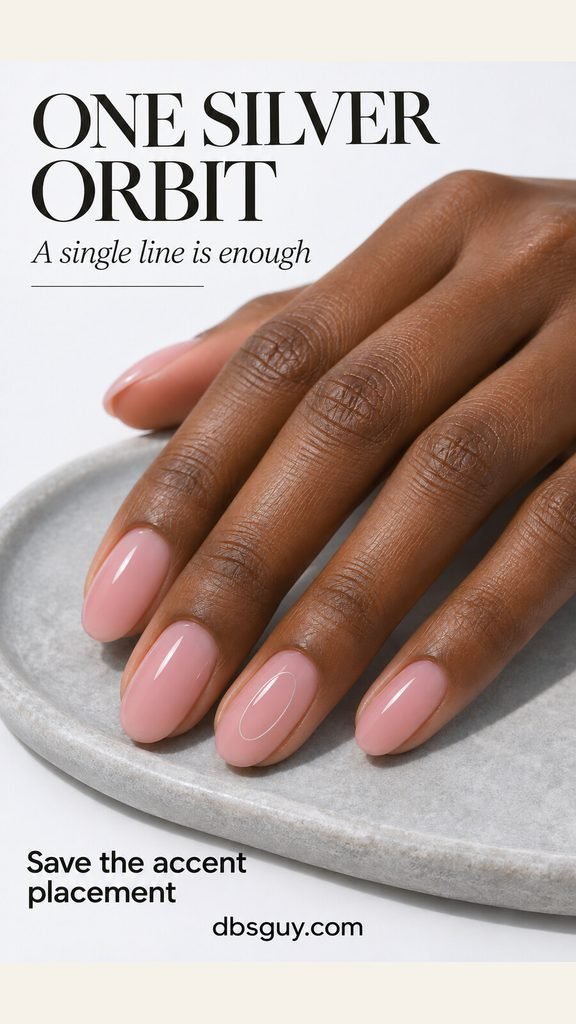
Keep the loop entirely inside the nail’s outline. It should not trace the cuticle or run into the free edge. A slightly irregular oval feels drawn by hand; it does not need to become a mathematically perfect ellipse.
Save this for its line weight and open space. Ask for a flat painted detail if you want the smooth surface shown here. Raised wire, a metal charm, or a thick sculpted border would create a different result. A silver nail-art polish gives a painted interpretation; a chrome detail requires a compatible application system and may reflect differently.
On very short nails, make the oval smaller while keeping a visible pink margin on every side. If the loop can only fit by touching the edges, choose a finer line or a smaller accent before changing your preferred nail length.
Also Read: 15 Elegant January Nail Art Ideas to Pair With Your Winter Jewelry.
6. A Tiny Olive Sprig on One Ivory Nail
Muted olive brings a grounded color into a January board, and one ivory accent gives a tiny botanical drawing room to show. Keep the surrounding nails solid olive so the sprig remains the only motif.
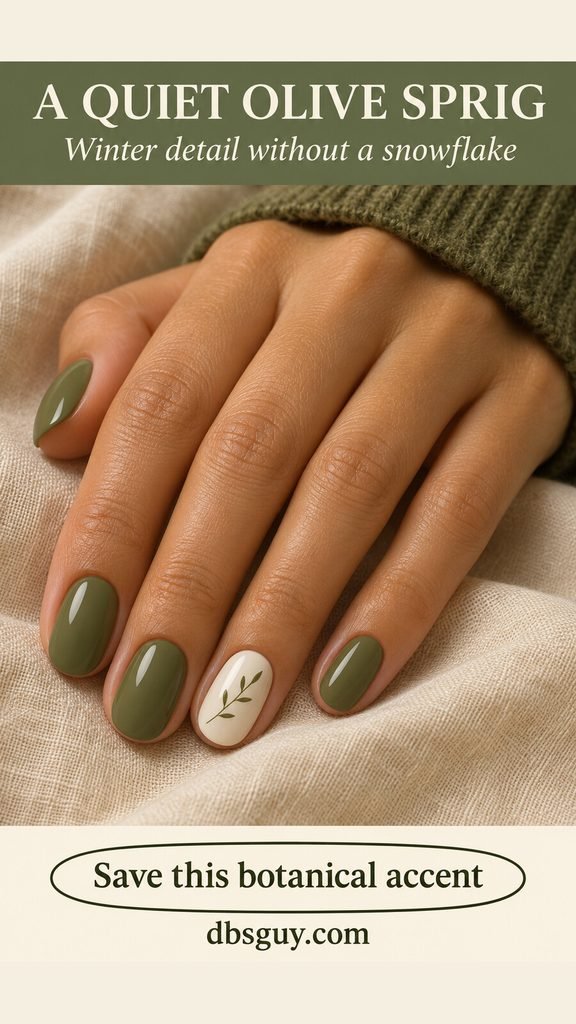
The accent needs a slender stem, a few narrow leaves, and plenty of ivory around them. Position it diagonally through the middle of the nail. Turning it into a dense vine or adding flowers would lose the spare quality that makes this reference useful.
This is a good option when you want the manicure to work beside cream knits, olive outerwear, or brown accessories without including snowflakes or holiday greenery. Those are styling connections, not rules about what colors belong in January.
Short oval nails give the small sprig a soft outline. If freehand leaves are beyond the home manicure you want to attempt, look for a flat nail decal that fits fully inside the accent nail and follow its application directions. Check the actual decal size before buying; the product photo may show a much longer nail.
Salon wording: “Muted olive with one ivory ring nail and a tiny flat olive sprig. Keep the stem and leaves fine, with no raised details.”
Also Read: End-of-January Nail Designs for the Weeks Between Snowflakes and Hearts.
Turn Your Saved Images Into One Clear Appointment Reference
You do not have to combine all six designs. Pick a main image, then add a note that separates what you want to keep from what you want to change. If you borrow the color from one reference and the placement from another, label that clearly.
- Length and shape: name your usual shape and say whether you want to keep the current length.
- Color and coverage: specify sheer or opaque, and compare the actual swatches beside your hand.
- Artwork map: identify which fingers get the detail and whether you want the same layout on both hands.
- Finish and surface: state glossy, magnetic, or metallic, and whether all artwork should stay flat.
For example: “Keep my short oval shape. Use the cranberry half-moon layout, with a small sheer pink opening on every nail. I want the glossy finish shown in the reference.” That gives your artist a clearer starting point than several unlabeled screenshots.
Send the reference when booking so the salon can confirm the service and artwork involved. The same design may be interpreted with regular lacquer, gel, or prepared press-ons; its appearance alone does not identify the product system or price.
Before You Choose a Gel Version
If you book gel, the American Academy of Dermatology’s gel manicure guidance recommends broad-spectrum, water-resistant SPF 30 or higher on the hands before the appointment, or dark opaque gloves with the fingertips exposed, to help protect against curing-light UV exposure. It also advises against cuticle cutting or pushing, and against picking off gel polish. Arrange appropriate removal instead.
January Nail Inspiration Questions
Do January nails have to be blue, white, or covered in snowflakes?
No. Those are recognizable winter choices, but cranberry, cocoa, plum, and olive can all belong on your board. Pick a palette you want to wear and a detail that works at your nail length.
Can I use these ideas on natural short nails?
Yes, the layouts can be scaled to short nails. The corner checks and olive accent already use compact shapes. For the silver orbit, preserve the open space around the loop; for half moons, keep the opening shallow enough to leave room for the main color. Extensions are not a requirement for the design concept.
Can I recreate every finish with regular nail polish?
The painted layouts can be interpreted with compatible air-drying colors and nail-art products. The magnetic cat-eye needs a suitable magnetic polish and magnet, used according to that formula’s directions. A silver lacquer loop may look softer than chrome. Choose the version you can apply correctly rather than treating different systems as interchangeable.
How many pictures should I bring to the salon?
Start with one main reference and add another only if it explains a specific change. Write “this color” or “this placement” beside the extra image. A small, labeled selection is easier to discuss than a board in which every picture asks for a different shape, finish, and pattern.