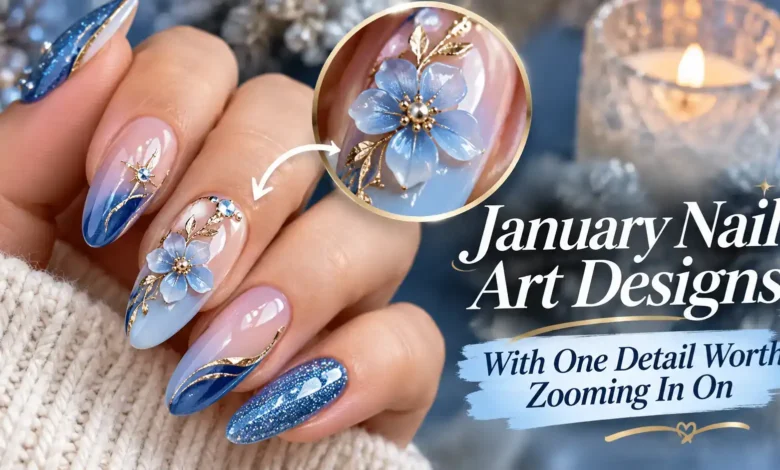
Try a dark navy manicure with one ivory sprig, a sheer base with a tiny windowpane, or charcoal nails with glossy curves you notice when the light moves. These January nail art designs give you a single focal detail to look at closely, while the rest of the set stays quiet.
The seven references below are planned around one decorated ring nail per hand. Each explains what to preserve, what to simplify on shorter nails, and how to describe the look at your appointment. Choose one design for the set; the details do not need to compete with each other.

The visuals are AI-generated nail-art concepts created for dbsguy.com. They illustrate color, placement, and finish; they do not document completed salon work or tested wear.
Pick the Detail You Want to Notice
For a detail that reads clearly without moving your hand, start with the ivory sprig, black windowpane, navy bow, or gold frame. The charcoal curves rely on reflected light, so they are the quieter choice. Plum lace gives a soft color palette a more intricate edge; smoky marble is for a less geometric accent.
Save the full-hand reference as well as a close-up of its accent. Your artist needs to see which nails stay plain. Decide on your actual length first, then ask to see the motif at that size before repeating it on the other hand.
1. Ink Navy With a Tiny Ivory Sprig
A slender ivory branch breaks up glossy navy without turning the manicure into an all-over floral print. The useful detail is the space between the leaves: each little shape remains separate, and dark blue shows around the whole sprig.

Keep the stem gently curved and a little diagonal, following the length of the ring nail. Pointed leaves give it a botanical shape; rounded petals would make it read more like a flower. The remaining nails stay the same deep navy, with no extra branches.
On a very short nail, ask for a shorter stem with fewer leaves. Keeping the leaves distinct matters more than matching the reference’s exact count. A fine white botanical nail decal can offer an alternative to hand painting if you find one small enough to fit fully inside the nail.
Tell your artist: “Glossy ink navy, with one small ivory leafy sprig on each ring nail. Please leave blue showing around it and keep the other nails plain.”
Also Read: 23 Winter Nail Designs: Snowflakes, Chrome and Cozy Knits.
2. Sheer Rosy Beige With a Four-Pane Window
This accent puts a small black rectangle inside the nail, then divides it once vertically and once horizontally. Those four open panes make the design recognizable. The rosy beige remains visible inside the frame and around all four sides.

A short squoval shape gives the straight lines a simple setting. Keep the frame inset rather than tracing the nail’s entire perimeter. That surrounding margin is what makes it look like a little window rather than a full outlined manicure.
Fine intersections are the tricky part: a heavy brush load can turn the crossing into a dark spot. Treat this as a precision-painting salon reference if straight lines are new to you. On a narrower nail, make the whole window smaller while keeping the panes open; if four panes no longer read clearly, simplify to an undivided rectangle.
Tell your artist: “A sheer rosy-beige set with one small black four-pane window on the ring nail. I want an inset frame, thin lines, and clear base showing inside every pane.”
3. Matte Charcoal With Three Glossy Ripples
Here the decoration comes from reflection. Three slender glossy curves sweep across one matte charcoal accent nail, with charcoal visible between them. The surrounding nails stay matte in the same shade.

Ask for a subtle finish contrast and a smooth, low-profile result. Show the artist that you like the curves, since “matte and glossy” could also mean a French tip, a diagonal panel, or a whole glossy accent nail.
Look at a sample while tilting it under ordinary light. The lines should appear as the reflection changes, but this design will be less obvious in flat lighting than a pale motif on navy. On a short nail, two well-separated curves may be clearer than three crowded ones.
A regular-polish interpretation uses compatible matte and glossy finishing products according to their directions. The final finish needs to stay different in those areas: covering the entire accent with one more matte or glossy layer would hide the contrast. Your artist can choose the application system that suits the requested result.
Also Read: Easy Nail Art for January Using Dots, Lines and a Little Shimmer.
4. Dusty Mauve With a Plum Lace Crescent
A little row of open loops turns a shallow curved line into a lace-like border. Dark plum gives dusty mauve enough contrast for the scallops to show, while the related colors keep the effect soft.
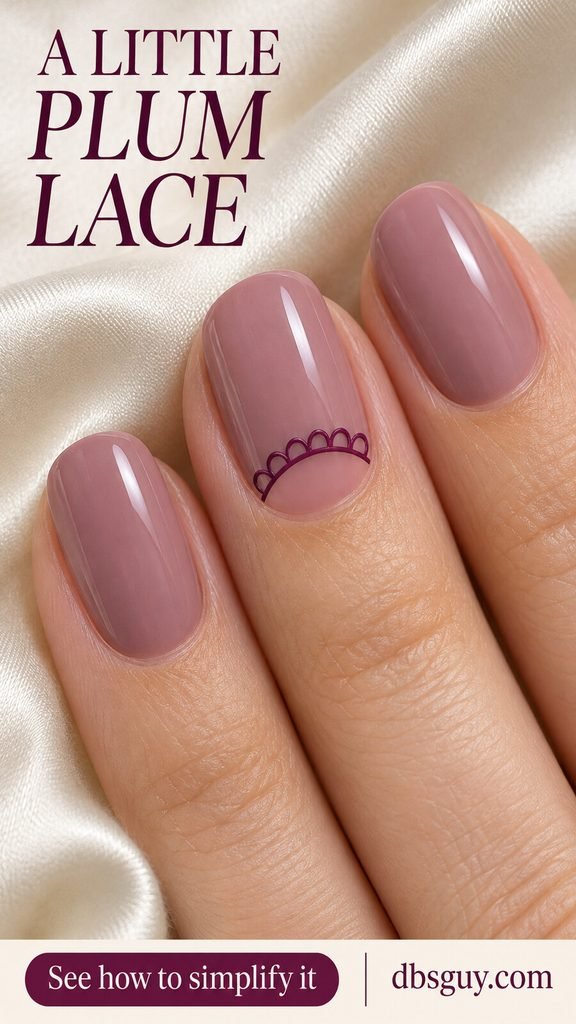
Place the curve low on the ring nail, with a visible mauve margin between the artwork and the skin. Keep the tiny loops along its upper edge open. Filling them in would create a solid scalloped band and lose the lace detail.
For a smaller nail, reduce the number of loops and give each one a little breathing room. You can also choose only the plain crescent if the lace feels too delicate at your preferred length. Skip a second row of loops; the single border is enough to make this accent different from the rest of the set.
Tell your artist: “Glossy dusty mauve with a thin plum crescent and one row of open lace loops on each ring nail. Please keep the design away from the skin and leave the rest solid mauve.”
5. Creamy Ivory With a Fine Navy Bow
Two open loops, a small center, and two slim tails make this bow readable without a raised charm. Creamy ivory supplies the light background, and navy keeps the detail connected to the cooler January palette.
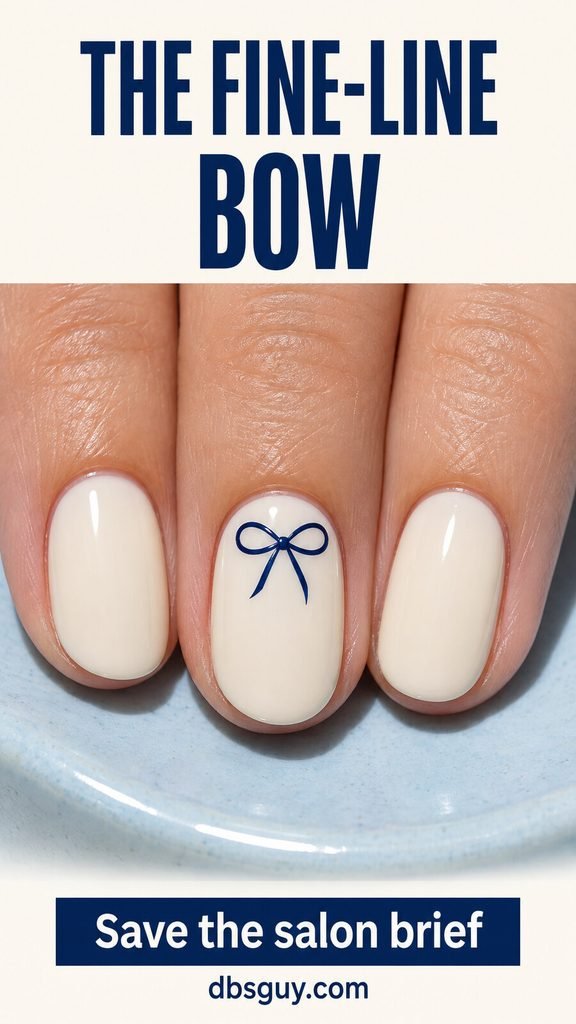
The reference places the bow near the base of the ring nail, leaving a generous ivory area toward the tip. Ask for that placement explicitly if you like it; a bow at the free edge would change the balance of the design.
Keep the tails short enough to stay separate. On very short nails, simplify them before shrinking the loops into solid dots. A flat bow decal is another option, but compare its actual size with your nail before choosing it. The loops need enough room to remain visibly open.
Tell your artist: “Creamy ivory nails with one small, painted navy bow near the base of each ring nail. Two open loops, fine tails, and plain ivory on the remaining nails.”
Also Read: 21 Short December Nail Ideas That Make Tiny Details Stand Out.
6. Oxblood With a Fine Inset Gold Frame
A continuous gold outline gives deep oxblood a little structure. The frame sits inside the ring nail’s border, leaving a narrow red margin outside it and an uninterrupted red center.

Follow the softly rounded square shape rather than forcing sharp corners onto an oval nail. The important feature is a closed, delicate outline. A thick metallic rim would cover more red and become a much bolder accent.
This is a useful reference if you like dark winter color but want the artwork contained. On short nails, frame only the ring finger and keep the line fine enough for the red center to remain obvious. Ask for a sample first if you are choosing between a painted metallic line and a more reflective salon finish; they will not necessarily catch light the same way.
Tell your artist: “Glossy oxblood with one fine, closed gold frame inset on each ring nail. Please leave red outside the frame on every side and keep the center empty.”
Also Read: 15 Elegant January Nail Art Ideas to Pair With Your Winter Jewelry.
7. Smoky Marble With One Silver Seam
Soft gray wisps give the ring nail depth, while one irregular silver line provides the feature to zoom in on. The surrounding nails stay translucent taupe. Keeping the marble on one finger lets its layers remain the focus.
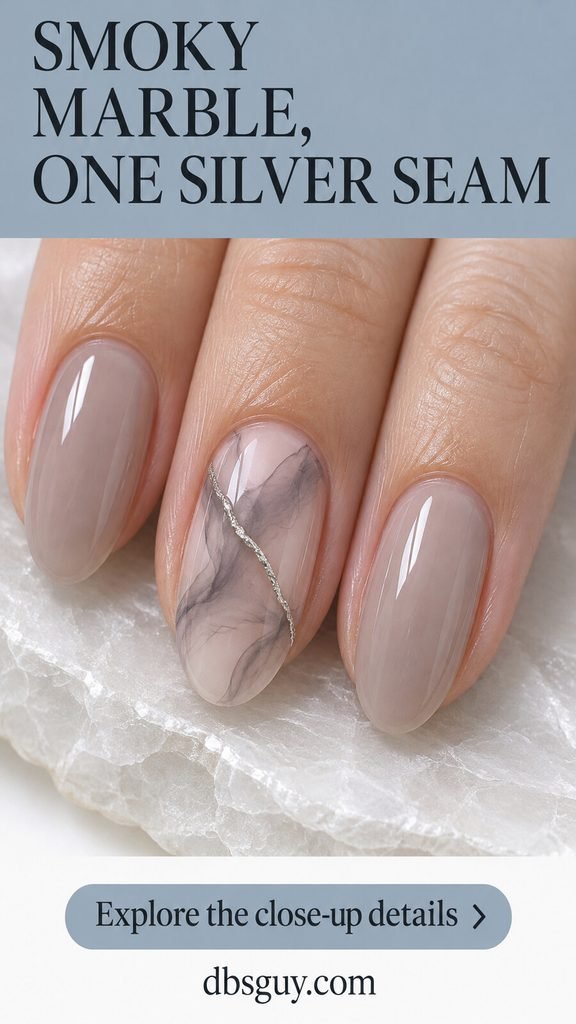
Ask for light areas to remain visible through the smoky accent. Solid gray polish crossed with white stripes would have a different effect. The silver line should follow one loose diagonal through the wisps, without branching into a network of metallic veins.
This is a salon reference for layered, translucent art rather than a universal home marbling recipe. Products blend differently, so ask the artist to show the gray opacity and silver finish on a sample. On a shorter nail, use fewer wisps and preserve one clear silver path instead of packing in more veins.
Tell your artist: “Sheer taupe nails, one smoky gray marble accent on each ring finger, and a single fine silver seam. Please keep pale space in the marble and the other nails plain.”
Turn Your Saved Image Into a Clear Appointment Brief
Before booking, tell the salon how many nails need art and send the reference. Ask whether the quoted service includes the fine painting and whether a sample is possible. There is no useful single price or appointment time for all seven designs; the artist, materials, and amount of detail will affect both.
At the appointment, confirm the base shade on your own hand, the finished length, the decorated fingers, and the finish. For the charcoal look, point out the matte-and-gloss contrast. For the window and lace, point out the open spaces. Those details are easy to lose if the request is only “something like this.”
Fine artwork does not require cutting away skin to make space. The American Academy of Dermatology’s manicure guidance advises against cutting or forcefully pushing back cuticles and recommends moisturizing nails after polish removal. Keep decoration on the nail, with a clean margin from the skin.
Questions About Detailed January Nail Art
Which design works best on very short nails?
Start with the bow, a shortened sprig, or two charcoal curves. These can be simplified without needing a large central area. The four-pane window and lace loops need enough space for their openings to remain visible, so have your artist check the motif at your actual nail size.
Do I need extensions or gel for these designs?
The designs describe an appearance, not a required nail system. Natural nails can provide a canvas if the artwork is scaled to fit. Several painted motifs can be interpreted with regular polish; salon gels and specialist finishes have their own application and curing requirements. Confirm the system you want rather than assuming a concept image identifies a product.
Can I try a home version without painting tiny lines?
Look for a small flat sprig or bow nail decal. Check that the whole motif fits within your nail, then follow its preparation, application, and sealing instructions with compatible products. Choose the motif first and leave the rest of the set plain. For drawing practice, start with the 13 Easy January Nail Ideas Where One Small Detail Does the Work.
Should the accent be identical on both hands?
Match the base, decorated finger, approximate scale, and finish. A leafy branch or smoky wisp can vary slightly while still belonging to the same set. For the window and gold frame, prioritize the clear outline and balanced margins. Ask to approve the first accent before the second is painted.