15 Healthy Habits for College Students (That Have Nothing to Do With Food)


Healthy habits for college students can be as ordinary as protecting your bedtime, looking up from your laptop, keeping earplugs in your bag, and making plans with someone you like. You can work on your well-being without turning every spare hour into another assignment.
Start with one habit that solves a problem you actually have this week. A routine that fits around your commute, job, classes, and energy is more useful than a perfect checklist you cannot keep. The time suggestions below are small starting points, not medical targets or promises about how quickly you will feel different.
Choose your starting point: Short on bandwidth? Choose a sleep window if you are running on too little rest, a repeatable check-in if you feel isolated, or one short movement break if most of your day happens at a desk. Keep that one habit small before adding another.

The visuals are AI-generated concepts illustrating student routines, not photographs of actual students, campuses, or tested results.
1. Protect a Sleep Window You Can Actually Keep
Look at when you need to leave for your earliest regular commitment, then work backward to make room for sleep and getting ready. CDC guidance recommends at least seven hours for adults ages 18–60; students ages 13–17 need eight to ten. Seven hours is a minimum recommendation for adults, not a ceiling on what you may need.

Try keeping bedtime and wake-up time reasonably consistent, including on days without an early class. Set a reminder to finish studying and start getting ready for bed. An alarm that only tells you when to wake up cannot protect the hours before it.
For a shared room, agree on a specific quiet period and where late-night calls happen. If work shifts make a steady schedule difficult, plan around the sleep opportunity you can protect. Ongoing sleep trouble deserves a conversation with a healthcare professional.
2. Take a Screen-Free Break Outside
Pick a convenient outdoor spot: a courtyard bench, a covered entrance, or a quiet stretch of your route to class. Spend a few minutes there without making the break an email session. Notice the weather, the buildings, or what you can hear.

Keep the break easy to repeat. You can sit, leave your backpack beside you, and let your attention move beyond the work in front of you. A covered bench near your classroom may be more practical than a park across campus.
Use a library window seat or another comfortable indoor spot when heat, cold, smoke, severe weather, or access makes going outside impractical. Attach the pause to something predictable, such as the end of your first class, instead of waiting until you remember.
3. Give Everyday Movement a Regular Place
Choose one route or gap in your day that can include movement: a short campus loop after class, dancing in your room, an accessible recreation session, or activity that fits your mobility. Put it beside a commitment that already happens.

For adults, the general guideline is at least 150 minutes of moderate-intensity aerobic activity a week, or 75 minutes of vigorous activity, or an equivalent combination. You can split activity into smaller amounts; some is better than none. A short loop is a starting point, not the entire weekly recommendation.
Begin with a manageable amount and build gradually. Keep an indoor option for bad weather. If a health condition or disability affects activity, a clinician or adaptive recreation professional can help you choose a suitable version.
4. Put Strength Work on Its Own Schedule
Walking to class and strengthening your muscles serve different purposes. Adult activity guidance also includes muscle-strengthening work on at least two days a week, covering all major muscle groups.

If strength training is new, make your first task learning the setup. Ask campus recreation whether it offers equipment orientations, beginner instruction, or adaptive options, and check any fees. You can also use suitable bodyweight or resistance-band exercises; a gym membership is not a prerequisite.
Choose a routine you understand before increasing the challenge. Two calendar appointments, such as Tuesday and Friday, give you something concrete to organize around. Get instruction when a movement is unfamiliar, and stop if an exercise causes pain.
Also read: 15-Minute Dorm Room Workout: No Equipment, No Noise, No Excuses
5. Let Your Eyes and Body Leave Study Mode
Use the end of a page, practice problem, or study timer as a cue to look away from the screen. Focus on something farther away and blink normally. When convenient, change position or move gently before you begin again.

The commonly recommended 20-20-20 reminder means looking about 20 feet away for 20 seconds every 20 minutes. Treat it as a prompt for regular breaks, not a guarantee against eye strain. Switching from your laptop to your phone keeps your attention on another close screen.
Reduce glare, enlarge text that makes you lean forward, and keep the screen at a comfortable distance. Arrange the desk so you can look up easily. Book an eye-care appointment for persistent eye discomfort, headaches, or vision changes.
Also read: Morning Stretch Routine for Students: 10 Minutes Before Your First Class
6. Give Your Phone a Parking Spot
Choose a place for your phone during one study block: a zipped bag pocket, a drawer, or a shelf outside easy reach. Decide what you are working on before you put it away, and choose when you will check it again.

Mute notifications you do not need for that period. If you rely on your phone for accessibility tools, medical alerts, caregiving, or work, keep those functions available and quiet the optional ones. A useful boundary should fit your responsibilities.
Notice what actually interrupts you. If you keep opening social apps on your laptop instead, close those tabs or use a temporary site limit. After the block, check your messages and decide whether the setup is worth repeating.
7. Put a Small Pause Between Demands
After a difficult class or before opening a stressful message, pause for about a minute. Sit comfortably, let your feet rest on the floor if that works for you, and release tension in your shoulders. Let your breathing stay gentle and unforced.

You do not need to empty your mind or hold your breath. Simply notice a few breaths, then decide what the next task requires. If focusing on breathing makes you uncomfortable, look around and name a few ordinary objects instead.
Finish by choosing one next action: find the lecture notes, walk to the next room, or write the first sentence of the reply. Try the pause at one transition you already make, such as the moment you sit down to study.
8. Write a To-Do List That Fits Today
Separate the task that truly needs attention today from the things you would like to finish eventually. Keep your full task list elsewhere, and give today a short page with three lines:
- Must do: The task with the nearest real consequence or deadline.
- Next: One useful task if there is time after the first.
- Can wait: Something you are deliberately leaving for another day.

Make the first task small enough to start. Replace “catch up on chemistry” with “work through problems one to three and mark what I cannot solve.” Check your calendar before deciding how much fits; a day with classes and a work shift has less open time.
At the end of the day, reschedule what remains. If the same task keeps moving, ask whether it needs a smaller step, a clearer deadline, or help from an instructor. Make that change before putting it on tomorrow’s page.
9. Make One Social Plan Repeatable
Choose a form of connection you would actually enjoy: a weekly club meeting, a short call home, a shared walk, or a regular study session with room to talk. Make the next time specific before the conversation ends.

If you are new on campus, try returning to the same welcoming group rather than expecting every event to produce a close friend. Familiar faces give you an easier opening for the next conversation. You can leave a group that feels uncomfortable and try another.
Commuter and online students can put the plan near an existing class or use a scheduled call. A small circle is enough to start. Focus on people who make room for you, listen, and respect your limits.
Also read: How to Join Clubs in College: Find Your People Freshman Year
10. Practice a Clear, Kind Boundary
Before accepting a favor, extra shift, or group commitment, check what it would displace. You can take a moment to answer: “Let me check my schedule and get back to you.” Give yourself time to see whether the request fits before committing.
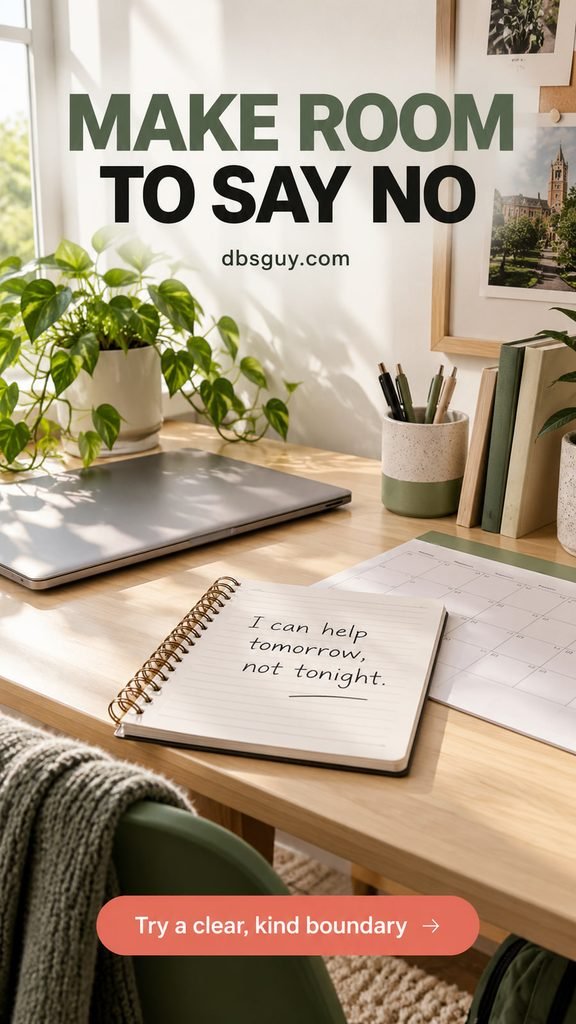
Keep the boundary specific. Try “I can help tomorrow, not tonight,” or “I need the room quiet after eleven; can you take the call in the lounge?” Offer an alternative only if you can genuinely manage it.
If a roommate repeatedly ignores an agreement, ask an RA or housing staff member about the next step. When an obligation cannot change, such as a required shift, look for another commitment you can adjust instead of blaming yourself for limited time.
11. Keep a Hobby That Does Not Need a Grade
Give a little space to something you enjoy without needing to improve, post it, or add it to a résumé. Sketch a messy page, play a familiar song, read a few pages for pleasure, or work on a small craft.

Make starting easy. Keep a sketchbook where you sit, borrow a book you want to read, or leave your project in a container you can open quickly. Try a short session before deciding you need an entire free evening.
If the hobby turns into another performance standard, simplify it. Play casually, leave a drawing unfinished, or choose something else. Use supplies you already have or can borrow so trying an activity does not require a shopping trip.
12. Reset One Small Part of Your Room
Pick a stopping point that takes roughly five minutes: clear your desk, put laundry in the hamper, collect trash, or restore the path between your bed and the door. Choose one area instead of beginning a complete room makeover.
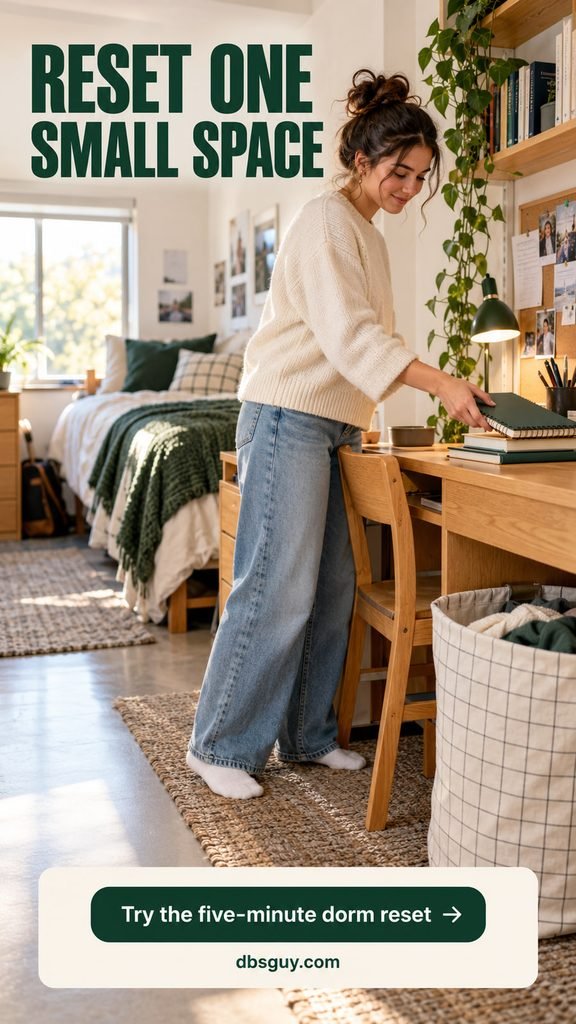
Use the time to remove tomorrow’s friction. Put the notebook you need by your bag and return borrowed items to their place. Keep walkways and exits clear of cords, shoes, and piles.
Stop when the area is usable, even if the rest of the room needs attention another day. In a shared room, agree on the common areas and leave your roommate’s belongings alone. A usable room can still look lived in.
13. Make Handwashing Part of Existing Routines
Wash after using the bathroom, blowing your nose, coughing or sneezing, and handling trash. In a shared living space, those ordinary moments are useful cues; you do not need a complicated cleaning schedule to remember them.

Use this simple sequence:
- Wet your hands with clean running water and apply soap.
- Lather the backs of your hands, between your fingers, and under your nails.
- Scrub for at least 20 seconds. Turn the faucet off while scrubbing when practical.
- Rinse under clean running water, then dry your hands.
When soap and water are unavailable, use hand sanitizer containing at least 60% alcohol and follow its label. Hand sanitizer is not a substitute for every situation; use soap and water when your hands are visibly dirty. Keeping a small bottle in your bag makes the backup easier to find.
14. Protect Your Hearing Before the Event Starts
Put hearing-protection earplugs in your bag before a concert, game, rehearsal, or loud work shift. Choose a type you can fit correctly and follow the instructions; earplugs sitting in their case cannot protect you.

Lower headphone volume, move farther from loud speakers, and take breaks in quieter areas. Loud sound can damage hearing, and both the level and the time you are exposed matter. A phone’s volume percentage is not a reliable universal safety limit.
Ordinary headphones and noise-canceling earbuds are not automatically hearing protectors. For loud environments, use products designed for hearing protection. Get advice from a healthcare professional if you notice ringing or muffled hearing after noise exposure.
15. Check What Support You Need Before You Hit a Wall
Once a week, ask yourself what has become harder to manage: sleep, mood, coursework, pain, money worries, or getting through ordinary tasks. Choose one next step instead of treating the check-in as another scorecard.

Save the contacts for student health, counseling, academic advising, and disability or accessibility services. Check eligibility, appointment procedures, fees, and after-hours options at your own school. Those details vary, especially for online, part-time, and commuter students.
NIMH’s guidance on caring for your mental health recommends professional help for severe or distressing symptoms lasting two weeks or more. You can reach out sooner, particularly if symptoms are worsening or affecting daily life. A habit list can support you; it cannot diagnose a problem or replace care.
How to Start Without Taking On All 15
For the next week, choose one habit and attach it to something that already happens. Write a sentence you can follow: “After my afternoon class, I will put my phone away and sit outside for a few minutes.”
Decide on a smaller backup for a crowded day. If the outdoor break is impractical, pause by a window before the next task. If you miss a day, return at the next opportunity; you do not need to restart a perfect streak.
At the end of the week, ask whether the habit helped with the problem you chose. Keep it, adjust it, or try a better fit. Add another only when the first one feels manageable.
Questions About Building Healthy Habits in College
Which healthy habit should I start with in college?
Start with the problem that keeps disrupting your day. If you routinely leave too little time for sleep, protect that time first. If you feel cut off from people, arrange one repeatable check-in. You do not need to begin with the most impressive habit on the list.
Do I need to do all 15 habits every day?
No. Strength work, social plans, and checking campus resources may happen on different days. These are options to build a workable routine, not 15 daily tasks. Choose a few that fit your current needs.
What should I do during midterms or finals?
Make the routine smaller before abandoning it. Keep a realistic sleep opportunity, shorten optional projects, and give study sessions clear stopping points. If the workload cannot fit, ask an instructor or advisor about priorities and available support. A new planner cannot create hours you do not have.
Can I use these habits if I commute or study online?
Yes. Tie them to logging out of class, arriving home, or finishing a shift. Use accessible local spaces and scheduled calls when campus activities are inconvenient. Confirm which student services you can use rather than assuming every campus benefit is included.
Choose the habit you can picture doing on an ordinary busy Tuesday. Put its next opportunity on your calendar or beside a familiar routine, and make the first version small enough to begin.
Also read: Dorm Yoga for Beginners: Quiet Flows for Tiny Spaces