A flocked artificial Christmas tree makes sense when you love the snowy look, have room to store it, and plan to reuse it for several seasons. A real Christmas tree suits you better when fresh evergreen scent, the tree-shopping tradition, and a smaller first-year bill matter more than daily watering.
The price tag tells only part of the story. In the example below, a flocked setup costs $415 in year one, while a real-tree setup costs $175. After five Christmases, the same assumptions put the totals at $415 versus $635. Those are transparent budget examples, not national averages or guaranteed savings.
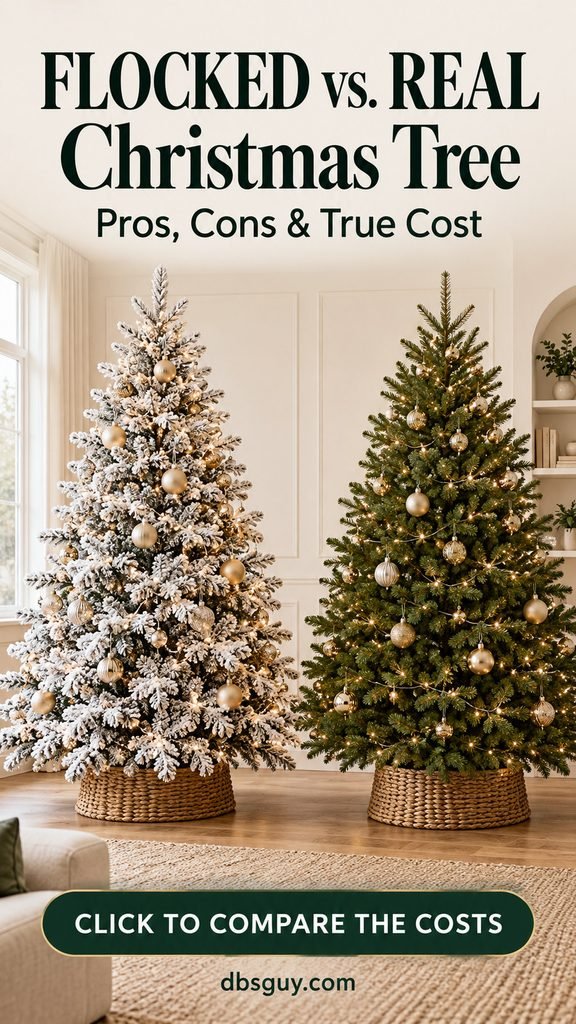
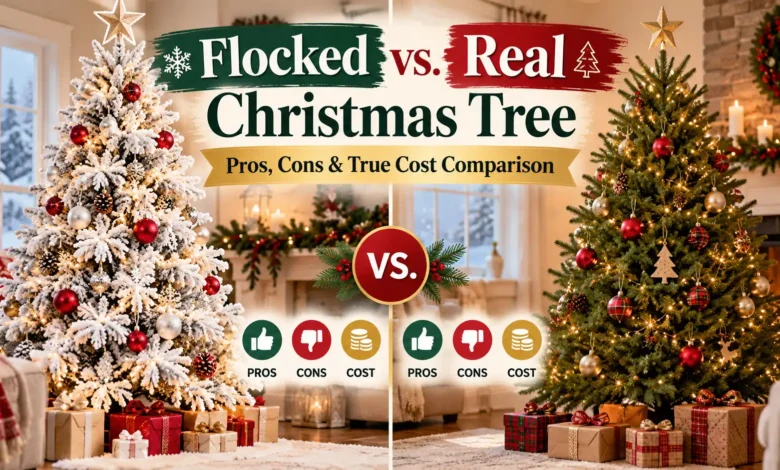
The images in this guide are AI-generated concepts that illustrate the comparison; they are not photographs of tested trees or specific retail products.
First, what does “flocked vs. real” actually mean?
Flocking is the white, snow-like finish on the branches. It describes a treatment, not whether the tree is natural or artificial. You can buy a flocked real tree, too.
For this comparison, “flocked tree” means a reusable artificial tree with factory-applied flocking, and “real tree” means a fresh-cut, unflocked evergreen. A potted living tree is a separate purchase with different care needs. A professionally flocked fresh-cut tree combines an annual tree purchase with coating-specific care and disposal questions, so ask the seller about those before ordering.
Flocked vs. real Christmas tree: the quick comparison
| What matters | Flocked artificial | Fresh-cut real |
|---|---|---|
| Appearance | Consistent snowy finish; the same shape each year | Natural green needles; each tree has its own shape |
| Scent and tradition | No natural evergreen fragrance; decorate on your schedule | Evergreen fragrance and the annual choosing-the-tree experience |
| Cost | Larger initial purchase; reuse can reduce the cost per season | A new tree purchase every year; stand and lights can be reused |
| Care and mess | No watering; flocking can shed during handling | Daily water checks; needle cleanup and seasonal removal |
| Storage | Needs space for the tree between holidays | Store the stand and decorations, rather than the tree itself |
| After the holidays | Pack carefully and keep using it | Remove decorations and use an accepted local collection or mulching program |
If you already own a tree you like, that changes the decision immediately: reusing it avoids another tree purchase this year. Compare the cost of switching with the cost of continuing, rather than treating both options as brand-new purchases.
Flocked artificial Christmas tree: the pros and cons

Where a flocked tree earns its place
- You get the snowy finish from the start. A few ornaments and lights can be enough to make it feel decorated. The white branches create contrast for colorful baubles and soften an all-neutral room.
- You can plan around a known size. Published height and width make it easier to choose a full, slim, or narrow tree for the same corner each year. Check whether the listed height includes the stand, and allow room for your topper.
- There is no daily watering. An artificial tree lets you begin decorating earlier without managing a cut tree’s freshness.
- The purchase can serve several Christmases. The financial benefit comes from continuing to use the tree, rather than replacing it whenever your decorating preferences change.
The drawbacks that are easy to underestimate
Flocking is not mess-free. Moving sections, shaping branches, hanging ornaments, and packing the tree can release some of the coating. The amount varies by product and handling. Put down a removable sheet during assembly, and assess shedding before you add decorations.
Storage is part of ownership. You need a space that fits the packed tree and meets its manufacturer’s storage instructions. A damp basement or very hot attic may be a poor fit. Buying a tree that looks wonderful in December but has nowhere suitable to go in January is an expensive mistake.
The finish needs gentle handling. Aggressive brushing or scrubbing can damage it. You also commit to a snowy look: changing the ribbon is easy; changing heavily flocked branches back to natural green is not a sensible routine decorating adjustment.
Pre-lit convenience adds another component to maintain. Before paying extra, check the lighting warranty, replacement parts, and what happens when a section stops working. An unlit tree with separate lights may suit you better if you want to choose and replace the lighting independently.
Real Christmas tree: the pros and cons
Why the annual purchase can still be worth it
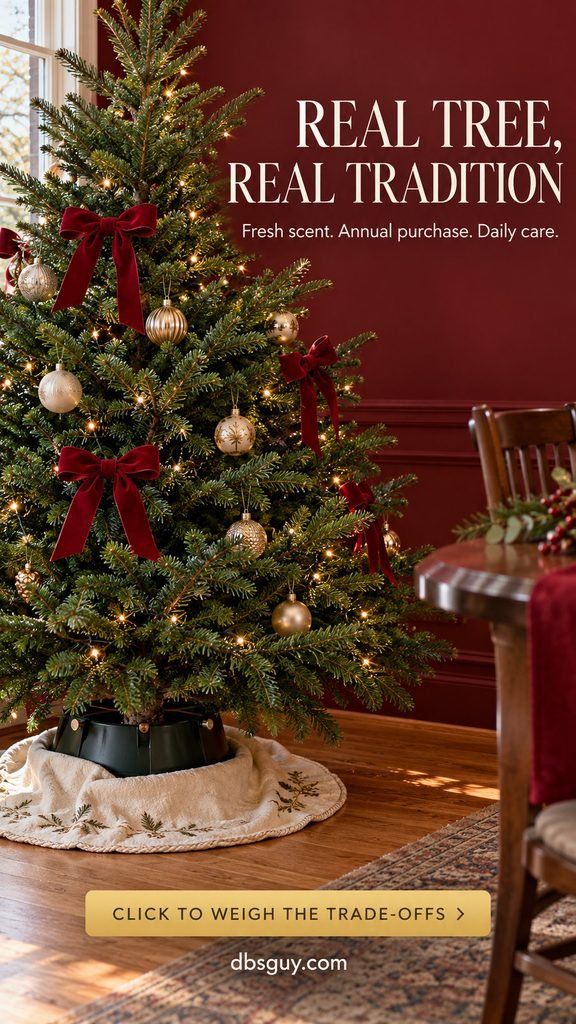
The appeal is more than appearance. A real evergreen brings its own scent, branch texture, and small irregularities. For some families, choosing it is a holiday outing they would miss more than they would appreciate the savings from an artificial tree.
- You are not committing to one tree for years. Choose a different size or shape if your home or decorating plans change.
- The initial tree purchase can be easier on the budget. This depends on your local quote; a large premium tree or delivered city purchase can cost much more than a small tree picked up nearby.
- There is no full-size tree to store. That is a meaningful advantage in an apartment with limited closets.
- An unflocked tree may have a useful local afterlife. Eligible collection programs can turn it into mulch or compost, provided you follow their rules.
What you take on in return
You buy another tree each season, arrange pickup or delivery, set it securely in a water-holding stand, and check the reservoir every day. Needles can fall, especially as the tree dries. Removal is another job: you must take off the decorations, protect your floors, and arrange disposal.
There is also a timing trade-off. An artificial tree can cover a long decorating season without drying out. With a fresh-cut tree, choose your purchase date around its freshness, your room conditions, and the holiday dates that matter most to you. A seller’s storage and care history is more useful than a blanket promise that every real tree will last a fixed number of weeks.
Before buying, look at the tree you will actually take home. Check the widest branches against your room measurements, leave room for the stand and topper, and consider whether its branches suit your ornaments. A beautiful shape on the lot can still be too wide for the living room.
The true cost comparison: year one through five seasons
Use actual quotes, not an outdated “average”
For context, the National Christmas Tree Association reported a $75 median price for real trees purchased in 2023. That is historical survey data, not a quote for a particular size or the 2026 season.
At the time of this comparison, October 11, 2026, the manufacturer’s page for the 7.5-foot King Flock unlit artificial tree displayed a $349 sale price and $579 regular price. Its listed package includes a stand and storage bag. This is one dated retail example, not an endorsement or an average for all flocked trees; prices and offers can change.
Ask your local real-tree seller for a quote in the height range you need. For the artificial option, compare the checkout total, included accessories, lighting type, and return-shipping cost. Comparing a delivered premium real tree with a small budget artificial tree will not tell you much about two trees that genuinely fit your home.
A transparent household budget example
The following model compares two unlit trees with the same $25 allowance for separate reusable lights. The amounts are illustrative assumptions:
- Flocked setup: $350 for the tree with its stand, $40 for a storage bag if one is not included, and $25 for lights. Initial total: $415.
- Real setup: $100 for each season’s tree, $15 each season for combined pickup travel or disposal, plus a one-time $35 stand and $25 lights. Initial total: $175; later seasons: $115 each.
The model assumes free storage at home, unchanged annual real-tree costs, and reuse of the stand, lights, bag, and artificial tree throughout the period shown. It excludes sales tax, electricity, water, paid delivery beyond the stated allowance, financing, repairs, and the value of your time. These are costs to add where they differ for your household.
| Seasons used | Flocked total | Real total |
|---|---|---|
| 1 | $415 | $175 |
| 3 | $415 | $405 |
| 4 | $415 | $520 |
| 5 | $415 | $635 |
| 10, if the same equipment remains usable | $415 | $1,210 |
In this example, the flocked setup becomes cheaper during the fourth season. At five seasons, it costs $220 less in total. The ten-season row is an arithmetic scenario, not a promise about the tree’s lifespan or future prices.
For your own comparison, use: artificial total = initial setup + storage fees + repairs or replacements. For a real tree, use: real total = reusable setup + the sum of each year’s tree, transport, and disposal costs. Count only new expenses if you already own the accessories.
Three changes that can reverse the result
- A bag is included. Remove the $40 bag allowance and the flocked setup becomes $375. Under the other assumptions above, it becomes cheaper in season three. Do not buy accessories twice.
- Storage costs money. If you genuinely incur an extra $60 each year to store the artificial tree, its five-season total becomes $715. That is $80 more than the real option’s $635. With those unchanged costs, the flocked option becomes cheaper in season seven. An existing storage unit does not create a new $60 expense unless the tree increases what you pay.
- You replace the artificial tree early. Buying another $350 tree after three seasons raises its five-season total to $765, assuming the original bag and lights are reused. That exceeds the real-tree model. The savings depend on keeping a tree you will still want to use.
Electricity belongs in the comparison when the lighting differs. Compare rated wattage and hours of use, rather than assuming “pre-lit” means cheaper to run. For example, a hypothetical 20-watt light set used six hours daily for 30 days consumes 3.6 kWh. Multiply that by your electricity rate; it is an illustration, not a specification for either pictured tree.
Daily care and January storage: where the work goes
For a real tree, make watering easy
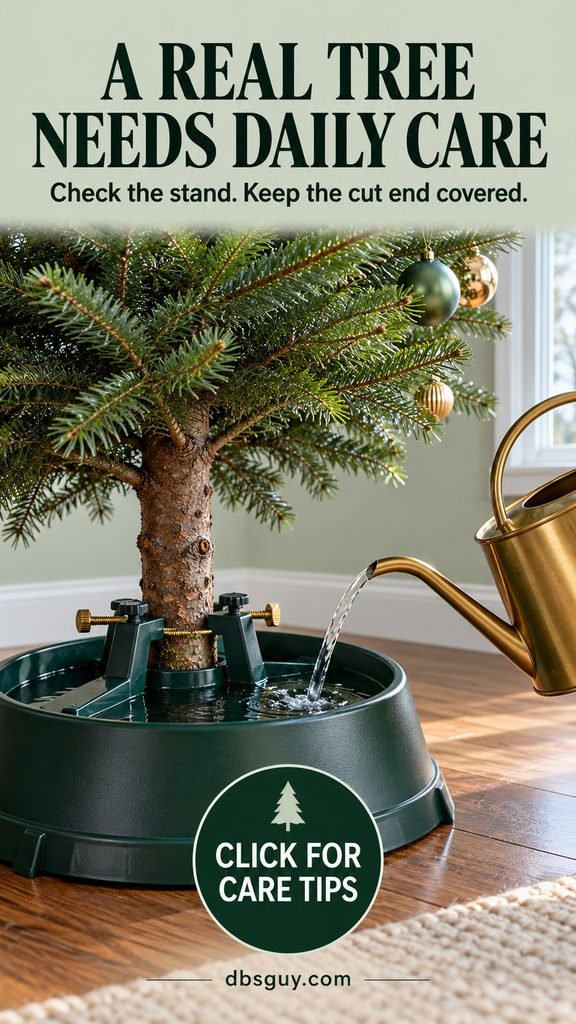
The Real Christmas Tree Board’s care guide emphasizes a fresh cut, prompt watering, plain tap water, and daily checks that keep the cut end submerged. Build access to the reservoir into your setup:
- Ask the seller for a fresh cut before you take the tree home, and put it in water promptly.
- Use a stable stand rated for the tree’s size, with a reservoir you can reach after decorating.
- Check the water level daily and refill as needed. Water elsewhere in the reservoir is not enough if the cut end is exposed.
- Use plain tap water. Skip sugar, aspirin, bleach, and other homemade additives.
- Keep the water accessible to the person doing the checks, while preventing pets from drinking it.
A tree collar or skirt should leave a practical way to inspect the stand. Assigning the check to one person is more dependable than assuming someone else has already watered it.
For a flocked tree, plan the packed size before buying

Measure your storage space as carefully as your display space. The shipping box dimensions can help you estimate what must fit, but a storage bag may be a different size. Check the weight and whether you can move the sections safely through stairs and doorways.
Balsam Hill’s guidance for flocked and frosted trees recommends limiting unnecessary contact, gently compressing branches, and using secure storage in cool, dry conditions. Follow your own tree’s instructions, particularly if it has built-in lights.
- Unplug the tree and remove decorations and any separately added lights.
- Take apart and fold the sections gently according to the manual. Avoid scrubbing the coating or forcing the tree into an undersized bag.
- Close the storage bag and keep it in a suitable dry location, protected from crushing and direct heat.
Use a removable sheet to catch shedding during packing. Avoid applying sprays or wet cleaning methods to the flocking unless the manufacturer specifically allows them.
Safety and pets: both options need sensible placement
Watering is a safety task as well as a freshness task. NIST’s Christmas tree fire research demonstrates the difference between a well-watered tree and a dry one under its test conditions. It does not make a watered tree fireproof.
The U.S. Fire Administration’s holiday guidance calls for keeping the tree at least three feet from heat sources, leaving exits clear, checking light strands, and removing a real tree after Christmas or when it is dry. Follow the light manufacturer’s connection limits. Turn off tree lights when you leave home or go to bed, and never put burning candles on the tree.
With either type, use a secure stand and protect cords and breakable decorations from curious pets. The ASPCA advises securing the tree and making tree water inaccessible to pets. Flocking materials vary, so check the specific product information and prevent chewing or swallowing the coating. “Safe for indoor use” should not be treated as permission for a pet to eat it.
If your pet persistently chews branches or climbs the tree, access control matters more than choosing a particular finish. A plain artificial tree without flocking is another option to consider, though it still needs the same attention to stability, cords, and ornaments.
Sustainability and disposal: check the end of the season
Financial break-even is not the same as environmental break-even. A cost calculation cannot establish which tree has the lower carbon footprint. Growing, manufacturing, transport, years of reuse, and disposal all affect that separate question.
For a real tree, check your city or county’s current collection rules before adding artificial snow. Remove all ornaments, lights, tinsel, and stands before using a tree-recycling program. As a concrete example, Seattle’s guidance for the 2025 holiday season required removal of flocking and wiring for its compost collection. Other programs have their own requirements and dates; do not assume a flocked real tree will be accepted.
For an artificial tree, choose a finish and size you will keep using, protect it during storage, and repair replaceable parts where practical. If you no longer want a usable tree, ask a local donation organization whether it accepts seasonal decorations. Check local disposal rules for damaged trees and their electrical components.
Which tree fits your household?
Choose a flocked artificial tree if the snowy finish is central to your decorating plans, you want a long display season, you have suitable storage, and you expect to keep the same tree for several years. The budget advantage is strongest when reuse does not require additional paid space or frequent replacement.
Choose a real tree if scent and the annual outing are part of Christmas for you, storage space is scarce, and you can manage watering and removal. Paying again each year can be a deliberate choice for an experience you value.
If you want reusability but do not want snow shedding, compare an unflocked artificial tree as a third option. You can change its ribbons and ornaments each year without committing to the white coating.
Before paying, write down three things: the full checkout or local seller’s quote, where the tree will go after Christmas, and how many seasons you realistically expect to use that setup. Those answers usually reveal more than the prettiest product photo.
Frequently asked questions
Is a flocked Christmas tree always fake?
No. Flocking describes the snow-like finish. Both artificial and real Christmas trees can be flocked. This guide compares a flocked artificial tree with an unflocked fresh-cut tree.
Is a flocked tree cheaper than a real tree?
It can be after enough seasons of reuse. In the example here, the $415 flocked setup becomes cheaper in season four. Your local real-tree price, included accessories, storage costs, and replacement timing can move that point substantially.
How long will an artificial flocked tree last?
There is no reliable lifespan for every product. Construction, storage, handling, the coating, and built-in lighting all matter. Treat a ten-year cost calculation as a scenario to assess, not a guarantee that a particular tree will remain usable that long.
Does a flocked tree shed more than a real tree?
There is no universal winner. A flocked artificial tree may drop coating during assembly and packing; a real tree may drop needles as it dries or is moved. Product quality, freshness, and care make more difference than a blanket “no mess” claim.
Can you recycle a flocked real Christmas tree?
Ask the local program before buying or flocking it. Coatings can prevent acceptance in programs that collect clean natural trees. Follow the program’s current instructions rather than placing it in a yard-waste bin by default.