For yellow January nails, start with buttercream micro tips if you want just a little color, an opaque pale yellow if you want a brighter everyday set, or a brown-based mustard if you prefer something deeper. The amount of yellow matters as much as the shade: a fine edge and a full mustard nail give very different results.
These 13 ideas move from soft butter yellow to earthy ochre, with clear differences in coverage, finish, and artwork. Pick the one you would enjoy seeing beside your usual winter sleeve, then borrow its details at a length that works for you.

The images are AI-generated manicure concepts for dbsguy.com. They illustrate color, shape, and design placement rather than completed salon work or wear tests. Actual polish, lighting, and your nail shape will affect the result.
Choose the yellow before the artwork
Here, buttercream means a pale, creamy yellow with plenty of white in it. Mustard means a deeper, muted yellow with an earthy brown cast. Ochre sits toward that earthy end of the palette. Shade names vary, so compare actual swatches rather than ordering by the name alone.
- For a small change: start with the micro tips or reverse half-moons. Most of the nail stays sheer.
- For straightforward color: compare solid butter yellow with glossy mustard against your own hand.
- For a designed set: choose one focal detail, such as a checker nail, a cocoa tip, or a narrow center window.
Hold your two favorite swatches beside a sweater you wear often, near a window and under ordinary indoor light. If pale yellow disappears more than you like, compare a slightly stronger yellow. If mustard looks too orange or olive to you, ask for another sample. Your preferred contrast is more useful than a rule about which skin tones can wear yellow.
1. Buttercream micro tips on short squoval nails
A very narrow yellow edge gives a familiar French manicure a softer color. Keep the base translucent rose-beige and the tip creamy enough to read as yellow beside it. The short squoval outline has a gently squared end with softened corners.
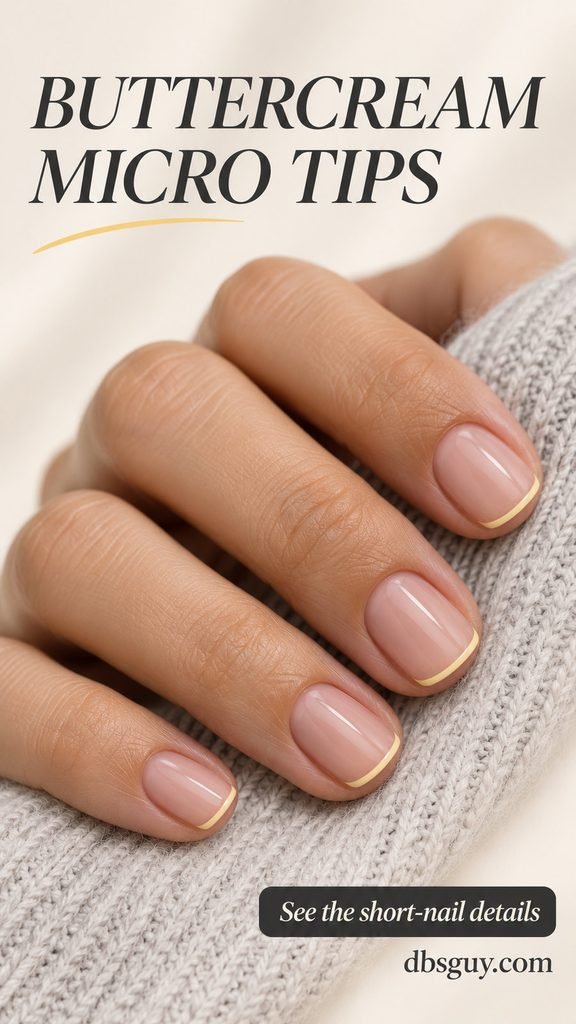
The useful detail is the balance between base and tip. Ask to see one finished nail first: if the yellow takes over the upper nail, narrow the band before repeating it. On a tiny nail, a fine curved edge gives you the color without using up most of the visible base.
Salon request: “Short squoval nails, a sheer rosy base, and the thinnest butter-yellow French edge that will still look clean.”
Also Read: Extra-Short January Nail Designs With Tiny Details That Fit.
2. Opaque butter yellow on short, softly rounded nails
Choose this when you want the yellow itself to be the whole manicure. Every nail is the same pale buttery shade, with full coverage and a plain glossy finish. There is no separate tip or accent to plan.

The reference keeps a softly squared edge with rounded corners. If you already wear round nails, keep that outline and borrow the color. Check that the sample is opaque enough for your taste; a sheer yellow wash will leave the natural tip visible and create a different look.
For regular polish at home, build coverage in thin layers according to the formula’s instructions. If the first coat looks uneven, avoid trying to fill every pale patch with one thick stroke. Check the next dry layer before deciding whether you need more coverage.
3. Butter-yellow reverse half-moons
This design puts a small rounded patch of yellow at the cuticle end of each nail. The rest stays sheer pink-beige, including the free edge. It is a useful option when you like a minimal manicure but want the color somewhere other than the tips.

Show your artist the placement rather than asking only for a reverse French. That phrase can also mean a thin outline around the base. Here, you want a filled half-moon: a small curved area of pale yellow sitting just inside the lower nail.
Keep the patch shallow on shorter nails so plenty of sheer base remains above it. Ask for a similar visual proportion across the hand rather than an identical patch size on every nail.
4. Pearlescent butter-yellow almond nails
A soft pearl sheen changes pale yellow without adding a separate pattern. Look for a creamy yellow base with an ivory glow across the surface; the yellow should remain visible when the nail catches the light.

The almond shape gives the highlight room to travel along the nail. You can use the same finish on a shorter oval if extra length would get in your way. Compare the sample in shade as well as direct light so you can judge both the underlying color and the sheen.
Describe the finish as “pale butter yellow with a delicate pearlescent glow.” Ask the salon to show you the effect on a swatch before choosing a product or service; a photo alone does not tell you how the sheen was made.
5. Buttercream nails with fine charcoal side curves
Two thin charcoal curves give a pale-yellow set a darker detail that connects with gray knitwear. In this version, the middle and ring nails each have one line running near a long side; the remaining nails stay plain buttercream.

Keep a little yellow visible between the curve and the nail’s edge. That gap makes the mark look like deliberate line art. A heavy line touching the edge can read more like a dark border.
For a simpler version, use the curve on the ring nail alone. At the appointment, point out that you want a side curve with an open center, since a line across the tip would turn this into another French design.
6. A slate-blue checker accent with butter-yellow nails
If your winter wardrobe includes denim or navy, try one muted blue-and-yellow checker nail. Keep the other nails solid butter yellow so the grid has a clear place to stand out.
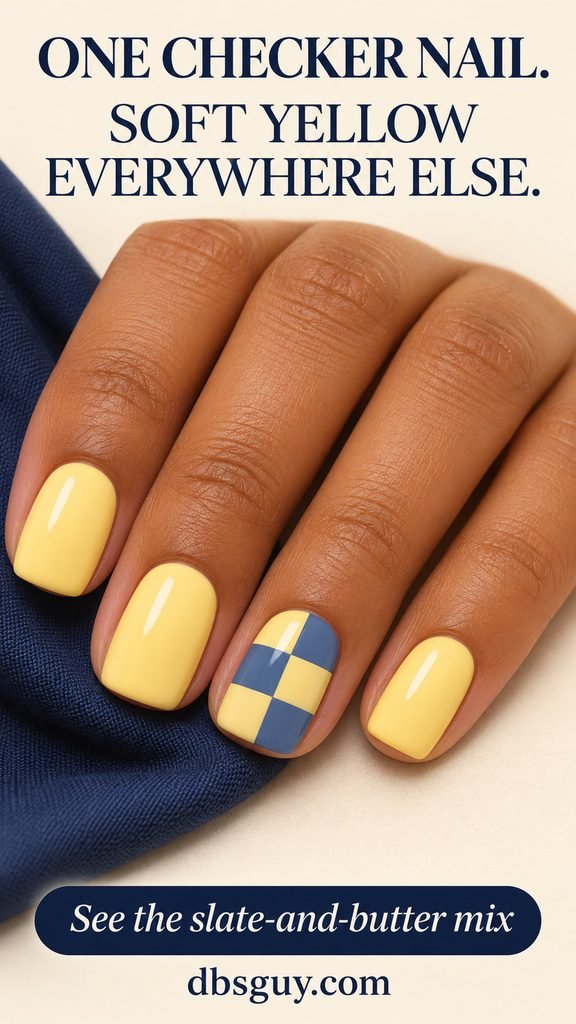
The ring nail shown uses two columns and three rows of alternating butter-yellow and slate-blue squares. Those six large checks are easier to read at this short length than a dense checker pattern. A soft-square tip also gives the grid a fairly straight edge to finish against.
Choose the blue beside the yellow swatch. A gray-blue gives the quieter contrast shown here; a vivid cobalt would make the accent much bolder. If your ring nail is especially small, ask whether a four-square version would be clearer.
7. Glossy deep mustard on short squoval nails
Deep mustard offers a richer yellow without adding artwork. Choose a cream finish, meaning smooth color without shimmer, and let a glossy top coat supply the reflection.

Look for an earthy yellow that you can still recognize indoors. Compare it beside charcoal or dark denim: if the sample looks almost brown, move toward a clearer yellow; if it looks greener than you wanted, try a less olive-leaning option.
What to ask for: “A muted golden mustard, fully opaque and glossy, on short squoval nails.” The short shape keeps this a color decision rather than a commitment to extra length.
8. Matte mustard ovals
Matte mustard puts more attention on the earthy color by taking away the bright gloss reflection. The softly rounded outline and oatmeal knit in the reference make this an easy direction to picture with a neutral winter outfit.

Check a finished matte sample before choosing the shade. A glossy color stick will not show you the final surface. If you like the mustard but miss the shine, keep the same color and choose the glossy option above.
For a home manicure, use a matte finish compatible with your color and follow its application directions. Avoid adding a glossy final layer over it, which would change the finish you chose.
9. Mustard with one espresso diagonal accent
A single espresso-brown corner gives mustard a darker companion while leaving yellow in charge of the set. Paint the ring nail mustard, then place a clean brown diagonal across roughly its outer third. Keep the other nails plain mustard.

Ask for one sharp boundary between the colors. A blended edge would become an ombré design and lose the graphic corner. At a very short length, make the brown area smaller so the yellow portion still has room to show.
This is a useful reference if you wear camel, cream, and brown together. Bring the mustard and espresso swatches side by side; the brown needs enough depth to stay distinct from the yellow in ordinary light.
Also Read: Brown January Nails: Espresso, Cocoa and Latte Looks for Sweater Weather.
10. Cocoa nails with mustard French tips
For a deeper French manicure, make the whole base cocoa brown and use mustard across the free edge. Both colors are opaque, so the result has more contrast and coverage than the sheer buttercream micro tips.

The reference uses medium almond nails with a narrow curved mustard band. If you want a shorter version, reduce the width of the tip along with the length. Keeping a large band on a much shorter nail can leave very little cocoa visible.
Send the image when booking and specify “opaque cocoa base with mustard tips.” That gives the salon enough information to confirm the two-color French service and any artwork charge before the appointment.
11. Mustard nails with a small ivory plaid accent
One plaid ring nail adds a patterned detail without covering the whole hand in tiny lines. Start with the same mustard base on every nail, then cross two fine ivory vertical lines with two ivory horizontal lines on the accent.

A very fine cocoa line beside one of the ivory verticals adds definition. Leave visible mustard between the lines so the pattern stays readable. On a smaller nail, reduce the number of lines rather than squeezing the entire grid into the space.
Ask for flat painted plaid with an ordinary smooth finish. The knitwear can supply the texture; this design does not need raised nail details to suggest a cozy January outfit.
12. Golden ochre with fine shimmer
Choose golden ochre shimmer when you want earthy yellow with a little light-catching detail. The color should still read as yellow in softer light, with fine warm particles appearing as you move your hand.

Compare the particle size on an actual swatch. Fine shimmer gives a more even glow than scattered large glitter pieces. Keep all the nails the same color if that quiet surface effect is what drew you to the reference.
Short oval nails are enough to show it. Ask for “muted ochre yellow with fine gold shimmer,” then check that the salon’s option does not look more bronze or orange than you want.
13. Mustard side panels with sheer center windows
For a graphic yellow manicure with some natural nail showing, place mustard along both long sides and leave a translucent pink-beige strip down the center. Each window runs from the cuticle end all the way to the free edge.

Use the center third of the nail as a starting point for the sheer strip, then adjust it to your nail width. Keep the yellow panels separate at both ends; joining them across the tip would turn the design into a frame.
This placement benefits from a steady hand and a clear reference. Ask your artist to map out one nail first so you can check the width of the window. If your nails are very narrow, use the panels on one accent nail per hand and keep the rest solid mustard.
Make your saved image useful at the appointment
Send one chosen design with your preferred length, finish, and any changes to the artwork. Mention what is currently on your nails, then ask which service can create the look and whether the quote includes removal and nail art. The images describe an appearance; they do not require a particular gel, overlay, or extension system.
For regular lacquer at home, follow the directions for the products you use. Essie’s application FAQ recommends thin layers and explains that thick or closely stacked coats can trap solvent and form bubbles. Allow the formula’s stated drying time before adding detailed artwork, and practice the checker or plaid on a sample tip first if you are unsure about the scale.
Questions about yellow January nails
How do I keep yellow nails from feeling too summery?
Start with a creamy pale yellow or an earthy mustard, then try it beside charcoal, navy, cocoa, or oatmeal clothing. The darker side curves, cocoa French, and mustard plaid offer different ways to make that connection. These are styling choices; you can keep a brighter yellow if that is what you enjoy.
Which design should I choose for very short nails?
Start with solid butter yellow, glossy mustard, or a fine micro tip. If there is little room for a curved tip, choose solid color. For patterned options, keep the artwork on one nail and simplify the grid before adding length just to copy the picture.
Can I get these looks with regular nail polish?
The solid colors and painted designs can be interpreted in regular lacquer when suitable colors and finishes are available. Detailed lines need controlled application and enough drying time. Ask your salon what it offers, especially for the pearl and shimmer effects, and choose the service separately from the picture.
What should I do if butter yellow looks too pale on my hand?
Compare a slightly more saturated yellow before abandoning the idea. You can also try the mustard family if you want a deeper contrast. Check the swatch against your hand and sleeve in more than one light; you do not need to match the model’s skin tone to use the design.