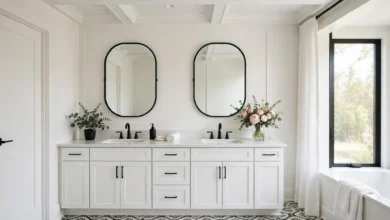
A Deco-style mirror works best when its shape solves something in the room: a stepped frame gives an entryway focus, a wide beveled mirror finishes a dining sideboard, and a tall clipped-corner design makes a dressing space useful. Start with the job you need the mirror to do, then choose the amount of shine you want.
These 10 picks are mirror styles to look for, with room-specific ways to use them—not a list of tested products or current retailer listings. The images are AI-generated styling concepts. Suggested dimensions are starting points to mock up in your own space, not installation rules.
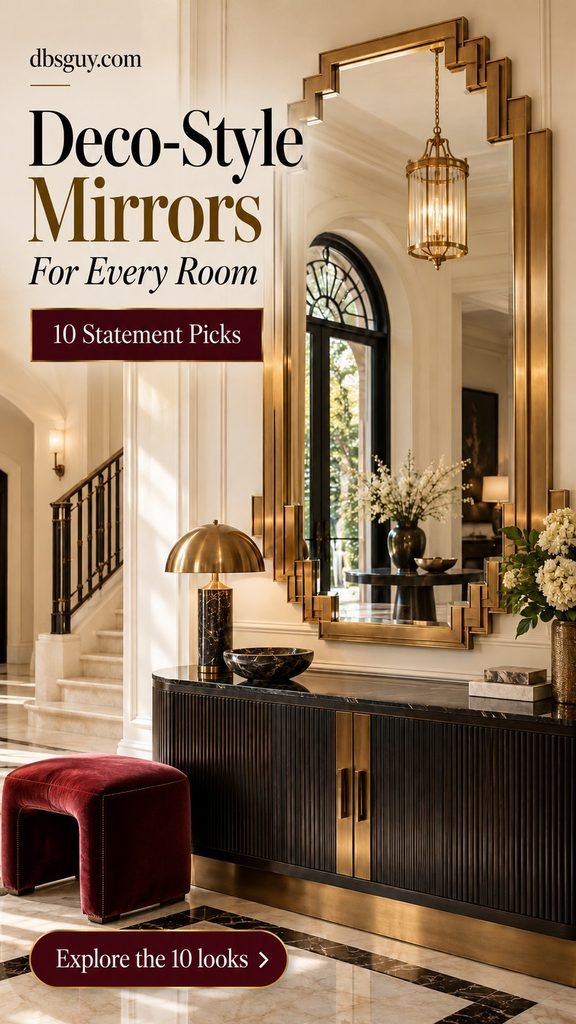
Choose the Shape Around the Room
For everyday use, favor a generous clear center: an octagon for the sink, a layered arch over a dresser, or a full-length mirror for dressing. For decoration, a fan, sunburst, or bronze-tinted design can take a more theatrical role. A broad frame may look substantial while leaving very little usable glass, so compare both measurements.
Art Deco is not limited to gold. The V&A’s overview of Art Deco in the home shows its range, from rich wood surfaces to chrome, mirror, and colored glass. Here, “Deco-style” describes contemporary styling cues rather than a claim that a mirror is an authenticated antique. For a broader room scheme, explore our Neo Deco decorating ideas.
1. A Stepped Brass Mirror for the Entryway
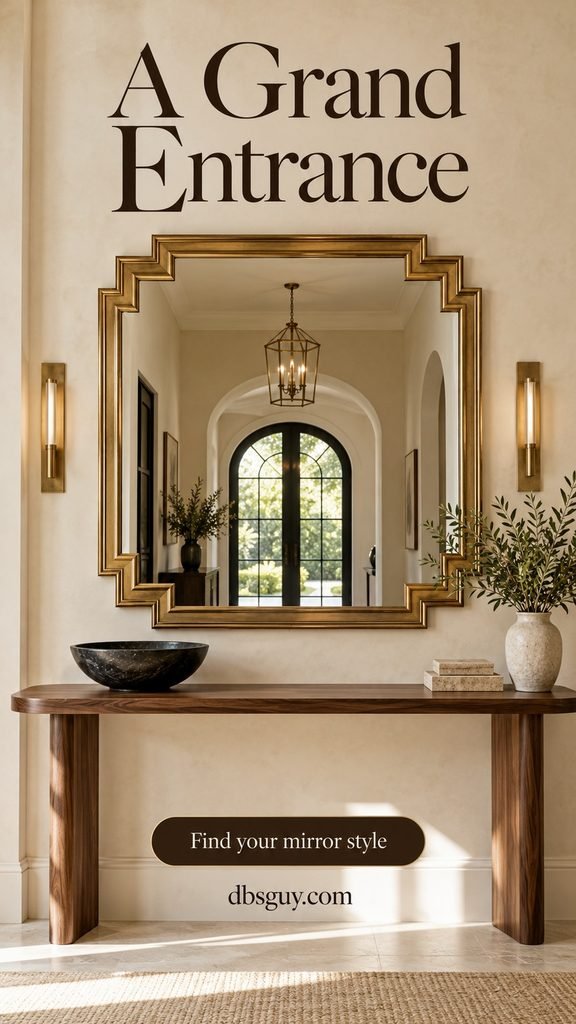
Choose this if your entry already has the basics—a console, a place for keys, and decent lighting—but still feels unfinished. A rectangular mirror with a tiered brass frame adds architectural detail without asking you to introduce another pattern. Pale plaster and dark wood give its outline enough contrast to read from the front door.
For a 48-inch console, try a paper template roughly 30 to 36 inches wide. Start with the bottom of the frame about 6 to 8 inches above the tabletop, then adjust for the mirror’s usable viewing height and your lamp. These are styling suggestions; a short mirror should not end up so high that it stops being useful.
Keep the surface simple: a low catchall on one side and a narrow vase on the other. Stand in the doorway before committing to the location. If the reflection is mostly coats, bags, or an open bathroom door, moving the mirror a few inches may improve the composition more than adding accessories. Our entryway table decor ideas can help you finish the console around it.
Useful search phrase: stepped brass rectangular wall mirror.
2. A Fan-Shaped Mirror for the Living Room
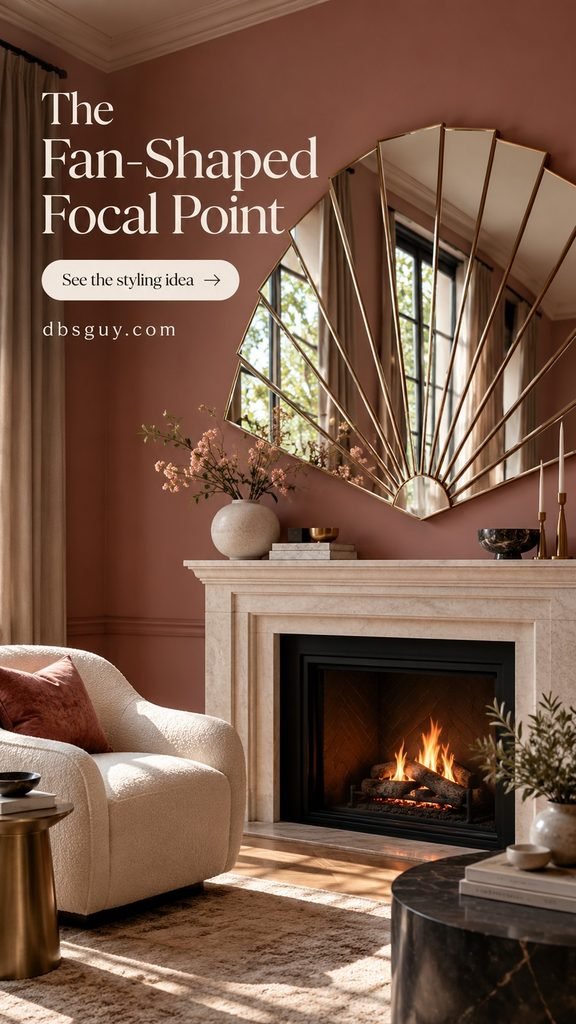
A fan mirror spreads outward rather than rising in a straight rectangle. That makes it a lively choice above a mantel or low living-room cabinet, especially when the sofa and surrounding furniture have uncomplicated lines. Look for a recognizable fan outline and a reasonably large central reflective area; narrow decorative segments offer sparkle but little useful reflection.
Let the fan be the strongest shape on the wall. An ivory chair, a solid-color cushion, and one low ceramic object are enough company. In a small room, choose a restrained frame and fewer segments so the mirror does not turn into a busy mosaic.
Mock up its full width, including the outer tips, and check the reflection from the sofa. A beautiful frame can still put a ceiling fixture in an awkward spot. Above a working fireplace, follow the fireplace and mirror manufacturers’ placement guidance; the mantel’s decorative arrangement should never determine heat clearance.
Useful search phrase: Art Deco fan shaped wall mirror.
3. A Chrome Octagon for the Bathroom
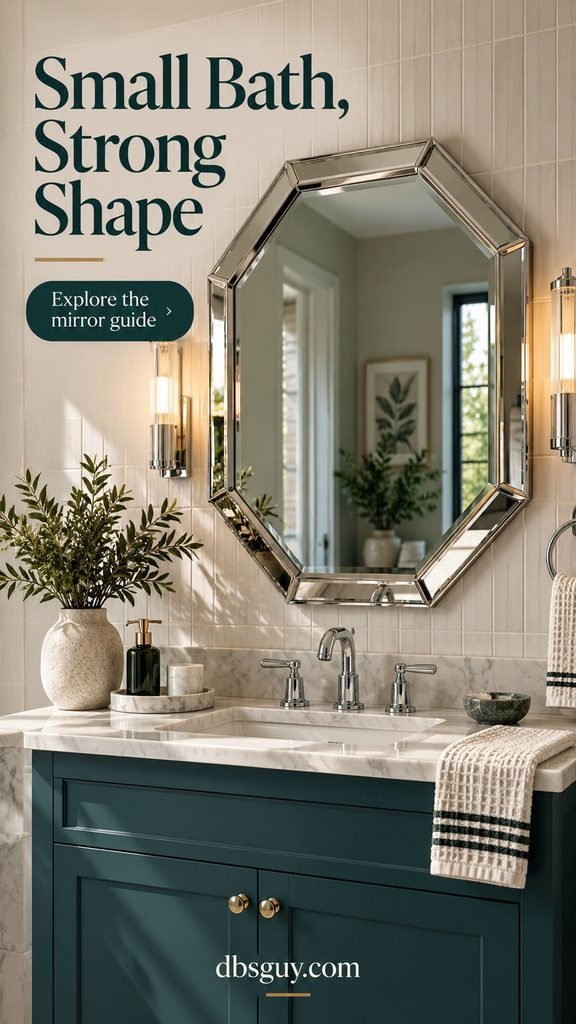
An octagon gives a small bathroom more personality than a plain rectangle without using an elaborate surround. Chrome pairs easily with cool white tile and blue-green cabinetry. A slim frame leaves more of the overall size available for the part you actually use: the clear glass.
Over a 30-inch vanity, a 22- to 26-inch-wide template is a useful place to start. Check the faucet, backsplash, sconces, and the heights of everyone who uses the sink before choosing the final size. Keep the main pane uninterrupted at face level; decorative borders should not cut across the area you need for grooming.
Buy a mirror whose manufacturer explicitly allows bathroom use in the conditions you have. A powder room and a steamy shower room are different environments, and a metallic finish alone tells you nothing about moisture suitability. If you already have patterned tile, skip etched glass and let the octagonal outline do the work.
Useful search phrase: bathroom suitable chrome octagonal mirror.
4. A Beveled Border Mirror for the Dining Room
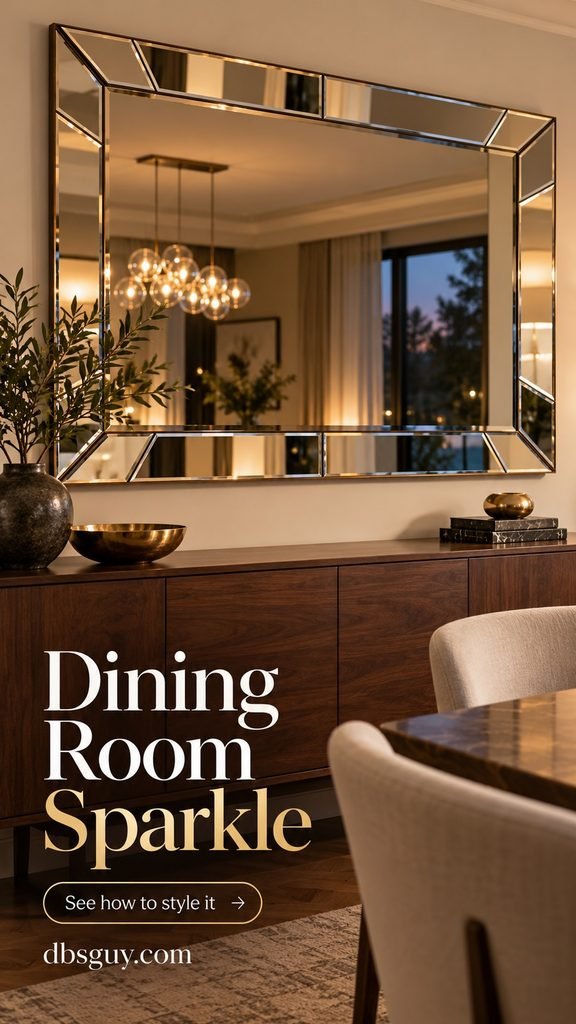
For a dining room that needs a little occasion, look for a broad mirror with a geometric beveled border. The angled edges catch light, while the main pane stays visually calm. It suits a plain wall above a sideboard better than a wall already crowded with artwork.
Try a 40- to 48-inch-wide outline over a 60-inch sideboard, leaving visible wall at both ends. A horizontal shape relates naturally to the cabinet; a taller version can work when you want to emphasize ceiling height. Measure the entire frame, not only the central glass.
Check the reflection while seated at the table, with the dining lights switched on. If it sends a bright bulb straight back at eye level, change the position or lighting arrangement. Style the sideboard with a low bowl and a short vase so the mirrored border remains visible. In a compact room, our small dining room ideas offer other ways to keep the layout comfortable.
Useful search phrase: wide geometric beveled border mirror.
5. A Layered Arch for the Bedroom Dresser
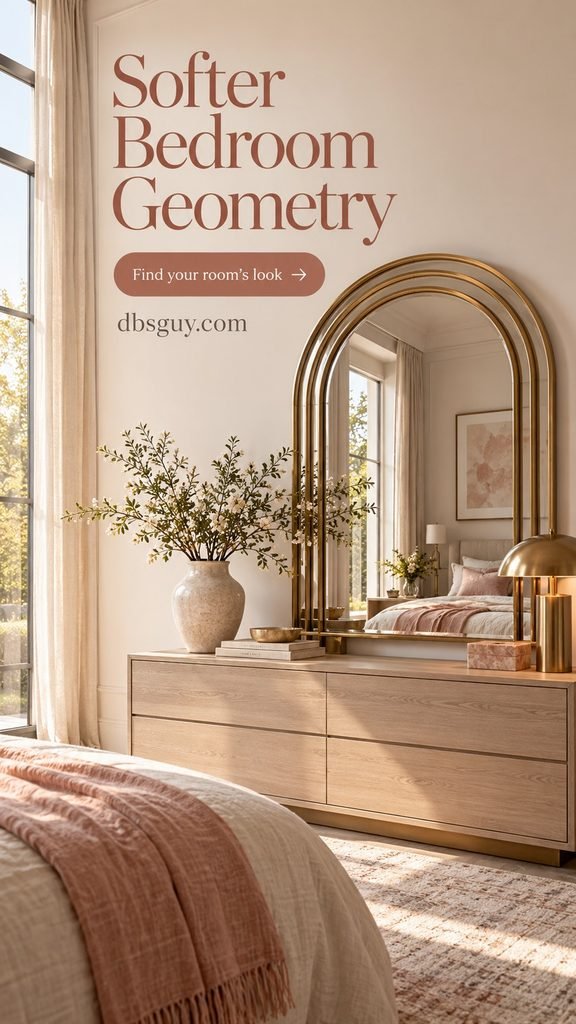
A single arch can feel fairly neutral; two or three nested arches make the silhouette more deliberately Deco-inspired. This is a good pick for a bedroom where you want gentle geometry rather than a dramatic metallic sunburst. Pale oak, linen curtains, and a muted blush accent keep it relaxed.
Choose a frame with enough separation between its arches for the layers to read clearly. Above a dresser, test the width against the furniture and place your everyday tray before deciding on the mounting height. The mirror should work with the objects you actually keep there, not only with an empty surface.
Use wall mounting if the mirror is intended for it, following the supplied instructions. Do not copy a styled leaning arrangement unless the product is designed and secured for that use. If the bedroom already has an arched headboard, a simpler frame may feel more settled than repeating the same shape at full volume.
Useful search phrase: layered arch brass wall mirror.
6. A Compact Sunburst for the Powder Room
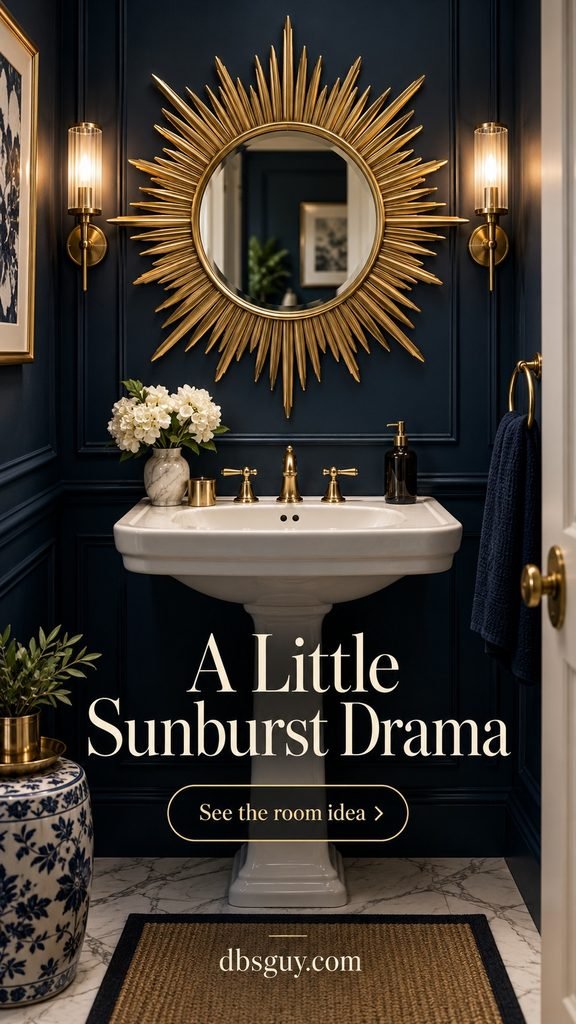
A sunburst is the most decorative pick here. Its radiating spokes create a focal point even when the room has little space for accessories. Against navy walls and a white pedestal basin, a warm brass finish supplies most of the room’s ornament.
Pay attention to two measurements: the outside diameter and the clear center. A 30-inch sunburst can have a surprisingly small viewing area. For a mirror above the sink, choose the central glass first and confirm that its position works for a quick face check. If you mostly want wall art, place the sunburst elsewhere and keep a more practical mirror at the basin.
Leave room around the outer rays so they do not collide visually or physically with sconces. Sunburst forms appear across several decorative styles; choose crisp, orderly rays for the geometric direction shown here. For a shower room, confirm moisture suitability instead of assuming a decorative powder-room mirror will cope.
Useful search phrase: geometric sunburst mirror large center.
7. Smoky Bronze Glass for a Bar Corner

Smoky bronze glass is a mood-setting choice for a bar cabinet or dining-room drinks station. The tint and dark geometric corner details make the mirror feel like part of the cabinetry rather than a bright opening in the wall. Aubergine paint, walnut, and a small warm lamp make a convincing combination.
Keep this one decorative. Tinted glass changes the appearance of reflected colors and is less useful than clear glass for makeup, grooming, or checking an outfit. Look for a frame or corner treatment with clean geometry so the Deco reference comes from more than the tint alone.
Place the mirror above the cabinet with only a few glasses or bottles in front. A crowded collection becomes twice as visually busy in reflection. Test the lamp position at night: a glowing shade can be attractive, while a bare bright bulb reflected at seated eye level is distracting. In a multipurpose room, a shallow tray helps contain the drinks setup.
Useful search phrase: bronze tinted geometric wall mirror.
8. A Jade Stepped Frame for the Home Office
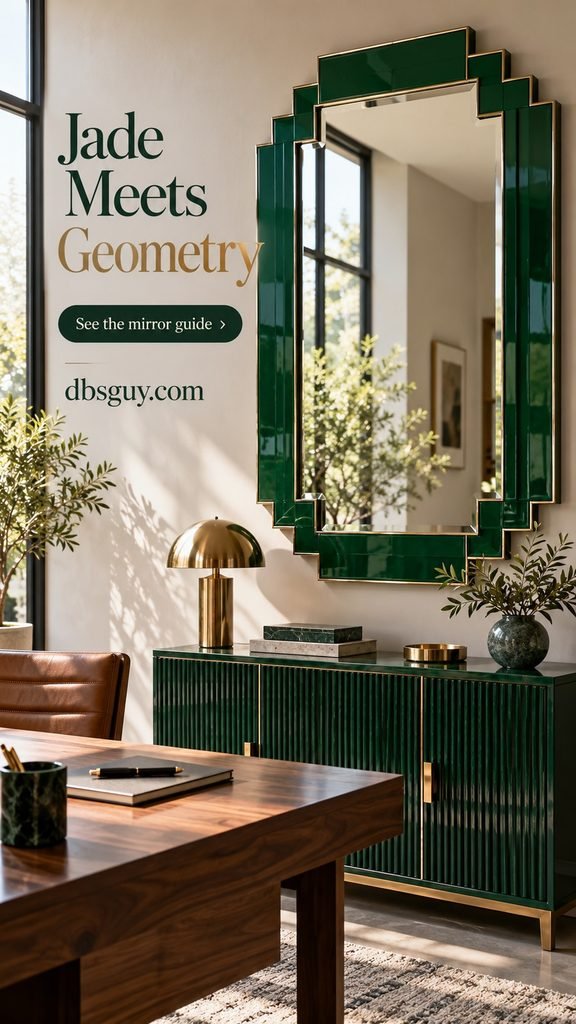
If brass feels too dressy for your workday, try a jade-green frame with stepped edges. The color supplies personality while the angular outline keeps the connection to Deco. Place it above a side cabinet or on a wall beside the desk, where it can finish an otherwise neglected corner.
Choose clear central glass and a frame wide enough for the color to register. Repeat the green once in a notebook, small artwork, or fabric accessory; you do not need a matching desk and chair. Walnut and warm white make a quiet background for this combination.
Test the position from your working chair during the brightest part of the day. Avoid reflections of the monitor, exposed bulbs, or a distracting view behind you. If you regularly take video calls, check the camera view as well. A smaller mirror on a side wall often earns its place more easily than a large one directly behind the screen.
Useful search phrase: green lacquer stepped frame mirror.
9. A Full-Length Clipped-Corner Mirror for Dressing

For a dressing room, closet wall, or bedroom corner, put function first: a tall clear mirror with clipped corners gives you an outfit view and a subtle geometric outline. A thin brass or dark metal frame makes a statement without eating into the reflective area.
A 20- to 28-inch-wide, 60- to 72-inch-tall mirror is a useful shopping range to test, not a guarantee of the right fit. Mark the proposed outline, stand where you will actually get dressed, and check the sightline for your height and distance. Make sure doors, drawers, and your walking route still work.
Use the mounting or anti-tip system specified for the product and wall construction. Do not rely on a heavy mirror simply resting against the wall, particularly in a busy household. Keep a stool or basket beside it rather than in front of its lower edge so the floor-level view remains usable.
Useful search phrase: full length clipped corner mirror.
10. A Geometric Walnut Frame for the Hallway
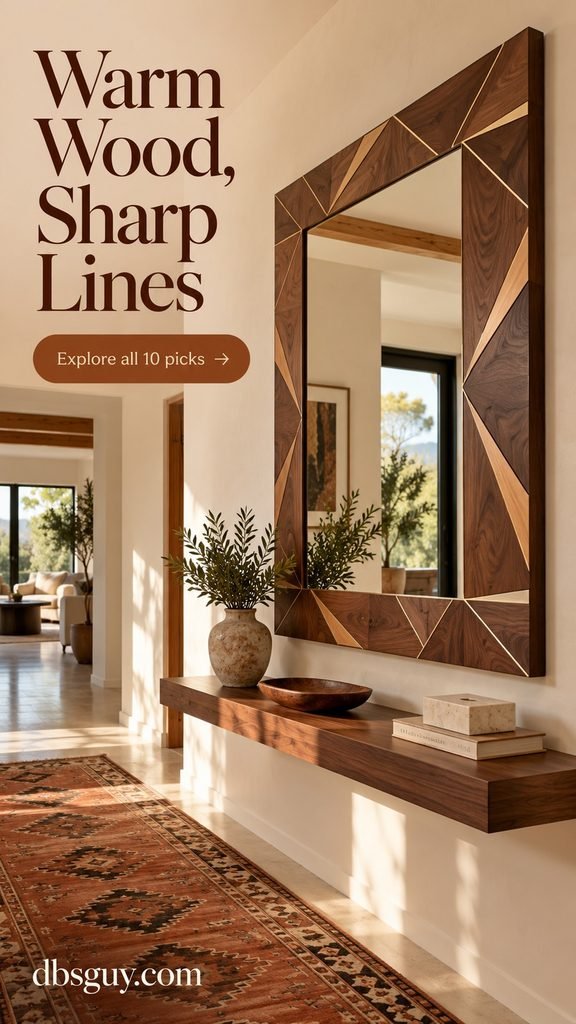
A walnut frame with angular inlay or a stepped profile is the pick for anyone who likes Deco geometry but wants less shine. It sits comfortably with wood floors, neutral paint, and everyday furniture. The grain gives the frame interest, so the rest of the hallway can stay simple.
In a narrow passage, prioritize a shallow profile and enough room to pass comfortably. A slim shelf underneath can hold a small dish, but skip it if it turns the route into an obstacle. Match the warmth of the existing wood rather than trying to find an identical grain pattern.
If buying secondhand, ask for close-up photos of the corners, veneer, back, and hanging points. Check for lifting veneer, loose joints, chipped glass, and dark areas in the silvering. Some age-related marks may suit your taste, but damage still affects usability. A Deco-looking shape is not proof of age; without reliable documentation, describe it as Deco-style.
Useful search phrase: walnut geometric inlay wall mirror.
Before You Order or Hang It
- Measure the whole piece. Include frame projections, rays, and decorative corners. Tape the outline on the wall and check nearby switches, doors, and lights.
- Inspect the view. Check reflections from standing and seated positions in daylight and after dark. Mirrors redirect available light; they cannot replace lighting in a dark room.
- Check the listing beyond the photo. Confirm weight, frame material, glass tint, permitted orientation, mounting method, and bathroom suitability where needed. Ask whether hanging hardware is included and appropriate for your wall.
- Plan installation before delivery. Follow the maker’s directions and use fixings suited to the mirror’s weight and wall construction. For a heavy piece or an uncertain wall, get a qualified installer’s help.
- Read the care instructions. Use the cleaning method specified for the glass and frame; avoid letting cleaner collect around edges or behind decorative panels.
A Few Questions Before You Choose
Does a Deco-style mirror work with modern furniture?
Yes. Start with a simple sofa, cabinet, or dresser and let the mirror provide the detail. Repeat one of its finishes somewhere nearby, then leave enough quiet wall space for the shape to stand out.
Should the mirror be wider than the furniture below it?
For the arrangements in this guide, a mirror narrower than the furniture is an easy starting point. There is no universal proportion that fits every room. Compare a full-size template with the furniture, wall width, and nearby objects before buying.
Which pick is the easiest to live with?
A slim octagon or a geometric wood frame is a good starting point if you want clear reflection and restrained decoration. Choose a fan or sunburst when the mirror’s main job is to be the room’s focal point.
Pick One Shape You Want to See Every Day
You do not need to decorate an entire room around a mirror. Choose the wall that needs it, check what it will reflect, and test the outline before ordering. One well-placed geometric frame can be enough to give familiar furniture a fresh sense of purpose.