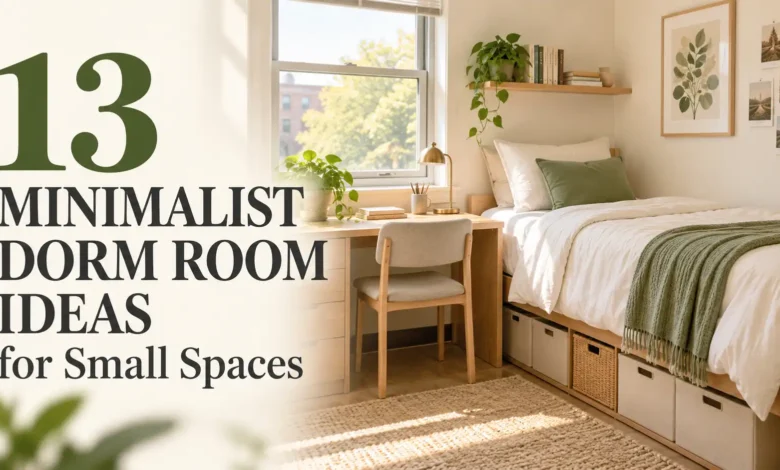
A minimalist dorm room works best when you can get dressed, study, and go to bed without moving a pile of stuff first. Keep the furniture your school provides, give your everyday belongings a reachable home, and leave enough open space to use the room comfortably.
These 13 minimalist dorm room ideas for small spaces tackle different trouble spots, from the crowded desktop to the chair that keeps disappearing under laundry. Choose the ones that solve a problem you actually have. A bedside pocket and a rolling cart, for example, are alternatives; your room may not need both.
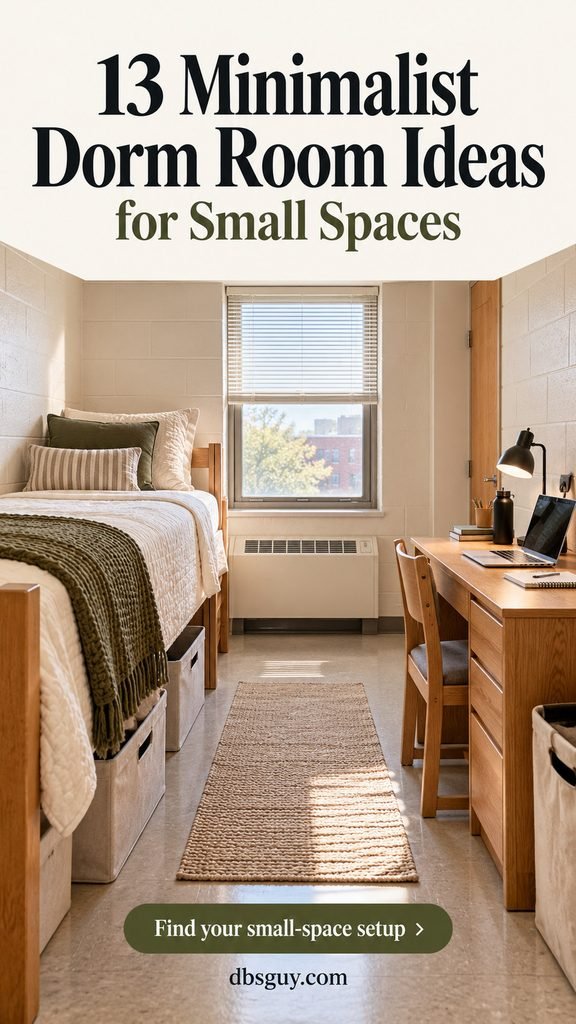
The visuals are AI-generated design concepts. Use them to compare arrangements and details, then adapt each idea to your room measurements and campus policies.
Start With the Room You Have
Before buying organizers, check the housing furniture list and measure the mattress, lowest under-bed clearance, closet opening, and usable desk surface. Open every drawer and door, pull out the desk chair, and check the route from your bed to the exit. An organizer that fits an empty corner can still interfere with using the room.
Read your own residence hall rules before adding furniture, adhesives, lamps, or bed accessories. Restrictions differ: the University of Virginia’s residence hall fire-safety guidance, for example, prohibits added curtains and over-the-door racks on room doors. It also requires clear exits and keeps electrical cords out of walking routes and from underneath rugs. Your campus’s requirements determine what belongs in your room.
Choose your starting point: for visible clutter, try ideas 3, 5, and 7. For a crowded floor, look at 4, 6, and 10. For a room that feels unfinished, start with 1, 2, or 11.
1. Repeat Three Finishes Instead of Buying a Matching Room
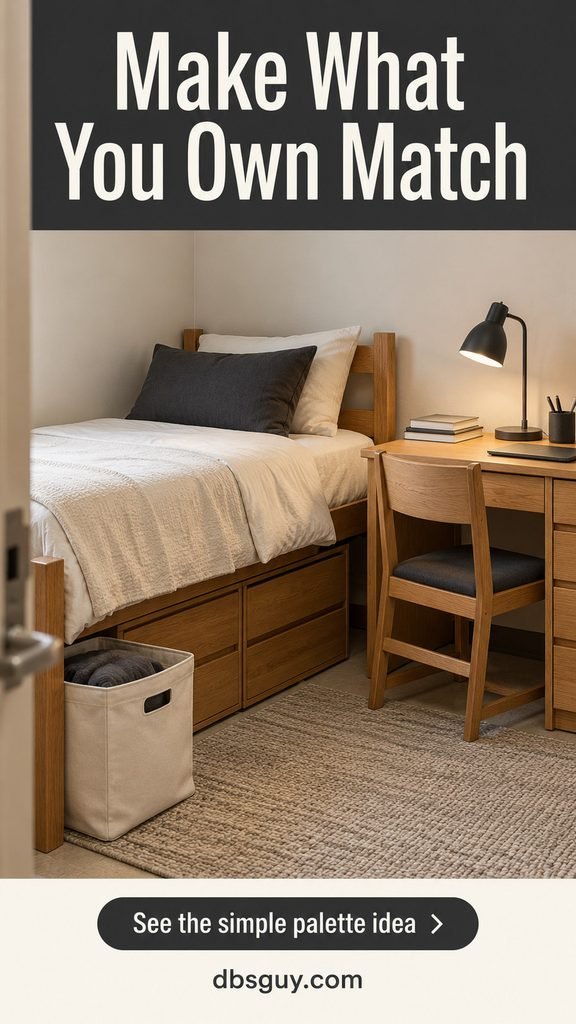
Use the existing furniture finish as your first choice, then repeat two more finishes through things you need. In this concept, oak furniture, ivory fabric, and charcoal accessories connect the bed and desk. The wood stays visible, so there is no need to cover the desk or replace a perfectly useful chair.
Try an ivory bedcover with a charcoal pillowcase and lamp. If you already own colorful bedding, let that color take the place of charcoal. Three finishes are a useful editing tool, not a strict limit on everything you own.
Before purchasing another decorative item, look across the room from the doorway. Repeating a color in a storage bin or notebook may do more for the overall look than introducing another accent.
Also read: 13 Blue Dorm Room Ideas for a Calm, Coastal Vibe.
2. Simplify the Bedding You Have to Move Every Night
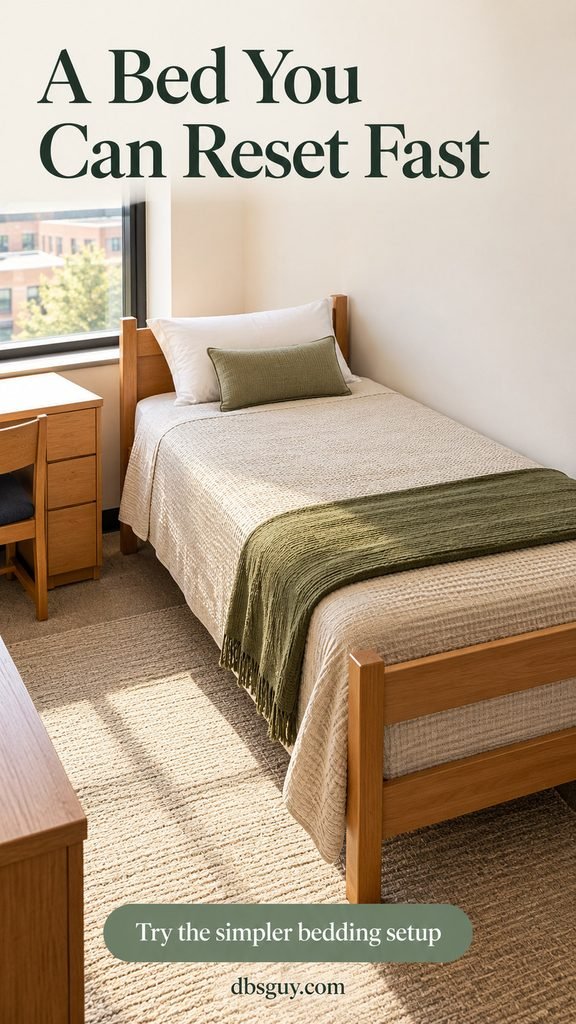
A narrow bed can look comfortable without a stack of decorative pillows. The setup shown uses one sleeping pillow, one small lumbar cushion, a textured oatmeal coverlet, and a single olive throw. Texture gives the bed detail while the bedding remains easy to straighten.
Keep the sleeping pillows and warmth you need; edit the decorative extras first. If an accent cushion ends up on the floor every night, skip it or give it a place in your closet.
Check your assigned mattress measurements before buying fitted sheets. Choose bedding with care instructions you can manage in campus laundry facilities. A washable cover you like is more useful than several delicate layers that spend the semester waiting to be cleaned.
Also read: 15 Pink Dorm Room Ideas That Are Anything But Basic.
3. Turn Under-Bed Space Into Reachable Storage

Low storage boxes work well for belongings that do not need a place on the desk or dresser. Use one for spare linens and another for clothing you wear less often. Put the category you reach for most frequently nearest the open side of the bed.
Measure beneath the lowest rail or crossbar, not just from the floor to the mattress. Compare that clearance with the container’s full outside height, including its lid. Also check whether you can pull the box far enough out to reach the back without moving your roommate’s furniture.
The concept uses two fabric boxes under an ordinary-height frame. Start with the clearance you already have. If raising or lofting the bed is necessary, check housing rules and use only the school-approved method.
4. Replace an Extra Nightstand With a Bedside Pocket

If you only need somewhere for glasses, a paperback, and your phone, a soft bedside pocket may solve the problem without using floor space. The gray organizer shown has separate pockets so smaller items do not disappear behind the book.
Choose an attachment designed for your bed and mattress arrangement, follow its installation instructions, and check that it stays secure when you sit down or change the sheets. Keep the contents light and within the product’s stated capacity.
This setup suits dry, small essentials. Keep drinks on a stable surface, and charge your phone on an uncovered hard surface according to its instructions. If you need room for a lamp and a water bottle, using an existing dresser beside the bed may fit your routine better.
5. Give Your Desk a Clear Work Zone and a Supply Drawer
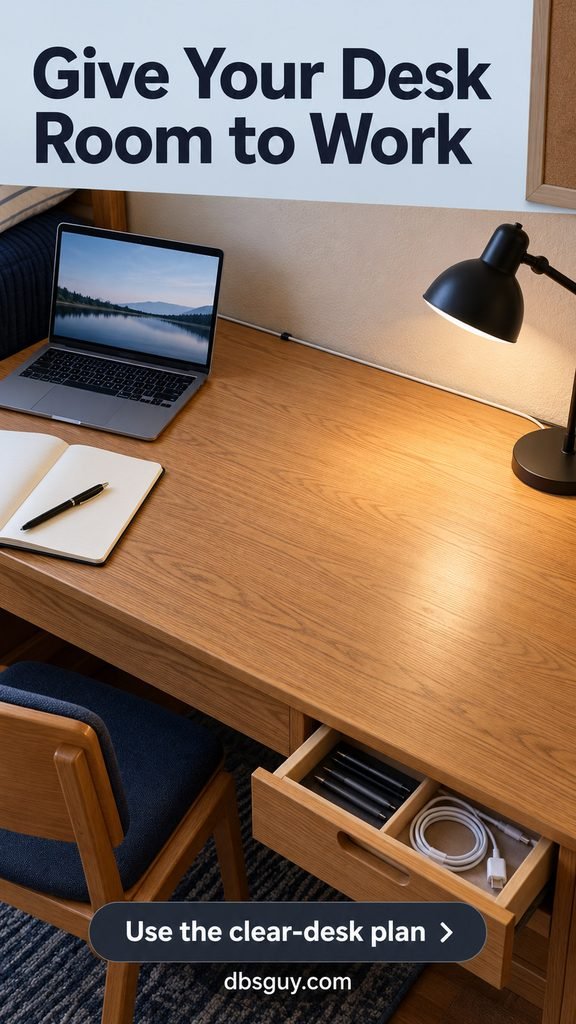
Set up the desk for the task you do most: an open notebook beside a laptop, a textbook and worksheet, or a drawing pad. Place those items first. Then find room for the lamp and anything else you use during that task.
Put backup pens, adapters, and loose supplies in shallow drawer dividers. You do not need a full organizer set; small containers you already own can separate categories. Leave the supplies you use every day near the front.
Route a charging cable along the back edge using an attachment your school permits. Leave enough slack to move the laptop, and keep cords out of the walking path. At the end of a study session, file loose papers and return supplies to the drawer so the desk is usable when you come back.
Also read: 15 Bedroom Design With Study Table Ideas.
6. Use Closet Height Without Filling the Whole Rod

A short fabric hanging organizer can give folded clothes a home when the closet has a rod but few shelves. The concept places three fabric compartments on one side, shirts on slim hangers on the other, and shoes in a single row below.
Measure the organizer’s width and hanging length before ordering. Subtract its width from your hanging space, and check that the bottom will clear your shoes. A full-length organizer is a poor trade if it leaves nowhere for coats or longer clothes.
Use it for light folded items within its capacity and the closet rod’s limits. Leave bulky or heavy belongings on appropriate existing shelves. If your dresser already holds all your folded clothes, you can skip this addition and keep the rod available.
7. Give Each Closed Bin One Specific Job

Opaque bins can quiet a busy open shelf while keeping useful belongings close. In this setup, three ivory fabric bins sit below the books. They could hold stationery refills, clean spare linens, and dry personal-care backups—one category per bin.
Choose containers for the shelf and its contents, rather than buying a set and searching for things to fill it. Check the usable opening between shelf supports and leave room to grip the handles. Keep books upright where you can see their spines.
Closed storage needs an understandable system. If you keep opening every bin to find one item, add small labels or simplify the categories. Do not use opaque boxes to postpone deciding what belongs in the room.
8. Park a Narrow Rolling Cart Beside the Desk

A rolling cart makes sense when you have more active study materials than desk storage. The sage cart shown has a notebook and pencil cup on top, course books in the middle, and a supplies pouch below. Keeping one purpose makes the open shelves easier to maintain.
Measure its complete footprint, including handles and wheels. The parking spot needs to stay outside the walking route, and you need room to roll the cart out without hitting the desk chair. Follow the cart’s load limits, keep heavier items low, and use wheel locks if provided.
Try the existing drawers first. A cart is worth adding when it replaces a floor pile or another piece of furniture; an empty cart bought for its color still takes up space.
9. Choose a Storage Ottoman Only When You Need the Seat

A compact storage ottoman can hold a spare blanket and provide a place for a visiting friend to sit. The cream version shown keeps the soft furnishings simple while making use of the space inside.
Buy a piece specifically designed and rated for seating. A lidded storage box is not automatically a safe seat. Check the outer dimensions, stated weight capacity, and room needed to open or remove the lid.
Keep the contents easy to lift out; loose papers and tangled chargers are awkward beneath a seat. If the ottoman would obstruct the exit route or leave you shuffling it around every day, skip it. Your bed and supplied desk chair may already provide all the seating the room can accommodate.
10. Use a Compatible Clamp Lamp to Save Desk Surface

A clamp-style task lamp leaves room where a lamp base would otherwise sit. This concept shows a slim black lamp attached to a free desk edge, with the light directed toward the notebook.
Check your housing rules, the lamp’s clamp range, desktop thickness, and clearance underneath the edge. A drawer apron, curved edge, or fragile surface may make the attachment unsuitable. Use the manufacturer’s protective pads and installation instructions; do not force a clamp onto incompatible furniture.
Adjust the light while seated, checking both the page and the laptop screen for shadows or glare. Keep its cable along the desk edge and out of foot traffic. If clamping is prohibited or the furniture does not fit, a compact lamp with a stable base is the practical alternative.
11. Give Personal Photos One Small Display Area

A minimalist room can still hold reminders of people and places you care about. A small freestanding corkboard groups them together without filling the entire wall. The concept uses three images on a tabletop easel, with a shallow dish for keys beside it.
Use a board designed to stand securely on the dresser, with its supports fully on the surface. Leave enough space that opening drawers does not catch the base. Keep the display below anything it could obstruct, and check your school’s rules for personal decor.
Choose a few images you want to see every day and rotate them when you feel like a change. This is especially useful when wall attachments are restricted or you want to avoid buying several frames.
12. Make a Laundry Station That Keeps the Chair Available

Put a narrow hamper close to where you change clothes, with its opening easy to reach. The gray mesh hamper shown sits beside existing shelving, so laundry has somewhere to go before it reaches the desk chair.
Choose a size you can carry when full, and check that it fits without blocking a door, drawer, or vent. Keep damp towels separate until they are dry rather than enclosing them with dry clothing.
A perforated shower caddy can live on a nearby shelf after it has drained and dried. Keep toiletries contained and separate from clean linens. This corner works because it supports a routine: carry the caddy to the shower, return it to its spot, and take the hamper out on laundry day.
13. Coordinate Shared Space Without Requiring Matching Beds

Roommates do not need identical bedding to make a small room look coherent. Here, olive and navy beds share ivory sheets and the original wood furniture. Each side has its own color, while the middle stays clear.
Before adding anything for both of you, agree on where shared supplies belong, who is bringing larger items, and which floor areas need to remain open. Check room dimensions and housing rules together before rearranging furniture.
Keep individual belongings on your own side unless you have agreed otherwise. A shared room is easier to maintain when both people can reach their storage and use their desks without negotiating around someone else’s organizer. If your roommate loves more decoration, focus on your own bed, desk, and storage instead of trying to redesign their half.
Also read: 31 Freshman Tips That Make Your First Year Easier.
A Small First Step That Makes the Room Easier to Use
Pick the place that interrupts your day most often. Clear enough desk space for your next assignment, sort the belongings beneath your bed, or move laundry into a reachable hamper. Use the room for a few days before deciding whether another purchase would help.
If you are setting up before move-in, prioritize correctly sized bedding and the essentials on your housing list. Wait to buy larger organizers until you can check the actual clearances. A smaller shopping list leaves room to adapt once you know how you and your roommate use the space.
Questions About Minimalist Dorm Rooms
How do you make a minimalist dorm room feel cozy?
Keep the comfort you use: soft bedding, a reading light, and a few personal images. A textured coverlet and one favorite throw can make a plain bed inviting without requiring several decorative cushions. You can also use color; minimalism does not require an all-white room.
What should I buy first on a small budget?
Start with the essentials your housing list requires, then solve the biggest storage problem using what you own. Reuse small boxes as drawer dividers and try your existing bedding before replacing it for a color scheme. Buy an organizer only after measuring where it will go and deciding what it will hold.
Can I organize a dorm without drilling or wall adhesives?
Yes. Use existing drawers, measured under-bed containers, a compatible hanging closet organizer, and a freestanding tabletop display. Check your hall’s rules for each addition. “Removable” on a package does not establish that your school allows it.
How can I keep a small dorm organized during the semester?
Make the return trip easy for things you use daily. Keep the hamper reachable, frequently used supplies at the front of drawers, and active books close to the desk. When the same pile returns, change its storage location or reduce what you keep there before buying another container.
Also read: How to Actually Sleep in a Noisy Dorm (Even When Your Roommate Doesn’t).