Some treatments arrive quietly and then seem to be everywhere at once — at least in the questions readers ask. That is how Ashley Rebecca describes XERF: a name turning up again and again in article comments, on social media, and in treatment rooms, even though beauty coverage of it is still thin and most people have not yet heard of it. The volume of questions is what prompted her to look into it properly, and this guide follows the questions she set out to answer — what XERF is, how it works, what it actually does, whether it is worth considering, and whether it could be right for you — so that by the end, you can judge that for yourself.
The short version first: XERF is a nonsurgical treatment with no downtime that uses FDA-cleared radiofrequency technology on the face, neck, and body, with the aim of tightening and firming the skin.
The experts consulted for the source article are Dr. Sapna Palep, MD, a board-certified dermatologist and founder of Spring Street Dermatology in New York City, and Anna Karp, DO, a board-certified dermatologist at Dermatology Partners. A third dermatologist, New York-based board-certified dermatologist Dr. David Kim, MD, is also quoted in the article.
What Is XERF?
XERF is a non-invasive skin-tightening treatment. A handpiece delivers monopolar radiofrequency energy that heats the deeper layers of the skin, prompting the body to produce more collagen and elastin. It is used on the face and the body, and its purpose is firmer, tighter-looking skin rather than added volume or a changed facial expression.
Dr. David Kim explains the idea in straightforward terms: radiofrequency heats the dermis, the skin’s deeper layer, and that heat triggers the body’s own collagen-building response. Over time, he says, that can leave skin looking firmer, tighter, and more lifted — which makes it an option worth considering for someone who wants visible tightening without surgery and without downtime.
Dr. Sapna Palep adds that XERF works on that deeper dermal layer rather than only on the surface, and that this depth is what allows it to address laxity, firmness, and texture together.
Timing matters for expectations. XERF received FDA clearance in August 2025, which makes it one of the newer radiofrequency devices available, and it is currently offered only at selected clinics and medical spas rather than everywhere. That limited availability is also why the source article stresses checking that a provider is properly trained and qualified before booking.
It helps to place XERF correctly among the alternatives. It is not a replacement for a surgical facelift: what it offers is a subtler, gradual improvement with no incisions, no anaesthesia, and no recovery period. It is also different from injectables — it does not add volume the way fillers do, and it does not relax muscle the way Botox does. Its work is on skin quality and tightness.
How It Works
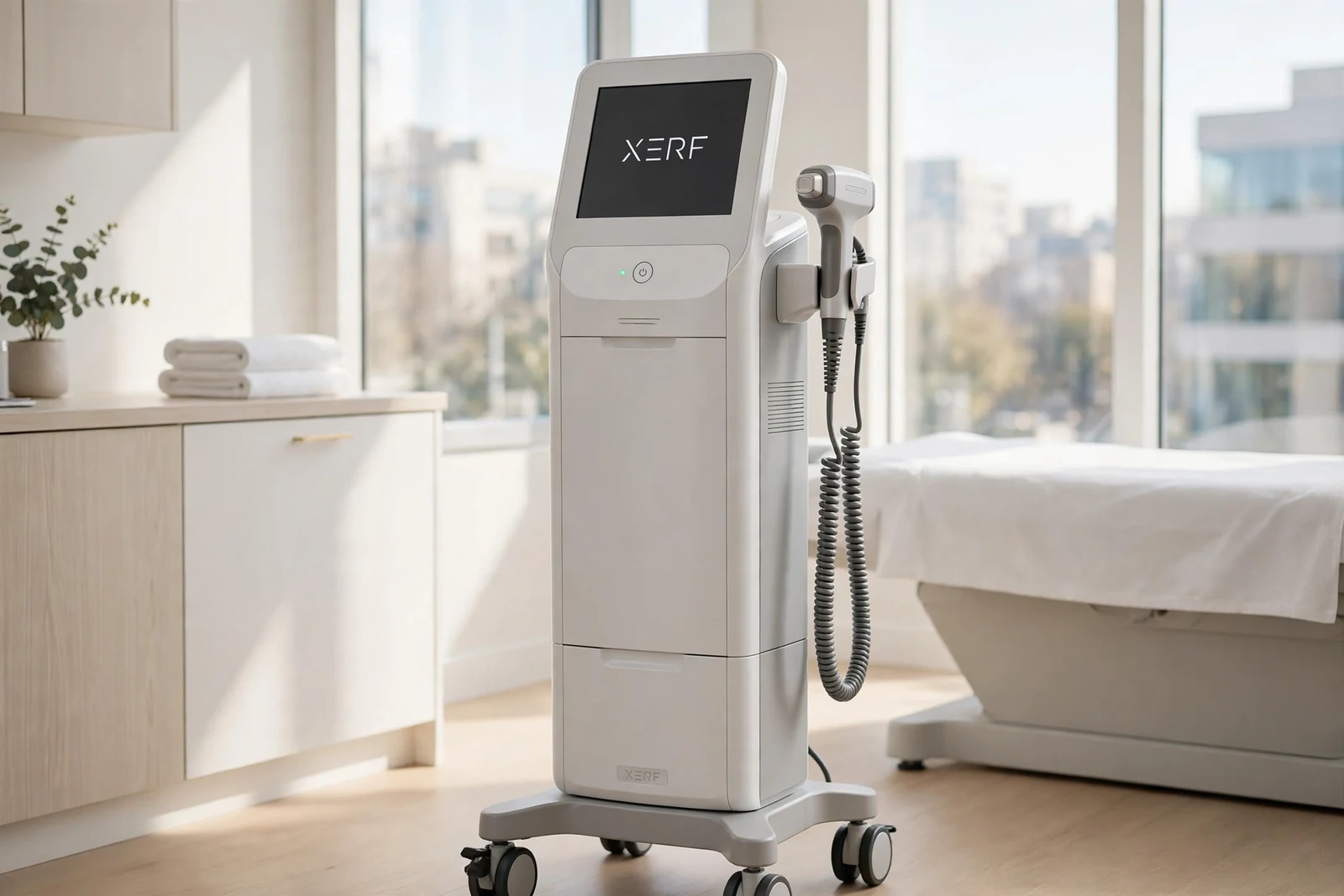
The handpiece delivers monopolar radiofrequency energy at 6.78 MHz. That energy reaches the dermis and the tissue beneath it, heating it to a controlled temperature. The heat causes collagen to contract straight away, and then, over the following weeks and months, encourages new collagen and elastin to form.
Depth is adjustable. The device can target different depths, and the provider can change the energy and depth for each area and each concern, so the face, neck, jawline, under-chin area, and body can each be treated with different settings. A cooling and temperature-monitoring element is described as protecting the skin’s surface while the deeper tissue is heated.
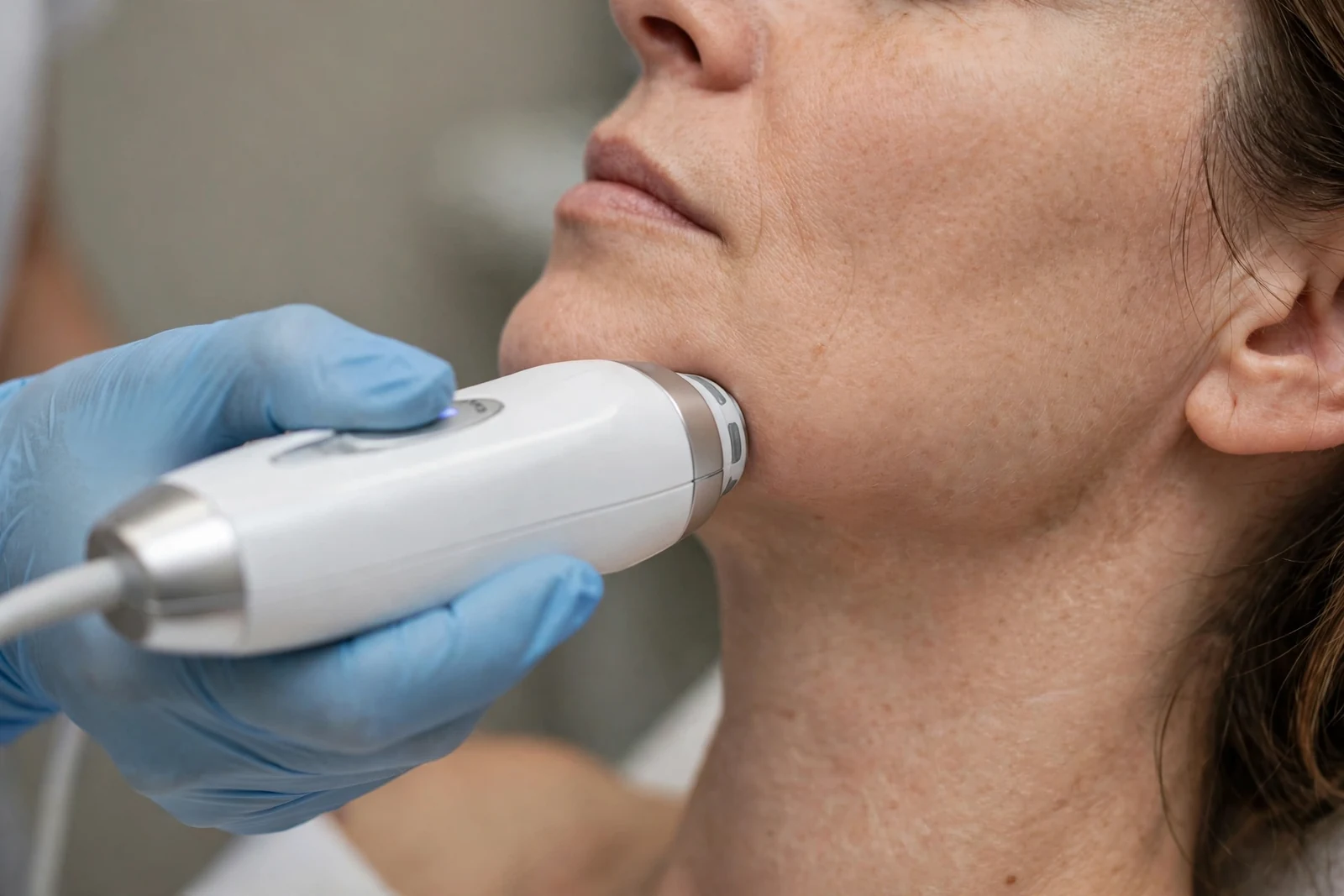
The procedure itself is simple in outline. The skin is cleansed, a conductive gel is applied, and the handpiece is moved slowly over the area in passes while the provider checks comfort and heat throughout. There are no needles, no incisions, and no anaesthesia.
Most people feel warmth and a mild heating sensation, sometimes with a brief feeling of heat. It is described as tolerable, and it can be adjusted — if it becomes uncomfortable, the provider can lower the energy.
A session lasts roughly 20 to 45 minutes depending on the area, with the face usually at the shorter end and larger body areas taking longer.
Compared with some older radiofrequency devices, XERF’s monopolar, single-pass approach is presented as reaching deeper tissue more efficiently, whereas older devices may use bipolar energy or several passes at lower energy. The article notes that this may explain why some providers prefer it for laxity, while also noting that results vary from person to person and that evidence is still emerging because the device is new.
The Benefits
The benefits are gradual, not instant. They build as collagen remodels, so this is not a surgery-like change overnight. In the source article’s list, the benefits are: tighter, firmer-looking skin; better jawline definition and a reduced appearance of jowls; softening of fine lines and crepey texture; improved skin texture and tone; a more lifted, contoured appearance in the treated areas; tightening on body areas such as the abdomen, arms, and thighs; and no downtime, so normal activities can resume immediately.
The people most likely to benefit are those with mild to moderate laxity — early jowling, loss of firmness along the jaw and neck, or crepey skin — who want improvement without surgery.
On the body, XERF is also used for laxity after weight changes or pregnancy, and for areas where skin has lost elasticity, through the same gradual collagen mechanism.
There are limits, and the article states them plainly. XERF will not remove a significant amount of excess skin, it will not replace a facelift where laxity is advanced, and its results are subtle and cumulative. Expectations need to stay realistic.
What to Expect
It starts with a consultation. The provider assesses the skin, the degree of laxity, medical history, any implants or devices, and the person’s goals, photographs the area, and decides whether XERF is appropriate and how many sessions are needed.
On treatment day, the area is cleansed and marked or mapped, gel is applied, and the handpiece is passed over the skin. The article gives roughly 20 to 30 seconds per section per pass, with 3 to 4 passes per area in the author’s own session, and a total face session of roughly 30 to 45 minutes in her experience.
Comfort-wise, expect warmth with brief spikes of heat. Numbing cream is typically not needed, and the provider adjusts the energy for comfort.
Immediately afterwards, skin may look slightly flushed or feel warm, but there is no required downtime. Makeup and normal activities can resume the same day — the treatment can genuinely fit into the middle of a workday.
For results, some immediate tightening from collagen contraction is possible, but the main result builds over 2 to 3 months as new collagen forms, with full results around the 3-month mark, and results said to last up to about 12 months. A typical course is 3 to 4 treatments spaced 4 to 6 weeks apart, with maintenance sessions afterwards as needed.
Potential Side Effects
Because the treatment is non-invasive, side effects are described as generally mild and temporary. The list in the source article is: redness; swelling; mild tenderness or sensitivity; a temporary feeling of warmth or heat; rare blistering or burns if the energy is too high or the technique is poor; and rare changes in skin texture or pigmentation, especially if aftercare is not followed.
Most redness and swelling settles within 24 hours to a few days, and serious complications are described as uncommon when a trained provider uses the device.
Some people should discuss it first or avoid it: people who are pregnant or breastfeeding; people with metal implants, pacemakers, or other implanted electronic devices in the treatment area; people with active skin infections, open wounds, or severe skin conditions in the area; and people with certain medical conditions. A consultation and a full medical history are stressed for exactly this reason.
The safety advice is practical: choose a board-certified dermatologist or another qualified, trained provider, ask about their experience with XERF specifically, and report persistent pain, blistering, or unusual changes promptly.
The Cost
Cost varies by clinic, by city, by the provider’s experience, and by the area being treated, and body treatments cost more than face treatments because larger areas take longer. No price figures are given in this blog, following the standing rule on prices.
Sessions are typically sold in packages rather than singly, and a package usually lowers the per-session cost compared with buying sessions one at a time.
Because the treatment is cosmetic, it is not covered by insurance. Clinics may offer payment plans or financing, and the article advises asking, before committing, for the total package cost, the number of sessions included, and what follow-up or maintenance will cost.
Aftercare
Aftercare is simple because there is no downtime, but the skin should still be treated gently while it recovers. The source article’s aftercare points are: keep skin hydrated and use gentle skincare; avoid harsh active products and exfoliants for a few days; avoid saunas, steam rooms, hot showers, and vigorous exercise or heat for 24 to 48 hours; use sunscreen and avoid direct sun exposure; do not pick, scrub, or irritate the treated skin; and support the skin barrier with barrier-supporting products.
More specifically, the article recommends avoiding retinoids, strong acids, and abrasive treatments for about a week, and avoiding other in-office treatments such as lasers or peels for a period after XERF unless the provider advises otherwise.
Follow-up matters too: attend follow-up appointments, take before-and-after photos to track a gradual change that is easy to miss day to day, and contact the provider if redness, swelling, or pain lasts longer than expected.
My Review
This review is Ashley Rebecca’s own account, in her own experience — not the experience of this blog’s author. Rebecca says she falls squarely into the collagen-loss category: after turning 41, she noticed laxity around her jawline. She had not developed significant jowls, but she wanted a much more defined jawline and general tightening, and that was her goal.
She chose XERF over other options because she did not want surgery or injectables at that point, she wanted a treatment with no downtime that she could fit around work, and she was curious — she had heard so much about it from readers.
At her appointment, she had a consultation, photographs were taken, the provider mapped her jawline and lower face, and she was told she would need a course of sessions, not a single treatment, for the best results.
During treatment, gel was applied and the handpiece was moved over her jawline and lower face in passes. She felt warmth building, with brief hot moments, while the provider checked in and adjusted the energy. She describes the sensation as uncomfortable at moments but tolerable, and she did not need numbing.
Immediately afterwards, her skin looked slightly flushed and felt warm, but she could return to work the same day.
Over time, she saw some immediate tightening, then more definition over the following weeks as collagen built, and by her follow-up she could see a clearer jawline in photographs — though she stresses the change was subtle, not dramatic.
Compared with the microcurrent devices and LED masks she uses at home, she says XERF felt more intensive and gave more visible tightening, but home devices are for maintenance, not a substitute. She also says XERF involved less downtime than other in-office treatments she has tried, such as Fraxel or IPL.
After XERF, she kept her routine gentle — double cleansing, barrier-supporting products, and sunscreen — alongside the products she names: the Jill Black Holistic EC/DC Microcurrent Device, the CurrentBody Skin LED Light Therapy Face Mask Series 2, and products from Solsoller and Maya Chia. She says she used microcurrent twice a week and LED a few times a week as maintenance, not as a replacement for XERF.
Her honest assessment: she would repeat XERF, and she recommends it for people with mild laxity who want subtle tightening without downtime. It is not, she says, for someone expecting a facelift result or an instant dramatic change. Her advice is to have a consultation, choose a trained provider, and take before-and-after photos.

The Final Takeaway
XERF is a new, FDA-cleared, non-invasive monopolar radiofrequency treatment that tightens skin on the face, neck, and body by stimulating collagen, with no downtime.
It suits mild to moderate laxity best, and people who want gradual, natural-looking tightening. It is not a substitute for surgery where there is significant laxity or excess skin, and it is not an instant fix.
The closing advice is to book a consultation with a board-certified dermatologist or another qualified provider, discuss goals, session numbers, and total cost, check the provider’s experience with XERF, and take before-and-after photos so the gradual result can actually be judged.