A wide sideboard, a dedicated doorway table, or a cleared shelf can give a menorah a thoughtful place beyond the windowsill. The best choice depends on whether you want a spot for nightly lighting, an unlit holiday display, or a meaningful piece you can leave out all year.
These ten modern menorah displays start with furniture you may already own. Choose the setting that fits your room, then borrow its balance of shape, color, and open space. You do not need a new menorah—or a matching set of holiday accessories—to make the arrangement work.
The images are AI-generated styling concepts, not photographs of tested installations. All candles shown are unlit. Decorative arrangements need a separate safety and placement check before any lighting.

Before styling: decide where you will actually light
A Hanukkah menorah, also called a hanukkiah, has eight festival lights plus a separate helper light, the shamash. Choose a ritual-appropriate design; the conventional arrangement keeps the eight lights in an even row and distinguishes the shamash. A seven-branched decorative menorah is a different object.
A beautiful display spot is not automatically the right ritual location. Chabad describes a doorway and a street-facing window as preferred options; customs and individual circumstances vary. Follow your household’s practice and ask your rabbi about a proposed lighting location if you are unsure. Settle that location before lighting.
For fire safety, the National Fire Protection Association recommends keeping candles at least 12 inches from anything combustible, using sturdy holders on an uncluttered surface, and never leaving burning candles unattended. Keep children and pets away. Do not light beneath shelves or beside curtains, books, greenery, or leaning artwork. Follow the menorah maker’s directions and use an appropriate heat-resistant, noncombustible supporting surface; a decorative tray alone does not certify the furniture beneath it as heat-safe. Read the NFPA candle-safety guidance before setting up.
1. Give a sideboard one quiet focal point
A black menorah against a pale wall is a useful starting point when your dining room already has plenty of color. The dark outline stays easy to see, while light oak keeps the arrangement from feeling stark. Place the menorah directly on a low, stable tray rather than raising it on books.

Clear the middle of the sideboard first. Add one small bowl toward an outer end, leaving a visible stretch of bare wood between it and the menorah. The tray gives the central piece a defined footprint without filling the entire cabinet top.
The concept includes a leafy vase and framed art at the edges. Those are daytime styling elements: remove or relocate them before lighting wherever they compromise clearance. If this is also your serving station, choose another surface for hot dishes and drinks so guests do not reach across the candles.
2. Make the dining-table display easy to live around
On a dining table, a lower menorah base leaves more room for faces and conversation than a tall pedestal arrangement. Warm brass works well with blue dishes because it brings a different finish into the setting without requiring more objects.
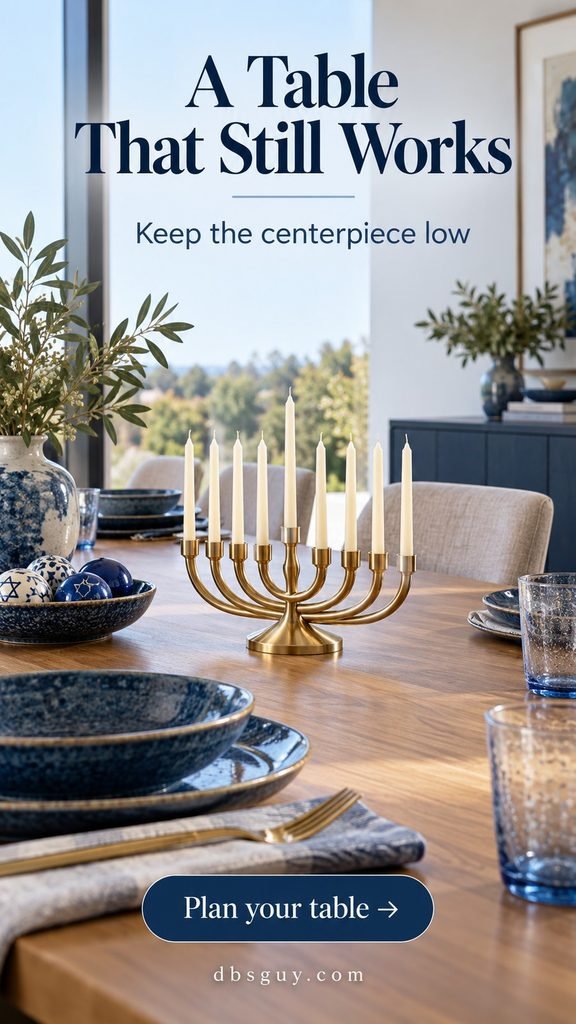
Set out your actual plates, glasses, and largest serving platter before placing the menorah. Sit in each chair and check the sightline. If the centerpiece leaves no comfortable place to pass a dish, it belongs on a nearby sideboard instead.
Keep this styled tablescape unlit while people are serving themselves. The pictured flowers, napkins, and decorative bowl are not a ready-to-light arrangement. If you intend to light at the table, confirm the location fits your practice, clear the surrounding area first, and establish that setup before lighting. Never solve a crowded dinner table by carrying a burning menorah elsewhere.
Also Read: 27 Genius Small Dining Room Ideas to Transform Your Space
3. Give a doorway table a single purpose
A small table beside a doorway can make the menorah feel like an intentional part of the home rather than something squeezed onto available furniture. Here, a dark square table and a silver tray provide enough contrast; extra seasonal decorations would only crowd the surface.

Choose a table that stands firmly on all four feet and fully supports the menorah and its base. Open the door all the way, walk through carrying a bag, and check that neither the door nor a passing sleeve can strike the display. Avoid a spot where keys, mail, or coats are routinely dropped.
The image is a decorative doorway example, not a diagram of ritual placement. For a traditional doorway setup, confirm the appropriate side and height for your practice. An exterior door that creates drafts or a busy entrance may make another location more suitable. Keep the exit clear.
Also Read: 45 Modern and Elegant Entryway Table Decor Ideas
4. Use an unlit menorah as a mantel sculpture
An empty black menorah can hold its own on a pale stone mantel. Its branching outline supplies the detail, so a small stone vessel at the other end is enough to balance the display. You can skip the garland, scattered ornaments, and extra candleholders.

Check the depth of the mantel before trying this: the entire base must sit securely on the ledge without an overhang. Position the piece where it can be seen from the seating area, then step back. If a large picture competes with the branches, move one of them sideways rather than adding another accessory.
Treat this as an unlit display only. The pictured fireplace is unused. Heat from a working fireplace and the clearances required by its manufacturer need separate consideration; a stone surround does not make every object on the mantel safe. For nightly lighting, use your prepared location elsewhere.
5. Clear a bookshelf compartment for the menorah
A shelf display works best when the menorah has room to read as one complete shape. The cream ceramic piece in this concept stands out against dark walnut, while books on the shelves above and below give it a place within the room’s everyday decor.

Remove enough books to expose the full outline of the branches. Keep the base directly on the shelf, and check the shelf’s load rating and mounting if the piece is heavy. A small object at the far edge can stay, but avoid placing anything in front of the menorah’s arms.
Leave the sockets empty here. A bookcase combines combustible materials with overhead surfaces, so this is not a lighting station. Before Hanukkah lighting, move the unlit menorah to the appropriate prepared surface; after use, let it cool completely before handling or returning it.
6. Let a blue-and-white cabinet do the color work
If you already have a navy wall or a white cabinet, you have most of this look. Silver gives the menorah a crisp outline, a cobalt vase repeats the wall color, and a shallow white bowl connects the upper display to the cabinet below.
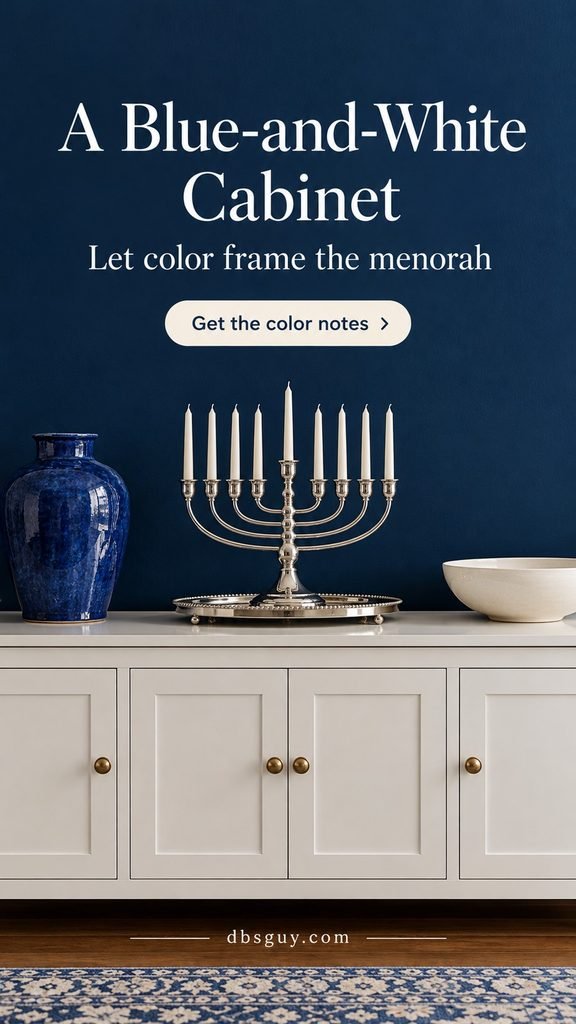
Use three distinct shapes: the branching menorah, a rounded vase, and a low bowl. They do not need matching patterns. Keep the vase empty so stems do not cross the candle line, and resist filling the open spaces with small themed decorations.
You can try the same palette without repainting: start with blue ceramics on an existing light-colored cabinet. Avoid propping a fabric-covered or paper backdrop behind a menorah you plan to light. Let permanent room finishes supply the color, and check clearance from the wall as well as nearby objects.
7. Put an heirloom on a clean-lined console
A modern display does not require a modern menorah. An ornate family piece can look especially striking on a plain console because there is less visual competition around its scrollwork and base.
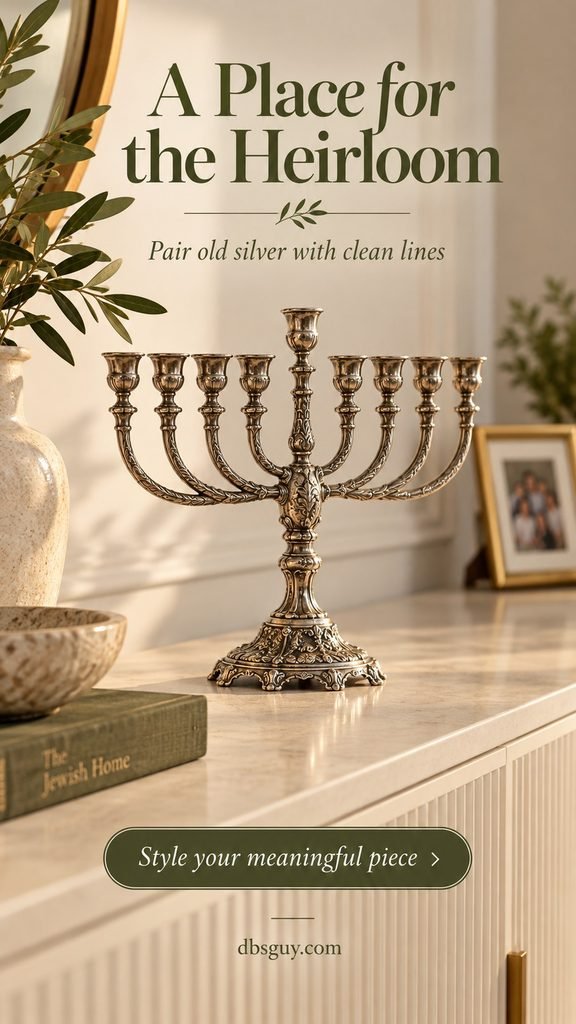
Keep a photograph off to one side, where it adds personal context without hiding the menorah. The concept pairs aged metal with cream furniture and a few warm accessories. Start with the menorah and photo alone; add the bowl or vase only if the surface still feels spacious.
Do not polish an unfamiliar heirloom aggressively just to match a picture. Identify the material and finish, and seek appropriate care advice for valuable or delicate pieces. If the base wobbles, a joint is loose, or the candle cups are damaged, keep it as an unlit display until its suitability for use has been assessed.
8. Borrow a small table and remove everything else
When every cabinet top is already spoken for, a compact side table can provide a dedicated surface. This works differently from ordinary side-table styling: you are making room for one purpose, not trying to fit a lamp, remote, drink, and menorah together.
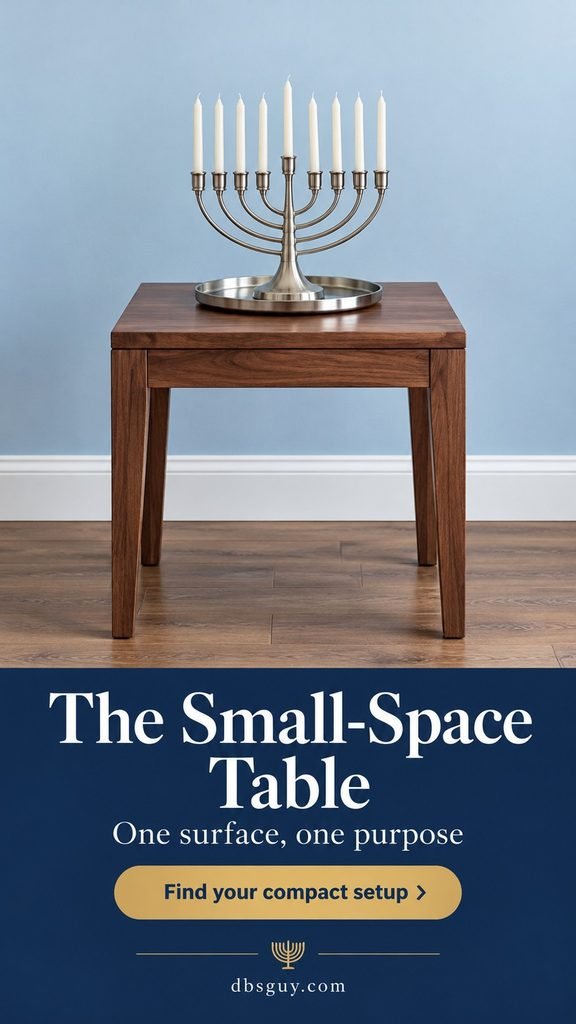
Measure the menorah at its widest point, then check both the tabletop and the tray. All parts should remain comfortably within the supported surface. A sturdy four-legged table is easier to assess than a narrow plant stand or a folding tray that shifts when touched.
Place it out of the walking route and away from upholstery. The pictured wall-side arrangement shows the furniture choice, not a measured flame clearance. If there is no location with adequate clearance and supervision, use the table for an unlit display and arrange your lighting elsewhere.
Also Read: 30 Side Table Decor Ideas That Look Designer
9. Arrange a collection so each silhouette stays visible
If you own several menorahs, display them together instead of scattering one onto every surface. The contrast between brass, cream ceramic, and silver makes this group interesting without adding a separate holiday theme.
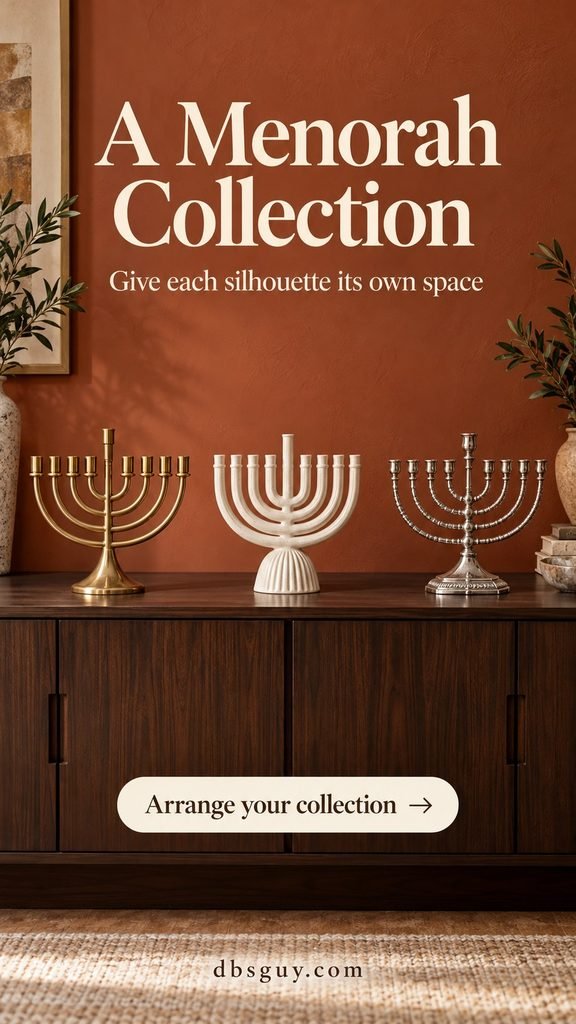
Line them up on one level and leave enough space that their branches do not visually overlap when viewed from the doorway. Put the broadest or most visually substantial piece near the middle, then adjust the gaps by eye. Equal spacing is less important than being able to see each complete form.
This is an unlit collection display, with decorative objects confined to the outer edges. Do not assume its spacing is suitable for several burning menorahs. If multiple household members light, plan separate, clearly distinguishable positions with appropriate clearance and guidance for your practice before adding candles.
10. Keep one sculptural piece out after the holiday
A simple brass menorah can remain part of a room after the seasonal decorations come down. With empty sockets, a pale console, and a low bowl nearby, the silhouette has enough presence to carry the display.
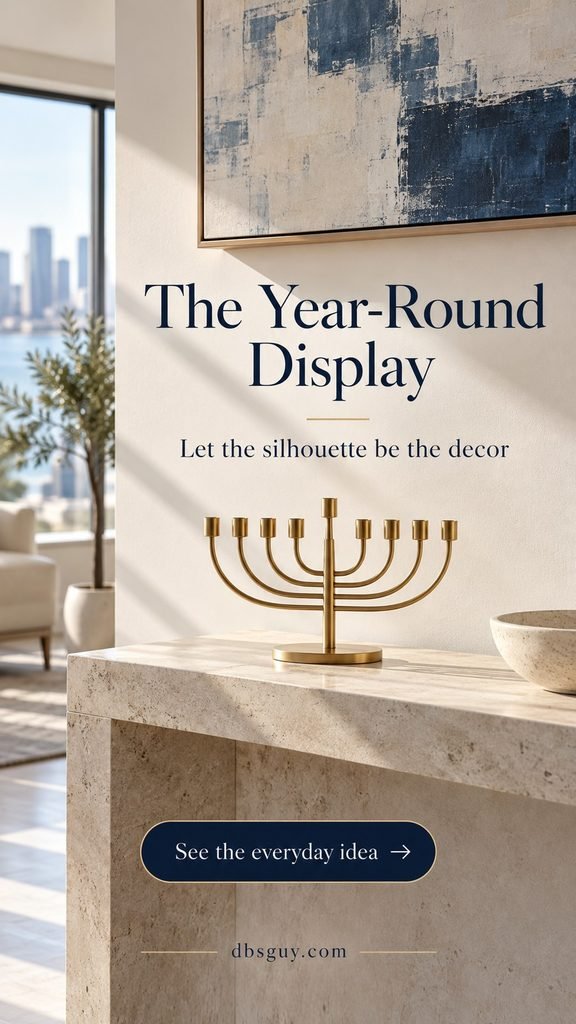
Choose a place you see often rather than a shelf where it disappears behind larger objects. If you already have artwork above the console, leave visual space between its frame and the highest branch. The blue painting here provides color without adding more items to the tabletop.
Once the menorah is cool after its final use, clean it according to the maker’s material-specific directions. Put spare candles and lighting supplies away separately. This keeps the everyday display simple and avoids turning the console into permanent holiday storage. Empty sockets also make the year-round arrangement clearly decorative.
Choose the setup that fits your room
Start with the furniture you have and the job it needs to do. A sideboard gives a single menorah breathing room. A dedicated small table helps separate the display from daily clutter. A shelf, mantel, or console can hold an unlit piece without taking over the dining table.
Before buying accessories, remove everything from the chosen surface and place the menorah alone. Add one supporting object, step back, and stop if the arrangement already feels complete. The most useful finishing touch may be the empty space you leave around it.
Questions about modern menorah displays
Does a menorah have to go on a windowsill?
No. A doorway is another traditional option. For ritual lighting, placement is more than a decorating decision, so follow your household’s custom or ask your rabbi about your space. The unlit styling ideas here offer additional ways to display the object.
Can I put it on a tray?
A low tray can define the display and help contain wax, provided it is stable and fully supports the base. For lighting, its material, heat suitability, and the supporting surface all matter. Skip wicker trays, cloth liners, and raised stacks of books.
Should the display include all nine candles every night?
The fully filled, unlit concepts show the menorah’s shape; they are not a nightly lighting sequence. Hanukkah lighting adds one festival light each night, alongside the shamash. Arrange the actual candles for the night you are observing.
Can an electric menorah be used for decoration?
Yes, a purpose-made electric menorah can provide a decorative display where open flames are unsuitable. Follow its electrical and placement instructions. Do not assume an electric display fulfills ritual-lighting requirements; ask your rabbi about your circumstances.
Do the colors need to be blue and white?
No. Use colors that help the menorah stand out in your room. Black against cream emphasizes the outline; brass beside walnut adds warmth; silver against navy gives stronger contrast. Choose one direction and repeat it sparingly.
Also Read
For more ways to work with the furniture around your display: