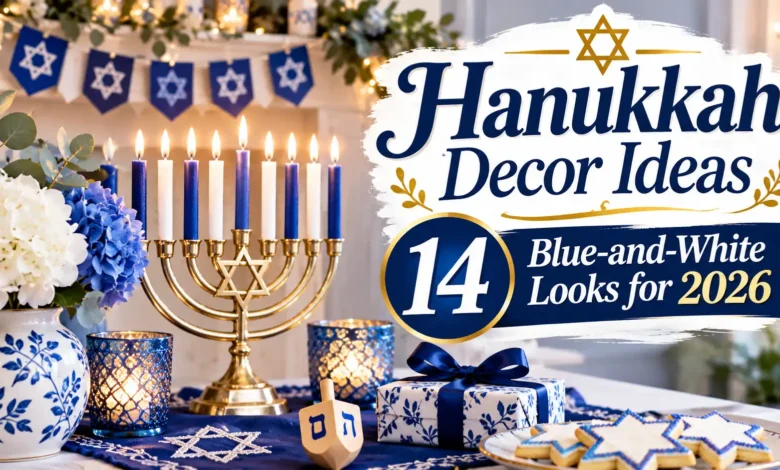
Start with the place where your family gathers: a clear spot for the menorah, a dinner table that still has room for food, or a shelf you pass every day. Blue-and-white Hanukkah decor feels more personal when it works around those habits instead of covering every surface.
These 14 looks range from a simple navy-and-white place setting to a family craft wall. Choose one main display and one smaller detail nearby; you do not need to recreate the whole list. Most of the color can come from dishes, fabric, paper, and glass you already own.
In 2026, Hanukkah begins at sundown on Friday, December 4, and ends at nightfall on Saturday, December 12. Plan your decorating before the first evening, and check local candle-lighting times separately. Friday lighting takes place before sundown; Saturday lighting follows the end of Shabbat.
The visuals are AI-generated styling concepts, not photographs of completed projects. Suggested sizes and arrangements are starting points to adapt to your home.
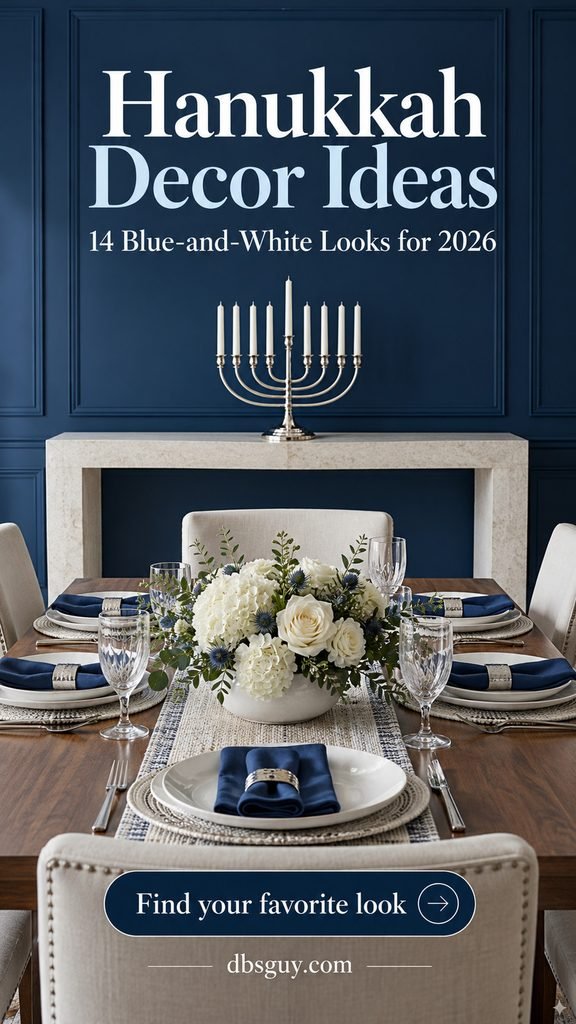
Choose your blue, then make space for the celebration
For a crisp look, pair navy with bright white. For something softer, use pale blue with ivory. Cobalt glass adds a stronger accent without needing much of it. Pick one main blue and repeat it in two or three places; keep the remaining surfaces quieter.
Separate decorative displays from the area used for candle lighting. A Hanukkah menorah, or hanukkiah, has eight lights for the holiday plus a distinct helper light, the shamash. Use a suitable menorah on a stable, nonflammable surface, away from curtains, paper, greenery, and other combustible decor, and beyond children’s reach. Do not leave burning candles unattended.
For ritual setup and lighting, consult Chabad’s menorah-lighting guidance and your community’s practice; use a current local calendar for dates and times. The styling ideas below are not a substitute for those instructions.
1. Give the menorah a calm, uncluttered corner
A deep-blue wall makes a silver menorah and white candles stand out without adding anything around their base. This is a useful starting point if your home already has a console or another steady surface near a suitable window.
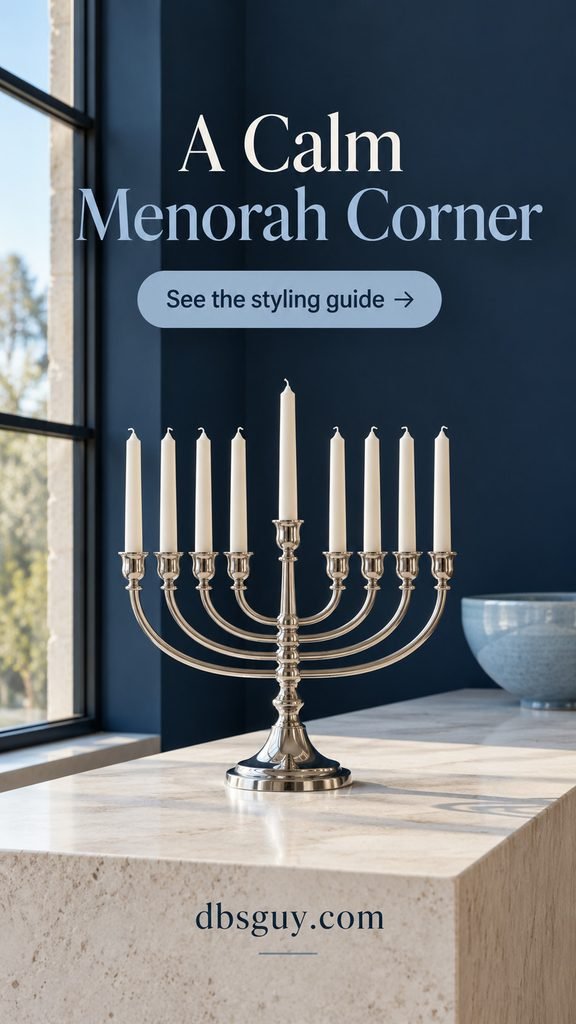
Clear the surface first, then position the menorah according to your household’s practice and the manufacturer’s instructions. Keep all eight holiday lights at the same level, with the shamash visibly separate. Do not raise individual branches on books or wrap the base with ribbon.
The image shows an unlit styling arrangement, not a particular night’s candle setup. Add the appropriate candles for that evening when preparing to light. If the location has curtains, a narrow ledge, or a busy route behind it, choose another suitable location rather than trying to squeeze decoration around the flames.
2. Set a navy-and-white table with room for dinner
White dishes, navy napkins, and clear glasses give you a coordinated table without a separate holiday dinnerware collection. An exposed wood edge keeps the setting from feeling overly formal.
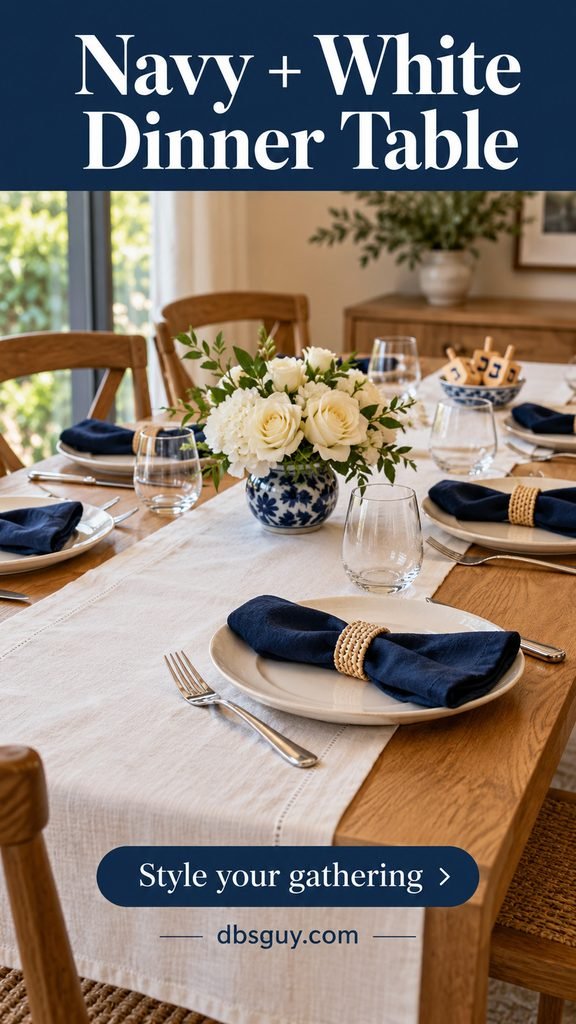
Lay a white runner down the center and put out the actual serving dishes while they are empty. Arrange the place settings around them before adding a short vase of flowers. If a platter has nowhere to land, take away a decorative piece rather than narrowing someone’s eating space.
Fold each napkin into a simple rectangle, or slip it through a plain woven ring as shown. Keep the flower arrangement low enough that seated guests can see one another. A small dish of dreidels can sit at the end of the table until it is time to play; the candle-lighting area can stay on a separate suitable surface.
3. Build a small display around blue-and-white porcelain
If you own patterned pottery, use it as the starting point. Two vessels of different heights create a collected look, while a plain white dish gives the eye somewhere to rest.
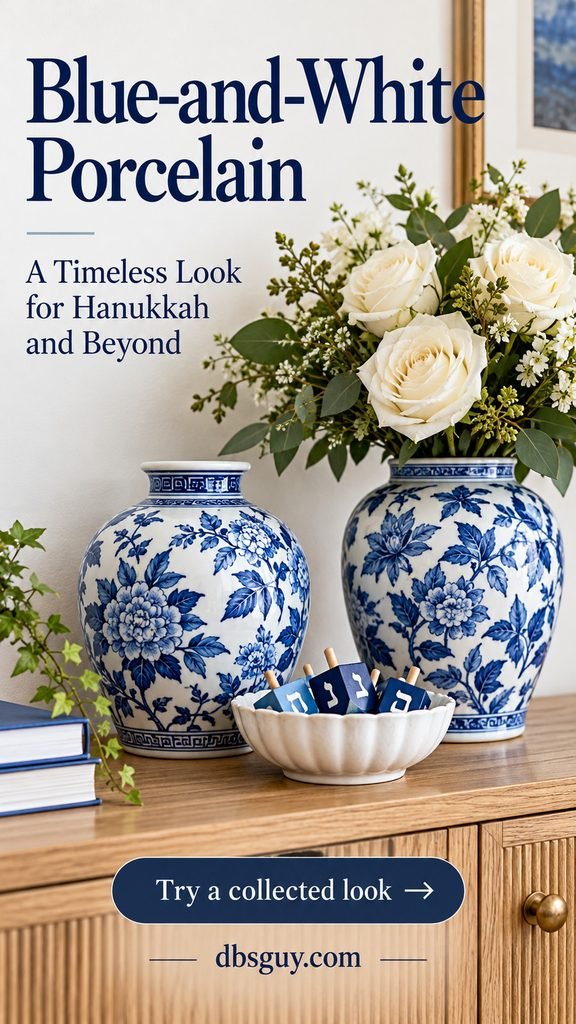
Place the taller vase toward the back and the shorter piece slightly forward. Add white flowers to just one vessel. Check that the vase is watertight, or use a properly fitted inner container, and protect a wood surface from moisture.
A bowl of dreidels makes the arrangement specific to the gathering without turning every item into holiday merchandise. Leave the rest of the cabinet clear. On a narrow sideboard, one patterned vase and the bowl are enough; you do not need to reproduce the full grouping.
4. Hang a paper Star of David display
This is the look to choose when you want a noticeable change without using tabletop space. Flat cardstock stars store easily afterward, and their shadows add a little depth against a plain wall.
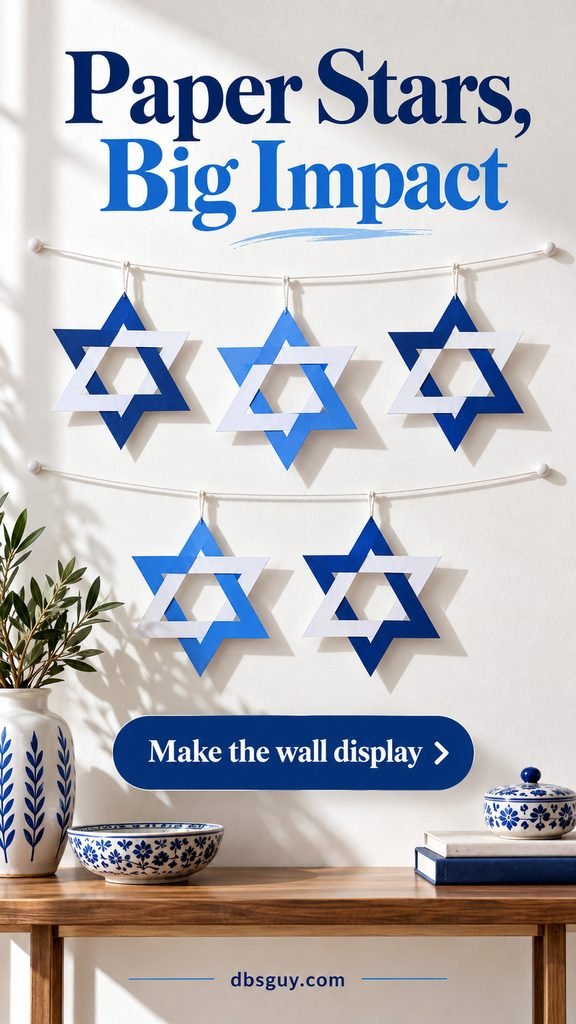
For the openwork look shown, use ready-cut cardstock Stars of David in blue and white, or layer blue and white triangle frames cut from a template. Each finished shape should have six points. Adults should handle interior cuts with a craft knife on a cutting mat; solid star silhouettes are the simpler option for a children’s project. Start with five finished stars about 5 to 7 inches wide.
Lay them on the floor to work out the spacing, then suspend them at staggered heights from two cords. Use fixings suitable for your wall and follow their load and removal instructions. Keep cords out of children’s reach and place the whole arrangement away from candles, heaters, and door swings.
5. Give the entryway one clear Hanukkah greeting
A small framed greeting is enough to tell guests what you are celebrating. Pair it with a white vase and a blue basket rather than building a display across the entire console.
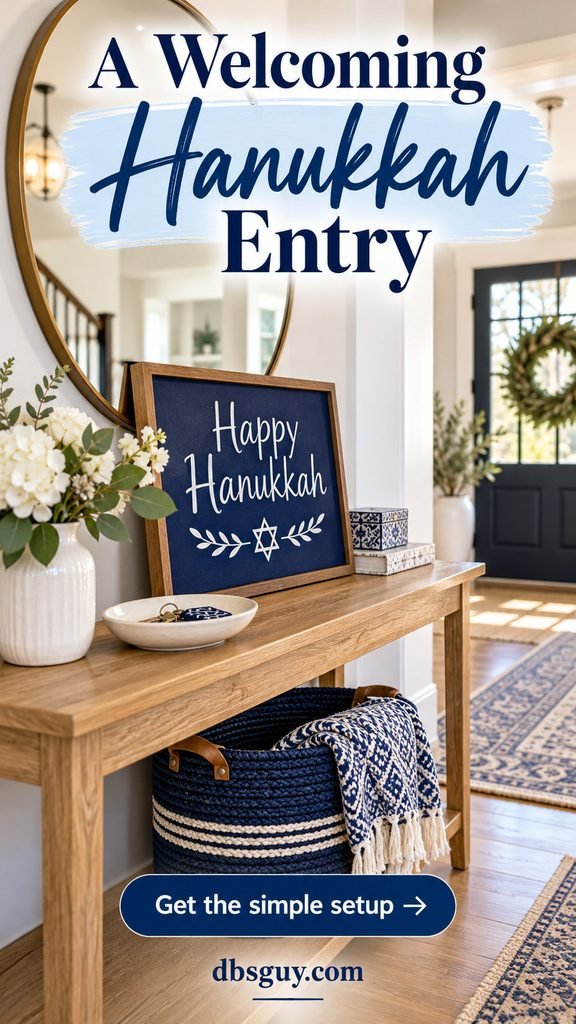
Keep the key dish in its usual reachable spot. Stand the frame toward the back, put the vase at the opposite side, and check that neither gets brushed by a coat or bag. If the table is shallow, hang the greeting instead of leaning it.
Use the basket below for clean spare scarves or guest slippers, with nothing projecting into the walkway. For more ideas on scale and furniture placement, browse our modern and elegant entryway table decor ideas and adapt the layout to your existing console.
6. Add translucent blue stars to a window
Window clings make sense when shelf space is scarce. Pale-blue translucent shapes let daylight become part of the display, while a single cobalt vase adds a stronger note below.
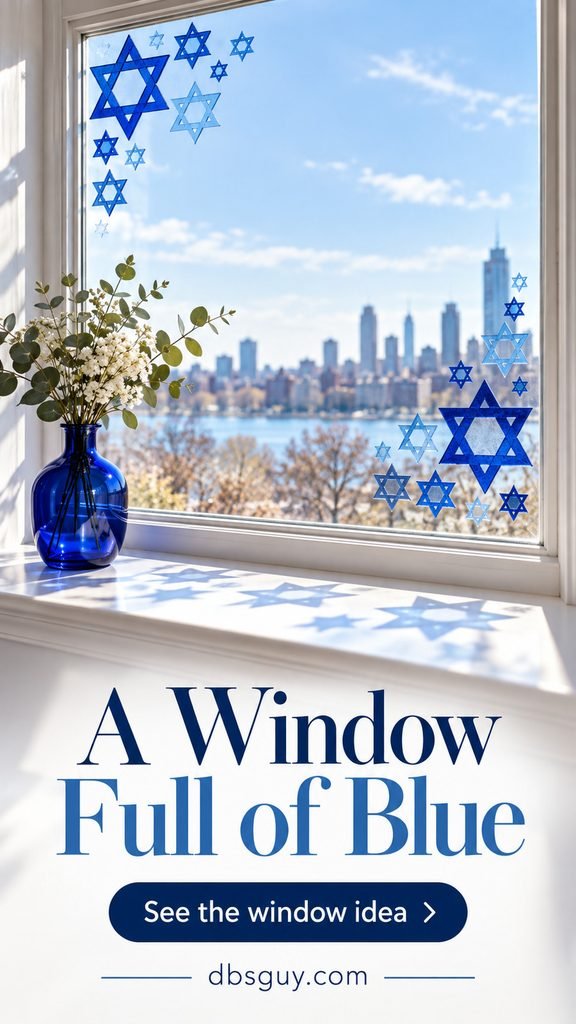
Choose removable clings labeled for your glass surface. Clean and dry the glass as directed, then group the shapes in two corners instead of filling the whole pane. Start with fewer pieces and view them from both inside and outside before adding more.
Keep handles, locks, and any required escape opening unobstructed. Skip loose hanging cords and do not attach craft paper near a candle-lighting area. The pictured sill is a decorative display, not a place to add a burning menorah among the objects.
7. Make a dreidel tray that is ready for play
A game tray brings the holiday into the living room without adding another object that only sits there. Blue and natural-wood dreidels look good against white, and small bowls keep playing pieces together.
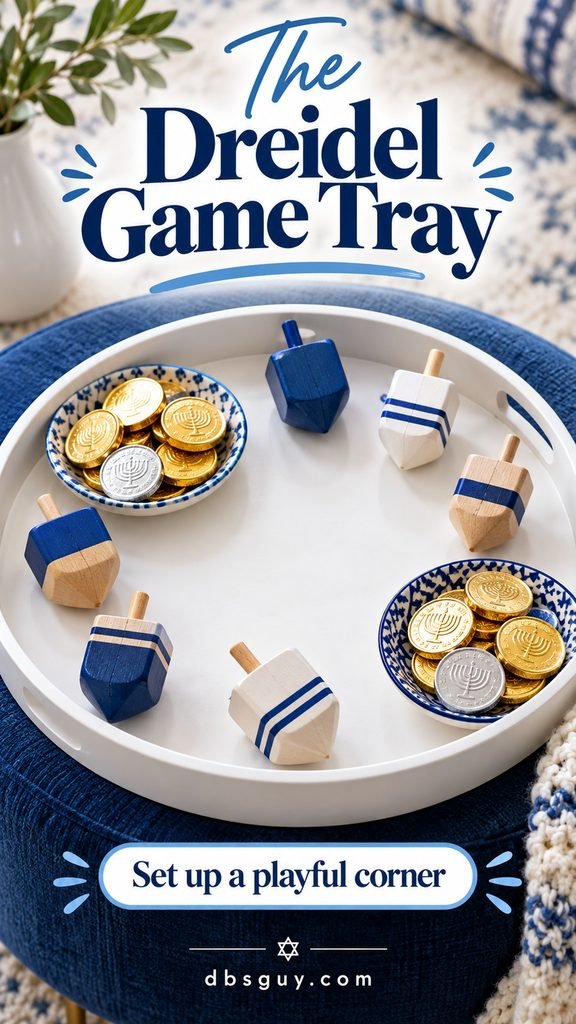
Choose a smooth, firm tray with a low rim. Put dreidels and wrapped gelt around the edge, leaving an open center. Before using an ottoman as the base, check that the tray sits level; a firm coffee table is better if it rocks or sinks. For actual game play, choose dreidels with clearly marked sides; the image focuses on the tray arrangement.
Bring out age-appropriate game pieces when it is time to play. Small dreidels, coins, and wrappers should stay away from young children who may put them in their mouths. When the game is finished, return everything to the bowls so the tray is easy to lift away.
8. Style a single shelf instead of the whole bookcase
Choose a shelf near eye level so a few pieces can do the work. A white pitcher, patterned bowl, and small framed print each bring a different shape; open space between them keeps the grouping readable.

Put the tallest piece at one end and the frame toward the other. Use a bowl with enough depth to hold the dreidels securely, without letting them teeter over the edge. Check the shelf’s fixing and load rating before rearranging heavy ceramics.
A blue print can be as simple as one carefully drawn six-point star on white paper. If you want a softer edge, our lace doilies in modern decor guide includes shelf styling ideas. Use any textile only in this unlit display, well away from candle lighting.
9. Carry the palette onto the sofa
You do not need holiday sayings on every cushion. One navy cover, one pale-blue stripe, and a white throw can connect the seating area to your table while remaining useful after Hanukkah.
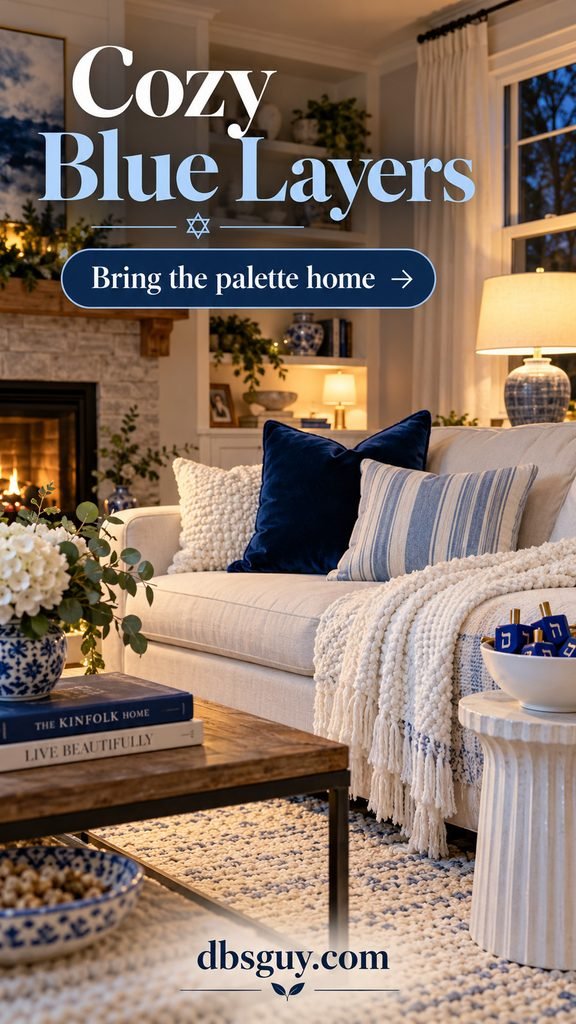
Reuse your existing pillow inserts and choose covers made for their size. Let one fabric supply the strongest texture—velvet in the pictured room—while the other stays simpler. Fold the throw over an arm so it is available to use instead of spreading it across the whole seat.
A small bowl of dreidels on the side table adds the holiday detail. Leave space for a drink and keep the table lamp usable. Our side table decor ideas can help you choose a grouping that fits your tabletop.
10. Use a tiny dreidel beside each place card
This detail is especially useful when you are seating a larger group. The name card does the practical work; the dreidel adds color and a small connection to the evening.

Cut white cardstock into rectangles about 4 by 3 inches, then fold each in half to make a 4-by-1½-inch tent. Write names in a dark pen and check them from a seated position. Set each card on a folded napkin, with a small dreidel beside it.
Do not glue the dreidel to the napkin or balance it on a pointed end. Guests should be able to lift the pieces off easily. At a young child’s place, use a drawn dreidel motif on the card instead of a loose small object.
11. Create evening glow with blue glass and LED lights
Blue glass looks very different after dark. A few LED tealights inside colored votive cups can give a sideboard a soft glow without placing extra open flames among your decor.
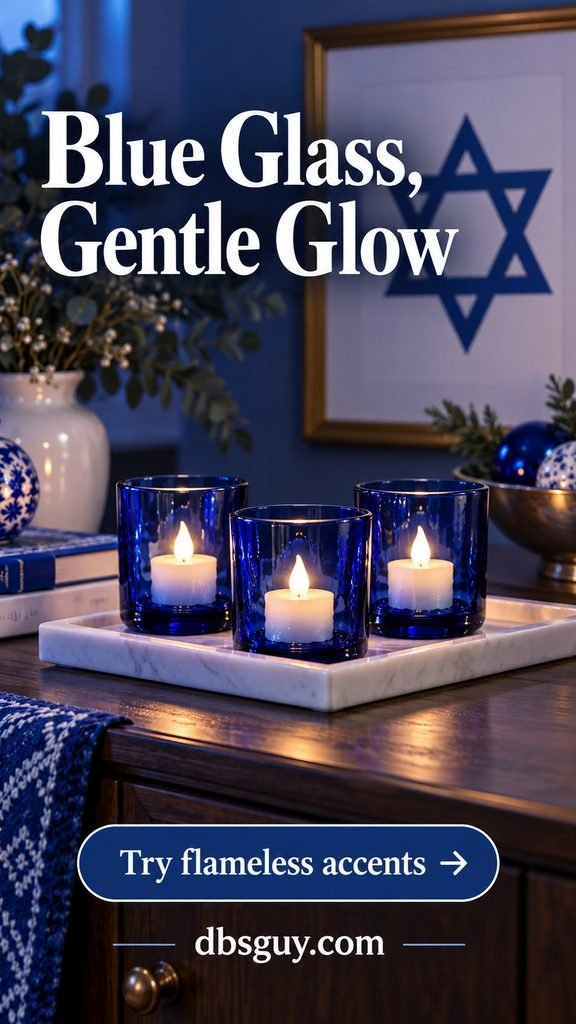
Use three cups of compatible size on a plain tray. Choose warm-white LEDs if you want the blue to feel less icy, and test the effect in the room’s normal evening light before arranging the rest. Keep the lights removable so you can reach their switches.
Follow the products’ instructions and keep batteries, especially coin or button cells, inaccessible to children. LED accents are decorative; do not assume they fulfill the ritual candle-lighting requirement. If open flames are not permitted where you live, ask your rabbi about your circumstances.
12. Gather wrapped gifts into one modest corner
If gift giving is part of your household’s celebration, let the wrapping do some decorating. A few white and navy packages on a bench can make a complete vignette without a separate backdrop.
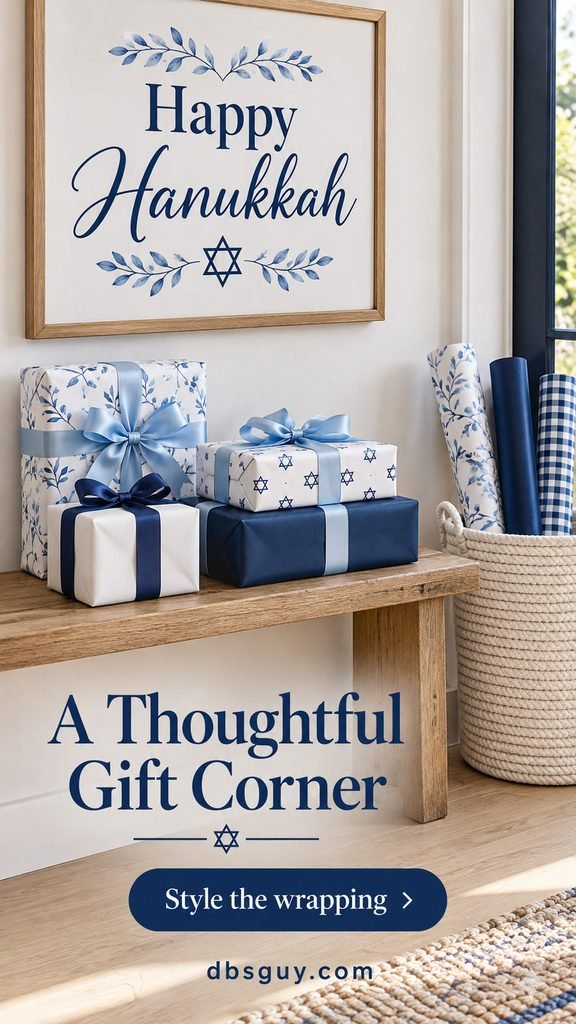
Choose two wrapping papers and repeat one ribbon color. Write names clearly on tags rather than hiding them under bows. Place the largest box underneath and keep the stack low and steady, with fragile items stored separately until they are given.
Do not add empty boxes just to make the pile bigger. A white basket can hold the remaining gifts if space is tight. Keep the bench out of the main walking route and clear of the menorah; wrapping paper and ribbon belong away from flames.
13. Turn family crafts and cards into a changing display
A craft wall gives children’s work a visible place without asking every piece to match. A limited paper palette provides enough connection; different drawing styles are part of its appeal.

Use a securely mounted board with clips appropriate for the users’ ages. Begin with a few blue and white paper shapes and leave gaps for cards or drawings that arrive later. Put heavier pieces in proper frames rather than forcing them under small clips.
Keep the craft surface below usable: paper in one stack, washable drawing supplies in a container, and scissors put away after supervised use. Mount the display away from heat and candle lighting. Photograph the finished board before taking it down, then let family members choose which pieces to keep.
14. Make the dessert station part of the decor
White platters and blue plates can carry the color scheme all the way through dessert. Jelly doughnuts provide the focal point, so the station needs little more than a small greeting behind them.

Set out empty platters first and decide which direction guests will move. Place plates at the beginning, food in the middle, and napkins near the end. Keep serving tongs beside the platter instead of behind it, and leave a clear place for someone to set down a plate.
Use food-safe dishes and keep craft decorations off food-contact surfaces. Follow the bakery’s storage instructions, especially for filled pastries, and retain ingredient or allergen information for guests who need it. Put out a manageable portion and replenish it rather than crowding the display with everything at once.
Make the looks work together
Choose your anchor first. If you are hosting dinner, start with the table and add the place cards or dessert station. For a small apartment, choose the window, one shelf, or the entryway. For a family gathering, the game tray and craft wall make the decorations part of what people actually do.
Before buying anything, gather your white dishes, blue textiles, frames, and serving pieces in one place. Pick the items that work together in your room’s light. Put the others back. A few repeated colors feel more deliberate when there is still space to sit, serve food, and celebrate.
Questions before you decorate
Does all Hanukkah decor have to be blue and white?
No. Blue and white are the palette for these ideas, not a decorating obligation. Keep a wood table, a warm-colored rug, or your family’s existing menorah. Repeating one blue accent is enough to connect the display.
What is the easiest look for a small home?
Start with one shelf or a framed greeting, then use blue napkins when you gather for a meal. Avoid covering every small surface; you will still need places for keys, drinks, and serving dishes.
Can I leave these decorations up for all eight nights?
Paper displays, wrapped gifts, and textiles can stay in place if they remain secure and clear of heat. Check flowers and water daily, put food away according to its storage instructions, and reset game pieces after use. Prepare the menorah separately for each evening.
How can I keep the look affordable?
Choose one change that has a clear job: blue napkins for the table, paper stars for a blank wall, or coordinated wrapping for gifts you already plan to give. Reusing a plain vase or frame usually serves the design better than adding several unrelated holiday accessories.
When should I decorate for Hanukkah in 2026?
Have the main setup ready before the first evening on December 4. Finishing paper crafts and table planning a day or two earlier is a practical choice, not a religious requirement. Keep the actual candle-lighting schedule separate from your decorating plans.
Choose the corner you will enjoy most
You do not need a houseful of blue and white. Start where you will notice it: the table where everyone eats, the window you pass each morning, or the tray that comes out for a game. Leave enough room around the decoration for the celebration itself.