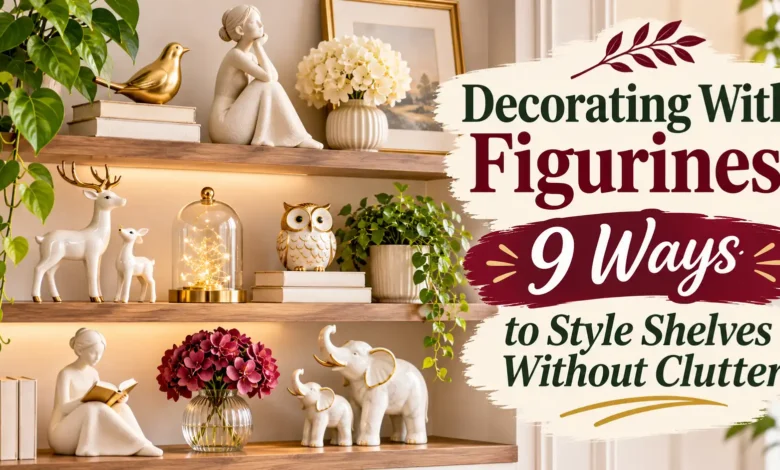
Start with the figurine you most want to notice, give it a clear outline, and leave enough room to reach it without moving everything else. That is the useful starting point for decorating with figurines—whether you collect porcelain animals, small sculptures, or colorful souvenirs.
You do not need to use all nine arrangements on one bookcase. Choose the one that solves your shelf’s problem: a solo display for a standout piece, a tray for scattered little objects, or a divided cubby for miniatures. Use the other shelves for books and everyday storage.
The images are AI-generated styling concepts, not photographs of tested arrangements. Adapt each layout to your objects and the shelf’s actual depth, clearance, and load limit.

Before you rearrange the shelf
Clear one shelf and put its contents on a stable surface. Set aside the books you use regularly, choose the figurines you want visible now, and give the remaining pieces a storage spot. An object can matter to you without being on display all year.
Measure the usable depth and height before adding a tray, frame, or stand. Include projecting tails, wings, and ears—not just the base. Keep the entire object inside the shelf footprint, and leave enough hand room to lift it out safely. Follow the shelving maker’s installation and weight guidance; styling cannot correct a loose bracket or an unstable bookcase.
1. Give one standout figurine a shelf of its own

A detailed horse, dancer, or animal sculpture can supply all the interest a small shelf needs. Start with the piece alone before deciding whether anything else belongs beside it. The ivory horse shown here has room above its ears and a broad stretch of bare walnut alongside it.
Try placing your figurine slightly off-center, then look from the doorway and your usual seat. Turn it enough to show its most recognizable profile while keeping its base fully supported. If the tail disappears against a book spine or the head merges with a frame, remove that competing object.
This arrangement suits a substantial piece that is easy to see from across the room. A tiny souvenir on a wide shelf may still look lost; give that piece a smaller setting using idea 4 or 8. Do not buy filler just because the first arrangement feels unusually spare.
2. Style a pair with a visible gap between them

A pair makes sense when two figurines already belong together: matching animals, a gift set, or pieces in the same finish. You do not need to add a third ornament to satisfy an odd-number decorating rule.
Place the pair close enough to read together but far enough apart that their outlines stay separate from your main viewing position. With birds like these, angle the beaks gently inward without letting them touch. The taller and shorter forms give the arrangement variation without another accessory.
On a short shelf, let the pair be the whole display. On a wider one, keep neighboring books or a plant outside the pair’s immediate space. If both figures are identical, try a small difference in angle rather than a precarious height trick. Decorative balance is a choice; steady footing is a requirement.
3. Raise a small favorite on two sturdy books

A low book stack can bring a small figurine into view when it sits too low within a tall shelf opening. In this arrangement, cream and rust covers create a quiet base for the fox instead of introducing more patterned objects.
Use two flat, sturdy hardcovers as a starting point, with the larger one underneath. The top cover should extend beyond every part of the figurine’s base. Check that the covers lie level and do not slide, bow, or rock before adding a lightweight, broad-based piece.
Choose books you rarely need to pull out. If you read them often, keep the figurine beside them instead. Skip valuable books, slippery jackets, heavy sculptures, and tall stacks: an attractive arrangement should not make retrieving a book a balancing exercise. A small figure that is already unstable belongs directly on a suitable shelf or in an appropriate support, not on books.
4. Gather small figurines inside one shallow tray
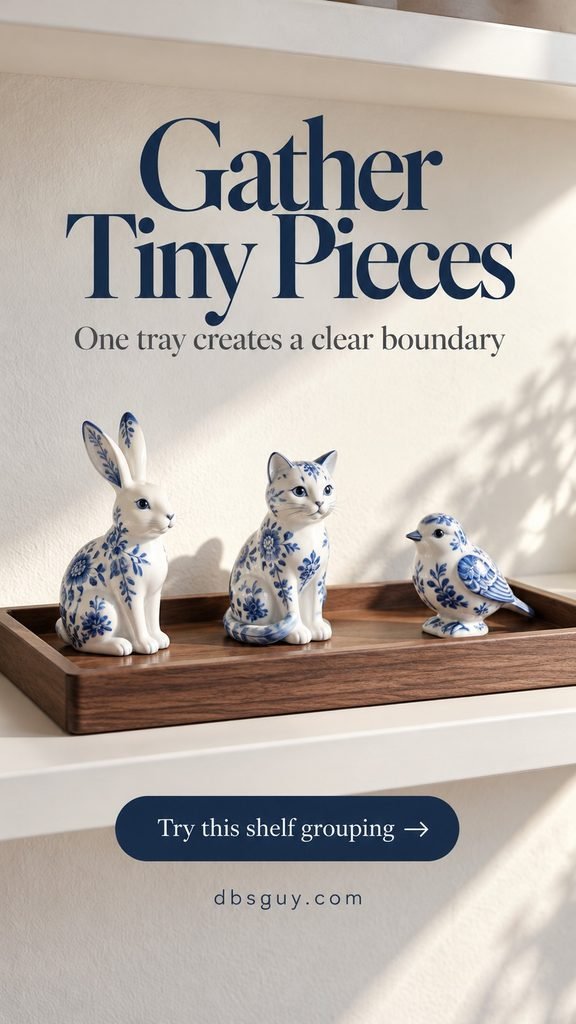
Use a tray when little figurines look scattered across a long shelf. Its outline gives the group a beginning and an end. A low rim matters: a deep basket might hide the very details you want to enjoy.
Choose the pieces first, then test the tray around them. The rabbit, cat, and bird shown here share blue-and-white decoration, but each has its own visible space. Arrange the tallest toward one end and check that you can see the smaller piece without leaning over the shelf.
Leave part of the tray’s base exposed. If you need to overlap figures or add a second row to make them fit, reduce the group or choose a different display. Do not fill the gaps with beads, shells, or potpourri; those additions make this particular arrangement harder to read and clean.
Remove fragile pieces individually before moving the tray. A decorative rim is a visual boundary, not a promise that objects will stay secure while carried.
5. Repeat one color across different shelves
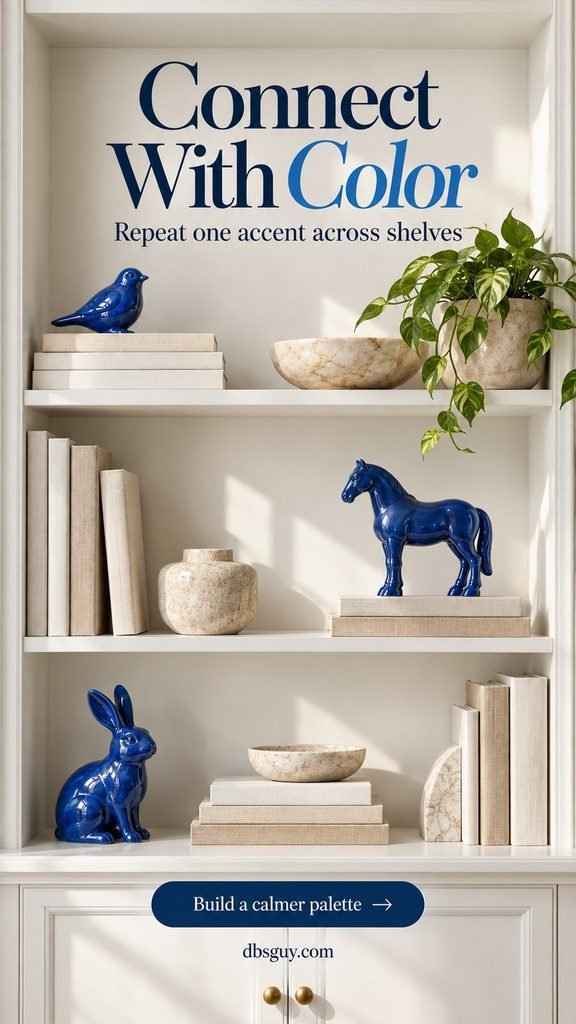
When your figurines have different subjects, a repeated color can connect them. Here, a blue bird, horse, and rabbit belong together visually even though their shapes differ.
Work with a color already present in your collection. Place one piece on an upper shelf and another farther across the shelf below. Add the third only where there is room for a distinct grouping. Stand back to check the whole bookcase rather than perfecting each shelf in isolation.
Keep nearby accessories quieter so that the repeated color remains easy to follow. You can use real books with varied covers; there is no need to hide their titles or purchase matching decorative volumes. Move the busiest covers away from the most detailed figure if the combination feels distracting.
If your collection is multicolored, repeat a material instead—such as carved wood or brass. Avoid repainting an heirloom to force a palette. Selecting a smaller group is the easier, reversible decision.
6. Use a quiet picture as a backdrop

A pale figurine can disappear against a pale wall. Before adding more objects, try one simple framed print behind it. The charcoal area in this example makes the ivory bird’s head and back easier to see.
Choose artwork with a calm area behind the figure, then position the figurine slightly to one side. Leave enough of the picture visible for both pieces to make sense. A busy landscape or a face directly behind the bird would introduce competing details.
Check the frame’s support before placing anything in front. Use its intended stand if it fits fully on the shelf, or an appropriate secure mounting method. The figurine should never act as the frame’s doorstop. If the frame pushes the figure close to the shelf edge, the shelf is too shallow for this arrangement.
Want another way to work older decorative pieces into a simpler room? Also read: Lace Doilies in Modern Decor: 9 Ideas Beyond Grandma’s Table.
7. Separate figurines from the books you actually use

A shelf can be decorative and still work as a library. Give frequently used books their own uninterrupted run, then put one figurine beyond the bookend. The open area between the books and this green owl provides room for your hand.
Use a proper bookend suited to the books’ weight. A lightweight or fragile figurine is not a substitute, even if it looks like one. Pull out the book nearest the display as a practical check: you should not have to lift the owl, brush its ears, or shift a plant first.
Keep the figure toward the front of its own zone without bringing it to the edge. Do not tuck it behind the books simply to fit more onto the shelf. For a bookcase packed with daily reads, reserve one small section for decoration and let the remaining shelves do their storage job.
8. Give miniatures a divided cubby

Miniatures need a viewing space that suits their scale. A compact divided display can be more useful than spreading tiny pieces across a deep bookcase, where they are hard to notice and easy to knock over.
Measure the tallest and widest figure before choosing the cubby. Each compartment needs clearance around projecting parts and enough room for you to lift the piece out. Start with one miniature per compartment, as shown, and keep the surrounding shelf largely empty.
A freestanding cubby must sit fully and steadily on the shelf; mount or secure it as its manufacturer specifies. Include the cubby’s weight when checking shelf capacity. Place it at a comfortable viewing height where small pieces are out of reach of children and pets.
If dusting many delicate pieces is the main problem, consider a suitable glass-front version. Check door clearance and access before buying. Dividers organize a collection, but they do not turn an overloaded shelf into a safe one.
9. Rotate a small display instead of expanding it
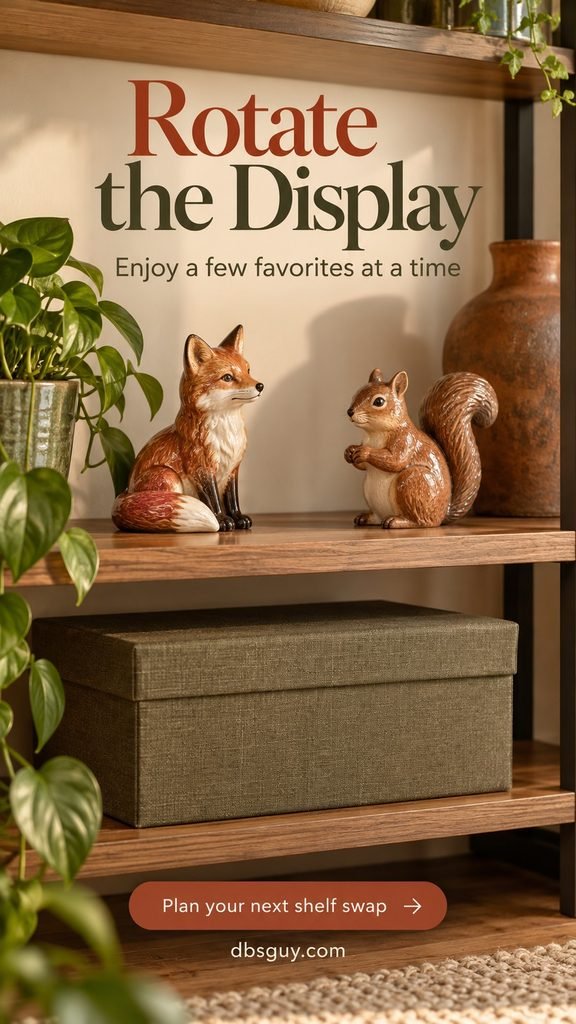
When every figurine is a favorite, rearranging may not create enough room. Keep a small selection on display and store the rest carefully. Changing the selection lets you enjoy more of your collection over time without extending it onto every nearby surface.
The fox and squirrel make a quiet fall grouping, but rotation does not have to follow holidays. You might change the display when you clean the shelf or when a different piece catches your attention. Take a quick photo of an arrangement you like so you can rebuild it later.
Give stored pieces individual padded spaces so they cannot knock together. A fabric box like the one pictured needs a firm base and suitable internal protection; loose figurines should not be piled inside it. Label the box and keep it somewhere accessible enough that changing the display remains practical.
Bring out a new piece by putting another away first. For seasonal colors and bookshelf combinations, also read: Best Fall Decorations Bookshelf Ideas for Warm Autumn Vibes.
Keep the arrangement easy to live with
Before calling the shelf finished, check it from the room’s entrance and from your usual seat. Can you recognize each figurine? Can you reach a book without brushing an ornament? Is there a visible stretch of bare shelf between separate groups? If one answer is no, remove or reposition something before adding another accessory.
For fragile ceramics and glass, the Canadian Conservation Institute’s care guidance emphasizes careful handling and protected storage. Support a piece from underneath while stabilizing it, rather than lifting it by a projecting detail. Keep stored objects from touching, and move fragile pieces individually before cleaning around them. Follow material-specific care instructions; avoid experimenting with water, cleaners, or adhesive putty on valuable or damaged pieces.
Questions about decorating with figurines
How many figurines should go on one shelf?
There is no useful universal count. One large sculpture may fill a small shelf, while several miniatures fit comfortably in separate compartments. Start with your favorite, then add another only if both remain visible, stable, and easy to reach. If the group needs a back row of half-hidden pieces, edit it.
Do figurines have to match?
No. Connect them through one clear feature: subject, color, material, or a personal story. Let that connection do the work instead of adding accessories to explain it. An unrelated favorite can have its own shelf rather than being forced into the group.
Can old porcelain figurines work in a modern room?
Yes. Try one detailed piece against a plain background with a simple wood shelf. Let its ornamentation supply the detail, and keep nearby objects restrained. You do not need to alter the finish or discard a sentimental piece to simplify its setting.
What if the shelf still looks cluttered after rearranging?
Remove the smallest supporting accessories first, then reassess the figurines themselves. A tray cannot disguise an overfilled tray, and a coordinated palette cannot create physical space. If the display still blocks access or hides pieces, store part of it and rotate.
Start with one shelf
Choose the figurine you want to see tomorrow morning, then choose the arrangement that gives it a comfortable place. Leave the remaining shelf space alone for a day before filling it. The useful result is a display you can enjoy, reach, and care for—not a shelf that holds the maximum number of objects.