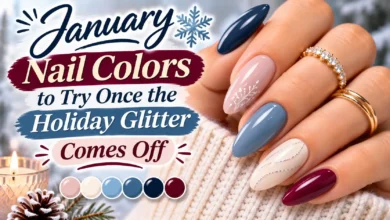
January Nail Colors for 2027: Build a Palette Around Your Favorite Winter Shades


To build a January nail palette, start with the winter shade you already love, then add a neutral and a contrasting accent. Icy blue can sit beside dove gray and navy; cocoa can take oatmeal and espresso. Give your favorite color three nails on each hand so the finished manicure still feels like your choice.
These five combinations turn January nail colors for 2027 into usable manicure plans, with shades to compare and finger placement you can show your nail artist. They are editorial styling suggestions for your winter appointments, rather than predictions of which colors will trend.
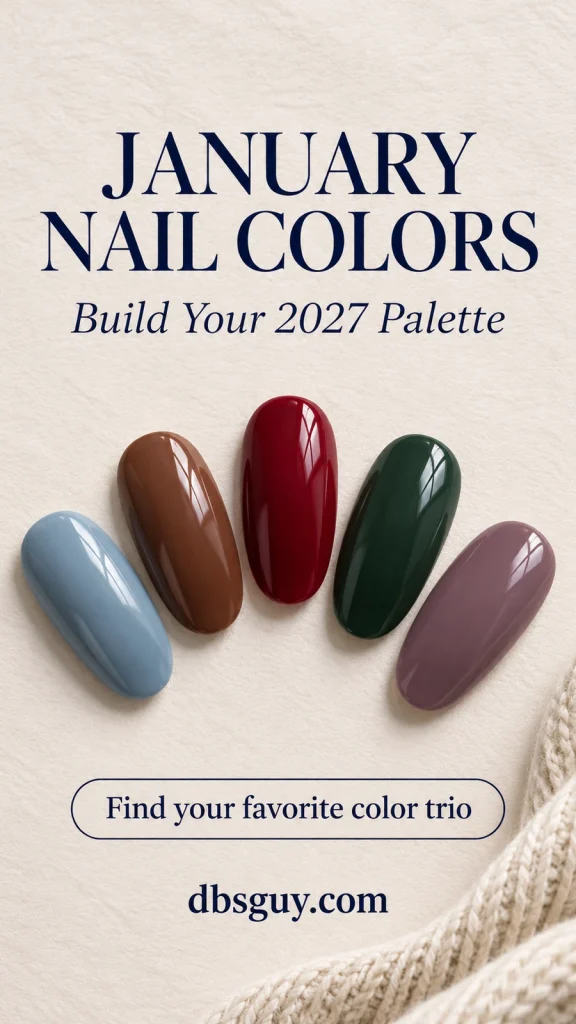
The images are AI-generated color and placement concepts. They do not document salon work or product testing, and they are not exact matches to named polishes. Confirm your colors with finished swatches.
Build your palette around one favorite shade
Start with a color you would happily wear on every nail. That is your anchor. Choose a neutral to give it a quieter neighbor, then an accent that is noticeably lighter, darker, or different in color. The three shades need different jobs; three nearly identical browns may look like an accidental mismatch.
Use this simple placement for any palette below: anchor on the thumb, index, and pinky; neutral on the middle finger; accent on the ring finger. Repeat it on the other hand. This three-one-one arrangement is a design starting point, not a manicure rule.
- Love a crisp, cool look? Start with icy blue, dove gray, and navy.
- Reach for camel coats and oatmeal knits? Compare cocoa, oatmeal, and espresso.
- Want to keep wearing red? Try wine, dusty rose, and mushroom taupe.
- Prefer an earthy color to a neutral? Choose pine, ivory, and smoky sage.
- Want pink with a quieter winter feel? Build around smoky mauve, gray-lilac, and plum.
You can also use a palette across several appointments: wear the anchor first, the neutral next, and save the accent for a darker or lighter change. Owning all three colors is optional if you are choosing from a salon’s swatches.
1. Icy blue, dove gray, and navy
This palette keeps the coolness of a pale blue manicure but gives it more definition. Look for an icy blue with a little gray in it, a light dove gray that reads neutral, and a navy that still looks blue in ordinary indoor light. If both supporting shades look dark, the pale anchor loses its airy setting.

Placement: Icy blue on the thumb, index, and pinky; dove gray on the middle finger; navy on the ring finger. A glossy, opaque finish keeps the three colors easy to compare. The short squoval nails in the concept also leave the color pairing as the main detail.
Take a charcoal or denim sleeve into the comparison. Gray beside gray creates a quieter pairing, while navy makes a stronger edge against pale blue. If the dove gray looks unexpectedly purple beside your anchor, compare a less lavender gray before committing.
Salon wording: “I’d like three icy-blue nails, one light neutral gray, and one clearly blue navy on each hand, all solid and glossy.”
Also Read: January Gel Nail Colors for 2027: Icy Blues, Creamy Whites and Deep Reds.
2. Cocoa, oatmeal, and espresso
For a warm winter palette, choose three clearly separated depths: medium cocoa, pale oatmeal beige, and deep espresso. The oatmeal nail supplies the light contrast. Espresso adds depth without introducing a fourth color family, which makes this a useful starting point if most of your winter clothes are cream, camel, or brown.

The concept puts cocoa on the thumb, index, and pinky, oatmeal on the middle nail, and espresso on the ring nail. All five nails have a smooth, glossy finish. There is no painted sweater pattern to fit into a small space, so you can keep your usual short rounded shape.
Compare the browns side by side, rather than choosing each from a separate photo. A red-brown cocoa and a very cool espresso create more contrast in undertone; two warm browns give the closer relationship shown here. Neither is wrong, but choose that difference deliberately.
A neutral does not have to blend into your skin. OPI’s guide to nude and brown nail polish discusses contrast as well as undertone when choosing a neutral. Use that distinction here: oatmeal creates a light contrast against deeper skin, while espresso gives stronger dark contrast against lighter skin.
Also Read: January Nail Ideas by Mood: Minimal, Cozy, Playful or Full Glam.
3. Wine red, dusty rose, and mushroom taupe
If red is the color you keep returning to, let it lead. A wine-red anchor can carry most of the manicure, with dusty rose adding a lighter red-family shade and mushroom taupe bringing in a gray-brown neutral. The result keeps a visible red presence without needing glitter or a holiday motif.
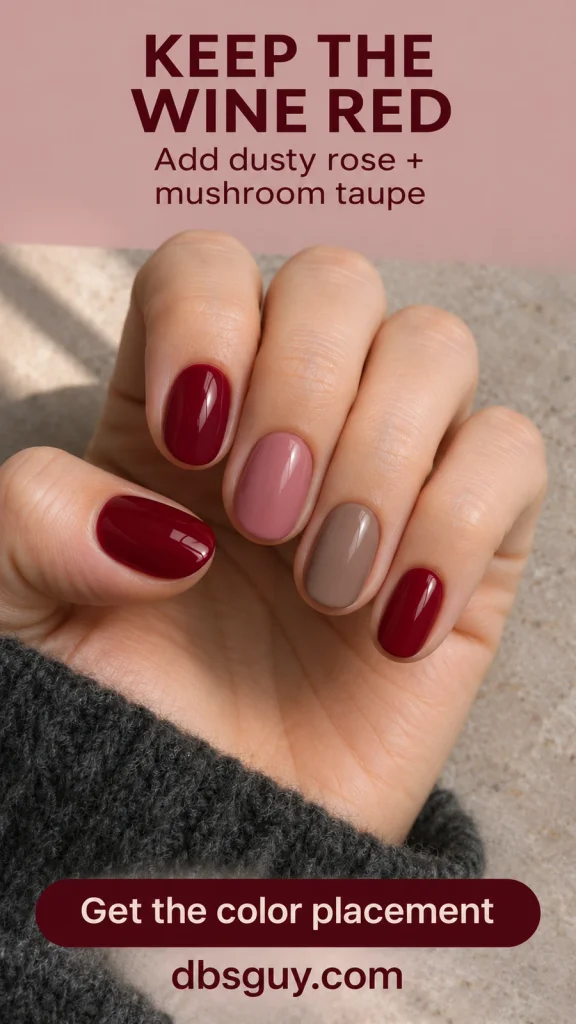
Use wine on the thumb, index, and pinky, dusty rose on the middle finger, and mushroom taupe on the ring finger. In this arrangement, rose takes the soft supporting role and taupe supplies the different-color accent. Keep the rose muted rather than candy pink if you want the quieter relationship in the image.
The important check is the wine swatch. If it reads almost black away from the salon lights, compare a slightly lighter red before choosing it. Then hold the taupe next to the rose: you should be able to see a gray-brown nail beside a pink nail, rather than two versions of beige.
This combination also gives you a simple route toward February. At your next manicure, change which of these three colors leads rather than adding a heart design before you want one.
Also Read: End-of-January Nail Designs for the Weeks Between Snowflakes and Hearts.
4. Pine green, ivory, and smoky sage
Pine green gives this palette its depth, ivory opens it up, and smoky sage connects the light and dark shades through a softer green. Choose a sage with visible gray rather than a bright yellow-green if you want the subdued combination shown here.
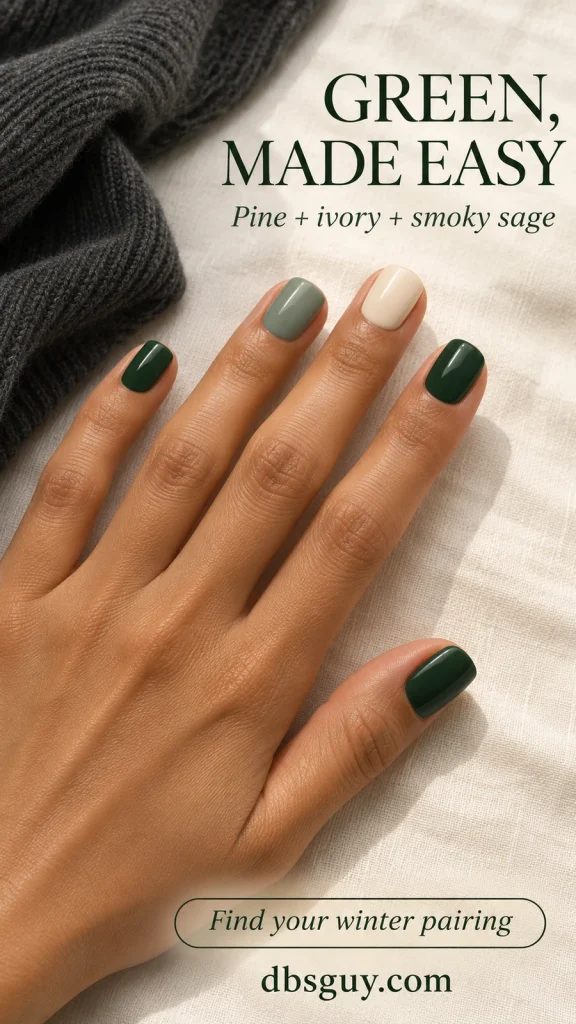
Place pine on the thumb, index, and pinky, ivory on the middle nail, and smoky sage on the ring nail. The glossy solid colors need no extra line work. Keeping red and gold out of this particular palette lets the green stand on its own after the holidays.
Check the ivory against your actual green. A warm cream gives a softer light nail; a stark white makes the contrast sharper. Also compare pine and sage at arm’s length. If the green shades seem interchangeable, choose a lighter sage or a deeper pine so the placement remains visible.
Ask for: “A green-led set with three pine nails, one warm ivory middle nail, and one muted sage ring nail on each hand.” Bring the image so “sage” does not become a completely different green on the swatch ring.
Also Read: January Dip Nail Colors for Winter: Soft Neutrals and Rich Jewel Tones.
5. Smoky mauve, gray-lilac, and plum
Smoky mauve is a middle ground when pale pink feels too light and burgundy feels too dark. Choose a muted pink-purple anchor, a much paler gray-lilac, and a deep plum. This palette uses a near-neutral lilac instead of beige, keeping the three shades close in color while separating their depth.
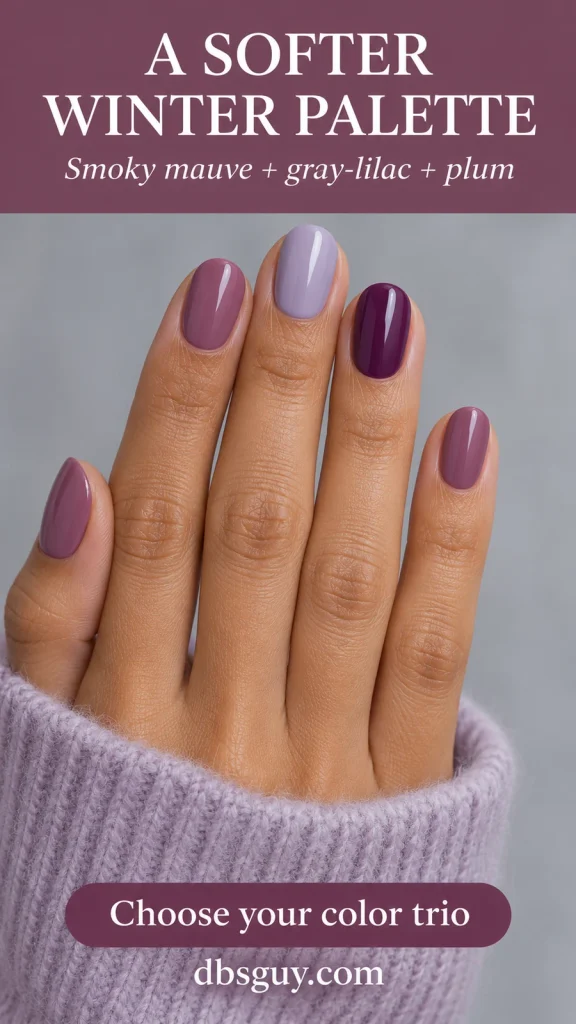
Mauve belongs on the thumb, index, and pinky; gray-lilac goes on the middle finger; plum goes on the ring finger. Use an even glossy finish across the set. The pale middle nail should be light enough to separate from the mauve, while the plum should remain visibly purple.
Color names are especially slippery here. One salon’s “mauve” may be mostly brown, and another’s may be pink. Put all three finished swatches together and describe what you want to see: a muted pink-purple, a pale gray-purple, and a deep purple. That is more useful than relying on the labels alone.
Also Read: Extra-Short January Nail Designs With Tiny Details That Fit.
Check your three shades before the appointment starts
Once you have a favorite palette, ask to compare the finished colors in the nail system you plan to use. A reference made with one product does not identify an exact match in regular polish, gel, or dip powder.
- Check the colors together. Put the three swatches beside your hand near a window, then compare them in ordinary indoor light. Avoid judging only from a bright phone image.
- Confirm coverage. These five concepts use opaque colors. If you prefer a sheer neutral, say so; visible natural nail will change the contrast.
- Keep the finish consistent for the first version. A glossy set makes the color differences easier to judge without also comparing matte, pearl, or shimmer effects.
- Show the placement. Point out the thumb, index, and pinky anchor nails, then the two supporting nails. Confirm the same arrangement on the second hand.
For an at-home version, pick the closest shades from your existing regular polishes before buying more. Paint separate practice tips if you have them and let the polish dry before comparing. Follow each product’s application directions; a concept image does not tell you how many coats a particular formula needs.
Questions about building a January nail palette
Do all three nail colors have to suit the same skin undertone?
No. You can choose a close tonal relationship or enjoy the contrast of a cool color beside warmer skin. Compare the finished swatches against your own hand and the clothes you wear. Skin undertone can help narrow a choice, but it does not have to exclude a color you like.
Can I use these palettes on very short nails?
Yes. Each nail in these concepts is one solid color, so you do not need extra length to fit a pattern. Keep a comfortable shape and choose shades that remain distinct on your smaller nail area. The three-one-one placement works without extensions.
What if I only want to wear one color at a time?
Treat the palette as a small rotation. Start with your favorite shade, then choose one of its partners for your next manicure. The benefit is having a few related options ready, even when every nail in a set is the same color.
Do I need new 2027 polish releases for these combinations?
No. These are color-family suggestions, not a shopping list tied to a collection or a claim about future releases. A salon swatch or a polish you already own may give you the color relationship you want.
Choose the trio whose anchor you would wear on its own. Save that palette’s image, compare the three real swatches, and decide whether to wear them together or across your next few appointments.