
The best small Christmas tree is the one that lets you keep using your living room. Start with a slim corner tree if you have a spare patch of floor, a tabletop tree if you already have a sturdy surface, or a flat wall tree if every inch is spoken for.
These 21 small Christmas tree ideas cover those choices, plus colorful mini trees, living plants, and decorations that pack flat after the holidays. Each comes with a specific placement suggestion and a detail that helps the look work in an apartment. You can keep your favorite chair, your walking space, and your Christmas mood.
The images are AI-generated decorating concepts, created to illustrate the ideas rather than document real homes. Suggested dimensions are planning starting points; check your room and the actual tree measurements.

Choose the spot before you choose the tree
Tree height gets all the attention, but width and depth usually decide whether a tree fits. Measure its widest branches, the stand or pot, and any collar you plan to add. On a tabletop, include the surface height when checking the total height of the display.
- A spare floor corner: start by looking at slim trees around 4–5 feet tall. Compare their listed widths rather than relying on the word ‘slim.’
- An existing side table or cabinet: a tree around 18–30 inches tall is a useful starting point. Its base must sit entirely on the surface, with room for the branches.
- No usable floor or furniture space: choose a flat garland, light, branch, fabric, or felt tree for a suitable wall.
- Very little storage: favor a tapestry, folding paper tree, slotted cardboard tree, or a genuinely collapsible design.
Make a temporary outline of the proposed footprint with a sheet of paper or a spare towel. Walk past it, open nearby doors and drawers, and sit in your usual seat. If the spot is awkward before decorations arrive, a smaller footprint is the better choice.
Keep exits clear. The NFPA Christmas tree safety sheet, hosted by Stoughton Fire Department, recommends keeping trees at least three feet from heat sources. A tiny room needs a different placement when that clearance is unavailable.
1. A slim corner tree that keeps the walkway open
A slim tree gives you a recognizable Christmas silhouette without the wide lower branches of a traditional full tree. The corner beside an armchair or at the end of a sofa can work beautifully, provided the tree does not crowd the seat or the route through the room.
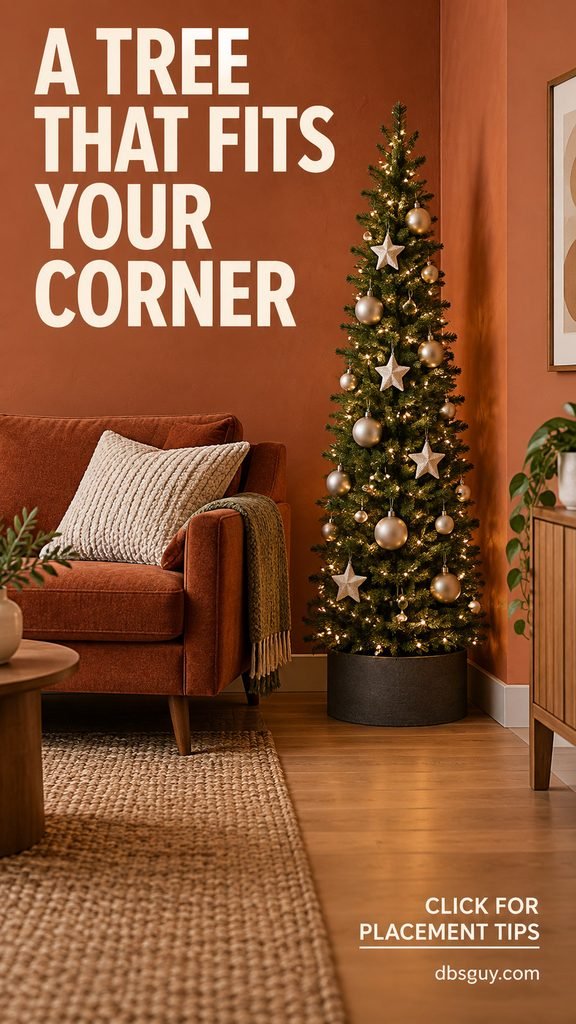
For an apartment, begin your search around 4–5 feet tall and roughly 20–26 inches wide, then confirm the product dimensions. The champagne ornaments and pale stars shown here stand out against the green branches without needing a thick ribbon garland. Keep heavier ornaments nearer the trunk so they do not pull branch tips outward.
Make it fit: use a close-fitting collar around the proper stand, and keep gifts within that same footprint. An oversized skirt can undo the space savings of a narrow tree.
2. A half tree with a flat back
When your only available spot is along a wall, a purpose-made half tree is worth considering. Its decorated front projects into the room while its flat back sits close to the wall. That shallow profile can be more useful than simply buying a shorter, round tree.

Look for an actual flat-back design with a stand intended for that shape. Do not cut an ordinary artificial tree in half or assume its rear branches can be removed safely. Check the listed depth, stand dimensions, and assembly instructions before choosing one.
Navy and silver ornaments give the front a finished look, especially when the wall is pale. Put your best decorations on the visible front and sides. Leave enough space to reach the plug, and avoid pressing light wires between the tree and the wall.
3. A tabletop tree on your existing end table
An existing end table can turn a little tree into the room’s main holiday feature. Raising the tree brings the decorations closer to eye level, so a 2–2½-foot tree can feel substantial beside the sofa.

Choose a broad, sturdy table with a level surface. The whole base should rest securely on it, and the widest branches should leave useful clearance around the display. Remove the usual lamp or accessories rather than squeezing the tree between them. Red baubles, tiny gold stars, and warm lights make this version feel traditional.
A lower shelf can hold a few small presents without filling the floor. If the only available table is a lightweight pedestal or a narrow stool, pick a much smaller tree or use a different surface; extra height is only helpful when the display stays stable.
4. A narrow tree behind the sofa
A narrow console behind the sofa is an easy place to create a tree display without adding another piece of furniture. Use a miniature tree that rises above the sofa back so you can enjoy it from the seating area.

Depth matters here. A tree might be short enough but still spread wider than the console. Measure both the pot and the branches, and choose a narrow model that fits entirely on the surface. Small copper bells and cream bows suit a walnut console; they add detail without long ribbon tails brushing the sofa.
Keep the rest of the console quiet—one small dish is plenty. Route the light cord behind the furniture without pinching it, and leave space for the sofa to move slightly when someone sits down. This works best with a substantial console that stays steady.
5. A little real fir with a tidy base
A small real fir brings the look and scent of a fresh tree into a room that cannot accommodate a full-size one. Choose it by its actual branch spread, not just its height; a short fir can still be surprisingly wide.

Let the natural shape stay visible. A handful of red wooden ornaments and little gingham bows suit a 3–4-foot tree better than several heavy garlands. Use a sturdy water-holding stand made for the trunk size. A bucket-style cover can hide that stand, but it needs to leave access for checking and adding water.
The practical part: check the reservoir every day and keep it supplied with water, following the stand’s instructions. The NFPA guidance calls for daily watering and removal when the tree dries out. Plan how you will carry it out of the apartment before bringing it in.
6. A sparse Nordic tree with breathing room
A sparse Nordic-style tree is a good match for a living room with pale wood, simple furniture, and an uncluttered feel. Its separated branches give each decoration a little room, so the tree does not need to look packed to feel finished.
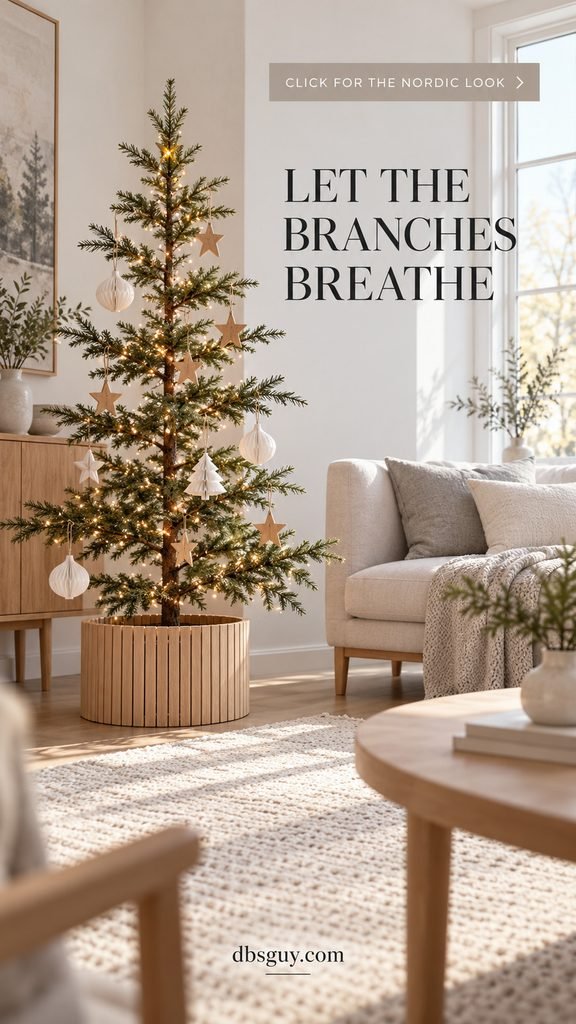
Use lightweight wooden stars or small white paper ornaments, and repeat them at different heights. Add a fine light string if you want evening glow. With this shape, winding thick ribbon around every tier can hide the very branching pattern that makes it appealing.
Measure the longest branches carefully. An airy tree can look narrow in a photograph while extending quite far into the room. Choose the shape for its visual lightness, then check its physical footprint just as you would a dense tree. A simple fitted base completes the look.
7. A lights-only tree for a calm room
A little green tree with warm lights alone can be enough, especially in a living room that already has patterned cushions, books, or colorful art. This approach lets the tree supply atmosphere without introducing another set of colors and shapes.

Choose a tree with a pleasing outline and spend the styling time on fluffing its branches. Distribute a fine light string through the depth of the tree rather than leaving every bulb on the front surface. On a pre-lit tree, follow the manufacturer’s setup instructions.
Keep the base plain and skip the topper if it makes the silhouette feel crowded. The navy room shown here makes the warm glow especially noticeable. Use lights labeled for indoor use and turn them off before bed or leaving home; a quiet decorating style still needs ordinary electrical care.
8. A retro mini tree on a record cabinet
A retro mini tree works well on a record cabinet, low bookcase, or vintage sideboard. The cabinet gives it a home, while small multicolor lights and bright baubles bring the playful feeling of older family Christmas displays.

For a 2-foot tree, try tiny red, turquoise, and yellow ornaments with one lightweight star. Keep the decorations small enough that you can still see the branches. A peach wall or teal cabinet makes the palette feel intentional rather than random.
Use modern light sets that meet current safety labeling requirements, even if the styling is nostalgic. Old cracked sockets or frayed cords are not part of the look. Keep the tree away from a turntable lid, speakers, and ventilation openings so the record cabinet can continue doing its everyday job.
9. A white tree that suits a neutral room
A white artificial tree can sit comfortably in an ivory or beige living room when you want a holiday display that follows the room’s existing palette. Pearl, champagne, and pale blush decorations add texture while keeping the overall effect soft.

Choose a compact tree around 3 feet tall and a base cover that stays close to the stand. Small bows give the branches variation; large loops of ribbon can overwhelm a tree this size. Warm lights soften the white branches in the evening.
White branches do not make a tree physically smaller, so still check its diameter. Leave a little space around it and avoid adding a wide white skirt, extra floor lanterns, and several decorative houses. The calm look comes from a limited display, not from fitting more objects into the same pale color scheme.
10. An icy blue tree on a deep windowsill
A deep windowsill can host a miniature tree and give it a lovely backdrop after dark. Icy-blue and white ornaments echo the winter light outside, while a short string of warm lights keeps the display from feeling cold.

This idea needs a genuinely deep, sound sill. Start with a tree around 18–20 inches tall, then check that its full pot rests on the sill and that branches do not interfere with curtains, blinds, or window operation. A narrow ledge is better left for something smaller.
Do not use a sill directly above a radiator or other heat source. Keep cords from crossing moving window parts and preserve any window needed for emergency escape. If your sill fails those checks, recreate the blue palette on a cabinet near the window instead.
11. A living rosemary tree in a terracotta pot
A rosemary topiary shaped like a little tree is a charming option for someone who enjoys caring for plants. Its fine leaves and terracotta pot suit a sunny apartment corner, and a few tiny fabric bows are enough to suggest Christmas.

Give the plant the brightest suitable spot rather than treating it as a decoration you can put anywhere. Iowa State University Extension recommends at least six hours of direct sunlight for rosemary indoors, watering when the soil is dry to the touch, and draining away excess water. A dim room may need a grow light or a different tree choice.
Use a pot with drainage and a protective saucer, and avoid decorations that bend or crowd the stems. This is a living herb with ongoing care needs; keeping its clipped cone shape takes maintenance after the holidays.
12. A bottlebrush forest on one bookshelf
A bottlebrush forest lets a bookshelf take the place of a single traditional tree. Grouping a few tiny trees at different heights gives the display a clear holiday shape without needing a stand, a light cord, or a patch of floor.
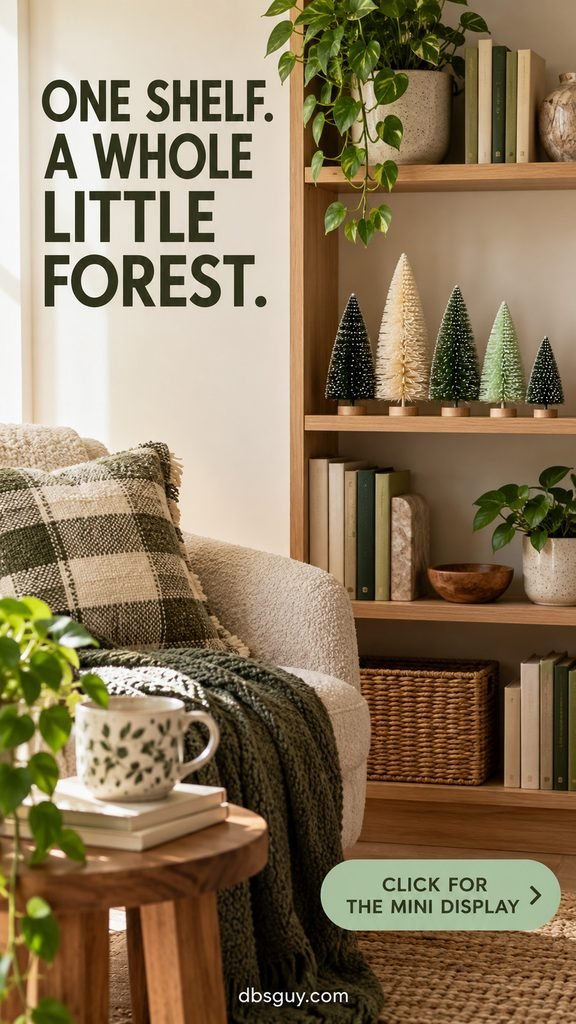
Try five trees between about 4 and 10 inches tall, using forest green, mint, and cream. Put the taller ones slightly toward the back and leave visible gaps between their bases. A shallow arrangement is easier to live with than filling the whole shelf from edge to edge.
Move the everyday objects from that shelf into storage for the season instead of stacking decorations in front of them. Keep your books accessible on neighboring shelves. For a home with young children, place the tiny trees out of reach, since small bases and detachable pieces are decorative items rather than toys.
13. A flat garland tree on the wall
A flat garland tree gives you the texture of greenery while keeping the floor open. Arrange short horizontal rows of faux pine on a suitable wall, widening each row as you work downward to create a tree silhouette.

For a manageable apartment display, sketch a shape roughly 3 feet tall and 2 feet wide before installing anything. Seven rows can create a clear outline, but adjust their spacing to the garland you have. Add a light paper star and a restrained scattering of small ornaments.
Support each row properly: use fixings rated for the material and combined decoration weight. Check your lease and the adhesive manufacturer’s surface instructions; removable does not guarantee damage-free on every paint finish. A few fine lights can add glow, provided their wires are secured without staples or sharp fasteners and the wall is clear of heat.
14. A tree outline made from string lights
For a tree that is mostly light and line, trace a branching outline on a blank wall with a fine LED light string. It becomes an evening focal point without foliage, a stand, or a collection of ornaments to store.
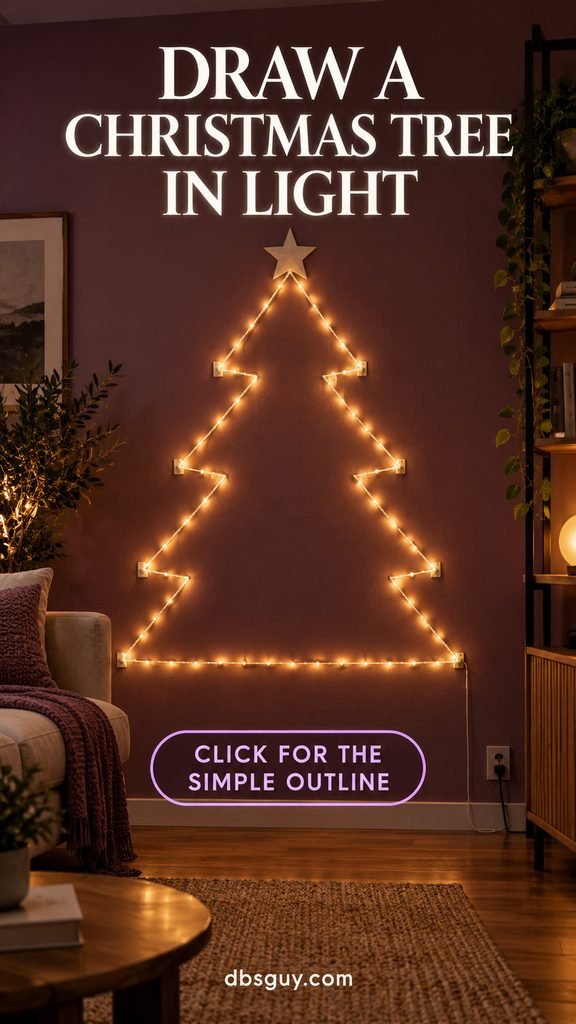
Sketch the outline first. A simple shape with a few stepped branches is easier to read than a complicated zigzag. Use a lightweight paper star if you want a topper, and pick a wall color that lets the lit outline stand out. The dusty-plum version shown here has a soft, modern feel.
Use appropriate insulated light clips or suitable supports, and follow the light set’s instructions. Do not nail or staple through the cord. Route the remaining wire close to the wall and away from walking routes. Leave the outline unburdened by ornaments that could pull on the wiring.
15. A hanging branch tree with wooden ornaments
A hanging branch tree brings a rustic texture to the wall without using evergreen foliage. Horizontal sticks in increasing lengths create the triangle, with twine connecting the rows and a few lightweight ornaments hanging below them.
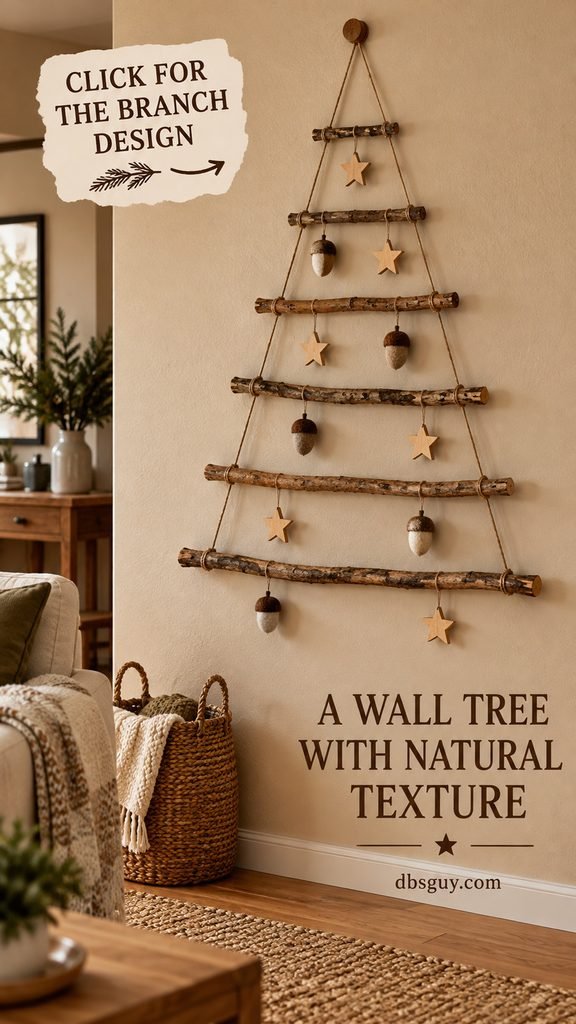
Six rows are a good starting point for a display around 2½–3 feet tall. Use clean, dry branches or prepared wooden rods, and test the arrangement on the floor before hanging it. Small wooden stars and felt shapes look at home here; heavy glass ornaments make the construction harder to balance.
The top support must hold the weight of the whole finished piece. Keep the two side connections secure and the bottom row level. Mount it against a wall rather than hanging it over a seat, and keep loose twine away from children. The finished tree should sit calmly instead of swinging into the room.
16. A Christmas tree tapestry that stores flat
A printed tree tapestry is one of the easiest choices when January storage is as important as December decorating. The tree is part of the fabric print, so there is no frame of branches to dismantle and no pot to find room for later.

Choose a narrow textile with a clear tree image and colors that work with your room. A wooden hanging rail gives the top a tidy finish; a weighted hem helps the lower edge sit neatly. Check the fabric’s care instructions before ironing or steaming creases.
Hang the rail with appropriate wall fixings and let the printed design do the work. Adding bulky ornaments can distort the fabric or increase the load. After the season, clean and dry it as directed, then fold or roll it loosely with the rail stored alongside. It is particularly useful in a studio with limited closet space.
17. A felt tree with big soft decorations
A felt tree can become a small family decorating project, especially for preschool-age children who enjoy rearranging colors and shapes. A flat green tree with large felt circles, stars, and snowflakes gives them their own display without a second floor tree.
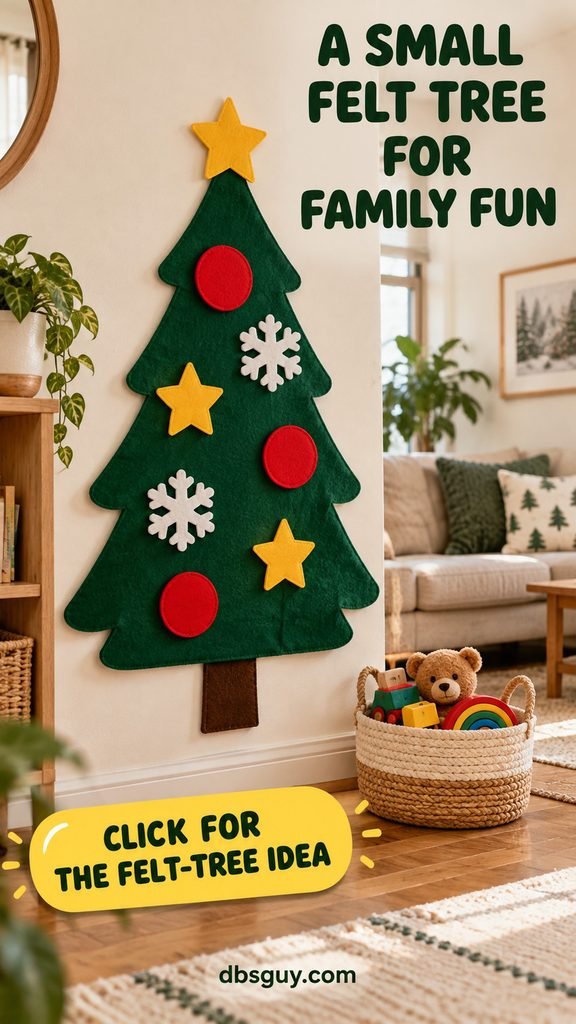
Cut the tree to suit the available wall area and use securely attached fabric hook-and-loop patches for the decorations. Keep the shapes large and simple. The example uses bold red, yellow, and white pieces, with no light cord or dangling garland.
Choose materials and a mounting method appropriate for the child’s age, and supervise decorating. This is a craft display, not a certified toddler toy. Avoid small detachable parts, beads, magnets, and accessible strings; the CPSC holiday guidance advises keeping small removable decoration parts away from young children. Check attachments whenever the tree is used.
18. A honeycomb paper tree trio
A trio of honeycomb paper trees makes a sculptural display on a small cabinet. Unlike a dense evergreen, the interest comes from the folded paper texture, so you can skip ornaments and still have a complete look.
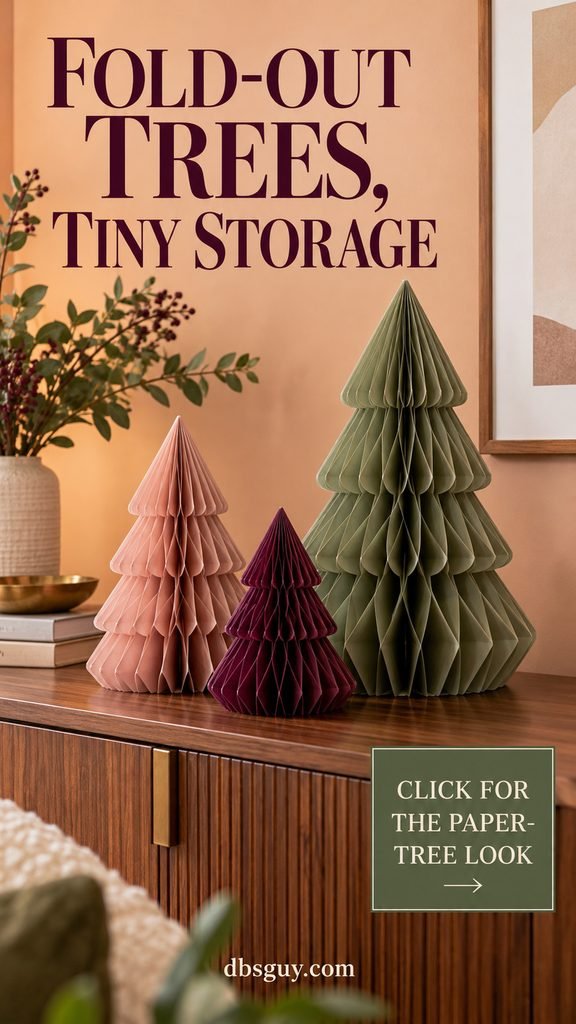
Use three different heights—around 8, 12, and 16 inches is a workable starting point—and give each tree room to open fully. Plum, blush, and sage make a softer alternative to red and green. Set the tallest tree toward the back and keep the front edge of the cabinet clear.
Choose folding versions that close with tabs, clips, or magnets if you want to reuse them. Follow the maker’s directions when opening and closing the paper so the cells do not tear. Keep the trees dry and away from heat, flames, and electrical connections; these are unlit paper decorations.
19. A wooden dowel tree for favorite ornaments
A wooden dowel tree turns your favorite ornaments into the main attraction. With no foliage behind them, the shapes and colors are easy to appreciate. It works particularly well for a small collection you would rather display than bury inside branches.

Look for a tabletop design around 18–24 inches tall with a broad, stable base. A central trunk and graduated horizontal rods create the outline. Hang lightweight ornaments in balanced pairs, then vary a few colors so the arrangement does not look too rigid.
Respect the display’s weight limits and keep heavier keepsakes elsewhere. If making your own, use a reliable construction plan with properly secured rods and a stable foot. A finished stand designed for ornaments is a straightforward option when you want the look without a woodworking project. Store ornaments separately so their surfaces do not knock together.
20. A slotted cardboard tree you can take apart
A slotted cardboard tree is a useful DIY option when you want something small, inexpensive to assemble, and easy to take apart. Two matching flat tree silhouettes slide together at right angles to create a freestanding shape.

For a tabletop version, start around 18–24 inches tall with a broad lower section. Cut one central slot downward from the top of one piece and the other upward from the base of its partner. Each slot should extend roughly halfway and fit the cardboard thickness snugly. Test the plain tree for stability before painting.
Paint small stars or dots directly onto the surface rather than adding hanging decorations. Let the paint dry completely, and keep the finished tree unlit and away from heat or flame. Adults should handle craft-knife cutting on a protected cutting surface. Pull the two pieces apart for flat storage after Christmas.
21. A collapsible tinsel tree for easy storage
A compact collapsible tinsel tree is a cheerful answer for someone who wants sparkle but has little space to store a conventional artificial tree. Choose a design that really collapses around its central pole, rather than assuming every small tinsel tree folds down.

A 3-foot narrow cone can brighten an apartment corner without needing a heavy ornament collection. Let red and silver tinsel supply the color. Check the assembled diameter, the stand’s spread, and the packed dimensions before buying.
For a metallic tree, keep the sparkle unlit: the CPSC advises against attaching electric lights to metallic trees. Use the room’s ordinary lighting to catch the reflective strands instead. Follow the maker’s collapse instructions, keep the stand and pole together, and store the tree without crushing the tinsel. That makes the space-saving design useful after the holidays, too.
Small decorating choices that make the tree feel finished
Give a small tree one clear decorating idea. That might be red bows and gold stars, blue ornaments by a window, or warm lights alone. Repeating a few materials is usually easier to balance than squeezing every decoration you own onto a miniature tree.
Use a topper that the top branch can support. A light paper star or small bow is often enough. Choose a base cover close to the stand’s size, and move everyday accessories out of the display area for the season. Try removing one garland or one surrounding object if the corner feels crowded.
Before buying, also ask where everything will go afterward. Measure the storage box, check whether the tree separates into sections, and confirm whether a ‘folding’ display actually packs flat. A tree that fits in December but has nowhere to go in January creates another small-space problem.
A few checks before you switch on the lights
Use light sets with the label of a recognized testing laboratory and follow their instructions for use and the number of strands that can connect. Replace damaged wires or loose connections. Turn decorative lights off when you leave home or go to bed. These recommendations come from the NFPA Christmas tree safety sheet.
Keep your route to exits clear, keep trees away from heat sources, and use a stable stand or fully supported pot. Do not attach lights to metallic trees or add them to homemade paper and cardboard displays. In a rental, check permitted wall fixings before making a wall tree. No decorative effect is worth a display that tips, snags, or blocks daily movement.
Frequently asked questions
What size Christmas tree works best in a small apartment?
There is no single size that fits every apartment. A slim 4–5-foot floor tree or an 18–30-inch tabletop tree is a useful place to start looking. The deciding measurements are the full branch spread, base footprint, and available clearance. Include the tabletop height and topper when checking the total display height.
Where should I put a Christmas tree in a tiny living room?
Try a usable corner, an existing end table, a broad cabinet, or a deep sofa console. Check doors, drawers, seating, cords, and exits before committing. If every surface is busy, a suitable wall can hold a flat tree without displacing furniture.
How can I decorate a small tree without overwhelming it?
Start with a few small ornaments in a limited palette. Add lightweight bows or stars, then step back from your usual seat. Keep the branch shape visible and stop when the tree looks balanced. You can put favorite ornaments that do not fit into a separate bowl or display rather than forcing them onto the branches.
What if I cannot put adhesive hooks on my rental walls?
Choose a tabletop tree, bottlebrush forest, or freestanding paper or wooden tree. Do not assume a removable hook is acceptable or suitable for your paint. Check the lease, surface requirements, and load rating before using wall fixings.
Is a potted Christmas tree the same as a houseplant?
No. A living rosemary topiary needs appropriate light and watering, and a hardy outdoor evergreen is a different proposition again. Iowa State University Extension notes that containerized hardy evergreens should spend only a short time indoors, generally no more than 7–10 days. Follow care guidance for the actual plant rather than treating every potted tree as an indoor houseplant.
The right choice is the tree that fits the way you already use your room. Choose its home first, keep the footprint manageable, and give it a few details you enjoy seeing every day.