
Seven days, three states, and a suitcase of layers you will actually wear: start in Boston, head into New Hampshire’s White Mountains, continue to Stowe and Woodstock in Vermont, then return to Boston. These East Coast fall outfits pair each day’s drive or walk with comfortable shoes, repeatable basics, and one clear styling idea.
This is a New England slice of the East Coast, designed for scenic stops, village wandering, and short walks. It is not a summit-hiking itinerary. The looks lean toward women’s casual style, but the same layer combinations work with your preferred cuts and fit.

The route at a glance
Boston → North Conway → Kancamagus Highway → Lincoln → Stowe → Woodstock → Boston. Plan six nights on the road: one in Boston, one in North Conway, one in Lincoln, two in Stowe, and one in Woodstock. Arrive early on Day 1; if your flight arrives late, add an arrival night.
- Day 1: Boston on foot; striped shirt, cardigan, stretch trousers, sneakers.
- Day 2: Boston to North Conway; fleece, hiking trousers, grippy boots.
- Day 3: North Conway to Lincoln via the Kancamagus; rain shell, sweater, jeans.
- Day 4: Lincoln to Stowe; barn jacket, stripes, black trousers.
- Day 5: Stay in Stowe; beanie, fleece, and an easy path walk.
- Day 6: Stowe to Woodstock via scenic Route 100; cream knit, denim, burgundy scarf.
- Day 7: Woodstock to Boston; soft cardigan and comfortable travel trousers.
Allow roughly 600–700 miles including local exploring. Driving times below are broad planning estimates in ordinary conditions, not live navigation results; foliage traffic, weather, and stops can stretch them considerably. Enter each overnight town and named scenic road into your navigation app before departure.
When to go—and how to pack for the forecast
For this northern loop, start by considering late September through the first half of October. Vermont Tourism describes its usual strongest color window as late September into the first or second week of October, while emphasizing annual variation. Check its foliage timing guide and weekly report before fixing your daily stops.
Use New Hampshire’s official foliage tracker for the mountain leg. One week will not put every elevation and every town at peak. Boston is your practical gateway; it may be greener than the mountains. Later in October, favor lower valleys if the reports show that high elevations have already faded.
Check the forecast for each overnight town and any elevated stop. Build each look from a light base, an insulating middle, and a weather layer you can reach without unpacking. A barn jacket gives structure; a hooded rain shell handles wet sightseeing. They are different pieces with different jobs.
The images are AI-generated outfit concepts with illustrative New England settings, not photographs documenting these destinations or current foliage conditions.
Day 1: Boston in stripes and soft layers
Route: Arrive in Boston. Keep the day local. Sleep: Boston.
Start with a manageable walk through the Public Garden and nearby Beacon Hill streets, leaving time for lunch and an early night. If you can collect the rental car on Day 2, compare that option with a full-week rental plus overnight parking. There is no need to spend your first afternoon driving between city photo stops.
Wear: A navy-and-cream striped long-sleeve shirt, an open camel cardigan, black stretch trousers, and broken-in ivory sneakers. A small crossbody leaves your hands free. Choose trouser hems that clear the pavement rather than dragging through fallen leaves.

The open cardigan lets you adjust quickly between a warm café and a breezy street. If rain is forecast, put the shell over it and switch to your waterproof boots. Save smooth-soled dress shoes for another trip: this day is built around walking.
Day 2: Boston to North Conway in a forest-green fleece
Drive: About 3–3½ hours before stops, commonly via I-95, the Spaulding Turnpike, and NH-16. Sleep: North Conway.
Leave after breakfast and make North Conway your main destination. Have lunch, settle in, and choose a short local walk or legal scenic pullout according to the weather and daylight. Keep the afternoon flexible instead of adding a major mountain hike after the drive.
Wear: A forest-green fleece over a lightweight base layer, black hiking trousers, and waterproof hiking boots you have already worn. Pack the rain shell in a small daypack; add a rust beanie when it feels cold. The green supplies the color while the dark trousers can reappear later in the week.

Use trousers with enough room to sit comfortably and step up without pulling at the knees. Adjust or remove the fleece before you get sweaty on a walk. If the plan changes to a strenuous hike, reassess the route, forecast, equipment, and daylight separately—this sightseeing capsule is not a complete hiking kit.
Day 3: The Kancamagus Highway with a burgundy rain shell
Drive: North Conway to Conway, then NH-112 west to Lincoln; allow roughly 1¼–1½ hours moving time and most of the day for exploring. Sleep: Lincoln.
The Forest Service describes the Kancamagus Scenic Byway as about 34 miles long. Approach from Conway and work west, picking a few signed overlooks instead of stopping everywhere. Fuel up and bring lunch before starting the scenic stretch.
Wear: A burgundy hooded rain shell over a cream sweater, straight indigo jeans, and brown hiking boots. Wear the shell open in dry conditions and close it when wind or rain arrives. Leave enough space beneath it for your sweater without pulling across the shoulders.
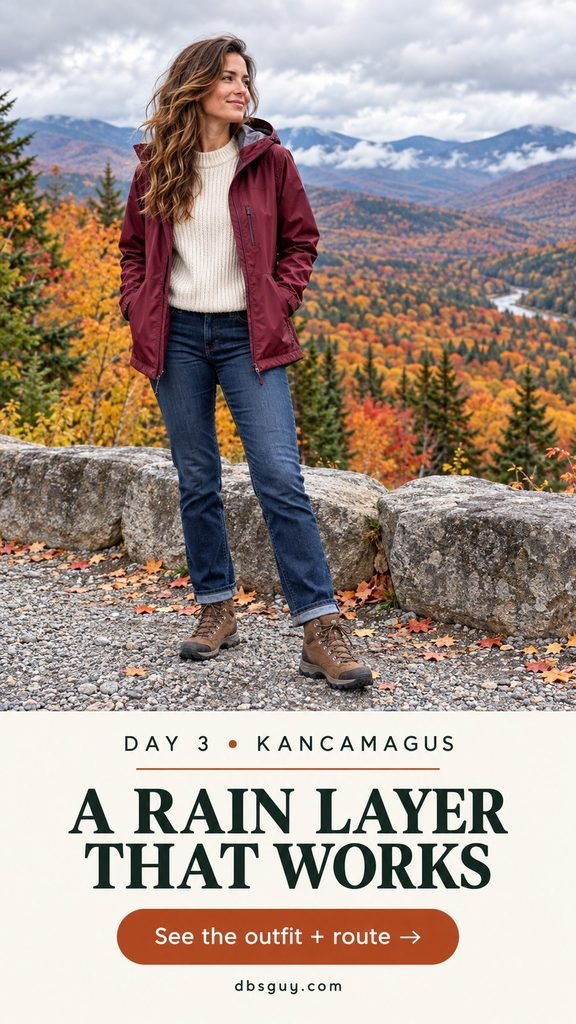
Jeans suit short, mostly dry overlook visits. For a wet forecast or a longer walk, repeat yesterday’s quick-drying hiking trousers instead. Check Forest Service alerts before leaving and the recreation-pass guidance for your chosen parking areas; some developed sites require a pass. Use marked parking and keep photographs out of the travel lane.
Day 4: Lincoln to Stowe with a barn-jacket reset
Drive: Roughly 2–2½ hours via I-93 north, I-91 north, US-2 west, and VT-100 north. Sleep: Stowe, first of two nights.
This is a transfer day with room for an unhurried lunch. Follow the main-road route into Vermont, then spend your afternoon exploring Stowe village on foot. Check in before planning extra drives so a pretty roadside stop does not turn into a late arrival.
Wear: Your striped shirt and black trousers again, this time with an olive barn jacket and ivory sneakers. A jacket with room for the cardigan underneath gives you an extra option for the evening. Keep accessories simple; the contrast collar and stripes already add interest.

Choose a jacket length that feels comfortable while seated. A stiff, tight layer can look lovely standing up and become annoying after an hour in the car. Keep the rain shell accessible even if the barn jacket is the outfit’s visual centerpiece.
Day 5: A Stowe path day with a beanie and practical layers
Drive: Local trips only. Sleep: Stowe, second night.
Use your no-transfer day for a slow breakfast and a section of the Stowe Recreation Path. The town describes the paved greenway as 5.3 miles long. That is the full path’s length, not a required walk: choose a comfortable out-and-back and turn around when you have used half your available walking time.
Wear: A fresh base layer, the green fleece, black hiking trousers, brown boots, and the rust beanie. Carry water and the shell in your daypack. This repeats your practical mountain pieces on purpose; the soft hat and open meadow setting give the look a different mood.
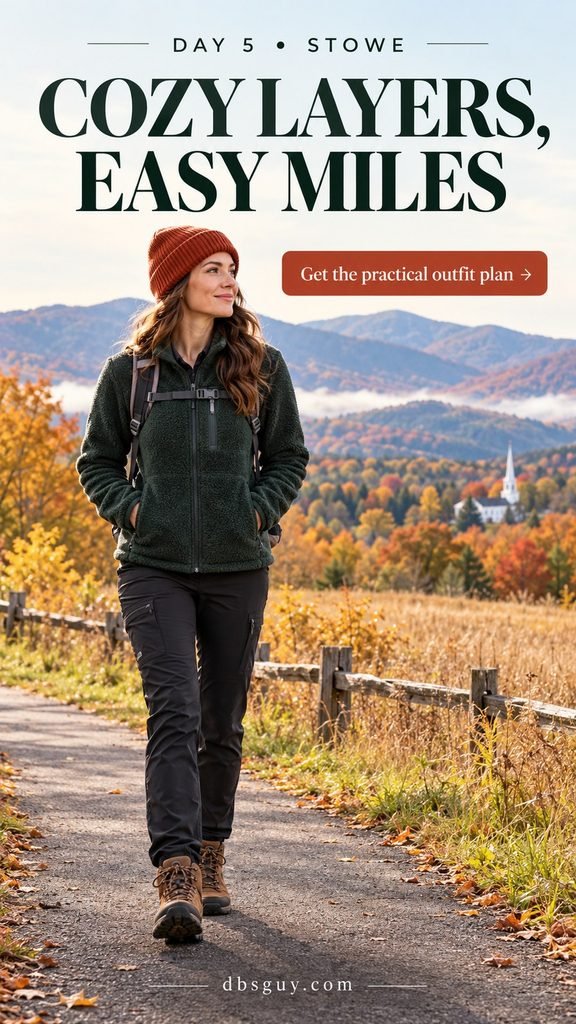
On a dry day, comfortable sneakers are also suitable for your paved-path plan. Keep boots for wet conditions or any unpaved detour. Leave the afternoon open for village browsing and a laundry reset. If low cloud hides the mountains, you still have a useful day without chasing a summit view.
Day 6: Route 100 to Woodstock in cream knit and denim
Drive: Roughly 2½–3 hours before stops using VT-100 south through Waterbury, Waitsfield, and Rochester, then US-4 east toward Woodstock. Sleep: Woodstock.
Make this your countryside drive. Pick one village lunch stop and a few legal pullouts rather than scheduling every town. Once in Woodstock, walk around the village green and view the covered bridge from public areas. Respect private drives and any posted access restrictions.
Wear: Your cream cable-knit sweater, indigo jeans, brown ankle boots with a low stacked heel, and a burgundy scarf. A crossbody works for a short village wander; keep the barn jacket in the car for the cool end of the day. The pale knit stands out against a busy foliage background without competing with it.

If you would rather walk than browse, review the Marsh-Billings-Rockefeller trail information and choose a route that fits your remaining time. Switch to your hiking trousers and hiking boots for a longer or damp woodland walk. Do not add a forest outing just to fill the schedule after a stop-heavy drive.
Day 7: Back to Boston in a comfortable travel outfit
Drive: Roughly 2½–3 hours from Woodstock to Boston via US-4, I-89, and I-93 before traffic or stops. Sleep: Boston if needed for your flight.
Have breakfast, pack the car, and keep the return simple. For an evening departure, add time beyond the driving estimate for traffic, fuel, rental return, airport transfers, and your airline’s check-in guidance. An early flight belongs after an extra Boston night, not at the end of a rushed drive from Vermont.
Wear: The striped shirt, camel cardigan, black stretch trousers, and ivory sneakers. Carry the burgundy scarf rather than wearing every layer in a warm car. Choose a waistband you can sit in comfortably and put a clean base layer near the top of your bag.

The final outfit intentionally echoes Day 1. Freshen the striped shirt during your Stowe stay, or pack a second similar top if you prefer not to do laundry. Photographing new combinations is fun; carrying clothes you will not use is less useful.
The packing list that makes all seven days work
Start with pieces you already own. These quantities support the pictured looks with repeated outer layers and a midweek refresh:
- Tops: One striped long-sleeve shirt, two lightweight base-layer tops, one cream sweater, one camel cardigan, and one green fleece. Add a spare striped or neutral top if skipping laundry.
- Bottoms: One pair each of indigo jeans, black stretch travel trousers, and black quick-drying hiking trousers.
- Outerwear: One olive barn jacket and one hooded waterproof shell that fits over your warm layers.
- Shoes: Comfortable walking sneakers and broken-in waterproof hiking boots. The separate brown village boots are optional; use your hiking boots on Day 6 to keep it to two pairs.
- Small essentials: Burgundy scarf, warm beanie, light gloves, walking socks, enough underwear, sleepwear, sunglasses, daypack, crossbody, water bottle, charger, and a bag for damp or dirty clothing.
Keep the shell, fleece, hat, and spare socks in an accessible day bag. Air out repeated garments overnight and wash base layers as needed. If the forecast is substantially colder than your layers can handle, add an insulated jacket; if it is warm, wear the base alone and carry the middle layer.
Questions worth answering before you leave
Can I wear jeans every day?
For dry village wandering and driving, yes, if they are comfortable. For a wet outdoor day, use the hiking trousers instead. You do not need a different pair of jeans for every photograph.
Do I need a new pair of boots?
No. Prioritize comfortable footwear you have already walked in. Check the tread and the manufacturer’s water-protection description for your existing pair; a rugged-looking boot is not automatically waterproof. Bring dry socks.
Can this trip work without serious hiking?
Yes. The core plan uses village streets, scenic overlooks, and a chosen section of a paved path. Individual stops can still involve uneven ground or steps. Check accessibility information for the exact locations you select.
Should I book lodging ahead?
For a fixed-date fall trip, booking your overnight bases ahead is the practical choice. Compare cancellation terms so your plans retain some flexibility. Keep optional sightseeing flexible even when the hotels are fixed.
Can I add Acadia, New York City, or the whole East Coast?
Those deserve more time or a different route. This seven-day plan gives New Hampshire and Vermont room to breathe. For a shorter trip, remove a destination rather than compressing every stop into longer driving days.
Choose your travel week, check the foliage reports, and lay out the repeatable pieces before packing. Each day then has two decisions already made: where you are going and what you can comfortably wear there.