
For a foliage-focused New York trip in October, spend one day in Central Park, one in the Hudson Valley, one in Brooklyn’s Prospect Park, and one in Fort Tryon Park. Keep the order flexible: give the clearest day to the Hudson River and follow current leaf reports for the city walks.
The timing matters more than the calendar label. New York City’s strongest fall color often arrives in late October or early November. An October trip can be beautiful without coinciding with peak foliage, and no four-day schedule can guarantee peak color everywhere.
This itinerary uses New York City as your base, with one car-free day trip to Cold Spring. It assumes four full sightseeing days, with arrival and departure outside that window. The suggested hours and walking distances are planning estimates, not booked departures or measured accessible routes.

The images are AI-generated travel concepts inspired by these destinations, not location photographs or reports of current foliage. Use the linked official maps for navigation.
When to go—and how to find the best color
If your dates must fall in October, the last week is a sensible starting preference for city foliage. Treat that as an editorial planning choice, not a forecast. Central Park can still be developing color then, while some places farther north may already be past their best.
Before committing to your daily order, check the I LOVE NY Fall Foliage Report for the Hudson Valley and the Central Park Conservancy’s live foliage tracker for individual park areas. A statewide report is more useful than an attractive photo with no date; a park-specific update is more useful than assuming all of Manhattan changes together.
- Early October: plan on plenty of green in the city. Keep the river excursion if local reports justify it, but do not assume Cold Spring is already at peak.
- Mid-October: use the reports to choose where to spend extra walking time. A mixed canopy can still make a lovely trip.
- Late October: prioritize city parks with good current color. If the Hudson Valley is past peak, make Cold Spring a scenery-and-village day or repeat your favorite city park instead.
Your four days at a glance
- Day 1 — Central Park: the Mall, Bethesda Terrace, Bow Bridge, and the Ramble; an easy Upper West Side evening.
- Day 2 — Cold Spring: Hudson Line train, waterfront views, Main Street, and a relaxed return to Manhattan.
- Day 3 — Prospect Park: Grand Army Plaza, woodland paths, the Lullwater, and a Park Slope meal.
- Day 4 — Fort Tryon Park: gardens, Hudson overlooks, and an optional visit to The Met Cloisters.
Choose a base near useful subway connections. Midtown near Grand Central simplifies the train day; the Upper West Side works well for the park-heavy city days. Compare the actual walking distance from your hotel to its station before booking. You do not need a rental car for this plan.
Day 1: Follow Central Park’s golden paths
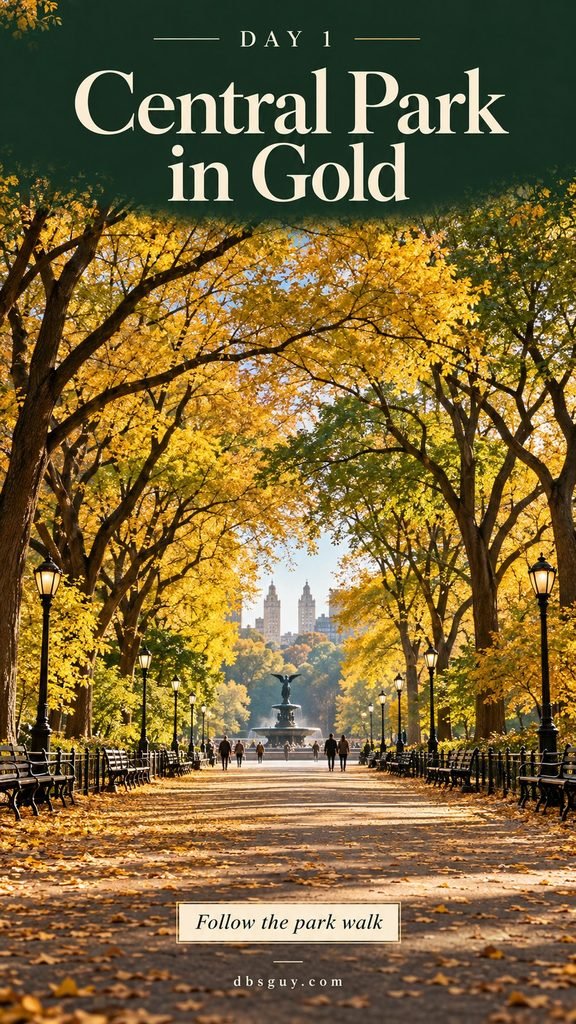
Suggested window: 9 a.m.–4 p.m., with a long lunch. Walking: roughly 3–5 miles across the day, depending on detours. The point is to linger, not cover the whole park.
Morning: the Mall, Bethesda Terrace, and Bow Bridge
Start near the southeast corner at Fifth Avenue and 59th Street. Walk into the park toward the Mall, then continue to Bethesda Terrace and the Lake. This sequence lets the scenery build from tree-lined promenade to water and bridge views without repeatedly crossing Manhattan.
Allow about two hours for this first stretch, including photo stops. Around the Mall, look upward into the canopy; by the Lake, use water reflections and a few colorful branches to frame your shot. You do not need every tree to be orange for an autumn photograph to work.
Continue to Bow Bridge, then take a short loop through the Ramble if you are comfortable with winding paths, slopes, and uneven sections. Keep the official park map open: the Ramble is a place to wander slowly, not a shortcut when you are running late.
Afternoon: lunch and one deliberate choice
Exit toward the Upper West Side for lunch around the 70s. Afterward, choose either another hour by the Lake or an indoor visit at the American Museum of Natural History, checking admission and entry arrangements first. Trying to fit a full museum visit and every park landmark into one afternoon leaves little time for either.
If the tracker favors the north: replace the southern walk with the Pool and North Woods area. Enter near West 100th Street and build the morning around that smaller zone; do not add it to an already full southern loop. The Conservancy’s foliage map helps locate these areas.
Rain adjustment: shorten the park walk and give the museum more time. Stay on broad paved paths if wet leaves make woodland sections slippery. Finish with dinner near your hotel rather than adding another major transit journey.
Day 2: Take the train to Cold Spring

Suggested window: leave Manhattan around 8–9 a.m.; return in the late afternoon. Walking: about 2–3 miles for the village and waterfront, with uphill sections on Main Street. Reserve the clearest day of the trip for this outing.
Morning: Hudson Line views and the waterfront
Take a Metro-North Hudson Line train from Grand Central Terminal that stops at Cold Spring. Allow roughly 80–100 minutes each way as an initial planning buffer, then use the MTA schedule lookup or TrainTime for your exact date. Check both the outward and return journeys before leaving; weekend work can change the timetable.
Facing the direction of travel, the left side on the northbound journey usually offers the river-side view. Consider it a bonus if seats are available, not something worth missing your train over. Buy the correct rail ticket; a subway tap does not pay for this Metro-North journey.
Cold Spring’s station serves the walkable village, as the state tourism guide explains. After arriving, head toward the riverfront for open water and wooded hillside views. Spend the first hour here while you are fresh, then wander uphill along Main Street.
Afternoon: a slow village lunch
Choose a café or restaurant along Main Street, leaving time for a wait on a busy fall weekend. Browse a few shops, then return to the waterfront for another look as the light changes. The contrast with Manhattan is the attraction: more open sky, a smaller street scale, and a long river view.
This is a village-and-waterfront day, so it does not depend on a strenuous summit hike. Avoid adding a trail you have not researched just because a dramatic overlook appears in a social post. A mountain route needs its own time, conditions check, suitable footwear, and daylight plan.
Before boarding home: confirm the next two practical departures and leave time to reach the correct platform. Do not make a nonrefundable dinner or theater booking immediately after your estimated return.
If it is pouring or the hills are obscured: swap this day with a city day. If the entire trip is wet, skip the regional excursion and use the time for a museum and a shorter repeat park walk. You will lose less time in transit and keep the trip enjoyable.
Day 3: Find Brooklyn’s quieter autumn around Prospect Park
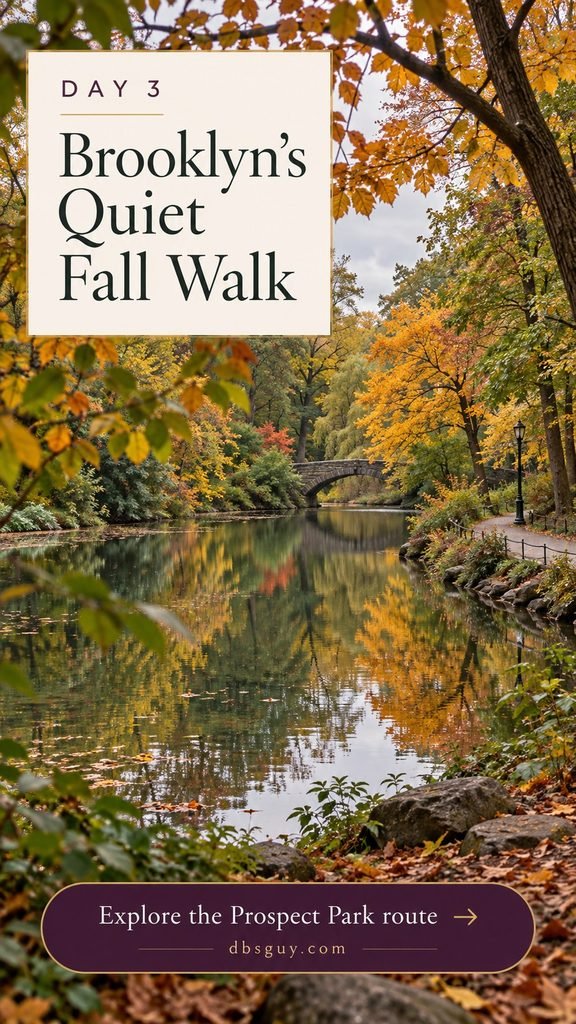
Suggested window: 9:30 a.m.–4 p.m. Walking: around 3–4 miles with a lunch stop. This day is for woodland texture and water reflections rather than Manhattan skyline views.
Morning: Grand Army Plaza to the Lullwater
Begin at Grand Army Plaza, then enter Prospect Park and follow the park map toward the Long Meadow. Continue through the central park landscape toward the Nethermead and the Lullwater area, using marked paths rather than trying to improvise a straight line through woodland.
The Prospect Park Alliance’s foliage walk highlights the Lullwater and Nethermead. Give these areas unhurried time instead of treating them as quick photo stops. Look for reflections in sheltered water and the contrast between leaves already turning and trees still green.
For a shorter outing, make the Lullwater your main destination and choose the closest practical entrance using the official park map. That is easier than starting with the full north-to-south approach and realizing halfway through that everyone is tired.
Afternoon: Park Slope and a relaxed meal
Work back toward the west side of the park and leave for lunch in Park Slope. Allow the afternoon to stay small: a meal, a few residential blocks, and perhaps another short park stop if the light improves. Brownstone streets add neighborhood atmosphere, but the park is the foliage anchor.
Rain adjustment: use the Brooklyn Museum as your indoor alternative if it is open that day; check its current calendar before choosing the day order. If it is closed, move an indoor day elsewhere in the city here rather than traveling to a locked door.
Do not automatically tack on the Brooklyn Bridge and DUMBO. They deserve additional transit and walking time, and this itinerary already gives you a full foliage day. Finish early enough to rest your feet before dinner.
Day 4: End above the Hudson at Fort Tryon Park

Suggested window: 10 a.m.–3 p.m., plus travel from your base. Walking: roughly 2–3 miles, with hills and possible stairs depending on the paths you choose. Keep the evening light if you depart the next morning.
Morning: gardens and river overlooks
Travel to Fort Tryon Park in Upper Manhattan. Use the directions linked by The Met Cloisters and check current subway or bus service before setting off. Budget about an hour from many Midtown starting points, with extra time for the walk into the park.
Begin around the Heather Garden and continue toward river-facing paths and overlooks. The appeal here is the breadth of the view: nearby leaves, the Hudson, and the wooded Palisades beyond. In hazy weather, concentrate on the garden paths and foreground trees instead of expecting a crisp distant panorama.
Bring water and a snack, or eat before arriving. Keeping a simple food plan helps you enjoy the park without turning lunch into an unexpected detour.
Afternoon: an optional Cloisters visit
Allow about two hours for The Met Cloisters if medieval art, architecture, and gardens interest you. This is the trip’s most natural indoor pairing. At the time of checking, the museum lists 10 a.m.–5 p.m., closed Wednesdays; verify the official page for your date, ticket terms, and accessibility details. If Day 4 falls on Wednesday, move this entire day earlier or enjoy the park without the museum.
The park can also be a satisfying shorter finale on its own. If you have a same-day flight, do not treat the 3 p.m. finish as permission to book a tight departure: luggage collection and airport travel need a separate buffer based on your airport and airline.
Practical details that make the trip easier
What to pack
Bring comfortable broken-in walking shoes, removable layers, a light rain shell, and a warmer layer for sitting beside the river. Add a compact umbrella, refillable water bottle, and phone battery. Check the actual forecast before packing; an October average cannot tell you how cold a windy waterfront will feel during your visit.
What to reserve—and what to leave flexible
Book accommodation and any must-see performance first. Check museum operating days before assigning the park days, then reserve admission where required. Keep the Cold Spring day flexible until the short-range forecast is useful. Verify rail fares and current museum prices on their official pages rather than building your budget around an old screenshot.
The main outdoor walks do not require an attraction package. Your spending categories are accommodation, local transit, the separate Metro-North round trip, meals, and optional museum admission. For a lower-cost version, bring a picnic, choose one paid museum, and spend more time in the parks.
Walking less
Choose one focal area in each park instead of the complete route, use buses or taxis to reduce approaches, and plan a seated break before you need one. These routes are not audited step-free itineraries: woodland paths, slopes, station access, and temporary closures can affect suitability. Check the destination’s access information for your specific needs.
Questions to settle before booking
Is October or November better for peak foliage in NYC?
Late October and early November are both worth considering for city color. If peak leaves are your main reason to travel, keep November in the comparison instead of assuming October is always better. Current reports should decide where you walk once you arrive.
Can I do this itinerary without leaving New York City?
Yes. Replace Cold Spring with a second Central Park visit, using the tracker to explore a different area from Day 1. You will miss the small-town river excursion but gain a slower pace and avoid the regional rail fare. The other three days stay within NYC.
Will four days cover all of New York’s major attractions?
No. This is a fall-focused itinerary, with time deliberately given to trees, water, and neighborhood walks. If the Statue of Liberty, several observation decks, and multiple museums are priorities, replace a park day or extend your visit rather than squeezing them all into the evenings.
What if the leaves have barely changed?
Use the same route for the parks, river scenery, architecture, and museums, then let current reports guide any extra leaf-peeping. Seek individual colorful trees and reflections. Do not spend the trip chasing a promised peak date that the weather has not delivered.
Your final planning step: check foliage reports, weather, museum days, and return trains a few days before departure. Assign the four days only after those pieces line up, and leave enough room to stop when you find the view you came for.