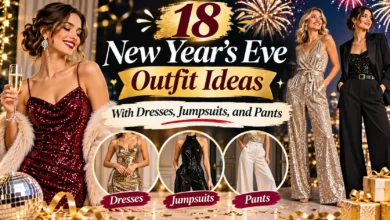
New Year’s Eve Dress Guide: Choosing a Style for Your Party’s Dress Code

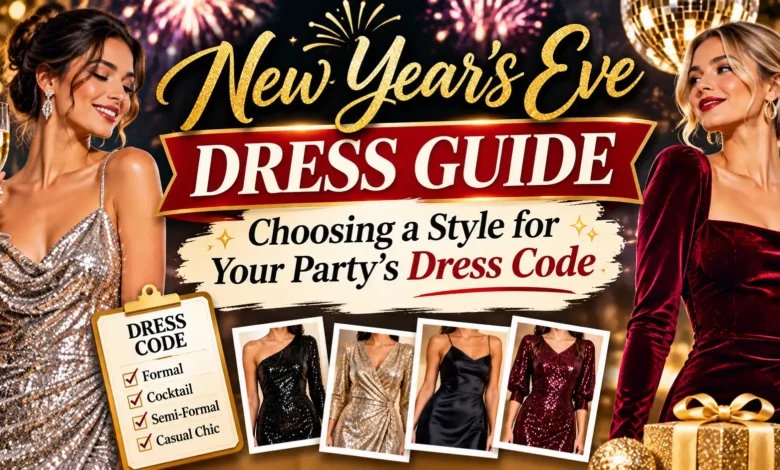
Choose your New Year’s Eve dress by the wording on the invitation first. For cocktail, start with a polished knee-length or midi dress. For festive, keep that level of dressiness and add color, shine, or texture. For black tie, a floor-length evening gown is the safest starting point. A relaxed gathering calls for a different decision altogether.
This guide focuses on dresses, with five dress-code examples and a cold-weather adaptation. Find your invitation below, then check the whole outfit against the evening you actually have planned: dinner, dancing, standing, and the trip home.

The visuals are AI-generated styling concepts. They illustrate outfit combinations rather than real products or garments we have worn or tested.
Read the invitation before choosing a silhouette
A hotel ballroom can host a cocktail party or a black-tie gala. A friend’s home can host a casual potluck or a dressed-up dinner. Use the venue as context, then follow the organizer’s instructions.
If the invitation says only “formal,” “party chic,” or “dress to impress,” ask a concrete question: “Would a dressy midi fit the evening, or are you expecting floor-length gowns?” That tells you more than asking whether people are dressing up.
The Emily Post attire guide distinguishes dressy casual, semi-formal, festive, and black-tie options. These are useful starting points; a host’s explicit requirements still need your attention.
A theme is another layer of instruction. “All-black cocktail” asks for both the color and the formality. A masquerade mask alone does not tell you whether to wear a mini or a gown. Confirm the underlying dress code before choosing the themed detail.
Dressy casual: a knit midi for a relaxed gathering
For an invitation that specifically says dressy casual, try a charcoal long-sleeve knit midi with opaque black tights, polished ankle boots, and small gold hoops. The simple shape leaves you comfortable room to settle into a sofa or move between the kitchen and the table.
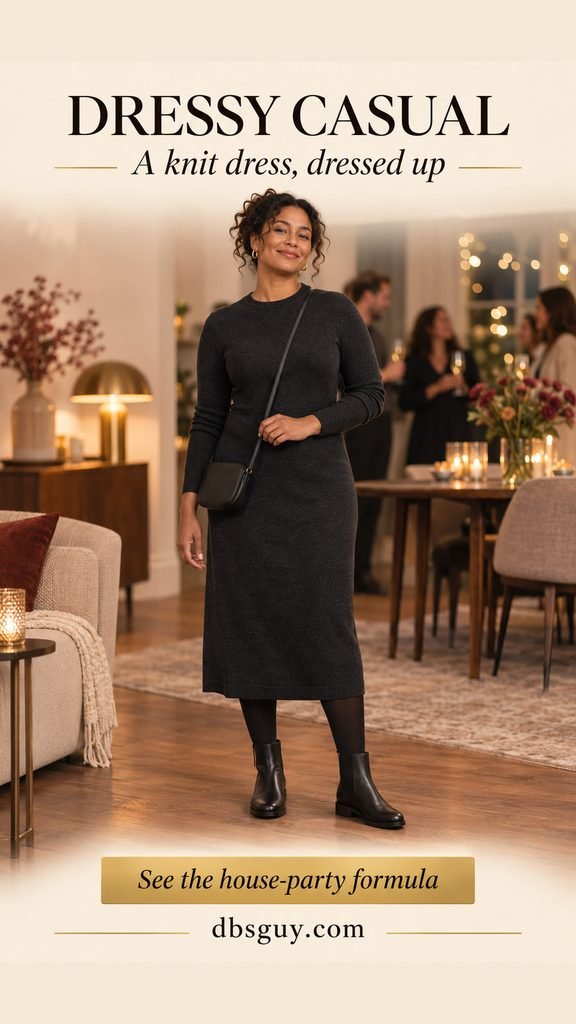
Look for a knit that hangs smoothly when you stand and remains comfortable when you sit. Check for transparency and pulling across the hips in the actual dress. If the skirt rides up every time you take a seat, try a roomier cut rather than spending the party tugging it down.
Keep a small crossbody bag if you will be helping with food or carrying a plate. At a shoes-off home, ask about that in advance and choose tights or socks you are happy to have on show.
This is a relaxed-party suggestion. Save it for a gathering whose stated expectations suit knitwear; use the next sections when the invitation calls for eveningwear.
Cocktail or semi-formal: choose a dress with an evening finish
For a typical evening cocktail or semi-formal invitation, a knee-length or midi cocktail dress is a useful starting point. Pay attention to construction as well as length: the neckline, fabric, fit, and accessories should work together.
Our example is a matte black crepe dress with a square neckline, broad straps, a defined waist, and an A-line skirt ending just below the knees. Silver block-heel pumps and a compact black clutch give the plain dress a clear evening finish.
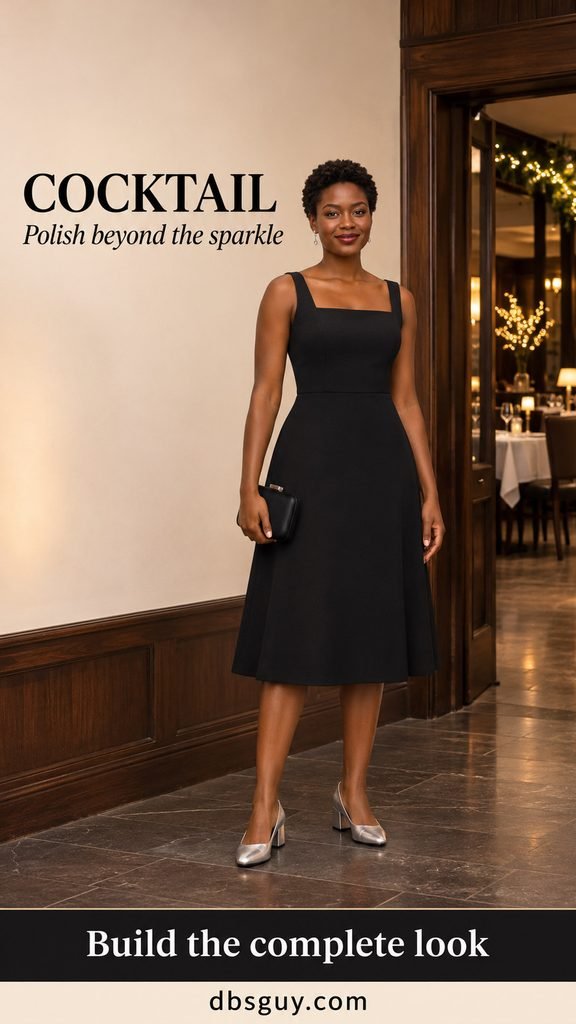
That skirt shape is worth trying if you prefer more room for a walking stride. During a fitting, sit down, reach forward, and lift your arms. Check that the neckline stays where you want it and that the straps work with your preferred bra.
For a dinner followed by dancing, test the shoes with the dress before committing to the pairing. Dressy flats are also an option; choose the pair you can comfortably stand and move in. A mini may fit some cocktail parties, but confirm the expectations if the event is conservative or work-related.
Also read: 13 College Formal & Semi-Formal Outfits: Dresses That Win the Night for more comparisons of cocktail dresses and gowns.
Festive attire: add a celebratory detail to a cocktail look
Festive attire generally means cocktail-level clothing with a holiday touch. You can bring that touch through sequins, a rich color, or a decorative accessory. You do not need to add all three.
Here, a silver sequin midi carries the sparkle. A scoop neckline and simple sleeveless shape keep the outline easy to read, while black ankle-strap pumps and a small black clutch give the eye somewhere quieter to land.
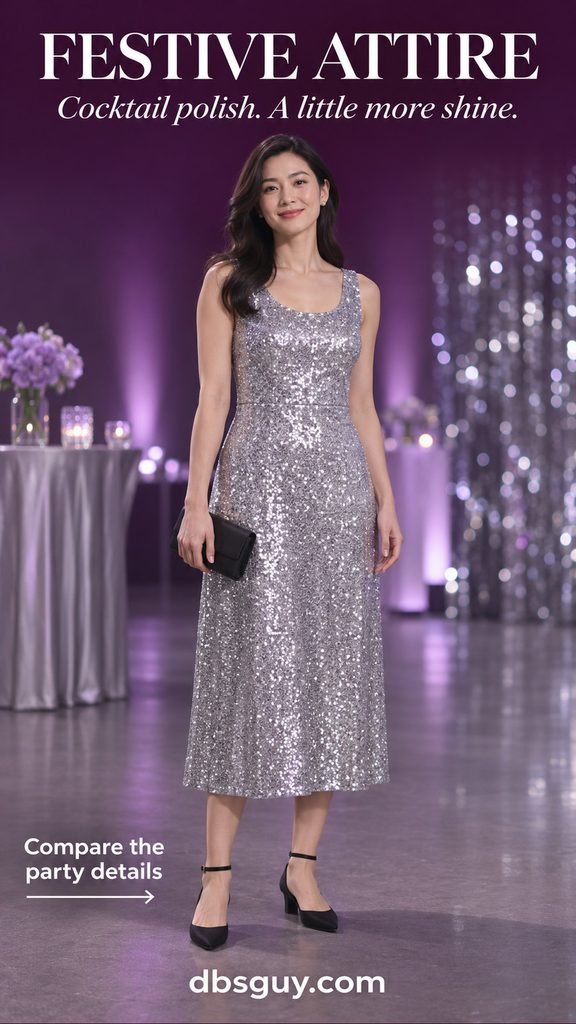
Before choosing a sequined dress, check the lining, armhole edges, and the surface that touches your inner arms. Move your arms as you would while dancing. An edge that already scratches in the fitting room deserves another option.
If you dislike wearing sequins, use a cocktail dress you already own and add one festive detail, such as metallic shoes or crystal earrings. Treat that as a styling choice, not a rule limiting how much sparkle you can enjoy.
For an office-connected celebration, consider the workplace context as well as the party label. Check coverage and fit while seated, and choose details you will feel comfortable wearing around colleagues.
Black tie optional: keep the dress unmistakably eveningwear
Black tie optional gives you room to choose a formal gown or a sufficiently dressy cocktail outfit. “Optional” allows alternatives within a dressed-up evening setting; it does not make the gathering casual.
An ankle-length navy satin dress offers a practical middle direction. In this concept, a crystal-trimmed neckline, fluid cape sleeves, and a softly flared skirt supply the detail. Silver pointed shoes and a small evening clutch finish the look without a full floor-length hem.

If you want arm coverage, try this sleeve shape and check how it behaves when you reach for a glass or sit at a table. Coverage is useful only if the garment still lets you move comfortably.
Look at the complete outfit before deciding it meets the code. A long everyday dress with a casual bag will read differently from an evening dress with considered accessories. If the organizer expects gowns despite the optional wording, you want to know before arranging alterations or buying shoes.
Black tie: start with a floor-length evening gown
A floor-length gown is the most straightforward choice for a traditional black-tie New Year’s Eve event. Some hosts accept very dressy shorter styles, but confirm that flexibility before relying on it. The words “black tie” do not require your dress to be black.
Try an emerald satin gown with a boat neckline, short sleeves, and a restrained A-line skirt. The rich color gives this example its festive character; a small gold clutch and drop earrings are enough to complete the combination.

Have the hem assessed with the shoes you plan to wear. You should be able to take a normal step and approach stairs without stepping on the front. For a crowded dance floor, a manageable skirt without a trailing train is worth considering.
Check seated comfort too. A bodice that feels fine for a photograph can feel different through dinner. Try sitting back in a chair and reaching forward before deciding on the fit.
If the invitation says creative black tie, retain the eveningwear foundation while using the host’s theme to guide color or accessories. If it says white tie, ask for the event’s full requirements; that is a more formal code and needs separate planning.
Cold-weather plans: make the coat part of the outfit
Once you know the dress code, plan the time outside. A brief walk from a car and an outdoor countdown need different layers. Check the forecast, the venue’s indoor access, and whether you can check a coat or change shoes.
For a dressy casual or suitably relaxed festive gathering, consider a burgundy velvet midi with opaque tights, black knee-high boots, and a long camel coat. A scarf and gloves make the outer layer feel considered rather than hurried.

This is an outerwear example, not a separate dress code or a promise of enough warmth for every forecast. For prolonged cold, choose layers and weather-appropriate footwear for the conditions, even if that changes the outfit. Do not count on velvet or tights alone to keep you warm.
For a black-tie event, keep the gown as your indoor outfit and plan suitable outerwear around it. If you travel in different shoes, carry the evening pair and confirm there is somewhere to change. A thin decorative wrap can finish a look, but assess warmth separately.
Check the complete outfit before buying anything else
Start with the dress, shoes, and coat you already have. Borrowing or rewearing may solve the invitation without adding a whole new outfit. If you do shop, check the current return terms and leave time for any fitting or alteration work.
- Try the real underlayers. Check bra straps, lining, and transparency with the underwear you intend to wear. You do not need a particular type of shapewear to meet a dress code.
- Move through the evening. Sit, walk, reach, and try a few dance steps. Reconsider a hem, neckline, or closure that needs constant adjustment.
- Check the light. Look at the dress in ordinary room light and take a photograph. Notice any transparency or reflections you would prefer to avoid.
- Pack the actual bag. Make sure it closes with your phone, keys, cards, and anything else you need. A pretty clutch is less useful if your essentials do not fit.
- Try the coat over everything. Check that sleeves and embellishments fit comfortably underneath and that the coat closes when you need it to.
Questions about choosing a New Year’s Eve dress
What should I wear if there is no dress code?
Ask the host about the expected level of dressiness. For a ticketed event, check the event page and venue’s entry requirements. If you cannot get clarification, use the planned activities and venue as clues; avoid assuming every New Year’s Eve party expects cocktail attire.
Can I wear a black dress without sequins?
Yes. A well-chosen black dress can work at different levels of formality depending on its fabric, shape, and styling. For a festive party, add an accessory you enjoy. For black tie, check that the dress itself has the required eveningwear character.
Does a longer hem automatically make a dress formal?
No. Length is one part of the decision. Fabric, construction, and the complete outfit matter too. An everyday knit maxi and a structured evening gown can reach the same point while serving very different occasions.
Do I have to wear heels?
No. Consider polished dress flats or another suitable evening shoe if that works better for you. Try the dress with your chosen pair, especially when checking a long hem. Comfort and a coordinated finish matter more than choosing a heel height you dislike.
Can I choose sleeves or a higher neckline?
Yes. Choose your preferred coverage while keeping the requested formality. For example, the navy evening dress above uses a high neckline and cape sleeves. Check that added coverage still gives you the reach and seated comfort you need.
Before you settle on the dress, put the invitation beside a photograph of the complete outfit. Confirm the code, then check the parts of the evening that a photograph cannot show: sitting, walking, warmth, and the trip home.
Also Read
- 15 Gold Jewelry Ideas for the Holidays — for a finishing detail when your dress is simple.
- 15 New Year Nails Simple Enough for a Quiet Countdown but Cute Enough for a Party — for a manicure to pair with the outfit you choose.