
The best way to use vintage textiles as wall art is to choose the support before the styling: frame a small doily on a fabric-covered mount, give a sound tapestry even support across its top, and hang a sturdy quilt from a properly fitted sleeve. If a textile is brittle, torn, or shedding, pause before hanging it. A beautiful wall should not come at the expense of the piece you love.
From there, keep the room simple. One strong textile, a little breathing room, and a color repeated elsewhere are usually enough. These four approaches cover delicate lace, a substantial tapestry, a whole quilt, and a small surviving quilt block—with practical ways to make each feel at home today.

The images in this guide are AI-generated styling concepts, not photographs of completed installations. Hidden supports are described in the text; the images are not construction diagrams.
First, decide what your textile can handle
Lay the piece on a clean, supported surface and look at both sides. Check the upper edge, seams, and any areas that would carry its weight. Splitting silk, powdery fibers, loose patches, and stretched holes are reasons to consult a textile conservator rather than try a hanging hack. Do not pull an old textile taut to see whether it is strong.
- Small, lightweight, and stable: consider a fabric-covered rigid mount inside a frame.
- Large and structurally sound: consider a full-width hanging support appropriate to its weight.
- Fragile, valuable, or irreplaceable: ask a textile conservator about supported display. A photograph or reproduction can provide the everyday wall display while the original rests.
Record any known maker, date, family history, or place of origin before mounting. Keep that information with the piece. Describe an unknown textile honestly; a faded palette alone does not identify its age or cultural origin.
1. Frame a doily so the lace becomes the artwork
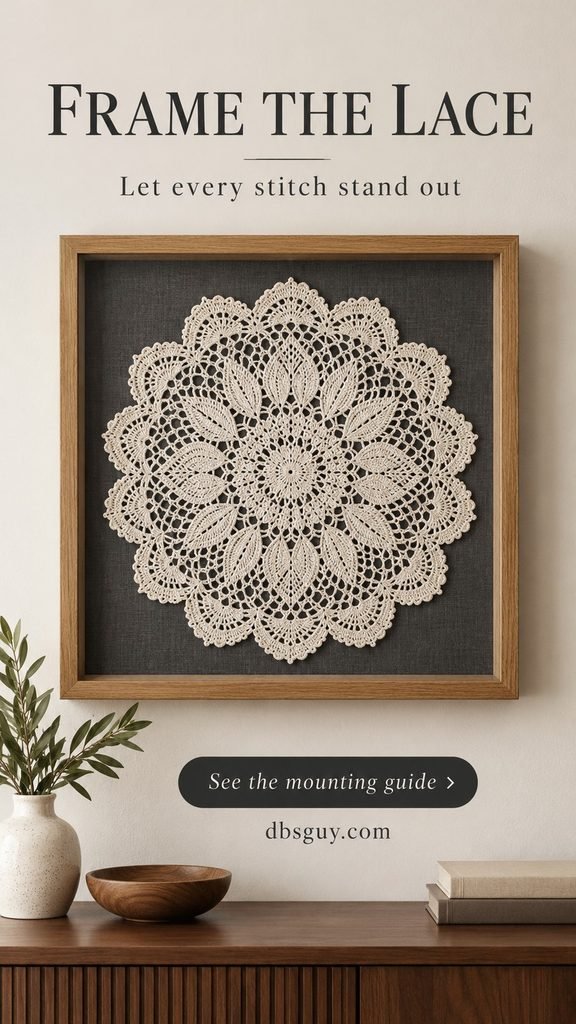
A single doily works especially well when its outline is beautiful: a scalloped circle, a starburst, or a carefully worked floral center. Give it a plain backing so the open stitches remain visible. Here, ivory crochet against muted charcoal reads as a graphic shape, while a slim oak frame keeps it warm.
As a styling starting point, leave about 2–3 inches of visible backing around the doily. For a piece roughly 10 inches across, that suggests a frame with an interior display area around 14–16 inches square. Measure the actual frame opening and depth before buying; the label on a frame does not tell you whether thick crochet will clear its glazing.
What to ask a framer for
Ask for a conservation-appropriate rigid backing covered in suitable washed fabric, discreet stitched support, and enough space between the textile and glazing. The Canadian Conservation Institute’s guide to mounting small textiles explains fabric-covered supports and stitching methods. Colored backing fabric needs to be colorfast; an attractive scrap is not automatically a suitable mounting material.
For a sound, inexpensive piece you choose to mount yourself, gather the frame, appropriate support board, washed backing fabric, a fine needle, and suitable thread before starting. Lay the doily naturally on the backing, without stretching. Use discreet support stitches in sound areas, following a mounting guide suited to the textile; do not rely on a single attachment at the top. If you cannot identify secure stitching points, have it mounted professionally.
Skip hot glue, spray adhesive, and pressure from sandwiching the lace between glass. An embroidery hoop also puts tension on the fabric, so it is not the default choice for an inherited doily.
Hang the finished frame where someone can get close enough to enjoy the stitches. A quiet corner beside a chair is a good fit; our cozy reading nook ideas for small spaces can help you plan the surrounding seating without crowding the wall.
2. Let a tapestry be the room’s main focal point

A tapestry brings its own composition, so treat it like a large painting. The botanical example here uses faded olive and ochre beside a simple chair. A plain wall allows the woven scene to hold attention without competing wallpaper, shelves, or several smaller artworks around it.
Before choosing the wall, measure the entire textile, including fringe. Tape up a paper outline of that size and view it from the doorway and the usual seat. Keep the lower edge clear of chair backs, lamps, and anything that might rub against it. A tall, narrow piece can suit an awkward wall better than a broad hanging forced into the same space.
Support the width, not just the corners
For a tapestry strong enough to carry its own weight, a properly constructed hook-and-loop support can spread the load across the top. In the CCI hook-and-loop mounting system, the soft strip is first machine-sewn to cotton tape or a sleeve; that carrier is then hand-stitched to the textile. It is not adhesive-backed fastener pressed onto old fabric.
The matching wall support must be sized and secured for the textile and wall construction. A heavy tapestry may need a custom system, so provide the installer with its dimensions, weight, and condition. The CCI method is intended for sound textiles that can support themselves, not very thin or weakened pieces.
Avoid hanging an old tapestry from two corner clips or driving tacks through the weaving. A piece can appear secure while its upper corners slowly distort.
Repeat one quiet tapestry color in a cushion or ceramic piece, then stop. If you prefer spare rooms and natural finishes, our Japandi living room ideas offer useful background choices for letting a detailed textile stand on its own.
3. Display a whole quilt as a large piece of art

A quilt’s patchwork can do the work of a large abstract painting. In this concept, rust, navy, and cream star blocks stand out against a sage wall above a low bench. The uninterrupted border matters: it lets the viewer read the quilt as a complete composition.
Choose a location where people will not lean against it and pets cannot easily reach the lower edge. Check the wall throughout the day for patches of direct sun. A bedroom wall opposite the bed can be easier to view and keep clear than a spot directly behind pillows.
Use a sleeve that carries the top evenly
The CCI quilt-care guidance describes a hand-stitched sleeve at the top with a rod supported on wall brackets. Have the sleeve fitted to the rod with enough room for its thickness so the quilt hangs without a ridge or pull across its face. Use suitable isolated or sealed support materials rather than placing old fabric against raw wood.
For an heirloom, ask a textile conservator whether the backing and seams can accept a sleeve. The presence of a strong binding does not prove that the interior fabric can tolerate hanging. Do not attach the weight to a few safety pins, and do not assume a commercial clamp is appropriate just because it is sold as a quilt hanger.
Keep nearby bedding or upholstery mostly solid so the quilt remains the focal point. Our sage green bedroom ideas are useful if you want a muted backdrop for warm patchwork colors.
Plan for temporary display rather than treating hanging as permanent storage. Take a clear condition photo before it goes up, and check for new sagging, pulled stitches, or fading when you inspect it. If the shape begins to change, take it down with support rather than tightening the mount.
4. Give a surviving quilt block a generous frame

You do not need a bed-size quilt to make textile art. An already-detached block, unfinished sample, or existing fragment can have a strong enough pattern to hold a small wall. The dusty-blue and cream block shown here keeps its irregular edges visible within a spacious walnut frame.
This is a way to display something that already exists separately—not a reason to cut up an intact quilt. An uneven edge can tell part of the object’s story. Avoid trimming it just to fit a standard frame.
Let the frame provide order while the fabric retains its character. Start with a backing border wider than the busiest patchwork strip, then adjust by eye. A very small block often looks better in a generous frame than in a tight frame that crowds every seam.
Ask for a supported mount that accounts for loose edges and any remaining batting. A shadowbox must be deep enough to keep the glass away from raised stitching. The support, rather than the glazing, should hold the textile in place. If the block is breaking down, a conservator may need to stabilize it before framing.
On a small chest or hallway wall, keep the nearby objects low so the frame stays readable. Store any maker’s information with the frame, without writing on or sticking a label to the textile itself.
Placement and care that protect the finished display
Choose a low-light, stable location. Keep vintage textiles away from direct sunlight, steamy bathrooms, cooking splashes, radiators, and fireplaces. UV-filtering glazing is worth discussing with a framer, but it does not make a sunny wall safe. Visible light also matters.
Give originals time off the wall. The Smithsonian explains why it rotates light-sensitive objects, including textiles. At home, establish a display-and-rest plan suited to the piece rather than waiting for obvious fading. Light damage cannot be undone by later storage.
Do not automatically wash a thrifted find. Unknown dyes, weak seams, and mixed materials complicate cleaning. In particular, the Smithsonian’s care guidance for Victorian silk quilts cautions against cleaning methods that put fragile silk under stress. Ask for textile-specific advice before wet cleaning, dry cleaning, steaming, or stain treatment.
Inspect the mount as well as the front. Look for loose hardware, dust accumulation, insect activity, and changing shape. Support a textile fully when taking it down. For storage choices, the Smithsonian’s antique textile guidance explains why sharp folds and unsuitable hanging can harm fragile cloth.
Questions before you hang vintage textiles
Can I use removable adhesive strips?
Do not put adhesive strips directly on a vintage textile. For a framed piece, any wall-hanging product must be compatible with the frame, wall finish, and total weight, and installed according to its manufacturer’s directions. An old textile’s mounting needs do not change because the home is a rental.
Should a doily touch the glass?
No. Choose enough frame depth and spacers to separate the glazing from the raised stitches. The doily should be supported by its mount rather than flattened to hold it in position.
Can I hang a heavy or fragile quilt?
Those are different problems. A heavy but sound quilt may need a stronger, custom support; a fragile quilt may be unsuitable for free hanging at all. Have a textile conservator assess an important piece before choosing hardware.
How do I keep the room from looking overly vintage?
Let the textile supply most of the pattern. Pair it with a straightforward frame or unobtrusive mount, simple furniture, and a restrained palette. You do not need to surround an antique quilt with other antiques for it to belong.
Start with the textile you most want to see every day. Measure it, assess its condition, and choose a wall with suitable light before buying the frame or hanging hardware. The right display makes the craftsmanship easier to appreciate while respecting what the fabric can safely carry.