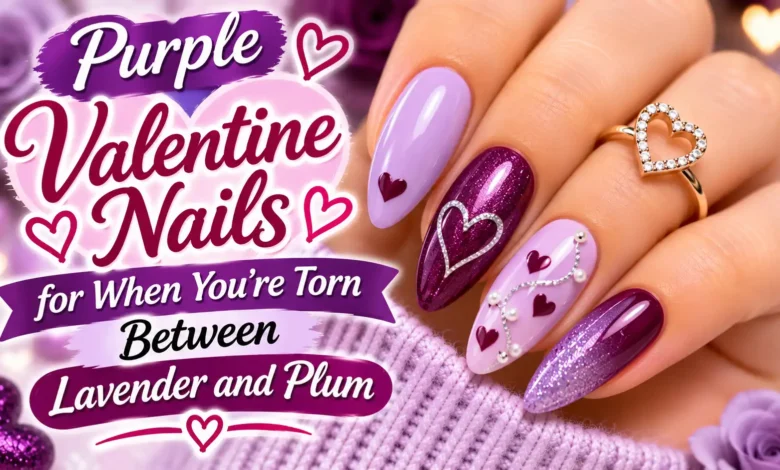
For purple Valentine nails, let lavender cover most of the set if you want a soft pastel manicure, or give plum the larger role if you prefer dark polish. If you keep changing your mind, use both: separate them across your fingers, blend them into an ombré, or put a crisp dividing line down each nail.
These six designs show what each choice looks like, with the color placement and salon details that make the difference. Start with the amount of purple you want to wear; choose the heart detail afterward.
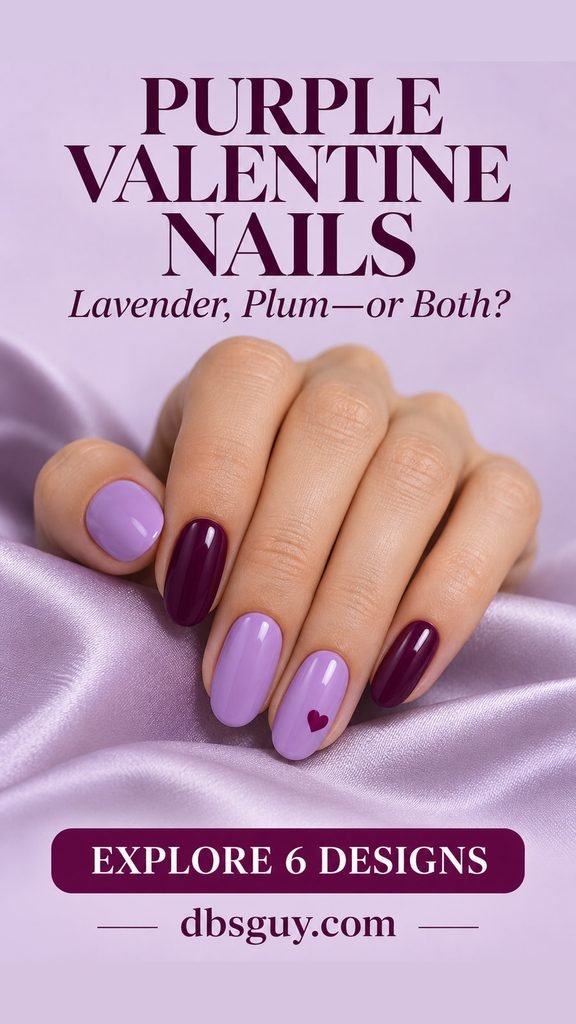
The images are AI-generated manicure concepts for dbsguy.com. They illustrate color, shape, and placement, rather than completed salon work or exact polish swatches.
Decide How Much Lavender and Plum You Want
Here, lavender means a light pastel purple, while plum means a deep purple with a berry cast. Those names vary between polish brands, so compare painted samples together instead of choosing from bottle names alone.
- Mostly lavender: Choose the single-heart design when you want the light shade to remain the first thing you notice.
- Mostly plum: Try the lavender-edged French manicure when dark polish feels more like your usual style.
- A visible share of both: Pick separate solid-color nails for the clearest comparison, ombré for a soft transition, or split nails for a defined boundary.
- Very little solid color: Keep the base sheer and use the two purples only in the hearts.
Look at your chosen pair beside your own hand in daylight and ordinary indoor light. If the lavender looks almost white or the plum reads almost black, decide whether you like that contrast before committing to the set. A lighter plum is a useful adjustment when you want the manicure to stay visibly purple.
1. Lavender Nails With One Plum Heart
A lavender base and one small plum heart give you both shades without making the whole hand look two-toned. The short squoval shape keeps the reference compact, while the dark accent is easy to pick out against the pastel.
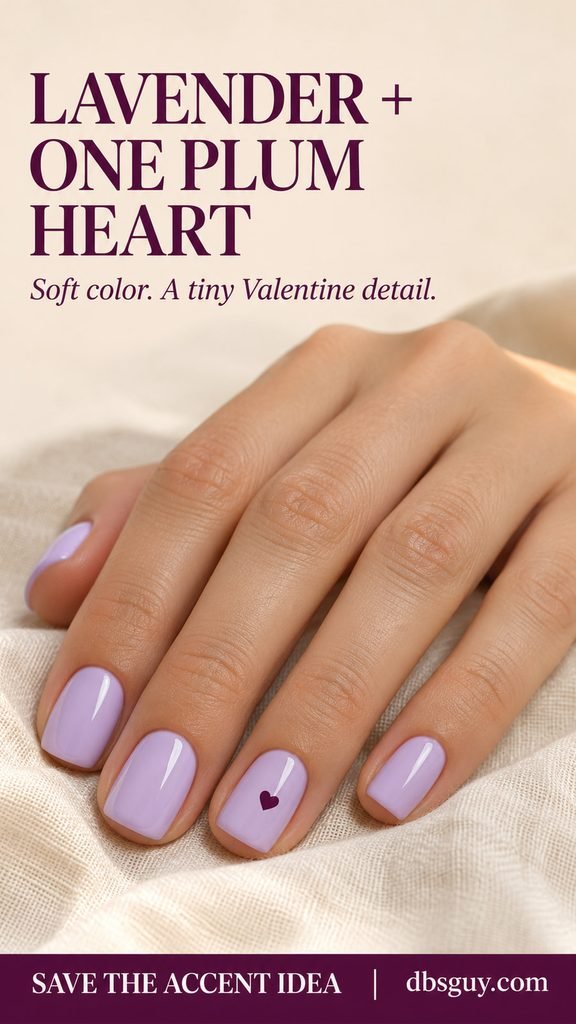
Place one filled heart on each ring nail and leave the other fingers plain. Keep a visible lavender margin around the symbol. On a very small nail, reducing the heart preserves the look better than enlarging it until it nearly reaches the sides.
This is the most approachable home-polish option here if you already paint solid nails comfortably. A small flat heart decal can replace freehand art. If you draw it, let the lavender dry first and make the heart with a small amount of plum polish; the shape should have two rounded lobes and a clear point.
Salon wording: “Short squoval nails in opaque lavender, with one small, flat plum heart on each ring finger. Glossy finish, no other artwork.”
2. Deep Plum With Lavender French Edges
Give plum almost the entire nail and reserve lavender for a narrow band at the free edge. The pale border makes the curve of an oval tip visible, so the manicure has a different structure from an allover dark set.

The reference adds one lavender heart near the base of the ring nail. Keep that heart separate from both the cuticle and the tip band. The space between those details lets the plum remain the main color.
Ask to see the first finished tip before your artist repeats it. A wide pastel band changes the balance quickly, especially on short nails. For less length, keep the edge shallow and use a smaller heart; medium ovals simply offer more room between the two details.
The detail to preserve: Plum should occupy most of the nail. Describe this as a plum base with lavender French edges, since “purple French” could also mean purple tips over a sheer base.
Also Read: Oval Valentine Nails With Soft Curves and Delicate Accent Art.
3. A Two-Shade Set With Separate Lavender and Plum Nails
If you want to see each color clearly, put the shades on different fingers. There is no blending or fine tip line to compete with the polish itself. The reference uses lavender on the thumb and two center nails, with plum on the index and pinky.
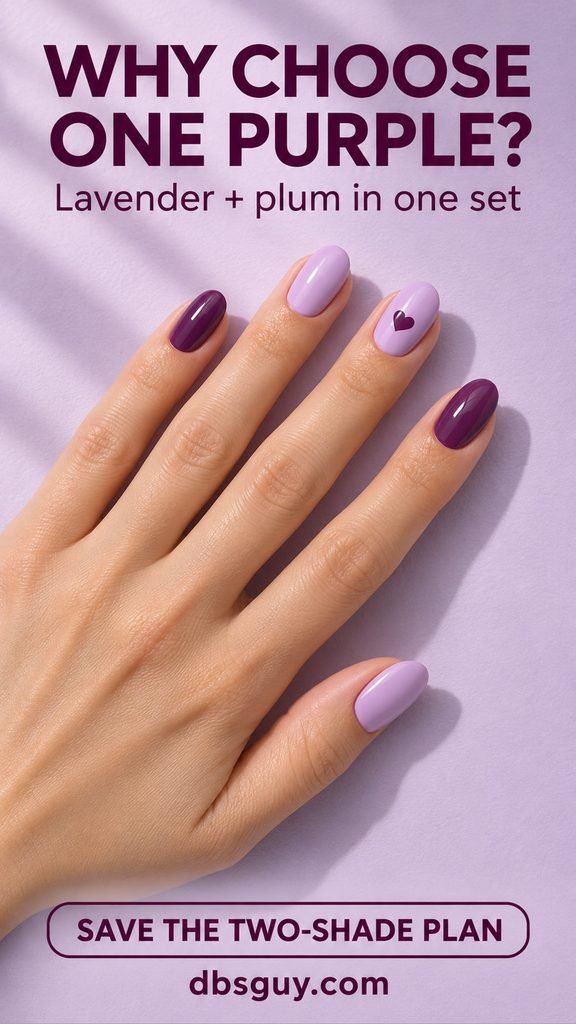
Three lavender nails and two plum nails give the hand a lighter overall balance. One little plum heart on the lavender middle nail connects the colors without introducing a third shade. Repeat that arrangement on the other hand if you want a coordinated pair.
Prefer the darker version? Reverse which shade goes on each finger, and make the heart lavender so it remains visible on plum. You can settle that decision by laying the two polish swatches in a three-to-two arrangement before painting.
For an at-home set, write down the finger order first. It is easy to lose track when switching bottles between hands. Keep the same glossy finish on both colors if you want the contrast to come from shade alone.
4. Lavender-to-Plum Ombré With a White Heart
Ombré lets both purples share every nail without a hard edge between them. In this version, lavender starts near the cuticle and gradually deepens into plum at the tip. A tiny white heart sits in the lighter area of the ring nail.

The transition is the part to discuss at the salon. Ask for the middle of the nail to show a blended purple, with enough lavender left near the base that the fade does not become an almost-solid plum manicure.
Medium almond nails give the transition room to stretch. On shorter nails, ask your artist to show how much space each shade will have before adding the heart. If the gradient already fills the nail visually, leaving the heart off is a reasonable simplification.
Bring this instruction with the reference: “Lavender at the cuticle, plum at the free edge, and a gradual blend between them.” The direction matters: reversing it produces a noticeably different set.
5. Sheer Nails With Paired Purple Hearts
You can wear lavender and plum without using either as a full base color. Start with a translucent neutral tint and put a little heart in each purple on two neighboring accent nails. The remaining nails stay plain and glossy.

Leave a small gap between each pair so the pale heart and dark heart remain separate shapes. The reference places them around the middle-to-upper part of the nail, leaving the base clear of artwork. Keep the hearts away from the sidewalls, where the curve can hide part of the design.
Choose the sheer tint on your own hand. The warm beige in the concept is one option, rather than a shade every reader needs to match. If you want more of your natural nail visible, ask for clearer coverage before the hearts go on.
On the shortest nails, use one accent nail per hand instead of two. That changes how much decoration you see while keeping the lavender-and-plum pairing intact.
Also Read: Minimalist Valentine Nails With Tiny Details and Plenty of Bare Space.
6. Half Lavender, Half Plum With a Crisp Center Split
For equal space rather than a soft fade, divide each nail lengthwise into lavender and plum halves. The straight seam is the feature here. One white heart straddles that seam on the ring nail, giving the geometric set a Valentine detail.

A medium squoval gives the two colors a broad, readable surface. Ask for the split to run from the base to the free edge, with the same color order repeated across the hand. “Half-and-half purple” alone does not explain whether you mean a vertical, horizontal, or diagonal division.
At your appointment, check the center line on one nail before the artist continues. Keeping the two halves close to equal is more important to this look than adding extra decoration. Skip outlining the seam or adding glitter if you want the clean division shown in the reference.
For short nails, preserve the lengthwise split and make the white heart smaller. You can also ask for the split on the two center nails and keep the others solid, if repeating it across every finger feels too busy.
Before You Book or Open the Polish Bottles
Save one design and identify the detail you want to keep: a tiny dark heart, a pale tip edge, separate solid shades, a soft gradient, open space, or a straight split. Bring a second image only if it clarifies a specific change, such as a shorter shape.
If you want to paint the little hearts yourself, ORLY’s heart-art guide shows a dotting-tool method. Let the base color dry before adding artwork, and allow the art to dry before finishing with top coat. Follow your own products’ application and drying directions rather than assuming every formula behaves alike.
The single-heart and separate-color sets are sensible starting points for home painting because most nails need only solid color. Fine French edges, smooth gradients, and precise split lines ask for more control. Choose a salon version if that detail is the part you most want to match.
Questions About Purple Valentine Nails
Should lavender and plum have the same undertone?
They do not have to, but compare them together. A blue-leaning lavender beside a visibly purple plum keeps the pair close in color family. A pinker lavender and berry-heavy plum create a warmer pairing. Choose the combination you like on your hand, rather than relying on the shade names.
Which design suits very short nails?
Start with the lavender single heart, separate solid-color nails, or sheer paired hearts. Each gives you a clear place to simplify. Keep the shape and length you find comfortable, and scale the artwork to the available surface.
Do these designs need gel or extensions?
The color layouts do not require extra length, and the solid-color and small-heart versions can be painted with regular nail polish. Your artist can discuss the medium for a more detailed version. Ask for the appearance you want first, rather than treating the concept image as proof of which products were used.
What if I still cannot choose between lavender and plum?
Pick the separate-color set. It gives each shade its own space and lets you adjust the overall balance by changing just one finger. Choose the lavender-heavy arrangement if you want the lighter version, or reverse it for more plum.