For a one-night Dolly Parton costume with fluffy bangs, a basic-cap synthetic wig is usually the better place to spend your money. A synthetic lace-front wig becomes worth considering when you want to sweep the hair off your forehead and have the hairline look convincing in close-up photos.
There is one important detail behind that answer: lace front describes how the wig is built; synthetic describes what its hair is made from. A wig can be both. The useful comparison is a standard-cap synthetic costume wig versus a synthetic wig with a lace front.
This guide compares those two choices for a Dolly-inspired costume. The recommendations are editorial judgments based on cap construction and care guidance; they are not results from hands-on product testing.

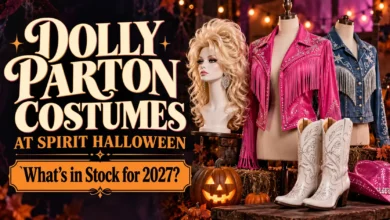
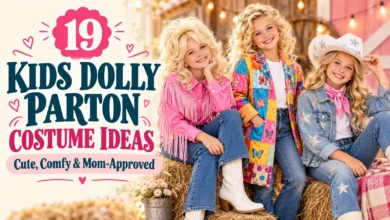
The images are AI-generated styling concepts, not photographs of products tested or sold here.
What the labels actually tell you
A basic or standard wig cap commonly uses rows of hair sewn onto strips called wefts. A lace-front wig has a sheer panel at the front, with hairs individually tied into it to suggest a growing hairline. The rest of that wig can still have a wefted back.
Neither label tells you everything about quality. Lace front does not automatically mean human hair, heat-safe fiber, a fully hand-tied cap, or a part you can move anywhere. Look for the cap construction and fiber listed separately.
For a helpful manufacturer explanation, Jon Renau’s synthetic wig guide distinguishes lace-front, monofilament, and open-cap features. Those are separate features you may see combined in one wig.
Basic-cap synthetic: the sensible choice for fluffy bangs
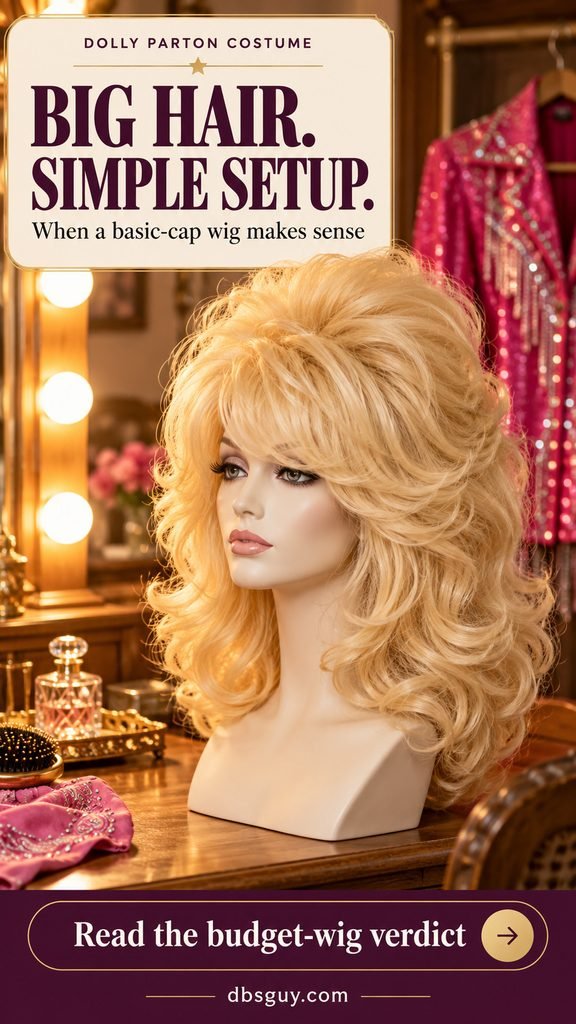
If your reference look has a high crown, soft bangs, and big blonde curls, the fringe already covers the place where the wig meets your forehead. Paying extra for a hairline you plan to hide may add little to the finished costume.
Start with a wig that already has the shape you want. For this look, a full, feathered fringe and layered shoulder-length curls are a more useful starting point than a long, flat wig you hope to transform on Halloween afternoon.
Where this option earns its place
- A single party: you want recognizable big hair without making the wig the largest part of your costume budget.
- A quick getting-ready routine: you prefer arranging bangs to working on an exposed lace edge.
- Group photos: the overall silhouette matters more to you than a detailed hairline close-up.
The trade-off appears if you push the bangs back: a basic front edge may become visible. Before buying, check side views and customer photos for sparse areas around the crown and temples. A very shiny finish or a cap that shifts can also distract from the look, regardless of the price.
Try this first: fit the cap properly before deciding that the bangs need cutting. Moving a poorly positioned cap changes where the fringe falls. If they still need shortening, ask a wig stylist to shape them while the wig sits in its intended position.
Also read: DIY Dolly Parton Costume Under $50 (Thrift Store Edition).
Synthetic lace front: the upgrade for an exposed hairline

A lace front addresses a specific detail: the transition between your forehead and the wig. That can matter when you want a swept-back front, an open forehead, or close-up costume portraits.
Choose it because you want to show that area. The word “lace” alone does not promise a better Dolly silhouette. A beautifully blended hairline on a flat, low-volume wig may still need more styling than a basic-cap wig that arrives with the right curls.
What to inspect before paying extra
Ask for a clear front view and a cap-interior photo of the exact style and color. Check how far the lace extends toward the temples, whether the front looks excessively dense, and how its tone appears against skin similar to yours. An edited studio image cannot establish how the edge will look on you.
Also confirm the parting area. A narrow lace front does not necessarily let you create a deep center part or move the part across the whole top. A full updo can expose the nape, which a front lace panel does not cover.
Installation varies. Some wigs have ready-to-wear lace; others have excess lace that needs trimming. Some are designed for a secure fit without adhesive, while others have different attachment instructions. Read the exact product directions before cutting, applying adhesive, or assuming “glueless” guarantees the right fit.
Worth it when: the visible hairline is central to your chosen look, you have time for a fitting, and the actual wig also supplies the volume you need. Repeated wear can make the expense easier to justify, but lace itself is not a durability guarantee.
Also read: Dolly Parton Costume Guide for a Fun and Authentic Look.
Compare the total cost, not just the wig price
Add up the wig, shipping, any liner or grip you need, suitable care products, and any professional fitting or styling. Count adhesive and remover only if your particular wig’s instructions call for them. A low sticker price loses its appeal if the wig needs several extra purchases to become wearable.
Here is a hypothetical budgeting example, not a current price comparison: a basic wig costing $30 plus $10 in extras totals $40. A lace-front option costing $75 plus $20 in extras totals $95. For one evening, that is an additional $55 to get the hairline you want.
If you actually wear the $95 setup five times, its purchase cost works out to $19 per wear. The $40 setup worn five times is $8 per wear. Neither calculation predicts lifespan; it simply helps you decide whether the visible difference is worth the premium to you.
For a bangs-covered party costume, put fit and the curl shape first. For an exposed-hairline portrait look, compare the lace-front premium with the value you place on that detail.
Before you order: a Dolly wig buying check
- Pick one reference hairstyle. Decide whether you want a feathered fringe or an open forehead. That choice makes the cap comparison much easier.
- Measure for the seller’s size chart. Use a soft tape and follow its measuring instructions. Adjustable straps fine-tune a fit; they do not make every cap the same size.
- Look for height and layers. In the concept images, lift at the crown and curls around the shoulders do most of the visual work. Extra length alone does not create that shape.
- Check the blonde in ordinary lighting. Compare daylight customer images when available. Choose the cream, honey, or pale blonde that suits your reference rather than relying on a color name.
- Read the fiber and heat instructions. “Synthetic lace front” does not establish whether a curling iron is allowed.
- Read returns before altering anything. Check conditions involving tags, try-ons, lace cutting, adhesive, and styling. Keep the packaging while you decide.
- Leave time for a trial fitting. Before a Halloween event, allow for delivery, a try-on, and a possible exchange. Use the seller’s current delivery estimate rather than a generic holiday cutoff.
Search terms such as “blonde synthetic wig with feathered bangs” or “voluminous blonde synthetic lace-front wig” can help narrow the choices. Then check the actual photos and specifications; a listing titled “Dolly wig” is not enough to establish its construction or quality.
Keep the volume without damaging the wig
Start with the manufacturer’s care sheet. For ordinary, non-heat-friendly synthetic fiber, keep curling irons, flat irons, and hot blow dryers away. Jon Renau’s standard synthetic-care directions also warn about heat sources such as open ovens. A heat-protectant spray does not turn ordinary synthetic fiber into heat-friendly fiber.
If the wig is explicitly heat-friendly, follow that model’s tool, temperature, and cooling instructions. There is no single safe temperature to apply to every synthetic wig.
For a first fitting, gently separate and arrange the curls with your fingers. If the maker allows backcombing, add a little lift beneath the crown and smooth the visible top layer over it. Avoid aggressive teasing around the lace and knots. Ask a wig stylist for a lifted crown and a soft front if the shape needs substantial work.
Detangle and clean according to the fiber’s instructions, then let the wig dry on an appropriate stand. Store it without crushing the crown or burying the curls under costume accessories. Good care helps preserve the shape you bought; it cannot guarantee a particular number of wears.
Questions worth answering before checkout
Can a lace-front wig also be synthetic?
Yes. Lace front refers to the front of the cap, while synthetic refers to the hair fiber. Check both fields in the product description.
Does a Dolly Parton costume need a lace front?
No. A well-fitting synthetic wig with full bangs can work well for a Dolly-inspired costume. A lace front is most useful when you want to show the hairline.
Will a lace front look more natural in every photo?
No. Fit, lace tone, hair density, lighting, and placement affect the result. Bangs can hide a front edge effectively, while a poorly fitted lace front can remain visible.
Do all lace-front wigs require glue or lace cutting?
No. Ready-to-wear fronts and attachment systems vary by model. Follow the maker’s instructions, and check return terms before making permanent changes.
Is human hair necessary for big Dolly-style volume?
No. A prestyled synthetic wig can supply the curls and crown height a costume needs. Buy the shape you want rather than assuming a fiber upgrade will create it.
Which wig is worth it for your costume?
Choose the basic-cap synthetic wig if you want fluffy bangs, a recognizable country-glam shape, and a sensible one-event budget. Consider the synthetic lace front if you want an exposed forehead and are willing to pay for a convincing front edge, fit it carefully, and follow its care directions.
The deciding question is simple: will anyone see the hairline you are paying to improve? Once you answer that, compare the cap fit, crown height, curls, and total cost of the actual wigs on your shortlist.
Also read: Last-Minute Dolly Parton Costume: 13 Things in Your Closet That Work.