
To split bills with roommates without the drama, agree on what is shared, choose a fair split for each expense, keep one visible record, and set a payment deadline before the bill is due. Put those decisions in writing. An app can calculate a balance; it cannot decide whether your roommate agreed to buy the expensive Wi-Fi plan.
Start with a short household meeting and the bills you actually have. The four steps below cover the rules, the math, the payment routine, and what to say when something goes wrong. There is also a fill-in agreement you can use together.

The visuals are AI-generated concepts that illustrate the planning process. All dollar amounts below are examples, not estimates of typical housing costs.
1. Agree on a fair split for each kind of bill
Bring the lease, the current utility bills, and a list of recurring subscriptions to the conversation. Check what rent already includes so you do not charge everyone twice for water, internet, or another service.
A useful opening is: “Can we decide how the household bills work before the next round is due? I want everyone to know the amount, the reason, and the deadline.”

Rent: account for the room you get
An equal split is a reasonable starting point when the rooms and arrangements are similar. If one person gets a larger bedroom, a private bathroom, or an exclusive parking space, discuss a different rent share before committing to the rooms.
For example, two roommates might agree to divide $1,800 in rent into $1,000 for the room with a private bathroom and $800 for the smaller room. Those amounts are a negotiated example, not a universal formula. Write down the final dollar amounts and check that they add up to the rent.
For a couple sharing a bedroom, separate the two questions: what is that room worth, and how many people share the household services? A room-based rent arrangement can coexist with per-person utility shares. Nobody should have to accept a new split after moving in simply because someone announces that it is “fair.”
Utilities and internet: choose a manageable rule
For ordinary shared use, splitting electricity, gas, water, and internet by the number of residents is a simple starting point. Follow any different arrangement in your lease or utility contract.
If someone wants a more expensive internet plan, ask whether the household wants it. One workable agreement is to divide the mutually approved base plan and have the person requesting the upgrade pay the difference. Discuss unusually high-use equipment before it starts affecting the bills; avoid inventing a surcharge from a guess about someone’s showers.
Groceries and household supplies: define what counts
Keep groceries personal unless everyone actively wants a shared food budget. Different diets, schedules, and appetites make a blanket grocery split easy to resent. A shared dinner can be its own agreed expense.
Make a short approved list for supplies, such as toilet paper, dish soap, and trash bags. Agree on a spending limit that suits your household—for example, getting approval before any shared purchase over $20. That is a suggested rule, not a required threshold.
Subscriptions, pet supplies, takeout, and furniture stay personal unless the affected roommates agree otherwise before purchase. For a jointly bought couch or appliance, also decide who owns it and what happens when someone leaves.
Also read: 23 Easy Microwave Recipes for Dorm Rooms: No Kitchen Needed for meal options when you are keeping food purchases separate.
2. Keep one shared record and calculate what is still owed
Choose one place everyone can access: a shared spreadsheet, a simple shared document, or an expense tracker such as Splitwise. Splitwise supports equal and unequal expense splits and balance tracking. Before choosing any app, check its current limits, costs, and payment options; you do not need a subscription to follow the spreadsheet method here.
A payment app moves money. A ledger explains why the money is owed. Even if your chosen tool does both, make sure everyone understands which action records an expense and which action actually sends a payment.
Record enough detail to check the bill
For each expense, record the purchase date or billing period, description, total, who paid the provider, who participates, each person’s share, and the reimbursement deadline. Attach the receipt or bill, covering unnecessary account numbers and other private details.
Track reimbursements separately, with the amount, sender, recipient, date, and payment status. A transfer between roommates settles an existing expense; it is not a new household purchase.
A three-roommate example without double counting
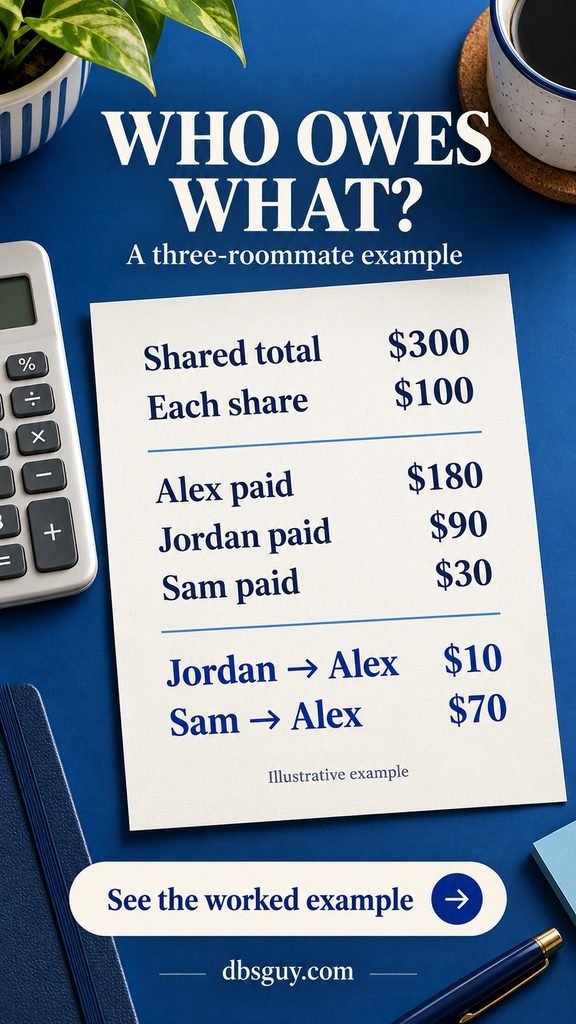
Alex, Jordan, and Sam split the following approved expenses equally:
- Alex pays the $180 electricity bill.
- Jordan pays the $90 internet bill.
- Sam buys $30 of shared household supplies.
The household total is $300, so each person’s share is $100. Compare that share with what each person has already paid:
- Alex: paid $180, which is $80 more than their share. Alex should receive $80.
- Jordan: paid $90, which is $10 less than their share. Jordan sends Alex $10.
- Sam: paid $30, which is $70 less than their share. Sam sends Alex $70.
After those transfers, each person has contributed $100 overall. Nobody owes another full $100 on top of the bills they already paid.
The calculation: agreed share minus money already paid toward the included expenses. A positive result means you still owe money; a negative result means you should receive money. Include each original expense once, and keep unrelated rent payments out of this calculation unless you deliberately included rent in the same ledger.
For unequal splits, calculate each person’s share expense by expense before adding their totals. Do not apply a bedroom-based rent percentage automatically to groceries or internet. If dividing creates a spare cent, assign it explicitly so the recorded shares match the actual bill.
3. Set a payment routine that does not rely on reminders
Give each bill a named coordinator who checks the statement, posts the correct shares, and confirms that the provider was paid. That person is handling the administration; the role does not require them to advance everyone else’s money.
Check the actual account arrangement too. A roommate assigned to collect reimbursements is not necessarily the person contractually responsible to the utility company or landlord.
Work backward from the provider’s deadline
Set the household collection deadline early enough for the chosen transfer method to clear. Check weekends, bank holidays, transfer limits, and any fee for faster availability. A balance appearing in an app does not necessarily mean it is already available in the bank account paying the bill.
For example, if a provider must receive payment by the 15th, the household might review the bill on the 8th and collect shares by the 10th—if that gives the chosen payment method enough time. Use the real processing time rather than treating these example dates as a guarantee.
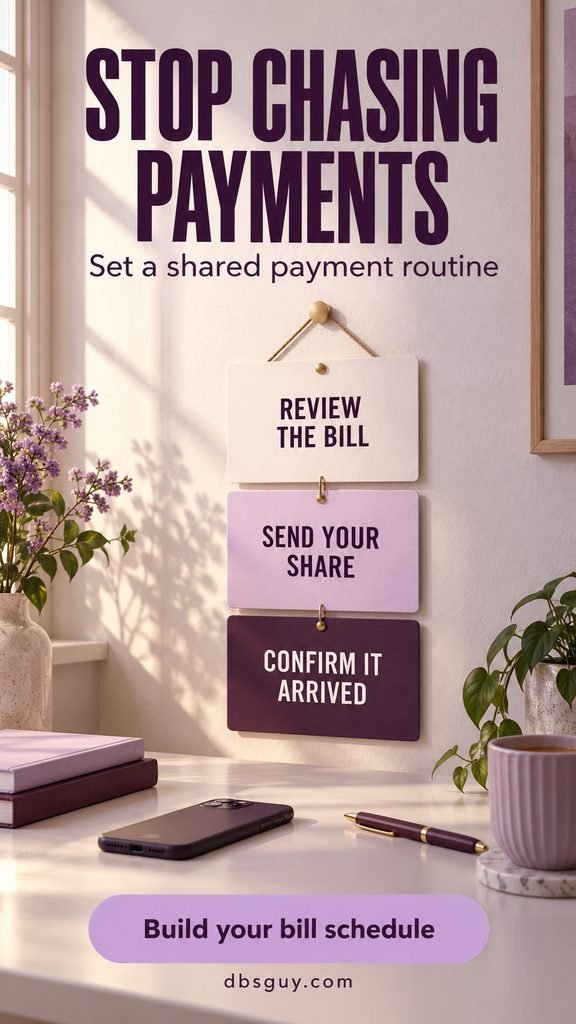
- Review: the coordinator posts the statement, billing period, split, amount owed, and collection deadline.
- Send: each roommate checks the amount and recipient, then pays using the agreed method. Use a clear note such as “October electricity.”
- Confirm: the recipient verifies the payment in their own account, updates the ledger, and keeps the provider’s payment confirmation.
Do not mark a balance settled just because someone says they sent it. Use “pending” until it can be confirmed. For cash, have both people acknowledge the amount and date in the shared record.
Automate the predictable parts
Calendar reminders work for almost any setup. A scheduled transfer can suit a stable rent share; variable utility bills need the current statement checked first. Before enabling autopay, confirm who funds the account and when that money must arrive.
Agree on who handles an actual late fee caused by a missed household payment, subject to the lease and applicable rules. Do not invent a penalty after the fact. Review the setup when a resident changes or the household agrees to a new service.
Also read: Freshman Year: The Complete Survival Guide for fitting bills, classes, and weekly spending into a workable college routine.
4. Handle late payments and changing plans with specific requests
Raise a problem with the person involved, using the bill and the agreement as the starting point. Avoid making a group-chat audience part of the punishment. State the amount, the deadline, and the next action you need.

If a payment is late
Try: “Your $60 electricity share was due yesterday. Can you send it today? If you cannot pay the full amount, please tell me what you can send and the date for the rest before tonight.”
If you can accept a short repayment plan, make it concrete: “Can you send $40 today and $20 on Friday?” Record the plan, then mark each payment when received. A plan between roommates does not extend the provider’s deadline.
If you cannot front the shortfall, say so promptly. Contact the provider or landlord before the due date to ask what options exist, without assuming an extension is available. For recurring nonpayment, keep records and seek campus mediation or local tenant advice. Mediation can help with a conversation; it does not erase an unpaid balance.
If someone disputes an expense
Try: “Let’s check the receipt and the rule we agreed on. Was this purchase approved, and did we include the right people?” Separate a calculation mistake from a purchase nobody authorized. Pay the undisputed portion on time while working on the disputed amount; do not assume the provider will pause its full bill during the discussion.
If a guest starts staying regularly
Start with the housing or lease guest rules, then discuss the practical change: “We agreed to split utilities between three residents. Your partner is now staying most nights. Can we review the guest rules and agree on a plan going forward?”
A proposed extra contribution should have an agreed start date and method. Paying toward utilities does not itself authorize someone to move in, and there is no universal number of overnight visits that settles the question for every lease. Avoid retroactive charges that nobody agreed to.
If someone goes away or moves out
For a temporary trip, a practical default is to keep agreed rent and fixed-service shares in place. Discuss any adjustment to usage-based costs in advance. A whole-home utility bill usually cannot tell you exactly what one absent roommate would have used.
For a mid-month move, agree which charges will be prorated, the effective dates, and how to handle bills that arrive later. For illustration, if everyone agrees to divide a $180 usage charge by resident-days, two people staying 30 days each and one staying 15 days create 75 resident-days. Their shares would be $72, $72, and $36. This is an optional household method, not a rule for rent or a substitute for the lease.
Check the contract before treating a move-out as the end of someone’s obligations. The University of Michigan’s Student Legal Services guidance explains that a lease with joint and several liability can leave each tenant responsible for the full rent if another does not pay. Your lease, account terms, and local law determine your situation; a private roommate split does not by itself change the landlord’s agreement.
Keep a forwarding contact, save the final statements, and agree how later utility charges will be reconciled. Record who contributed to the security deposit and how any return or deductions will be addressed under the lease and local rules. Do not assume the deposit can replace the final rent payment.
A fill-in roommate bill agreement
Copy these lines into a shared note and fill them out together. This is a household planning checklist; get appropriate local advice if you need an enforceable legal agreement.
- Household and start date: [Names, address, effective date].
- Rent: [Each person’s dollar amount, payment method, deadline, and any room or parking adjustment].
- Utilities and internet: [Included services, each split, account holder, coordinator, and provider due dates].
- Shared purchases: [Approved supplies, spending limit, and how approval is recorded]. Food and subscriptions are [personal/shared under these terms].
- Tracking and payment: We use [shared record]. Bills are posted [when]. Shares are collected [when, allowing for transfer time]. Payments are confirmed by [method].
- Problems: If payment will be late, contact [person] by [deadline]. We record any repayment plan and how actual late fees will be handled, subject to applicable rules.
- Changes and leaving: [Guest rules, travel arrangements, move-out dates, final-bill process, deposit contributions, and ownership of shared items]. Any change needs agreement from everyone affected before it takes effect.
- Review and acknowledgment: [Review date]. Each roommate saves a copy and confirms the agreed terms [names and date].
Roommate bill questions that come up often
Should roommates split everything 50/50?
Only when that matches the agreed arrangement. Equal shares can work for comparable rooms and ordinary shared use. Room differences, additional residents, and personal purchases may need different rules. Choose the method for each category rather than using one percentage for everything.
Should the roommate who earns more pay more?
An income-based split is an option if everyone freely agrees to it, but a higher income alone is not an agreement to subsidize the household. Start with the housing arrangement and each person’s affordable commitment. If you choose income-based shares, define the calculation and when it will be reviewed.
What if my roommate refuses to use an app?
Use a shared spreadsheet or document with receipts and payment acknowledgments. Everyone needs access to the same totals and deadlines; everyone does not need the same favorite software.
Can I stop paying my share because someone owes me money?
Do not assume a roommate debt cancels a separate rent or utility obligation. Check the lease and account terms and get local advice before withholding a required payment. Keep the debt documented and address it through the appropriate process.
Before your next bill arrives, agree on each split, put the collection dates on the calendar, and create the shared record. The goal is for every roommate to be able to check the same numbers without having to start another argument.