Beauty Is Getting Weird On Purpose—25 “Glitchy Glam” Looks That Make Perfect Makeup Feel Boring

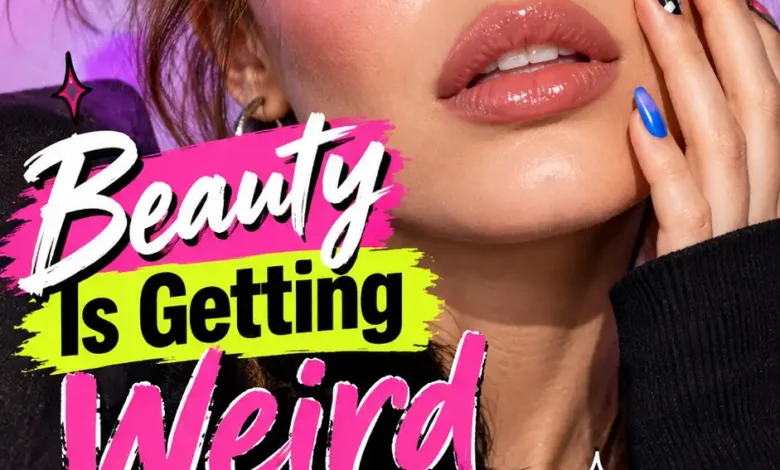
For years, beauty tutorials taught us to make both wings match, blend until no edge could be accused of existing, and fix the nail that was the “wrong” color. Now people are looking at that rulebook and asking a much more entertaining question: what if the mismatch is the point?
There is a particular kind of panic that happens when one eyeliner wing comes out perfect and the other develops a completely different personality.
Traditionally, that is the moment you reach for a cotton swab.
Glitchy Glam looks at the two wings, considers the evidence, and says: interesting—keep going.
Pinterest named Glitchy Glam one of its major 2026 beauty trends after seeing sharp growth in searches for intentionally unconventional beauty: avant-garde makeup editorial rose 270%, nails with different colors on each hand 125%, weird makeup looks 115%, eccentric makeup 100%, and asymmetrical lob 85%. Pinterest describes the trend as beauty that “misses the mark” on purpose—mismatched manicures, two-toned lips and contrasting eye colors replacing automatic symmetry. Source: Pinterest Predicts 2026.
Beauty coverage throughout 2026 has picked up the same shift. Glamour has framed makeup maximalism as a move away from the polished “clean girl” uniform and toward color, experimentation and a deliberately imperfect finish, while Who What Wear has highlighted mismatched nails, editorial eye makeup and asymmetric hair as key expressions of Glitchy Glam. Glamour UK; Who What Wear.
But there is an important difference between intentional asymmetry and makeup that simply looks unfinished.
The strongest Glitchy Glam looks usually have a clear idea you can describe in one sentence: one eye is cobalt and the other lime; the lip is split exactly down the middle; each hand has its own manicure; the liner repeats the same shape but shifts position. There is a pattern inside the disruption.
That is why the trend feels less like “giving up on perfection” and more like changing what perfection is supposed to mean.
Before experimenting around the eyes: use products specifically intended and labeled for the eye area. The U.S. FDA notes that some color additives allowed elsewhere in cosmetics are not approved for use around the eyes, and it specifically advises against repurposing products such as lip liner as eyeliner. Keep tools clean, do not share eye cosmetics, stop using anything that causes irritation, and follow the product label. False lashes and their adhesives can also cause irritation or allergic reactions, so check ingredients and directions. FDA Eye Cosmetic Safety.
With that settled, here are 25 ways to make beauty look deliberately, gloriously “wrong.”
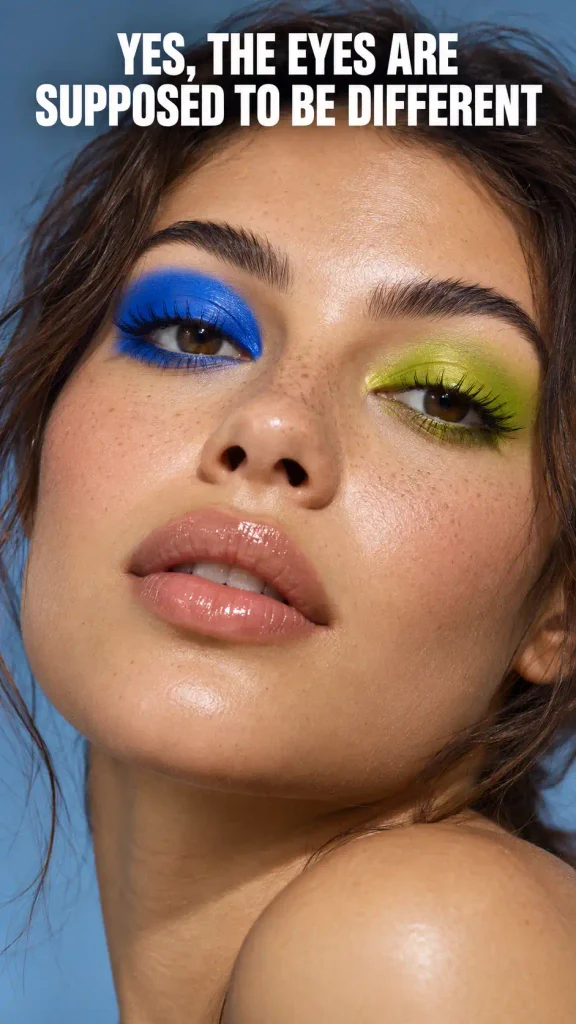
1. Two Eyes, Two Completely Different Colors
This is the easiest way to understand Glitchy Glam because the rule is visible immediately.
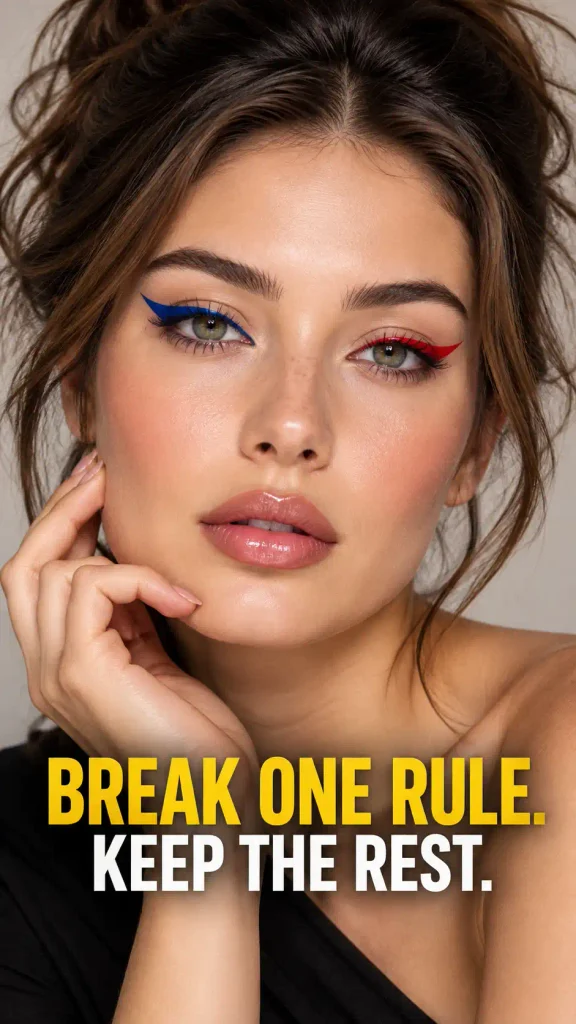
Choose two colors that clearly disagree—cobalt and orange, violet and chartreuse, turquoise and fuchsia—and give each eye its own shade. Keep the shape similar on both sides so the color mismatch reads as the intentional disruption.
The mistake beginners make is choosing two colors that are too close. One mauve eye and one slightly different mauve eye can look like you grabbed the wrong pan halfway through. Strong contrast is easier to read as design.
You can also keep mascara, brows and skin relatively quiet. When the eyes are already having a debate, the rest of the face does not need to moderate.
Why it works: identical placement creates order while opposite colors create the “glitch.”
Easy version: use different colored liners instead of full shadow.
Best rule: make the difference obvious enough to look planned.
2. One Dramatic Eye, One Almost-Bare Eye
Matching colors are one thing. Matching effort is apparently optional too.
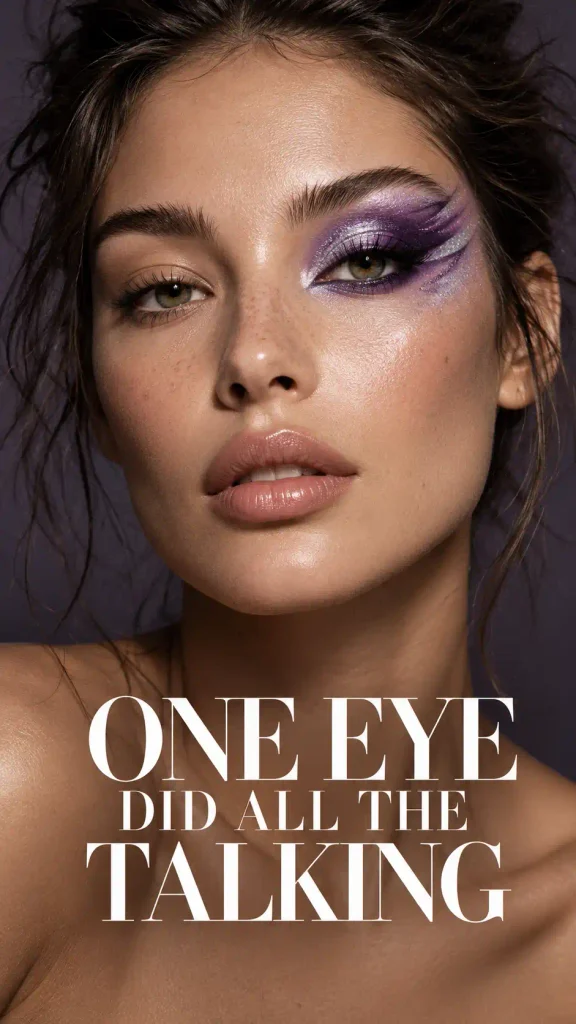
A full graphic eye on one side paired with an almost-bare lid on the other creates a much stronger interruption than two colorful eyes. Think one smoked metallic shape, one clean lid with mascara.
The key is making the “bare” side genuinely clean. If there is half-finished shadow there, the look reads like you got interrupted. If it is deliberately stripped back, the contrast becomes architectural.
This is also a surprisingly wearable way to try avant-garde makeup because you are only committing to one difficult eye.
Why it works: the contrast is not just color—it is visual weight.
Easy version: one bold wing, one mascara-only eye.
Keep polished: repeat one tiny detail on both sides, such as the same inner-corner highlight.
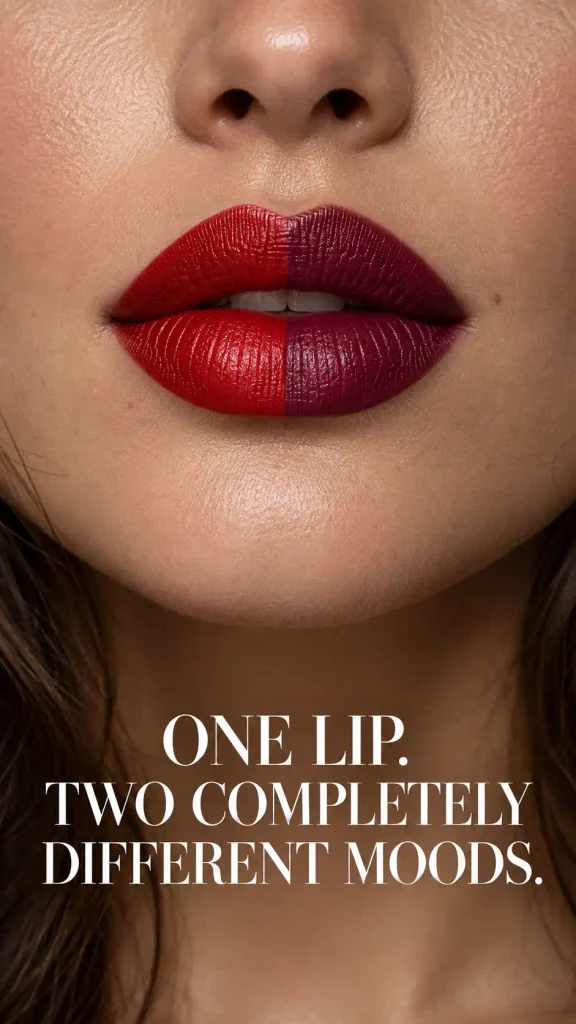
3. The Split Lip: One Mouth, Two Color Stories
A vertically split lip might be the most immediately readable Glitchy Glam move of all.
Draw an imaginary line down the center of the mouth and use one shade on each side. Deep berry with hot pink feels dramatic; brown with cherry feels more wearable; red with cobalt moves straight into editorial territory.
Precision matters here. Oddly enough, one of the best ways to make an “imperfect” trend look intentional is to be extremely precise about the imperfection.
Use a lip brush if you want a clean division, and choose products intended for lip use. If the shades have similar finishes—both matte, both cream, both glossy—the color split stays the main story.
Why it works: the face is naturally symmetrical, so a clean 50/50 split is instantly disruptive.
Easy version: use two neighboring reds rather than opposite colors.
Watch out: creamy formulas can migrate into each other; blot between layers.
4. Top Lip One Color, Bottom Lip Another
If the vertical split feels like advanced geometry before breakfast, stack the colors instead.
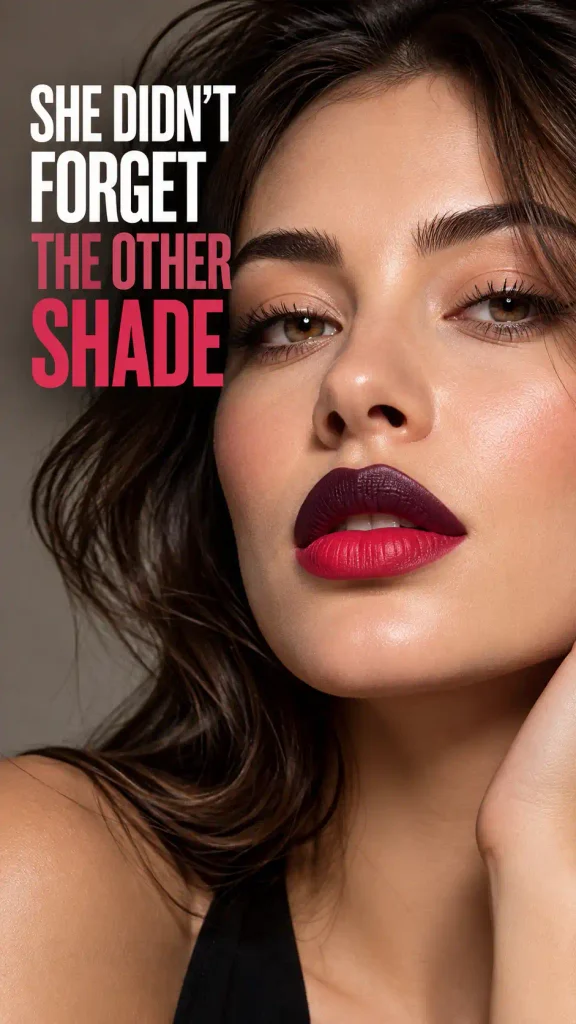
A darker upper lip and brighter lower lip creates a deliberate imbalance without requiring an exact center line. Plum over coral, espresso over ruby, black cherry over rose—there is plenty of room to play while still keeping the mouth recognizably “makeup.”
The smartest pairings share something: similar depth, similar undertone, or identical finish. That connection keeps the look from becoming two unrelated lipsticks that happened to meet.
Why it works: the mouth remains balanced left-to-right while the usual top-to-bottom match disappears.
Easy version: choose two shades from the same color family.
More editorial: pair a dark upper lip with a bright lower one.
5. A Winged Liner That Deliberately Does Not Match
For generations, eyeliner tutorials have treated matching wings like an entrance exam.
Glitchy Glam offers a loophole.
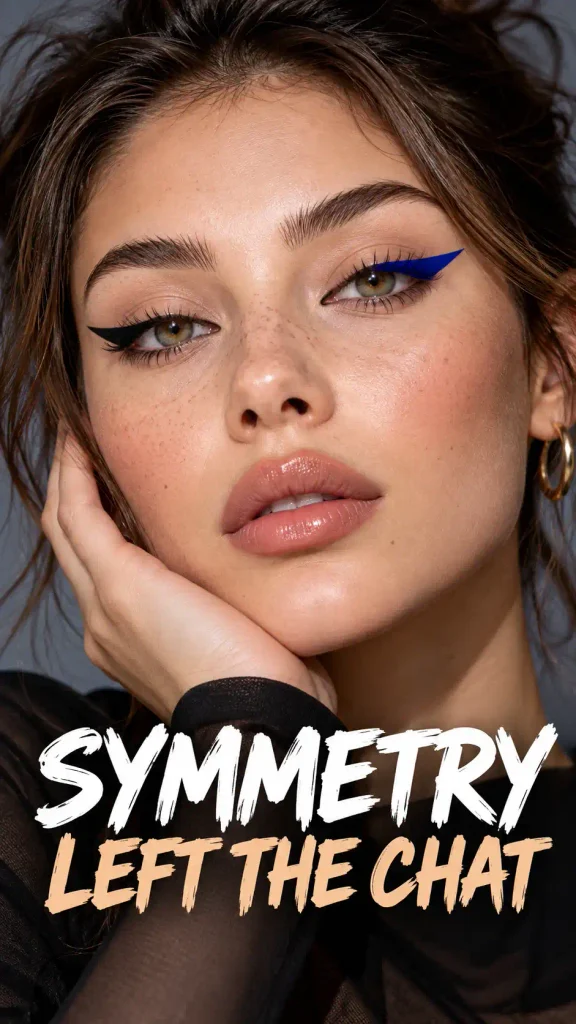
Keep both wings sharp, but change one variable on purpose. One could be long and horizontal while the other kicks upward. One could be black and the other electric blue. One could be a single line while the other is doubled.
The phrase “on purpose” is doing a lot of work here. If every element is different, the eye loses the concept. Change one thing, repeat everything else.
Why it works: it takes a familiar beauty rule and breaks exactly one part of it.
Easy version: same wing shape, different colors.
Design trick: preserve line thickness so the mismatch feels controlled.
6. Floating Liner That Sits Where Liner “Shouldn’t”
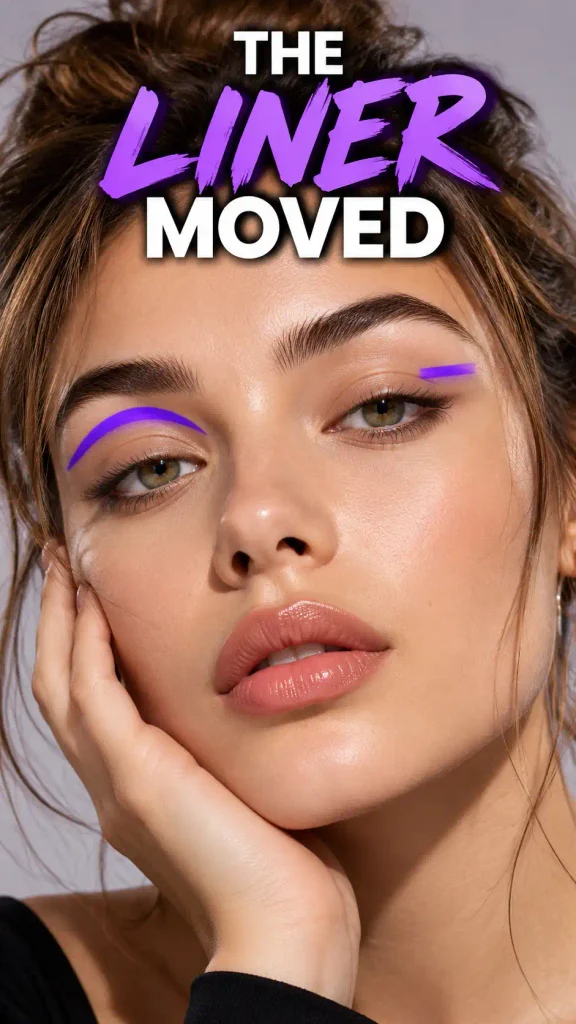
Floating liner removes eyeliner from the lash line and lets it exist in the crease, above the lid, or as a disconnected graphic shape.
For a Glitchy Glam version, place the floating line differently on each eye: one high arc, one short horizontal dash, for example. Use the same color so placement becomes the glitch.
This works best with a product intended for the eye area and enough contrast against your skin to make the line look deliberate rather than accidental transfer.
Why it works: familiar eyeliner is displaced rather than merely exaggerated.
Easy version: add one floating dash above only one crease.
Clean-up tip: map the placement lightly before committing to a long line.
7. Pixel Liner That Looks Like The Face Briefly Lost Signal
This is where the “glitch” part becomes literal.
Instead of a continuous wing, build the shape from tiny squares, dots or short rectangular marks that appear to skip across the outer eye. A few repeated blocks are more convincing than covering half the face in random confetti.
Use cosmetic products intended for the eye area, especially when experimenting with unusual colors. FDA guidance is straightforward here: a color being permitted in cosmetics generally does not automatically mean it is permitted around the eye.
Think of it like an old screen freezing for half a second—recognizable image, tiny digital interruption.
Why it works: the shape references digital artifacts without requiring costume makeup.
Easy version: three small liner blocks at one outer corner.
Best finish: keep the blocks crisp so they look digital rather than smudged.
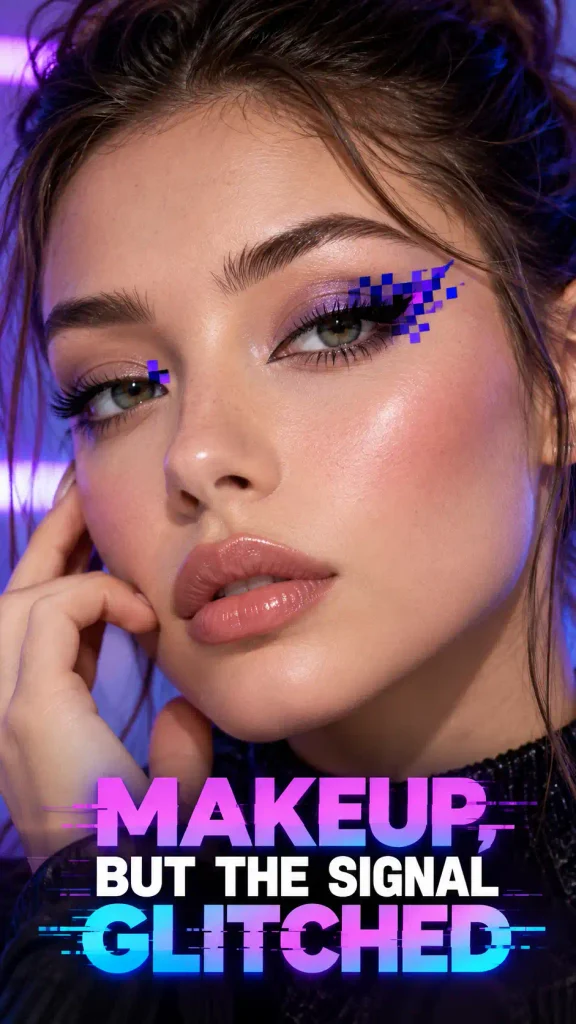
8. One Smudged Eye Beside One Sharp Eye
Texture can mismatch even when color does not.
Use the same deep liner on both eyes, then keep one side razor-sharp and deliberately diffuse the other into a hazy, lived-in shadow. The repetition of color tells the viewer these eyes belong together; the texture tells a different story.
This is a particularly good entry point if bright color is not your thing. Glitchy Glam does not have to look like a box of highlighters exploded.
Why it works: one side represents control, the other diffusion.
Easy version: black liner on both eyes, smudge only one outer corner.
Keep intentional: blur the edge with a brush instead of randomly rubbing the lid.
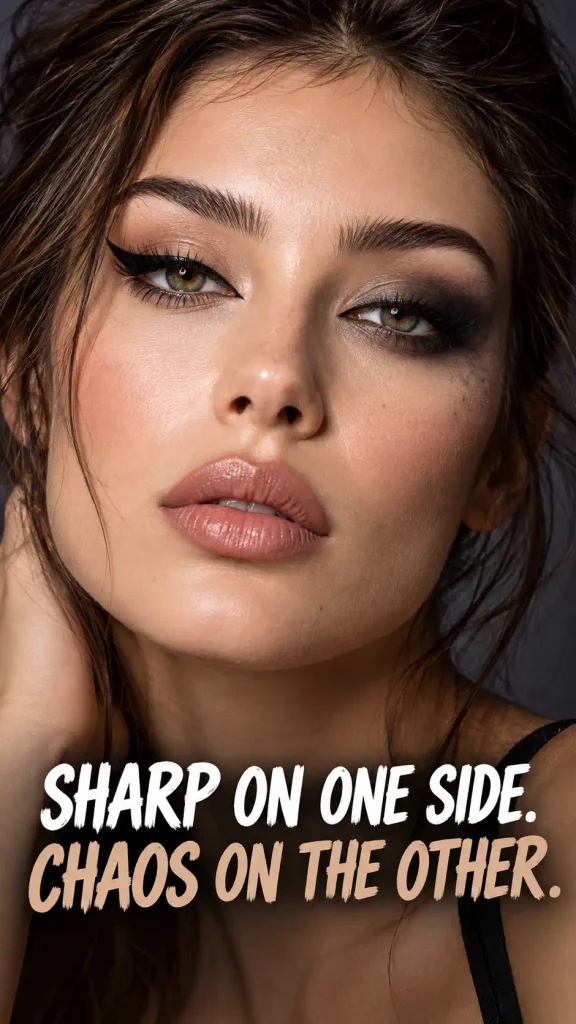
9. Negative-Space Shadow That Leaves A Piece “Missing”
Sometimes the glitch is what you do not fill in.
Paint a strong block of color across the lid but leave a clean stripe, circle or geometric cut-out of bare skin inside it. The missing section creates the illusion that part of the makeup failed to load.
The negative space needs crisp edges to be readable. A flat brush and small amount of remover on a precise swab can help refine the shape, but keep remover out of the eye itself and follow product directions.
Why it works: the brain expects a continuous patch of color and notices the interruption immediately.
Easy version: leave one clean vertical stripe through a single-color shadow.
More graphic: repeat the cut-out in a different position on the other eye.
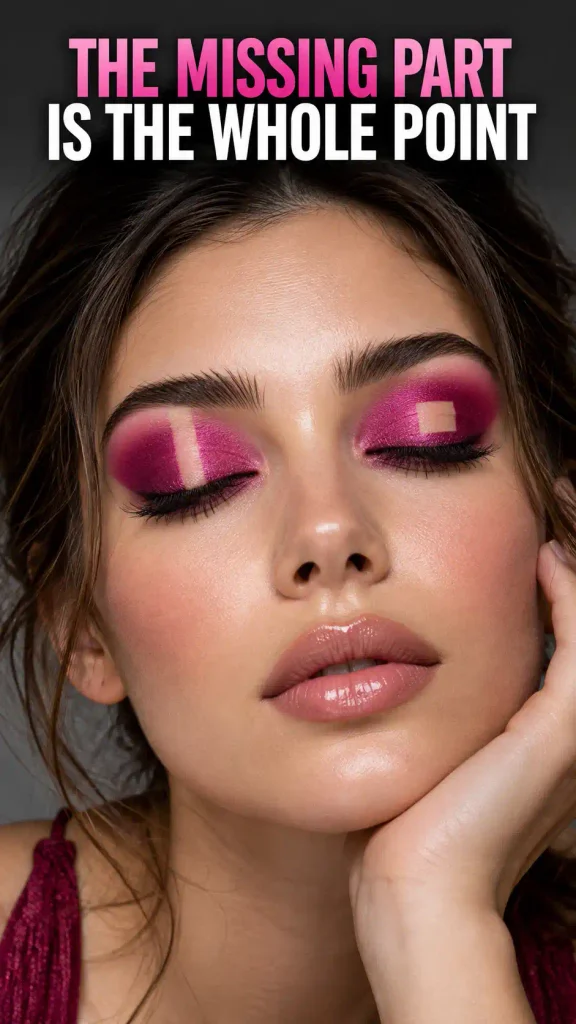
10. Mismatched Metallic Lids
Color mismatch becomes even more obvious when the finish catches light.
Try silver on one lid and copper on the other, icy blue against molten gold, or lavender chrome opposite green shimmer. Keep the placement simple—just the lid—so the reflectivity does not turn into visual noise.
Metallic products can behave differently from matte shadows, so press rather than aggressively sweep if the formula is prone to fallout, and use only products intended for the eye area.
Why it works: light exaggerates the contrast every time the face turns.
Easy version: gold versus silver.
Balance tip: keep cheeks and lips restrained.
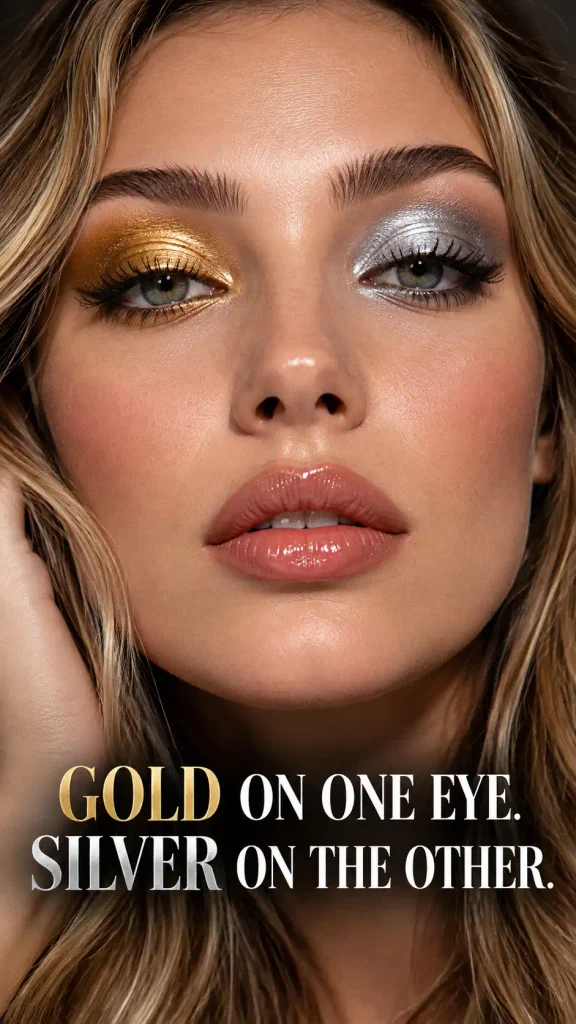
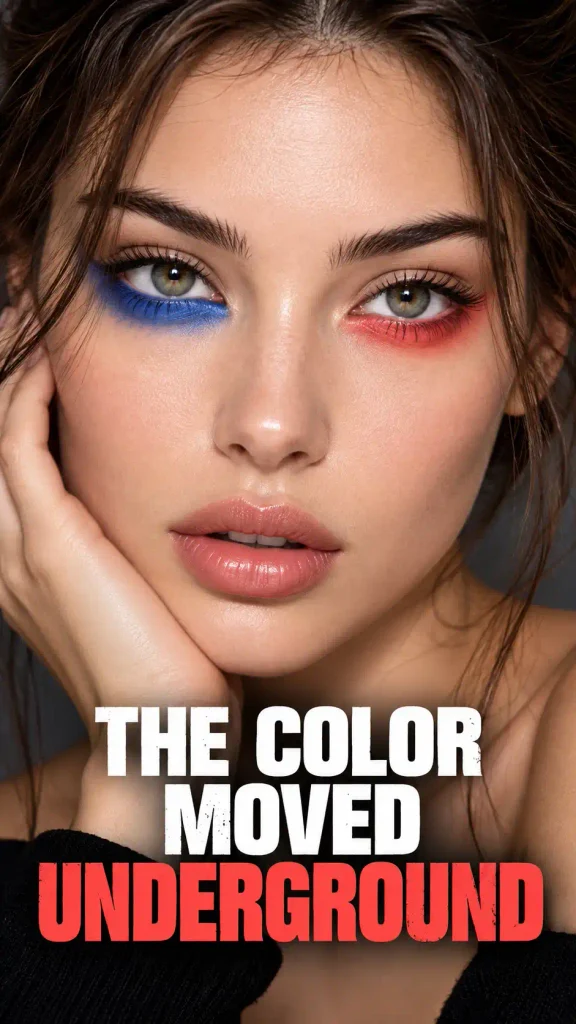
11. Contrasting Color Under The Eyes Instead Of On Top
If full neon lids feel like a lot, move the color somewhere less expected.
Keep the upper lids neutral and place a saturated block or haze directly beneath each lower lash line—blue under one eye, red under the other. It gives the face a strange little undercurrent without covering the whole lid.
Because this is the eye area, only use products intended for that location. “Creative” does not mean turning random art supplies into cosmetics.
Why it works: it reverses the normal visual hierarchy of eye makeup.
Easy version: use two colored pencils below the lower lashes.
Wearable variation: keep both shades muted rather than neon.
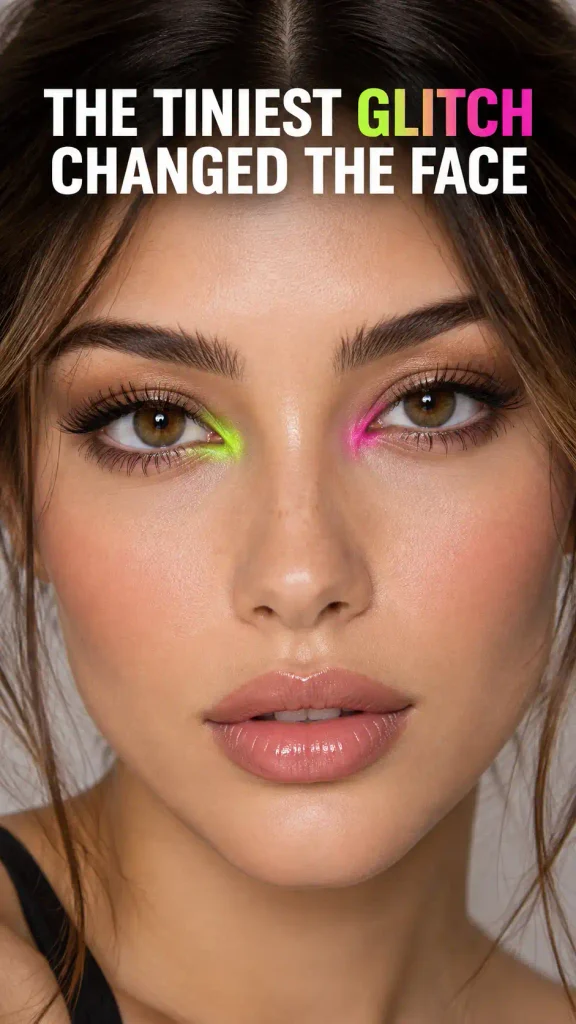
12. Inner Corners That Refuse To Match
This may be the smallest possible Glitchy Glam experiment.
Do your usual makeup, then make one inner corner acid green and the other electric pink. That is it.
Because the detail is tiny and close to the eyes, use products labeled for eye-area use and avoid placing product inside the eye itself. The result is subtle from a distance and delightfully strange up close.
It is also useful proof that you do not need a full editorial face to participate in an eccentric trend.
Why it works: one familiar highlighting step becomes mismatched.
Easy version: use different pastel shades.
Best for: people who want the idea without the full spectacle.
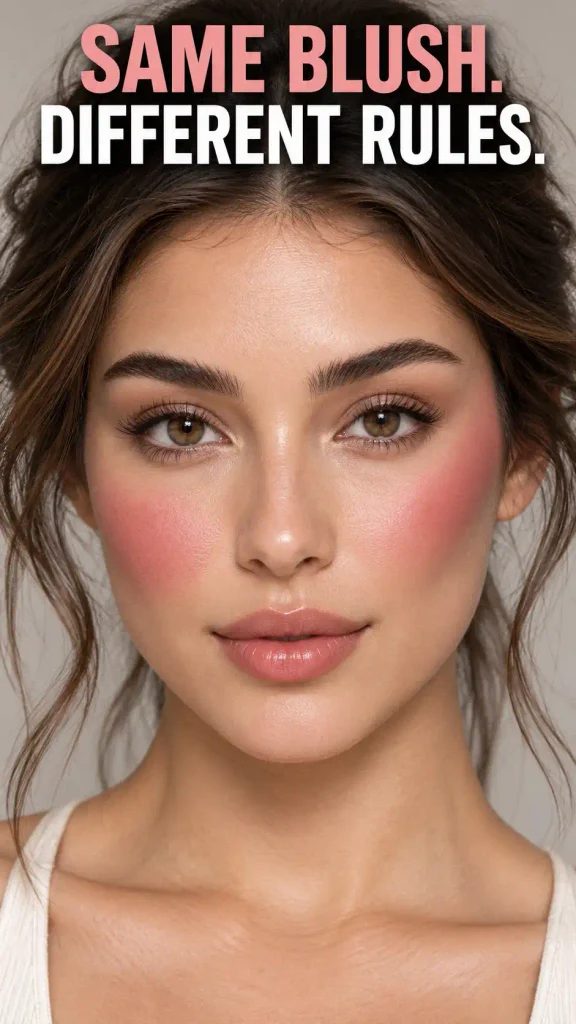
13. Blush On Two Different Coordinates
Blush placement changes the architecture of a face more than people realize.
For this look, use the same color on both sides but place it differently: one cheek gets a traditional soft flush over the apple, while the other pulls higher toward the temple.
The same product keeps the face connected. The placement creates the glitch.
This is also a good reminder that asymmetry does not need to be neon. A muted rose can look surprisingly editorial when the geometry changes.
Why it works: the color repeats, so the eye notices placement rather than wondering if two products were accidentally mixed.
Easy version: keep both applications sheer.
More dramatic: make one side circular and the other elongated.
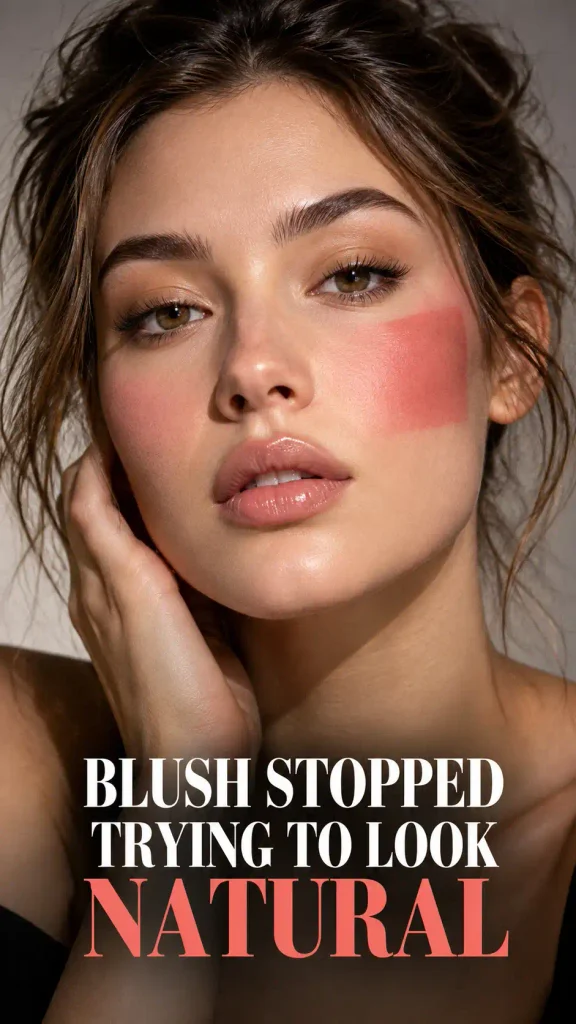
14. A Blush Block Instead Of A Blush Blend
We are used to blush disappearing softly into skin. A color block refuses.
Use a cosmetic blush or face pigment intended for the area and build a clearly defined shape—an oval, rectangle, or diagonal bar—on one cheek while leaving the other much softer.
Again, the point is not to make the face look randomly unfinished. The sharp edge is what announces that this is a decision.
Why it works: blush stops pretending to be natural color and becomes graphic design.
Easy version: use a muted shade with a soft rectangle.
Editorial version: high-opacity color plus a completely clean opposite cheek.
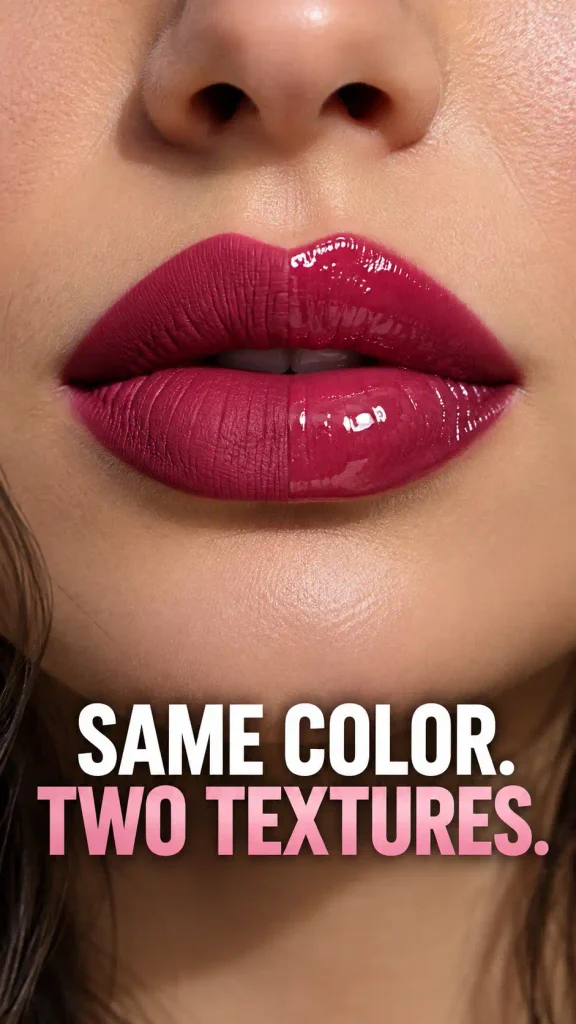
15. One Matte Lip Half, One Glossy Lip Half
You do not always need two colors. Two textures can create the interruption.
Apply one lip shade across the whole mouth, then leave one side matte and add a compatible lip gloss only to the other half. The effect becomes obvious as soon as light hits.
Because the color stays constant, this look can feel sophisticated rather than costume-like. It also proves that Glitchy Glam is really about broken expectations, not mandatory rainbow makeup.
Why it works: the lip is chromatically unified but optically split.
Easy version: use a medium nude or berry shade.
Practical note: gloss will migrate with wear, so treat this as a short-duration editorial effect rather than a twelve-hour promise.
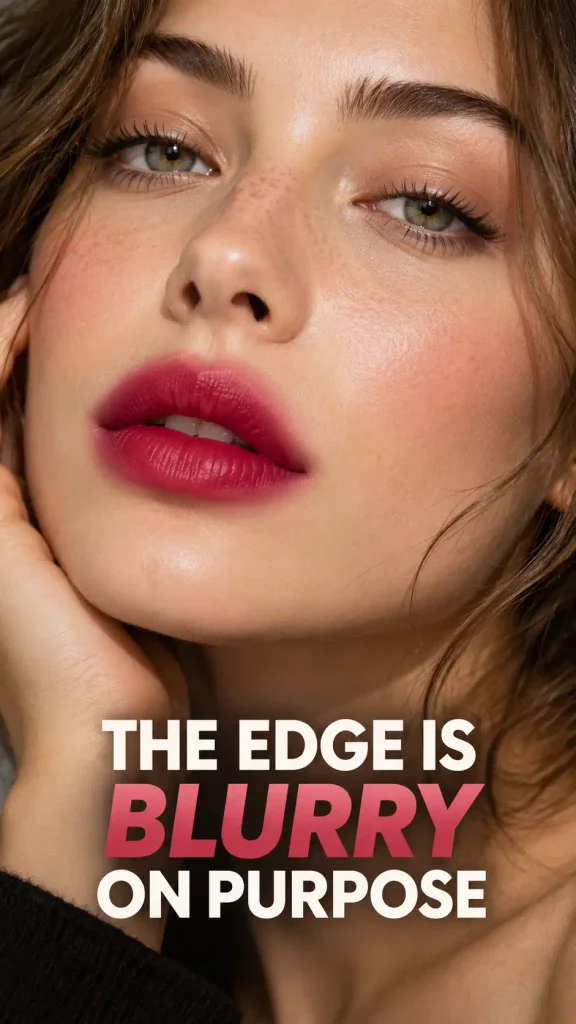
16. The Deliberately Blurred Lip
Not every glitch needs a hard edge.
A blurred lip pushes color beyond the usual crisp boundary in a controlled haze, especially at one side or corner. The difference between “editorially blurred” and “lipstick accident” is usually the rest of the face: if skin and eyes are considered, the soft lip edge reads as contrast.
Use a lip product as directed, tap the edge outward with a clean fingertip or brush, and keep the center richer. You are creating a gradient, not smearing color everywhere indiscriminately.
Why it works: it breaks the expectation that a finished lip must have a perfectly traced perimeter.
Easy version: berry stain with one softened corner.
Balance: pair it with clean, restrained eye makeup.
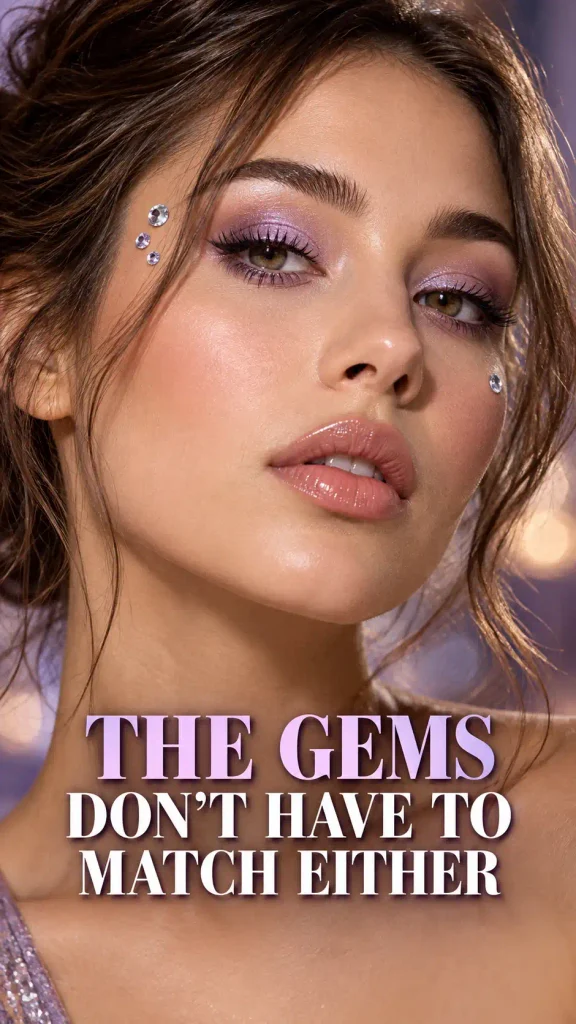
17. Face Gems That Refuse To Be Mirrored
Symmetrical rhinestone placement had its moment. Glitchy Glam shifts the constellation.
Try three small cosmetic face gems near one temple and one single gem on the opposite cheekbone, or create a short diagonal trail on only one side.
Use products and adhesives intended for cosmetic skin use, keep them away from the eye itself, and follow the adhesive directions. FDA notes that eye-area adhesives and cosmetics can cause irritation or allergic reactions, so discomfort is a stop sign, not part of the aesthetic.
Why it works: the sparkle stays glamorous while asymmetry keeps it unpredictable.
Easy version: one gem on one side, two on the other.
Safety: avoid craft glue and random decorative adhesives on skin.
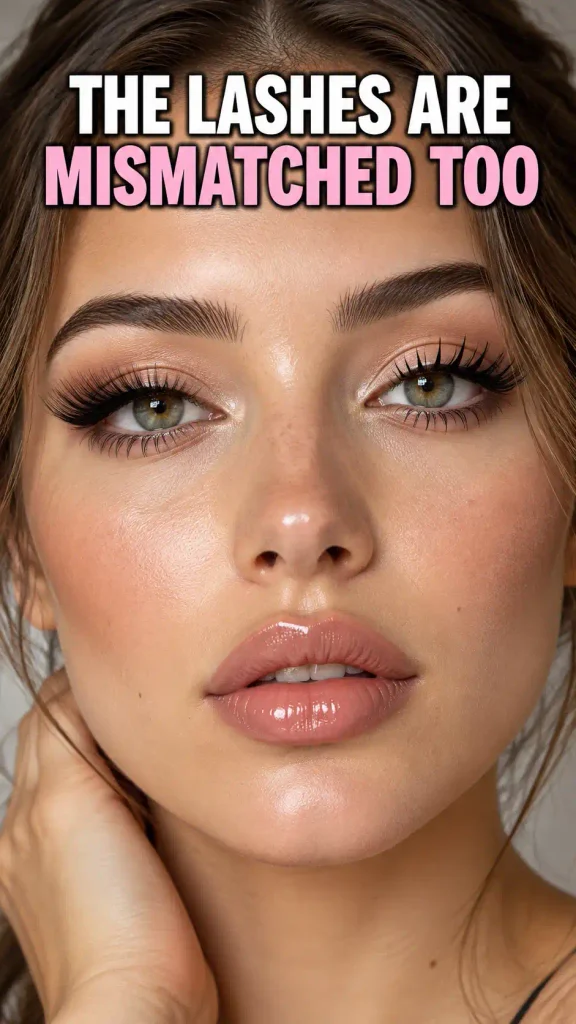
18. False Lashes With Deliberately Different Silhouettes
This one takes the mismatch right to the lash line.
Instead of identical false lashes, use two styles with a clear relationship: one side could be longer at the outer edge while the other is spikier and more vertical. Keep length and overall visual weight reasonably balanced so the result feels artistic rather than like one lash started falling off.
False-lash adhesives are cosmetics too. Follow the label, check ingredients, and stop if you develop irritation. Do not place adhesive inside the eye or improvise with non-cosmetic glue.
Why it works: it changes the silhouette of the eyes without adding more color.
Easy version: use cluster lashes and vary placement slightly.
Watch out: extreme weight differences can feel physically uncomfortable as well as visually accidental.
19. Two Hands, Two Completely Different Manicures
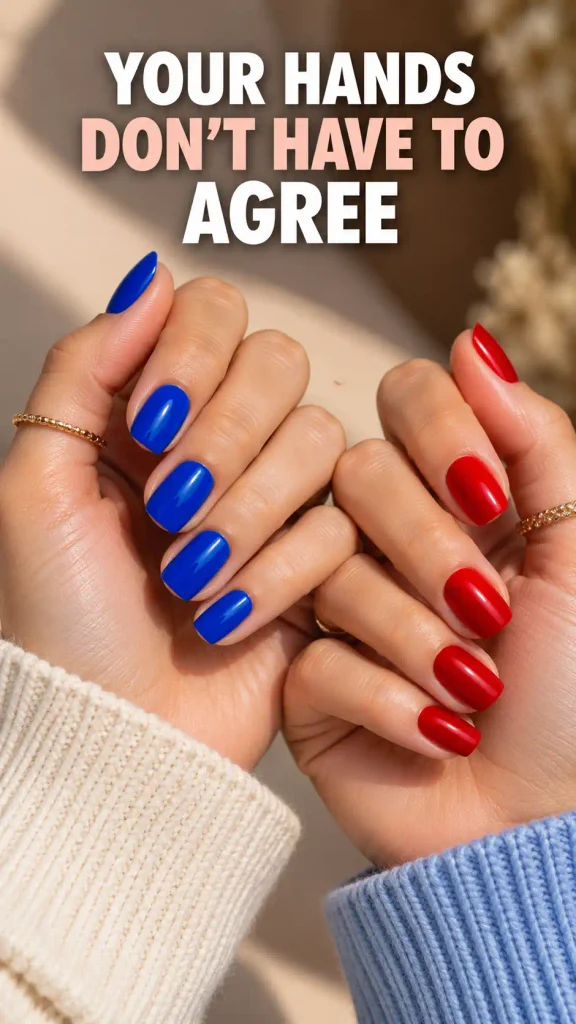
Pinterest specifically reports a 125% increase in searches for nails with different colors on each hand, making this one of the clearest data points behind the trend.
The cleanest version is simple: one hand red, one hand blue. But you can also give each hand its own full aesthetic—one metallic and futuristic, the other soft and translucent.
Because the mismatch happens across entire hands, the manicure still feels coherent when you look at each side separately. The “glitch” only appears when the hands meet.
Why it works: each hand is internally consistent, while the pair breaks the rule.
Easy version: same polish formula, two different colors.
More editorial: one hand glossy chrome, the other soft jelly.
20. A Different Nail Design On Every Finger—Without Turning Into Visual Static
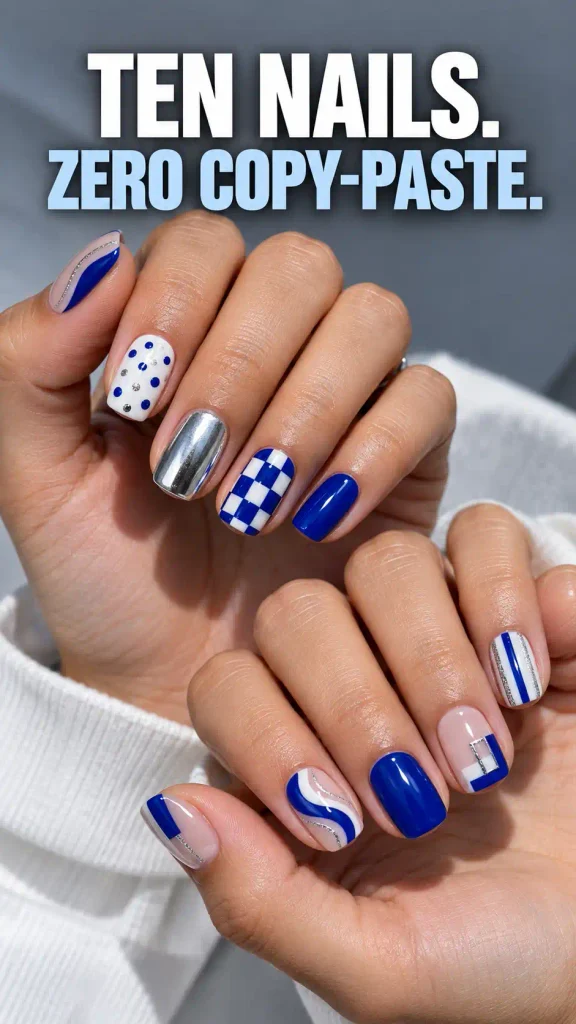
Ten different nails can work if they share a visual language.
Choose one palette and vary the design: a cobalt base, white dots, silver line, translucent blue, tiny checker, chrome accent. The motifs change but the colors keep them related.
The easiest way to make ten unrelated designs feel chaotic is to introduce ten unrelated palettes too.
Think playlist, not random radio scan.
Why it works: repetition of color creates coherence across different motifs.
Easy version: alternate two designs and add one “wild card” nail.
Rule of thumb: vary pattern or color aggressively—not both at maximum volume.
21. Chrome On One Hand, Matte On The Other
Like the half-gloss lip, this manicure glitches texture instead of color.
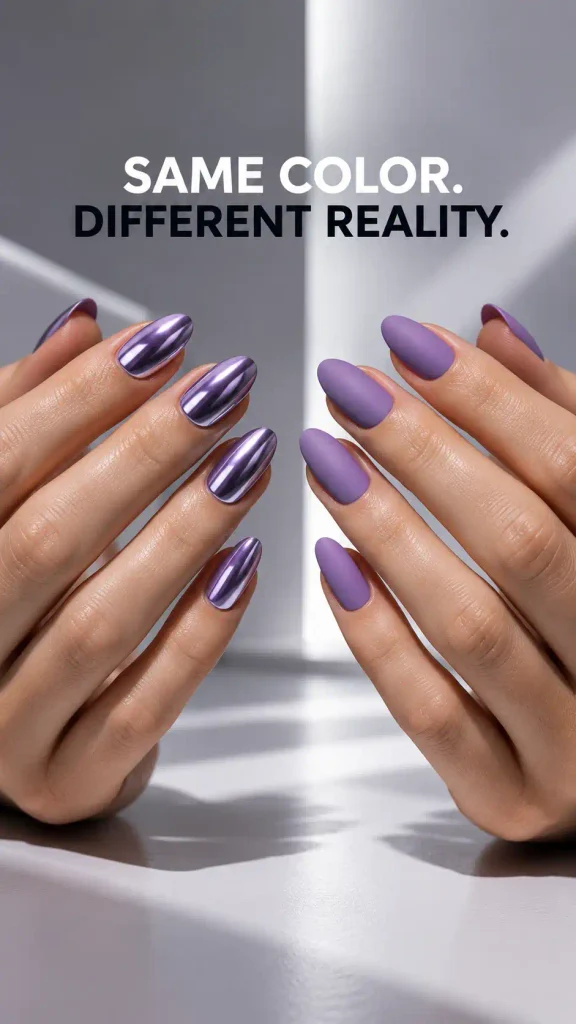
Use the same shade family on both hands—say, lavender—but make one reflective chrome and the other velvety matte. When the hands are apart, both look “normal.” Together, they create the interruption.
This is probably one of the easiest ways to make the trend feel polished enough for someone who is not trying to become a walking editorial spread before lunch.
Why it works: color ties the hands together while finish creates contrast.
Easy version: same polish shade with glossy versus matte topcoat.
Good for: people who like unusual details more than loud color.
22. The Asymmetrical Lob That Looks Better Because It Is Uneven
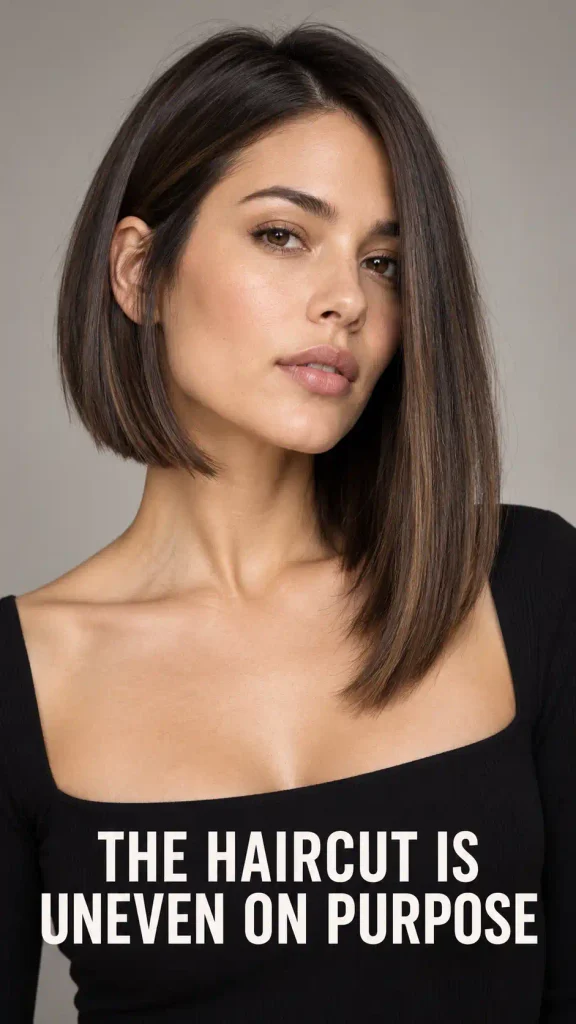
Glitchy Glam is not limited to makeup. Pinterest also reports searches for the asymmetrical lob up 85%.
The appeal is straightforward: a familiar long bob gets one destabilizing detail—one side is visibly longer than the other. The difference can be subtle enough to tuck behind an ear or dramatic enough to read from across the room.
This is not the place for impulsive bathroom scissors if precision matters to you. The strength of the haircut comes from a deliberate line, so a professional stylist can help tailor the angle to hair texture, density and how you actually wear it.
Why it works: the base haircut is classic, which makes the imbalance feel modern rather than random.
Easy version: choose a subtle one- to two-centimeter difference.
Commitment: unlike eyeliner, this one does not wash off tonight.
23. Halo Hair: A Ring Of Color Where You Do Not Expect It
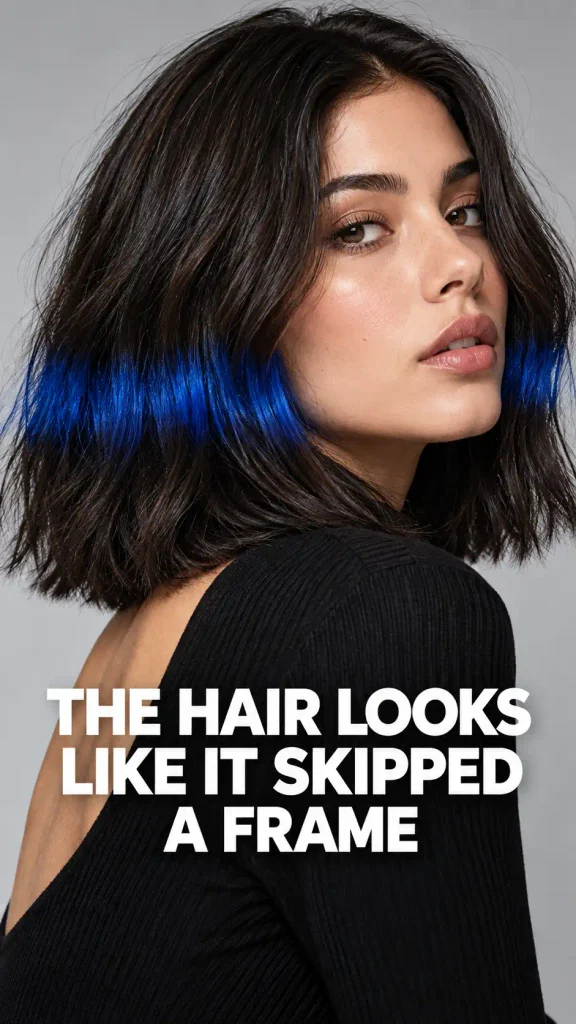
Another 2026 beauty look associated with Glitchy Glam is “halo hair”: a contrasting ring or band of color placed around the head or through a specific horizontal section, creating an almost digitally edited break in the hair.
It is visually powerful because the color interrupts the normal continuity of the hair rather than simply sitting at the ends or roots.
Bleaching and permanent color involve chemistry, not just aesthetics. If creating the effect would require significant lightening—especially on previously colored, fragile or textured hair—a professional colorist is the sensible route. The image is supposed to look glitched, not the hair fiber.
Why it works: one horizontal color break resembles a rendering error in an otherwise continuous surface.
Lower-commitment version: temporary color products designed for hair, used according to label directions.
Best design: keep the band placement deliberate and clean.
24. Split-Dye Fringe Without Splitting The Whole Head
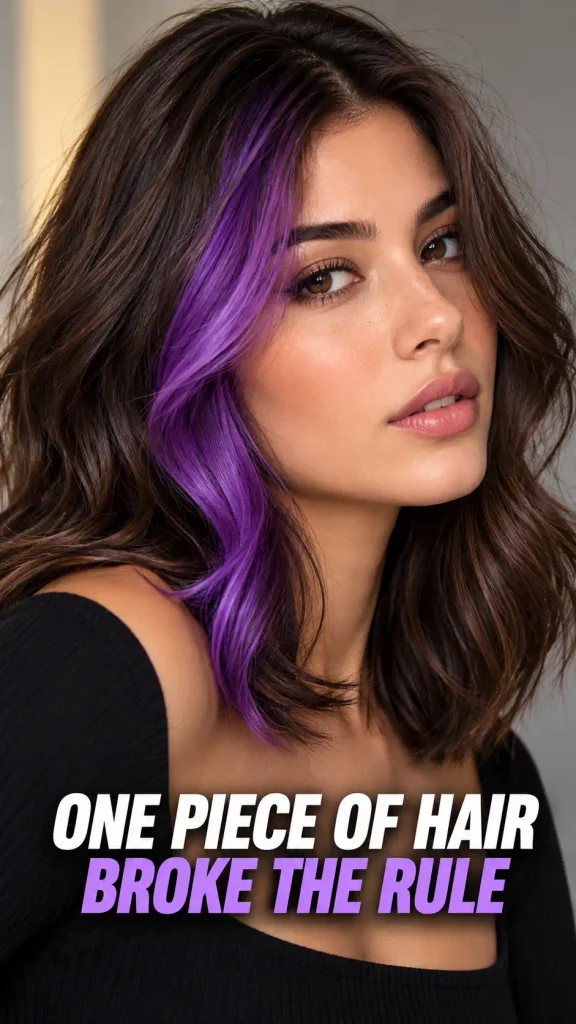
If a full half-and-half dye job feels like too much, isolate the color contrast to the front.
One side of the fringe can carry a bright shade while the other stays natural—or two face-framing sections can use deliberately unrelated colors.
The rest of the hair becomes negative space around the glitch. That restraint is often what makes the color look more editorial.
Again, permanent lightening and dyeing can damage hair when done poorly, so match the technique to your hair history and experience level rather than to the urgency of a trend.
Why it works: the color interruption sits exactly where the eye looks first.
Easy version: temporary hair color on one small face-framing section.
Keep modern: leave the majority of the hair natural or single-toned.
25. The Most Wearable Glitch: Break One Rule And Leave Everything Else Alone
After 24 deliberately strange ideas, this might be the most useful one.
You do not need mismatched eyes, split lips, pixel liner, asymmetrical blush, different lashes, ten nail designs and a blue stripe through your hair on the same Tuesday.
In fact, the look often gets stronger when you choose one disruption.
A clean face with two different inner-corner colors. A regular outfit with mismatched nails. Neutral makeup with one off-center graphic line. A classic bob with one longer side.
This is where Glitchy Glam becomes more than an editorial novelty. The underlying idea is not “make everything weird.” It is “stop assuming every part has to match just because that is how you were taught to finish it.”
Pinterest’s broader 2026 trend research points to the same appetite for personalization: among Gen Z and Millennials who engage with trends globally, nearly a quarter say putting their own spin on a trend helps them avoid trend fatigue. Source: Pinterest Newsroom.
That may be the real reason this aesthetic feels fresh.
Perfect makeup asks, “Did I do it correctly?”
Glitchy Glam asks a much better question:
“Does this look interesting?”
Why it works: one disruption gets all the attention instead of competing with five others.
Easiest starting point: mismatched liner colors or two different nail colors.
The rule: decide what is intentionally “wrong” before you start.
Beauty has spent a long time teaching people how to erase evidence of the hand that made it.
Blend the edge. Match the wing. Correct the imbalance. Make both sides agree.
Glitchy Glam is interesting because it does not simply reject skill. Some of these looks actually need more control than conventional makeup. A split lip has to be precise. Mismatched eyes need a color relationship. An asymmetrical haircut needs a deliberate line.
The difference is that the skill is no longer being used to make everything disappear into symmetry.
It is being used to make the interruption obvious.
And after years of beauty built around looking polished, seamless and algorithmically “right,” there is something refreshing about a face that looks like somebody made a choice you were not expecting.
Which Glitchy Glam look would you actually try—and which one would stay firmly in the “fun to look at, not on my face” category?
Sources & Further Reading
- Pinterest Predicts 2026 — Glitchy Glam trend data and methodology
- Pinterest Newsroom — 2026 personal-expression trends
- Who What Wear — Glitchy Glam beauty trend overview
- Glamour UK — 2026 beauty trends and makeup maximalism
- U.S. FDA — Eye Cosmetic Safety
- U.S. FDA — Color Additives Permitted for Use in Cosmetics
- U.S. FDA — Novelty Makeup and eye-area color guidance