7 Savings Challenges for Broke College Students (With Free Printables)


Start a college savings challenge with an amount you can spare after essentials—even if that amount is 25¢. Choose one small rule, give the money a purpose, and track what you actually set aside.
These seven savings challenges for broke college students cover different situations: a few dollars of breathing room, irregular paychecks, spare change, or an expense you can genuinely cut. Choose one. The seven free print-and-fill worksheets at the end match the challenges, and you can start on any date.

The visuals are AI-generated concepts illustrating the methods. The printable worksheets are plain, fill-in trackers; the images do not document real student savings or tested results.
Choose a Challenge That Fits This Week
- You can spare the same small amount regularly: try the $1-a-day challenge.
- You like a little variety with a low ceiling: try the $1–$2–$3 loop.
- Your hours or pay change: save a slice of your safe payday remainder.
- You have optional spending to trim: choose no-extras days, a planned-purchase swap, or a subscription cancellation.
- You want to work with cents: try capped manual round-ups.
Before moving money, reserve enough for food, housing, transportation, medication, required payments, upcoming school costs, and a checking-account cushion. Money already assigned to next month’s rent or next term’s books is not spare cash. If nothing is left, pause the challenge. Ask your school’s basic-needs or financial aid office what support may be available.
Pick a specific purpose, such as a $30 cushion for an unexpected expense. The CFPB’s emergency-fund guide explains that your savings goal should fit your circumstances and that even small amounts can help. It also recommends watching balances when using automatic transfers to avoid overdraft fees.
If you need to sort out the money available for the semester first, the weekly-money section in Freshman Year: The Complete Survival Guide is a useful starting point.
1. The $1-a-Day Challenge: A $30 Starting Cushion
This is the simplest option when you have a little predictable room in your budget. Set aside $1 for each of 30 days. The amount stays the same from beginning to end: 30 × $1 = $30.

Write a start date on Worksheet 1. Mark a box only after you have moved the dollar into savings or put it in a secure place apart from spending cash. You can make one $7 transfer each week instead of seven separate transfers; mark only the days that transfer actually covers.
If $1 is too much, write 25¢ in the worksheet’s custom-amount field. Thirty deposits of 25¢ total $7.50. You are choosing a different-sized challenge, not failing the original one.
A missed day does not create a bill you owe the tracker. Leave it blank, resume when affordable, and let the challenge take longer. Your completed total depends on the deposits you make.
2. The $1–$2–$3 Loop: Save $24 Across 12 Weeks
A traditional increasing challenge can become hardest just when finals or a school expense arrives. This version stops increasing at $3 and starts its small cycle again.
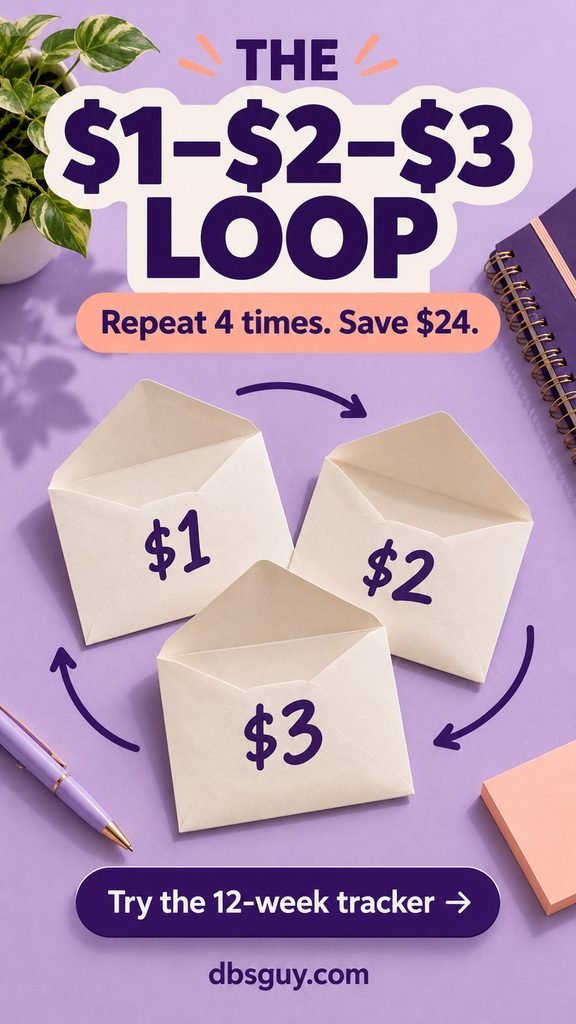
- Week 1: save $1.
- Week 2: save $2.
- Week 3: save $3.
- Repeat that three-week sequence four times in total.
Each cycle adds $6. Four cycles add $24, and no scheduled weekly deposit exceeds $3. Worksheet 2 lists all 12 deposits so you do not need envelopes or a purchased binder.
Choose a weekly check-in that fits your routine, such as Sunday evening. If a week is too tight, pause the sequence and continue with that same amount later. Do not jump ahead or add a penalty deposit. Halving every amount gives you a 50¢–$1–$1.50 loop totaling $12.
3. The Safe Payday Remainder Challenge
If your campus-job hours change, a fixed calendar transfer may be awkward. Make the trigger a payment that has actually arrived, then work out how much of it is genuinely uncommitted.
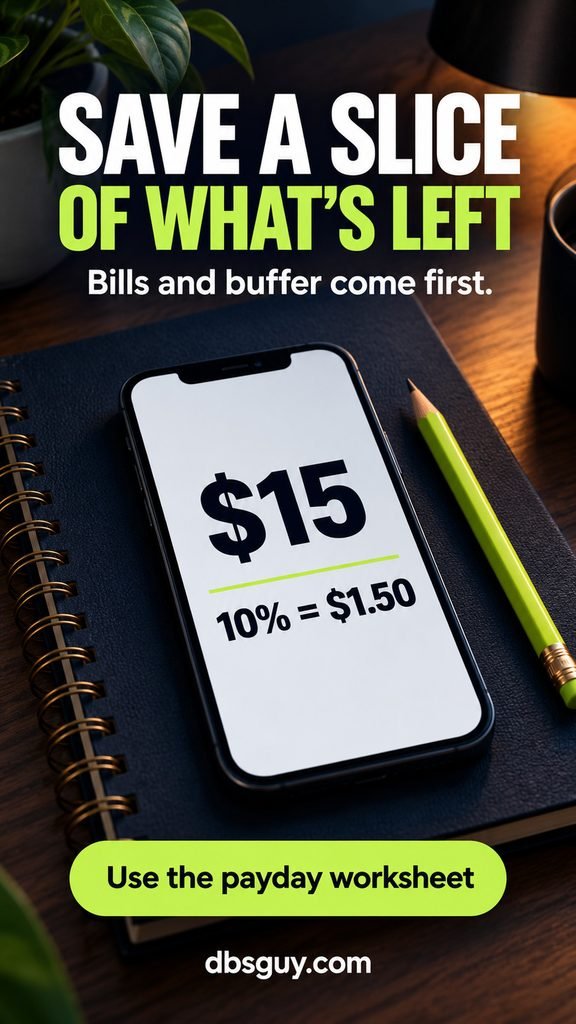
The rule: after reserving essentials, required payments, upcoming school costs, and your checking cushion, save a small percentage of the safe remainder. Ten percent is an optional starting rule for this challenge; it is not a recommended savings rate for every student.
For example, suppose a $180 take-home payment clears. You need $160 for commitments before the next reliable payment and keep a $5 cushion. That leaves $15 of safe remainder. Ten percent of $15 is $1.50—not $18.
Worksheet 3 has room for eight payment check-ins. Recheck the commitments each time, choose your percentage, and record the amount actually moved. If the remainder is zero or negative, the deposit is $0. If more costs are coming than you initially allowed for, reduce or skip the transfer.
This manual check-in works without an extra savings app. It also keeps a late or smaller paycheck from triggering a transfer you cannot cover.
4. Two No-Extras Days a Week
Pick two days each week for four weeks when you will skip optional purchases. Keep buying what you need, including meals, medicine, required supplies, and safe transportation.

Choose days that already suit your schedule. A library study day may be easier than a day with a planned birthday dinner. Write down your essential exceptions and an enjoyable free plan before you begin: a borrowed book, a walk with a friend, or a movie through a service you already have.
Use Worksheet 4 to record the eight days and any optional spending you genuinely avoided. If you would normally have bought a $4 snack but bring something already budgeted for, you might have $4 available to move. If the replacement costs $1, the difference is $3. If you were not going to spend anything anyway, count $0.
Watch the next day’s spending too. Buying the skipped item tomorrow postpones the purchase; it does not create savings. Count the money once, after you know it stayed available and you have set it aside.
5. The One-Planned-Purchase Swap
This challenge fits a student who wants to keep a small treat or convenience while spending less on it. For four weeks, replace one purchase you were already planning to make each week with a lower-cost option.

A coffee you make before class could replace a café drink. A meal using groceries you already planned to buy could replace a delivery order. Choose something you actually buy; an imaginary $25 purchase you never intended to make cannot fund savings.
Here is an illustrative example, not a current price quote: a planned $6 drink replaced by a $1.50 homemade drink leaves a $4.50 difference. Four such swaps would leave $18, if those are your real costs and you move the difference each time.
Include ingredients, delivery fees, or other costs that change the comparison. Buying a new tumbler or appliance solely for this challenge can use up the savings. Worksheet 5 keeps the planned cost, replacement cost, and actual transfer together.
For meal ideas that use a permitted dorm microwave, see 23 Easy Microwave Recipes for Dorm Rooms: No Kitchen Needed. Choose options that fit your food storage and equipment.
6. The Capped Spare-Change Challenge
Use purchases you already make to calculate a small manual round-up. At the end of the week, move only an affordable amount, with a maximum you set in advance.

A $4.35 purchase has a 65¢ round-up to the next whole dollar. A $7.10 purchase has a 90¢ round-up. Together, those two round-ups add up to $1.55. A purchase that already ends in .00 adds nothing.
For this four-week version, try a ceiling of $2 a week, or choose a lower one. Your weekly deposit is the smallest of your calculated round-ups, your chosen cap, and the amount you can safely spare. At a $2 cap, the most you would deposit over four weeks is $8; it may be less.
Worksheet 6 includes a small calculation log and four weekly totals. If you use cash, you can set aside change you actually receive and count it toward the same cap. Do not count both the cash and a second digital transfer for the same saving. Avoid making extra purchases to generate round-ups.
7. Cancel One Unused Subscription and Keep the Difference
This one changes a recurring expense instead of asking you to find another dollar every day. Look through recent statements for one optional service you pay for and no longer use.
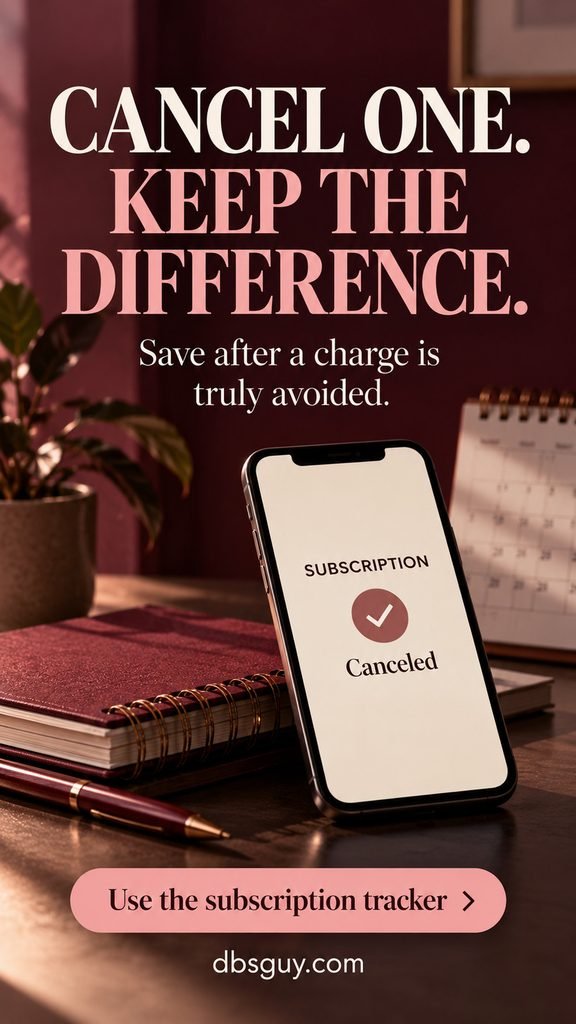
Before canceling, check the next charge date, billing period, cancellation terms, and any fee. Keep a confirmation. An annual subscription you already paid for may stay active until its renewal date; canceling renewal does not automatically return the money already spent.
Then use Worksheet 7 to check the next two dates when a charge would otherwise have happened. Transfer money only after a charge is genuinely avoided, there is no offsetting replacement expense or cancellation fee, and your remaining budget can cover the transfer.
For illustration, avoiding two future $9.99 charges with no replacement cost or fee frees up $19.98. Your actual result depends on your own bill. If you have no unused paid service, choose another challenge rather than canceling required school software or something you rely on.
Make the Tracker Match Your Real Savings
Choose one place for the challenge money so it does not disappear back into everyday spending. An existing separate savings account may be convenient; check its fees, balance requirements, access, and transfer terms. If you use cash, keep it secure. Cash can be lost or stolen.
At each weekly check-in, compare the worksheet with the money actually set aside. Subtract anything you withdrew. Do not count the same $4 under both a no-extras day and a purchase swap. The boxes are a record, not extra money.
If you need your cushion for an unexpected essential expense, use it and record the withdrawal. Restarting with a smaller amount is a sensible adjustment.
Free Savings Challenge Printables
The seven worksheets below are free to print and use, with no email signup. Choose the sheet for your challenge. Use your browser’s Print command, select your printer or Save as PDF, and choose the worksheet pages in print preview. Use portrait orientation and fit-to-page if needed. You can also copy the fields into a notebook.
Record only money you actually moved. Each sheet includes a place to subtract withdrawals, so the final balance does not overstate what remains. All amounts are in U.S. dollars.
Worksheet 1: The $1-a-Day Challenge
dbsguy.com · Free savings challenge printable
Set aside $1 on each affordable day. Thirty $1 deposits total $30. Mark a box only after the money is set aside. Pause instead of catching up with money you need.
Name: ____________________ Start date: ______________
My savings purpose: __________________________________________
Custom amount per box (optional): $________ 30 × my amount = $________
A weekly transfer may cover several boxes. Record each dollar once.
| Day | Day | Day | Day | Day |
|---|---|---|---|---|
| Day 1 □ | Day 2 □ | Day 3 □ | Day 4 □ | Day 5 □ |
| Day 6 □ | Day 7 □ | Day 8 □ | Day 9 □ | Day 10 □ |
| Day 11 □ | Day 12 □ | Day 13 □ | Day 14 □ | Day 15 □ |
| Day 16 □ | Day 17 □ | Day 18 □ | Day 19 □ | Day 20 □ |
| Day 21 □ | Day 22 □ | Day 23 □ | Day 24 □ | Day 25 □ |
| Day 26 □ | Day 27 □ | Day 28 □ | Day 29 □ | Day 30 □ |
Total actually set aside: $____________
Withdrawals: $____________ Balance left: $____________
Balance left = total set aside − withdrawals. Start this sheet at $0 and count each deposit once.
Next check-in: ______________ What I need to adjust: ___________________
Worksheet 2: The $1–$2–$3 Loop
dbsguy.com · Free savings challenge printable
Save $1, then $2, then $3 on successive weeks. Repeat four times for $24. Pause the sequence when necessary.
Name: ____________________ Start date: ______________
My savings purpose: __________________________________________
If halving the plan, use 50¢, $1, and $1.50. The full half-size total is $12.
| Week | Scheduled amount | Date set aside | Actual amount | Running total |
|---|---|---|---|---|
| 1 | $1 | ________ | ________ | ________ |
| 2 | $2 | ________ | ________ | ________ |
| 3 | $3 | ________ | ________ | ________ |
| 4 | $1 | ________ | ________ | ________ |
| 5 | $2 | ________ | ________ | ________ |
| 6 | $3 | ________ | ________ | ________ |
| 7 | $1 | ________ | ________ | ________ |
| 8 | $2 | ________ | ________ | ________ |
| 9 | $3 | ________ | ________ | ________ |
| 10 | $1 | ________ | ________ | ________ |
| 11 | $2 | ________ | ________ | ________ |
| 12 | $3 | ________ | ________ | ________ |
Total actually set aside: $____________
Withdrawals: $____________ Balance left: $____________
Balance left = total set aside − withdrawals. Start this sheet at $0 and count each deposit once.
Next check-in: ______________ What I need to adjust: ___________________
Worksheet 3: The Safe Payday Remainder
dbsguy.com · Free savings challenge printable
Each time a payment clears, reserve essentials, required payments, upcoming school costs, and a checking cushion. Only a positive, uncommitted remainder is available for this challenge.
Name: ____________________ Start date: ______________
My savings purpose: __________________________________________
For each row: payment received $______ − commitments and cushion $______ = safe remainder $______.
Recalculate for every payment. Safe remainder × chosen percentage = proposed deposit. Save $0 when nothing is safely available. Example: $15 × 10% = $1.50.
| Date paid | Safe remainder | Chosen % | Calculated amount | Actual amount moved | Running total |
|---|---|---|---|---|---|
| ________ | ________ | ________ | ________ | ________ | ________ |
| ________ | ________ | ________ | ________ | ________ | ________ |
| ________ | ________ | ________ | ________ | ________ | ________ |
| ________ | ________ | ________ | ________ | ________ | ________ |
| ________ | ________ | ________ | ________ | ________ | ________ |
| ________ | ________ | ________ | ________ | ________ | ________ |
| ________ | ________ | ________ | ________ | ________ | ________ |
| ________ | ________ | ________ | ________ | ________ | ________ |
Total actually set aside: $____________
Withdrawals: $____________ Balance left: $____________
Balance left = total set aside − withdrawals. Start this sheet at $0 and count each deposit once.
Next check-in: ______________ What I need to adjust: ___________________
Worksheet 4: Two No-Extras Days a Week
dbsguy.com · Free savings challenge printable
Choose two days per week for four weeks. Keep essentials. Record only optional spending genuinely avoided, minus replacement costs, then set aside what you can afford.
Name: ____________________ Start date: ______________
My savings purpose: __________________________________________
My essential exceptions: _______________________________________
My free plans: ________________________________________________
A purchase delayed until tomorrow is not savings. If no spending was planned, enter $0.
| Day / date | Optional purchase avoided | Cost avoided | Replacement cost | Actual amount moved |
|---|---|---|---|---|
| ________ | ________________ | ________ | ________ | ________ |
| ________ | ________________ | ________ | ________ | ________ |
| ________ | ________________ | ________ | ________ | ________ |
| ________ | ________________ | ________ | ________ | ________ |
| ________ | ________________ | ________ | ________ | ________ |
| ________ | ________________ | ________ | ________ | ________ |
| ________ | ________________ | ________ | ________ | ________ |
| ________ | ________________ | ________ | ________ | ________ |
Total actually set aside: $____________
Withdrawals: $____________ Balance left: $____________
Balance left = total set aside − withdrawals. Start this sheet at $0 and count each deposit once.
Next check-in: ______________ What I need to adjust: ___________________
Worksheet 5: One Planned-Purchase Swap
dbsguy.com · Free savings challenge printable
For four weeks, replace one purchase you already planned to make each week. Subtract the full replacement cost before counting the difference.
Name: ____________________ Start date: ______________
My savings purpose: __________________________________________
Week 1 replacement: __________________________________________
Week 2 replacement: __________________________________________
Week 3 replacement: __________________________________________
Week 4 replacement: __________________________________________
Include extra ingredients or supplies you bought for the swap. Example only: $6 − $1.50 = $4.50.
| Week / item | Planned cost | Replacement cost | Difference | Actual amount moved |
|---|---|---|---|---|
| 1 / __________ | ________ | ________ | ________ | ________ |
| 2 / __________ | ________ | ________ | ________ | ________ |
| 3 / __________ | ________ | ________ | ________ | ________ |
| 4 / __________ | ________ | ________ | ________ | ________ |
Total actually set aside: $____________
Withdrawals: $____________ Balance left: $____________
Balance left = total set aside − withdrawals. Start this sheet at $0 and count each deposit once.
Next check-in: ______________ What I need to adjust: ___________________
Worksheet 6: Capped Spare Change
dbsguy.com · Free savings challenge printable
Round existing purchases up to the next whole dollar. At week’s end, set aside the smallest of the roundup total, your cap, and the amount you can safely spare. Do not buy things to create roundups.
Name: ____________________ Start date: ______________
My savings purpose: __________________________________________
My weekly cap: $________ (example: $2; at most $8 across four weeks).
$4.35 → 65¢; a whole-dollar purchase → $0. Count cash or a digital transfer once.
Optional calculation log
| Date | Purchase amount | Roundup amount |
|---|---|---|
| ________ | ________ | ________ |
| ________ | ________ | ________ |
| ________ | ________ | ________ |
| ________ | ________ | ________ |
| ________ | ________ | ________ |
Four weekly check-ins
| Week | Roundup total | My cap | Actual amount moved | Running total |
|---|---|---|---|---|
| 1 | ________ | ________ | ________ | ________ |
| 2 | ________ | ________ | ________ | ________ |
| 3 | ________ | ________ | ________ | ________ |
| 4 | ________ | ________ | ________ | ________ |
Total actually set aside: $____________
Withdrawals: $____________ Balance left: $____________
Balance left = total set aside − withdrawals. Start this sheet at $0 and count each deposit once.
Next check-in: ______________ What I need to adjust: ___________________
Worksheet 7: Cancel One, Keep the Difference
dbsguy.com · Free savings challenge printable
Review one unused optional paid service. Check its terms, cancel if appropriate, and save only after a future charge is truly avoided. Canceling does not automatically refund a past charge.
Name: ____________________ Start date: ______________
My savings purpose: __________________________________________
Service: ____________________ Usual charge: $________
Billing period: ______________ Next charge date: ____________
Cancellation terms / fee: _______________________________________
Effective cancellation date: __________ Confirmation: ____________
□ Confirmation saved □ Renewal status checked
| Check-in | Expected charge date | Charge genuinely avoided | New fees / replacement cost | Actual amount moved |
|---|---|---|---|---|
| 1 | ________ | ________ | ________ | ________ |
| 2 | ________ | ________ | ________ | ________ |
□ First charge checked □ Second charge checked
If a charge still occurs, verify its status before recording savings. Subtract related fees and replacement spending. Keep required services.
Total actually set aside: $____________
Withdrawals: $____________ Balance left: $____________
Balance left = total set aside − withdrawals. Start this sheet at $0 and count each deposit once.
Next check-in: ______________ What I need to adjust: ___________________
Questions You Might Have Before Starting
What is the easiest savings challenge if I am really broke?
If essentials are covered and you can spare a few cents, start with the custom amount on the daily tracker or capped round-ups. If your budget has no surplus, a tracker cannot create one. Pause deposits and focus on covering the gap; you can still review optional charges without committing to a savings total.
Do I need a special account, binder, or paid app?
No special product is required for these challenges. The worksheets and an appropriate place to keep the money are enough. Review any costs before opening an account or enabling a paid service. A small challenge is not a reason to add a subscription.
Can I start in the middle of a semester?
Yes. These plans use day numbers, week numbers, or payment dates rather than January-to-December calendars. If you start near finals, choose a contribution that leaves room for travel and upcoming school expenses. You can also pause and finish later.
Can I combine two challenges?
You can, but begin with one until the contribution feels manageable. If you later combine methods, record each real deposit once and keep one overall savings balance. Two trackers do not justify moving money needed for a bill.
For today, choose one sheet, write a purpose at the top, and check what you can safely spare. Make the first deposit when it fits. A small amount you can keep is a useful place to begin.
Also Read
- Freshman Year: The Complete Survival Guide — build a weekly routine for money, coursework, and campus life.
- 23 Easy Microwave Recipes for Dorm Rooms: No Kitchen Needed — find practical meal options for your available equipment.