15 Pink and White January Nail Ideas for Frosty Tips and Blush-Pink Bases

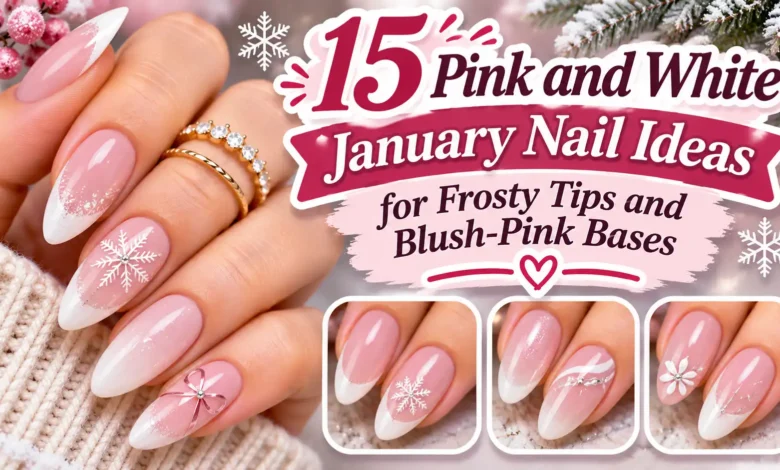
For pink and white January nails, start with the edge: a fine white French line looks crisp, a blended white tip looks snowy, and a few white dots give you a winter detail without a full pattern. Keep the base visibly blush pink so the two colors stay distinct.
These 15 ideas range from short, simple manicures to more detailed salon references. Choose the placement you like first, then adapt it to your usual length. You can get the frosty effect without long extensions or covering every nail in artwork.

The images are AI-generated manicure concepts for dbsguy.com. They illustrate color, shape, placement, and finish; they do not document completed salon work or wear tests.
Choose Your Pink, White, and Level of Detail
A sheer rosy base lets some natural nail show through. A milky blush gives the design a more even, softly opaque background. Hold a sample beside your hand in daylight: if the pink looks almost white, choose a slightly deeper blush so the snowy detail will remain visible.
For the white, decide between a crisp painted line, a cloudy fade, or a pearly reflection. Those produce different results even over the same pink. Tell your nail artist which feature matters rather than asking only for “frosty nails.”
- Little or no free edge: consider snowfall dots, white half-moons, or one windowpane accent.
- A quiet French manicure: choose micro tips, a soft ombré, or matte pink with glossy white.
- A recognizable winter motif: try one snowflake, a knit accent, or the frost fern.
- More visible artwork: double French curves and ice-marble tips benefit from enough space to keep their details separate.
If you are still deciding on length and polish service, start with January Nails: How to Choose Your First Manicure of the Year.
1. Short Blush Nails With White Micro-French Tips
A very fine white edge gives a short squoval manicure definition while leaving almost the whole nail pink. This is the most understated French option in the collection: the narrow tip, rather than added shimmer or a motif, creates the contrast.
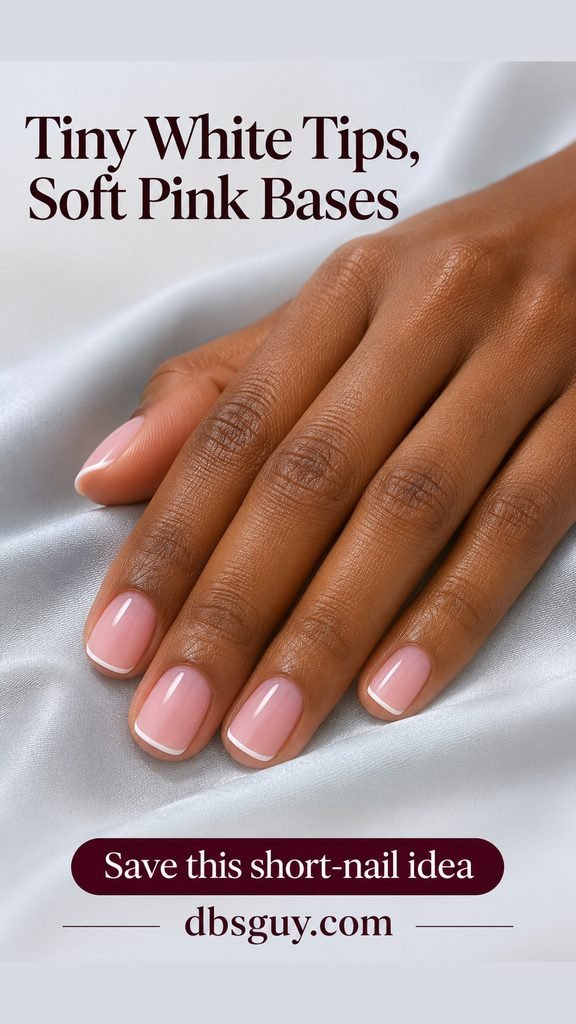
Ask for a sheer rosy base and a white smile line scaled to each nail. Squoval means a square outline with softened corners. If your natural white edge is wider or uneven, discuss whether a more opaque blush would give you the clean background you want.
Keep the white slim on the pinky instead of making every band identical in width. A broad white strip will produce a different, bolder French manicure.
2. Pink-to-White Ombré With a Snowy Fade
This version trades a drawn French boundary for a gradual change from blush to white. On medium almond nails, the white gathers at the tips while the lower part stays pink, giving the manicure its soft, snowy appearance.
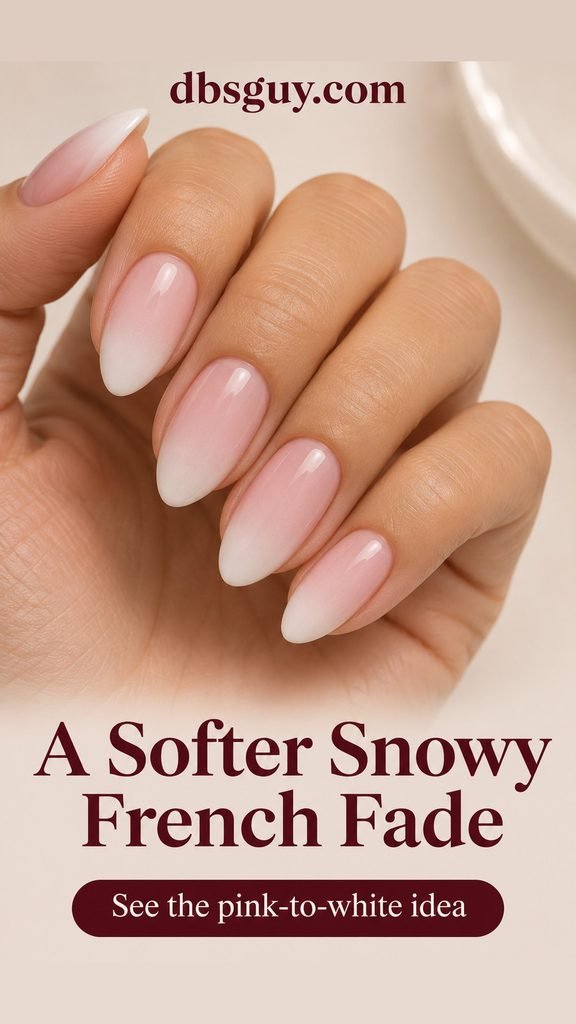
Bring the image and ask for white concentrated at the free edge, blended into the middle without covering the entire base. “Pink-to-white French ombré” is clearer than “white ombré,” which does not specify where the white should go.
For an air-drying polish interpretation, a cosmetic sponge can dab white onto the tips of a prepared pink base. Use light passes and follow your products’ layering and finishing directions. Practice on a spare tip first; a heavy first dab can leave a solid white patch instead of a fade.
3. Snowfall Dots Gathered Near the Tips
Small white dots suggest falling snow without requiring a detailed snowflake. Leave the base area mostly clear and gather the dots toward the tips of short oval nails. The open pink space is what keeps the pattern light.
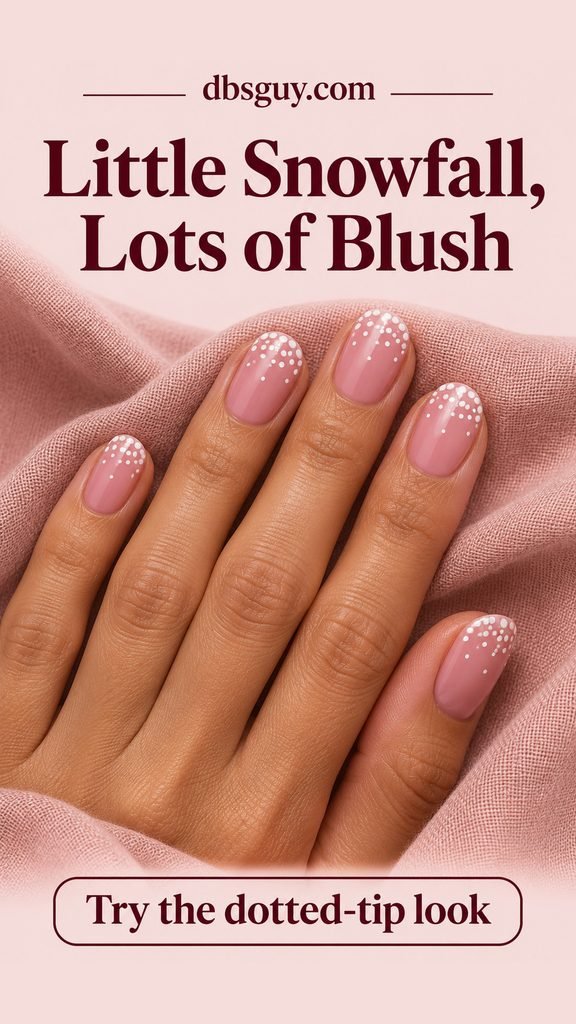
Vary the dot sizes slightly and leave a visible gap between them. You do not need a solid white French band underneath; the scattered dots create their own soft edge.
At home, try a nail-art dotting tool on a practice surface before touching the dried blush base. Start with fewer dots, look at the whole hand, and add only where the spacing feels empty. Joining the dots into one white mass loses the snowfall effect.
Also Read: January Nail Art for Beginners: Simple Designs to Practice at Home.
4. A Single White Snowflake Above French Tips
Keep a familiar blush-and-white French set, then give the ring nail one snowflake. The single motif makes the January reference easy to see while the other nails remain simple.

Leave pink between the snowflake and the white tip so the branches do not disappear into the edge. On a shorter nail, move the flake slightly higher or use a smaller decal rather than squeezing the two white elements together.
Salon wording: “Blush-pink oval nails with narrow white French tips and one small, flat white snowflake on the ring finger. Please leave clear space around the flake.” There is no need to add stones or surrounding dots unless you want a busier interpretation.
5. Diagonal White Tips That Look Like Snowbanks
A curved white sweep rises higher on one side of each almond nail. The result has more movement than a symmetrical French tip, with a broad pink area still visible underneath.
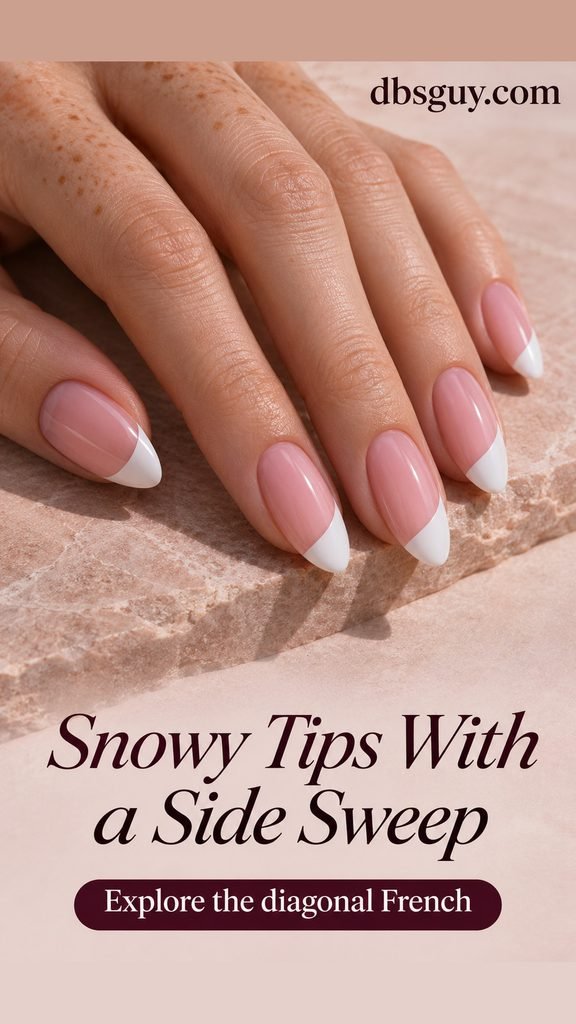
Choose a smooth, rounded diagonal boundary if you want the snowbank effect shown here. A straight slash or sharp V will make the design more geometric.
Ask the artist to repeat the same general sweep across the hand while adjusting its depth to each nail. On shorter nails, keep the high side shallower so white does not take over the nail bed. This is a useful choice when you want the tips to be the feature and prefer to leave out smaller artwork.
6. Double White French Curves With a Pink Gap
Two fine white arcs turn the French edge into open linework. A visible blush gap separates the curves, so this design reads differently from one thick white tip.
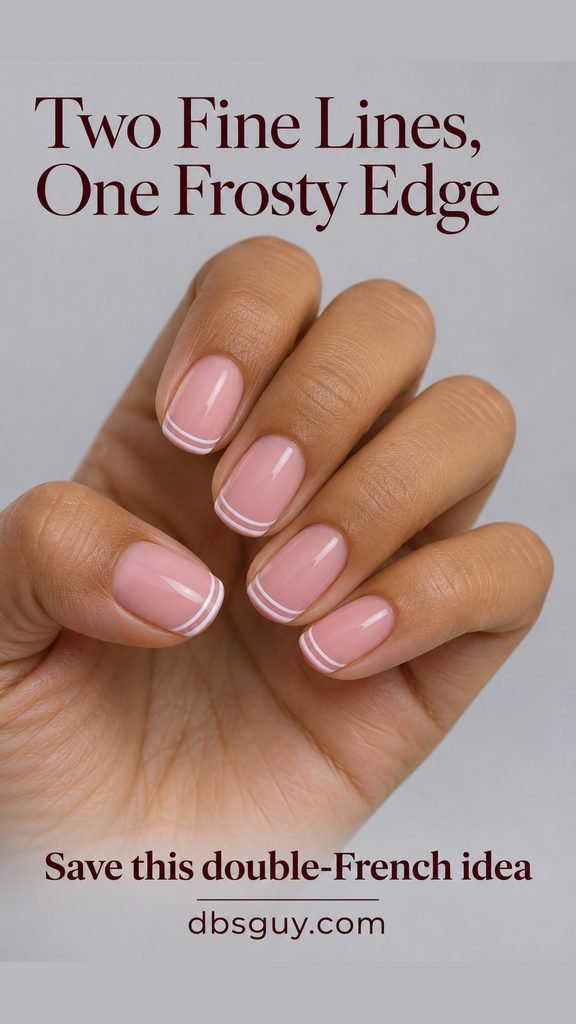
The clearest brief is: “Two narrow, parallel white curves near the tip, with pink showing between them.” Keep both lines light. If the gap disappears, the detail becomes a single band.
Short-to-medium squoval nails offer a broad edge for the curves. If your nails have very little space, put the double line on one roomier accent nail and use a single micro tip elsewhere. That preserves the feature without making every line too cramped to distinguish.
Also Read: 17 January French Tip Nail Ideas Beyond the Classic White Edge.
7. Pearl-Glazed White Tips Over Sheer Blush
Here, the change is in the reflection. The pink stays sheer and the white tips catch a soft, pearly light. Choose this if you like the basic French shape but want a finish that feels a little dressier.

Specify a white pearl sheen concentrated on the tips. “Chrome” by itself can lead to a stronger mirror effect or a different color shift. Show the reference and ask to see the finish over your chosen white before committing to the whole set.
The image shows a smooth surface, with no attached pearls or stones. A compatible pearlescent nail-polish topper can offer a softer interpretation; a salon powder finish is a separate product process, so let the artist select and apply the appropriate system.
8. Matte Blush Bases With Glossy White Tips
Matte pink beside glossy white makes a simple short French manicure more interesting at close range. The white tips have a small shine while the blush nail beds remain softly muted.
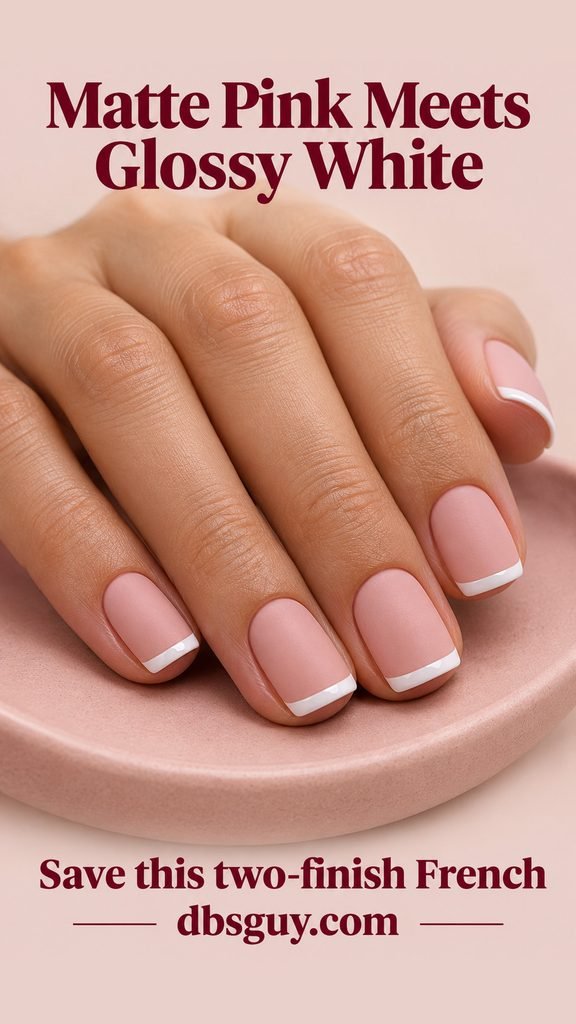
Ask for the two finishes explicitly. An all-over glossy finishing coat would erase the matte effect; an all-over matte coat would dull the tips. The artist needs to preserve the contrast in the finishing stage.
Short square nails with softened corners suit the straight, clean look of the reference. Keep the white band narrow enough to leave a generous matte area. If you are unsure about the finish, request a sample nail first so you can judge the difference in ordinary room light.
9. White Half-Moons on Short Pink Nails
Move the white from the tips to the base of each nail. Small white semicircles give short round nails a crisp detail while leaving the pink tips completely plain.
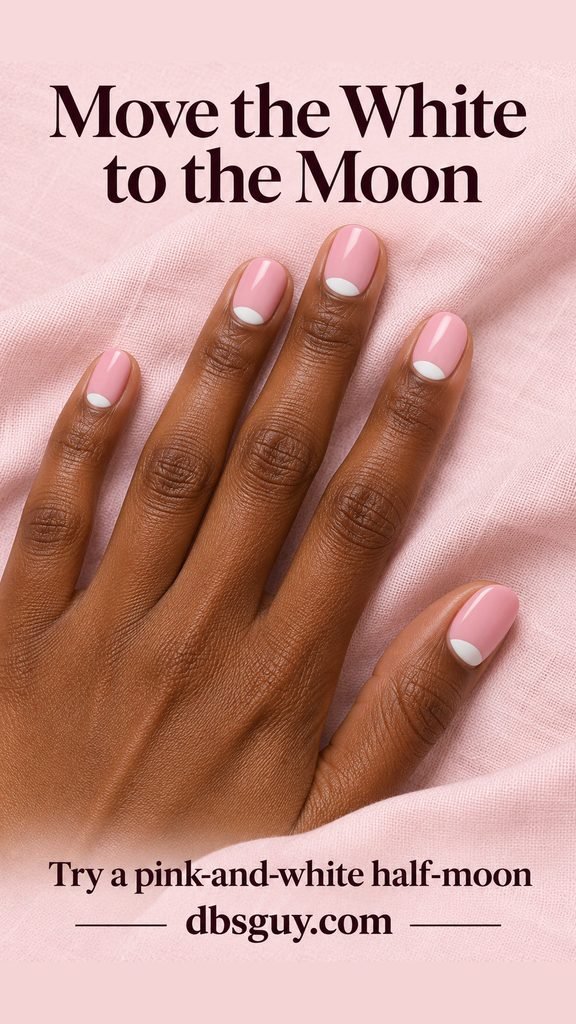
The white belongs on the nail plate, with a small visible gap from the skin. Ask for painted half-moons rather than a full white outline around the cuticle.
This placement does not depend on having a long free edge. Keep the moons shallow if your nails are compact; a large white semicircle can occupy more of the base than you intended. For a simpler variation, use one half-moon per hand and repeat only the blush color on the remaining nails.
10. A White Cable-Knit Accent With Blush French Nails
One white sweater nail adds texture to a blush French set. The reference puts a raised central braid on a matte white ring nail, letting the surrounding glossy pink nails frame the knit detail.
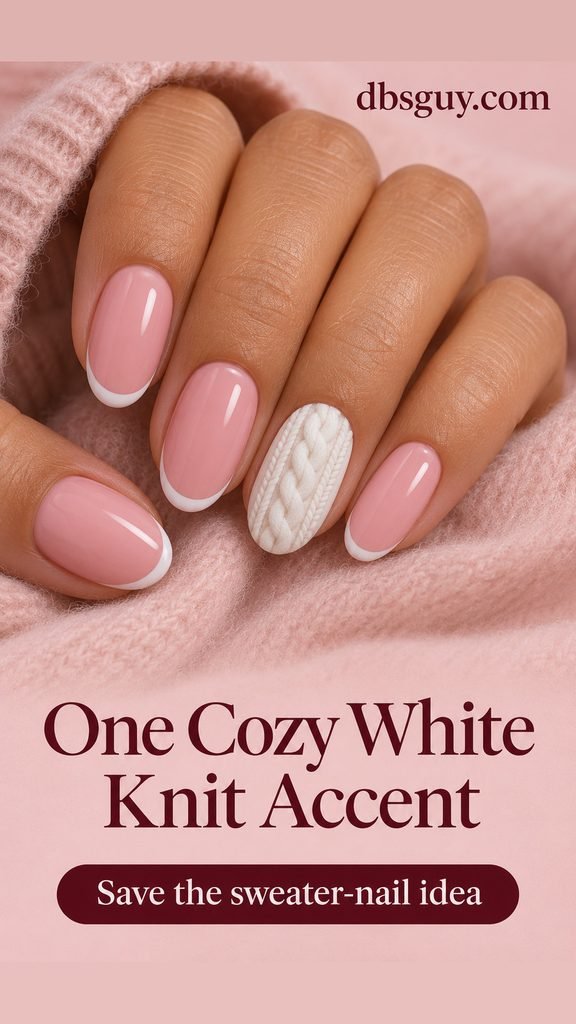
Choose this for the tactile pattern, not just the white color. Ask your artist for a restrained cable-knit accent with enough separation for the braid to show. A crowded arrangement of cables, dots, and stones would change the look substantially.
If you prefer smooth nails, request a flat painted knit interpretation or a suitable decal instead. It will suggest the pattern without reproducing the raised surface. On a shorter nail, one central braid is enough; remove side details before compressing the entire pattern.
Also Read: 17 Winter Nail Art Ideas for January That Feel Cozy, Icy or Both.
11. A Flat White Windowpane Accent
A small windowpane pattern brings a winter-fabric reference to pink nails without raised texture. In this version, two lengthwise white lines cross two sideways lines on the ring nail; the other nails stay plain blush.

Keep the lines thin and the pink spaces open. The design should read as a few clear rectangles, rather than a densely woven check or solid white patch.
Bring the close-up and ask for flat painted linework. For a smaller nail, reduce the number of lines instead of shrinking every space. A narrow nail can use one lengthwise line crossed by two short sideways lines and still carry the windowpane idea.
12. Ice-Marble French Tips With Clear Pink Bases
Milky white and pale translucent pink wisps give these tips an ice-marble effect. Keeping the marbling inside the French band makes the detail easy to distinguish from an all-over pink marble manicure.
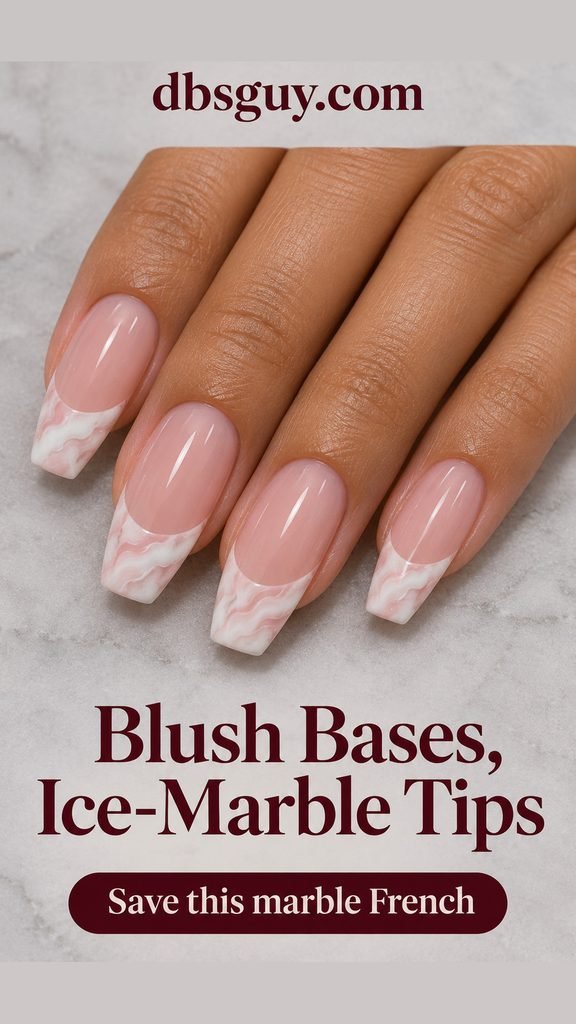
The medium coffin shape in the reference gives the tip pattern room to show. Tell the artist to preserve a clean blush base and keep the cloudy movement inside the tip band. Skip metallic veins if you want this soft two-color version.
On shorter nails, use a slightly deeper white tip on one accent nail and simpler white edges elsewhere. Too many fine swirls inside a very narrow band may be difficult to see. This is a salon reference if you want the controlled, translucent effect pictured.
13. Tiny White Winter Stars on Blush Pink
Two small four-point stars offer a winter detail without another snowflake. Put one toward the upper part of the middle nail and a slightly smaller one on the ring nail, leaving the remaining nails plain pink.

Give each point a visible border of blush. If a star reaches the edge, move it inward or reduce its size rather than adding more marks around it.
For a simple painted interpretation, cross a fine vertical stroke with a shorter horizontal stroke. A nail artist can taper the ends for the pointed sparkle in the reference, or you can choose a flat nail-art decal. Keep the stars white so the contrast comes from the drawing rather than metallic reflection.
14. Scalloped White Tips With a Soft Snowy Edge
Shallow rounded scallops soften the inside boundary of a white French tip. The blush base stays broad, while the little curves make the edge feel playful without adding a separate motif.

Ask for a narrow white tip with a few rounded dips along the pink-facing edge. The reference uses small scallops, not deep flower petals. Keeping them shallow matters on short oval nails, where a large scalloped band can quickly cover the pink.
The curves do not have to be identical across every nail. Scale them to the width available, keeping the overall white band light. Choose this when you want a visible change to a French manicure but prefer to keep the surface smooth and the palette simple.
15. One White Frost-Fern Sprig on Blush
A fine white sprig suggests the branching frost you might see on a cold window. Put the detail on one ring nail, angled gently across the pink, and leave the other nails glossy blush.
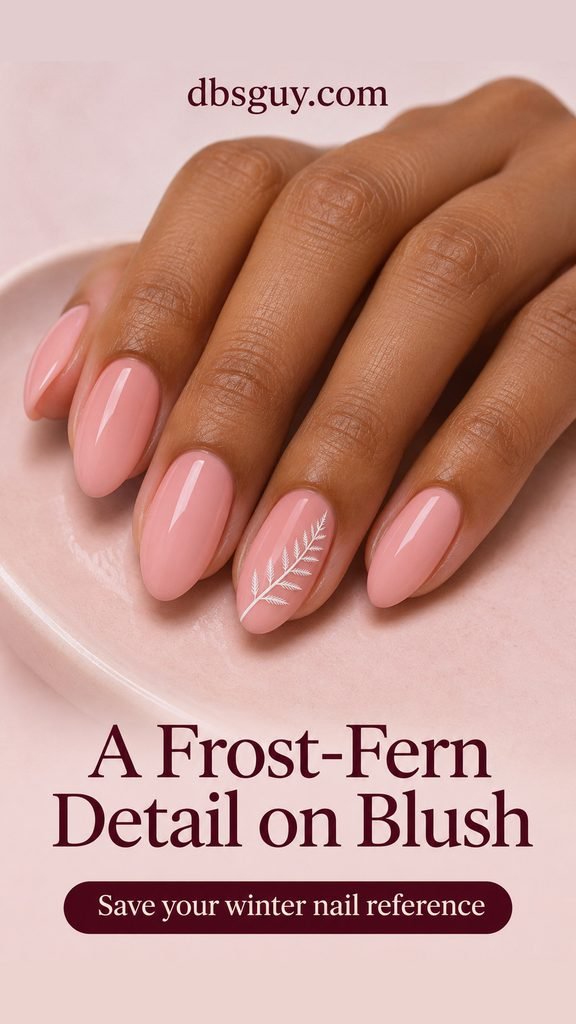
The identifying feature is a slender stem with small paired branches. Ask for white, flat painted linework with open pink space around it. Avoid filling the whole nail with leaves; the sparse arrangement is what makes this version feel delicate.
For a shorter nail, use a shorter stem with fewer branches, or move the accent to a roomier finger. A suitably sized white botanical decal can suggest the same placement at home. Check the decal against your nail before applying it, and keep the entire design within the nail surface.
Turn Your Favorite Reference Into a Clear Salon Request
Choose one image and name the detail you want carried over: the narrow white edge, the pink gap between two curves, or the single fern. Then tell the artist your preferred length, how sheer you want the blush, and whether you want a smooth or raised finish.
A useful starting brief is: “I want a visibly blush-pink base with soft white details, adapted to my usual length. The feature I want to keep is this placement.” Ask what can be simplified if your nails have less space than the reference.
For home painting, gather a blush polish, white nail-art polish, the recommended base and finishing coats, and the tool your chosen detail needs. The dots and single stars are more manageable starting points than marbling or raised knit. Follow the directions for the products you actually use; these concept images do not establish a universal coat count, drying time, curing method, or wear time.
Keep preparation gentle. The American Academy of Dermatology’s manicure guidance recommends leaving cuticles uncut, avoiding forceful pushing, and moisturizing after polish removal. You do not need to remove skin to make room for a painted detail.
Questions About Pink and White January Nails
How do I keep pink and white nails feeling wintry?
Use the white to suggest snow or frost: a cloudy tip, sparse snowfall dots, one snowflake, or a branching fern. Keep the pink soft enough for the white to stand out. Hearts and bows are optional; the winter effect can come entirely from the edge or motif.
Which idea works best on very short nails?
Start with dots, a small half-moon, or one windowpane accent. These sit on the nail plate and do not require a long white tip. A micro-French is another option when there is enough space to paint a clear, narrow edge.
Do I need gel or acrylic for these designs?
Many of the flat painted looks can be interpreted with regular air-drying polish. A precise pearl-powder finish or raised knit detail may call for a different salon process. Choose the design and discuss the product system separately; the picture alone does not tell you which service was used.
Why does the white detail disappear against my pink?
The two shades may be too similar in brightness, or the white marks may be too close together. Try a rosier base or a more opaque white, and leave more open pink around the detail. Check a sample in room light as well as near a window.