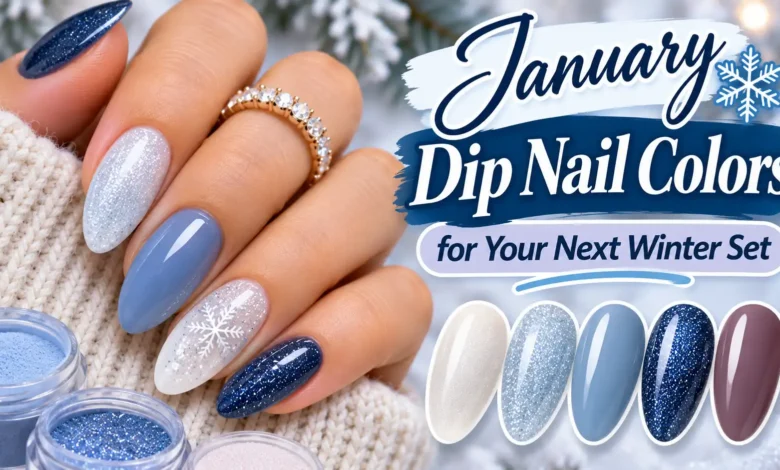
For your next January dip set, choose powder blue for a cool pop, milky ivory for a light finish, mushroom taupe for a muted neutral, cocoa for warmth, cranberry for rich red, or navy for a dark blue manicure. The best starting point is the color you want to notice beside your everyday coat, rather than a shade that only looks good in a saved photo.
Below, each of those six colors comes with a specific look to compare and a request you can take to your nail appointment. All six keep the artwork simple: one color, a glossy finish, and a comfortable length.
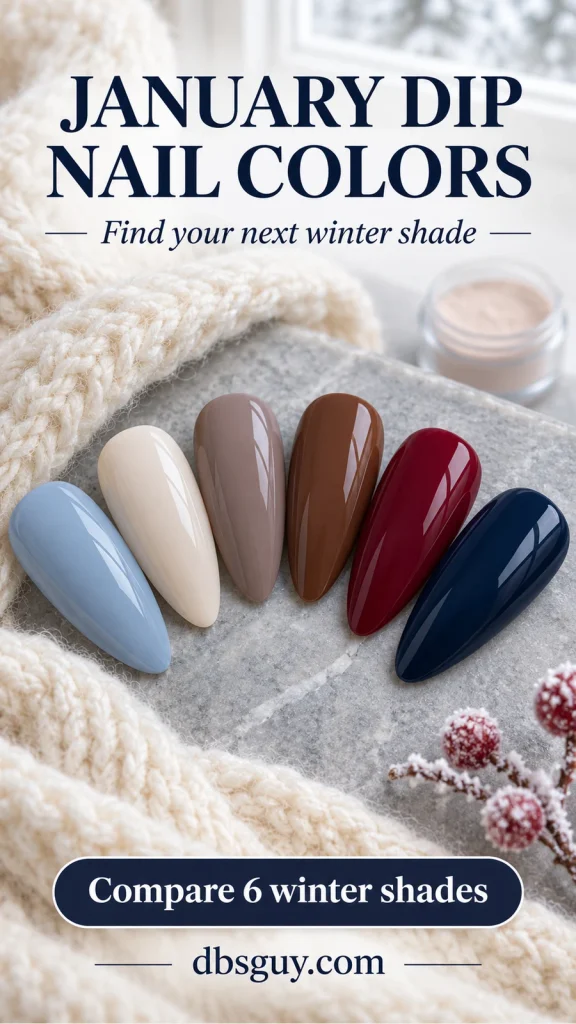
The images are AI-generated manicure concepts for dbsguy.com. They illustrate color, coverage, and shape; they are not photographs of tested dip powders or completed salon services. Confirm the result with a finished swatch.
Make Your Shortlist Before the Appointment
Save one pale option and one deeper option if you are undecided. Then compare them against the same sleeve. Powder blue and navy, for example, give you two very different ways to wear blue: a visible pastel or a dark outline.
- Choose the depth: Do you want a light manicure, a medium neutral, or a saturated dark?
- Name the coverage: A pale color can be opaque. A milky finish can let some of the natural nail show. Tell your artist which you mean.
- Keep the finish clear: These references use gloss. A shiny reflection does not mean the powder contains shimmer.
These are styling suggestions, not a seasonal ranking. You can wear any of them on any skin tone; the useful question is whether you like the contrast against your own hand.
1. Powder Blue When You Want a Noticeable Change
Powder blue is a good place to start if you usually choose beige but want your January manicure to have a clear color. Look for a pale blue with enough pigment to remain blue away from bright lighting. The reference has an even, opaque finish on short squoval nails.
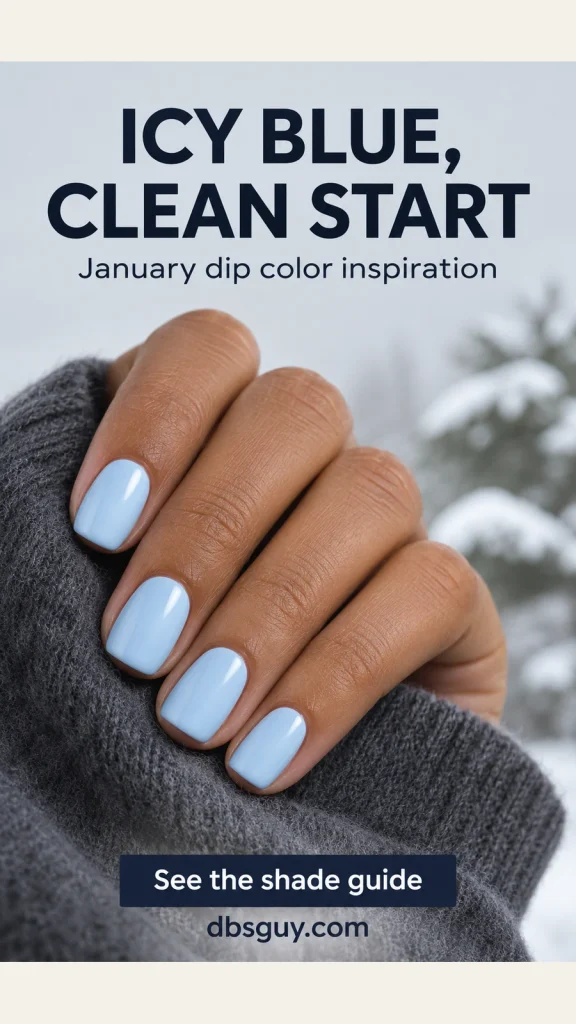
Put the sample beside charcoal or dark denim to see its blue clearly. Then move it beside your bare hand. If it looks minty to you, compare a blue with less green; if it looks almost white, ask for a slightly stronger blue. That small comparison is more useful than relying on a name such as “ice” or “frost.”
Ask for: “A plain, opaque powder-blue dip set with a glossy finish and short squoval edges. I want the blue to stay visible, with no glitter.”
The straight edge in this image gives the pastel a crisp outline. Keep your usual oval shape if that feels more comfortable; you do not need extra length to use the color.
2. Milky Ivory for a Soft, Light Set
Choose milky ivory when you want a bright manicure with a little warmth. The reference pairs short oval nails with creamy coverage that softly blurs the natural nail underneath. It is a quieter color change than blue, especially beside oatmeal and cream knits.

The word “milky” is worth explaining at the salon. Do you want a hint of the nail edge to remain visible, or would you rather hide it? Point to the coverage in the image, then compare an actual sample at that coverage. Asking for more layers of an unsuitable powder is not a reliable way to reproduce a photograph.
A useful request: “A soft ivory dip on short oval nails, with a glossy finish and lightly translucent coverage. Please keep it creamy rather than bright white.”
If ivory seems too yellow beside your hand, compare a more neutral soft white. If you want complete coverage instead, say so before the service starts; that changes the target even if you keep the same color family.
3. Mushroom Taupe for a Middle Ground
Mushroom taupe sits between a pale neutral and a dark manicure. Its brown-gray balance makes it a useful option when you wear camel one day and black or gray the next. Here, the short rounded-square shape and opaque gloss let the undertone do the work.

Taupe can lean rosy, gray, or brown. Hold two nearby samples together first, then test the favorite by itself beside your fingers. A pink cast that was obvious between swatches may feel much subtler on its own—or may be the very thing you dislike.
Tell your artist, “I want a medium mushroom taupe, balanced between brown and gray, with opaque coverage and a glossy finish.” Add “less pink” or “warmer brown” after you have looked at the samples, rather than trying to guess from the jar.
This is the option to consider when you want your nails to look deliberately colored without becoming the brightest part of your outfit.
4. Cocoa Brown for Warmth Without Red
Cocoa gives a winter set a warm brown color that is easy to see. The reference uses a medium milk-chocolate shade on short, softly tapered almond nails. It stays visibly brown instead of disappearing into an almost-black espresso.

Compare cocoa with your coat or bag if you enjoy coordinating warm neutrals. You do not need an exact match. A medium brown nail against darker wool, as shown here, creates enough separation to keep both visible.
The detail to watch is how much orange or red comes through. If the sample looks more like caramel than chocolate to you, move toward a more neutral brown. If you want warmth, keep that red-brown undertone intentionally.
Salon wording: “A medium cocoa-brown dip with full coverage and gloss. I want a visible chocolate brown, not a near-black shade, and a short, softly tapered shape.”
If you are deciding whether that taper suits your next set, our guide to January almond nails in sheer neutrals and winter darks shows how the same outline changes with coverage.
5. Cranberry Burgundy When You Still Want Red
There is no need to give up red when December ends. Cranberry burgundy keeps a red-berry note while adding depth. The short oval nails here use one solid glossy color, so the result feels dressed without needing seasonal motifs.
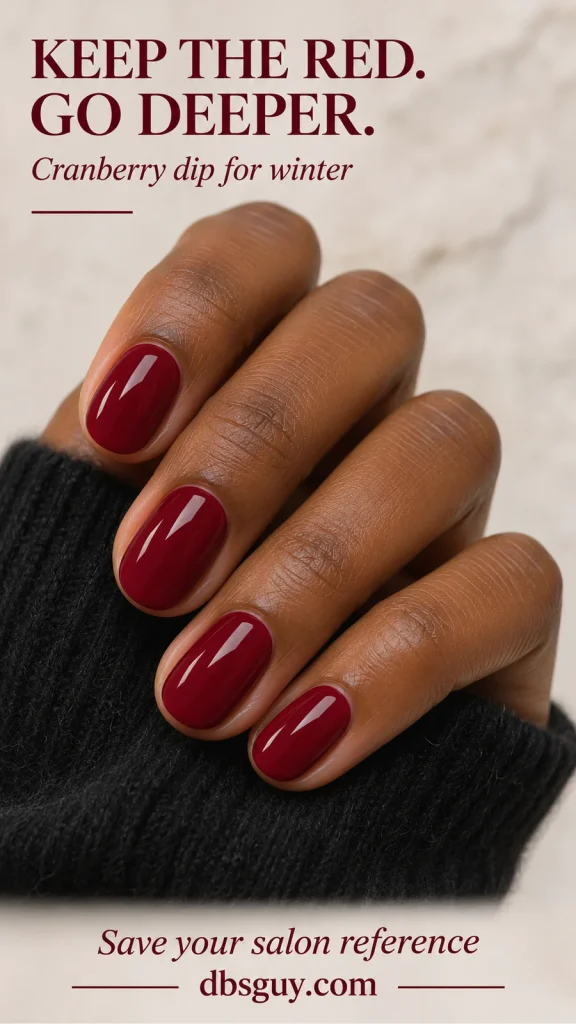
Look at the swatch where the light is not directly reflecting off it. That is where you can judge the actual depth. If it looks black in ordinary room light and you wanted red, try a lighter burgundy rather than hoping the finished set will photograph brighter.
Ask for: “A glossy cranberry-burgundy dip on short oval nails. I want it rich and deep, but still clearly red rather than purple or almost black.”
This is a useful choice for someone who likes a familiar red manicure but wants a deeper version beside a black coat. It also leaves your color palette open as February approaches. For a later appointment, browse our end-of-January nail designs for small details that build on winter colors.
6. Inky Navy for a Dark Set With a Blue Edge
Navy gives you the defined outline of a dark manicure with a distinct blue hue. On the short squoval nails in the reference, the glossy surface catches light while the color stays plain. Choose it when a pale blue feels too light for what you have in mind.
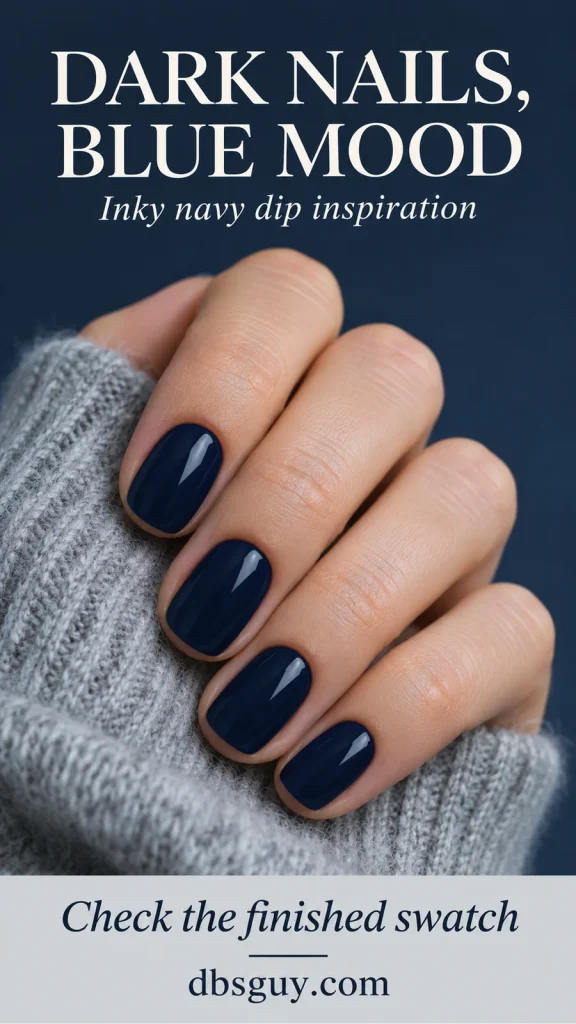
A very dark navy can look nearly black indoors. Decide whether you like that effect before choosing it. If the blue is the reason you saved the image, ask to compare a navy that is a little lighter or more saturated.
Say: “A plain navy-blue dip with opaque coverage, a glossy finish, and short squoval nails. Please show me a finished sample where the blue is visible in room light.”
Gray knit makes an easy visual pairing, but there is no need to restrict the color to cool clothes or silver jewelry. Hold it beside the pieces you actually wear and choose the combination you enjoy.
Check the Finished Dip Color, Not Just the Inspiration Photo
Use the image to explain your direction, then let the salon show you what its powder system can deliver. A color name from a polish bottle does not establish that the salon has the same shade in dipping powder.
- Confirm the format. Ask which dip powder shade would create the look, and whether the displayed sample was made with that product.
- Check the complete finish. Judge a finished sample with its intended coverage and top coat, rather than loose powder alone.
- Change the light. View the sample near indirect daylight and in ordinary indoor lighting. Check the pale colors for undertone and the dark colors for visible hue.
- Record the choice. Save the brand, shade name or number, coverage preference, and shape once you settle on them. Those details are more useful at a repeat appointment than a filtered photograph.
These concepts are not exact brand matches, so there is no universal coat count or powder recipe for them. Have your artist follow the selected system’s instructions. If a technique or top coat would add a gel step, clarify that before the appointment continues.
A Few Dip-Manicure Habits Worth Keeping
The American Academy of Dermatology’s dip-powder guidance recommends leaving cuticles alone and avoiding powder containers shared by dipping multiple clients’ fingers into them. Ask about fresh powder in a disposable container, with leftovers discarded, or a sprinkle-on application.
Moisturize dry cuticles, and inspect your bare nails when the old color comes off. If you notice lifting, swelling, discoloration, or other changes, pause the next manicure. Dip adhesives can cause allergic reactions; persistent skin or nail changes deserve a dermatologist’s advice. The AAD also recommends a month between gel or dip manicures after removal. A new color is not a reason to cover a problem.
Questions Before Your Next Winter Set
Which January dip color works best on short nails?
Any of these six can work at a short length. Choose ivory if you want a light surface, taupe or cocoa for a medium-depth neutral, and cranberry or navy for a darker outline. The references show the color doing the work without needing a long extension or an accent design.
Is milky ivory the same as opaque white?
No. Ivory describes a warm white color; milky usually describes a softened look that may leave some nail visible. An opaque white hides the natural nail. Show the coverage you like instead of relying on those labels alone.
Do darker colors make dip nails last longer?
Do not choose navy or burgundy expecting the color itself to guarantee longer wear. These are appearance recommendations. Application, the product system, removal, and the condition of your nails matter more than whether a shade feels wintry.
Can a pale dip set have a glossy finish without looking sparkly?
Yes. Gloss describes the smooth surface reflection; shimmer describes reflective particles in the color. Ask for a plain cream or milky shade with gloss, and check that the finished sample has no sparkle if that is your preference.
Once you have a favorite, save its image and the salon request beneath it. Bring one backup color, check the finished swatch, and settle the coverage before the first nail is started.