
Lace doilies look surprisingly at home beside charcoal linen, colored glass, and simple wood furniture. The trick is to give the lace a clear place to shine: a pillow front, a sheer curtain, or one small detail on a shelf. These nine ideas show you what to pair it with, how to put the look together, and when to use a new doily instead of a treasured old one.
Choose your starting point: For a no-sew change, try the basket, display tray, shelf, vase, or miniature tree. For a little hand stitching, choose the pillow, curtain, or garland. The clay dish is a craft project that borrows the lace pattern.
The images below are AI-generated styling concepts, created to illustrate the ideas rather than document completed projects. Suggested measurements are starting points to adjust to your own pieces.

First, decide which doily belongs in the project
For everyday decorating, look for a sturdy doily with intact edges and a pattern you can see against your chosen background. New cotton crochet pieces are useful for projects that involve stitching, repeated handling, or contact with craft materials. A woven center with a lacy border works especially well in a display tray.
An heirloom needs a different decision. If a piece is fragile, historically valuable, or irreplaceable to you, set it aside before experimenting. The National Archives’ textile-preservation guidance explains that cleaning can damage old textiles and that light exposure should be limited. Ask a textile conservator about a valuable piece; reversible decorating is not automatically conservation-safe.
1. Make a plain pillow feel special with a doily front
A charcoal pillow gives ivory crochet enough contrast for every opening and scallop to show. It is a particularly good choice when your sofa and other cushions are mostly solid colors.
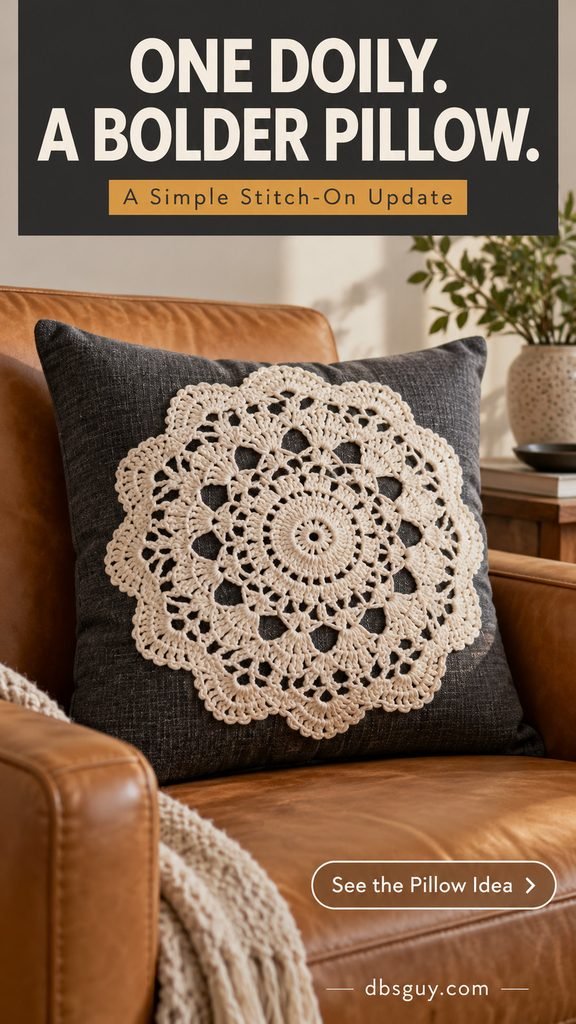
Start with an 18- to 20-inch removable cushion cover and a doily roughly 10 to 14 inches across. Lay both flat before deciding on the size: you want a visible border of plain fabric around the lace, rather than scallops disappearing into the pillow seams.
Remove the insert, center the doily on the cover’s front, and loosely baste it in place. With matching thread, hand-stitch through sturdy parts of the crochet at intervals around the edge and through a few inner motifs. Keep the cover relaxed so it does not pucker, and work through the front layer only.
Use a washable modern doily and a compatible cover, following both care instructions. A seamstress can attach the lace if you prefer; ask for small, distributed stitches and an unobstructed zipper. On a chair used heavily by pets or children, a textured lace cushion may snag, so save this one for a quieter seat.
2. Add doilies to a sheer café curtain
Small circles of lace can soften a kitchen window without turning it into a heavy patchwork. Here, the continuous sheer panel carries the doilies, while the upper half of the window stays open.

Choose a ready-made voile café panel that fits your window and five lightweight doilies around 4 to 6 inches wide. The pictured arrangement uses three across the upper part of the panel and two below. Lay it out on a table first, leaving plain fabric between the circles and keeping them clear of the bottom hem.
With the curtain off its rod, baste each doily flat, then add small stitches around its edge and at several interior points. Spread the support across the fabric instead of hanging a heavy doily from a single stitch. A lightweight panel should still gather easily when you lift it.
Use new, replaceable lace here. A bright window is a poor long-term display spot for a precious textile. Keep the finished curtain away from the faucet’s splash zone and any cooking heat. Sheer fabric and openwork lace provide decoration, not dependable nighttime privacy; use a separate suitable window covering when privacy matters.
3. Give a lined storage basket a soft lace cuff
This is one of the easiest ways to try doily decor before committing to a sewing project. The lace changes the basket’s outline, while the basket still does its ordinary job.

Pick a basket for clean throws or spare linens, then drape one large round or oval doily over the front rim. Tuck enough of it inside to hold the position, leaving a broad scalloped section visible outside. A cotton liner underneath helps separate the lace from rough woven fibers; extend the liner over any part of the rim that catches.
The balance matters more than an exact size. On a basket about 14 to 16 inches wide, try a doily around 12 to 16 inches across, then fold or reposition it until the lace sits neatly above the floor. Keep handles usable and avoid tying the doily tightly around them.
If the basket is emptied daily, leave the lace loose so you can lift it out first. Use a sturdy everyday piece, and keep this basket for dry textiles rather than shoes, damp laundry, or firewood.
4. Put lace beneath the clear top of a display tray
A black display tray gives pale lace a crisp outline. Its clear insert also separates the textile from the small objects arranged above it.
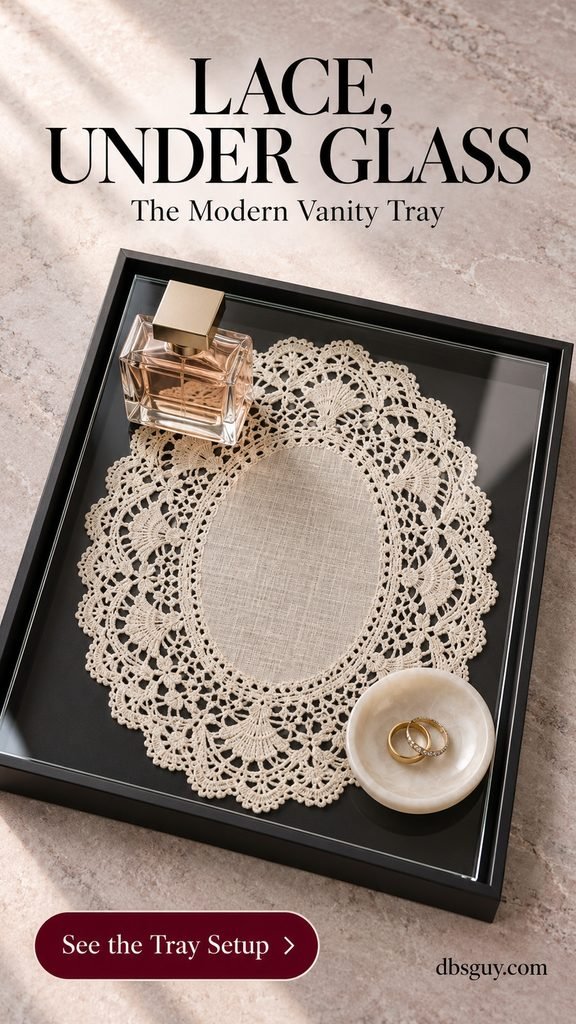
Use a tray designed with a removable clear display top or insert. Choose fine, flat lace that fits inside its display compartment without needing to be folded or squeezed. A 12-by-16-inch interior is a useful starting size for an oval doily, but measure your actual tray before buying anything.
Lift out the insert, place the doily on the clean base, and lower the insert into its intended supports. It should sit level without crushing raised crochet. Leave a slim border of the dark base visible. On top, place just a closed perfume bottle and a small ring dish so the lace remains the main detail.
Skip improvised loose glass with exposed edges. A purpose-made display tray is the simpler option. Keep it in a dry dressing area and remove everything before cleaning. This is an everyday styling project for a replaceable textile, not an archival storage method for an heirloom.
5. Let one scalloped edge interrupt a straight shelf
Against a dark painted bookcase, a single lace edge reads clearly. The surrounding empty space is what keeps the arrangement from feeling crowded.
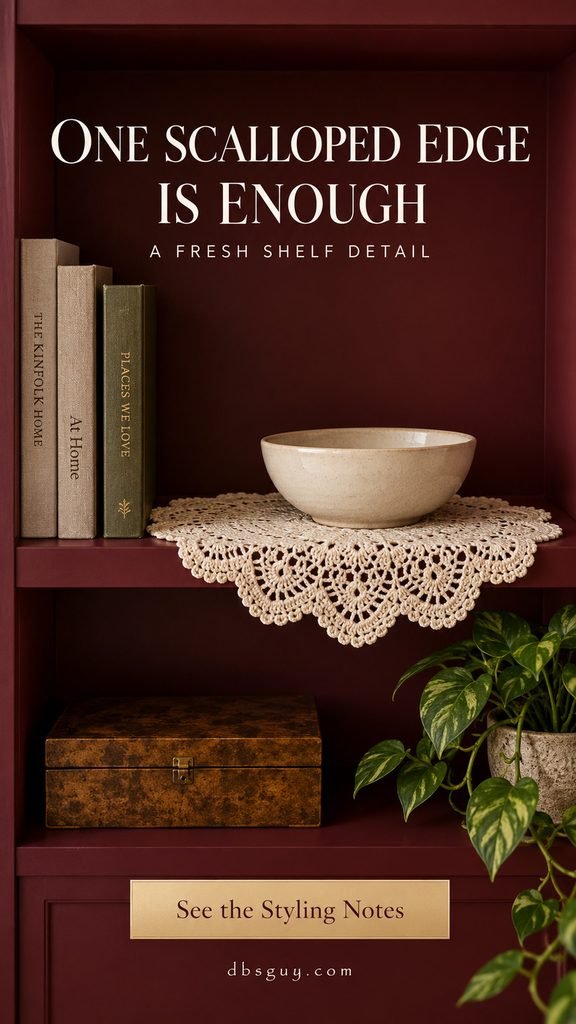
Choose a round or oval doily with a border worth showing. Lay most of it flat on one shelf, allowing a short section of scallops to fall over the front. Begin with about 2 to 4 inches of overhang, then check the view from across the room.
A low, smooth-bottomed bowl can rest on the flat area if it sits steadily. Leave space beside it, with a small group of books toward one end. Choose objects with simple shapes so they do not compete with the lace pattern.
Keep the doily on a display shelf rather than beneath something you pull out repeatedly. If the fabric slides or makes the bowl wobble, adjust the arrangement or remove the bowl. The lace should add texture without making the shelf awkward to use. Inspect the shelf finish and avoid placing delicate fabric on a rough, sticky, or freshly painted surface.
6. Fold a few doilies into a reusable garland
A short row of semicircles makes a gentle party decoration for a dining-room doorway or the wall above a buffet. Keeping the doilies whole means you do not need to cut up their patterns.

For a compact garland like this one, gather five lightweight, similarly sized modern doilies, cotton twill tape, a needle, and matching thread. Six-inch doilies with 1- to 2-inch gaps make a roughly 34- to 38-inch decorated section; add extra tape at both ends for attaching it.
Fold each doily loosely over the tape to form a semicircle. Baste through sturdy stitches on both layers just below the fold, catching the tape so the pieces stay spaced. Avoid sharp pressed creases. Hang the garland from suitable secure fixings with only a shallow dip.
Check the lowest point against people’s head height and the door’s movement. If there is not enough clearance, use the wall above a buffet instead. Keep loose ends out of reach of children and pets, and keep the lace away from candles and heat. After the gathering, remove the basting if you want the doilies flat again.
7. Press a lace pattern into a decorative clay dish
This idea is for anyone who loves the pattern but would rather display it in a solid material. The doily acts as a texture tool, leaving an impression in the clay.

Gather: air-dry clay, an inexpensive modern cotton doily, a craft rolling pin, a protected work surface, a round template about 5 inches wide, a suitable craft cutting tool, and a shallow form lined with plastic wrap. Use dedicated craft tools and follow the clay maker’s handling directions.
- Roll the clay into an even slab, starting around 1/4 inch thick or following the thickness guidance for your particular product.
- Lay the doily flat on top and make one light pass with the rolling pin. Lift one edge to check the impression before peeling the lace away slowly.
- Cut a circle around the pattern. Set it into the lined shallow form, gently lifting the edges to create a low rim. Avoid stretching the patterned center.
- Dry and release it according to the clay manufacturer’s instructions. Follow those instructions for drying the underside and for any paint or compatible finish.
Practice on a small scrap first: thick crochet can make a deep impression, while very fine lace may barely register. Do not use a sentimental doily, because clay can lodge in its threads.
Keep the finished dish for dry jewelry or decorative display. It is not a food dish, soap dish, or candleholder. Crayola’s air-dry clay guidance, for example, says that sealing does not make its clay waterproof and recommends indoor display. Check the instructions for whichever clay you use.
8. Wrap a plain vase with lace and a thin cotton tie
Olive glass brings out the openings in ivory crochet, while a narrow neutral tie keeps the arrangement relaxed. A few dried stems give the lace room to remain visible.

Start with a straight-sided vase and a flexible doily that can curve around the front without stretching. A cylinder roughly 3 to 4 inches across and 8 to 10 inches tall is an easy shape to work with. Test the wrap before adding a tie: a stiff doily or sharply tapered vase will be harder to fit.
Center the main motif on the front. Bring the sides around gently, then secure the lace with a thin cotton tie around the vase’s middle. Tie it at the back, keeping the tension just firm enough to hold the fabric. The lace does not need to meet all the way around.
Use the vase dry, with a few dried stems as shown. Take the wrap off before washing the vase. For fresh flowers, remove the fabric while filling and emptying the vase, and make sure the outside is completely dry before replacing it. This is a removable cover for a vase, not a sleeve for a candle or lamp.
9. Use a whole doily as a miniature tree skirt
A small holiday tree needs only a little lace to soften its base. With a potted tabletop tree, the doily can stay completely intact.

Choose a small artificial tree with a stable, smooth-bottomed container. Set it on the center of a flat round doily, letting the lace extend several inches beyond the pot. For a pot around 5 to 6 inches across, try a doily roughly 12 to 16 inches wide.
Keep the fabric flat rather than gathering it around the container. You should be able to see the outer scallops without the lace hanging over the edge of the furniture. If raised crochet makes the pot rock, choose a flatter textile or another display spot.
The concept here uses an unlit tree with a few small brass-colored ornaments. It suits a sideboard or entry console during the holiday season without requiring a full-size tree setup. Use a replaceable doily for this handled display, keep it away from heat, and remove the tree before lifting the lace.
How to make your chosen look feel at home
Start with one of these ideas in a room, then live with it before adding another. A dark background makes pale openwork more noticeable; a similar cream background makes the effect softer. Use the surrounding plain fabric, wood, or paint as part of the composition.
When shopping, bring measurements of the pillow, window, tray, or container. At a thrift store or estate sale, check the center as carefully as the edge for broken threads, repairs, and areas that feel brittle. Online, ask for an overhead photo and the actual dimensions. You are choosing a piece that fits a job, not just collecting a pattern you like.
Questions about decorating with lace doilies
Are doilies too old-fashioned for a modern room?
They can work beautifully with plain contemporary furniture. The pillow and olive-glass vase are easy examples: the background is simple enough to show the lace clearly. Choose the amount of detail you enjoy rather than trying to make the entire room match the doily.
Can I use a treasured family doily for these projects?
A strong family piece and a fragile heirloom need different treatment. Avoid craft materials, stretching, strong light, and frequent handling for irreplaceable lace. Even stitches or repeated folds can stress an old textile. Get conservation advice before adapting a piece whose condition or value you are unsure about.
How should I clean an old doily before displaying it?
Do not assume that a white doily is washable cotton. Fiber, dyes, previous repairs, and condition all matter. For a new piece, follow its care label. For antique or unidentified lace, skip online bleaching and soaking recipes and ask a textile conservator. The Canadian Conservation Institute’s basic textile-care guidance is a useful starting point for handling and storage.
Will a doily protect furniture from a wet glass or a hot pot?
Do not rely on it for either job. Openwork fabric is not a waterproof barrier, and a decorative textile is not a rated heat-resistant trivet. Use a proper coaster, plant saucer, or trivet suited to the surface and object. Keep lace outside spill-prone areas.
What is the best way to store doilies between displays?
Store them clean and dry, supported flat when practical, and away from strong light. The Canadian Conservation Institute recommends flat support for most textiles and padding unavoidable folds with appropriate acid-free tissue or muslin. Avoid crushing delicate scallops beneath heavier linens.
If you are choosing just one project today, the basket is a simple no-sew starting point; the pillow makes a more prominent accent. Pick the place where you will actually notice the lace, measure it, and begin with one well-fitting piece.