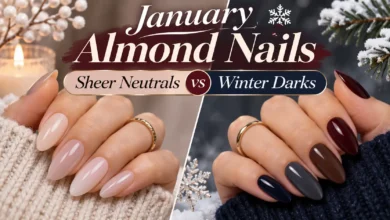
For January nail art in 2027, start with the kind of frost you want to see: a pearly blue sheen, a soft silver glow, a faded tip, or a small painted winter detail. The seven looks below give you different ways to get there, with clear notes on color, placement, and what to ask for at your appointment.
If you want the simplest starting point, choose the blue ice glaze. For visible nail art you can practice with regular polish, try the snowfall dots. If you prefer dark nails, the graphite outline keeps the winter reference in a slim silver curve.
These are design ideas to save for your January plans, rather than a prediction of which manicure will dominate 2027.

The images in this guide are AI-generated design concepts. Use them to communicate the look you want; they do not document completed salon work or product testing.
Choose the Frost Effect First
“Frosty” can describe several different things. Naming the finish helps your nail artist understand the reference before you settle on a color.
- Pearl glaze: a soft, luminous layer over a visible base color. It can give pale blue a cool glow without the appearance of a solid silver mirror.
- Magnetic velvet: reflective particles arranged with a magnet to create a shifting light effect. The surface can still be smooth and glossy; “velvet” describes its appearance.
- Shimmer fade: fine sparkle concentrated in one area, with a gradual transition into the base.
- Painted frost: dots, a snowflake, an outline, or branching veins. The placement supplies the winter detail even when the base is ordinary glossy polish.
Choose one of those effects as the main feature. Adding pearl, glitter, magnetic shimmer, and several motifs to the same small nail can make the detail you liked harder to see.
1. Blue Ice Glaze With a Soft Pearl Sheen
This look puts the finish across the whole nail: a pale blue base with a blue-white pearl glow. There is no tip band or painted motif. It suits someone who wants a winter color but would rather let the reflection do the decorating.
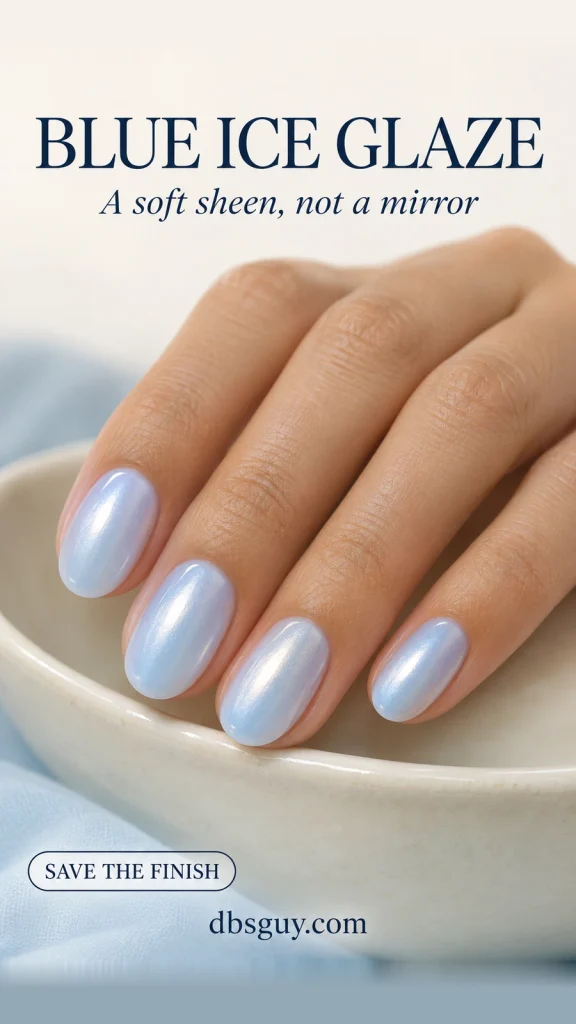
Ask to see the base and glaze together on a sample. A pearly layer over a sheer blue can look very different from the same layer over an opaque white. In the concept, the base remains slightly translucent and the sheen is luminous rather than a dense silver mirror.
Short oval nails can keep this exact full-nail layout. If you want to try a lacquer version, choose a pale blue and a compatible air-dry pearl topper. That gives a related soft sheen; it should not be treated as interchangeable with a gel chrome-powder system.
Salon request: “A pale, slightly sheer blue with a soft pearl glaze over the whole nail. I want the blue to show through, with no French tip.”
2. Soft Silver Velvet on Short Squoval Nails
Silver velvet gives you more visible sparkle than the blue glaze. Here, a charcoal-gray background anchors a broad silvery highlight, so the nails look dimensional rather than uniformly pale. The short squoval shape keeps the reference compact.
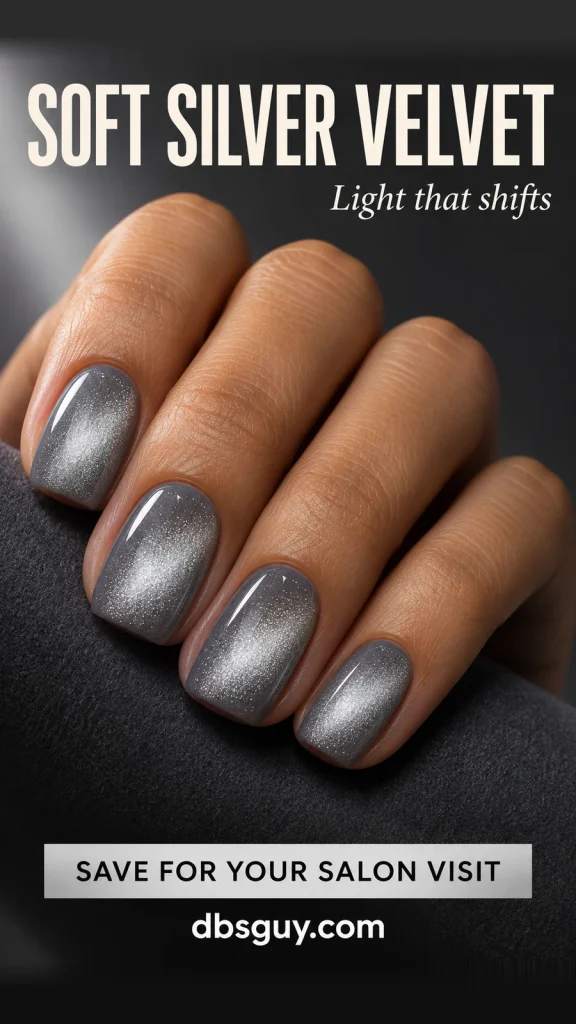
The important choice is the width of the glow. Ask for a diffused velvet effect across the nail instead of a sharply defined cat-eye stripe. View a magnetic sample from more than one angle: a still image captures only one arrangement of reflected light.
Keep the surface smooth and leave off additional motifs if the shifting shimmer is what caught your eye. Ordinary silver shimmer polish can echo the palette, but it will not reproduce the same magnet-shaped effect. Any magnetic product needs its own application instructions.
Ask before booking: Does the salon offer this broad velvet effect, and is it priced as a finish add-on? A photo alone does not tell you which service to select.
Also Read: 21 Winter Nails Aesthetic: Frosted Finishes That Look Right With Your Softest Sweater
3. Lilac Frost That Fades Back From the Tips
A lilac frost fade puts the brightest shimmer at the free edge, then softens it into a sheer pink-lilac base. The transition is the design. A crisp white border would turn it into a different manicure.
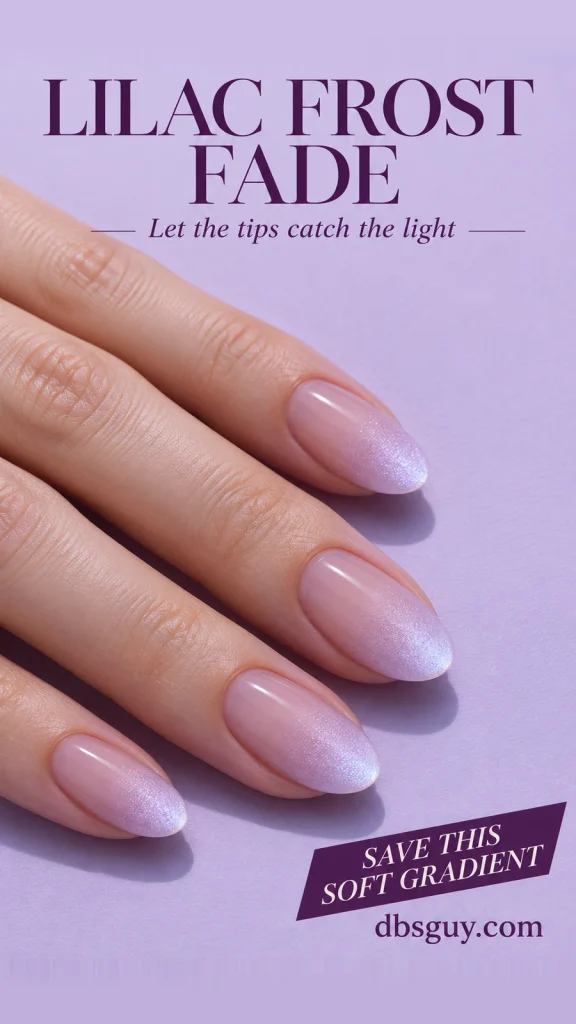
Save this if you like a decorated tip but do not want a defined French line. The concept uses medium oval nails, giving the shimmer room to taper. On shorter nails, keep the brightest area near the edge and make the fade shallower so the pink base still has space.
Request fine shimmer rather than large glitter pieces. Ask your artist to show you one finished fade before repeating it, especially if you prefer a barely visible edge. For a home lacquer interpretation, practice the taper on a spare nail tip first; the topper’s density will affect how easily it fades.
Salon request: “A sheer pink-lilac base with fine icy shimmer strongest at the tips, fading softly toward the middle. No hard smile line.”
Also Read: 17 January French Tip Nail Ideas Beyond the Classic White Edge
4. Tiny Snowfall Dots Over Smoky Blue
This is the most straightforward painted detail in the group. Smoky denim blue supplies the color, and a few white dots suggest snowfall. The reference uses short rounded nails, so you can see how little space the pattern needs.

For a regular-polish version, use your base coat, blue lacquer, white nail-art polish, a small dotting tool, and a compatible top coat. Follow the products’ drying directions rather than working to a fixed timer.
- Apply the base coat and blue color according to their instructions. Let the color dry before adding dots.
- Put a small drop of white polish on a disposable palette. Practice a few dots to check their size.
- Place three to five small dots on each nail, leaving plenty of blue between them. Vary the spacing and mix a couple of sizes.
- Let the dots dry before applying top coat gently so the brush does not drag white trails through the blue.
If your dots look crowded, use fewer on the next nail instead of filling every gap. A small irregular scattering reads more like this reference than evenly spaced rows. Keep the dots within the nail, away from the skin.
Also Read: January Nail Art for Beginners: Simple Designs to Practice at Home
5. One White Snowflake on Dusty Mauve
Dusty mauve gives a white snowflake enough contrast to stand out while keeping the rest of the manicure quiet. The concept places one branching flake on the ring nail and leaves the neighboring nails plain.
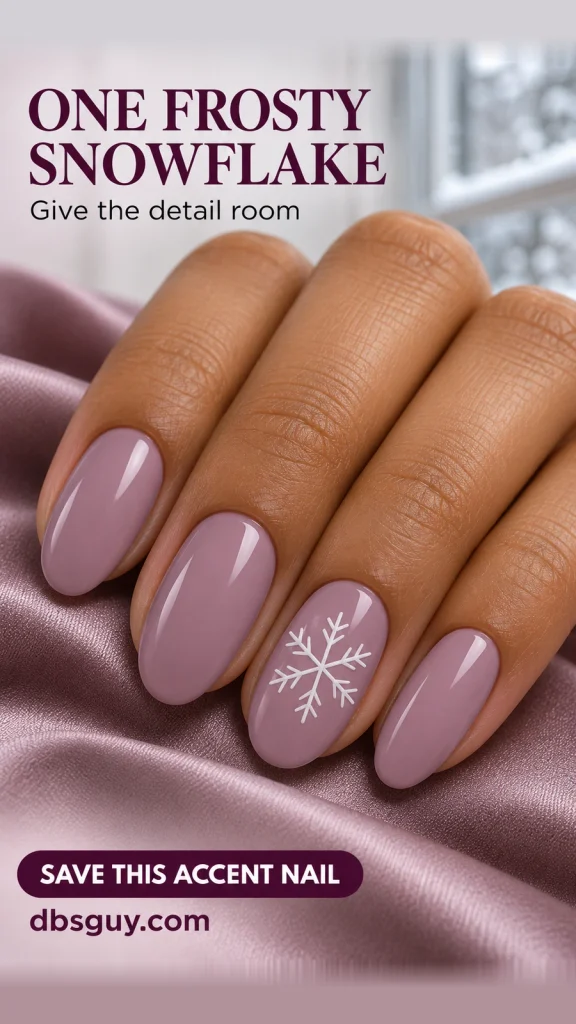
The snowflake needs open space around its arms. Choose its size after deciding on your nail length. On a short nail, fewer little branches will be clearer than squeezing a detailed large flake into the same area.
Ask for a flat painted design, or look for a flat decal small enough to sit fully inside your nail’s outline. Raised charms are a different surface choice and will change the reference. The white lines here provide the detail without any extra stones or silver dots.
Salon request: “Glossy dusty mauve on all nails, with one fine white six-armed snowflake on each ring nail. Keep the other nails plain and the artwork flat.”
6. Graphite Nails With Broken Silver Side Outlines
For a darker January manicure, pair glossy graphite with one slim silver curve along the side of each nail. The line stops before the cuticle and tip. Those breaks keep it from becoming a full metallic border.
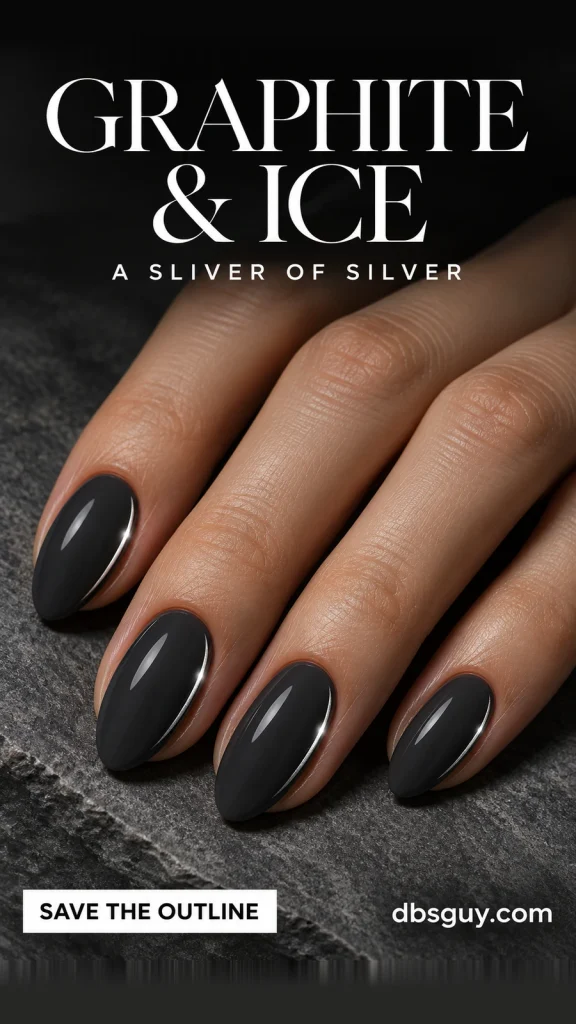
Most of the nail should stay charcoal. Show your artist the width of the silver arc as well as the color; a thick sweep would change the balance considerably. The concept uses an almond shape, but a shorter rounded nail can carry a smaller side arc.
Choose this when you want the contrast of dark polish and icy metal without a snow motif. Before the artist repeats the line, check one nail from straight above. The silver should read as a narrow edge detail, with a clear gap at both ends and a margin from the skin.
The detail to save: a partial side outline, not a French band, central stripe, or closed frame.
7. Frozen-Window Veins Over Mist Blue
This look borrows the branching paths of frost on glass. Fine white veins wander through a translucent-looking mist-blue base, leaving blue visible between them. Unlike the single snowflake, the branches are irregular and spread across the nail.
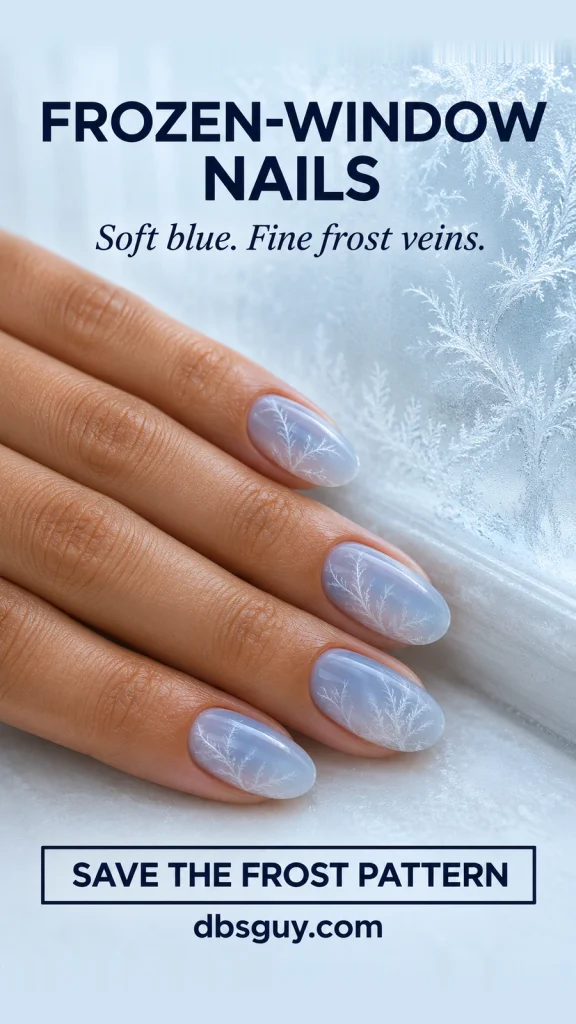
Ask for delicate frost linework rather than bold stone-marble veins. The difference is in the scale: small feathery branches with open blue areas, rather than thick bands that divide the nail into sections. A glossy, smooth finish suits the glass reference.
This is a useful salon reference if you enjoy detailed art but do not want a repeated emblem on every finger. Let the paths vary across the hand. For shorter nails, reduce the number of branches so the pattern remains visible at normal viewing distance.
Salon request: “A translucent-looking mist-blue base with fine white branching frost veins. Keep open blue space between the branches, with no dark marble lines or raised texture.”
Turn Your Saved Look Into a Clear Appointment Request
Choose the image closest to the result you want and bring a short description of its essential detail. “Winter nails” leaves room for very different interpretations; “a broad silver velvet glow on short squoval nails” tells the artist much more.
- Set the length first. Ask how the fade, snowflake, or linework will fit the nails you plan to wear.
- Name the coverage. Say whether you want the base sheer, softly milky, or opaque. That choice affects how the final color reads.
- Describe the surface. The concepts here show smooth surfaces. Confirm that you want flat artwork if you are avoiding raised decorations.
- Confirm the service and price. Ask whether magnetic finishes, chrome, or hand-painted art require a different booking or additional charge.
For gel services, use the lamp and curing directions specified for the actual product system; a timing from another tutorial is not a universal instruction. The American Academy of Dermatology’s gel manicure guidance recommends broad-spectrum, water-resistant SPF 30 or higher on the hands before UV curing, or dark opaque gloves with the fingertips exposed. It also advises against picking off gel and recommends moisturizing nails and cuticles between manicures.
Questions to Settle Before You Choose
Which look is easiest to try with regular nail polish?
The snowfall dots need the fewest specialized effects: a blue base, white dots, and a compatible top coat. A pearl topper can also give pale blue a soft glaze. Neither requires you to recreate a gel chrome system. Practice the dots before painting your full set.
Does a frosty manicure have to be matte?
No. In these designs, the frosty impression comes from pale reflection, fine shimmer, or winter linework. The illustrated finishes are glossy. If you want a matte version, ask to see a sample first because changing the surface changes the way the light effect appears.
Which details work best when my nails are very short?
Start with the full-nail blue glaze, silver velvet, or sparse dots. They do not need a separate tip area. For a snowflake or frost veins, simplify the branches rather than shrinking a dense pattern until its lines run together.
Can I combine two of these ideas?
Yes. The cover pairs a blue glaze with a single white snowflake. Keep one effect dominant, and ask your artist to check that the white detail remains visible over the reflective base. If you love the tiny silver outline, let that curve be the main artwork rather than adding a second motif beside it.
Save the look whose defining detail you can name easily. Whether that is a soft blue reflection or one fine snowflake, that detail gives you a useful starting point for your January manicure.