23 Winter Nails Ideas for When Your Favorite Sweater Needs a Manicure to Match


Your sweater can make the first manicure decision for you. Borrow its color, repeat a small part of its pattern, or echo its texture with a matte or light-catching finish. A cream cable-knit calls for something different from a navy striped cardigan, even when both go with the same jeans.
These 23 winter nails ideas give you a specific way to make that match. There are raised accents, smooth painted patterns, and simple finishes for days when detailed nail art feels like too much. Choose the length you actually enjoy wearing, then adjust the amount of artwork to fit.
The images are AI-generated design concepts. Use them to discuss the colors, placement, and finish with your nail artist; they do not document completed salon work or wear tests.
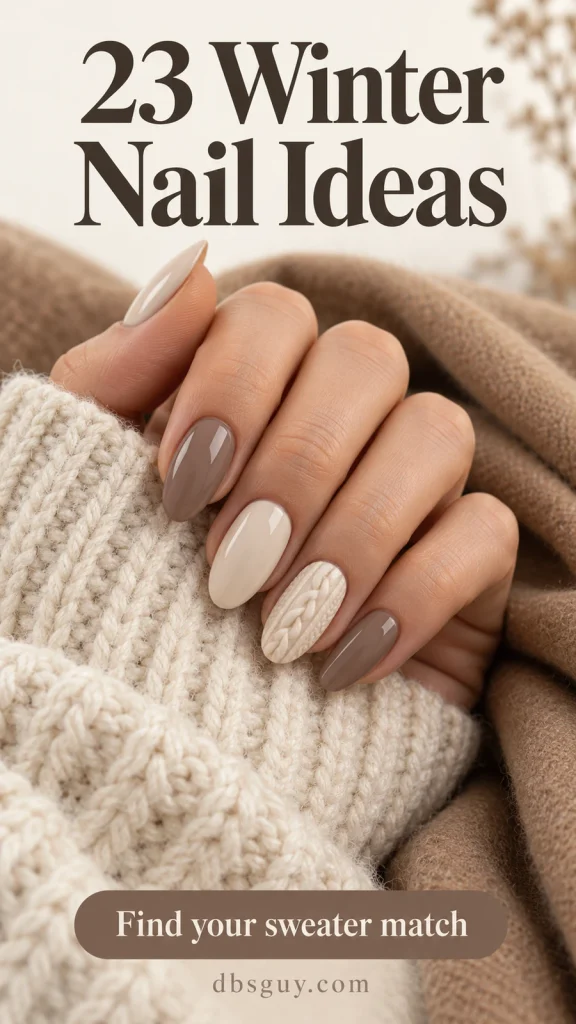
Find Your Sweater Match
- For a chunky neutral sweater: start with oatmeal cable knit (1), camel argyle (3), or taupe speckles (11).
- For a patterned cardigan: repeat one motif with navy stripes (4), Fair Isle bands (7), checkerboard (18), or patchwork (23).
- For a fine, smooth knit: compare charcoal finish contrast (9), icy pearl (15), and silver velvet (16).
- For very short nails: use fewer lines or a single accent. The sage palette (14) needs no drawn pattern at all.
1. Oatmeal Cable Knit With One Textured Accent
That thick cream sweater already has plenty of texture. Let one nail pick up the cable pattern and keep the surrounding oatmeal nails smooth. The concept uses a tapered almond shape and a centered braid on the ring finger, so the detail is easy to find.
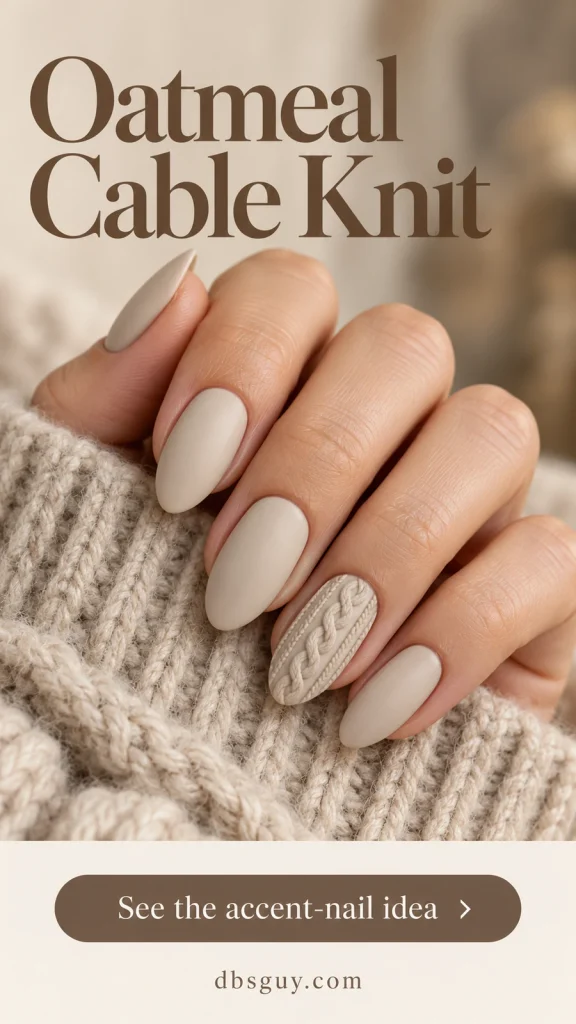
At the appointment, specify a low-profile raised cable and a softly matte finish. Show the artist how much height you are comfortable with, particularly if you wear fitted gloves. For a regular-polish interpretation, request a flat cream cable drawing on a slightly deeper beige base. It keeps the knit reference while changing the feel of the surface.
2. Dove-Gray Ribbing for a Fine-Gauge Sweater
Fine vertical ribs echo the narrow channels in a gray sweater cuff. Using gray for both the base and the lines makes the design quieter than a white-on-gray drawing. Short squoval nails leave enough room for a few evenly spaced ribs.
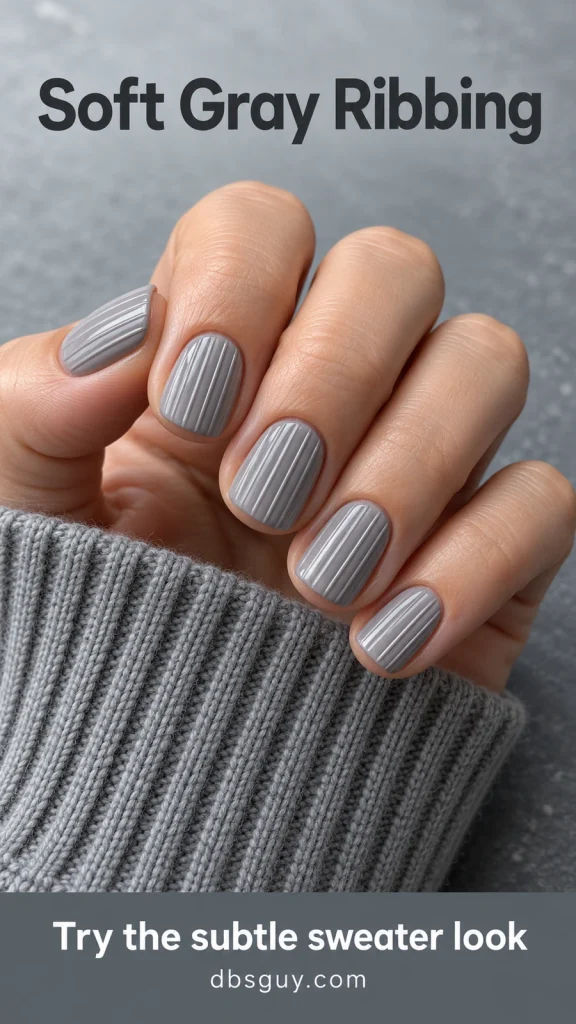
Ask for straight, restrained ridges with a little plain space at each side. Fewer clean lines will read more clearly than tightly packed ones on a narrow nail. If you prefer a smooth manicure, have the lines painted in a slightly lighter gray instead. Bring the cuff into the color conversation: blue-gray polish and warm charcoal fabric create a different pairing from two closely matched grays.
3. Camel Argyle for Your Favorite Cardigan
Camel, ivory, and chocolate make an argyle pattern easy to connect to a winter wardrobe. Put the diamonds on two neighboring nails and let solid camel surround them. The soft-square outline gives the pattern a clear edge without needing extra length.
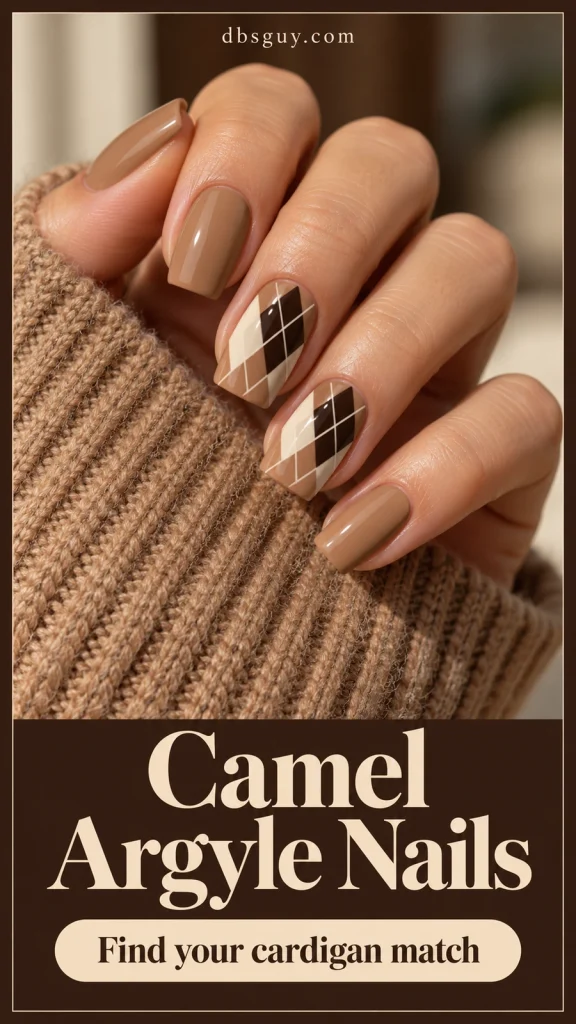
Choose the diamond size before the fine crossing lines. On a shorter nail, one broad diamond with partial shapes at the sides is enough to communicate argyle. Request flat artwork if you want the surface smooth. Wear this with a plain camel cardigan when you want the nails to supply the pattern, or pull just two colors from an argyle sweater for a looser match.
4. Navy Stripes That Echo a Breton Knit
Two slim ivory bands across a navy nail are a small, graphic nod to a striped sweater. The rest of the dark base stays visible, which keeps the bands readable on a short oval shape. A glossy finish sharpens the contrast.
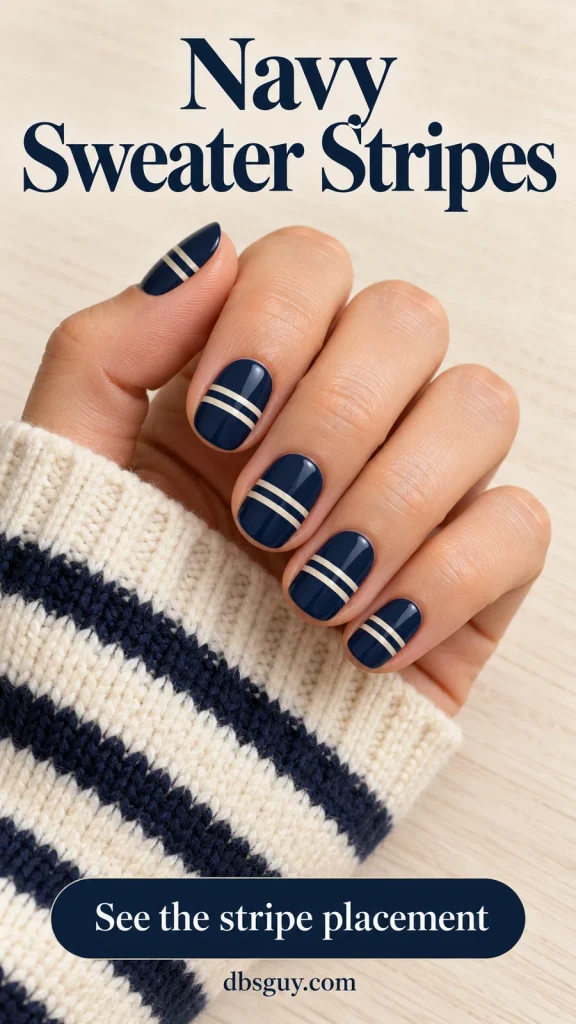
Decide where the stripes should sit across the set: near the middle, closer to the tips, or slightly offset. Consistent spacing matters more than making the lines impossibly thin. For a home version, a pair of flat nail-art striping decals can supply the pattern; follow their application instructions and keep every edge on the nail. You can also restrict the stripes to one finger if your sweater has a busy neckline.
5. Burgundy Windowpane With Blush Accents
Burgundy nails feel richer next to two pale blush accents crossed with fine wine-colored lines. This is an open windowpane layout: the blush spaces are large enough to see, rather than filled with dense plaid.

Have the artist map one vertical line and a small number of horizontal crossings before adding more. Keeping the middle and ring nails as the pattern area makes the set easy to describe. A burgundy sweater gives you a close color match; an ivory sweater lets the wine shade stand out. If your nails are tiny, use a single intersection on each accent instead of squeezing in a complete grid.
6. Forest Green With an Ivory Herringbone Detail
A small herringbone column brings a stitched, orderly detail to forest-green nails. In the concept, pale diagonal strokes climb the ring nail while the rest of the set stays solid green. The matte finish makes the color feel especially at home beside wool.
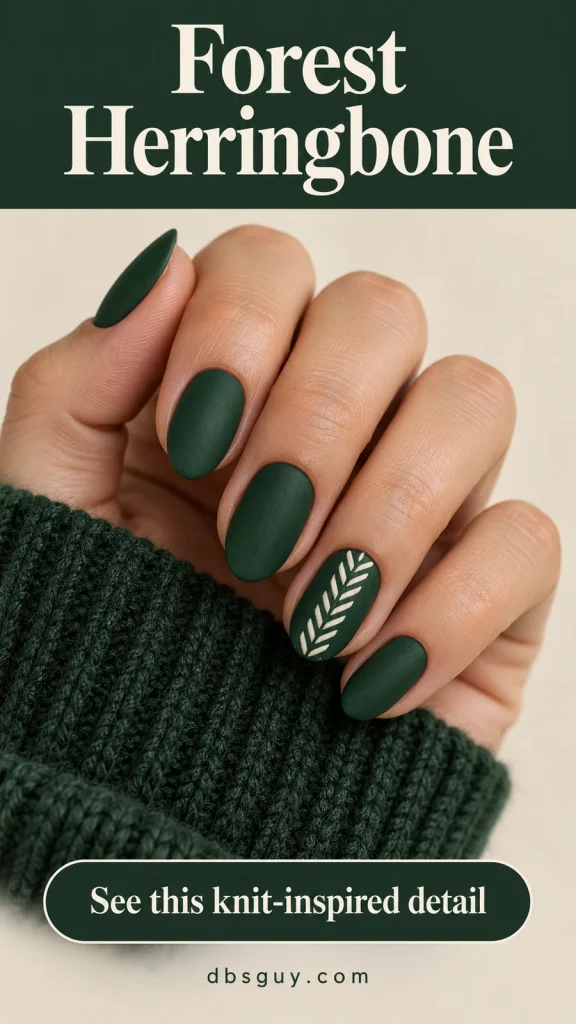
Request paired diagonal marks with visible green between them. As the nail gets shorter, reduce the number of pairs instead of shrinking every stroke. This is a painted design, so you can ask for a fully smooth surface. Pair it with a green crewneck for a close match, or a cream cardigan to pick up the ivory stitching.
7. Dusty Blue Fair Isle in Small Pattern Bands
Fair Isle-inspired bands make a sweater pattern recognizable on a much smaller surface. Dusty blue provides the base; ivory diamonds and chevrons supply the contrast. Keep the patterned area to a pair of nails so each little row has room.

Take a close photo of the sweater motif you love and choose one or two rows from it. Trying to reproduce the entire knit is likely to crowd the nail. A short square shape can carry one horizontal band across its width. Ask for flat, simplified geometry and blue space between rows. The result can stay useful through January and February without needing holiday symbols.
8. Lavender Haze for a Soft Mohair Sweater
Cloudy lavender fading into milky white picks up the softness of a mohair knit through color. The surface itself stays smooth. This is a good reference when you like a hazy, airy sweater but prefer your nails glossy.

Ask for diffused lilac patches or a softly blended gradient, with no hard dividing line. Agree on how much white should remain visible; too much purple changes the effect into a solid lilac manicure. On shorter nails, use one gentle fade rather than several separate clouds. A lavender cuff makes the match obvious, while gray knitwear gives the same colors a cooler setting.
9. Matte Charcoal With Glossy French Tips
Here, the sweater match comes from the finish. Matte charcoal across the nail and a narrow glossy charcoal edge create a quiet change as the hand moves. Both areas use the same deep color.

Show your artist the width of the glossy band you want. A shallow tip makes sense on short squoval nails, where a wide band could dominate the shape. Ask to see the finish contrast under ordinary light before deciding whether it is strong enough for you. This pairs well with a smooth charcoal sweater or a black turtleneck when you want a detail that reveals itself close up.
10. Chocolate Nails With an Espresso Stitch Curve
Chocolate brown beside a cocoa knit is an easy tonal pairing. A fine, glossy espresso curve along one side adds movement without introducing another obvious color. The longer almond reference gives that line room to travel.
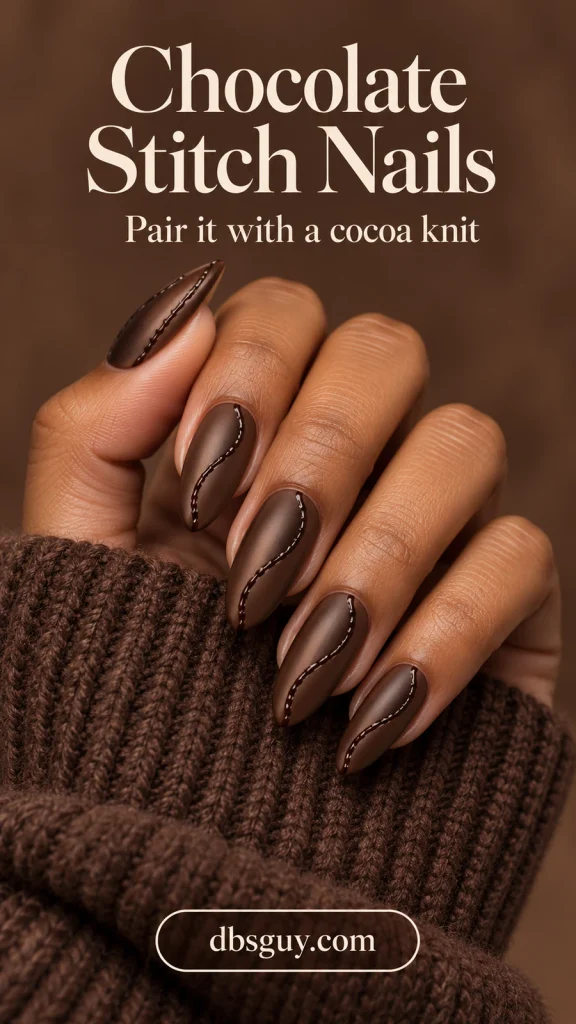
Describe the detail as one slender, slightly wavy line rather than an allover swirl design. Keep the surrounding chocolate space clear, and ask for enough difference in sheen for the curve to show. On a shorter nail, use a single gentle bend. If you are comparing brown swatches, hold them against the sweater sleeve: a reddish chocolate and a gray-brown create noticeably different combinations.
11. Taupe Speckles Inspired by Boucle
Tiny cream and deeper taupe flecks recall the irregular look of a boucle sweater. The important choice is scale: small scattered marks suggest the fabric more gently than large contrasting spots. A short oval shape suits this quiet pattern.

Ask for a smooth, sealed speckled finish. The image is a color-and-pattern interpretation of boucle, so there is no need to add loose particles or fibers. If your sweater already has a pronounced nubby surface, reduce the number of flecks on the nails. For more restrained color combinations, browse our neutral December nail ideas.
12. Blush Basketweave on a Single Nail
A basketweave accent gives a pink manicure a different kind of structure from a cable braid. Small groups of horizontal and vertical rose-colored marks alternate across the ring nail, while the surrounding blush nails stay plain.

Ask for a flat pattern and choose a rose shade that remains visible against the base. When the two pinks are extremely close, the little woven sections can disappear. On very short nails, use fewer, larger groups so the change in direction is readable. Try this beside a blush cardigan with a plain cuff; the manicure contributes the woven detail without competing with another small-scale pattern.
13. Rust and Cream Color Blocks
A rust sweater can inspire a bolder manicure than a simple matching solid. Divide each nail into terracotta and cream with a clean diagonal boundary. Changing the height of that division from finger to finger gives the set its movement.
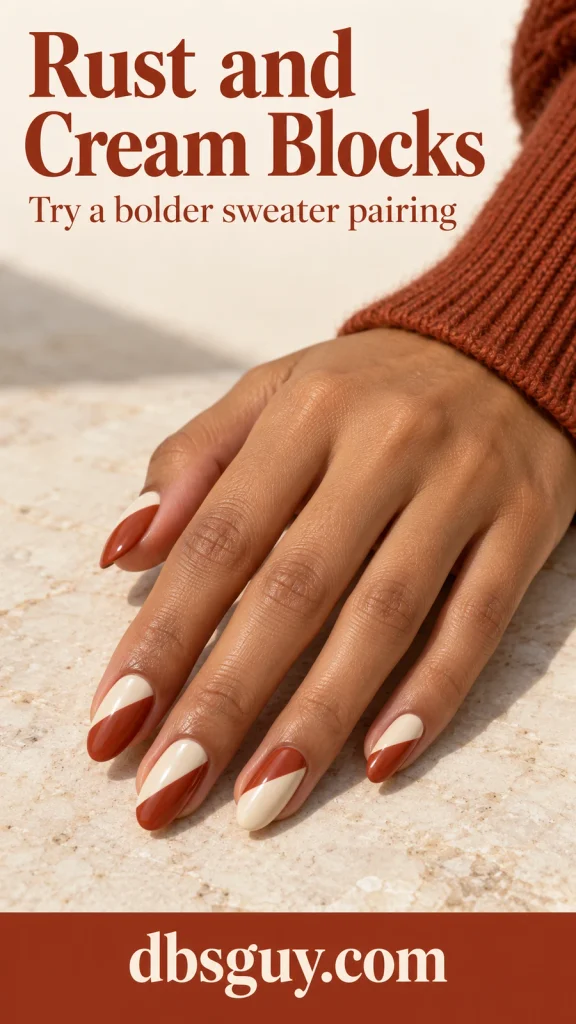
Keep the palette to two colors so the changing shapes are easy to follow. You can ask for the same diagonal on every nail if you prefer more repetition. For a home interpretation, work with regular polish and let the first color dry fully before using a suitable guide for the second. Choose a cream with the same warmth as your sweater’s lighter details.
14. A Five-Shade Sage Palette
Pick a family of greens and give each nail its own shade: pale gray-sage, soft sage, muted eucalyptus, deeper moss, and olive. This is the simplest route here if you want the sweater connection without drawn artwork.
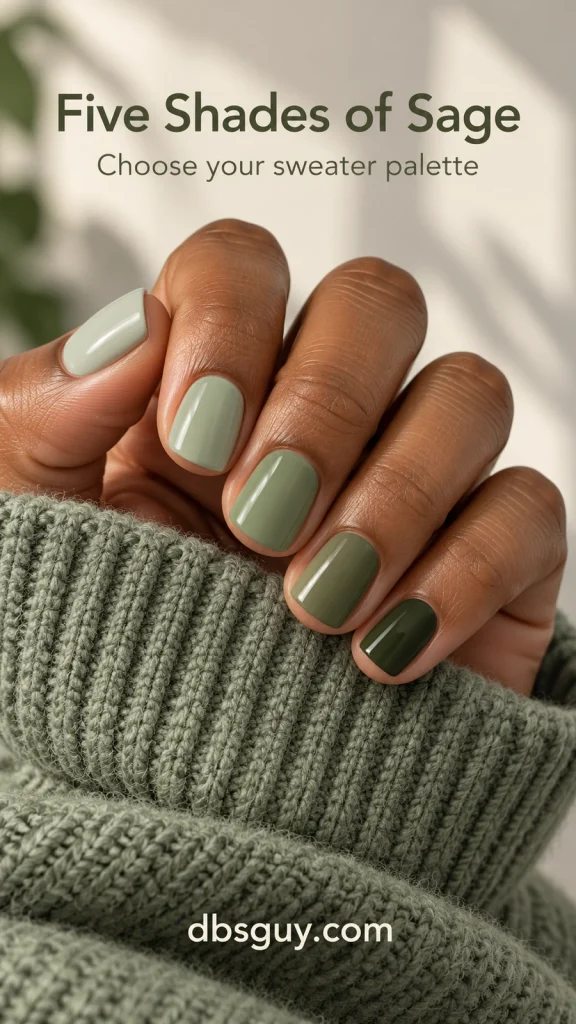
Lay out the five swatches together before painting. Aim for a visible light-to-dark progression and a similarly muted character, so one unexpectedly bright green does not interrupt the set. The reference keeps a short soft-square shape and a smooth finish. You can also use just three shades and repeat them if five close greens are hard to find. A sage sleeve anchors the palette without needing an exact polish match.
15. Icy Blue Pearl Beside a Pale Knit
Pearlescent pale blue gives a powder-blue sweater a little reflected light. The finish is soft and luminous rather than mirror-like, and a short oval shape keeps the color easy to picture for an ordinary winter week.
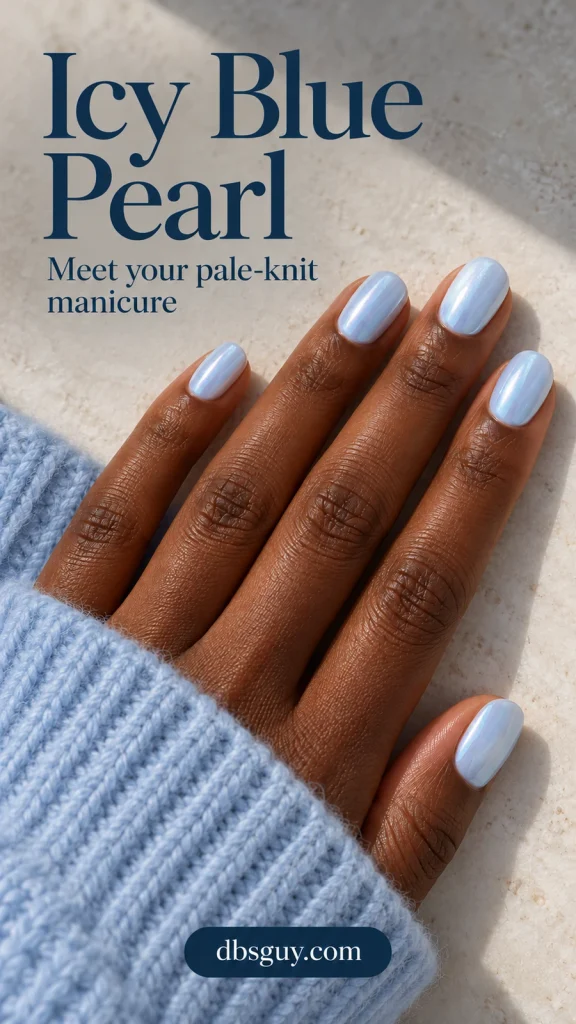
Ask for a pale blue base with a fine pearl sheen, and compare it under a window as well as salon lighting. A frosty pearl can read almost white from one angle and more blue from another. If you want a regular-polish version, choose a pearlescent lacquer that already contains the effect. There is no need to add a separate drawn motif when the changing reflection is the part you like.
16. Silver Velvet Glow With Dark Cashmere
A broad silver glow across a smoky base creates a light-catching partner for dark cashmere. Velvet nails use a magnetic effect to arrange reflective pigment; the finished nail can remain smooth and glossy.
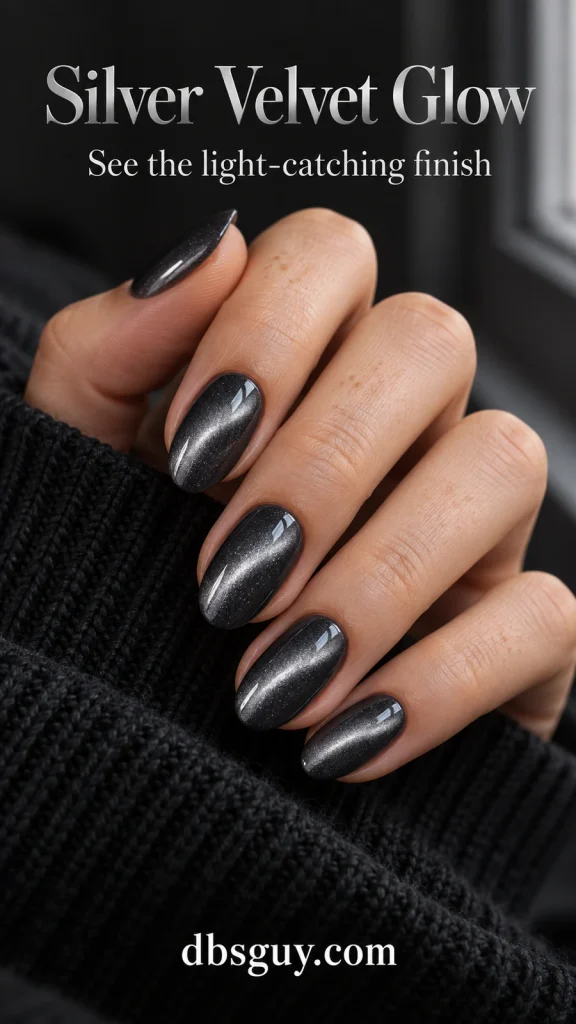
At the salon, ask for a diffused silver glow across the nail rather than a sharply defined narrow cat-eye stripe. Show the artist the reference and look at a sample from more than one angle, since the reflection changes with the light. Medium oval nails display plenty of the effect, but a shorter shape works with the same finish. Keep the sweater dark if you want the silver reflection to be the clearest point of contrast.
17. Plum Velvet French Tips
Plum makes a rich sweater color, and moving it to the French tips leaves the rest of the manicure lighter. A translucent rose base gives the violet magnetic reflection a clear boundary. The broad curved tips are the focus.

Specify that the velvet effect belongs inside the plum tip area. If you prefer a short shape, make the band shallower and simplify the curve. A plain plum French tip is also a useful adaptation when you want the color placement with a conventional polish finish. Wear it with a plum sleeve for a close match or a soft gray sweater to let the purple stand forward.
18. Black-and-Ivory Mini Checkerboard
A graphic cardigan can supply the entire nail palette. Put small black-and-ivory checks on two nails, then use solid black around them. On a short square shape, the checks have a clean outline and feel deliberately placed.
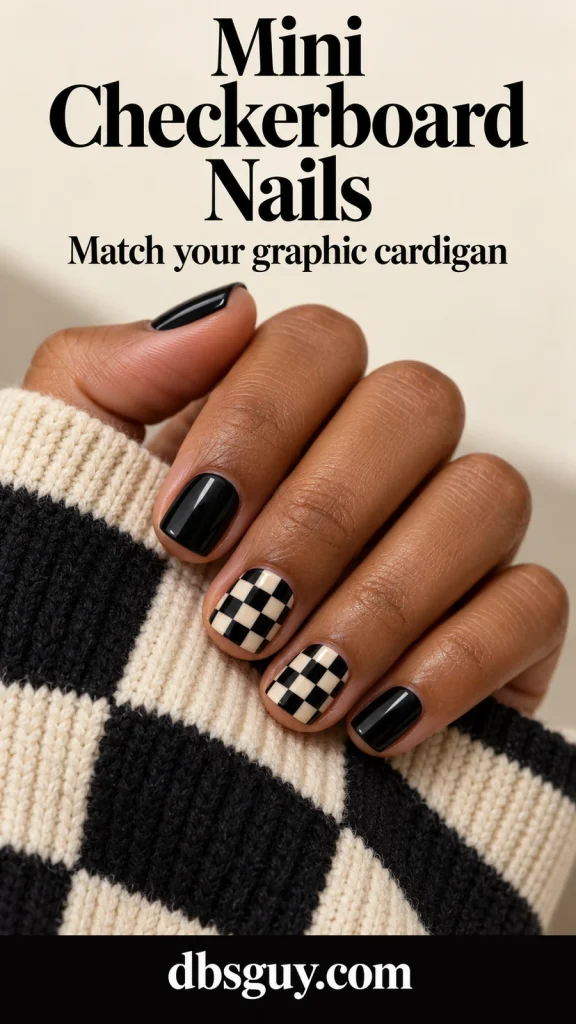
Choose a grid size that your artist can keep crisp on your nails. A few readable squares are more useful than a miniature pattern that turns into visual noise. Ask for flat artwork with clear alternating colors. If your sweater has oversized checks, you can keep the nail checks smaller to vary the scale while repeating the palette. One accent finger is enough for a quieter version.
19. Cobalt Scalloped Tips With a Crochet Feel
Rounded cobalt lobes along an ivory tip echo the shaped edging on a crochet cardigan. The blue is bold, but its placement leaves most of each nail light. A medium oval outline gives the scallops a soft edge to follow.
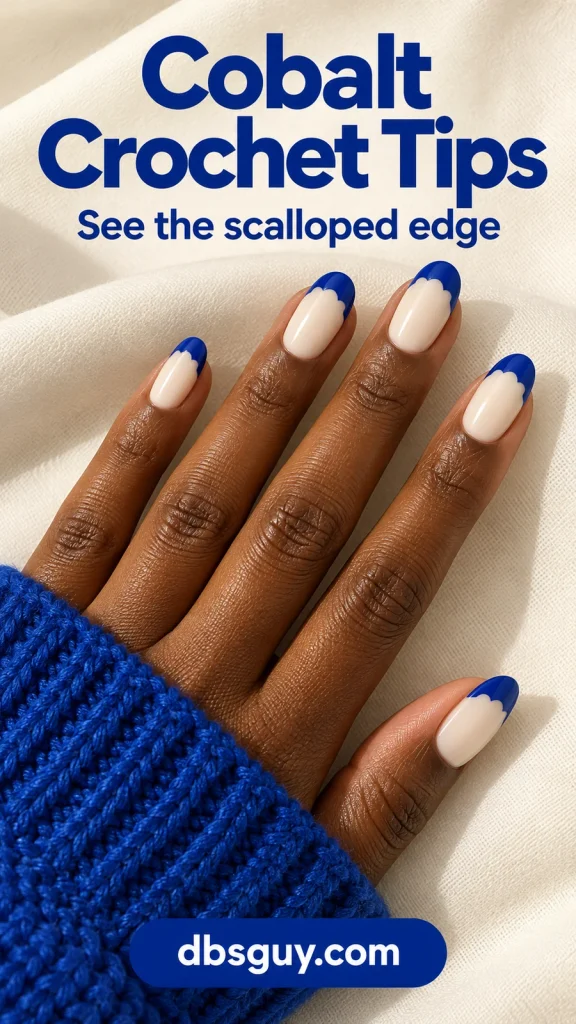
Ask for a few broad, connected curves rather than a row of tiny dots. The dip between each lobe should remain clear. For short nails, reduce the number of curves and keep the blue band shallow. This pairing works especially well when your sweater is solid cobalt and the nail shape supplies the crochet reference. You could reverse the colors for an ivory cardigan with blue trim.
20. Red Blanket-Stitch Borders
Cream accent nails edged with red stitches recall the trim of a cozy cardigan or blanket. The border consists of a fine connected line with short inward-facing marks. Solid red nails beside it make the little stitches easy to see.
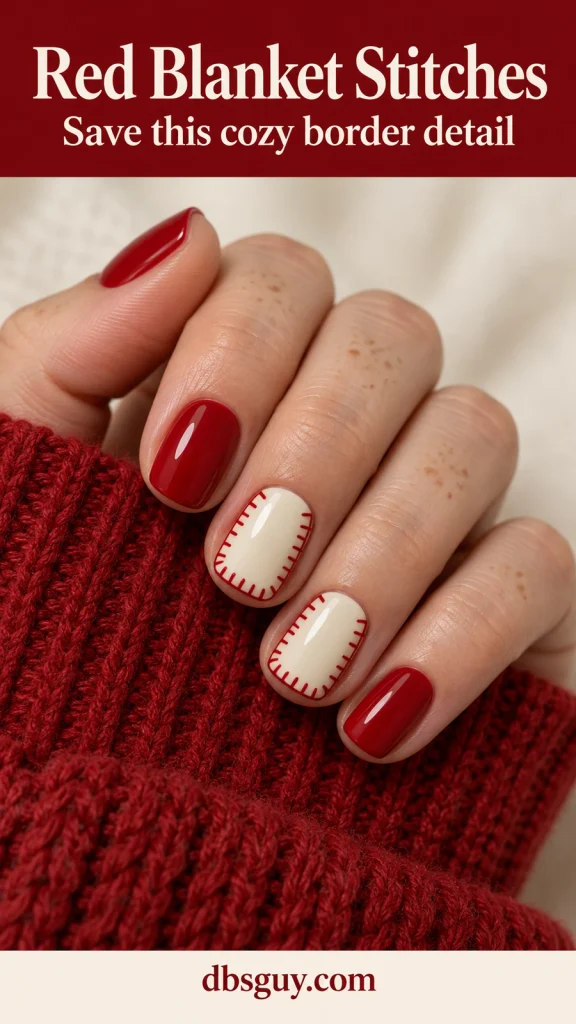
Show your artist where the border should run: along the sides and tip, leaving the cuticle area open. Keep the red marks flat and separated so the cream center remains visible. On a short nail, fewer stitches will give you a cleaner result. A red sweater repeats the color, while cream knitwear emphasizes the pale accents. This design gets its winter mood from the stitching without needing holiday drawings.
21. Mauve Half-Moons Made of Tiny Dashes
A delicate dashed arc near the base of each mauve nail suggests a line of stitching. Keeping the pale marks around the half-moon gives the rest of the nail breathing room. The softly matte finish sits comfortably beside a dusty-rose knit.

Have the artist follow the curve of your cuticle while leaving a clean gap from the skin. Choose short dashes with space between them; if they merge, the detail becomes a solid half-moon outline. You can reduce the design to the ring fingers for an even smaller accent. A muted mauve base keeps the look tonal, while a pinker base makes the pale stitching less pronounced.
22. Cream With a Fine Gold Cardigan Seam
One off-center gold line can pick up the buttons or metallic trim of a cream cardigan. Tiny perpendicular dashes give the line a stitched appearance, and the other ivory nails stay plain. The reference uses a softly squared shape.
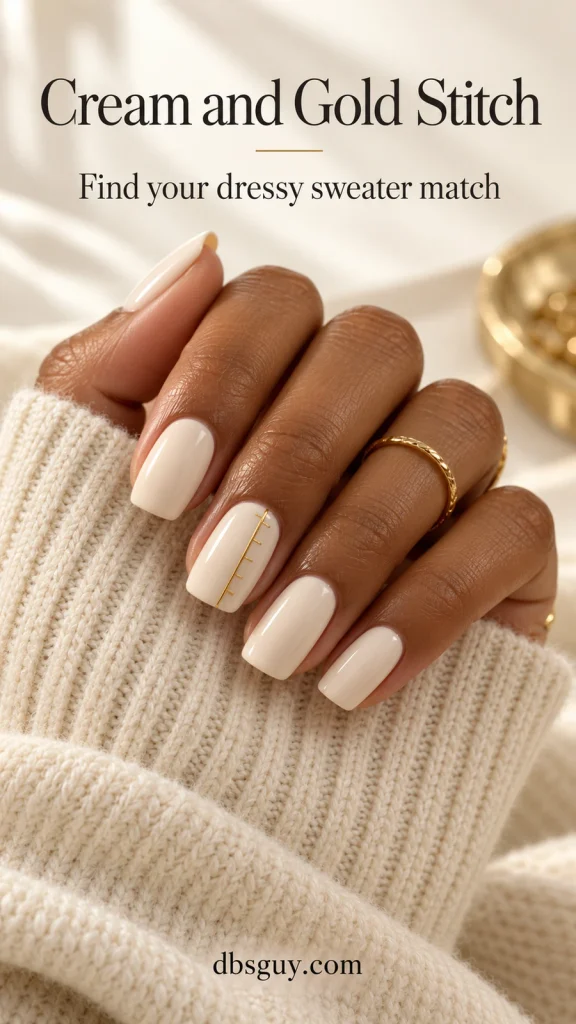
Keep the metallic detail fine enough that the cream remains the main color. Ask for flat gold artwork if you want an even surface, and choose which side of the accent nail the seam should follow. A single line without dashes is an easier interpretation with a striping decal. This is a useful sweater-and-dinner pairing when you want a metallic detail but do not want glitter across every nail.
23. Navy Patchwork With Painted Seams
Use navy, tan, cream, and muted blue to build small patchwork panels on two accent nails. Fine dashed seams connect the blocks, while solid navy nails keep the rest of the set settled. This is the most detailed pattern in the collection.
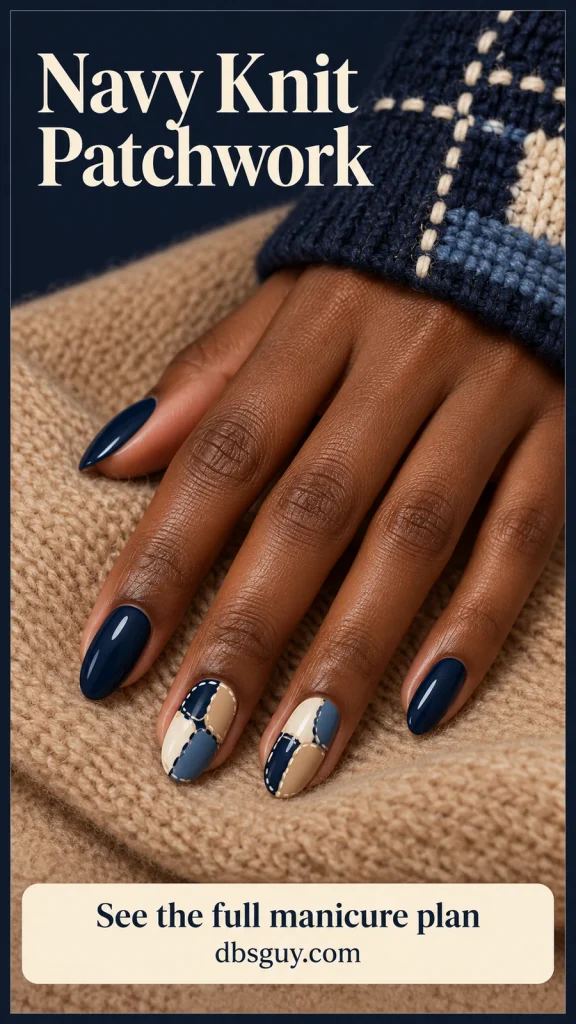
Choose a few broad panels for each accent and decide their positions before adding the seams. On smaller nails, two or three blocks can carry the idea more clearly than a crowded miniature patchwork. Match one panel to your sweater and let the others pick up a coat, scarf, or bag. For a simpler seasonal alternative, our early December nail ideas include more restrained starting points.
Turn the Reference Into a Useful Salon Request
Save the design that gives you the clearest combination of color, placement, and finish. At the salon, point out the exact part you want to keep: the cable on one nail, the spacing between plaid lines, or the wide silver glow. A reference is easier to adapt when the essential detail is clear.
For raised cable work, discuss the profile of the finished pattern and whether a flat version would suit your daily routine better. Gel application and curing should follow the specific product system’s instructions; a concept picture cannot tell you the correct layer thickness or lamp time.
For gel appointments, the American Academy of Dermatology’s manicure guidance recommends broad-spectrum, water-resistant SPF 30 or higher on the hands before curing, or dark opaque fingerless gloves. It also advises against picking gel polish and recommends moisturizing nails and cuticles between manicures.
Questions About Sweater-Inspired Winter Nails
How do I match my nails to a sweater without matching every color?
Choose one connection: a color, a repeated shape, or a finish. Navy stripes can echo a striped cuff, while plain silver velvet nails can add light beside black cashmere. If the sweater already has several patterns, a single-color manicure drawn from its palette is an easy starting point.
Which sweater nail ideas work on very short nails?
The sage palette, icy pearl, and charcoal finish contrast need no intricate drawing. For a pattern, choose a small number of broad stripes, a single argyle diamond, or one accent nail. The available nail width matters as much as length; simplify the number of marks until the design is readable.
Can I get a sweater-inspired look with regular nail polish?
Yes. Stripes, color blocks, speckles, and flat stitch drawings can be interpreted with regular polish or suitable flat nail decals. A painted cable motif can suggest a knit pattern on a smooth surface. Ask your artist which version fits the products and finish you prefer.
Does velvet nail polish feel fuzzy?
The velvet ideas here refer to a reflective magnetic effect. They are designed to look plush while retaining a smooth finished surface. Confirm that you want a magnetic velvet finish when booking; the word alone can be interpreted differently.
Choose the Detail You Want to Repeat
Start with the sweater you reach for most, then choose one detail worth repeating. That might be a cream braid, two navy stripes, or a single gold seam. Bring that detail and your preferred nail length to the appointment, and let the rest of the manicure support it.