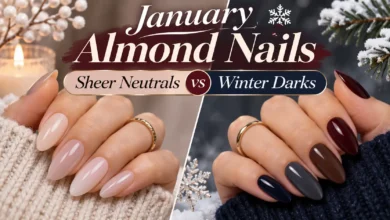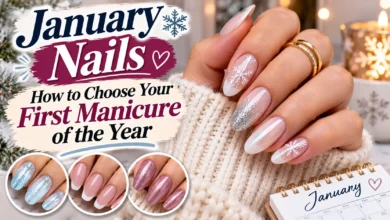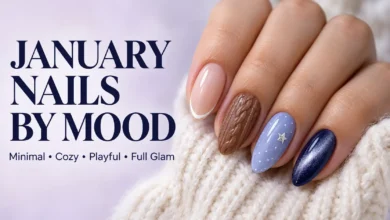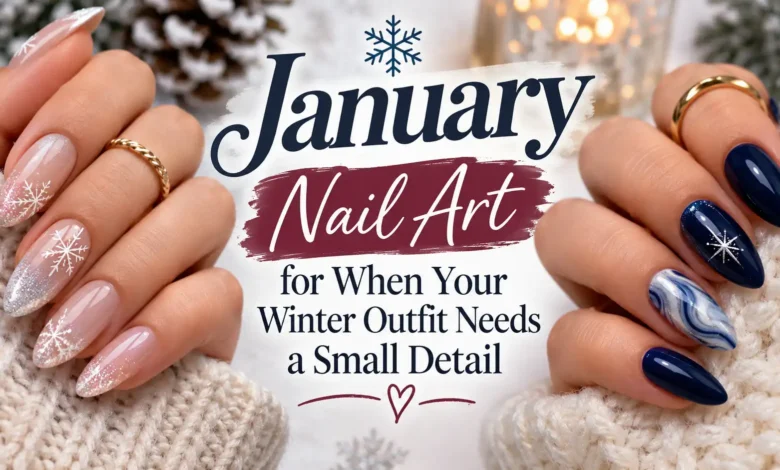
For January nail art that works with your winter outfit, borrow one small detail from what you already wear. Try an ivory edge with a camel coat, a silver line beside charcoal sleeves, or a tiny burgundy bow that picks up your bag. Keep the base simple so you can see the connection.
You do not need five different manicures for five different outfits. Choose the pairing closest to your everyday wardrobe, then use the placement notes below to make that one design work at your usual nail length.
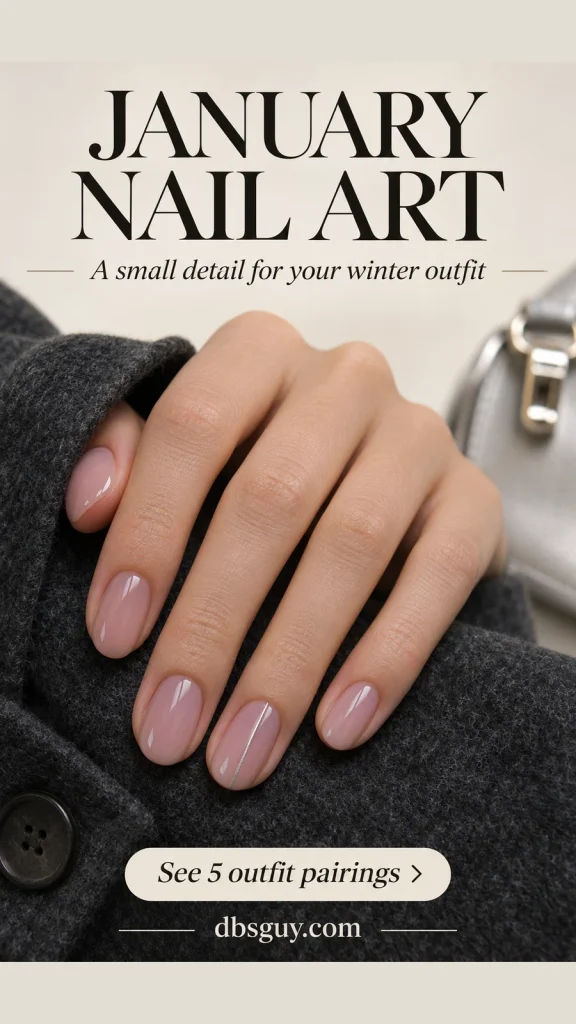
The images are AI-generated styling concepts for dbsguy.com. They illustrate color and placement rather than document completed salon work.
Choose the Detail You Want to Repeat
Look at the sleeve, scarf, or bag that will sit closest to your hands. Pick one feature to carry onto your nails: a light edge, a metal finish, or an accent color. The outfit pairings here are editorial suggestions; use them as a starting point rather than a rule about which colors belong together.
- Camel and oatmeal: an ivory micro French repeats the light knit underneath your coat.
- Charcoal and black: a silver line adds a small reflection beside dark fabric.
- Navy layers: an icy-blue star introduces a lighter shade of blue.
- Cream knitwear and a burgundy bag: a painted bow repeats the bag color.
- Dark denim and brown accessories: a cocoa half-moon brings the brown closer to your hands.
Before committing, hold a polish swatch against your sleeve in daylight. You are checking whether the accent is visible and whether you like the colors together. A shade that looks light in the bottle can disappear against a similar base.
1. Ivory Micro Tips With a Camel Coat
A camel coat over an oatmeal sweater already has a soft, warm palette. A fine ivory edge carries that light color onto your nails while leaving the warm beige base visible. This is the most evenly repeated design here: every nail gets the same small finish.
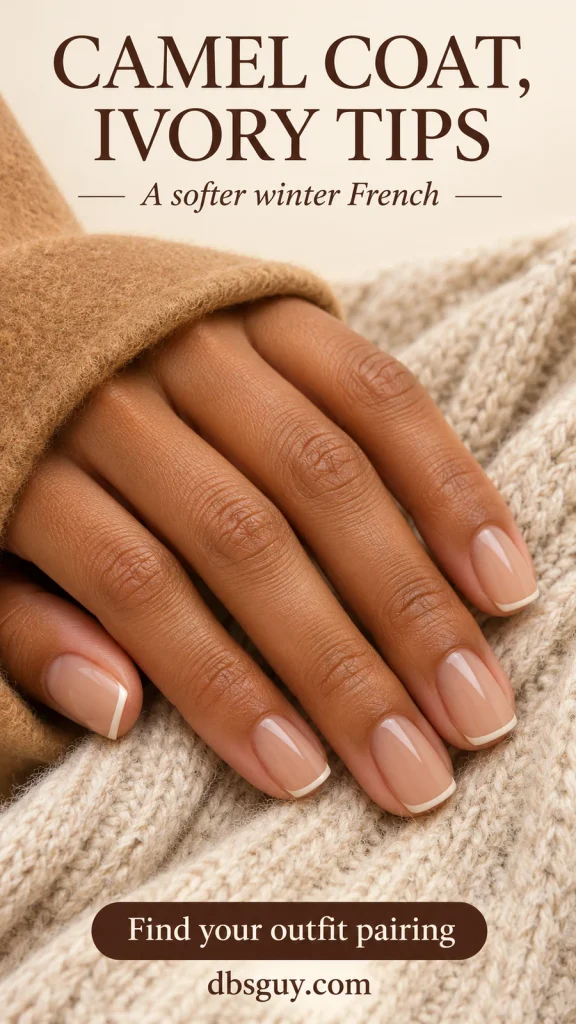
Choose a creamy ivory if you want a gentle connection with oatmeal knitwear. Bright white makes a sharper contrast, which can work beautifully, but it will change the quiet effect shown here. For the base, compare sheer beige and rosy beige on your own nail; you do not have to match the model’s skin or polish shade.
Ask your nail artist: “Short squoval nails, a sheer warm base, and a narrow ivory French that follows the tip. Please show me the width on one nail first.” The useful reference is the amount of base still visible, not a fixed measurement across every finger.
On very short nails, keep the curve shallow. If the ivory begins to look like a large white block, reduce its depth rather than adding length just to fit the design. A fine painted edge can suggest the French shape even when there is little natural white tip.
Also Read: 21 Short December Nail Ideas That Make Tiny Details Stand Out.
2. One Silver Line Beside Charcoal Sleeves
Dark wool makes a small metallic mark easy to notice. Use a translucent gray-pink base and give one ring nail a slender silver line running lengthwise, just off center. The remaining nails stay plain, so the silver has a clear place in the set.
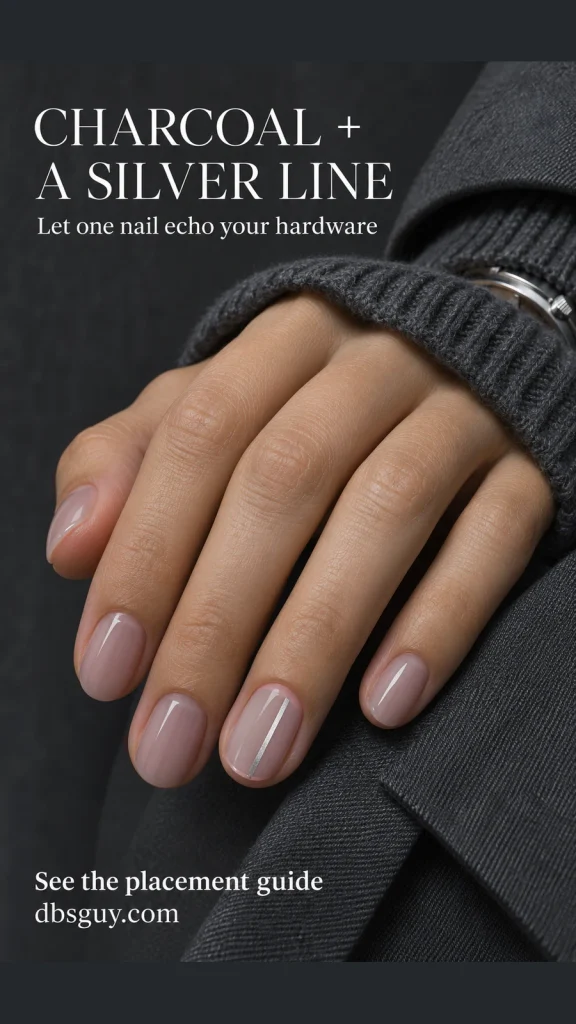
This pairing is especially useful when your outfit already includes a silver watch, zipper, or bag clasp. The nail detail repeats the finish in a much smaller area. If your hardware is gold, you can change the stripe to gold without changing the rest of the design.
Ask for a flat metallic line with base color visible on both sides. Keep it on the nail surface, clear of the skin. Point out whether you prefer it to finish just inside the tip or reach the outer edge; a short nail does not need a long stripe to make the connection.
For a regular-polish interpretation, choose an opaque silver nail-art lacquer and a fine liner brush. Test a short stroke on a spare tip over a dry base before painting your accent. A silver shimmer topper makes scattered sparkle; it will not necessarily give you the defined line in the concept. If a crisp stripe matters most, take this one to a nail artist.
Also Read: 15 Elegant January Nail Art Ideas to Pair With Your Winter Jewelry.
3. An Icy-Blue Star With Navy Layers
If your navy coat and scarf feel a little heavy together, a pale-blue accent gives your hands a lighter point of color. Put one small four-point star near an upper corner of the ring nail, over a sheer rosy base. The rest of the manicure can stay plain.

The placement matters as much as the color. Leave a border of pink around every point, including the point closest to the nail edge. The open space lets the little shape read clearly. Centering a much larger star would create a different, more prominent look.
Choose a pale blue that stays visible over your base. A nearly clear blue shimmer may look pretty in the bottle but lose the star’s outline once painted. Ask your artist to show a small swatch before choosing the final shade.
A flat four-point nail decal is an alternative to fine brushwork. Check its actual size against your nail and follow its application and sealing instructions. For the shortest nails, reduce the star itself rather than squeezing its points against the sidewalls. There is no need to add dots or a second star to fill the remaining space.
Also Read: Easy Nail Art for January Using Dots, Lines and a Little Shimmer.
4. A Tiny Oxblood Bow With Cream Knitwear
A cream sweater and burgundy bag give you a ready-made color pairing. A little oxblood bow on a rosy nail repeats the bag without turning the whole manicure dark red. Keep it painted flat, with two open loops and two short tails.
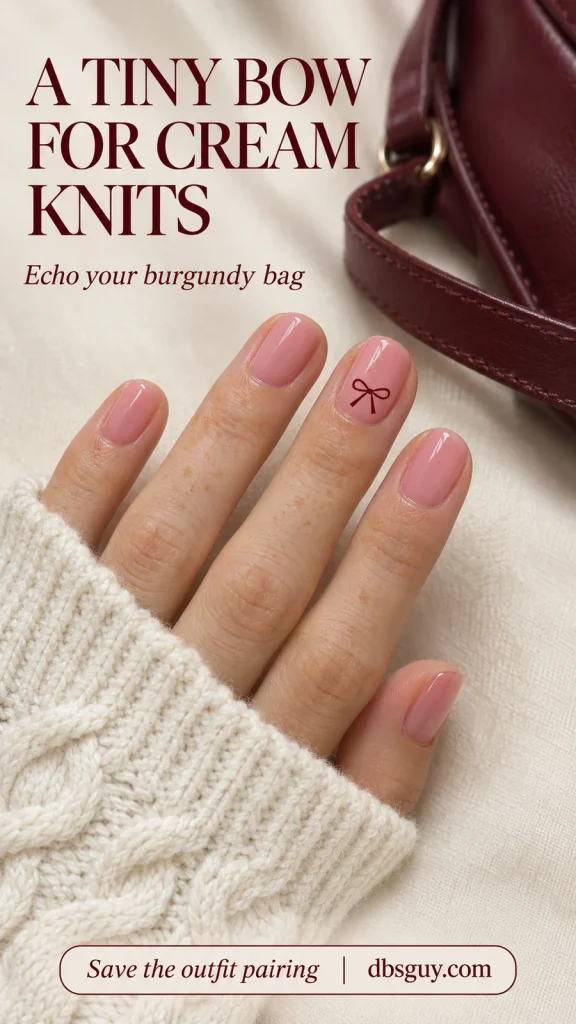
The base in this concept is noticeably rosy. If you want the bow to stand out more, choose a sheerer base; if you prefer the warmer pink, keep the oxblood dark enough that the loops remain visible. Compare the two colors together rather than picking them separately from a polish chart.
Bring the bag or a daylight photo to your appointment. Ask for a wine-colored line drawing, not a raised bow charm. You are borrowing the accessory’s color, so an approximate match is enough; a slightly redder or browner burgundy still belongs in the same outfit.
Fine loops take more control than a dot or straight stripe. If you are doing your own nails, a suitably small flat decal may be the more manageable choice. On a narrow nail, shorten the tails and leave room between the loops and the sides. Repeatedly thickening the outline can fill in the loops and hide the ribbon shape.
Also Read: 17 Cute January Nail Ideas for Cozy Days and Winter Plans.
5. A Cocoa Half-Moon With Dark Denim
When you wear dark jeans with a brown belt, bag, or boots, a small cocoa accent can connect those accessories with your manicure. Keep the nails warm beige and put a rounded cocoa half-moon near the base of one ring nail. Most of the nail stays beige.
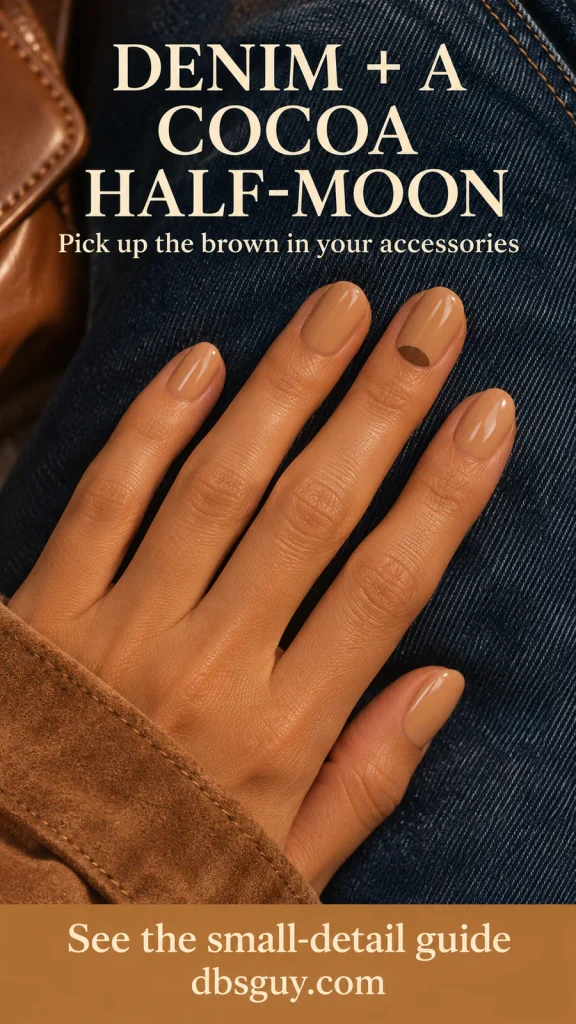
Use two browns with enough difference in depth to see the shape. If the base and half-moon are almost identical, the detail can disappear under ordinary indoor light. You can keep a pale beige base if the caramel shade pictured is more color than you usually wear.
At the salon, specify a painted cocoa half-moon near the cuticle end, with a small clean margin from the skin. This avoids confusion with a beige crescent left unpainted inside an otherwise brown manicure. Keep the rounded accent shallow and compact rather than filling half the nail.
For a home attempt, practice that compact shape on a spare tip with regular polish and a small nail-art brush. Let the base dry according to its instructions first. If you keep enlarging the brown area while correcting the curve, start again on the practice tip; adding more polish will change the design’s proportions.
Also Read: January Nail Art for Beginners: Simple Designs to Practice at Home.
Make One Manicure Work Across Your Week
Choose the garment you repeat most often, rather than the outfit you will wear once. If you spend weekdays in navy and charcoal, the silver line can work beside both. If camel, cream, and brown make up most of your wardrobe, ivory tips or the cocoa accent give you an easy connection to those colors.
Keep the same base and accent on both hands if you want a coordinated set. The exact artwork does not have to be a mirror image, but decide which nail carries it before painting. One ring-finger accent on each hand is a simple plan to explain at an appointment.
With a patterned scarf, borrow one color and leave the nail background plain. You already have a pattern in the outfit, so a single recognizable mark gives your hands a detail without asking you to reproduce the entire scarf on a tiny nail.
Before You Paint or Book
Save the image for your chosen pairing and take a photo of your sleeve or accessory beside it. Tell your artist the length you actually want to wear, which nail gets the accent, and whether you want a sheer or opaque base. Those details are more useful than asking for “something subtle.”
The home adaptations above refer to regular, air-drying nail polish. Use a suitable base coat and top coat as your chosen products direct, and follow their preparation and drying instructions. These notes are not a lamp-curing guide for gel. Test fine artwork on a spare tip before repeating it across a manicure.
Keep care simple, too. The American Academy of Dermatology’s manicure guidance recommends moisturizing nails after polish removal and avoiding cutting or forcefully pushing back cuticles. A neat-looking border does not require cutting the surrounding skin.
Questions About Styling January Nail Art
Do my nails have to match my coat exactly?
No. Repeating one related shade or finish is enough for these pairings. Ivory tips can connect with a cream sweater underneath a camel coat; the nails do not have to be camel. Try the colors beside each other and choose the relationship you like.
Which look works when I change outfits every day?
Start with the ivory micro French if you want a light neutral design across every nail. Choose the silver stripe if your everyday clothes are darker and you like a small metallic accent. Both leave most of the base visible, so the artwork supplies only a little color.
Can I keep my nails very short?
Yes. Scale the artwork to the nail you have. A shorter silver stripe needs little space; the star and bow need a clear border around their points or loops. Ask your artist to demonstrate the motif on one nail before repeating it, and simplify it if the outline becomes crowded.
What should I choose if I wear gloves most of the day?
Ask for the flat painted versions shown here. You can keep the bow, star, and metallic line in the artwork without adding raised charms. Choose your usual comfortable length and follow your polish’s drying or curing directions before putting gloves on.
For your next set, take the image that goes with the sleeve you wear most. Show the base color, point to the accent placement, and decide the size on one nail first. That gives you a clear plan for the small detail you wanted.