You can make a front door feel like fall with cream pumpkins, wine-colored leaves, dusty blue flowers, or nothing more than pale wheat. The trick is to keep a seasonal shape or texture, then choose a palette that works with your door.
Start with contrast: light wreaths stand out on dark doors, while burgundy, green, and brown are easier to see on pale ones. Then consider exposure. Dried grasses, husks, and fabric need a reliably dry spot; an uncovered entry calls for materials specifically rated for outdoor use.
These 15 fall wreath ideas each offer a different combination of shape, material, and color, with practical notes to help you choose or adapt the look.

Choose the Size and Materials Before You Shop
Measure the clear space on your door rather than buying by the wreath frame alone. Leaves, bows, and stems can extend several inches beyond the base. As a styling starting point—not a rule—a finished wreath around 20 to 24 inches wide often leaves comfortable space on a 36-inch-wide door. Tape up a paper circle first and check it from the sidewalk.
On a door with glass, a knocker, or a peephole, place the wreath so those features still work. With a storm door, measure the gap between doors and allow for the deepest flowers, fruit, and bow loops. Both doors must close freely.
Read the placement label. “Artificial” does not mean weatherproof. Look for an explicit outdoor rating when the wreath will get wet or sit in strong sun, and follow the maker’s care instructions. For natural dried materials, choose a sheltered position away from moisture and direct sun. A covered porch can still receive wind-driven rain.
The images below are AI-generated styling concepts, not photographs of tested wreaths. Use them to choose a look, then match the materials and hanger to your actual doorway.
1. Cream Pumpkins and Sage Eucalyptus
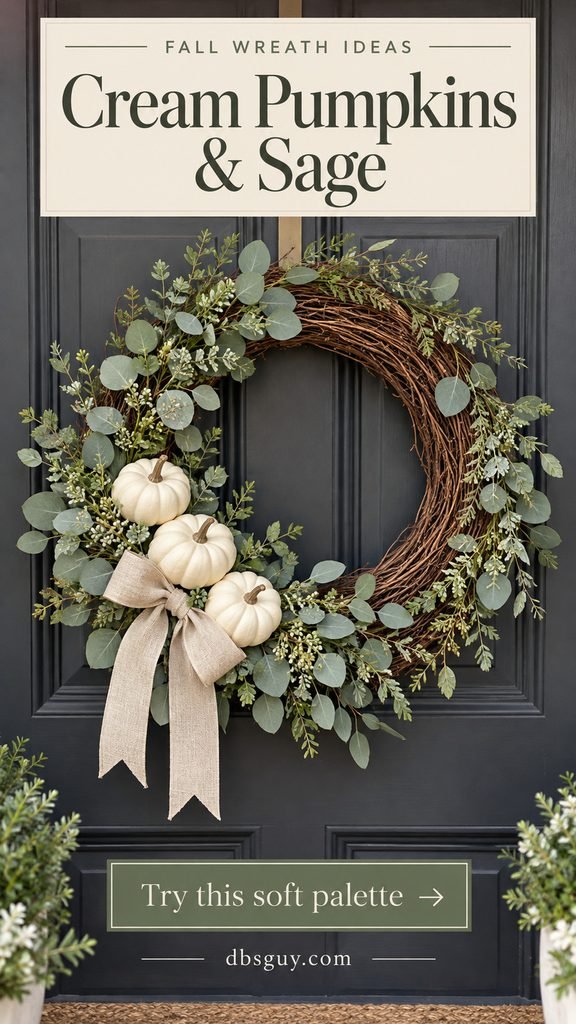
If you love pumpkins but orange fights with your exterior, keep the shape and change the color. Ivory pumpkins bring a clear fall cue, while silvery eucalyptus softens a charcoal, navy, or deep green door.
Start with a grapevine wreath and arrange three lightweight faux pumpkins together toward the lower left. Work eucalyptus around the ring, leaving some vine visible, then tuck a linen bow beside the pumpkin cluster. The grouped pumpkins give your eye one place to land instead of making the wreath feel dotted with ornaments.
Choose pumpkins with attached picks that can be wired to the frame; a dab of glue alone should not carry their weight. On a pale door, use a darker vine base so the cream details do not disappear.
2. A Burgundy Leaf Sweep
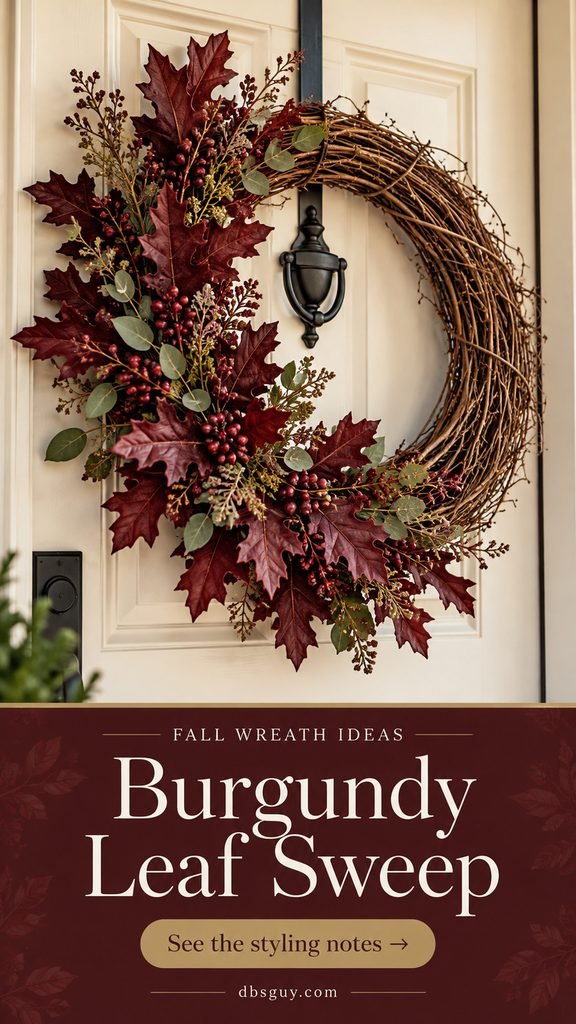
Deep wine-colored leaves make a light-colored door feel dressed for autumn without adding a pumpkin. This is a good choice when you want richer color but still like seeing the wreath’s structure.
Build a sweep of faux oak leaves up the left side of a grapevine ring, tapering the arrangement as it reaches the top. A few muted green leaves and small burgundy berry sprays can break up the large leaf shapes. Leave the upper-right section exposed; filling every gap would lose the off-center effect.
Use burgundy as the dominant color, rather than mixing it with bright red and purple. If your door is already dark red, choose the ivory corn-husk wreath below for a clearer outline.
3. Dusty Blue Hydrangeas with Tan Seed Heads
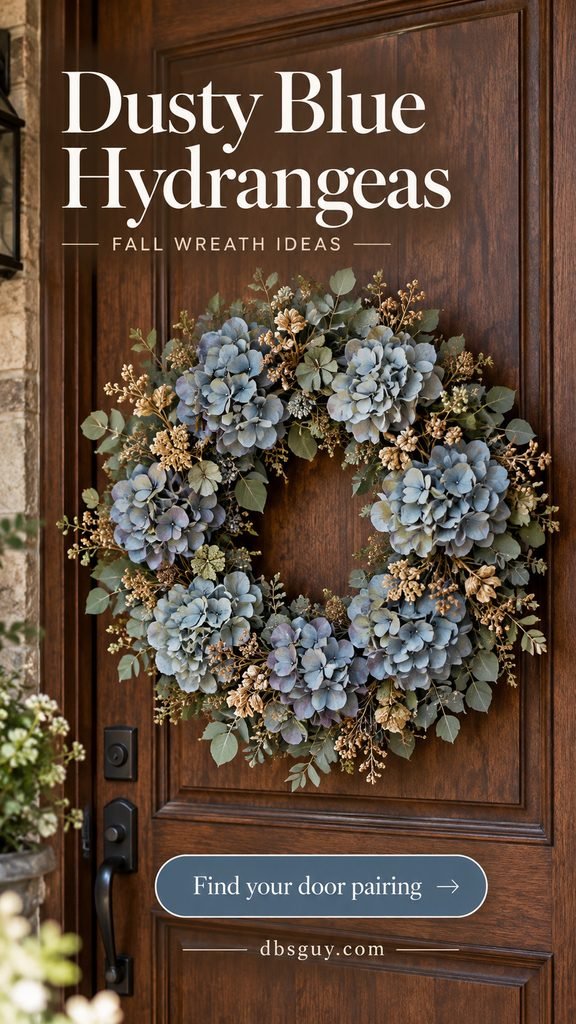
Blue can feel right for fall when it is muted and paired with dry, earthy textures. Here, dusty blue hydrangeas sit against warm wood, with tan seed heads making the arrangement feel less like a summer bouquet.
For a repeatable color, choose faux hydrangeas with gray-blue petals rather than bright turquoise. Arrange the flower heads around the frame first, then tuck small seed-head sprays into the gaps. A little gray-green foliage gives the rounded flowers breathing room.
Check the wreath from the side before buying or assembling it. Hydrangea heads can project farther than their front view suggests, which matters if you close a storm door over the wreath. This full floral look suits an entry with generous clearance.
4. A Wheat Sunburst
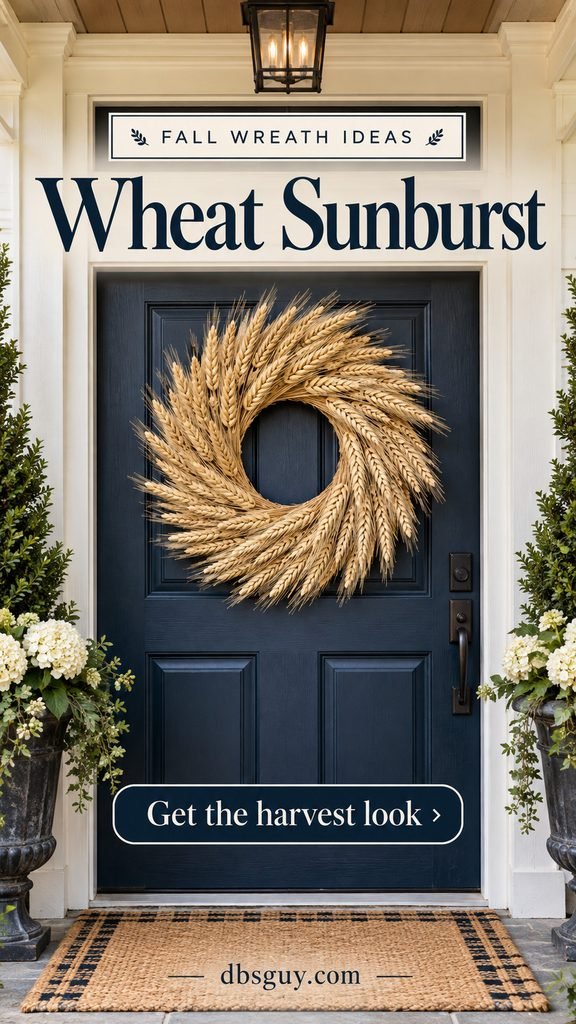
A wheat wreath brings the harvest feeling through its shape and texture. The narrow grain heads create movement, so this version does not need a bow, sign, or extra ornaments.
Look for a wreath with wheat heads angled consistently around the ring, like a gentle swirl. If you are assembling one, lay out small overlapping bundles in the same direction before securing them to the frame with floral wire. Keep the center open and the outer tips free rather than trimming everything into a rigid circle.
Natural dried wheat belongs on a dry, sheltered door, away from direct rain. A dark navy door makes the pale grain easy to see. For a doorway that regularly gets wet, choose an outdoor-rated imitation of the same silhouette.
Also Read: Fall Outdoor Decorations DIY Ideas for a Cozy Yard
5. Olive Branches and Oatmeal Linen
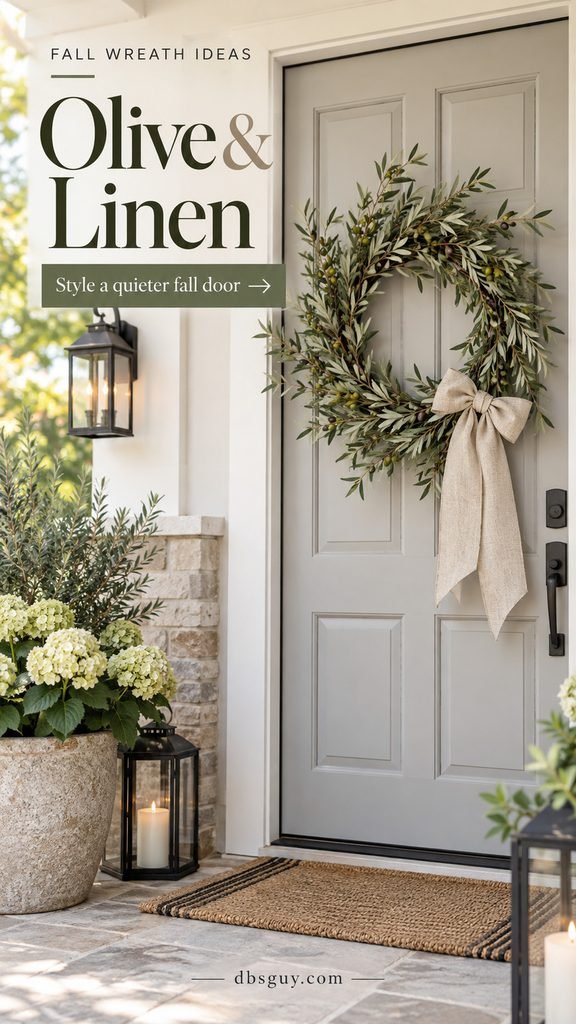
This is the quietest greenery option in the group. Narrow olive leaves and an oatmeal bow work well when your porch already has patterned tile, decorative glass, or other details you do not want to compete with.
Choose an airy faux olive wreath instead of a dense ball of foliage. A loose bow on the lower-right side adds softness; keep its tails clear of the handle. The green leaves read clearly against pale stone gray, while the linen warms up the cool background.
The autumn mood here comes from the muted fabric and restrained palette. Repeat the oatmeal color in a nearby planter or doormat rather than adding more ornaments to the ring. Keep real linen sheltered, or substitute outdoor-suitable ribbon with a linen-like texture.
6. Chocolate-Brown Magnolia Leaves

Magnolia gives you two colors in one leaf: dark green fronts and warm brown backs. Turning some leaves outward creates a layered fall wreath that feels substantial without berries or flowers.
For this look, choose faux magnolia stems with convincing brown undersides. Alternate the leaf faces as you work around the ring, keeping their tips flowing in one direction. A taupe ribbon at the top finishes the arrangement without interrupting the leaf pattern.
This palette needs contrast. A cream or pale greige door will show both leaf colors; dark stained wood may swallow the chocolate tones. If your door is brown, lean toward the lighter wheat or ivory-pumpkin looks instead. Use the magnolia version when you prefer broad, architectural leaves to wispy stems.
7. An Ivory Corn-Husk Starburst

Corn husks make a bolder silhouette than fine wheat. Their broad, pale blades create a sculptural ring that looks especially good on a forest green door.
Choose a finished wreath with an open center and a balanced spread of husks. For a handmade version, secure dry husks in overlapping layers around a sturdy ring, using shorter pieces near the center and longer pieces at the outside. Keep the attachment points covered by the next layer. The irregular tips are part of the appeal; the center opening is what keeps the shape organized.
Skip a large bow here—it would cover the material that makes the wreath different. Display natural husks only in a dry, protected entry, and bring the wreath inside when wind-driven rain reaches the door.
8. Plum and Mauve Flowers on a Crescent
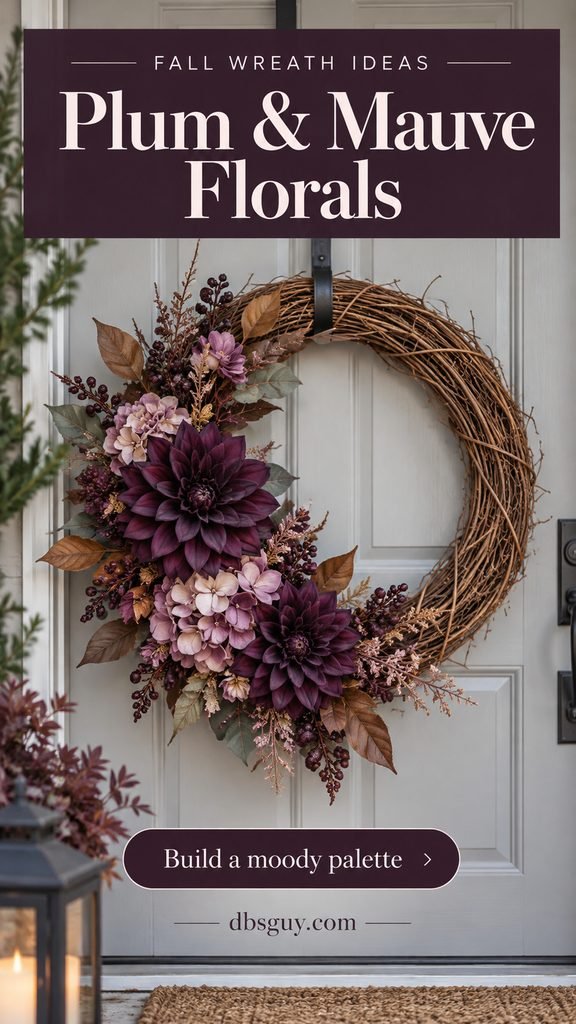
For a floral wreath with a little drama, use deep plum dahlias and quieter mauve blooms. The dark flowers create depth, while the lighter ones keep the arrangement readable from the sidewalk.
Concentrate the flowers along the lower-left arc of a grapevine ring. Place the largest bloom near the center of that cluster, then taper with smaller flowers and a few brown leaves. Leave the opposite side visibly open. This gives a floral wreath a different shape from the full blue hydrangea ring.
A pale gray door lets both flower colors show. Avoid adding glossy purple ribbon or bright pink blossoms if you want the muted effect pictured. Buy faux stems rated for your intended placement, and keep delicate fabric petals out of direct rain.
Also Read: How to Style Your Fall Decorations Entry Table Perfectly
9. Pinecones with a Small Burlap Bow
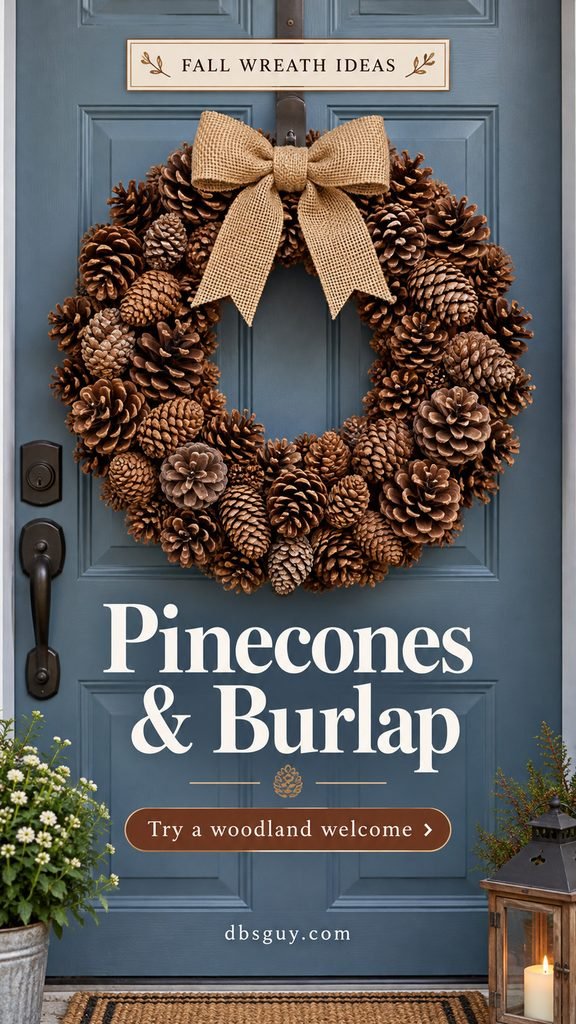
Brown pinecones can carry an entire wreath because each cone has its own layered shape. Against a dusty blue door, the contrast feels warm and woodsy rather than Christmas-specific.
Choose a compact ring with cones facing slightly different directions. A small burlap bow at the top is enough; large ribbon loops would hide the texture. If making your own, start with clean, dry craft pinecones and wire them securely to a rigid frame. Inspect the back for protruding wire before hanging.
A densely packed pinecone wreath may be heavier than a similar-size foliage wreath. Weigh the finished piece, including its ribbon, before choosing the hanger. Keep it sheltered and do not assume that natural materials are suitable for repeated soaking.
10. Green Pears and Mossy Texture
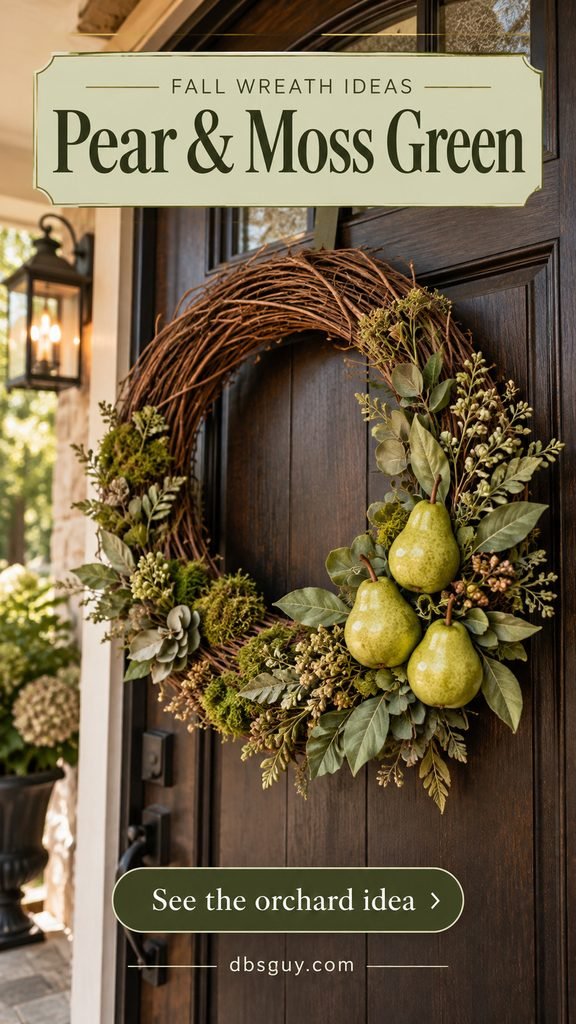
Pears offer an orchard-inspired alternative to pumpkins. Keeping them green makes the wreath feel mellow, especially with mossy texture and a visible brown vine base.
Use lightweight faux fruit rather than real pears, which add weight and can spoil. Group three pears toward the lower-right side and tuck muted foliage behind them. Small patches of artificial moss can soften the base, but leave sections of grapevine uncovered so the fruit remains the focal point.
Choose fruit with a matte finish; shiny plastic can dominate a close-up view. Attach fruit picks to the frame, not just to a handful of leaves. A dark wood door makes the green shapes stand out. For an exposed entry, check the fruit, moss, and foliage separately for outdoor suitability.
11. Black-and-Cream Check with Cream Mums

Let ribbon supply the pattern when you want a wreath that feels graphic. Black-and-cream gingham works particularly well on a black door because its light squares keep the bow visible.
Use an open grapevine ring with a few cream faux mums low on the left and a generous checked bow above them. Keep the flowers close enough to the bow to read as one arrangement, while leaving the right side mostly bare. The open space is useful on a small door where a fully decorated ring can look crowded.
Check the ribbon’s scale before cutting it. Very tiny checks may merge into gray from a distance; larger checks remain distinct. Use short, controlled tails near a frequently used handle, and keep fabric protected from wet weather.
12. A Soft Oat-Grass Crescent

Pale oat grasses and bunny-tail stems bring softness without a full, fluffy ring. Arranging them on one side of a thin metal hoop leaves a clean line on the other.
Choose a bronze-toned hoop and build the grasses along its left arc, with the longest stems rising toward the top. Keep the right half bare. A dusty rose door gives this cream-and-beige combination a gentle background, while the exposed metal keeps it from feeling overly rustic.
This is a sheltered-entry choice. Dried grasses are delicate, and frequent brushing or gusts can disturb their shape. If your door is exposed, recreate the crescent with outdoor-rated faux stems instead. Leave enough room around the latch so the soft edges do not get caught each time you come home.
13. A Muted Gold Metal-Leaf Ring

A flat metal-leaf wreath is a useful direction when you like clean lines or have limited depth behind a storm door. The leaves still signal the season, but the finish brings a more tailored look than dried botanicals.
Choose antique or brushed gold rather than mirror-bright yellow gold. A simple overlapping leaf ring looks crisp against navy. You do not need a bow; the repeating leaf shapes and open center are the design.
Metal does not automatically mean weatherproof. Check the product’s outdoor rating and care instructions, including whether the finish can be exposed to moisture. Also check the back and leaf edges for rough spots that could touch the door. Measure the actual projection before assuming it will fit behind glass.
14. Cream and Taupe Felt Oak Leaves
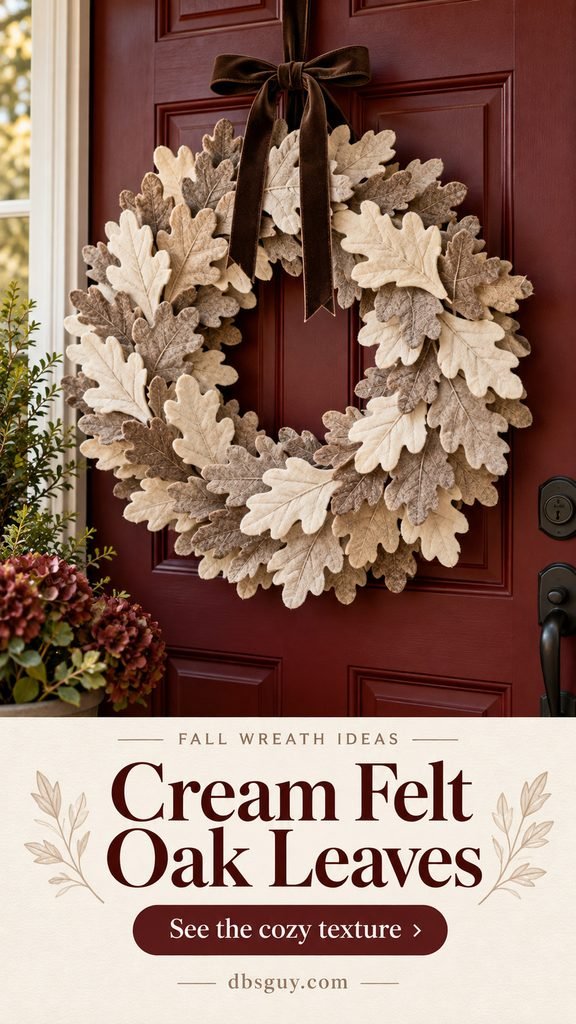
Felt gives an autumn leaf wreath the softness of a favorite sweater. Cream and taupe look especially inviting against burgundy, and the fabric makes this option visibly different from natural foliage.
For a craft version, cut oak-like leaves in two or three sizes and arrange them in overlapping layers on a wrapped ring. Keep the colors mixed rather than dividing the wreath into separate pale and dark sections. Follow your fabric adhesive’s instructions, or stitch the leaves to a fabric-covered base. A slim brown ribbon is enough to finish it.
Use this wreath only where it stays dry—such as a fully protected entry—or display it on the inside face of the front door. Ordinary felt is a poor choice for an uncovered door exposed to rain.
Also Read: 25 Fall Crafts for Adults That Are Actually Fun to Make
15. Bare Twigs and Sculptural Seedpods
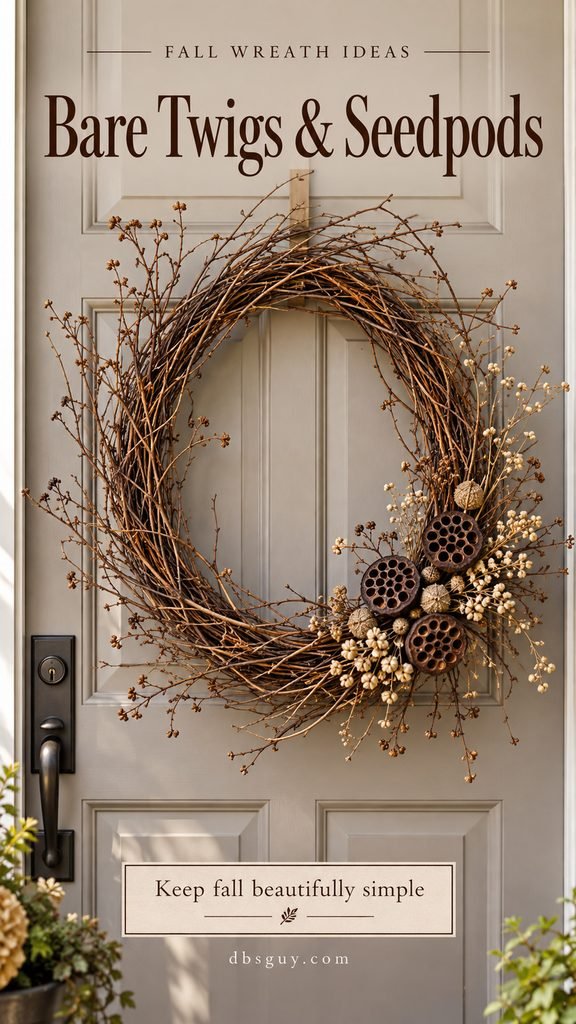
If your door has beautiful panels or a color you love, an open twig wreath lets more of it show. A loose oval feels different from the round rings above without needing extra decoration.
Choose a ready-made twig base with smooth, secured ends. Add a small cluster of brown lotus pods and pale seed heads at the lower right, keeping the rest of the oval spare. The pods provide a focal point; the visible twigs provide the shape.
Use a warm gray or light neutral door so the dark branches stay legible. Keep brittle pods sheltered and out of the path of hands, bags, and the door handle. If an irregular branch projects toward the frame or catches clothing, trim or reposition it before hanging.
Hang It Securely and Keep It Looking Good
Weigh your finished wreath with its ribbon and attachments, then choose a hanger rated for that load and compatible with your door. An over-door hanger must fit the door’s thickness and top clearance without forcing the door shut or interfering with its seal.
If you use an adhesive hook, choose the appropriate outdoor product and follow the instructions for its specific surface, temperature, preparation, and wait time. The Command hook installation guide explains why application steps differ between hook types. Do not assume an indoor hook or an arbitrary cleaning product will work outside.
Keep wire ends tucked into the frame and away from the finish. After hanging, open and close the door slowly, check the handle and viewing area, and make sure the wreath does not swing into surrounding trim. Bring delicate wreaths inside before severe weather. Let a wreath dry fully before storing it in a container that will not crush its shape.
Questions to Ask Before Choosing Your Wreath
What makes a wreath look like fall without orange?
Harvest grain, oak-shaped leaves, pinecones, pumpkins, and seedpods provide recognizable seasonal cues. Use one of those forms with a restrained palette. Cream pumpkins read as autumn even when the greenery stays sage; brown cones do the same job without flowers.
Which look is easiest to adapt from a wreath I already own?
An open grapevine wreath is a flexible starting point. Remove tired decorations, check that the base is sound, and choose one new focal detail: the burgundy sweep, pear cluster, or checked bow pictured above. Wire-on accents are easier to rearrange than a surface covered in permanent glue.
Can dried flowers stay on the front door all season?
That depends on moisture, sun, handling, and how protected the door is. Do not count on a fixed lifespan. Inspect them for damage or dampness, and move the arrangement inside if the location is not staying dry. For a regularly wet doorway, choose an outdoor-rated alternative.
How do I coordinate the wreath with the rest of the porch?
Repeat one color from the wreath in a planter, cushion, or doormat, then stop and look at the whole entry. You do not need a matching ornament in every corner. For a cream-and-sage wreath, a cream planter may be enough; for burgundy leaves, repeat the wine tone in one nearby accent.
Pick the Wreath That Fits Your Door
For a dark door, start with wheat, ivory husks, or cream pumpkins. For a pale door, consider burgundy leaves, magnolia, or plum flowers. If clearance is tight, look at the shallow metal-leaf ring; if the entry stays dry, felt and dried grasses give you softer options.
Choose the silhouette first, check the materials against your weather, and let one strong detail lead. That is enough to give your front door an autumn refresh without a single orange pumpkin.