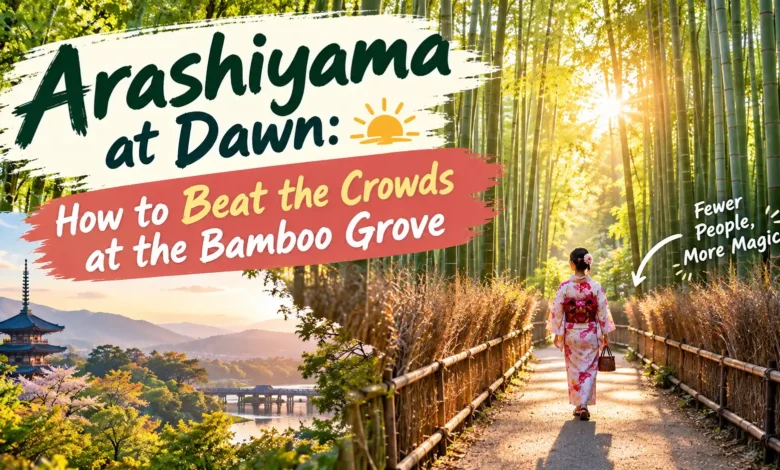
To beat the busiest crowds at Arashiyama Bamboo Grove, aim to enter the public bamboo path around sunrise, with 30–45 minutes set aside for walking and photos. When sunrise is early enough, a 6:00–6:30 a.m. arrival is a sensible target. In winter, move that plan closer to the actual sunrise rather than arriving in darkness just to meet a clock time.
The important detail is enter the grove. Reaching your train station at 7:00 a.m., stopping for breakfast, and then finding the entrance is a different plan. Work backward from the bamboo path, and give your morning one priority before adding anything else.

The images in this guide are AI-generated travel concepts, not photographs documenting a visit. They illustrate the setting and planning ideas; an empty path, particular lighting, and exact landmark details are not guaranteed.
Here is the useful version of “go early”:
- Best starting point: your travel date’s Kyoto sunrise time, followed by your earliest realistic transport connection.
- Access: the main public bamboo path is free and normally accessible 24 hours; nearby temples and paid gardens have separate hours.
- Getting there: JR Saga-Arashiyama Station is a straightforward option from Kyoto Station. Include the walk to the grove.
- Time needed: budget 30–45 minutes for the bamboo, or roughly three hours for a relaxed morning that includes the river and a temple visit.
- Expectation: fewer people and more breathing room. Other early visitors, photographers, and residents may already be there.
Choose an arrival time that works with sunrise
A fixed “arrive at 6:30” rule misses the biggest seasonal difference. Kyoto’s official tourism guidance puts summer sunrise around 5:00 a.m. and winter sunrise around 7:00 a.m. That makes the same alarm very different in July and January.

My planning recommendation is to arrive near sunrise or within about half an hour afterward. This is an editorial starting point, not a measured crowd cutoff. The dense canopy can keep the path dim even after the sky brightens, so balance quiet surroundings with enough light to enjoy them.
- Summer: compare sunrise with the first usable connection from your hotel. A 6:00 a.m. visit can still be an early visit even though sunrise has passed. If being there at sunrise matters, consider staying nearby or arranging a taxi.
- Spring and fall: use the exact date’s sunrise instead of a seasonal guess. During cherry blossom and fall foliage travel periods, choose the earliest workable morning and expect other people to have the same idea.
- Winter: arrive around the later sunrise if you prefer walking in daylight. A dark 6:00 a.m. arrival will not produce the bright green scene that drew you to the grove.
If you have a choice, a weekday outside a Japanese holiday is a reasonable planning preference. It still cannot guarantee a quiet path. Before settling on a morning, check the official Kyoto Travel Congestion Forecast, which includes the Bamboo Forest area and live-camera information. Forecasts can change, and a camera shows only its own viewpoint.
What if 7:00 or 8:00 a.m. is the earliest you can manage?
Go directly to the grove when you arrive. A 7:00 a.m. visit is a practical compromise for many travelers, especially when sunrise is later. At 8:00 a.m., treat a people-free photograph as a possibility rather than the purpose of the trip. The useful distinction is an early start versus a leisurely breakfast followed by a midmorning arrival.
Set up the morning the night before
Save your station, the public entrance near Nonomiya Shrine, the main bamboo path, and Togetsukyo Bridge in your map app. Download the area for offline use, charge your phone, and check a route for your actual departure time. The fastest connection at noon may not be available at dawn.
Put water, a small breakfast or snack, a light layer, and comfortable walking shoes by the door. Use the restroom before leaving your accommodation; do not build a dawn plan around shops, cafés, or visitor facilities being open. Leave large luggage at your hotel so the narrow path stays easy to navigate.
Also read: What to Wear in Japan: 37 Stylish & Comfy Outfits for Your Trip for clothing ideas you can adapt to a cool start and a full day of walking.
Get to the public bamboo path without waiting for a temple
For this plan, “Arashiyama Bamboo Grove” means the public Sagano bamboo walkway near Nonomiya Shrine, Tenryu-ji’s north side, and Okochi Sanso. It does not mean a paid garden that happens to contain bamboo, or every bamboo attraction labeled Arashiyama in a search result.

From Kyoto Station: use the JR Sagano Line
Take a suitable JR Sagano Line train to Saga-Arashiyama Station. The ride is roughly 15–20 minutes depending on the service. Japan’s national tourism organization describes the grove as about a 10-minute walk from the station; allow 15–20 minutes for a first visit, checking directions, and reaching the stretch you actually want to photograph.
A useful planning allowance is therefore about 30–40 minutes from boarding at Kyoto Station to the grove, plus your walk to Kyoto Station and time to find the platform and wait for the train. For example, to enter the grove at 6:30 a.m., choose a service that reaches Saga-Arashiyama by about 6:10–6:15 a.m. Check whether such a service runs on your date.
Do not confuse the JR Sagano Line with the sightseeing Sagano Romantic Train. The sightseeing train is a separate experience and is not the train you need for this early arrival.
From downtown Kyoto: compare the whole journey
Depending on your hotel, Hankyu via Katsura or the Randen tram may be more convenient. Check their early departures rather than assuming they start when JR does. Hankyu Arashiyama Station is across the river from the main sightseeing area, so its approach includes Togetsukyo Bridge and a longer walk. Randen Arashiyama Station is on the main sightseeing street, closer to the grove approach.
If the train options miss your preferred window, ask your accommodation about an early taxi pickup and an appropriate public drop-off near the grove approach. A taxi can simplify the start, but it is not necessary for every dawn visit. Confirm the fare estimate and pickup arrangements rather than relying on finding one outside at the last minute.
The walking approach to save
From JR Saga-Arashiyama, follow public streets toward Nonomiya Shrine and the signed bamboo path. Use the shrine as an orientation point, then continue along the public walkway beside the bamboo, past the area by Tenryu-ji’s north gate, toward Okochi Sanso. Follow current signs and keep any closed gates or roped-off paths out of your route.
Do not navigate through Tenryu-ji’s paid garden to reach the grove at dawn. The temple currently lists an 8:30 a.m. opening. A route that works through its grounds during opening hours can leave you facing a closed gate early in the morning. The public approach lets you visit the bamboo first and decide about the temple later.
The city describes the bamboo path as about 400 meters, roughly a quarter mile. It is a short scenic walk, not a wilderness hike. Your 30–45 minutes are for slowing down, looking up, and taking a few pictures, rather than covering a long distance.
Take better bamboo photos while keeping the path clear
Walk a little before choosing your first shot. The view changes as the path bends, and the first place with bamboo on both sides may not give you the composition you wanted. Stay on the public walkway throughout.
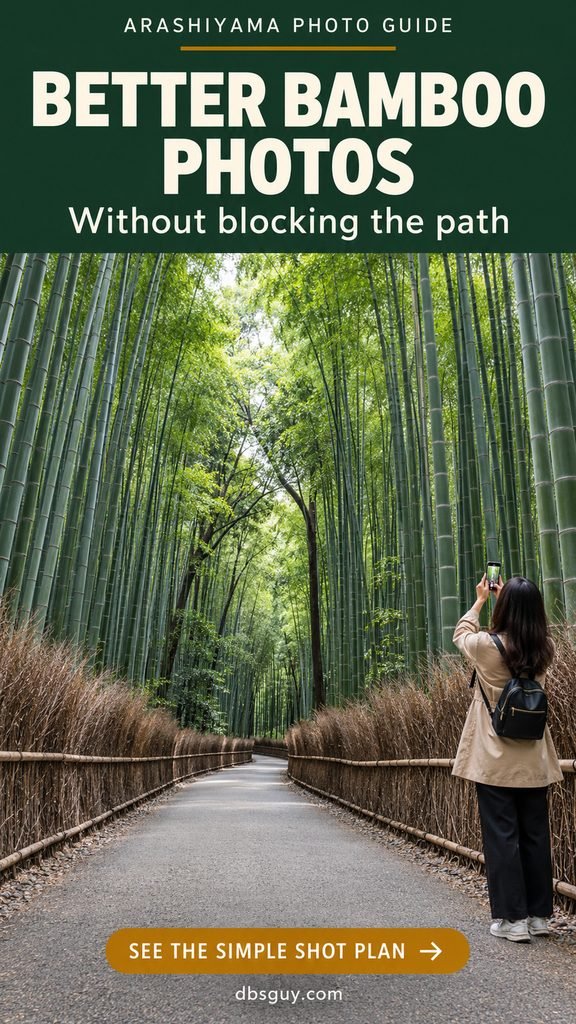
For a simple phone-photo sequence, start with one vertical view down the path. Keep the fence as a leading line and leave enough room above it to show the height of the stalks. Try the normal 1× lens first; switch to a wider view only if you need it, since very wide lenses can stretch people near the edges.
Then tilt upward for a canopy detail from the same safe position. For a travel portrait, have your companion stand to one side and take a few quick frames when there is a gap. Avoid making the middle of the path a staging area. The photo pin above illustrates this side-of-path approach.
- In dim light: hold the phone with both hands, pause your movement, and let a night-mode exposure finish if the phone uses one. Ask a portrait subject to stay still briefly.
- When the sky looks blown out: tap a brighter part of the scene and lower exposure slightly. Check that the bamboo still has detail.
- If people keep entering the frame: take a tighter view of the stalks or canopy, or include visitors as a sense of scale. Avoid standing in place indefinitely waiting for an empty corridor.
Keep tripods and equipment from obstructing the walkway, and follow any posted restrictions. Never climb or lean over the fence, bend a stalk for a composition, or carve the bamboo. Keep conversations low on the approach as well as inside the grove; these paths sit beside a neighborhood, not a closed film set.
If it is cloudy, expect softer light rather than dramatic sunbeams. Light rain may add texture to the scene, but it does not guarantee fewer visitors. Check the forecast before leaving, use grippy shoes on wet ground, and change your plans if severe weather or closures affect the area.
Give the rest of the morning somewhere to go
The awkward part of a very early bamboo visit is often what happens afterward: you are finished before the café or garden you saved has opened. Solve that before you leave the hotel.

After the grove, return along public streets toward Togetsukyo Bridge and the Katsura River. Allow about 15–25 minutes depending on your exit and walking pace. This makes a natural second stop without needing another ticket or a trip across Kyoto.
Spend a little time on the riverside, leaving room for other pedestrians and keeping to open paths. Treat breakfast as a scheduled stop: check the specific café’s opening hours, choose an accommodation breakfast you can return for, or carry something simple and eat where permitted. Take your trash with you.
A realistic example when sunrise is around 6:00 a.m.
This is a sample schedule, not a train timetable. Shift the grove visit to match your date’s sunrise and transport. The temple stop stays tied to its opening time.
- 6:15 a.m.: enter the public bamboo path and walk slowly through the main stretch.
- 6:15–7:00 a.m.: enjoy the grove and take a few photos, including a canopy view.
- 7:00–7:25 a.m.: walk toward Togetsukyo Bridge.
- 7:25–8:10 a.m.: spend time by the river and have your planned breakfast or snack.
- 8:10–8:30 a.m.: return toward Tenryu-ji if you want to visit its garden.
- 8:30 a.m. onward: visit the temple after it opens, or head back if the bamboo and river were your main priorities.
Tenryu-ji’s published garden admission is currently ¥500 for adults; building admission is additional, and special closures can affect a visit. Confirm the temple’s current details before going. The garden is an optional paid stop, separate from the free bamboo walkway.
If you arrive at the grove much earlier in summer, you may have a longer gap before the temple opens. You do not need to fill it with more attractions. A shorter bamboo-and-river outing, followed by breakfast back near your hotel, can be the better use of an early start.
For travelers with young children, a stroller, or limited walking tolerance, keep the route short and allow extra time on slopes and uneven surfaces. Do not add hillside park detours simply because they look close on a map.
Questions about visiting Arashiyama at dawn
Is the bamboo grove open before sunrise?
The main public path is normally accessible around the clock and has no admission fee. That does not make every adjoining shrine area, garden, shop, or temple available at dawn. Follow temporary restrictions and use the public walking approach.
Is an early-access tour necessary?
You can visit the public grove independently. An early tour may provide a guide, transport, or a planned route, but an early start alone is not exclusive admission to the public path. Read the tour description for what is actually included.
Can I visit at dawn from Osaka?
It depends on your starting station, travel date, and definition of dawn. Check the complete journey, including transfers and the walk from the station. If it misses sunrise, choose an early arrival you can realistically make. Spending the previous night in Kyoto is worth considering when this quiet morning is a major trip priority.
Is it worth going if I cannot avoid everyone?
Yes, if you want to experience the bamboo and will enjoy the wider neighborhood. The grove is compact, and its appeal is the height, texture, and sound of the bamboo. Expecting a private forest can make an otherwise lovely early walk feel disappointing.
What is the one mistake to avoid?
Scheduling your arrival at the station as though it were your arrival at the bamboo. Save the public entrance, include the final walk, and go to the grove before breakfast. That small planning change does more for this visit than adding another attraction to the morning.