For tortoise olive and plum nails, start with the amount of pattern you want to see: one amber accent, a patterned tip, or a larger panel framed by green and purple. Olive brings a muted, earthy color; plum adds depth; the translucent brown print gives the two solids something textured to sit beside.
These 21 combinations change the placement, scale, and finish rather than repeating one manicure in different shades. Try idea 1 for short nails, 9 for a graphic accent, 11 for matte color, or 18 if you want a different color on each hand. Every look keeps both olive and plum in the palette.

The visuals are AI-generated manicure concepts, not photographs of completed or tested salon services. Use them as references for color and placement; a nail artist can adapt the details to your nails.
1. One Amber Tortoise Accent on Short Nails
A single patterned ring nail gives this short squoval set its focus. The thumb and index stay olive, while the middle and pinky bring in glossy plum. Because the amber is confined to one nail, you can enjoy all three colors without turning the whole manicure into a busy print.

Keep the dark patches small enough to leave honey-colored gaps on the accent. If you are trying the pattern at home, finishing just one tortoise nail per hand is a manageable starting point. Ask for soft corners and a plum that still looks purple beside the brown.
2. Mixed Olive, Plum, and Tortoise French Tips
This version keeps the lower part of every nail sheer pink. Olive tips sit on the thumb and index, tortoiseshell tips on the middle and ring, and plum finishes the pinky. The shared French outline ties together three different tip treatments.
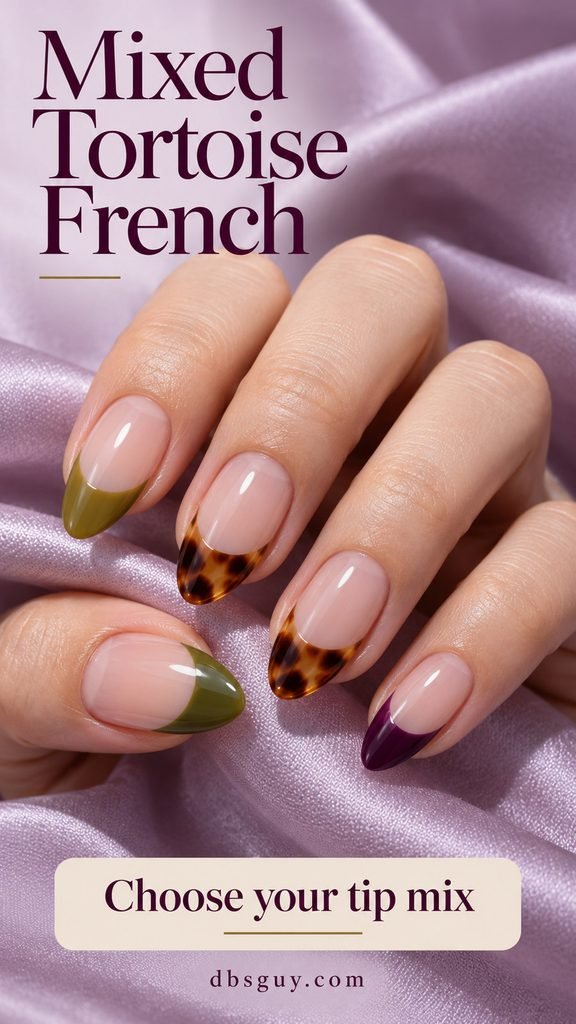
Choose the tip depth before choosing the number of brown patches. A shallower tip needs a simpler pattern, with a few uneven marks rather than an entire full-nail design squeezed into the edge. For a shorter adaptation, keep just one tortoise tip and repeat the two solid colors elsewhere.
3. Olive Tortoise With Plum Half-Moons
Here, the print itself turns green. An olive-tinted translucent background carries irregular dark patches, and a small plum half-moon sits at the base of each nail. The contrast comes from a patterned body beside a clean, solid curve.

Show your artist the cuticle placement: the plum belongs at the base, not at the tip. Keep each moon shallow so it does not crowd the olive pattern. A medium oval gives the mottling room, but on short nails you can use fewer patches and a smaller plum crescent.
4. Plum Tortoise Tips With an Olive Outline
A purple-tinted tortoise tip changes the traditional amber palette. The patterned edge stays translucent plum, with deeper brown patches inside it. A narrow olive line follows the smile line, separating the sheer pink nail bed from the darker tip.
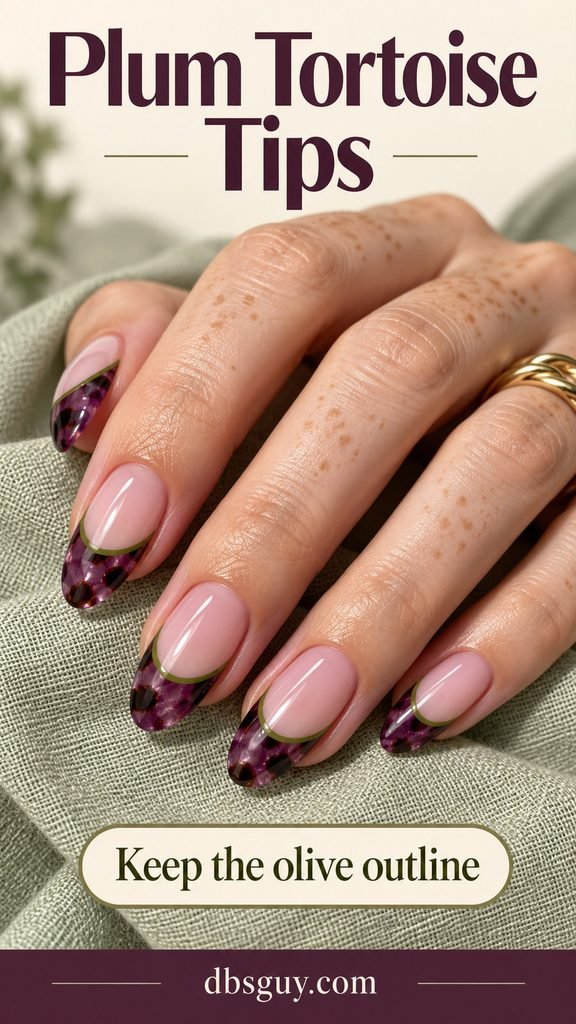
Ask for a plum jelly effect rather than opaque purple under black dots. You should still see lighter areas inside the patterned tip. Keep the olive outline continuous and slim; if it becomes a wide stripe, it starts to compete with the print. Save a close crop of the border along with the full-hand view.
5. Vertical Half-Tortoise Color Panels
A straight lengthwise split makes the print feel graphic. One half of each nail shows amber tortoiseshell; the other stays opaque olive or plum. Alternating the solid half across the hand brings both colors into the set without adding more shapes.

The dividing edge matters more than matching the brown patches. Decide whether you want equal halves or a narrower patterned panel, then keep that proportion consistent. On a small nail, reduce the number of patches inside the amber side so the split remains easy to see.
6. Tiny Tortoise Corners on Olive and Plum
Small diagonal corners introduce tortoiseshell without covering an entire accent nail. Most of each short nail stays olive or plum, with just a triangle of amber pattern at one side of the free edge. This is a useful option when you want the solid colors to remain the main event.
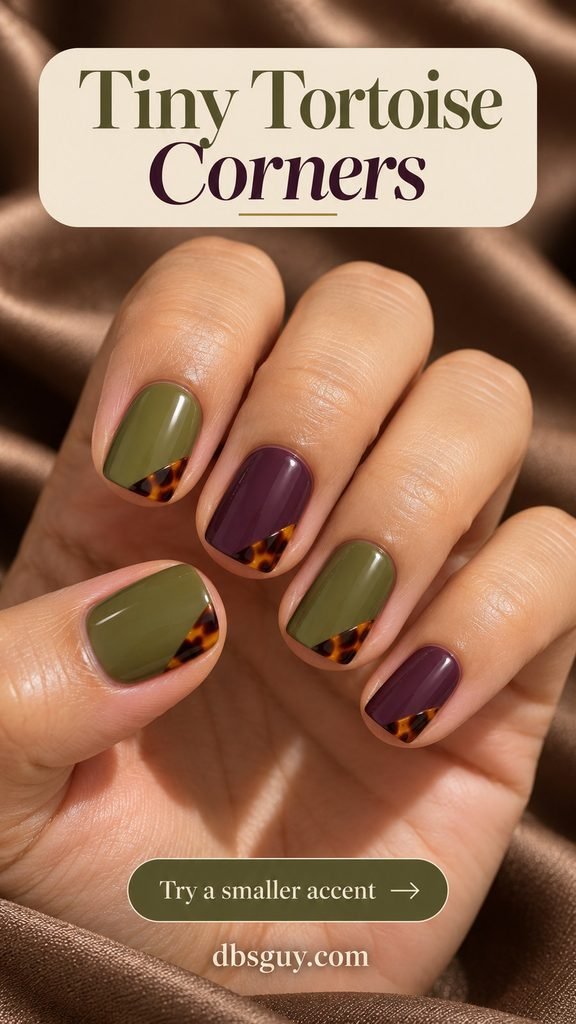
Keep the corner small enough that it reads as an off-center detail, not a deep French tip. One or two dark marks may be all the space allows. If your nails are especially narrow, put the triangles on two fingers and leave the rest completely solid.
Also read: 19 Olive Green November Nail Ideas That Pair Beautifully With Cozy Neutrals for more ways to build a manicure around the green shade.
7. Framed Tortoise Windows on Sheer Nude
Think of these as small patterned insets. An oval of amber tortoiseshell sits in the center of each sheer nude nail, with a fine olive or plum border around it. The nude space surrounding the oval is part of the design, giving each inset its own outline.

Ask your artist to size the oval to your nail bed rather than copying its length exactly. It needs a visible nude margin at the sides and both ends. If the frame touches the cuticle or tip, the inset effect disappears. On shorter nails, a smaller rounded oval is more useful than a tightly packed long one.
8. Tortoise Ribbon Waves With Colored Curves
A flowing strip of tortoiseshell takes the place of a full patterned nail. Each ribbon curves through a sheer pink base, with an olive or plum stroke alongside it. The irregular amber marks stay inside the ribbon, while the uncovered base keeps the movement easy to follow.
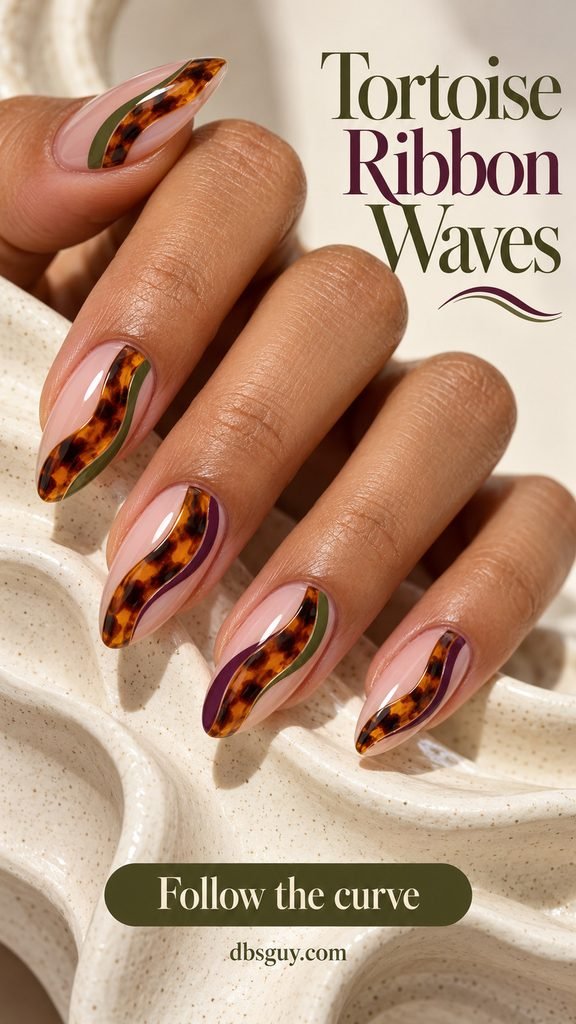
Request one broad bend per nail instead of several tiny loops. The ribbon needs enough width for its print to show; the colored companion line can stay much slimmer. If you prefer minimal art, use the ribbons on the middle and ring nails and repeat plain olive and plum on the others.
9. A Large Tortoise Checkerboard Accent
The ring nail uses a small grid of generous squares: olive, plum, and tortoiseshell share the same space. The surrounding nails stay solid. It is a more graphic choice than softly blended tortoise, and the square-ended nail gives the grid a clear outline.

Keep the checks large. Two columns can be more readable than a miniature grid, particularly when the tortoise squares contain their own pattern. Ask to preserve straight boundaries between the three treatments. If the darkest brown merges into the plum squares, choose a lighter amber or a slightly softer plum.
10. Double French Lines With Tortoise Edges
Two separate curves give this French manicure its structure. Tortoiseshell fills the outer edge, and a slim olive or plum band sits below it. A narrow strip of nude separates the bands, so the lower color reads as a second curve rather than a border pressed against the print.

This look needs room for three things: the tortoise edge, the nude gap, and the colored line. If your free edge is short, simplify to one patterned accent or use idea 4’s single outline instead. Making every band wider to fit the print will cover much more of the nail than the reference.
Also read: 25 November Nail Ideas That Give Classic French Tips an Unexpected Fall Twist if you want to compare other autumn tip placements.
11. Matte Olive and Plum With a Glossy Tortie
Surface finish does the extra work here. Olive and plum look soft and flat beside one shiny amber tortoiseshell accent. The pattern does not need foil, gems, or extra linework because its glossy reflection already stands apart from the surrounding matte nails.
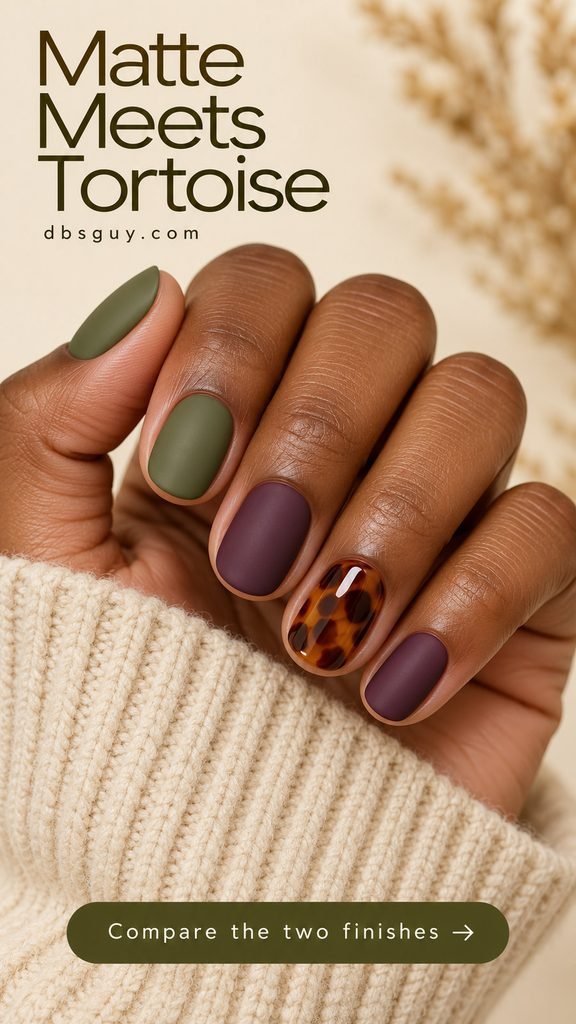
Be specific about which nails receive which finish: matte on the solids, gloss on the patterned ring nail. Ask to see the olive and plum with the intended matte finish before deciding on the shades. For a simpler home version, use a finished tortoise press-on accent that fits your nail width alongside the solid colors.
12. Gold-Foil Seams Between Color and Tortoise
An uneven gold seam runs between a tortoise panel and a solid olive or plum panel. The diagonal division changes the shape of the amber area from nail to nail, while the small foil fragments make the boundary noticeable. This is a dressier option without an all-over metallic finish.

Ask for scattered, flat foil along the join rather than a thick strip covering it. The brown patches should remain visible beside the gold. If the full set feels too detailed, keep the foil-panel treatment on two nails and use plain olive and plum elsewhere; the diagonal placement will still carry the idea.
13. Tortoise Cuticle Cuffs
Move the print to the base for a reverse-French effect. A rounded tortoiseshell cuff follows the cuticle end of each nail, leaving the rest solid olive or plum. Because the amber curves repeat across the hand, even a short rounded nail can show a deliberate pattern.

Show the artist that the print belongs at the lower edge, with the solid color extending to the tip. Keep the cuffs shallow and the patches sparse. Painting a tall patterned lower half would create a different color-block look and leave less room for the green and purple.
14. Plum Cat-Eye Beside Olive Tortoiseshell
Luminous plum nails sit beside olive tortoiseshell accents on the thumb and ring finger. The two finishes stay on separate nails, so the reflective plum and mottled green each remain easy to recognize. The result has more movement than a set of plain cream colors.

Bring a separate reference for the plum shimmer if you want a broad velvet glow rather than a sharp reflective stripe. Ask to tilt a finished sample: a still image only shows one angle. For the green accents, keep enough lighter olive visible between the dark patches so they do not read as solid brown.
Also read: 19 Plum November Nail Ideas That Make Deep Purple Look So Wearable for a closer look at purple shades and finishes.
15. A Single Tortoise Heart
One small amber heart makes this palette feel playful. It sits on a sheer nude ring nail with a plum outline, surrounded by plain olive and plum nails. The recognizable silhouette contains the tortoise detail, so the print becomes a small motif rather than a background.

Leave a generous nude margin around the heart and keep the notch between its upper curves visible. If the motif is tiny, use just a few brown marks inside it. A large number of patches can hide the shape. Ask for a flat painted design if you want the smooth surface shown here.
16. Side-Swept Tortoise French
Instead of crossing the tip evenly, the patterned crescent sweeps along one side of the nail and into the point. An olive or plum line follows its inner edge. A long nude center remains visible, giving the design an asymmetric outline without adding a second pattern.

Point out where the sweep should start on your own nail. A lower starting point creates a longer side panel; a higher one gives a smaller corner. For short nails, use a single shallow diagonal sweep and keep the companion line fine rather than trying to reproduce a long curve.
17. Tortoise Belts Between Plum and Olive
Every nail carries the entire palette in three horizontal sections: plum near the cuticle, an amber tortoise belt through the middle, and olive at the tip. The straight bands make a structured alternative to the vertical panels in idea 5.

Choose a band width that leaves room to recognize the print. On a very short nail, the three sections may feel crowded; use the belt on one accent nail and keep the others solid. The center should show honey and brown patches, not become a thin dark stripe between two colors.
18. An Olive Hand and a Plum Hand
Give each hand its own main color: olive on one, plum on the other. Matching tortoiseshell ring nails connect the two sides. It is a straightforward way to wear a mismatched manicure while keeping the artwork limited to two accents.
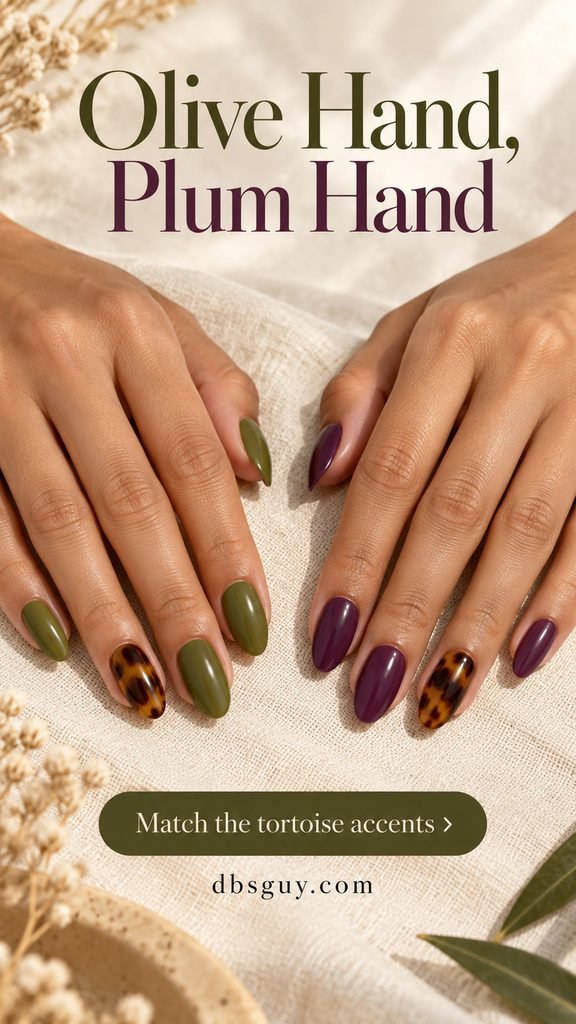
Use the same amber depth, nail shape, and glossy finish on both hands so the difference feels intentional. Decide which fingers carry the print before the appointment. If you only save a close-up of one hand, your artist may miss that the color changes on the other, so bring the full two-hand reference.
19. Blonde Tortoise With Muted Olive and Dusty Plum
A pale honey tortoise accent softens the whole combination. Instead of near-black patches on deep amber, the ring nail uses light cocoa clouds over a much lighter base. Muted olive and dusty plum keep the surrounding colors in the same quiet range.
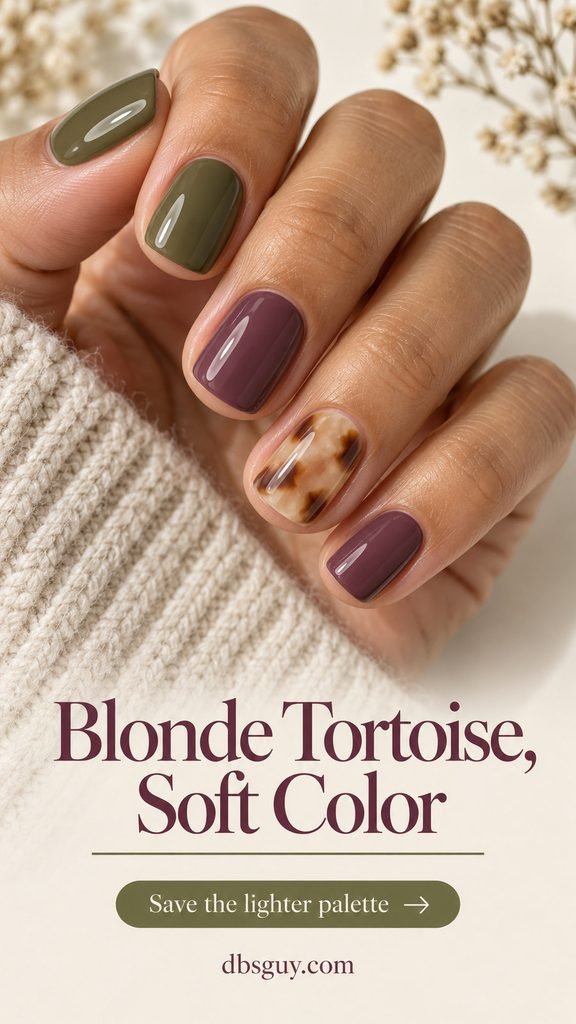
Ask to compare the patterned accent beside both solid swatches. Very dark purple would make this feel more contrasted than the reference. Keep the pale background visible through the cocoa marks, and use the same glossy finish throughout. This is a useful starting point if you like earthy nail inspo but prefer gentler color differences.
20. A Soft Tortoise Fade
The ring nail fades from a sheer nude base into amber at the tip, where the darker tortoise patches gather. Olive and plum solids surround it. Unlike a French tip, this design has no crisp smile line; the color and pattern gradually become denser toward the edge.
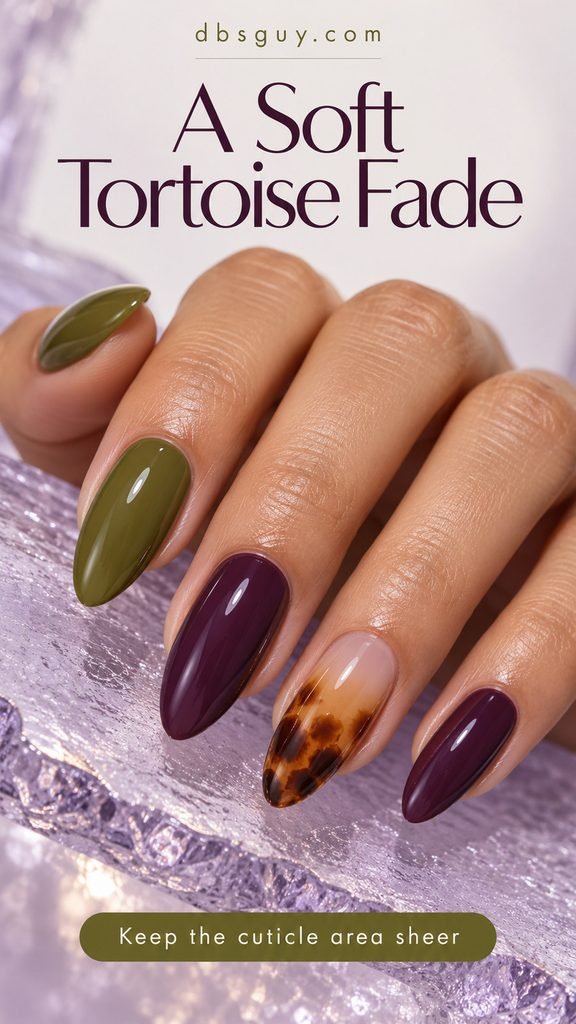
Ask to keep the cuticle end mostly clear-looking and reduce the dark marks as the amber fades upward. A hard boundary across the nail would change the effect. For short nails, use fewer patches and a smaller fade area rather than filling the entire nail with brown to make the pattern visible.
21. A Curated Five-Nail Tortoise Mix
This set assigns a different job to every finger: an olive French thumb, a solid plum index, a full tortoise middle nail, olive-and-plum curves on the ring, and a small tortoise corner on the pinky. Repeating the same three colors keeps the different placements connected.
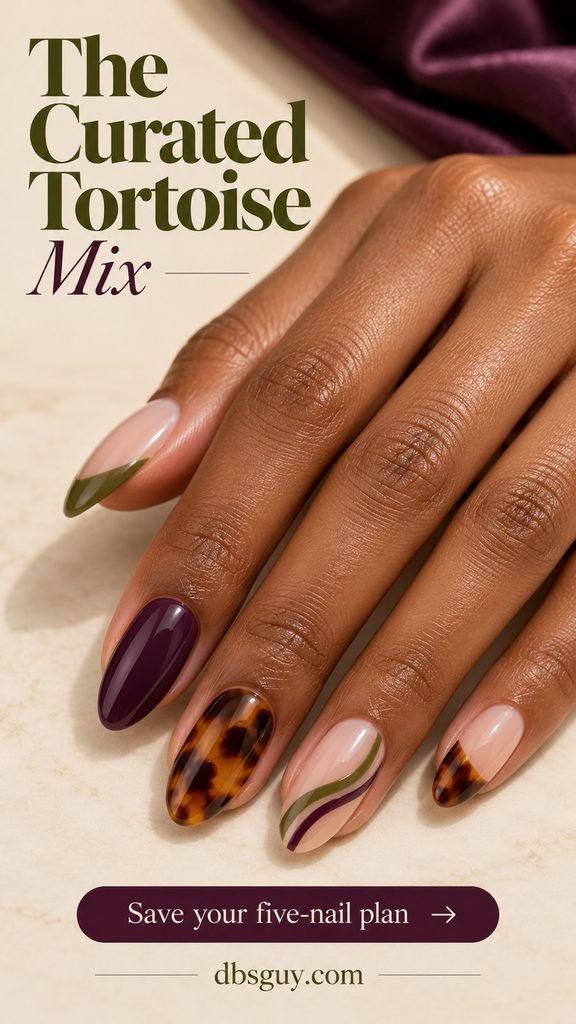
Save the finger-by-finger plan with the picture. The fully patterned middle nail is the focal point; the small corner echoes it without making every nail equally busy. For a simpler version, replace the ring-finger curves with plain olive. Resist adding another motif or accent color before deciding whether the five placements already feel complete.
Choose Your Shades Before Your Appointment
Lay an olive swatch, a plum swatch, and a tortoise sample together. If the green and purple both look almost black in normal indoor light, lighten one so the combination stays visible. A yellow-brown olive and a clearly purple plum create a different effect from gray-green and red-leaning berry; choose the actual colors rather than relying on their names.
A redder wine shade will make the pairing closer to burgundy and green nails. Choose a purple-based plum when you want the cooler contrast shown here. Check that shade beside the finished tortoise sample: a brown-heavy purple can blend into the darkest patches more than you expect.
Bring one full-hand image and a close-up of the detail you want to keep. Tell the artist your usual nail length, which fingers should carry art, and whether the solids should be matte or glossy. For tiny tips, cuffs, and corners, simplifying the patches usually makes more sense than widening the entire patterned area.
Questions About Olive and Plum Tortoise Nails
What makes a pattern look like tortoiseshell rather than leopard print?
Look for uneven dark patches with lighter translucent color showing between and through them. They should vary in size and depth. Repeated ring-shaped spots give a more leopard-like effect; closely packed opaque dots lose the layered appearance. Ask to see one finished accent before repeating the print across a whole set.
Can I wear these designs on very short nails?
Yes. Start with the single accent in idea 1, the small corners in idea 6, or the matte-and-gloss mix in idea 11. Keep the print in one clear area. Double French bands and multi-part belts need more visible nail space, so simplify those placements if the details become crowded.
Do tortoise nails require gel polish?
No. OPI’s Outta Your Shell lacquer tutorial demonstrates a tortoise effect with air-drying products, irregular shapes, and sheer overlapping color. If you use regular polish, follow the product’s drying instructions between layers. Gel is a separate system; do not substitute air-drying steps for its manufacturer’s application instructions.
Which design should I choose if I am unsure about the color combination?
Pick idea 1 if you want a compact preview of all three colors, or idea 19 for a softer palette. If your favorite part is the green-purple contrast, idea 18 gives each hand its own main color. Save the placement you like, then compare the actual polish samples before choosing the depth.
Also Read
For a broader range of amber patterns, explore 21 Tortoiseshell November Nail Ideas That Look Like Polished Amber. Keep the placement you like and bring olive and plum into the surrounding nails.