
There is a lovely moment in December when the sky turns blue, the room lights come on, and an ordinary window starts to feel like part of Christmas.
You don’t need to cover every inch of glass to create that feeling. A single glowing star, a few flameless candles, or a small group of ornaments can give the window a clear focal point while leaving the view open.
These 17 indoor Christmas window decor ideas range from simple lighting to flat paper decorations and small displays. Some provide their own glow. Others catch the light already in the room, which is useful if you want a festive window without adding another electrical set.
Choose one idea that fits the window you actually have. Then look at it from the sofa, from across the room, and—if practical—from outside. A window display should feel welcoming in your everyday view, not only in a close-up photograph.
Check the Window Before You Begin
Before arranging anything, measure the usable sill and check which panes move. Open the window, reach its latch, and operate the blinds or curtains. Those ordinary movements tell you where a decoration can comfortably sit.
A broad fixed pane gives you more room for hanging lights or flat artwork. A narrow sill may suit one compact object. If there is no sill at all, a suitable fixed pane can still hold a small cling design or chalk drawing.
Leave opening panes, handles, blind cords, and escape access clear. The U.S. Fire Administration’s home escape guidance says doors and windows should not be blocked. If a proposed display interferes with a window you need to use, choose a smaller arrangement or a different location.
Pick a mood before buying anything: warm white and greenery, navy and brass, burgundy and ivory, or soft pastel trees. Use the room’s existing colors as the starting point rather than introducing an entirely separate scheme at the window.
And decide where the power supply or battery controls will go. They should remain accessible, with no cable trapped in a sash or stretched across the floor.
1. Outline the Window with Warm White LED Lights
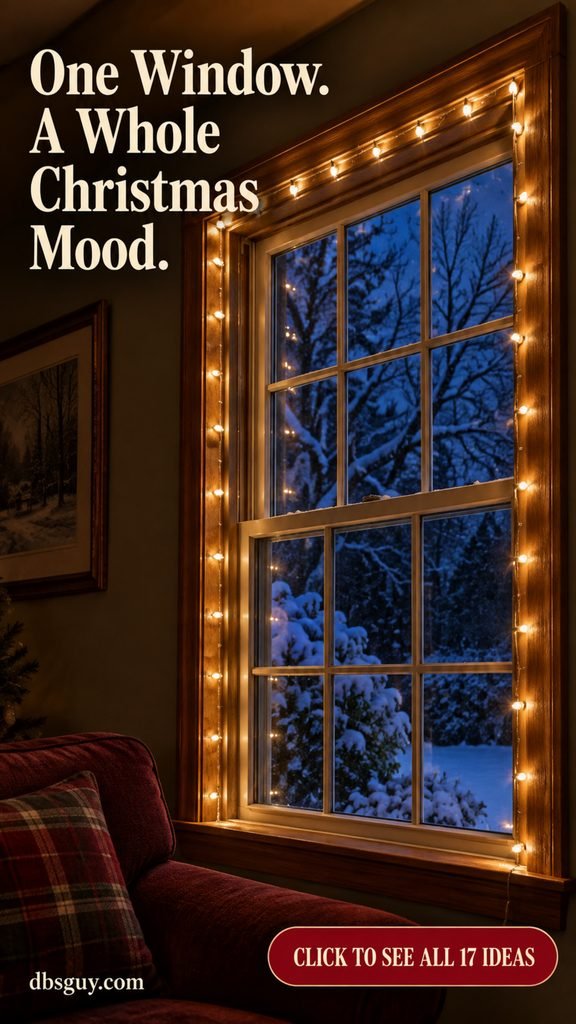
A simple light outline is one of the easiest ways to make a window visible after dark. It emphasizes the shape of the frame and leaves the sill available for everyday use.
Choose an indoor-rated LED set suitable for the location, with enough length to follow the fixed outer trim without stretching. Use clips designed for the lights and the mounting surface; don’t staple through the wire or close the window on it.
Test the set before hanging it. Warm white usually works well with wood, cream paint, and traditional Christmas colors, but labels can vary. Check how the actual bulbs look beside the lighting already in your room.
The CPSC’s holiday decorating guidance recommends lights with an independent safety-testing label, checking wires and sockets for damage, and switching decorative lights off before bed or leaving home.
Keep the outline restrained. One tidy strand often looks more inviting than several overlapping sets, especially on a small window.
Best fit: A window with suitable fixed trim and an accessible power source. If fabric curtains would touch the lights, use a different lighting location or choose an unlit window detail.
2. Hang a Light Curtain Across a Fixed Pane
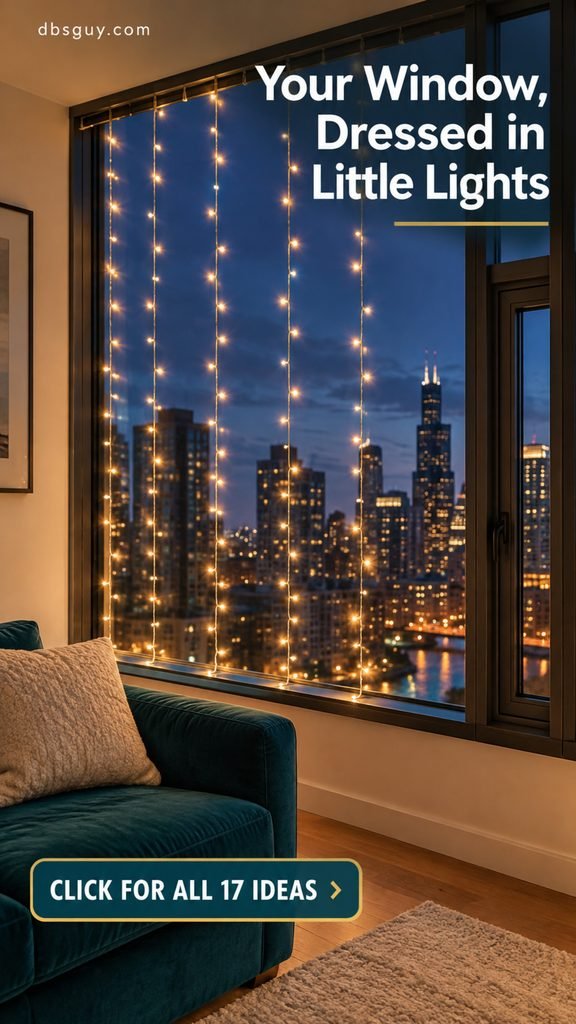
Curtain lights give you many small points of light instead of one bright shape. They can look especially lovely against a dark evening view.
This idea suits a fixed pane where hanging drops leave window movement and necessary access available.
Measure the width and drop length before choosing a set. Secure its top support to suitable fixed trim, keeping the strands separate and the ends above the sill or floor. Leave nearby fabric curtains out of contact with the lights.
Check the set’s operating instructions, including its power supply and connection limits. The U.S. Fire Administration advises following the manufacturer’s instructions for how many strands can be connected; there isn’t one connection rule that fits every modern light set.
Start with a steady setting. It lets the room feel calm and makes the lights easier to enjoy while reading or talking.
If the window opens frequently: Skip the curtain and try the light outline on suitable fixed trim, or one compact sill display instead.
3. Line a Wide Sill with Flameless Window Candles
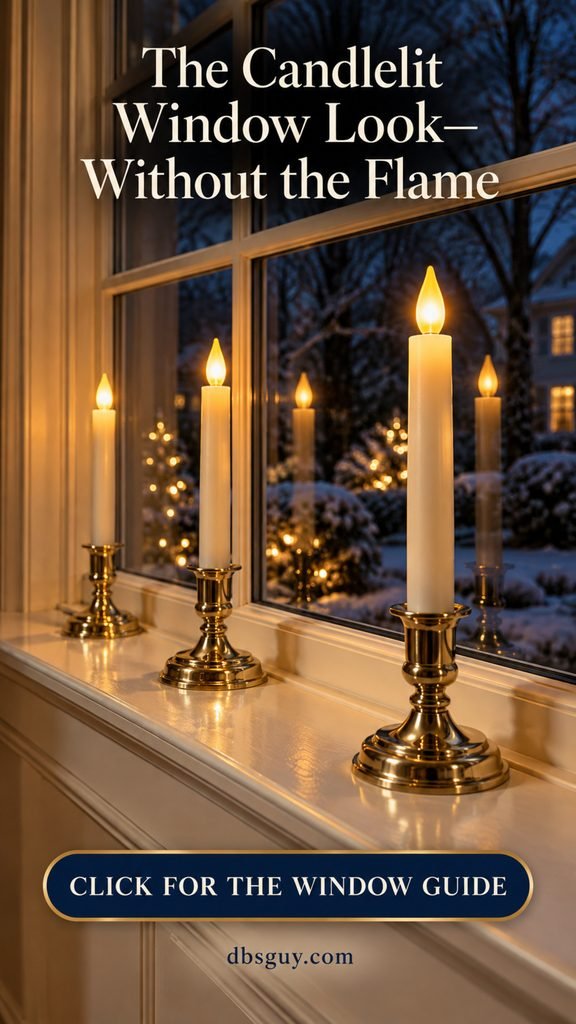
The traditional candle-in-the-window look feels welcoming from both sides of the glass. Battery-operated flameless candles provide that appearance without an open flame among your window decorations.
The U.S. Fire Administration recommends considering flameless alternatives. That is a useful choice for a display near glass, window treatments, and other seasonal pieces.
Use stable bases that fit fully on the sill, set back from the edge. Three evenly spaced taper-style candles can suit a broad window; one may be enough on a smaller sill.
Keep the arrangement simple. Brass bases and ivory candles already have a familiar Christmas character, so you don’t need greenery wrapped around each one.
Try the candles in the evening before settling on the spacing. From across the room, they should read as separate points of light rather than a crowded cluster.
Follow the battery and operating instructions, keep controls accessible, and turn the display off when you finish enjoying it.
No wide sill? Don’t balance candle bases on a narrow ledge. Choose a hanging or flat-glass idea that suits the window instead.
4. Make One LED Star the Focal Point

One illuminated star can do the work of a whole collection of small decorations. The silhouette gives the window a Christmas identity even when the surrounding room stays simple.
Choose a complete lighting decoration intended for indoor use, such as a metal-frame LED star. Use its supplied or recommended fixing method on a suitable part of the fixed frame or pane.
Compare the star’s dimensions with the visible glass before buying. It should have breathing room around it, with the latch, opening area, and power cable route left clear.
A warm white star looks soft against midnight-blue glass. In a room with pale wood and green accents, you can leave the sill empty and let the shape lead.
Keep the power supply accessible and follow the product instructions. Ordinary craft stars belong in the unlit-paper idea below; adding a bulb to one isn’t the same as using a purpose-made lighting product.
For a small window: One clear, moderately sized shape is usually easier to appreciate than several overlapping stars.
5. Build a Tiny Glowing House Village on a Deep Sill

Little lighted houses bring a story to the window: a few roofs, small squares of light, and the feeling of a quiet winter street.
Use ceramic or other house decorations with built-in LED lighting intended for that purpose. Three houses in related colors can make a complete display, particularly when their heights differ slightly.
Measure the deepest base against the usable sill. Every house should sit fully on a stable surface, well back from the edge, with enough room to reach its switch or battery compartment.
Arrange the houses with gaps between them. A larger house near one end and two smaller ones nearby often feels more natural than filling the whole ledge.
Leave artificial snow and loose glitter out. The illuminated windows provide the atmosphere, and a clear sill is much easier to wipe down.
If you already own a village: Choose a few pieces for this window rather than moving the entire collection. Use only the lighting each decoration was designed to hold; don’t improvise with lit tealights.
6. Suspend Unlit Paper Stars in the Evening View
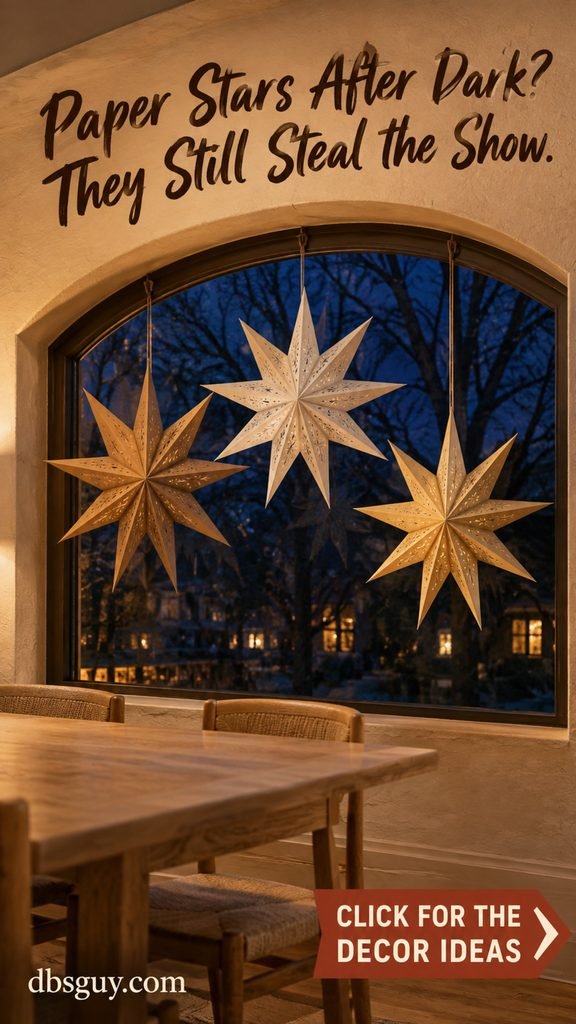
Paper stars don’t have to light up to look beautiful after dark. Their folded surfaces can catch the room’s existing light while the darker glass gives their shape contrast.
Choose a small group in ivory, kraft paper, or soft gold. Vary the sizes a little and leave enough space to see each outline.
Hang them from suitable fixings near a fixed upper frame, using short individual ties. Keep moving panes, blinds, curtain movement, and access clear. Avoid loose loops where children could reach them.
These stars stay unlit. Don’t push a bulb into an ordinary paper decoration or wind a light strand through its folds.
Look at the group in the actual evening lighting. If the stars disappear into a dark corner, choose a lighter paper or move them to a better-lit window area rather than adding lights directly to the paper.
For a quiet scheme: Pair the stars with plain surrounding fabrics and an empty sill. Their texture is enough detail on its own.
7. Run a Narrow Unlit Garland Along the Upper Trim
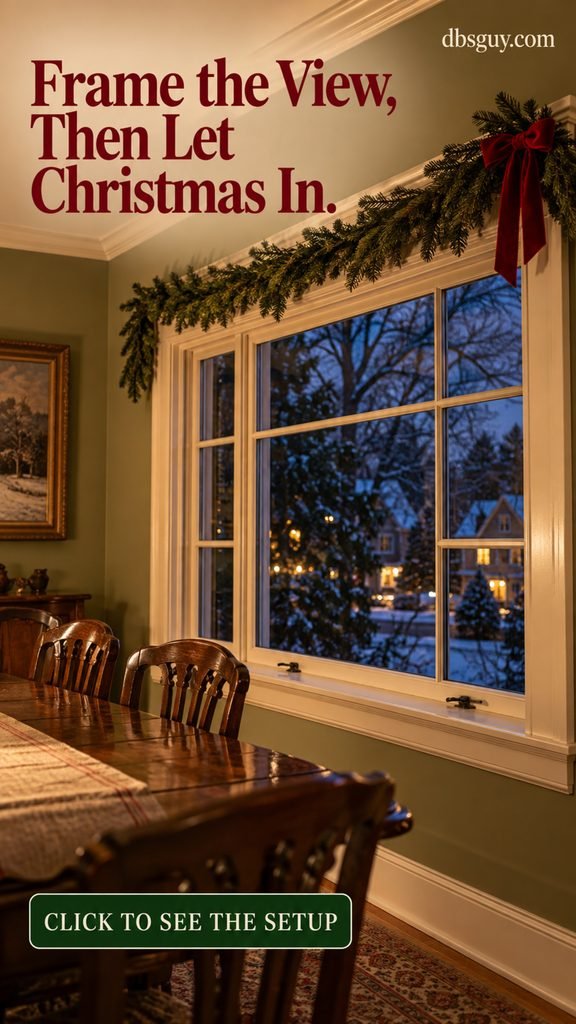
A little greenery across the top of the window can frame the evening view without taking over the glass.
Choose a narrow, lightweight garland that fits the fixed upper trim. A dense, heavy garland that works on a mantel may be too much for a window, particularly if you also need to operate curtains or blinds.
Lay out the greenery before attaching it. Keep the ends short and let one small bow repeat a color from the room. There’s no need to trail branches down both sides.
Use fixings rated for the complete decoration and suitable for the surface. Command’s manufacturer guidance explains that surface conditions, weight limits, humidity, temperature changes, and the stated application time affect how its adhesive products perform. Follow the instructions for the exact product you choose.
Keep this garland unlit and away from heaters or nearby lighting fixtures. Existing room light can give the greenery enough presence in the evening.
For a small window: A short section across the top may look better than a garland that tries to surround the whole frame.
8. Hang a Small Group of Baubles on Short Ribbons
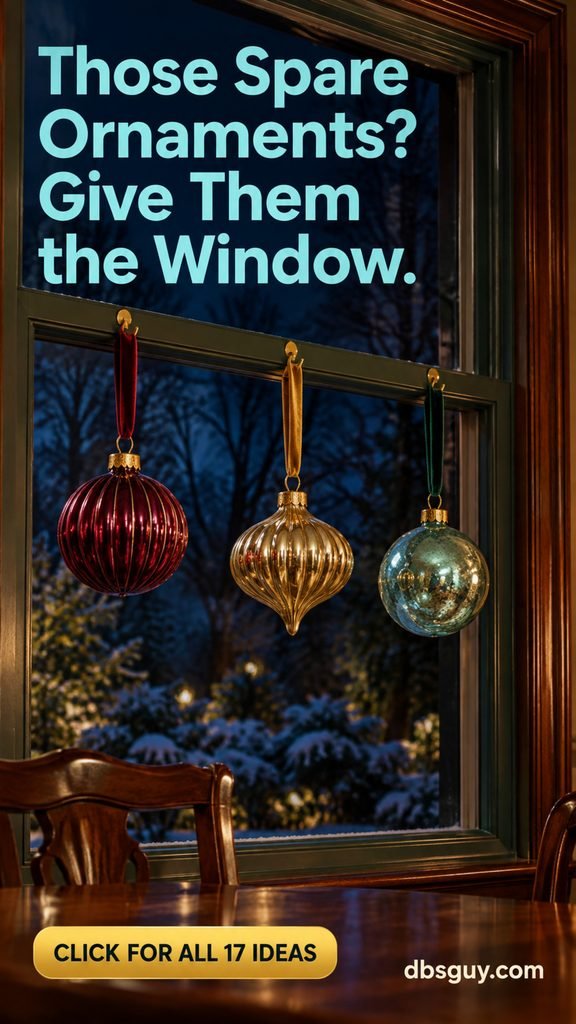
The ornaments left in the decoration box can become a window display instead of another collection on a table.
Choose three lightweight baubles with a shared color story. Burgundy, gold, and pale teal look rich against darker glass; ivory and champagne feel quieter in a neutral room.
Use individual ribbons on suitable fixed-frame hooks. Make the drops slightly different lengths, but keep them short enough that the ornaments stay clear of opening panes and the space you need to reach.
Test the spacing before fastening everything. Leave a visible gap between each ornament so the shapes don’t merge from across the room.
Glossy finishes can catch existing room light nicely. If your window area is dim, choose ornaments with a lighter finish rather than adding more of them.
Practical choice: Use lightweight, shatter-resistant pieces where they might be bumped. Keep small components and loose ribbon loops out of children’s reach, and don’t pinch a ribbon into the window to hold the display up.
9. Hang One Lightweight Wreath with a Velvet Bow
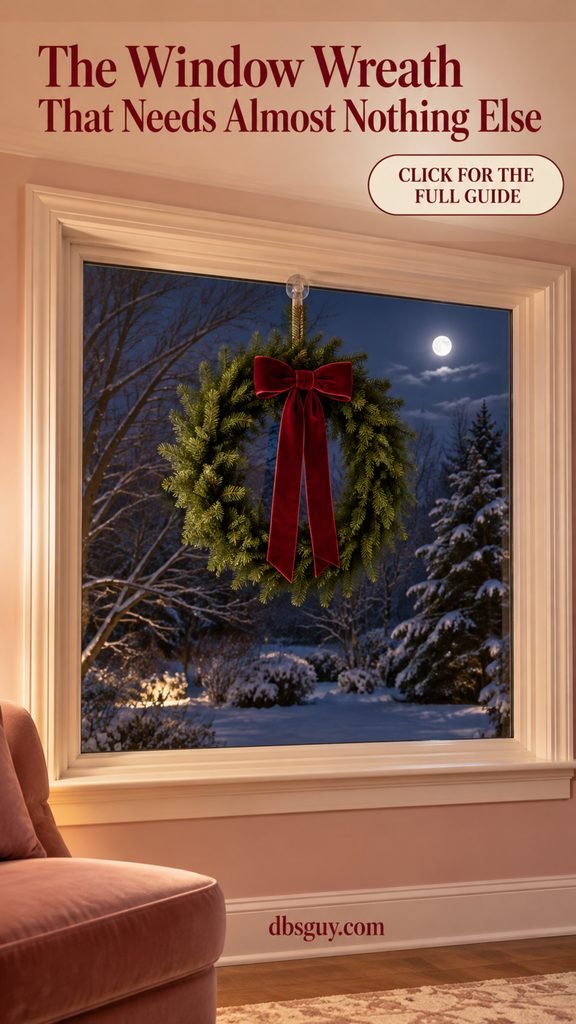
One wreath can make a window feel complete. The circle gives your eye a place to rest, while the open glass around it keeps the view part of the room.
Choose a wreath that looks balanced inside the pane rather than filling most of it. Hold it at the proposed height and look from your usual seat; a display positioned only for someone standing close to the glass may look oddly high from the sofa.
A single velvet bow can connect the wreath to a cushion, curtain, or other Christmas detail. Wine red suits warm pink walls; ivory ribbon works beautifully with a darker green room.
Use a suitable fixing on a fixed pane or frame, within its stated weight limit. Check surface compatibility and keep handles, blind movement, and any removal tab available.
Let the wreath stay unlit. A room with warm evening lighting can show the foliage and ribbon without another electrical set.
Keep the surrounding area simple: An empty sill often gives the wreath more presence than a row of competing objects underneath it.
10. Add Removable Snowflake Clings to the Glass

Snowflake clings are a useful option when you want a winter pattern without using the sill.
Choose a product intended for your glass surface and follow its application and removal instructions. Don’t assume that every sticker, vinyl decal, and static cling behaves the same way.
Arrange a few snowflakes in one lower corner or along one side of a suitable fixed pane. Vary their sizes and leave most of the glass open. You want individual shapes, not a solid white curtain.
Check the pattern after sunset. White shapes can read clearly against dark glass when the room is lit, but they still need enough contrast to be seen.
Leave handles, window seals, and moving parts free. Apply the design to clean glass according to the product’s directions, and don’t cover a window area you need for access.
For easier storage: If the clings are labeled reusable, keep their original backing and follow the storage instructions. A small set that you can use again may be more useful than a large one that never quite fits.
11. Create a Low Paper Village on a Fixed Pane

A paper village gives you the charm of little houses in a flat format. It’s a good fit for a window where there is no sensible place for a three-dimensional display.
Keep the design low, with plenty of visible glass above it. Simple rooflines and a few cutout windows are enough to suggest a town.
To make an original version:
- Sketch five small houses on plain white card, varying the roof shapes and heights.
- Cut them out on a protected work surface. Start with simple square windows rather than lots of delicate details.
- Arrange the shapes on a table until you like the spacing.
- Attach them only to a suitable fixed pane with a temporary method approved for the glass, leaving seals, handles, and opening areas clear.
Check the arrangement in the room’s usual evening light. The white card should be visible against the dark view; it doesn’t need lights placed behind or inside it.
Make it manageable: A short row in one section of the pane can be charming. You don’t need to recreate a village across every window in the house.
12. Group Bottle-Brush Trees on a Broad Sill

Bottle-brush trees give a window a little forest without a full Christmas tree base on the floor.
Choose three small trees with stable bases and slightly different heights. Sage, ivory, and dusty pink work well in a softer room; all-green trees can suit a more traditional palette.
Place the group on a broad, stable sill, well back from the edge. Leave space around it to wipe the surface and reach the window normally.
Keep the trees unlit and let existing room light catch their texture. Check that they aren’t close to a lamp, heater, or another light source that the manufacturer says to keep clear.
Avoid spreading loose glitter or imitation snow across the sill. The bristles already provide a wintry texture, and a contained group is easier to move when you need to clean.
If the sill is narrow: Use a smaller tree only when its entire base fits comfortably. Otherwise, choose one of the flat-glass ideas and keep the trees on a suitable shelf elsewhere.
13. Let One LED Lantern Anchor a Small Window

A small window can feel crowded very quickly. One lantern gives it a focal point without several separate objects to arrange.
Choose a battery-operated LED lantern intended for indoor use. A built-in LED panel or a properly designed flameless insert gives a warm glow; this display doesn’t need a burning candle.
Check the footprint, not just the lantern’s height. Its whole base should sit securely on the sill, set back from the edge, with the window and controls still accessible.
Brass or aged-metal finishes look warm against wood. A darker lantern can stand out on cream trim, while a pale one suits a softer room.
Let it stand alone. Greenery, ribbons, and a second lantern can make the arrangement harder to move without adding much to the effect.
Try it before styling anything else: If you like the lantern’s glow from your usual seat, you may already have enough Christmas atmosphere for that window.
14. Give a Bay Window Two Small Trees

A broad bay window has room for a more balanced arrangement, but it doesn’t need a decoration on every section of the ledge.
Place two small tabletop trees on suitable side areas, leaving the middle open. Similar trees or matching pots can connect the two sides even when their heights differ a little.
Use stable bases that fit fully on the ledge. Check that the trees don’t interfere with opening panes, blinds, a nearby walkway, or heating equipment.
A few copper or ivory ornaments can repeat colors from the room. Unlit trees are a simple option when you want to avoid additional cords.
If the fixed center pane can suitably hold a small purpose-made LED star, it can provide a quiet point of light above the open middle. Follow its fixing and operating instructions, keeping the cable on the fixed trim.
Make the scale work: Two compact trees can be more comfortable to live with than one large tree that occupies the entire bay. Keep the central view part of the arrangement.
15. Choose One LED Snowflake Silhouette
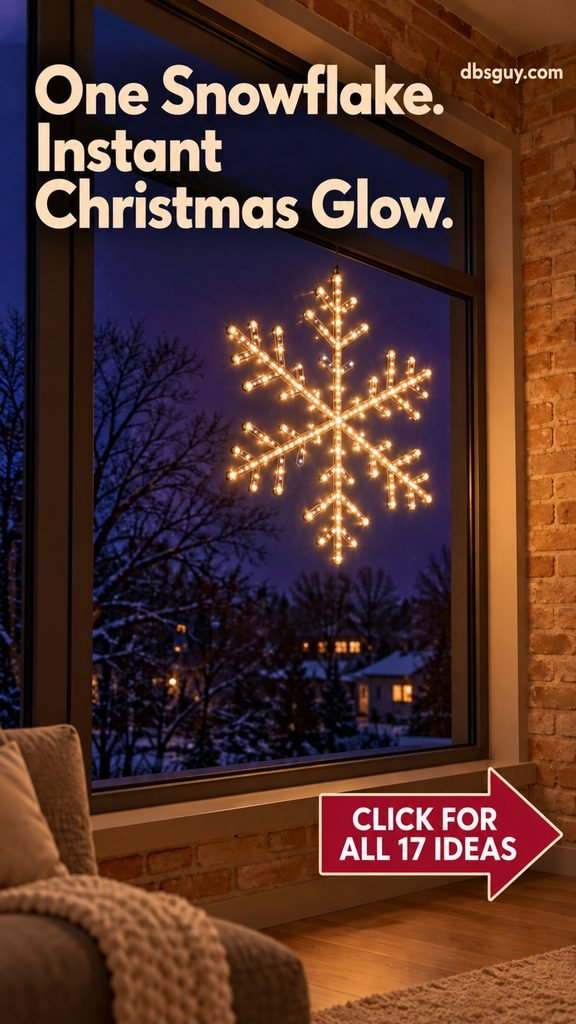
A lighted snowflake gives the window a clear seasonal shape without the styling work of a village or a group of ornaments.
Choose a complete indoor-rated lighting decoration with its recommended fixing method. Check its dimensions against the pane and leave space around the outline so its shape is easy to read.
Use a suitable fixed pane or frame, keeping nearby opening areas and the supply cable route clear. A silhouette that fits the glass but blocks a latch is still the wrong fit for that location.
Warm white can connect with wood and traditional room lighting. A cooler-looking set may suit a room that already uses cooler tones; test the actual light rather than choosing from the product photograph alone.
Keep the sill simple. The illuminated shape already has enough detail to be the main attraction.
For a group of windows: You can repeat one restrained silhouette across suitable panes for a related look. You don’t need a different character or shape in each window.
16. Draw a Simple Winter Scene with a Chalk Marker

A little window drawing can make Christmas visible where there is no space for objects. Three fir trees, a few snow dots, or a small crescent moon can be enough.
Choose a non-permanent chalk marker labeled for the specific glass surface. A permanent paint marker is a different product, so check the label before drawing. Follow any guidance for coated or treated glass, and test a discreet spot.
Edding’s window-drawing instructions provide an example of using suitable chalk markers for seasonal designs. Use the instructions for your own marker’s activation and cleanup.
Sketch a simple original motif on paper first. Draw it in one low section or along one side of a fixed pane, leaving plenty of clear glass and access to the window controls.
Use the room’s usual evening light to judge the design. White lines can look lovely against a darker view without filling the pane with a dense scene.
Keep the first attempt small: A short row of trees is easier to adjust and remove than an elaborate drawing across the whole window.
17. Make an Existing Window Seat Feel Like a Christmas Retreat

If your room already has a window seat, decorate the place where you can enjoy the view.
Swap one existing cushion cover for tartan, velvet, or a small holiday motif. Fold a throw neatly at one end, leaving most of the seat available for sitting.
A small unlit wreath on a suitable fixed pane can connect the textiles with the window. Keep moving panes and controls accessible, and don’t add lights or electrical cords to the cushions.
Use the room’s existing evening lighting. Keep the seat comfortable and the decorations easy to live around.
Check the everyday routine: can you still reach the blinds, open the nearby window, and put your feet on a clear floor? If one extra cushion or ornament makes that awkward, leave it out.
No existing seat? Choose another window idea. You don’t need to buy furniture just to make a seasonal corner.
Make the Display Work After Sunset
Decorate in daylight if that’s convenient, then check the result in your normal evening setup. Turn on the lights you actually use and sit where you usually sit.
A window that looks balanced close up may need more space between its objects when viewed across the room. A glossy ornament might catch enough light on its own. A bright light set might feel better with fewer surrounding decorations.
If you can safely and conveniently look from outside, check that view too. Use a clear shape or a small repeated group if the display needs to read from a distance. Tiny details can still be lovely for the indoor view.
Operate the curtains or blinds again after arranging the display. Keep fabric out of contact with decorative lighting, and change the setup if your normal privacy routine no longer works.
Use an accessible switch, remote, or compatible timer as directed by the product instructions. Turn decorative lights off before bed or leaving home; a lovely evening display doesn’t need to stay on all night.
Simple Combinations That Keep the Window Calm
Start with one main detail. These small combinations can help you choose a direction without filling every surface:
- Traditional and warm: One green wreath with a velvet bow, plus flameless candles only if a broad sill can comfortably hold them.
- Soft and natural: Unlit ivory paper stars against a warm room, with the sill left empty.
- Modern and simple: One illuminated metal star or snowflake, clear glass, and matching room lighting.
- Vintage and playful: A compact group of pastel bottle-brush trees on a suitable sill. Let the colors and texture be the decoration.
- Very little space: One low chalk drawing or a small set of removable clings on a suitable fixed pane.
Repeat a color from the room rather than introducing several new ones. Burgundy ribbon can connect with an existing cushion; ivory paper can echo the curtains; brass bases can pick up a nearby furniture handle.
Use What You Have Before Buying More
Look through the Christmas box for a lightweight wreath, spare baubles, small trees, or a lantern you already enjoy. Check its condition and whether it fits the proposed spot before planning a new display around it.
If you buy one new item, let it solve a specific problem: a complete lighted shape for an empty fixed pane, a lantern with a footprint that fits the sill, or suitable clips for the lights you already own.
Measure first, including room for the controls and window movement. Buying several pieces before checking those dimensions can leave you with a collection that looks lovely on a table but doesn’t work at the window.
Keep packaging that protects fragile decorations, the backing for reusable clings, and the instructions for lighting and fixings. Follow the storage directions when the season ends so the next setup is easier.
When the Window Display Doesn’t Quite Work
| What you’re noticing | A useful adjustment |
|---|---|
| The window looks crowded. | Remove one group and leave visible glass between the remaining shapes. |
| Decorations disappear after dark. | Try lighter unlit shapes in a better-lit area, or choose one suitable purpose-made lighting decoration. |
| The curtains catch on the display. | Move the decoration to a suitable fixed area or choose a smaller flat design. |
| A hook won’t hold reliably. | Check the product’s surface, temperature, weight, preparation, and waiting-time requirements. Don’t add more weight. |
| The sill display feels unstable. | Use a smaller piece whose whole base fits, or choose a hanging or flat-glass idea. |
| Different light sets look unrelated. | Test them together and keep the color and effect you prefer. You may only need one set. |
| You can’t reach the window normally. | Reduce or relocate the display until the latch, movement, and required access are clear. |
Questions About Indoor Christmas Window Decorating
What can you do if your window has no sill?
Use a small flat design on a suitable fixed pane, such as clings or a chalk drawing. A lightweight hanging ornament can also work with appropriate fixings. Keep handles, moving parts, and any access route clear.
Can you decorate a window that has blinds?
Yes, if the decoration leaves the blinds free to operate. Check the full movement before and after styling. Don’t attach lights to moving blind slats or put hanging ribbons where the blind cords travel.
How do you make a Christmas window look good from the street?
Choose a clear shape or a small related group, then check it from the actual viewing distance. A star, a wreath, or evenly spaced flameless candles can be easier to recognize than many tiny details. Keep the indoor view comfortable too.
Can Christmas window lights stay on overnight?
Switch decorative lights off before bed and when you leave home. Follow the product’s instructions, and use an accessible control so turning them off is part of the normal evening routine.
Do all Christmas window decorations need their own lights?
No. Paper stars, ornaments, wreaths, and white drawings can catch existing room light. If that window area is too dim for the look you want, choose a better-lit location or one suitable complete lighting product.
A Christmas window doesn’t need to compete with the tree or fill the whole room with light. Choose a detail that fits, leave the view open, and enjoy it in the part of the evening when you’re actually home. Sometimes one warm glow against the dark glass is all it takes to make an ordinary December night feel a little more welcoming.