TV Got Turned Sideways—25 Things That Explain Why America Is Hooked On Two-Minute “Microdramas”


The heroine discovers her husband is cheating. The elevator doors open. A billionaire walks in. Someone whispers that she is secretly the heiress. Cut to black. You have been watching for 73 seconds.
Traditional television spent decades learning how to keep you around until the commercial break.
Microdramas are trying to keep you around until the next thumb movement.
The format looks almost absurd the first time you see it. The video is vertical. The acting is big. The plot arrives with the subtlety of a fire alarm. Episodes can be shorter than the time it takes to microwave leftovers, yet one “season” can run for dozens of installments.
And people are watching.
Recent U.S. audience estimates cited by Reuters put monthly microdrama viewers at roughly 66 million, up from about 26 million the year before. The core American audience is not simply teenagers killing time between TikToks; women ages 25 to 55 make up a major part of the market. Meanwhile, Omdia analysis of U.S. mobile usage found ReelShort users spending about 35.7 minutes per day in the app—more mobile time per user than Netflix, Prime Video or Disney+ in the same comparison, although those traditional streamers still have much larger overall audiences. Reuters; IBC/Omdia.
The money is real too. Sensor Tower estimates short-drama apps generated roughly $750 million in global in-app purchase revenue in one recent quarter, with DramaBox and ReelShort each near $140 million. The United States remains one of the category’s most important revenue markets. Sensor Tower.
So what exactly happened?
Did America suddenly decide that prestige television was too patient?
Did soap operas get trapped inside TikTok?
Did mobile games discover casting directors?
A little of all three.
Microdramas are not simply “normal shows, but shorter.” Their structure, photography, writing, advertising, payment systems and production schedules are built around the fact that the viewer is holding the screen in one hand and can leave with one swipe.
The result is an entertainment format with a very specific survival strategy:
something has to happen right now.
What counts as a microdrama? There is no single universal definition, but the U.S. performers union SAG-AFTRA describes vertical programs as serialized dramatic content made for 9:16 mobile viewing, typically with chapters around three minutes or less. Reuters reports many commercial microdrama episodes running roughly 45 seconds to two minutes. A complete story may still total an hour or more once dozens of chapters are added together. SAG-AFTRA.
Here are 25 things that explain why this strange little format is becoming a serious part of American entertainment.
Part I — The Format Is Built For The Phone, Not Squeezed Onto It
1. The Screen Is Vertical Because You Are Already Holding It That Way
Traditional film and television assume a horizontal frame.
Microdrama assumes the viewer is standing in a grocery line.
The 9:16 portrait frame is not an afterthought. It changes blocking, composition and even what kinds of scenes read well.
Two faces can fill almost the entire phone. A threatening boss can loom over the heroine without needing an expensive office wide shot. A slap, a kiss, a shocked reaction or a hand revealing a ring can occupy the whole screen.
The format removes one tiny piece of friction too: you do not have to rotate the phone.
That sounds laughably minor until you remember how much modern app design is built around eliminating exactly that kind of friction.
SAG-AFTRA’s dedicated Verticals Agreement formally defines the format around portrait-mode 9:16 viewing, which is a sign that vertical drama is no longer just a social-media improvisation. It has become a recognized production category. SAG-AFTRA.
Why it works: the content matches the way the device is naturally held.
What changes creatively: faces, hands and reactions matter more than wide spectacle.
Bigger lesson: microdramas are phone-native, not television episodes awkwardly cropped for phones.

2. An Episode Can Be Shorter Than A Coffee Order
Reuters reports commercial microdrama episodes often run about 45 seconds to two minutes. Deloitte describes many micro-series as roughly 60–90 seconds per episode. SAG-AFTRA’s contract framework generally treats vertical chapters as approximately three minutes or less. Deloitte.
That tiny runtime does something psychologically useful:
The next episode feels cheap.
Not financially cheap—attention cheap.
Twenty seconds into a traditional 50-minute drama, you may think, Do I really want to start this tonight?
Twenty seconds before a microdrama ends, you think, Fine. One more minute.
That difference matters because viewers do not commit to the whole season at once.
They repeatedly commit to one tiny extension.
It is the entertainment version of eating chips directly from the bag. Nobody announces, “I will now consume 47 chips.”
One simply keeps becoming the next one.
Why it works: each decision to continue feels very small.
The irony: tiny installments can still add up to a long session.
Viewer reality: “short-form” describes the chapter, not necessarily the binge.

3. The Story Often Starts Where Normal TV Would Spend 20 Minutes Arriving
There is no leisurely establishing shot of the city.
No breakfast scene whose main purpose is proving the characters own cereal.
No slow walk through the office while somebody explains the company.
Microdramas frequently start inside conflict.
Reuters quoted Inkitt CandyJar production executive Lily Darragh Harty explaining that viewers are dropped directly into the middle of the story because there is simply no time for lengthy setup.
So the opening may be:
“Sign the divorce papers.”
“That baby is mine.”
“You married the wrong brother.”
“Why is the janitor wearing the CEO’s ring?”
Elegant?
Not always.
Efficient?
Extremely.
The viewer instantly knows there is a problem, and problems create questions faster than exposition does.
Why it works: conflict arrives before context.
What gets sacrificed: slow world-building and subtle setup.
What replaces it: instantly legible emotional stakes.

4. Every Episode Wants To End Half A Second Before The Answer
The cliffhanger is much older than the smartphone.
Serialized novels used it.
Radio used it.
Soap operas perfected it.
Microdramas simply increased the dosage.
When an episode lasts around a minute, a show cannot afford to save its major cliffhanger for Friday night.
It needs one now.
The door opens—cut.
The pregnancy test is revealed—cut.
The billionaire says, “There’s something I never told you”—cut.
The villain raises a glass and says, “To your real mother”—cut.
SAG-AFTRA’s own description of vertical programming explicitly notes that these short chapters use cliffhangers to encourage viewers to swipe to the next installment.
That does not mean viewers are helpless victims of cliffhangers.
It means the format has taken one of storytelling’s oldest continuation devices and placed it roughly every 60–120 seconds.
Why it works: unanswered questions create immediate continuation pressure.
What is new: the frequency, not the existence, of the cliffhanger.
Editorial rule: microdrama writers often need a fresh “why would I keep watching?” answer every chapter.

5. Fifty Tiny Episodes Can Secretly Be A Feature-Length Story
This is the format’s funniest trick.
The episode is tiny.
The season is not.
Reuters reports a typical CandyJar microdrama may span about 50 to 75 episodes. SAG-AFTRA’s labor agreement describes vertical projects as commonly totaling roughly 60 to 90 minutes in aggregate, even though each chapter is only a few minutes or less.
So the viewer who says “I don’t have time to watch a movie” can, in theory, consume a movie’s worth of melodrama in tiny bites while insisting the entire time that they are only watching one more.
Fox and Holywater demonstrated just how elastic the format can be when they re-edited a season of the reality series Farmer Wants a Wife into 101 vertical chapters averaging under two minutes each. Holywater Tech.
Short form did not eliminate long viewing.
It changed how the long viewing is packaged.
Why it works: a long story is broken into dozens of low-commitment decisions.
The paradox: shorter episodes can create very long sessions.
Best summary: the episodes got shorter; the binge did not.

Part II — The Stories Use Familiar Tropes As Compression Technology
6. Tropes Do The World-Building Before The Episode Starts
Microdramas love tropes for the same reason road signs love symbols.
Recognition is fast.
Say “secret billionaire” and the viewer already understands money, status and hidden identity.
Say “contract marriage” and the viewer understands the relationship began for practical reasons and will almost certainly become emotionally inconvenient.
Say “rejected mate” inside a werewolf romance and an entire hierarchy of loyalty, humiliation and future revenge arrives preloaded.
Sensor Tower describes romance, revenge, fantasy, family conflict and status reversal as core short-drama genres. Independent catalog analyses repeatedly surface billionaire romance, hidden identity, revenge, rebirth and werewolf stories among heavily searched or heavily stocked categories. Sensor Tower.
This is not necessarily evidence that microdrama audiences dislike originality.
It is evidence that a 90-second chapter benefits from premises that are understood before the first line of dialogue finishes.
Why it works: familiar premises carry preloaded meaning.
What tropes save: exposition time.
What good writers still need: a fresh emotional variation inside the recognizable structure.

7. The Billionaire Is Not Subtle—He Is Efficient
The billionaire CEO is to microdrama what the castle was to fairy tales.
One image communicates the power structure.
Private elevator.
Glass office.
Expensive suit.
Everyone is afraid of him.
Except, naturally, the woman who accidentally spills coffee on him in episode one.
The trope works because wealth creates immediate stakes without needing much explanation. He can buy the company. Save the family. Ruin the ex. Hide his identity. Secretly own the hotel. Secretly own the hospital. Secretly own, one suspects, the narrative itself.
Fox’s own vertical slate has leaned into instantly readable titles such as Billionaire Blackmail, while current short-drama catalogs heavily feature CEO and billionaire-romance categories. Fox Corporation.
Why it works: wealth creates instant status conflict.
Why phones help: a face, a suit and one luxury office can communicate the entire setup.
The joke: nobody in microdrama appears to have met a financially average man.

8. Contract Marriages Start The Relationship Before The Romance Has Time To
A normal romance may need several episodes to arrange the first date.
A contract marriage can put two people legally together before either one particularly likes the other.
That is useful in a format obsessed with speed.
The trope creates forced proximity, a secret arrangement, a ticking deadline and obvious emotional irony:
They are pretending to be together.
Therefore they will almost certainly become actually together.
The audience knows this.
The pleasure is not discovering whether the structure exists.
The pleasure is watching exactly how badly the characters underestimate it.
In microdrama, the familiar trope becomes a compressed story engine capable of producing dozens of tiny reversals: fake kiss, jealous ex, family dinner, one-bed hotel room, contract deadline, accidental confession.
Why it works: it forces the romantic leads into immediate contact.
Built-in fuel: secrecy, deadlines and fake intimacy.
Why it survives repetition: viewers know the destination but watch for the route.

9. Revenge Stories Deliver Satisfaction In Tiny Installments
Someone is humiliated.
Then the audience waits for the correction.
That structure is almost perfect for microdrama.
A betrayed wife returns successful.
The dismissed employee turns out to own the company.
The “poor” woman arrives at the gala as the real heiress.
The family that rejected someone discovers, one tiny episode at a time, that it made a spectacular administrative error.
Revenge and status-reversal stories generate frequent mini-payoffs. One villain can be embarrassed now while the larger secret stays hidden for twenty more chapters.
That makes them unusually compatible with short serials because the viewer does not have to wait until a two-hour finale for emotional compensation.
The story can pay a little interest every minute.
Why it works: humiliation creates an immediate desire for reversal.
Why it serializes well: revenge can be delivered in escalating stages.
Emotional engine: “they will regret this” is a very durable continuation hook.

10. Werewolves, Rebirth And Secret Identities Arrive With Their Own Rulebooks
Fantasy sounds harder to compress than office romance.
Microdramas solve that by choosing fantasy tropes whose rules audiences already know.
Werewolf pack.
Fated mate.
Hidden alpha.
Rebirth with memories intact.
Time travel.
Secret royal bloodline.
The viewer does not need a ten-minute lecture on magical governance.
The premise itself carries expectations.
Recent research on rebirth microdramas describes how the format compresses exposition, conflict, reversal and reward into short episodes, with frequent cliffhangers repeatedly renewing the emotional contrast between humiliation and comeback. Frontiers in Psychology.
In other words, fantasy becomes less about constructing a giant world and more about borrowing a rulebook the audience can recognize immediately.
Why it works: recognizable fantasy rules reduce explanation time.
Why rebirth is powerful: the protagonist knows what went wrong the first time.
What the format loves: secrets that can be revealed one episode at a time.

Part III — The Production Model Is Built For Speed
11. Close-Ups Are Not Just A Style Choice—They Are Screen Real Estate
A cinema screen can comfortably show six people sitting across a ballroom.
A phone cannot.
Microdramas frequently favor tight faces, shoulders, hands and reaction shots because those details remain legible on a small vertical display.
This also explains why the acting can feel larger than prestige television.
A tiny eyebrow twitch may be beautiful on a 65-inch television.
A shocked face that fills the whole phone is harder to miss while someone is watching on a bus.
That does not mean every vertical actor performs the same way. It means the medium rewards emotional readability.
Subtlety still exists.
It just has less room to hide.
Why it works: faces stay legible on small screens.
Production advantage: intimate framing can make modest locations feel larger.
Creative tradeoff: visual spectacle matters less than readable emotion.

12. A Whole Season Can Cost Less Than One Traditional TV Episode
The economics help explain why producers are interested.
Reuters reports CandyJar series typically cost roughly $100,000 to $300,000 for about 50 to 75 episodes, compared with millions of dollars for a typical half-hour sitcom episode.
That comparison is not perfectly apples-to-apples; production value, union structures, episode length, star salaries and distribution models differ dramatically.
But the scale difference is enormous.
SAG-AFTRA’s independent Verticals Agreement is itself designed for U.S.-shot projects with budgets up to $300,000, reflecting the size of many productions in this emerging tier. SAG-AFTRA contract bulletin.
Lower production cost means a platform can test far more premises.
The one that catches fire can pay for many that do not.
Why producers care: lower budgets make high-volume experimentation possible.
Important caveat: cheaper production is not automatically better labor practice or better storytelling.
Industry significance: verticals have become large enough to get their own union agreement.

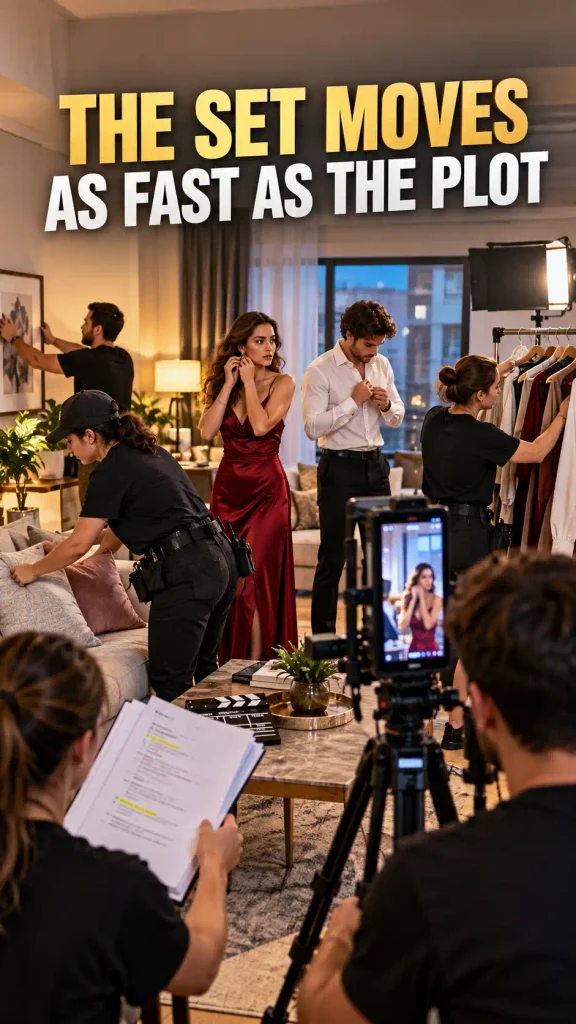
13. The Shoot Moves Fast Because The Release Machine Is Hungry
A traditional series may spend years moving from development to release.
Microdrama production is built around velocity.
Reuters reports CandyJar can move a series through production in roughly three months from the broader production process, while specialized vertical producers describe shoots that can capture dozens of chapters in a matter of days.
That affects writing.
Locations are reused.
Scenes are efficient.
Costumes have to communicate status quickly.
Dialogue carries exposition that a bigger production might communicate through a long visual sequence.
The model resembles a content factory only if “factory” is used descriptively rather than dismissively: frequent releases are central to keeping a mobile audience returning.
Sensor Tower specifically identifies frequent content drops as one of the strategies leading short-drama platforms use to retain and monetize viewers.
Why it works commercially: new stories keep the app from going quiet.
Creative pressure: scripts must be shootable quickly and read instantly.
Tradeoff: speed can create opportunity, but it can also expose weak production processes if labor protections are ignored.
14. Social-Media Ads Are Often Episode Zero
Many viewers do not decide, “Tonight I will explore a new vertical-drama platform.”
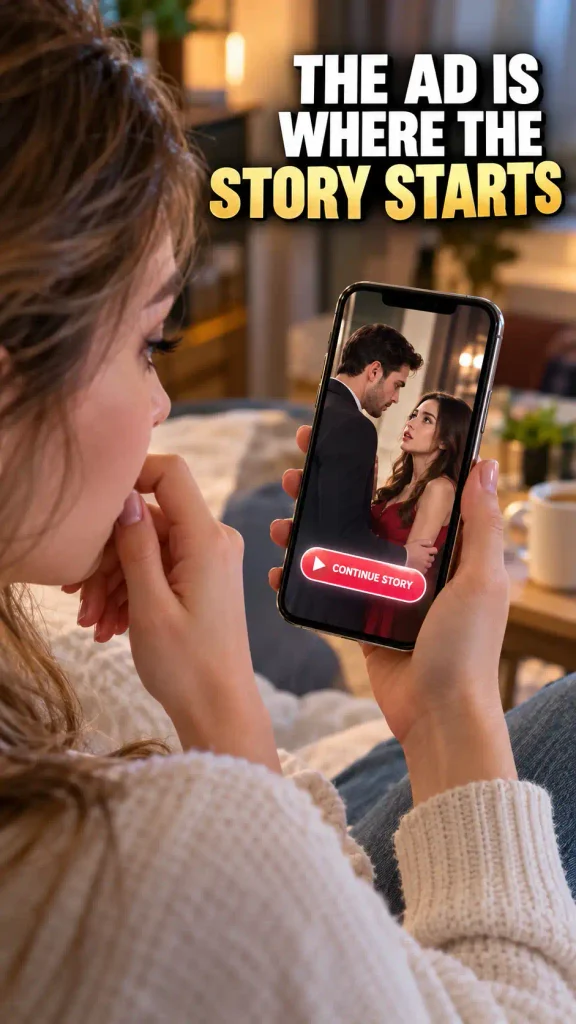
The drama finds them first.
A clip appears between ordinary social posts.
The wife catches the husband.
The CEO insults the wrong woman.
The rejected mate returns transformed.
The clip ends before the payoff.
Now the viewer needs the app.
Sensor Tower found paid acquisition has been central to the category’s growth, with Facebook and TikTok important advertising networks for major short-drama platforms. TikTok itself now supports micro-series discovery and monetization directly, including paid episode unlocks and ad-supported viewing. TikTok for Business.
In other words, the ad is not merely advertising the story.
It is part of the story’s first hook.
Why it works: viewers encounter narrative before they encounter the brand.
Discovery loop: dramatic clip → unresolved question → app/install → continuation.
Marketing lesson: the strongest ad behaves like entertainment, not a trailer explaining entertainment.
15. Viewer Data Can Shape What Gets Made Next
Traditional TV gets ratings after episodes air.
Mobile platforms can observe much more granular behavior.
Did viewers leave at episode four?
Did they pay at episode eleven?
Which ad creative produced installs?
Which trope converted?
Which country responded to which version?
Sensor Tower describes localized creatives, frequent drops, paid acquisition and market-specific execution as central competitive strategies in the short-drama business. Deloitte likewise notes that micro-series can be produced and refined quickly using audience interaction and data.
This does not mean an algorithm literally writes every successful story.
It means the feedback loop between audience behavior and commissioning can be much shorter than in traditional television.
The audience does not just watch the machine.
Its behavior helps teach the machine what to make more of.
Why it matters: digital platforms see where attention and spending change in real time.
Potential upside: fast learning and niche targeting.
Potential downside: successful formulas can become self-reinforcing until every hallway contains a billionaire.

Part IV — The Business Model Turns Cliffhangers Into Checkout Decisions
16. The First Episodes Are Often Free Because The Story Has To Earn The Paywall
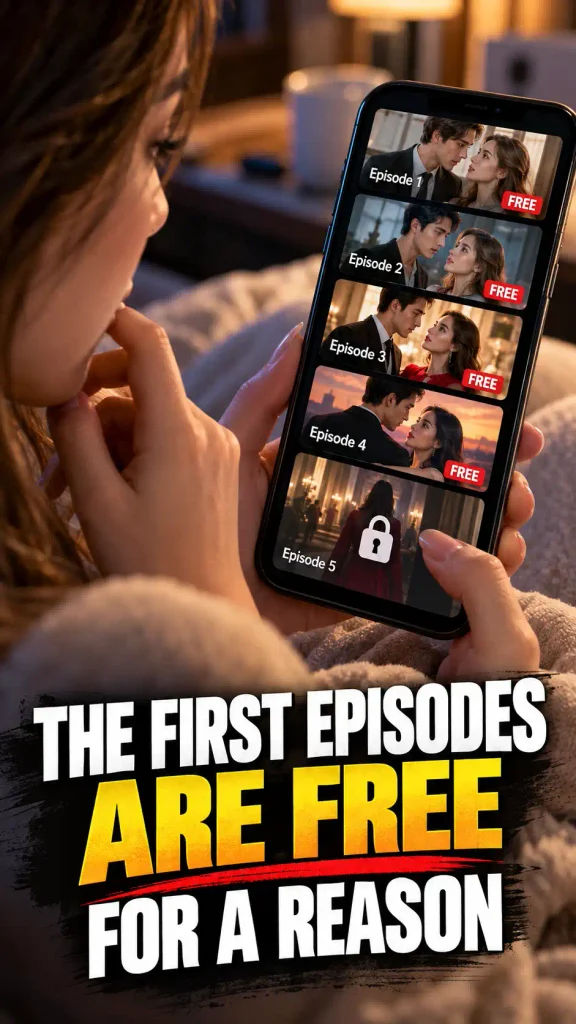
SAG-AFTRA’s own contract bulletin gives an unusually plain description of the business model: the first few chapters are typically available free on social platforms, while later chapters may be purchased in an app.
That structure makes sense.
The viewer is not being asked to buy an unknown story.
They are being asked to continue a story they have already started.
By the time the lock appears, the heroine may be standing outside the wedding, the CEO may finally know the baby is his, and somebody’s grandmother may be holding DNA results.
The emotional investment comes first.
The purchase decision comes second.
TikTok’s own micro-series product similarly supports paid unlocks and ad-supported ways to open further episodes.
Why it works: free chapters reduce the risk of trying a story.
Where the pressure appears: the paywall tends to matter most once a question is unresolved.
Viewer tip: before committing, check how the specific app charges for the rest of the series.
17. Virtual Coins Make The Price Feel Smaller Than The Story
Many short-drama apps use virtual currencies to unlock episodes.
This is familiar to anyone who has played mobile games.
Instead of asking whether episode 18 is worth a particular dollar amount, the interface may ask whether it is worth a particular number of coins.
The abstraction can make quick comparisons harder because the viewer has to convert:
dollars → coin pack → episode cost → number of episodes remaining.
Sensor Tower’s revenue numbers demonstrate how effective in-app purchasing can be at scale.
The practical reader lesson is less glamorous:
Do the conversion.
Before buying a large coin bundle, estimate what completing the specific series would cost under the current pricing system.
A 90-second episode can be cheap.
Seventy individually unlocked episodes can become a very different number.
Why platforms use it: virtual currency creates a flexible microtransaction system.
Viewer tip: translate coins back into real money before judging value.
Important: pricing models and coin costs change, so do not rely on old screenshots or third-party totals.

18. Ads Can Become A Second Currency
Money is not the only thing a viewer can trade.
Attention works too.
Some micro-series systems allow users to watch advertisements in exchange for additional access or rewards. TikTok explicitly supports ad viewing as one way to unlock further micro-series episodes.
This creates a familiar mobile-game equation:
Pay with money.
Or pay with time.
For viewers who do not want another subscription, rewarded ads can make a story accessible without direct payment.
For impatient viewers, the repeated interruptions can become the exact reason to pay.
Either way, the cliffhanger keeps doing economic work.
The model: ad attention can substitute for some direct payment.
The tradeoff: free viewing may require repeated interruptions.
Viewer tip: decide whether you prefer spending money, spending ad-time, or stopping the series—those are all legitimate choices.

19. A Subscription Badge Does Not Automatically Mean “Everything Is Unlocked”
Microdrama apps do not all use the same monetization model.
Some emphasize coins.
Some emphasize subscriptions.
Some mix subscriptions, coins, daily rewards and ads.
Benefits can differ by app, region and offer.
That creates a simple but valuable rule:
Read the purchase screen.
Do not assume a badge labeled “VIP,” “premium” or “subscription” necessarily means the same thing as an all-you-can-watch Netflix-style library unless the terms explicitly say so.
This is not unique to microdramas. Digital subscriptions increasingly bundle different combinations of access, discounts, currency and perks.
But the rapid cliffhanger cadence makes misunderstanding the offer particularly annoying because the viewer can encounter locked chapters again and again.
Viewer rule: check exactly what the purchase unlocks before subscribing.
Look for: all-access language, coin allowances, auto-renewal, ad benefits and cancellation terms.
Do not assume: every “premium” plan works like a traditional streaming subscription.

20. Tiny Episodes Have Become A Very Large Business
The format would be easy to dismiss as novelty if the economics were still tiny.
They are not.
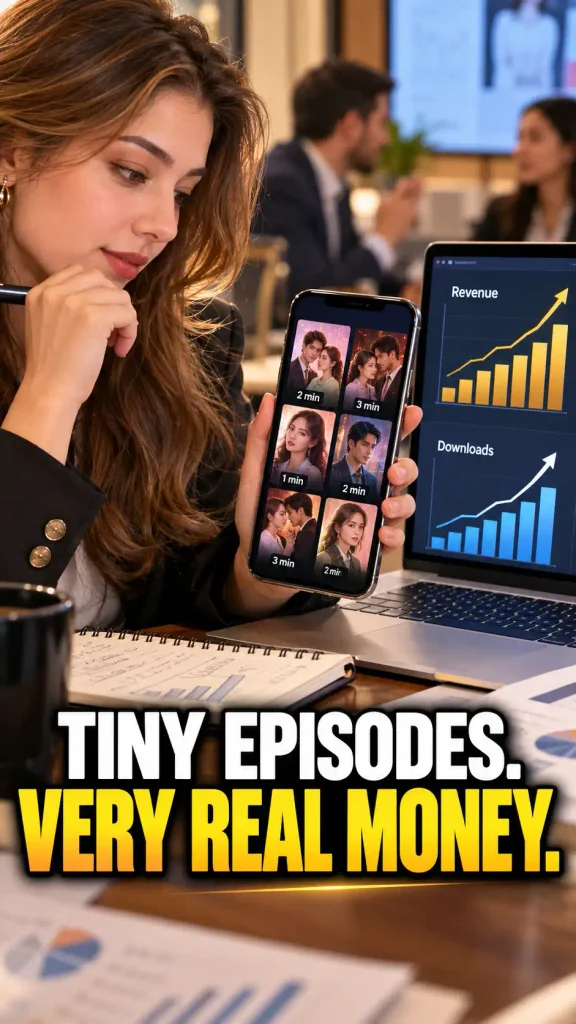
Sensor Tower estimates short-drama apps passed 850 million global downloads in one recent quarter and generated about $750 million in quarterly in-app purchase revenue. DramaBox and ReelShort each approached $140 million for that quarter.
Deloitte has projected continued rapid growth for the broader micro-series market and identified the United States as a major revenue center.
Reuters also reports Inkitt’s CandyJar was on track for more than $100 million in annual sales.
None of these figures means every microdrama company is profitable.
Downloads are not profits.
Revenue is not profit.
User acquisition can be expensive.
But they do prove one thing:
vertical drama is far past the stage where the appropriate industry response is laughter.
What the numbers prove: substantial consumer spending and audience scale exist.
What they do not prove: that every app, series or business model is profitable or sustainable.
Why Hollywood noticed: attention that converts into purchases gets taken seriously.
Part V — Hollywood Is No Longer Watching From The Sidelines
21. The Core U.S. Audience Is Older Than The Stereotype
Say “vertical video” and many people picture teenagers.
The microdrama audience complicates that assumption.
Omdia data cited by Reuters says women ages 25 to 55 form the core U.S. audience.
Deloitte’s U.S. survey found around 30% of Gen Z and millennials were already familiar with micro-series, and among those familiar viewers, nearly half said they were watching more than a year earlier.
Both things can be true.
Younger viewers can help normalize phone-first storytelling while adult romance audiences become its commercial center.
That also explains the dominance of relationship melodrama.
This is not necessarily TikTok trying to become HBO.
It may be the daytime soap, romance novel and mobile app discovering they have been looking for each other.
What surprises people: the U.S. core is not exclusively Gen Z.
Why romance matters: adult female audiences are commercially central to major platforms.
Broader implication: phone-first viewing is a format behavior, not an age bracket.

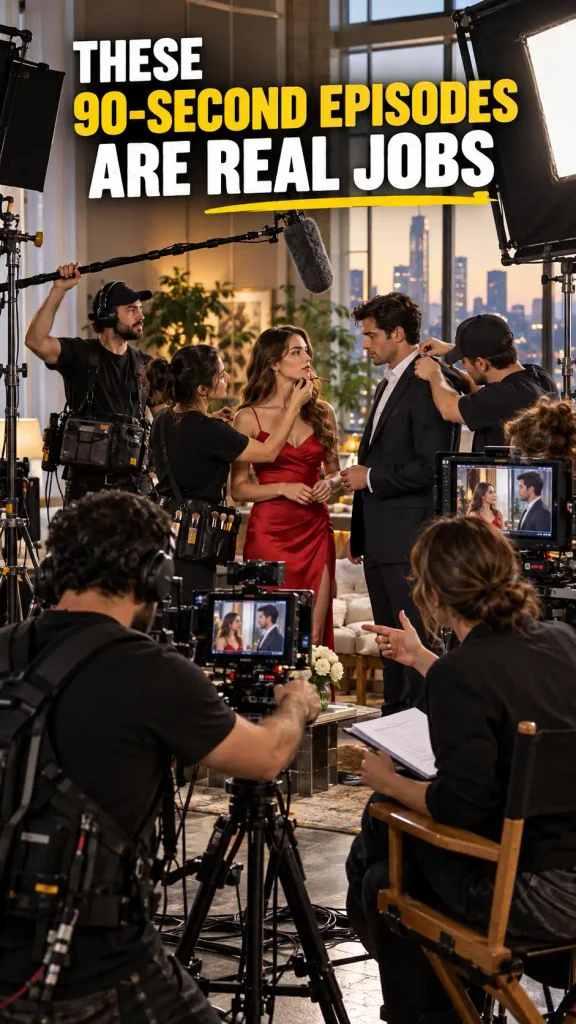
22. Vertical Dramas Are Creating Real Acting Jobs—And Real Labor Questions
One reason the boom matters in Los Angeles is painfully practical.
People work on these shows.
Actors.
Directors.
Writers.
Camera crews.
Hair and makeup.
Production staff.
Reuters described microdramas as a bright spot for employment during a period when traditional Hollywood production has been under pressure.
SAG-AFTRA’s dedicated agreement shows the labor system catching up. The independent Verticals Agreement covers U.S.-shot projects up to $300,000 and includes day rates, pension and health contributions, overtime provisions, stunt protections, intimacy-coordinator requirements in relevant scenes, and protections around artificial intelligence.
That is important because “new format” should not be shorthand for “old workplace protections no longer apply.”
Why it matters beyond viewers: a new production category creates jobs and bargaining questions.
Union signal: verticals are significant enough to have dedicated terms.
Key principle: faster/cheaper production still requires safe professional working conditions.
23. Peacock And Fox Have Already Decided This Is Worth Testing
The clearest signal that vertical drama moved beyond outsider apps is that major U.S. media companies started making it themselves.
NBCUniversal launched Peacock’s first original vertical microdrama and framed vertical video as a way to give users reasons to open the app more frequently. NBCUniversal.
Fox went further.
It took an equity stake in Holywater and committed Fox Entertainment Studios to more than 200 vertical video titles over two years. Fox and Holywater later announced a multi-year deal with Dhar Mann Studios for an initial slate of 40 narrative vertical titles. Fox; Holywater.
Traditional media companies do not need microdramas to replace television for the experiment to matter.
They only need the format to capture a slice of mobile attention they currently lose elsewhere.
Why this is validation: major studios are investing production resources, not merely commenting on the trend.
What they want: more mobile engagement and new viewing occasions.
What remains unknown: how much vertical content traditional streaming audiences ultimately want.

24. AI Can Make Microdramas Even Faster—Which Is Exactly Why The Debate Matters
Microdramas already reward speed and volume.
Generative AI can push both further.
Reuters reports AI-powered microdramas are being produced for some platforms, reducing costs and turnaround time. Holywater also operates in AI-assisted vertical content and has invested in AI/VFX capabilities.
That creates obvious business appeal:
more worlds, more languages, more testing, lower production barriers.
It also creates obvious creative and labor questions:
Who was trained on?
Whose face or voice is being replicated?
Was consent obtained?
Are human performers being replaced?
SAG-AFTRA’s current agreements explicitly include AI protections for vertical performers, and the union’s broader framework emphasizes consent, compensation and control over digital replicas. SAG-AFTRA AI resources.
The right question is not simply “Can AI make this cheaper?”
It is “What is the creative and labor deal when it does?”
Why AI fits the format: microdramas reward rapid, high-volume content production.
Why caution matters: likeness, voice, training data and job displacement are not abstract questions for performers.
Useful standard: efficiency should not erase consent or compensation.

25. Microdramas Probably Do Not Need To Kill TV To Change It
New media formats are routinely introduced as assassins.
Streaming killed television.
TikTok killed movies.
Podcasts killed radio.
Vertical video will kill prestige drama.
Reality is usually less cinematic.
Formats coexist.
They borrow from one another.
They steal certain viewing occasions while leaving others intact.
Omdia’s mobile engagement data is a perfect example. ReelShort users can spend more daily time in the app than mobile users of major streamers, while Netflix still has a much larger U.S. mobile audience. Both facts matter.
A person may watch a 90-second romance episode in an elevator and a two-hour film that evening.
Those experiences are competing for attention, but they are not identical products.
The bigger change may be structural:
Hollywood is learning that “episode length,” “screen orientation,” “payment model” and even “where the trailer ends and the show begins” are no longer fixed rules.
Television did not simply get shorter.
It got modular.
And sometimes, yes, it got turned sideways.
The likely future: coexistence, borrowing and hybrid formats—not one universal replacement.
What microdramas have already proven: serialized fiction can work natively inside mobile-feed behavior.
The question now: which parts of this model will traditional entertainment adopt permanently?

Microdramas look ridiculous if you judge them by the rules of prestige television.
The acting can be louder.
The premises can be shamelessly familiar.
The cliffhangers arrive with suspicious punctuality.
The billionaire population is wildly disproportionate.
But judging the format only by what it lacks misses what it has been engineered to do.
It starts immediately.
It reads clearly on a six-inch screen.
It gives the viewer a new emotional question every minute.
It travels through social feeds.
It can be produced quickly.
It can be monetized one tiny decision at a time.
And it fits into pockets of time traditional television never really owned.
The most revealing part of the microdrama boom may not be that Americans suddenly prefer two-minute television.
It may be that once entertainment moved fully onto the phone, somebody finally stopped treating the phone like a miniature television.
They designed the story around the device instead.
Then they ended the episode one second before the answer.
Would you actually watch a 70-episode story if every episode were only 90 seconds—or would the cliffhangers drive you insane?
Sources & Further Reading
- Reuters — Microdramas Boom in a Shrinking Hollywood
- IBC / Omdia — U.S. Mobile Engagement for Microdramas vs. Streamers
- Sensor Tower — State of Short Drama Apps
- Sensor Tower — U.S. Revenue, Ads and Audience Overlap
- Deloitte — Short-Form Video Series and U.S. Consumer Familiarity
- SAG-AFTRA — Verticals Agreement Contract Bulletin
- SAG-AFTRA — Verticals Agreement
- SAG-AFTRA — 2026 TV/Theatrical Contracts and Vertical/AI Protections
- NBCUniversal — Peacock’s Original Vertical Microdrama Strategy
- Fox Corporation — Investment in Holywater and 200+ Vertical Titles
- Holywater Tech — Fox/Dhar Mann 40-Title Vertical Deal
- Holywater Tech — 101-Episode Vertical Adaptation of a Fox Reality Series
- TikTok for Business — Micro-Series Discovery, Paid Unlocks and Ad-Supported Access
- Frontiers in Psychology — Narrative Compression and Rebirth Microdramas
- SAG-AFTRA — Artificial Intelligence, Consent and Performer Protections