25 November Nail Ideas That Give Classic French Tips an Unexpected Fall Twist

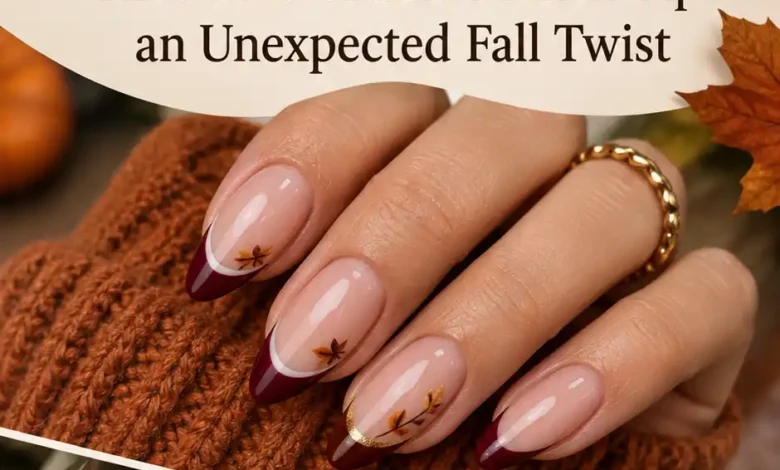
A familiar curve, a fall palette, and a few details you might not see coming.
The most interesting part of a fall French manicure is often the last few millimeters. A little olive and mustard, a fine row of stitches, or a smoky stone pattern can change the whole set. You still get the tidy outline you love, with something new waiting at the edge.
These 25 November nail ideas explore that possibility through color, shape, pattern, and finish. Some are soft enough to disappear into your everyday wardrobe; others have a detail you will want to show someone up close. Every design includes a visual reference, a practical adjustment to consider, and a short salon note to make the idea easier to explain.
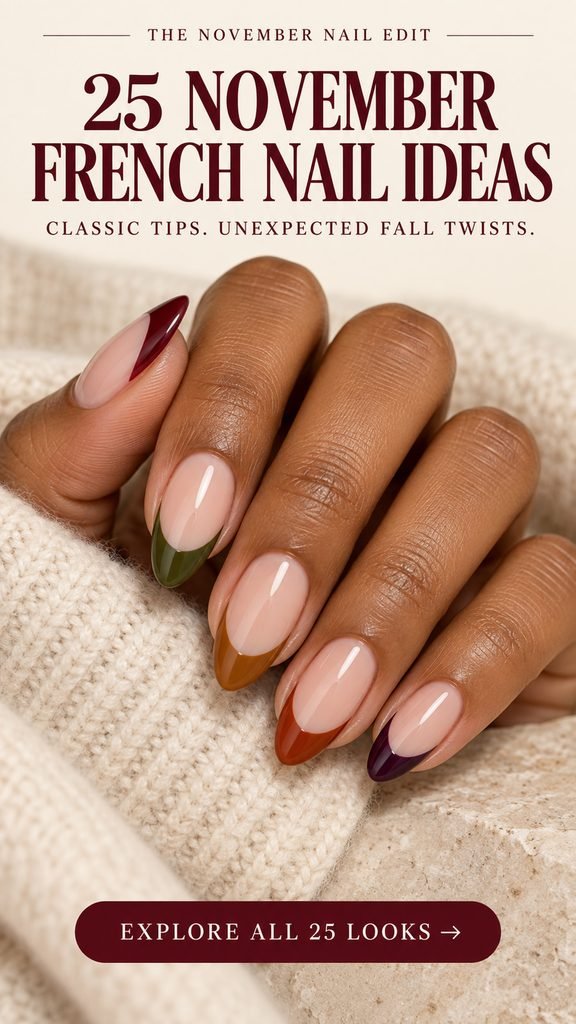
Decide How Much Tip You Want to See
The curved border between the base and the tip is called the smile line. Essie’s French manicure guide shows how changing its curve and depth creates different versions, including a very fine edge or an angled shape. Applying that principle here, choose the space for your design before choosing how many details to fit inside it.
A thin border gives color a small role. A deeper tip leaves room for checks, little stars, or layered effects. Look at the proportions on your own nail length: if the pattern needs more space than you want to give it, reduce the pattern to one accent or simplify its repeats. The nude or sheer area is part of the composition, too.
Also decide whether you want a smooth surface or a visible texture. Painted motifs, translucent color, pearls, and raised ribs can create very different versions of a French manicure. The notes below point out those choices so you can save the idea you like and make its finish a deliberate part of the conversation.November French nail idea 01 / 25
1. Mulberry Jelly French Tips
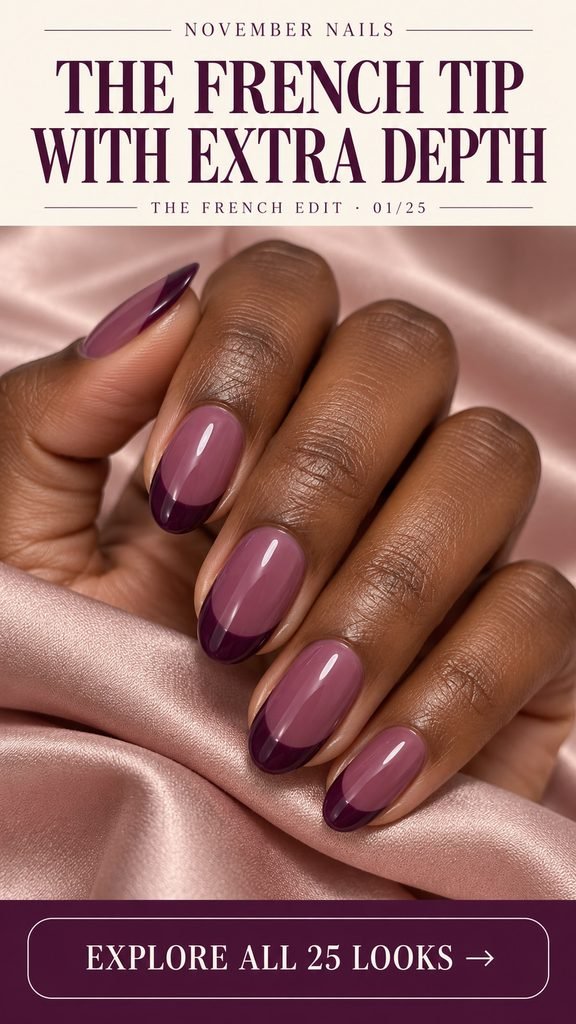
Mulberry gives a French manicure a little depth before you even reach the tips. A tinted base lets the darker plum edge feel like part of the same color story, and the glossy finish carries the two together. It is a lovely option when you want a richer manicure with a clearly defined French shape.
Choose the base and tip as a pair. The base needs enough transparency or lightness for the darker edge to stand out. If both swatches look equally dense, the French can disappear at a glance. On a shorter nail, a shallow plum curve leaves more of that softly tinted base in view.
Salon note: A mulberry-tinted jelly base with deeper opaque plum French tips. Check the contrast on a sample nail and leave the base visibly lighter.November French nail idea 02 / 25
2. Olive-and-Mustard Split French
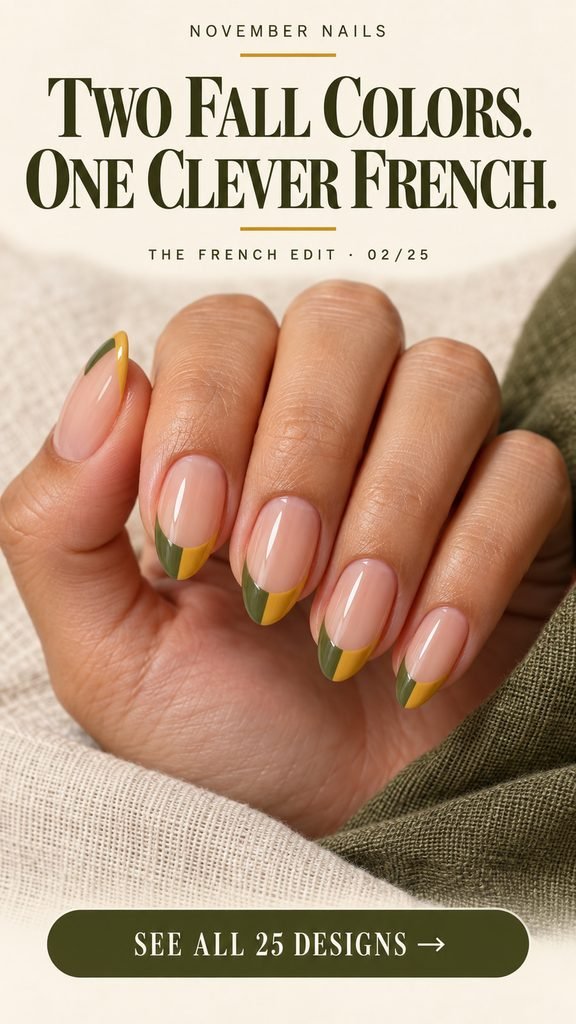
Olive and mustard look especially good when each gets a clear little section of the tip. The straight division adds a graphic detail inside the familiar curved French shape. A warm, sheer base ties the colors together and gives this autumn palette enough breathing room to feel easy to wear.
Aim for a similar depth of color on both sides: a muted mustard sits more comfortably beside olive than a very bright lemon yellow. The center join should meet the curve neatly. If you prefer less pattern across the hand, keep the split on two nails and use plain olive tips on the others.
Salon note: Sheer nude nails with rounded tips split into olive and muted mustard halves. Keep the center seam crisp and the two colors equally visible.November French nail idea 03 / 25
3. Soft Terracotta Fade Tips
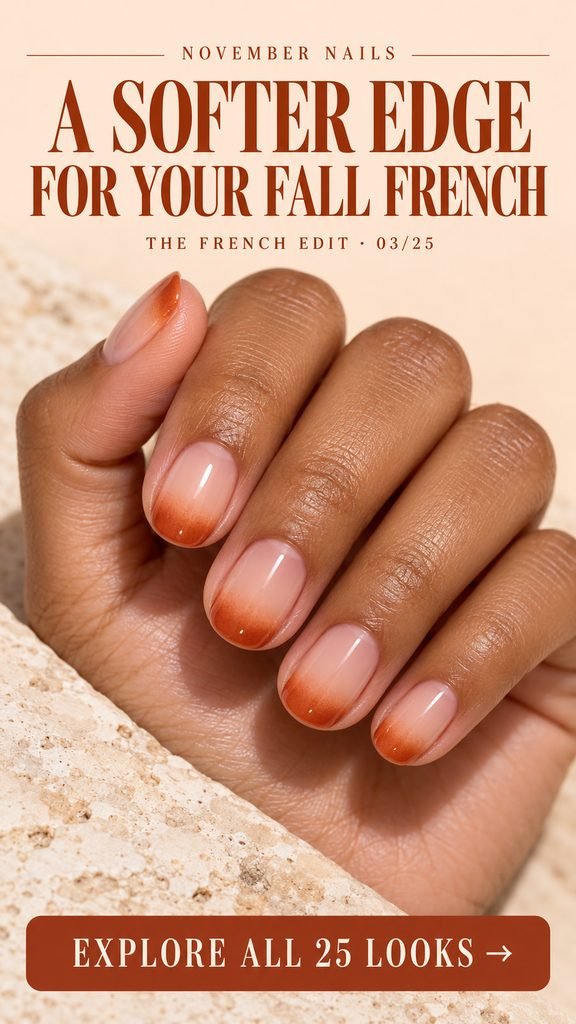
Terracotta looks particularly soft when it drifts into the base instead of stopping at a sharp line. The strongest color sits at the free edge, giving short rounded nails a warm, blurred French effect. There is still plenty of light space near the cuticle, so the orange stays a small part of the manicure.
Tell the artist where you want the fade to stop. If it travels too far down, the result becomes an all-over ombré. For this version, the upper quarter is a useful visual starting point, adjusted to your nail length. Keep the edge noticeably terracotta and let the transition do the softening.
Salon note: A sheer peach-nude base with terracotta concentrated at the tips and softly faded inward. Preserve a large clear area below the fade.November French nail idea 04 / 25
4. Espresso Checkerboard French Tips
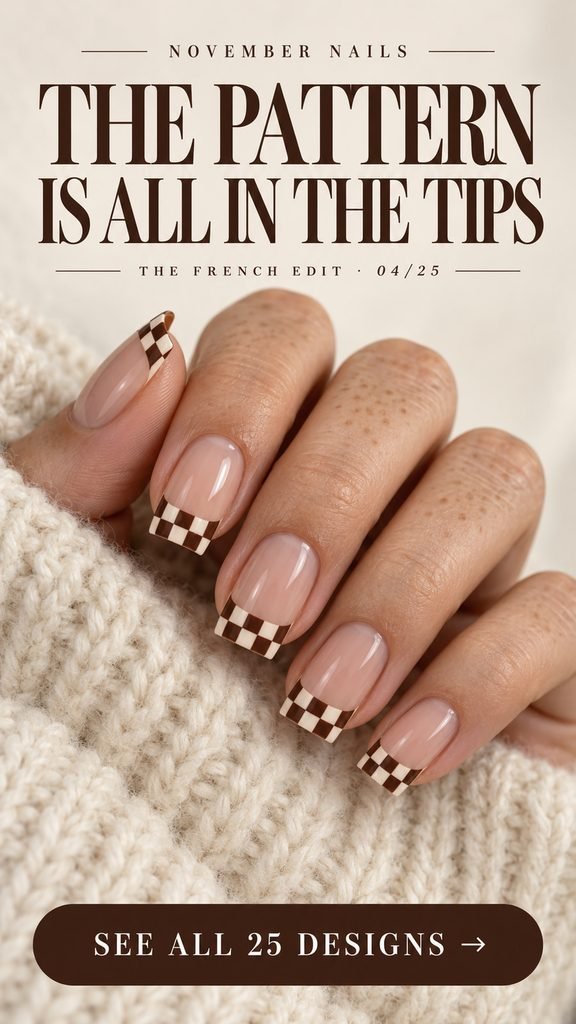
Two rows of little checks make the free edge look almost like a ribbon. Espresso and ivory give the pattern clear contrast, while the nude base keeps the rest of the nail quiet. A softly squared shape gives the checkerboard a tidy edge to follow, which is part of its appeal.
Decide the size of the squares before deciding how many you want. Tiny checks can merge into visual noise when you look at your hands normally. On a narrow nail, use fewer complete squares rather than squeezing in another column. Ask for the rows to follow the tip without drifting down into the base.
Salon note: Espresso-and-ivory checks confined to a moderate French tip, with clear, evenly sized squares. Use fewer checks where the nail is narrow.November French nail idea 05 / 25
5. Molten Pewter French Tips
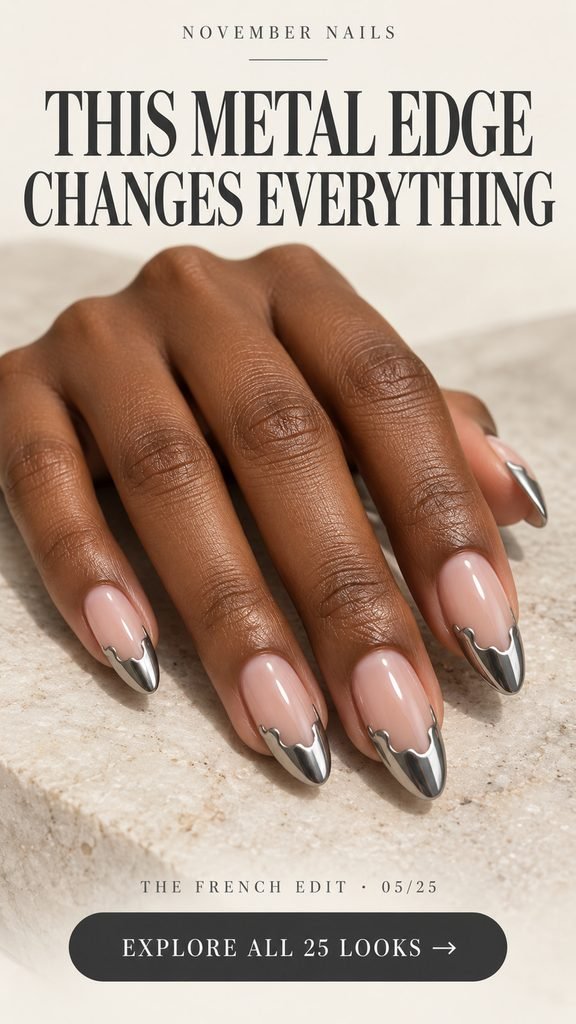
Pewter gives the French edge a cool, liquid-metal shine. The softly uneven boundary makes it feel poured on, with small rounded dips that interrupt the usual smile line. Against a sheer pink base, those reflective tips are the main event; they do not need another metallic detail lower on the nail.
A convincing melted edge still needs a deliberate shape. Choose a few smooth dips rather than lots of little spikes, and leave enough nude space for the outline to show. The reference has a slight sculptural effect. Ask for a flatter chrome interpretation if you prefer a smooth surface with the same flowing border.
Salon note: Smoky pewter French tips with a gently melted inner edge. Keep the dips controlled and discuss whether the finish should be flat or subtly raised.November French nail idea 06 / 25
6. Olive French with a Rose-Gold Sweep
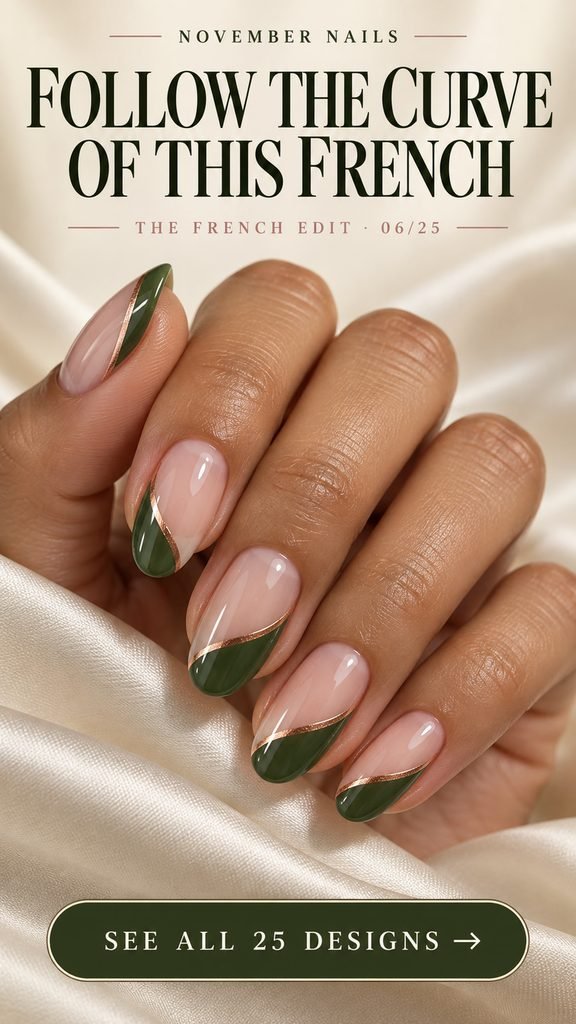
An olive tip sweeping up one side changes the whole direction of a French manicure. The thin rose-gold border follows that movement, giving the curve a warm glint. The contrast feels especially considered: earthy green, softly reflective metal, and a neutral base that lets both remain visible.
Treat the metallic edge as a fine border. If it becomes too wide, it can crowd the olive area and change the balance. Before painting the whole set, decide how high the curve should travel on the sidewall. A gentler sweep is an easy adaptation for shorter nails or a more understated result.
Salon note: Asymmetric olive French tips with one fine rose-gold line following the inner curve. Keep generous nude space and agree on the height of the sweep.November French nail idea 07 / 25
7. Ivory French with Burgundy Stitches
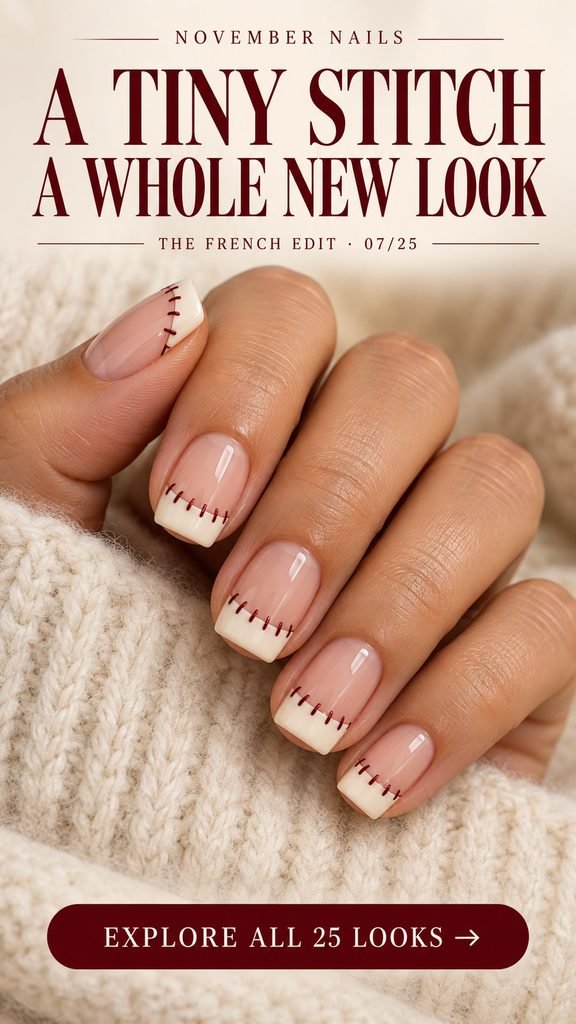
A few burgundy stitches turn an ivory French into a tiny tailoring detail. Each short mark crosses the join between the tip and base, making the edge look neatly sewn. The palette is soft enough for everyday wear, with just enough red to stand out beside a cream sleeve.
Spacing is what makes the stitch idea readable. The marks can follow the curve without being packed tightly together, and their length should stay consistent. For a more subtle version, add stitches to the ring nails only. Keep the cream tips clean and simple so the little lines remain easy to pick out.
Salon note: Ivory French tips with short burgundy stitch marks crossing the smile line. Use even spacing and a consistent stitch length; leave the rest plain.November French nail idea 08 / 25
8. Amber Confetti French Tips
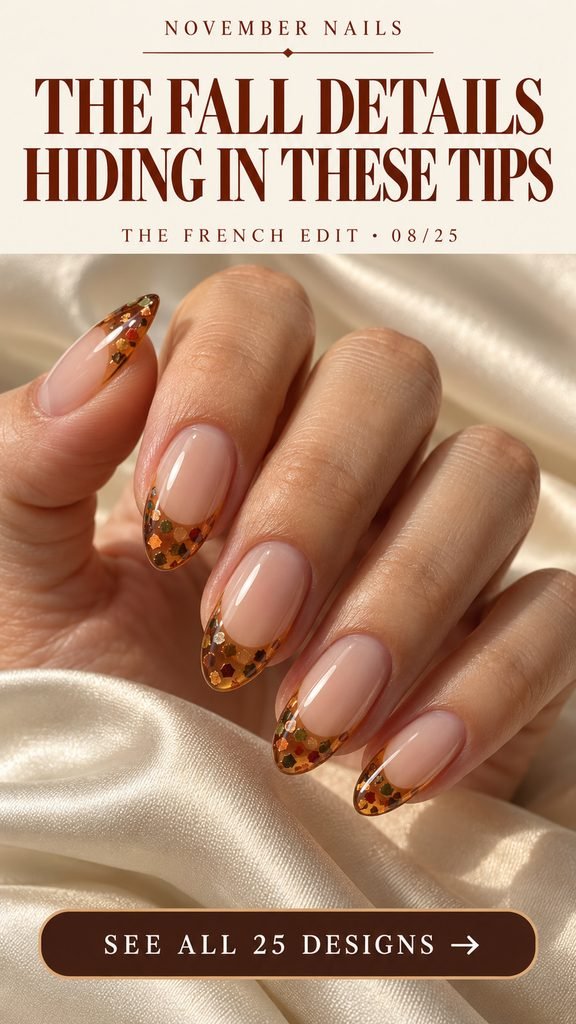
The amber tips hold little pieces of the autumn palette: rust, olive, and bronze floating in a translucent finish. The effect is more interesting when there is still clear amber between the flecks. Each tip becomes a small detail to examine while the nail bed stays soft and uncomplicated.
Choose small, flat pieces and a sparse arrangement. Too much confetti can turn the tip into a solid patch and hide the glassy effect. Ask to see the placement before it is finished, especially on the smallest nails. A few visible flecks will preserve the idea better than a dense layer of miniature pieces.
Salon note: Transparent amber French tips with sparse rust, olive, and bronze confetti. Keep the pieces within the tips and the final surface smooth.November French nail idea 09 / 25
9. Midnight French with Tiny Gold Stars
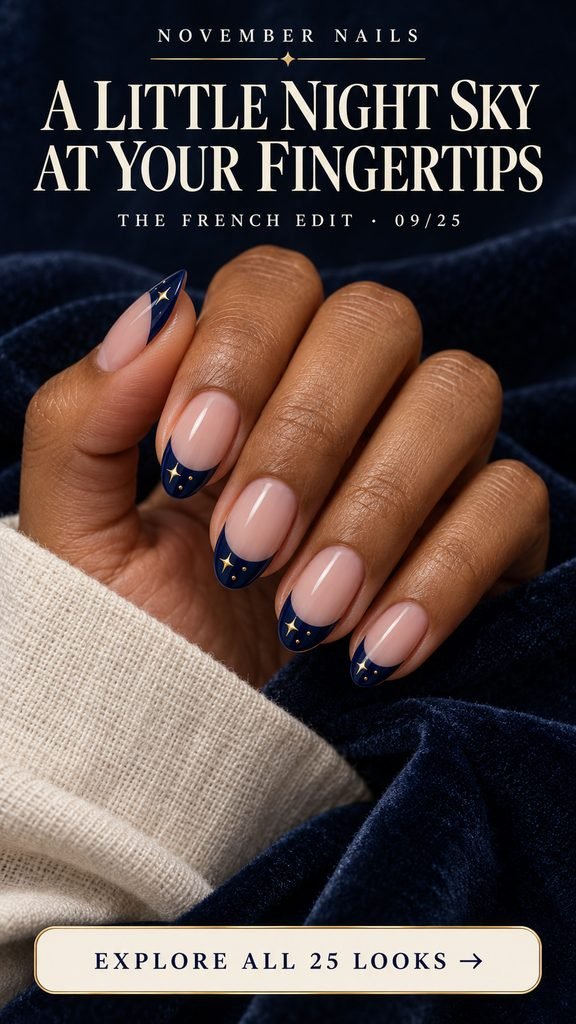
A navy French tip makes a small patch of night sky for one tiny gold star. Keeping the motif at the edge gives the design a lighter feel than covering the whole nail in celestial art. The warm metallic detail is easy to pair with gold rings or a simple bracelet.
The star needs a little navy around every point. If the tip is very narrow, place the star on one or two accent nails and leave the other navy edges plain. A crisp four-point shape can stay legible at a small size. Let any companion dots be much smaller so the star keeps its place as the focal point.
Salon note: Deep navy French tips with tiny flat gold stars inside the colored area. Keep the stars small, separated from the edge, and surrounded by navy.November French nail idea 10 / 25
10. Rust-and-Plum Wave French
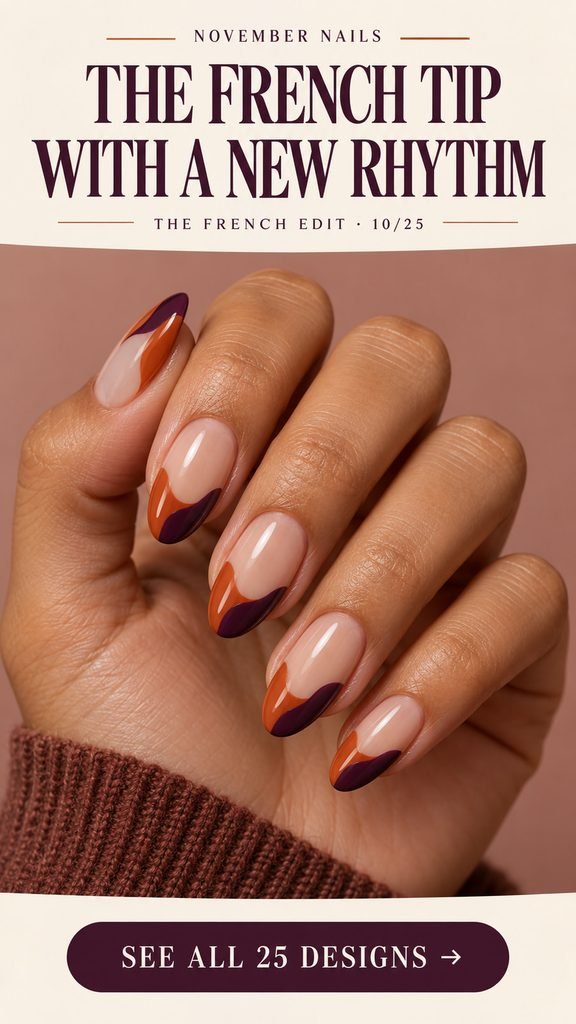
Rust and plum make an unexpectedly good pair when their boundary has a little movement. A broad wave curls through the tip, creating a different balance from a straight two-color split. The surrounding nude base keeps the curve easy to follow and lets both shades contribute to the fall mood.
Choose one color to carry more of the tip and let the other form the smaller wave. Equal, tightly packed bands can make the area feel crowded. On a short nail, one simple bend is enough. Bring the image to show the flowing shape, then let the artist adjust its proportions to the space available.
Salon note: Rust French tips with a smaller plum wave crossing part of each edge. Keep the curves broad, the colors distinct, and the nail beds nude.November French nail idea 11 / 25
11. Moss Ikat French Tips
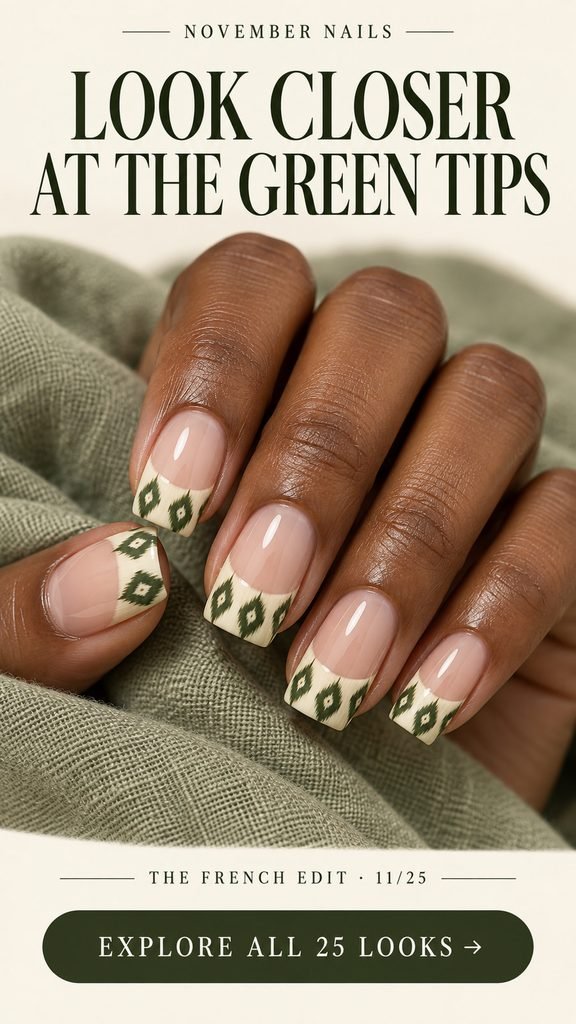
Moss-green motifs give these cream tips a textile-inspired finish. Their slightly feathered outlines soften the little diamond shapes, so the pattern has a different feel from a crisp checkerboard. With the print confined to the edge, the manicure can sit comfortably beside simple knits and neutral clothes.
Keep the pattern large enough to recognize its shape. A couple of motifs on each tip can be more effective than a row of tiny marks. The cream gaps are part of the design, so avoid filling every space with green. For a quieter hand, use patterned tips on two fingers and plain moss tips on the rest.
Salon note: Cream French tips with a few moss-green ikat-inspired diamonds and lightly feathered edges. Leave cream space between the motifs and keep the base sheer.November French nail idea 12 / 25
12. Pumpkin Tips with Espresso Dots
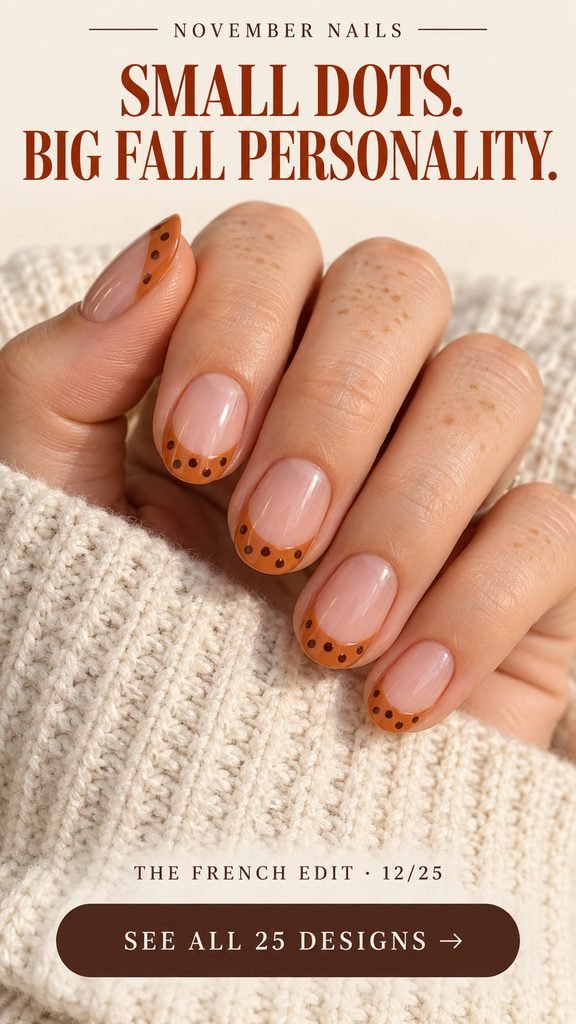
Pumpkin orange becomes a playful little border with the addition of espresso dots. The rounded French shape keeps the color contained, and the dark dots are easy to see against the warm background. It is a cheerful option for short oval nails that still leaves most of the nail bed light.
Use dots small enough to sit comfortably inside the orange. A few well-separated marks will look more deliberate than an edge-to-edge scattering. If the pumpkin shade feels too bright beside your hand, try a muted burnt-apricot version. Keep the espresso deep enough that the pattern remains visible after that color adjustment.
Salon note: Muted pumpkin French tips with a few tiny espresso dots, all contained within the orange. Use a sheer neutral base and a glossy finish.November French nail idea 13 / 25
13. Burgundy Windowpane French
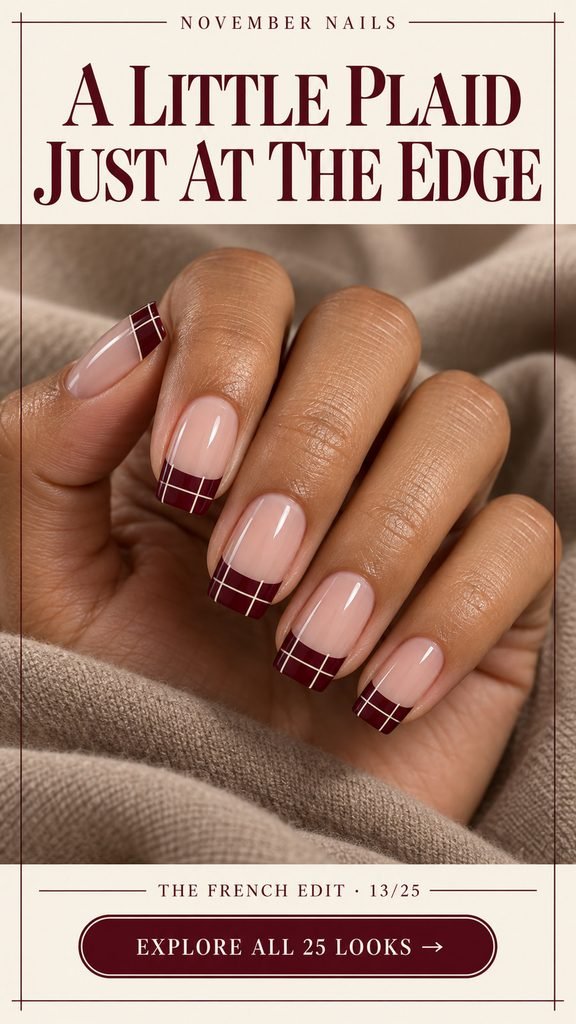
A fine ivory grid gives burgundy tips a little of the charm of a checked scarf. The large rectangular spaces keep it from becoming a dense plaid, and the straight free edge helps the pattern feel tidy. There is plenty of rich red between the lines, which is what makes the contrast work.
Agree on the grid size while looking at the actual nail. One horizontal line and a few vertical ones may be all the space can hold. On a narrower tip, reduce the number of cells rather than making every line heavier. You want a windowpane pattern that remains clear when your hand is resting on a table.
Salon note: Burgundy French tips with a fine ivory windowpane grid. Keep the cells fairly open, the line weight delicate, and the nude base free of pattern.November French nail idea 14 / 25
14. Matte Plum Tips with Glossy Dots
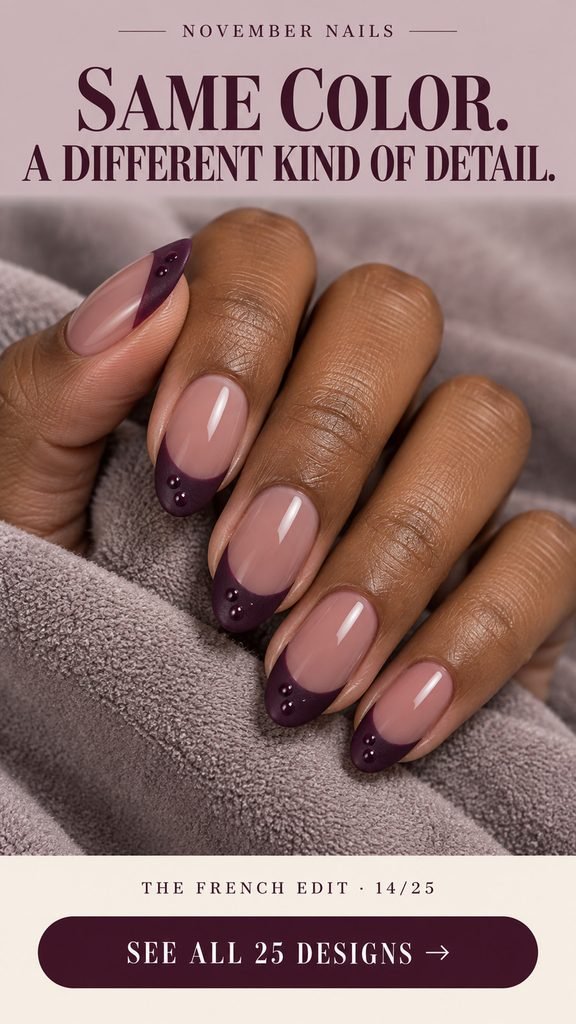
This plum French saves its surprise for the light. The tip has a soft matte finish, with small glossy spots in the same color catching the reflection. From farther away it reads as a dark purple French; closer up, the difference in finish becomes the detail you notice.
A sample is especially helpful for this one because a photograph can exaggerate or flatten the contrast. Ask to see the matte background and glossy dots together under ordinary light. Keep the dots separated and small enough to fit within the tip. If you want a smoother version, discuss flat glossy spots rather than raised droplets.
Salon note: Matte plum French tips with a few same-color glossy dots. Preserve the contrast between finishes and keep the glossy detail inside the plum.November French nail idea 15 / 25
15. Cream French with Tiny Ferns
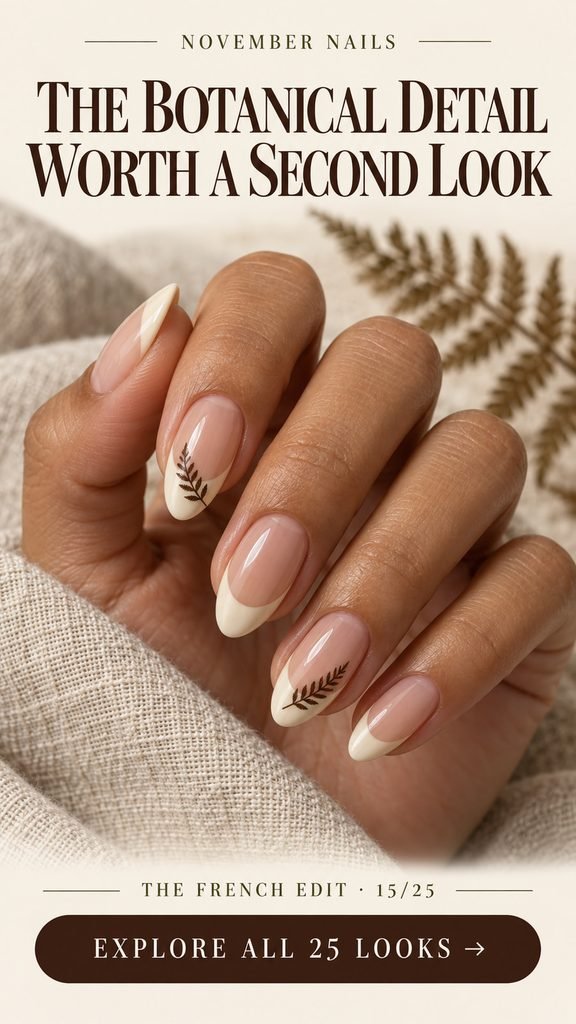
Tiny brown ferns give a cream French a gentle botanical detail. The fronds lie along the tips of two accent nails, leaving the other edges plain. Because the artwork sits on ivory, the fine leaflets are easier to appreciate without needing a bold green or a larger illustration.
Let the fern follow the available space. A single diagonal frond can sit comfortably on an almond tip, while a shorter nail may suit a smaller sprig with fewer leaflets. Keep the stem delicate and avoid carrying the artwork far down into the nude base. The cream around the fern helps the drawing stay recognizable.
Salon note: Cream French tips with one delicate brown fern on two accents. Place most of each frond over the cream, allowing a few leaflets to cross the curve.November French nail idea 16 / 25
16. Dusty Blue French with Oxblood Notches
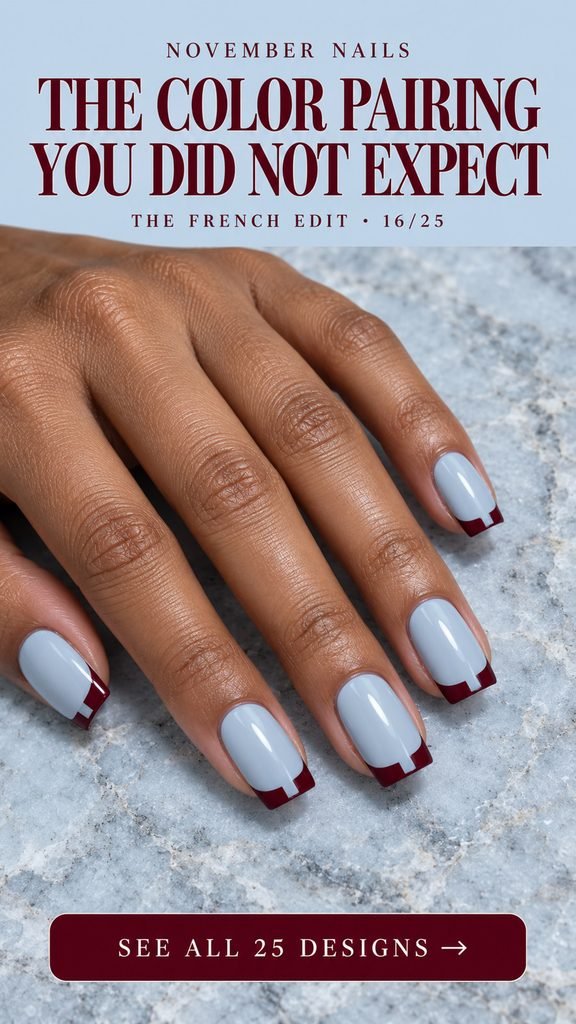
Dusty blue changes the mood before the burgundy tips are even added. A small notch in each dark edge lets the blue interrupt the French line, turning a familiar shape into something more graphic. The cool base and deep red border make a striking combination with gray or navy clothing.
The notch should look intentional from a normal viewing distance. Keep it clean and centered, with enough burgundy remaining on either side. If it is extremely narrow, it may be mistaken for a gap in the polish. A soft-square edge gives the little rectangle a clear setting, while a shallow tip keeps the color balance light.
Salon note: Dusty-blue nails with narrow oxblood French tips and a small blue notch at the center of each tip. Keep the notch crisp and clearly visible.November French nail idea 17 / 25
17. Hollow Espresso French Tips
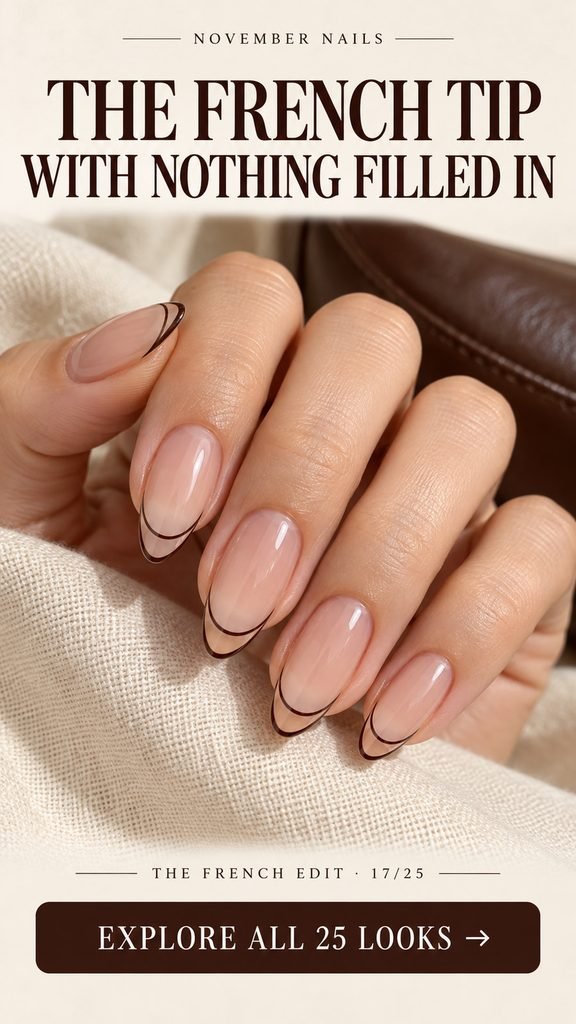
An espresso outline sketches the French shape and leaves the inside open. The two curves meet at the corners, creating a hollow band over a translucent base. It is a useful choice when you like a dark edge but want most of the nail to stay light and barely colored.
Both lines need room to remain separate. If the outlined area is too narrow, they can visually merge into a solid brown tip. Ask for a delicate line weight and a visible gap, then check the result without zooming in. A deeper almond curve gives the outline more space while keeping the center of the nail open.
Salon note: A hollow French band outlined in espresso, with a clear nude space between the smile line and the outer edge. Keep both lines fine and distinct.November French nail idea 18 / 25
18. Copper French with a Fine Mesh
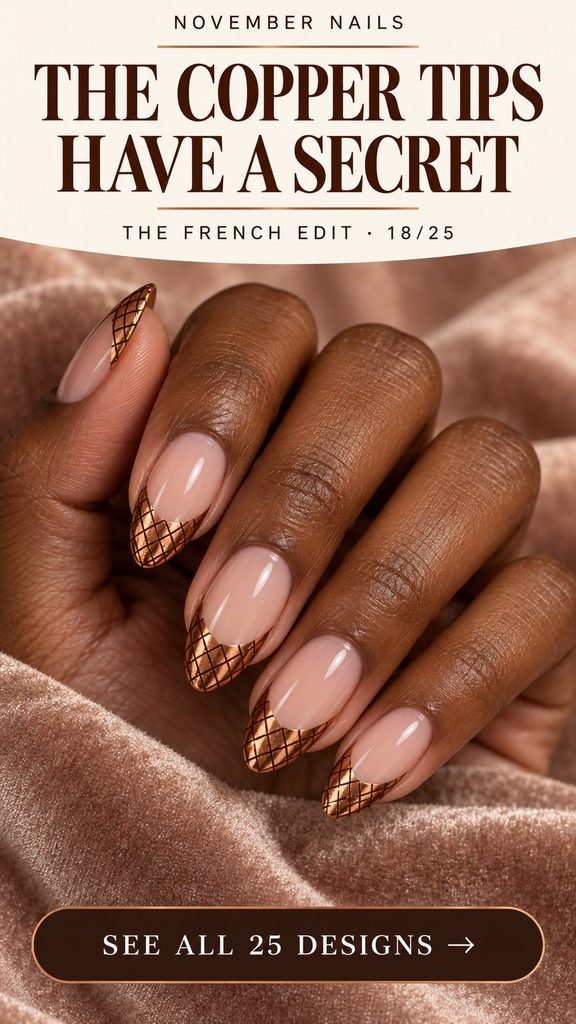
Copper tips bring the glow; a fine brown mesh gives them structure. The crossing lines create small diamond-shaped openings that let the metallic finish show through. It is a warm, detailed French that can look especially lovely with plain clothing, where the pattern has a little space of its own.
Start with the copper swatch you like, then decide how dark the mesh should be. A heavy grid can hide the reflective surface underneath. On narrow tips, a few wider diamonds are easier to see than a dense net. Keep the lines inside the French area so the pattern has a clean stopping point.
Salon note: Copper metallic French tips with a fine espresso fishnet pattern. Leave enough copper visible between the lines and keep the nude base clear.November French nail idea 19 / 25
19. Amber Honeycomb French
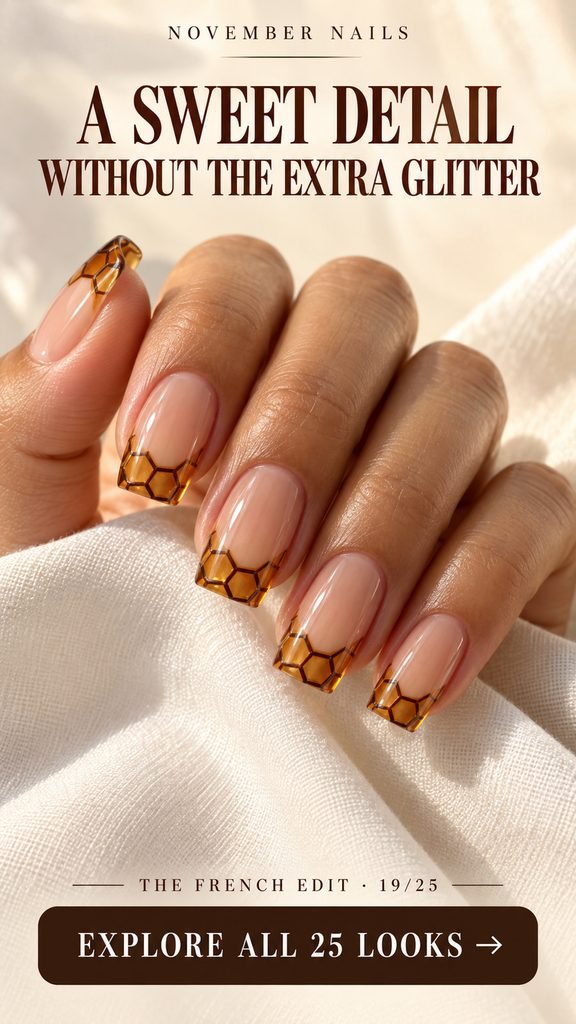
Honeycomb lines give transparent amber tips a precise little pattern. The hexagons repeat across the edge while the warm jelly color remains visible underneath. It is a different way to bring a honey-toned accent into November nails, with the interest coming from geometry and translucency.
Choose a small number of readable cells. If the hexagons are squeezed too tightly, the pattern can start to resemble a dark scribble. A softly squared free edge gives the shapes a straightforward space to fill. On a shorter nail, one complete cell with partial cells beside it can carry the idea without crowding the tip.
Salon note: Amber jelly French tips with a few thin cocoa honeycomb outlines. Keep the hexagons recognizable and enough amber exposed to retain the translucent effect.November French nail idea 20 / 25
20. Cranberry French with a Pearl Border
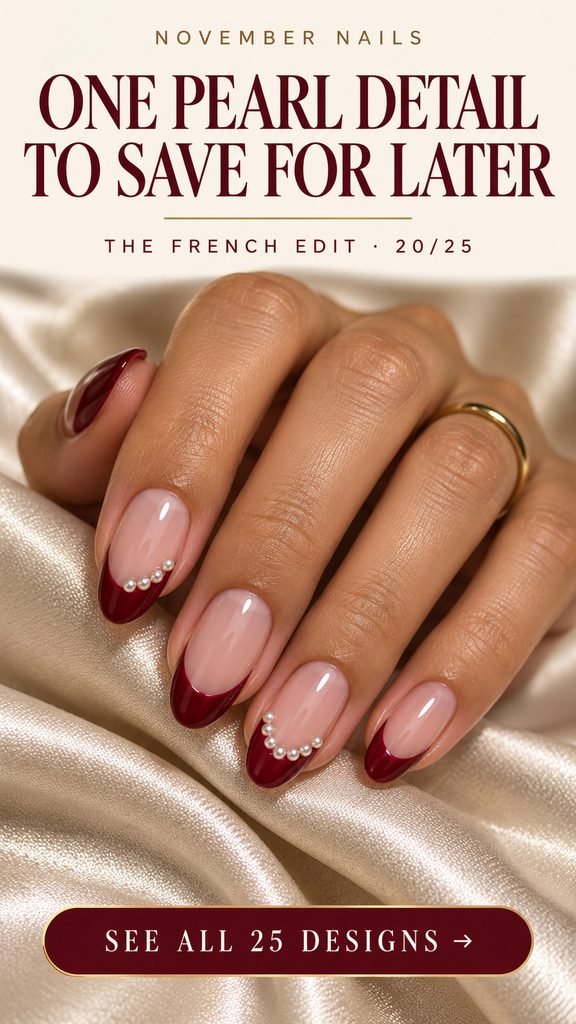
A short row of tiny pearls softens the boundary of a cranberry French. Placing it on two nails gives the set a dressed-up detail while the remaining red tips stay simple. The ivory beads look especially clear where they meet the darker color, making the curved border the part worth saving.
Check the pearl size against your actual tip depth. A large bead can cover too much of the red or make the edge feel heavy. If you prefer less texture, ask for a painted pearl-like dot border, or use fewer beads on one accent. A partial row can preserve the idea without surrounding the whole nail.
Salon note: Cranberry French tips with a short row of tiny ivory pearls along two accent smile lines. Keep the pearls small and discuss a flat alternative if preferred.November French nail idea 21 / 25
21. Lilac-and-Charcoal Offset French
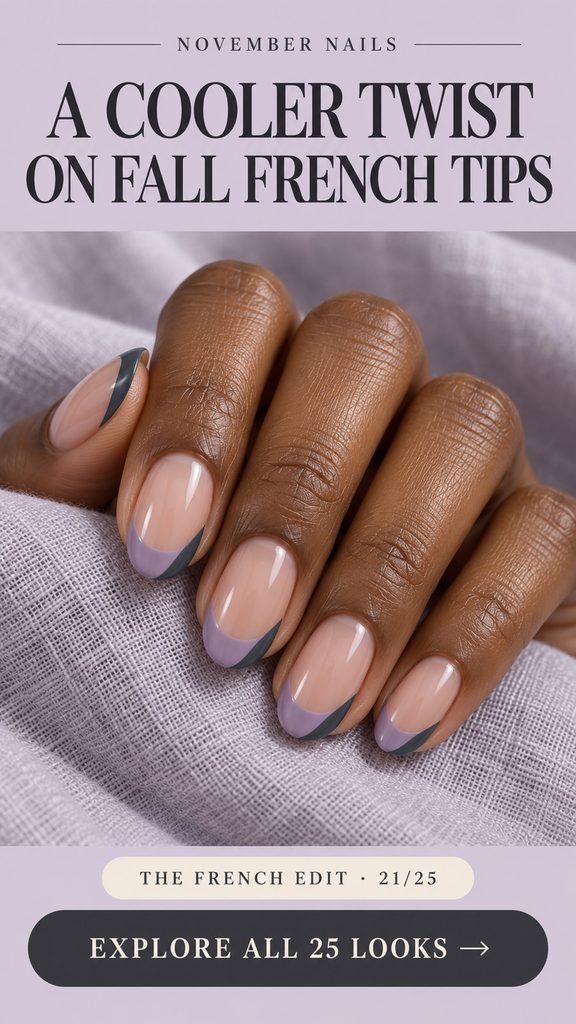
Lilac brings a cooler note to a fall manicure, and a little charcoal crescent gives it depth. The gray sits to one side of the tip, overlapping the lilac just enough to make the shape feel offset. The rest of the nail stays sheer, keeping this unexpected pairing light.
A muted, dusty lilac will give a softer result than a bright pastel. Keep the charcoal area smaller so the purple remains the main tip color. Before repeating the design, decide which side the gray curve should occupy. On a short nail, a tiny corner swoop can be enough to make the pairing work.
Salon note: Dusty-lilac French tips with a smaller charcoal crescent offset at one corner. Use a sheer base and keep the lilac as the dominant color.November French nail idea 22 / 25
22. Saffron French with a Taupe Crossline
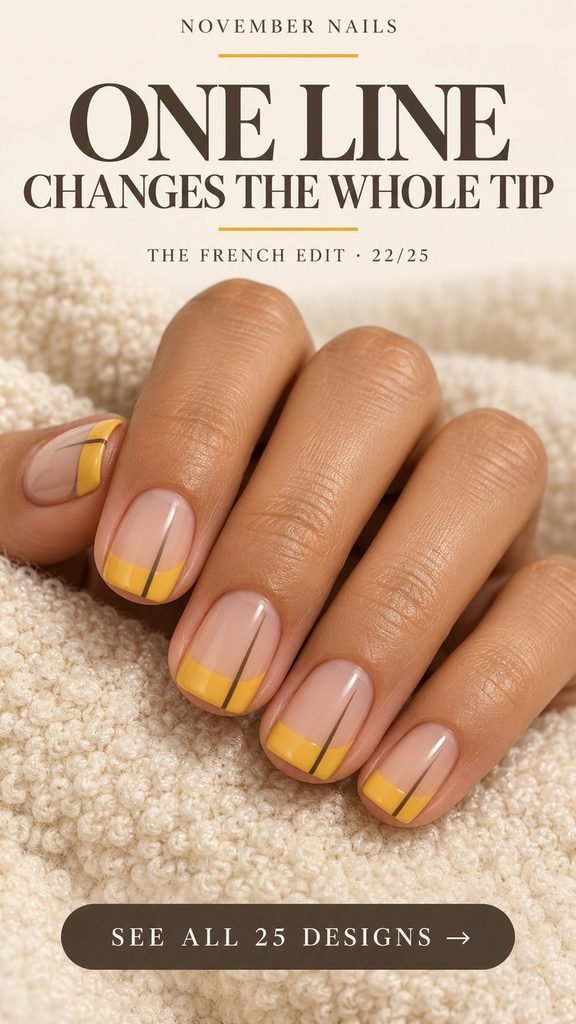
One taupe line cuts through a saffron tip and extends up the nude base. That crossing connects the two areas and gives a warm yellow French a more graphic finish. The idea stays simple enough to read clearly on short, softly squared nails, with the slender line adding direction.
Choose the length of the stripe before repeating it. The reference carries it well into the base; a shorter extension gives a quieter variation. Leave a clear stopping point before the cuticle. A taupe that is deeper than the base but softer than black keeps the contrast balanced without making the stripe too strong.
Salon note: Saffron French tips with one fine off-center taupe stripe crossing onto the nude base. Keep the stripe straight and agree on how far it should extend.November French nail idea 23 / 25
23. Smoky Quartz French Tips
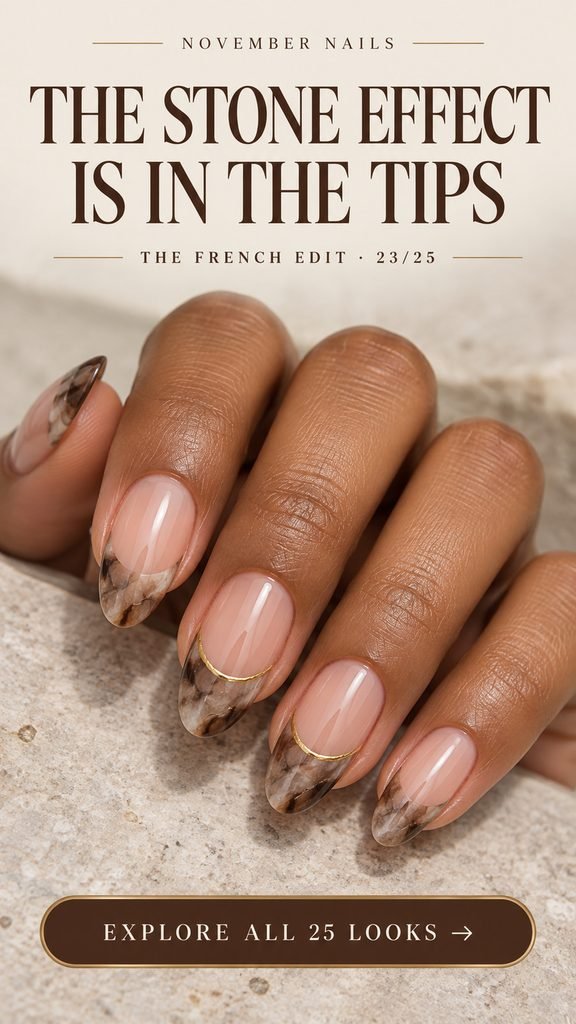
Smoky quartz tips mix translucent taupe, cream, and coffee into a small stone-like pattern. The wisps stay within the French edge, leaving the base open. A fine gold trace on two accent curves gives the soft colors a point of definition without outlining every nail in metal.
Ask for variation in the wisps rather than a repeated striped pattern. A few cloudy areas and fine darker trails create more depth than an even mix of all three colors. Keep the gold selective. On short nails, a lighter quartz blend can make the tip easier to read without turning it into a heavy dark band.
Salon note: Smoky taupe-and-coffee quartz French tips with fine gold edging on two accents. Preserve some translucency and keep the stone pattern inside the tips.November French nail idea 24 / 25
24. Rust Corduroy French Tips
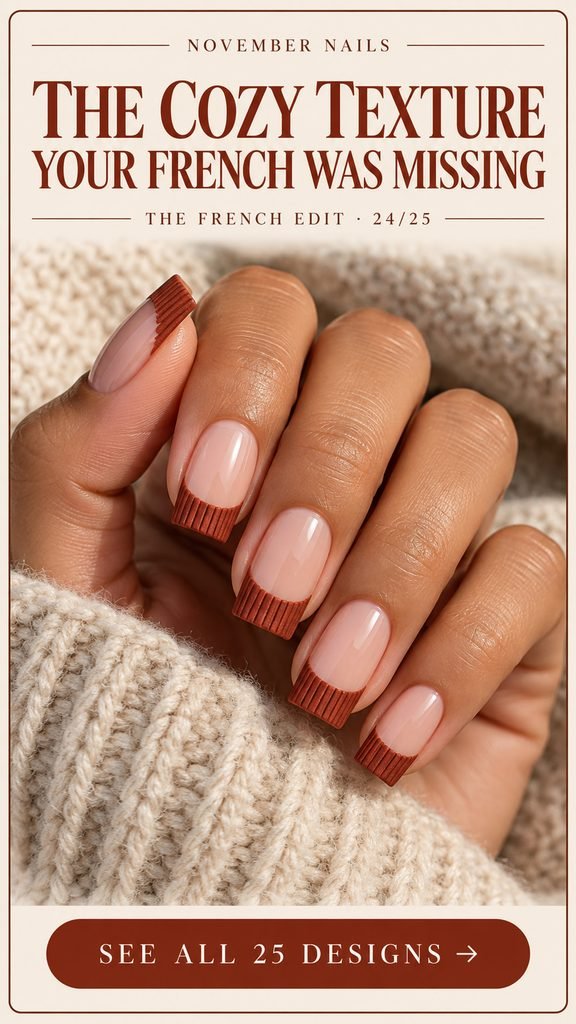
Fine ribs make rust-colored tips look a little like corduroy. The matte texture at the edge contrasts with the smoother, glossier nude base, bringing a cozy fabric idea into a clean French layout. A softly squared shape gives the parallel lines a tidy place to stop.
This is a texture-led concept to discuss with an artist who offers raised nail art. Ask for low, closely spaced ribs and a sample of the finished surface. If you want the visual rhythm with less texture, fine painted lines can suggest the same direction. Keep the ribs limited to the tips so the set remains balanced.
Salon note: Matte rust French tips with fine vertical corduroy-style ribs over a glossy nude base. Keep the texture low, or use painted lines for a flatter interpretation.November French nail idea 25 / 25
25. Caramel Magnetic Illusion French
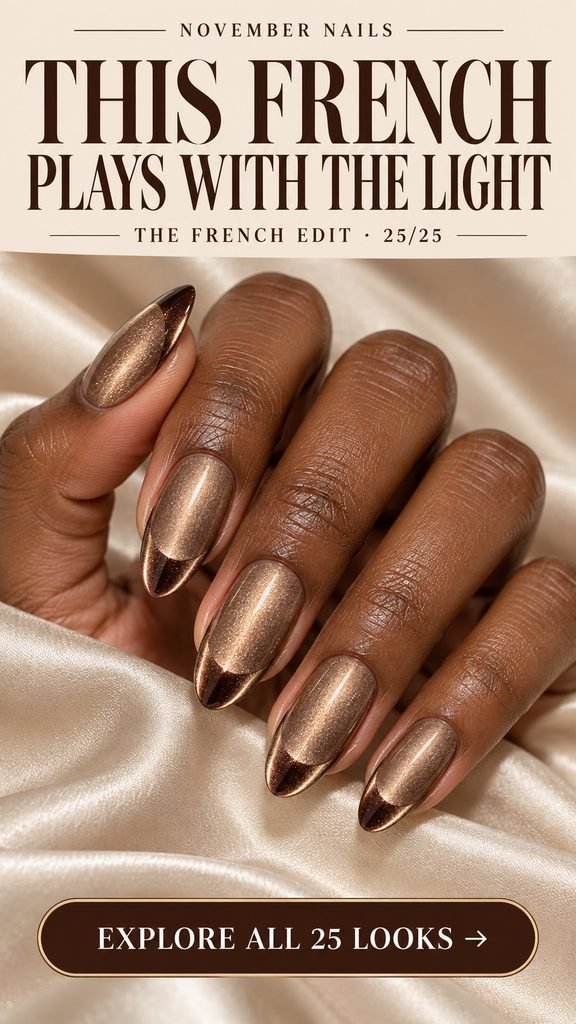
This French plays with the light on both sides of the curve. The caramel-taupe base has a brighter center, while the darker tip carries its glow differently, giving the edge an optical shift. The color palette is restrained; the movement in the finish supplies the surprise.
Ask an artist who works with magnetic polish to show what their products can achieve on one finished nail. The contrast depends on how the shimmer is arranged, so the effect will change as you tilt your hand. Agree on a visible French boundary and a warm caramel tone first, then refine the light pattern together.
Salon note: A caramel magnetic base and deeper chocolate magnetic French tip with contrasting shimmer placement. Show me the effect from several angles before repeating it.Technique reference: OPI’s French Illusion tutorial demonstrates magnetic effects in both the base and French tip. The caramel palette here is an original concept.
Make the French Shape Yours
Once you have a favorite, look at what made you stop. It might be the empty space inside the espresso outline, the cool blue under the burgundy notch, or the tiny fern crossing a cream edge. Name that one feature when you show the image. It gives your artist a clear priority if the design needs adjusting for your nail length.
Then check the silhouette before the details go on. Decide where the colored area begins, how it curves at the sides, and how much base you want left visible. A pattern can be simplified later; a French shape you already like gives the whole set a stronger starting point. Ask to see the first completed accent before repeating intricate artwork across the hand.
For a balanced combination, carry one tip shape through the set and vary just the feature you enjoy most. You could pair two fern accents with plain cream tips, or two checkerboard tips with plain espresso edges. Keeping one element consistent makes the combination feel intentional while leaving room for a little personality.
How do I explain the French shape at an appointment?
Show the full-hand image and point to the inner border of the tip. Say whether you like its depth, its curve, or its angle, then mention the amount of nude space you want to keep. Those details are more specific than asking for a French manicure alone. Add the preferred color and finish after the shape is clear.
Can I try a simple version with regular nail polish?
Yes. Essie’s regular-polish guide uses a sheer base, a fine brush to trace and fill the tip, and a top coat after the color dries. A two-color tip or a few dots can be a manageable starting point if you already enjoy painting your nails. Follow the directions for your products and leave the more intricate effects for a separate attempt or salon visit.
What if my free edges are different lengths?
Talk about the overall shape before selecting a deep French. Your artist can help you decide whether to shorten to a more consistent length or adjust the painted border on each nail. A narrower colored edge or softly blurred tip may suit the look you want. The goal is a balanced set on your hand, rather than copying every measurement from an image.
Does a detailed French need art on every nail?
It can work beautifully with only one or two accents. Choose the feature with the most detail, then repeat one of its colors on the other tips. That is also a useful way to discuss a simpler appointment: ask the artist for a quote for the exact accent count and finish you want, rather than assuming every version takes the same amount of work.
Save the French tip you would still want to look at on an ordinary November morning. The little edge you love is enough to build the rest of the manicure around.