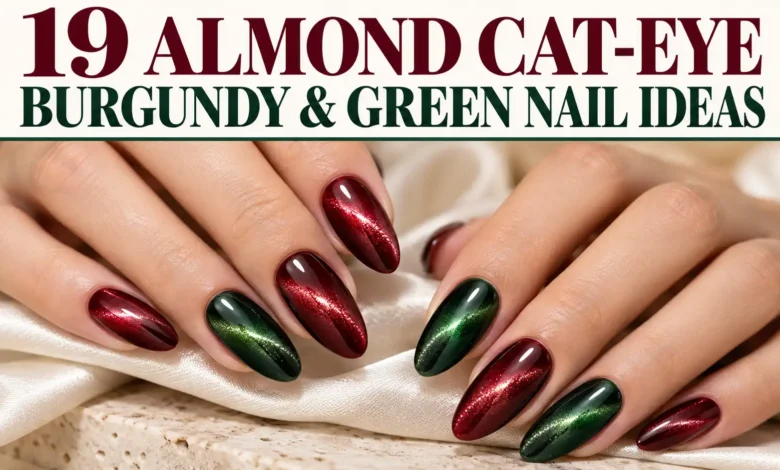
For a simple take on burgundy and green nails, start with alternating magnetic shades or one olive accent. For a lighter look, choose sheer French tips. If you want more detail, the half-moons, fine gold frames, and single-accent designs below give the colors a different job on each nail.
These 19 almond designs focus on the placement of color and light, so you can take a specific request to your nail appointment. Pick the layout first, then decide whether you want a sharp cat-eye stripe or a softer, wider glow.
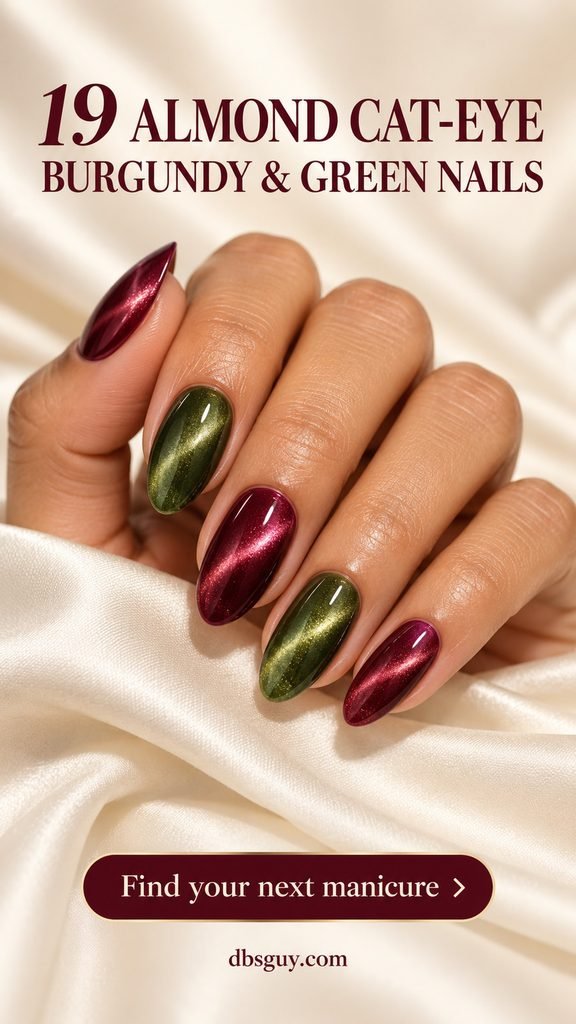
The images are AI-generated design concepts, not photos of completed salon work. Use them as visual briefs; your polish, lighting, and nail length will affect the finished look.
1. Alternating Diagonal Cat-Eye Beams
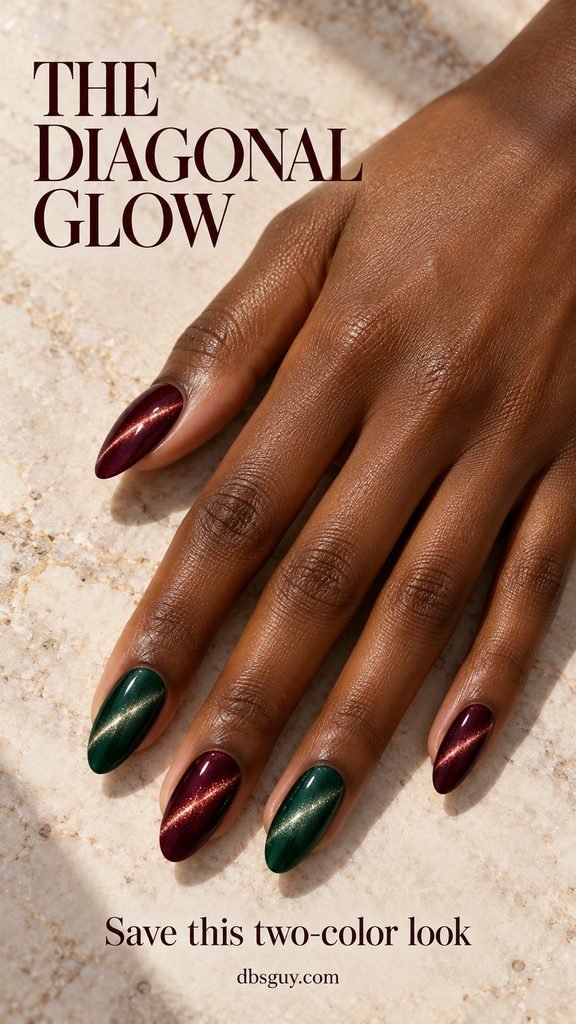
Start here if you want both colors to have equal attention. Alternate wine-red burgundy and forest green, then keep the bright magnetic stripe slanting in the same direction across the set. That repeated angle ties the two shades together without extra nail art.
Choose a medium almond with a softly rounded point so there is room to see the beam. Before the full set, ask your artist to show you one nail in each shade under the same light. If one looks almost black, choose a slightly lighter version so the alternation stays visible.
2. Short Almonds With One Olive Accent
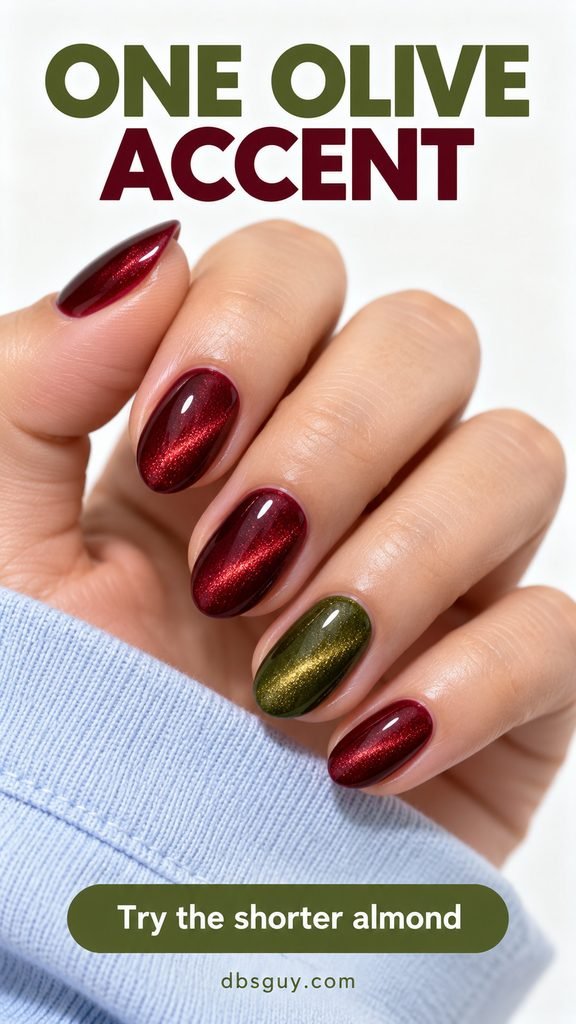
One olive nail is a gentle way into this color pairing. Keep most of the manicure burgundy and place the green on the ring finger, where the change looks deliberate even without decoration. The shorter almond makes this a compact option for someone who does not want much extra length.
Ask for a soft taper rather than a needle-sharp end. If your natural nails do not have enough free edge for this outline, discuss the closest comfortable shape with your nail artist instead of filing the sides aggressively. Keep the olive accent as dark and glossy as the wine-colored nails.
3. Burgundy on One Hand, Green on the Other
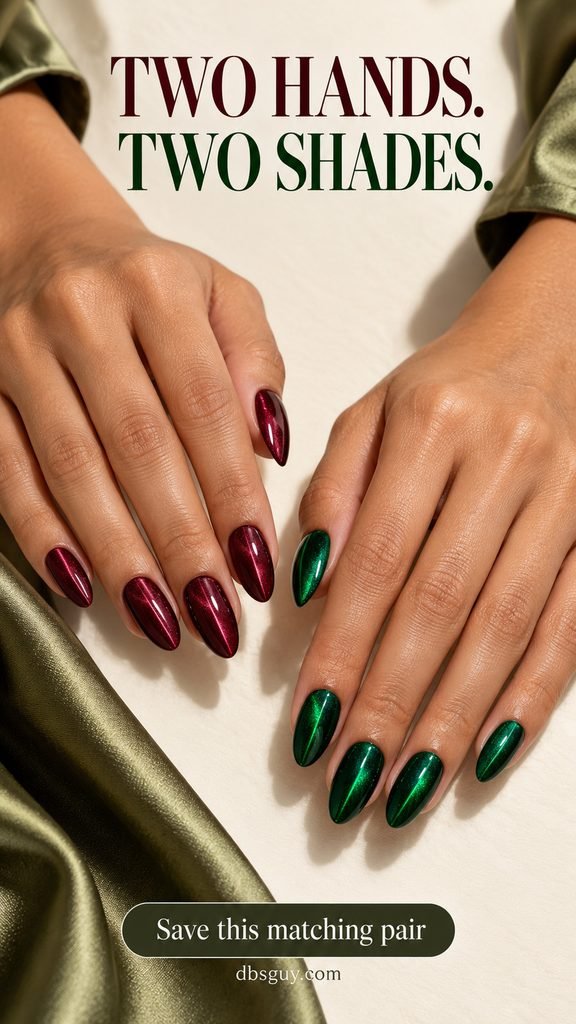
Wear burgundy on one hand and emerald on the other when you like a coordinated set with a clear twist. Keeping each hand to one color gives the pairing a different rhythm from alternating individual fingers. The matching almond shape does much of the work.
Repeat the same length and narrow magnetic highlight on both hands. A bright emerald can overpower a nearly black wine, so compare the swatches together before choosing. This is a useful reference for someone who enjoys two-color nails but prefers an uncluttered finish.
4. Two-Color Cat-Eye French Tips
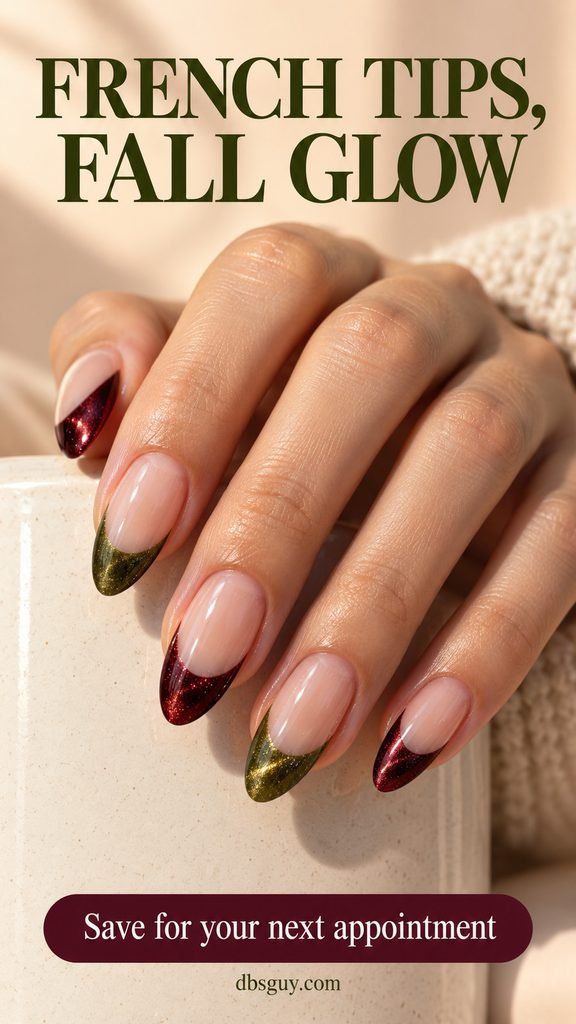
For a lighter take on burgundy and green nails, put the magnetic color only on the French tips. The sheer pink base keeps more of the nail visually open, while alternating wine and olive edges carry the autumn palette.
Give the colored tip enough width for its shimmer to show. An extremely thin line may read as a simple colored French rather than cat-eye. Ask for a tidy smile line that follows the almond outline, and choose the sheer base against your own hand rather than copying the exact nude in the image.
5. Sweeping Side-French Almonds
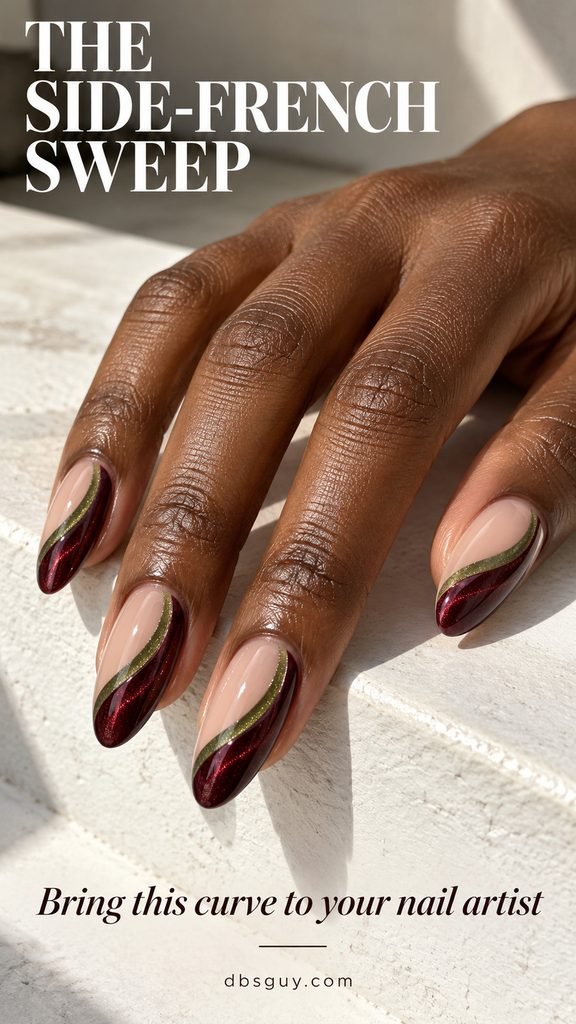
These curves travel down one side of the nail before wrapping around the tip. A broad burgundy sweep and a thinner green ribbon make the almond outline part of the design. Compared with a centered French, this placement leaves an uneven, interesting pocket of sheer base.
Bring the reference and point out which side the color should hug. The green needs to remain wide enough to read as its own ribbon, not disappear into the burgundy. On a shorter almond, simplify the curve instead of squeezing in a second decorative outline.
6. Burgundy Nails With Green Half-Moons
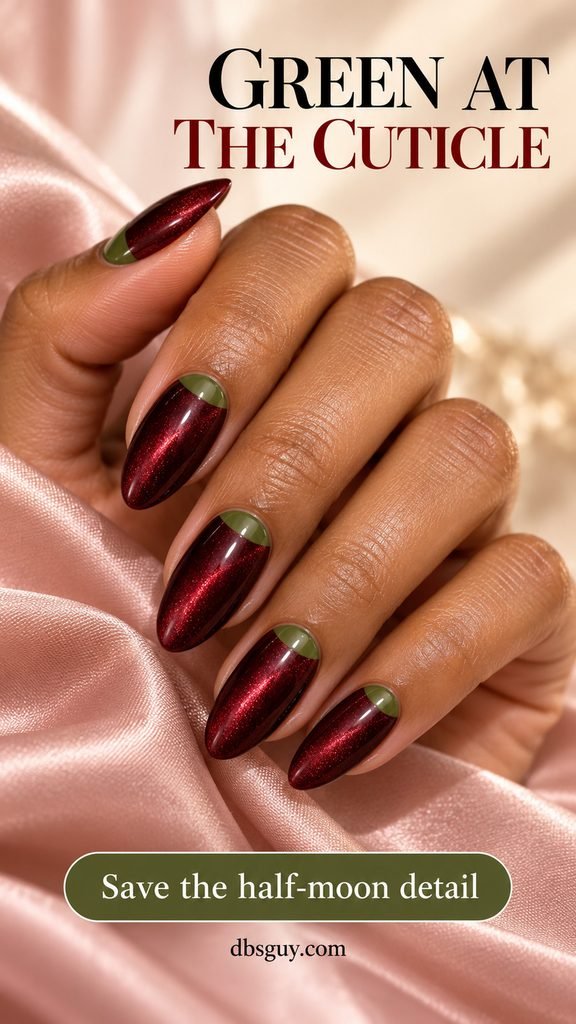
Move the green to the base for a half-moon manicure. Small olive semicircles sit beside the cuticles, with burgundy cat-eye covering the rest of the nail. The repeated green arc gives every finger a detail without making the set busy.
Ask for the half-moons to occupy roughly the same proportion of each nail, rather than making them identical in width. Leave the burgundy area large enough to carry the magnetic light. This is a good choice when you want the design close to the cuticle and the pointed tips kept simple.
7. Vertical Burgundy-and-Green Splits
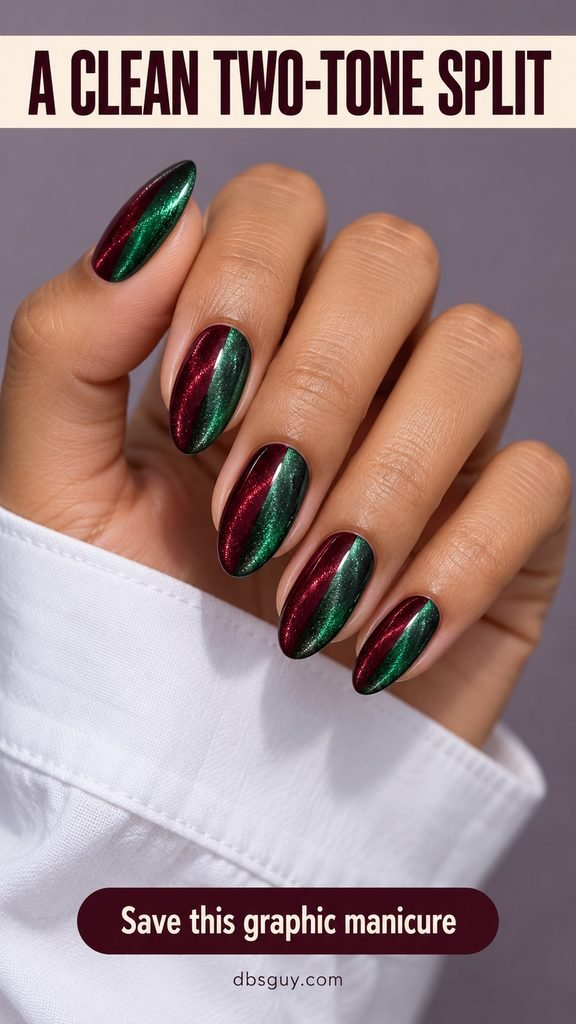
A straight lengthwise split puts both shades on every nail. Burgundy fills one side and emerald fills the other, creating a clean seam from base to tip. It is one of the more graphic choices here, especially when the colors remain clearly separate.
Keep the seam slightly flexible if your nail beds vary; visual balance matters more than measuring an exact half. Ask for magnetic shimmer within both colors, and skip an extra metallic divider if you want the two-tone geometry to stay crisp.
8. Diagonal Burgundy-and-Olive Blocks
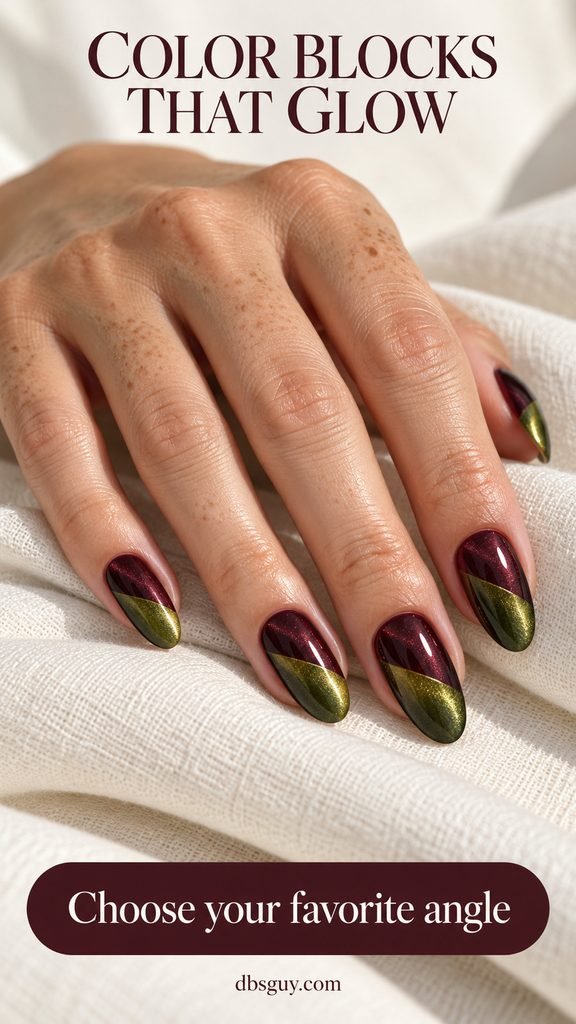
This color block changes direction: burgundy starts near the cuticle, and olive takes over beyond a diagonal seam. Unlike the lengthwise split, each nail has a dark lower section and a green tip section. The slanted join gives the set movement even when the colors are opaque.
Medium almonds offer space for both blocks. Tell your artist you want a firm color boundary rather than a blended fade, and keep the diagonal at a similar angle across the hand. A warm olive is particularly useful here if forest green looks too close to your burgundy in indoor light.
9. Burgundy-to-Green Magnetic Ombré
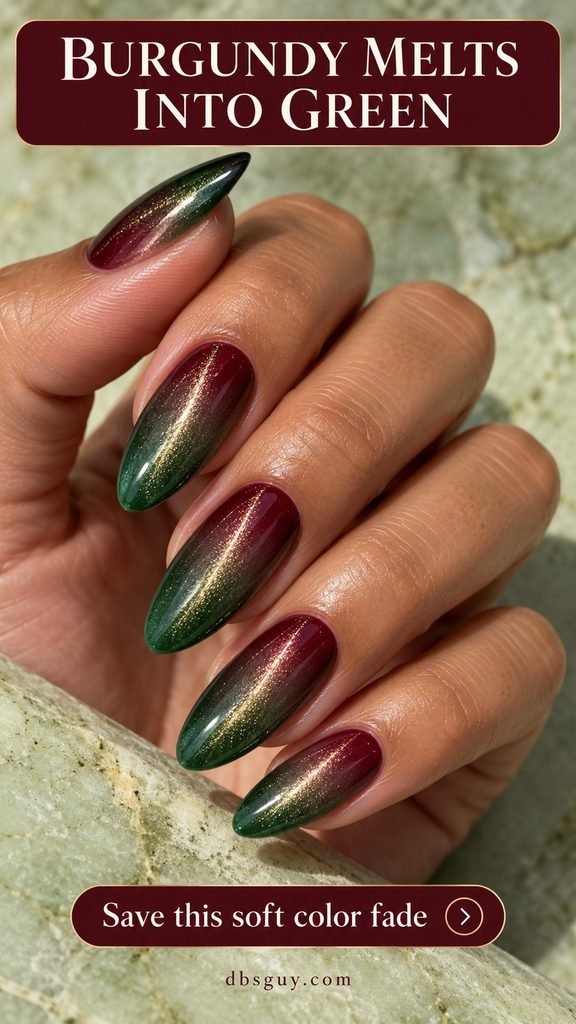
Choose an ombré when you would rather soften the join between the colors. Burgundy begins near the cuticle and moves through a smoky transition into green at the free edge. A magnetic highlight adds a second layer of movement over that fade.
Have your nail artist test the blend on a sample tip first. Two dark shades can create a murky middle, so the transition needs enough definition to show where wine gives way to green. Ask to see the result tilted under light; a still image cannot show the full shift of magnetic polish.
10. Negative-Space Magnetic Ribbons
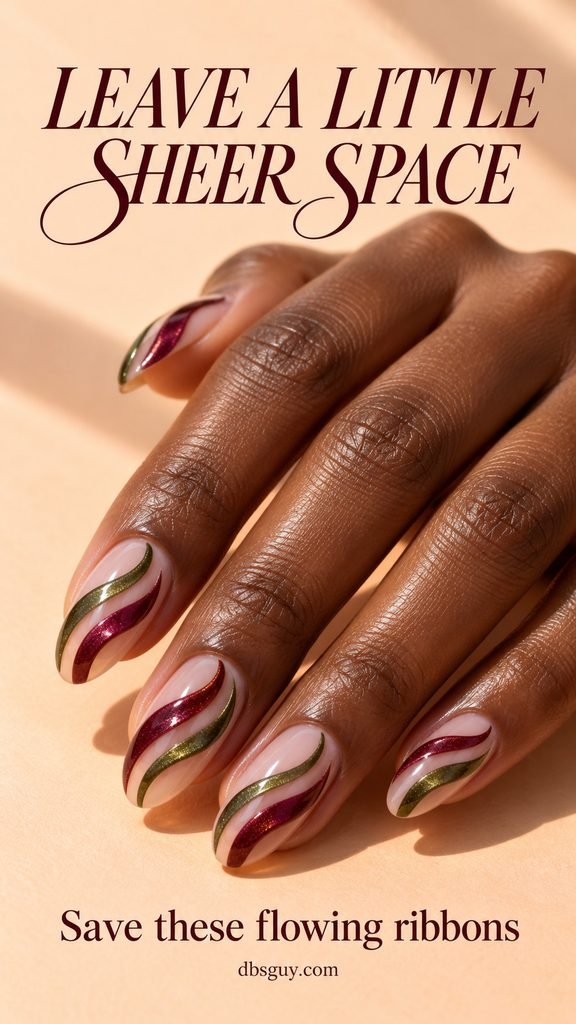
A pair of curved ribbons gives you the color combination without full coverage. Wine and olive lines flow over a sheer pink base, with visible space between them. The result depends on that open area: if the ribbons spread too far, the design loses its lightness.
Ask for smooth S-curves and keep the magnetic sections broad enough to catch light. You can vary the paths slightly from finger to finger while repeating the same two colors. This is a useful direction if a full dark manicure feels too heavy for your usual style.
11. Fine Gold Frames Around Jewel Tones
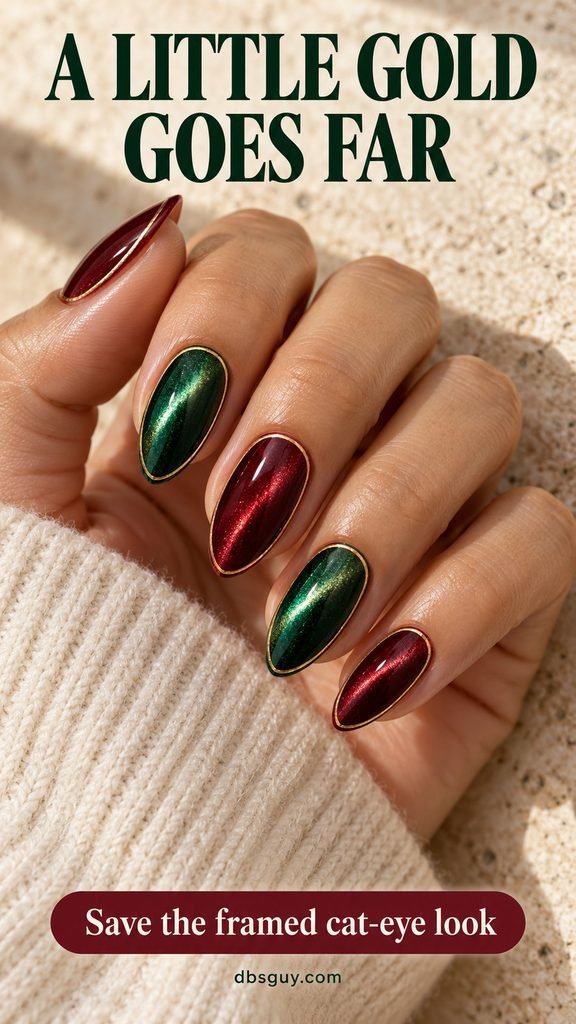
A fine gold frame makes the nail outline the decoration. The burgundy and green centers stay magnetic, while a narrow metallic border follows the perimeter. It suits someone who likes a little jewelry-like detail but does not want raised embellishments.
The border should remain delicate enough to leave the colored center clearly visible. Ask for a painted line and a smooth finished surface, rather than a thick raised rim. Keep other art off this set so the gold outline and shifting center have room to stand out.
12. Tiny Gold Stars Over Forest and Wine
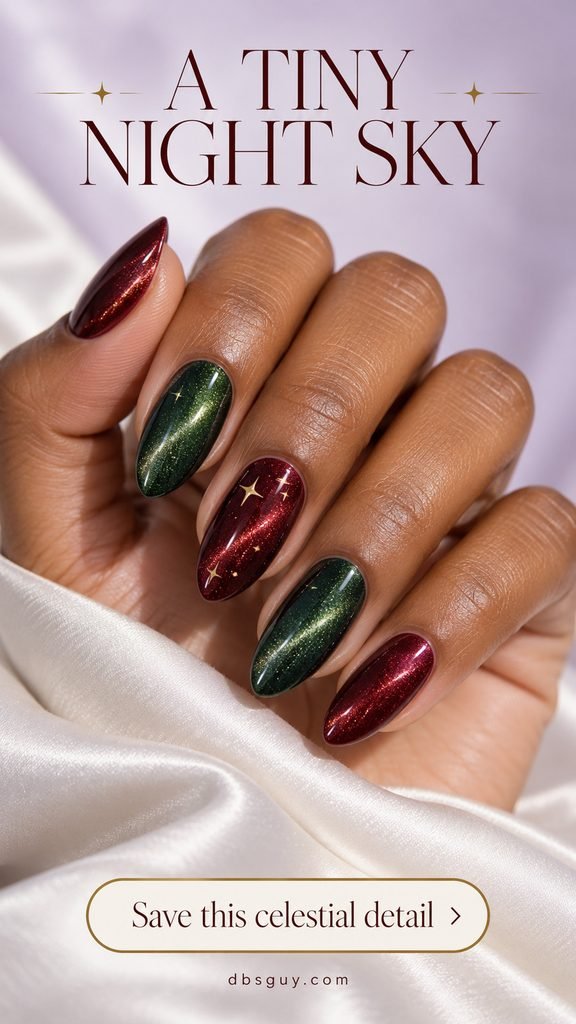
Tiny gold stars turn forest and wine nails into a quiet celestial set. Use them sparingly on a couple of accent nails, letting the other fingers show plain magnetic color. Four-point stars give a sharp little contrast to the rounded almond outline.
Place the stars beside the brightest part of the glow rather than covering it completely. On smaller nail beds, one clear star can be more effective than several crowded ones. Ask for flat painted details or thin decals if you prefer a smooth surface.
13. A Cream Bow on Burgundy Cat-Eye
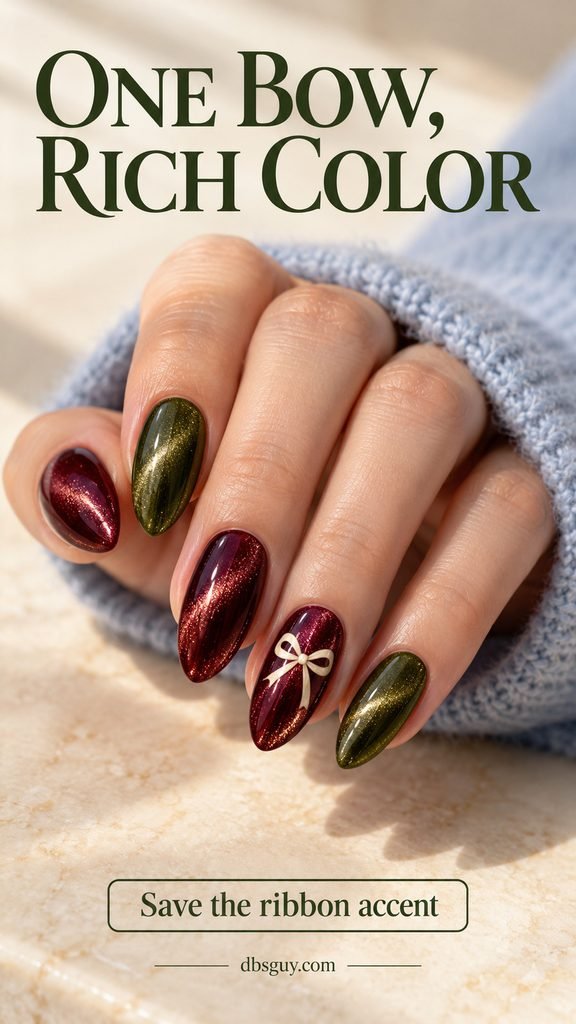
A small cream bow softens a rich burgundy ring nail. Keep olive-green cat-eye on a few surrounding fingers so the set still reads as a two-color manicure. The light bow is easy to spot against wine without needing a large charm.
Keep the ribbon compact, with two clear loops and short tails. The concept shows a bow with a little dimension; ask for a flat painted version if you prefer a smooth finish. Either way, leave magnetic shimmer visible around it, and choose warm ivory if bright white feels too stark.
14. A Botanical Accent Between Magnetic Nails
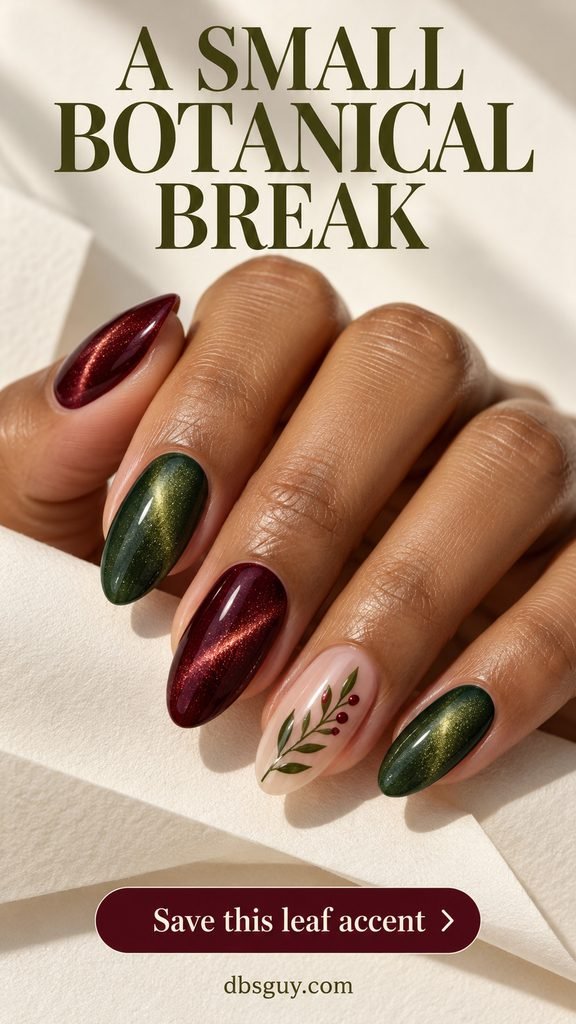
A sheer botanical nail gives the eye a break between saturated colors. Use a fine olive sprig and a few burgundy berry dots on the ring finger, then repeat those shades as magnetic polish on the other nails. The shared palette keeps the illustration connected to the set.
Keep the sprig narrow and the berries small; it should read as a little drawing, not a dense floral print. If you want an autumn feel without an obvious holiday theme, skip holly-shaped leaves, snowflakes, and extra sparkle.
15. A Large-Check Accent in Burgundy and Olive
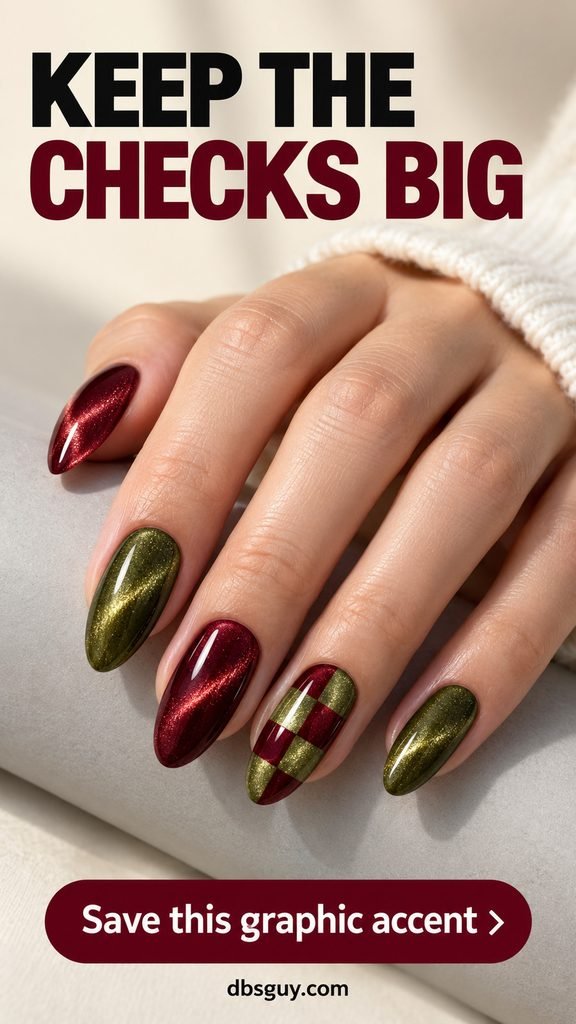
Make the checkerboard large enough to read. A ring-finger accent with a few burgundy and olive checks gives the set a graphic focal point, while the surrounding magnetic nails repeat the same shades. Tiny checks would compete with the shimmer and make the colors harder to distinguish.
Ask your artist to work out the grid on your actual nail width. The example uses a small number of broad checks; the outer squares can follow the curved almond edge. Keep the other nails free of stripes or metallic borders so the pattern has a clear place to land.
16. A Burgundy Heart on Green Cat-Eye
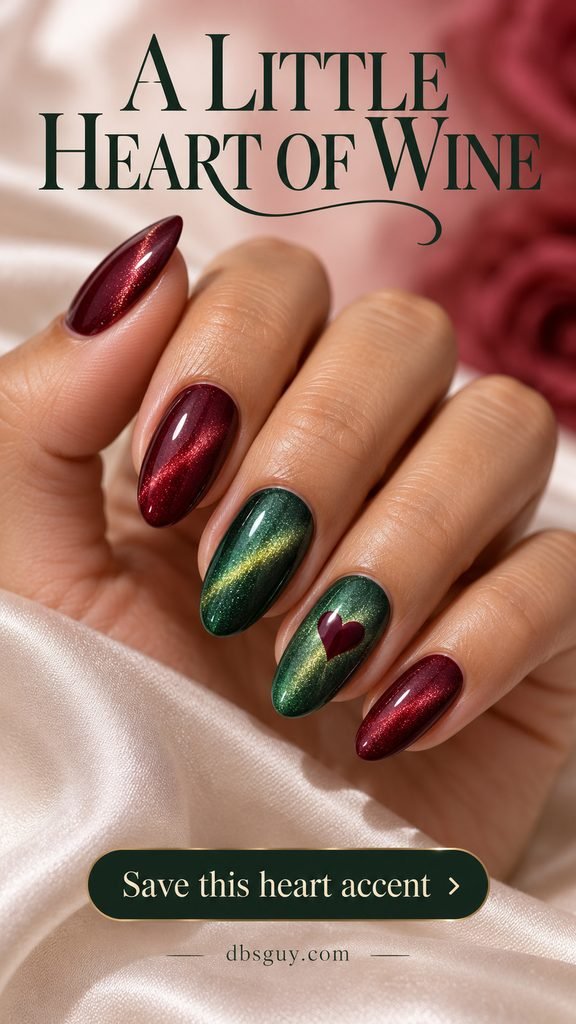
Put a small burgundy heart on one green nail for a softer accent. The shape is simple enough to recognize at a glance, and using wine instead of pink keeps it within the palette. The other nails can alternate green and burgundy magnetic color.
Leave a visible green margin around the heart so the background glow still shows. Ask for a crisp, filled-in heart with two rounded lobes and a clear point. Choose a flat painted version if you want a smooth finish, and keep its size modest on a shorter almond.
17. Tortoiseshell Beside Burgundy and Green
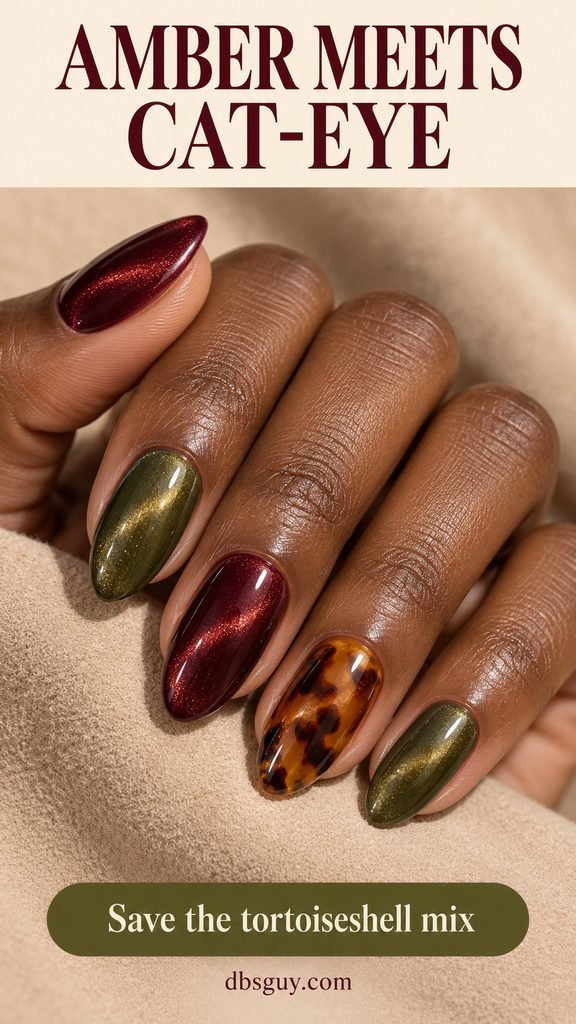
An amber tortoiseshell accent adds a third color with a purpose: it warms the wine-and-olive pairing. Keep just one nail translucent amber with irregular espresso patches, and use magnetic burgundy and green on the surrounding fingers.
Show your artist a reference for the mottling as well as the colors. Tortoiseshell should have uneven, layered-looking patches rather than a row of tidy animal spots. The amber nail does not need a magnetic finish; its translucent pattern supplies the contrast.
18. Matte Burgundy With Glossy Green Cat-Eye
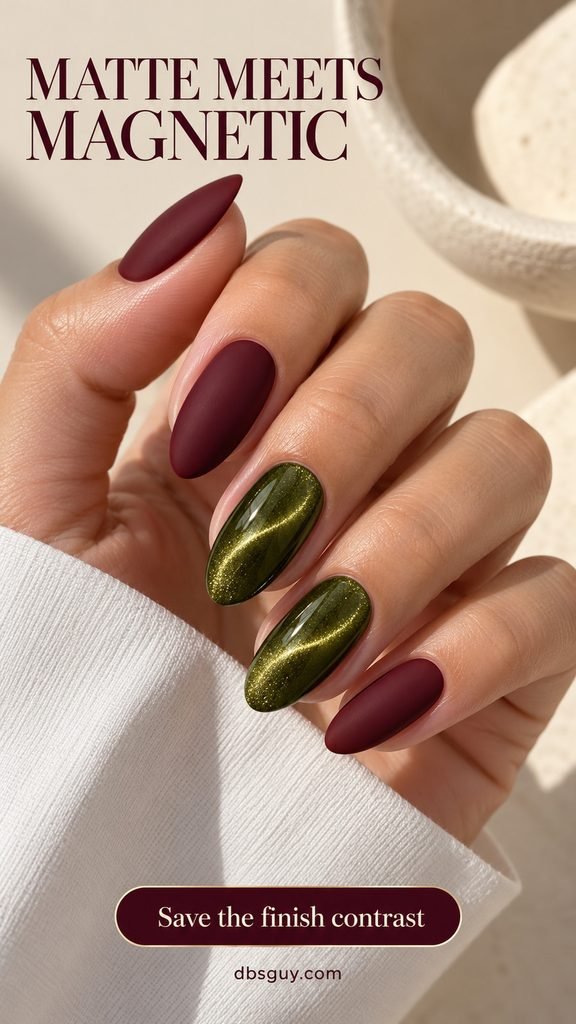
Let the finish do the mixing. Solid matte burgundy on some fingers sits beside glossy green cat-eye on others, making the shimmer easier to notice. There is no need for extra art when the surfaces already look different.
Be specific that the green nails should stay glossy and magnetic. Matte goes only on the solid burgundy portion of this design. This is worth spelling out before the final finish, since applying the same top coat across the entire hand would change the intended contrast.
19. A Tiny Green Gem on Burgundy Cat-Eye
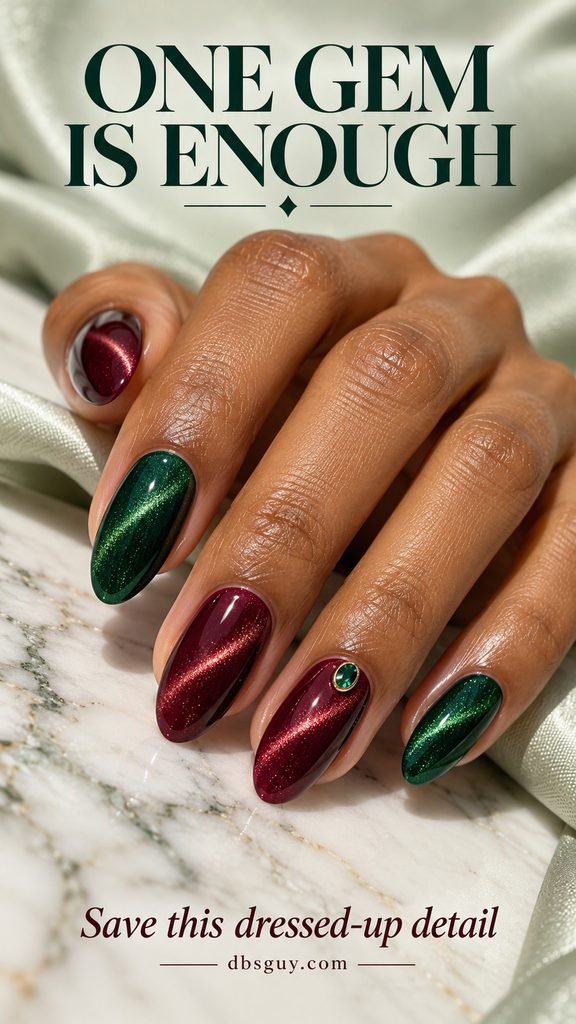
One small green gem can dress up a burgundy cat-eye nail without turning the whole set into a jeweled manicure. Place it near the base of the ring nail, with green magnetic polish on a couple of neighboring fingers to repeat the color.
Choose a low-profile embellishment and let your nail artist select a suitable attachment method. If raised details catch on your clothing or get in your way, substitute a painted green oval in a thin gold outline. Either version keeps the accent focused instead of covering the magnetic beam.
Choose Your Burgundy, Green, and Magnetic Finish
A red-leaning wine beside olive feels earthy; a deeper burgundy beside emerald looks more jewel-toned. Neither pairing is a rule for a particular skin tone. Hold the actual swatches beside your hand and look at them in daylight and indoor light before deciding.
If you have been saving olive and plum nails, check the wine shade carefully. Plum usually moves further toward purple, while this article keeps burgundy closer to a dark red-wine family. A very purple polish will change the palette even if the layout stays the same.
For fall cat eye nails with a clearly visible two-color effect, avoid choosing two shades that both look nearly black in the lighting where you will wear them. Ask for the shimmer color to work with both bases, too: a warm reflection and a cool silvery reflection can give the same layout quite different moods.
What to Ask Your Nail Artist
- Shape and length: A softly pointed almond, with the shortest comfortable length that still leaves room for your chosen art.
- Color placement: Name the fingers you want in burgundy and green, or point out the exact split, tip, or accent in your reference.
- Light pattern: Specify a narrow diagonal beam, a lengthwise line, or a broader diffused glow.
- Finish: Usually glossy; for idea 18, matte belongs only on the solid burgundy nails.
- Extra detail: Agree on the size and position of the bow, star, border, or gem before it is added.
Cat-eye polish contains magnetic particles that can be arranged while the product is still uncured. Magnet shape, orientation, and placement affect the result. Gelish’s magnetic-polish guide recommends practicing on a sample tip and hovering the magnet without touching the wet gel. Use the instructions and compatible lamp for the specific gel system rather than borrowing a universal cure time from a reference photo.
For layered or two-color designs, let your artist decide the application sequence for the products being used. Mixing ordinary gel into magnetic gel can dilute its effect; separate layers or separately placed colors are a clearer starting point than assuming every formula can be blended together in the bottle.
Questions About Burgundy and Green Cat-Eye Nails
Can short nails have an almond shape?
Yes, when there is enough free edge to taper the sides into a soft point. On very short nails, the outline may be closer to oval. Ask your artist what is practical at your current length; a reference image is a design direction, not a reason to force an unsuitable shape.
Are velvet nails and cat-eye nails the same thing?
Both can use magnetic polish. “Cat-eye” often describes a concentrated stripe of light, while “velvet” usually describes a broader, diffused glow. Salon wording varies, so show the light pattern you want instead of relying on the name alone. Neither description means the finished surface needs to feel fuzzy.
Will a magnet turn regular burgundy polish into cat-eye polish?
No. The effect needs a magnetic formula. A solid burgundy can still be part of the design, as in the matte contrast set, but it will not develop a magnetic band just because a magnet is held over it.
How can green and burgundy nails feel autumnal rather than Christmas-themed?
Choose olive, moss, or forest green with wine-red burgundy, then keep the decoration restrained. Sheer space, tortoiseshell, and simple color blocks steer the styling toward fall. Brighter red-and-green combinations with holiday symbols create a different mood.
Which design is the best starting point for a simple appointment brief?
The single olive accent is the clearest low-detail request: mostly burgundy magnetic color, one green ring nail, and a matching almond outline. If you want both colors evenly represented, take the alternating diagonal-beam reference instead. Save one favorite and one backup so your artist can adapt the idea to the shades available.
Also Read
- 19 Olive Green November Nail Ideas That Pair Beautifully With Cozy Neutrals
- 17 Negative-Space November Nail Designs for a Clean, Minimal Look
- 19 Celestial November Nail Designs for a Starry, Moody Manicure
- 21 Tortoiseshell November Nail Ideas That Look Like Polished Amber
- 31 October Nail Ideas You’ll Want to Screenshot Before Your Next Appointment