Acne rarely ends when the breakout does. The deep, under-the-skin cysts — the painful ones that sit there for days — are the ones most likely to leave something behind: dark marks, and worse, dents in the skin. Pitted acne scars are those dents, and they are one of the most stubborn forms of scarring there is. They can take months, sometimes years, to fade, and some never fully disappear on their own. When that happens, the only route to a lasting fix runs through a dermatologist’s office — a laser, a filler, or another in-office procedure.
The hopeful part is that they can improve — often a lot. Three board-certified dermatologists shared their advice on every option worth knowing about, from the ingredients you can buy over the counter to the procedures that rebuild collagen from the inside out. Here is the full picture: what pitted scars are, the three types, how to stop new ones from forming, and thirteen treatments that can soften them.
In this article: what pitted acne scars are; the three types — boxcar, ice pick and rolling; how to prevent new ones; and thirteen treatments, from salicylic acid and retinoids to Fraxel lasers, subcision and punch excisions.
Key takeaways: pitted acne scars form when deep breakouts destroy collagen and leave the skin hollowed out; treatments like microneedling, chemical peels and laser therapy can improve them by stimulating new collagen; and ingredients like salicylic acid and retinoids help manage acne and keep new scars from forming.
Meet the experts: Dr. Brendan Camp, a double board-certified dermatologist and dermatopathologist at MDCS Dermatology in New York City, specializing in medical and cosmetic dermatology; Dr. Jeriel Weitz, a board-certified dermatologist in Florida specializing in general, surgical and cosmetic dermatology; and Dr. Jessica Weiser, a board-certified dermatologist, founder of Weiser Skin MD in New York City and assistant clinical professor of dermatology at Columbia University.
What Are Pitted Acne Scars?
Pitted acne scars are the hollow, indented kind — the skin dips inward where the scar sits, because the breakout destroyed collagen underneath and the skin never fully refilled the space. That sudden loss of collagen is what gives them their concave look.
How do you get pitted acne scars? They are the opposite of raised scars. Hypertrophic scars, keloids included, come from the skin making too much collagen. Pitted scars come from damage and inflammation deep in the skin during a breakout, which carves out a small pit-like hollow in the face. The name is literal.
Types of Pitted Acne Scars
Dr. Camp says pitted scars are usually sorted into three types by how they look.
Boxcar Scars
Boxcar scars are wide dents with sharp, clearly defined edges, and they can be shallow or deep. “A good example is a chicken-pox scar,” says Dr. Camp.
Ice Pick Scars
Ice pick scars are small, narrow and deep — they plunge down into the skin like a tiny V. “Because they are deep, they tend to be difficult to treat,” says Dr. Camp.
Rolling Scars
Rolling scars are broad and shallow, with soft, sloping edges. Fibrous bands of tissue pull the skin downward, so the surface looks wavy and uneven. “They tend to be more shallow,” adds Dr. Camp.
How to Prevent Pitted Acne Scars
The simplest way to avoid pitted scars is to treat the acne before it scars. Dr. Weitz explains the chain reaction: “Scarring from acne is caused by the inflammatory response that occurs in response to acne lesions.” So the best prevention is dealing with breakouts properly and promptly — putting off treatment only raises the odds of scarring. Picking or squeezing spots makes it worse, because it drives up inflammation and the risk of a scar. Dr. Weitz’s advice is to see a board-certified dermatologist as soon as you can, so they can build a treatment plan for your acne.
How to Get Rid of Pitted Acne Scars
Dr. Camp frames the problem plainly: acne scars are “depressions in the skin as a result of prior inflammation,” and they can change the skin’s appearance, contour and texture. Fixing them means either making new collagen to correct the atrophy an acne scar leaves behind, or breaking up the scar tissue that tethers the skin down and creates the indentation. Left alone, pitted scars fade slowly — sometimes never completely — and the dent itself usually will not fill in on its own, though the discoloration around it can improve with time. Here are the treatments that can fade them, from the bathroom cabinet to the clinic.
01. Salicylic Acid
Salicylic acid is a beta hydroxy acid (BHA), and it has a useful quirk: it is lipophilic, meaning it likes to mingle with oils. That lets it travel deep into pores and clear them out. Alpha hydroxy acids (AHAs) such as glycolic and lactic acids are hydrophilic, so they do not get into pores as well — but they are good at sweeping away dead skin on the surface and keeping pores from clogging. Dr. Camp suggests a gentle salicylic-acid face cleanser that can be used on the face, shoulders and back. The products the article recommends are CeraVe SA Body Wash for Rough & Bumpy Skin or Paula’s Choice Weightless Body Treatment 2% BHA for the body, and La Roche-Posay Effaclar Medicated Acne Face Wash for the face.
02. Retinoids
Retinoids work on acne by regulating — normalizing — the process of cell turnover, which keeps pores from getting blocked. Over the long term, they are also thought to help the skin make collagen. “The long-term use of retinoids is thought to help with collagen production,” says Dr. Camp. His over-the-counter pick is Differin Adapalene Gel, which used to need a prescription and is now available without one.
03. Chemical Peels
A chemical peel uses a chemical solution to exfoliate the top layer of skin and prompt fresh collagen underneath. A good one, Dr. Camp says, “can expose fresh, healthy tissue” and stimulate new collagen production, so pitted scars look less pronounced. Dr. Weitz adds that resurfacing procedures — resurfacing lasers, chemical peels and dermabrasion — are all effective options, as are microneedling and even radiofrequency devices, all of which work by stimulating new collagen production. Peels have a reputation for being harsh, but done properly they are painless and give a deep exfoliation.
04. Microneedling with Radio Frequency
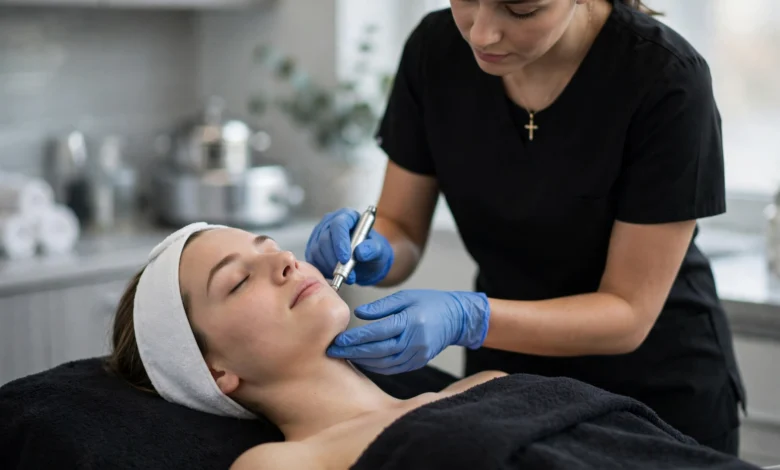
Microneedling makes tiny, narrow, superficial areas of mechanical injury in the skin, and the repair response that follows ramps up collagen production and improves how scars look. Add radiofrequency energy and the treatment gets a little more aggressive — the energy reaches deeper into the skin to trigger a stronger inflammatory and collagen response.
05. Accutane
Isotretinoin — better known as Accutane — is a common and potent prescription medication that targets oil production, inflammation and the growth of acne-causing bacteria, and it is often prescribed for moderate-to-severe acne that has not responded to other treatments. When other treatments have failed and been exhausted, Dr. Camp says isotretinoin can provide a durable remission in scarring acne. It is not a casual prescription: only start it under the guidance of your board-certified dermatologist, and go into the appointment knowing something about its potential side effects.
06. Fraxel Lasers
Fraxel lasers come in two forms. Non-ablative Fraxel sends columns of heat beneath the skin while leaving the surface intact; ablative Fraxel is more aggressive and removes a narrow column of skin, according to Dr. Camp. The gentler non-ablative kind is much less invasive than the ablative kind — but it takes multiple treatments to get there.
07. Subcision Procedure
Subcision is an in-office procedure, done by a dermatologist, that breaks up the cord of scar tissue tethering the skin down and creating the depression — the “pitted” part of the scar. A needle goes into the skin to break that collagen cord, releasing the tether so the skin can rise. One warning from Dr. Camp: it can cause bruising.
08. Acne Gel
For a simpler over-the-counter step, Dr. Camp recommends looking for acne gels that work on the whole face or as a spot treatment. Check the formula for azelaic acid and salicylic acid together — the pair gives extra exfoliation and helps reveal a smoother skin surface.
09. Fillers
Injectable fillers, such as those made with hyaluronic acid, can push out and plump up puckered skin to make it more even. Dr. Camp explains that hyaluronic acid “is a natural component of the extracellular matrix, the gel that surrounds skin cells and adjoining structures.” Other filler options include Sculptra (poly-L-lactic acid), autologous fat transfer, and FDA-approved Bellafill (polymethyl methacrylate microspheres with collagen).
10. Dermabrasion
Dermabrasion works along similar lines to a chemical peel, but instead of a liquid chemical it uses an abrasive, exfoliating material to remove the top layer of skin. It comes in varying depths, and it can also help limit breakouts and cut down excess oil in the pores.
11. Radio Frequency
Skin tightening with radiofrequency can help reduce the look of pitted scars by stimulating collagen production. The treatment creates kinetic energy that triggers the body’s healing process, and the skin responds by producing additional collagen, which helps soften the appearance of the scars.
12. TCA CROSS
TCA CROSS stands for Trichloroacetic Acid Chemical Reconstruction of Skin Scars. It is a type of chemical peel procedure used to treat acne scarring, and Dr. Weiser says icepick scars in particular may benefit from it. The dermatologist places trichloroacetic acid (TCA) into the depth of the scars to slowly induce a healing response, which closes off the depth of the scar.
13. Punch Excisions
Punch excision is a surgical option for ice pick scars. The scar is removed with a small excision or punch tool and the skin is stitched closed, so the acne scar is replaced with one that is smaller and less noticeable, as Dr. Camp describes it. Tiny cylinders of skin are removed to stimulate a wound healing response, adds Dr. Weiser. She also notes that the procedure has become less popular over time in favor of laser, which causes a “better tissue contraction and aesthetic result.”
The bottom line from the three dermatologists is consistent: pitted scars are stubborn, but they are not permanent in the way they first appear. Over-the-counter ingredients can help, in-office procedures can do more, and the earlier you treat the acne itself, the fewer scars you will have to chase later. If you are weighing any of the procedures above, the first step is a conversation with a board-certified dermatologist, who can look at your skin in person and talk through which option fits your scars.