Walking Pad in a Dorm Room: Is It Worth It? (Noise, Space & Storage)

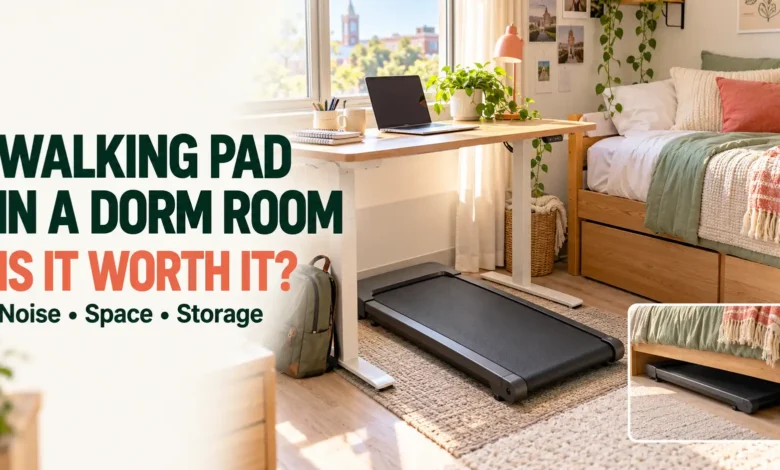
A walking pad in a dorm room can be worth it if your housing rules allow it, the noise works for the people around you, and you have room to use and store it safely. If any of those conditions fails, its small size will not solve the problem. A shared room where someone needs to sleep while you walk is a poor place to start.
The useful purchase is the one you can bring out, walk on, and put away during an ordinary school week. Before comparing motors or chasing a sale, work through the checks below.
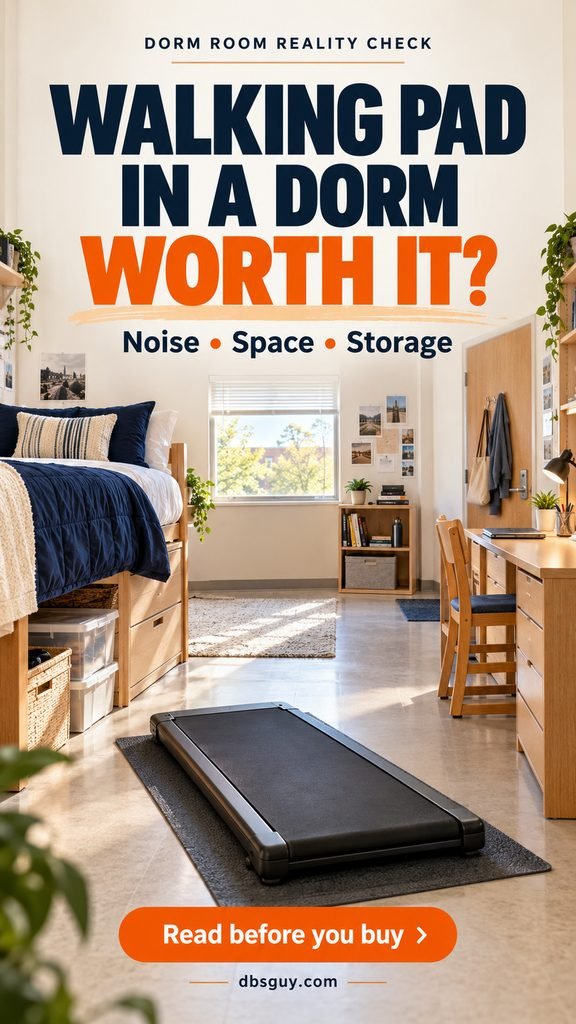
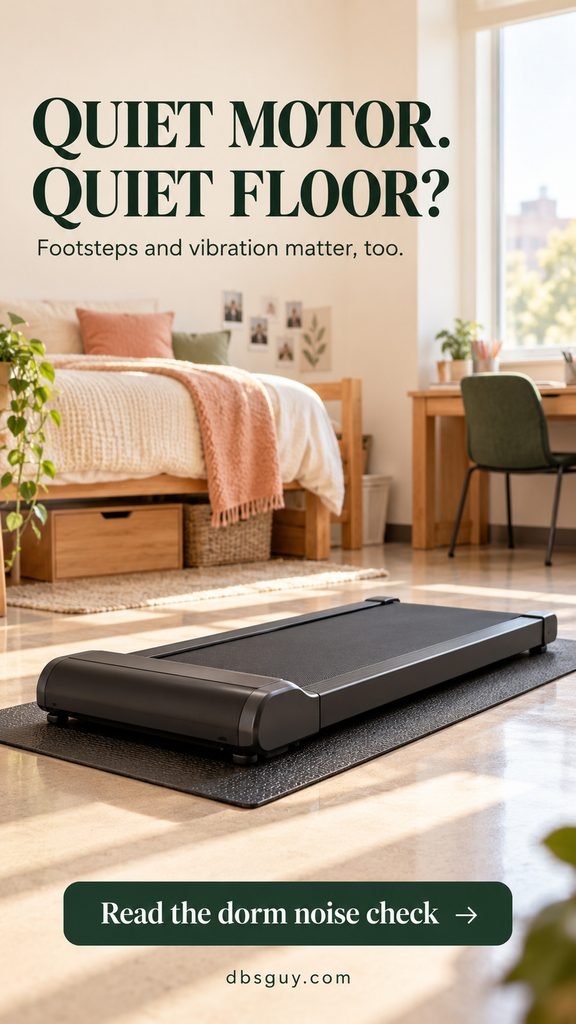
The visuals are AI-generated concepts illustrating noise, measurement, and storage considerations. They do not show a tested product or certify a room layout.
Start with the dorm rules, before you buy
Check your current housing agreement and prohibited-items list for walking pads, treadmills, motorized exercise equipment, and fitness machines. A compact machine may still fall under a broader ban. For example, Ramapo College explicitly lists treadmills and walking pads among prohibited large exercise equipment in campus housing.
If the policy is unclear, send housing staff the exact model and ask: “Is this motorized walking pad permitted in my residence hall, and are there restrictions on where or when I can use it?” Keep the answer. A roommate agreeing to it does not replace housing permission.
Check quiet hours, courtesy-noise rules, electrical requirements, and any extra restrictions during exams. Permission to own a machine does not mean permission to disturb another room. If it is prohibited, use an appropriate campus fitness space or a walking route instead of planning to hide it under the bed.
Noise: a quiet motor does not tell you what the floor carries
There are two sounds to consider: the motor and belt you hear in the room, and the repeating footstep impacts and vibration that may travel through the building. A walking pad that sounds acceptable beside your desk can still bother someone below you.
Manufacturer noise figures are not a reliable promise for your dorm unless you know the testing conditions. Speed, the person walking, flooring, and the machine’s condition all matter. There is no single decibel number that makes every walking pad suitable for shared housing.
Use a short, agreed noise check
If housing permits the machine, arrange a brief daytime check while you are still within a return window that actually allows the kind of use involved. Read the seller’s terms first; a return period is not automatically a free trial.
- Set it up as instructed. Use a firm, level surface and a compatible treadmill mat if the manufacturer permits one. Keep the mat flat. Do not try to solve vibration by balancing the machine on folded blankets or a pile of soft mats.
- Learn the stop control first. Begin at the manufacturer’s starting speed, without studying at the same time. Once comfortable, check the walking pace you intend to use.
- Have your roommate do a normal task. Ask them to read or sit at their desk for about five minutes, rather than judge from a quick listen at the doorway. If a downstairs neighbor is willing, arrange a listening check with them too.
- Agree on a decision. If the thumping is distracting, stop. Try only manufacturer-approved setup changes and reassess. If it still disrupts someone, that room has failed the check.
A suitable mat may reduce some vibration; it does not soundproof the floor. Likewise, headphones on your head do not make the room quieter for your roommate. Agree on usable times, including naps and exam study, before making the purchase part of your routine.
Also Read: Dorm Yoga for Beginners: Quiet Flows for Tiny Spaces for seated and mat-based options when a motorized machine does not suit your room.
Space: measure the operating area, not just the belt
Product listings often show a walking-surface measurement and a larger overall measurement. Use the full machine dimensions when marking the floor, then add every clearance required by the exact model’s manual.
For scale, WalkingPad’s U.S. A1 Pro listing gives an unfolded size of 56.5 inches long by 21.5 inches wide by 5 inches high and a net weight of 63 pounds. That is one model’s specification, not a standard size or a recommendation to buy it.
Clearance can change the fit completely. One manufacturer-issued A1 Pro manual specifies at least 1,000 mm, or about 39 inches, behind the machine and 500 mm, or about 20 inches, on each side. Check the manual supplied for your version; do not apply those figures to another model.
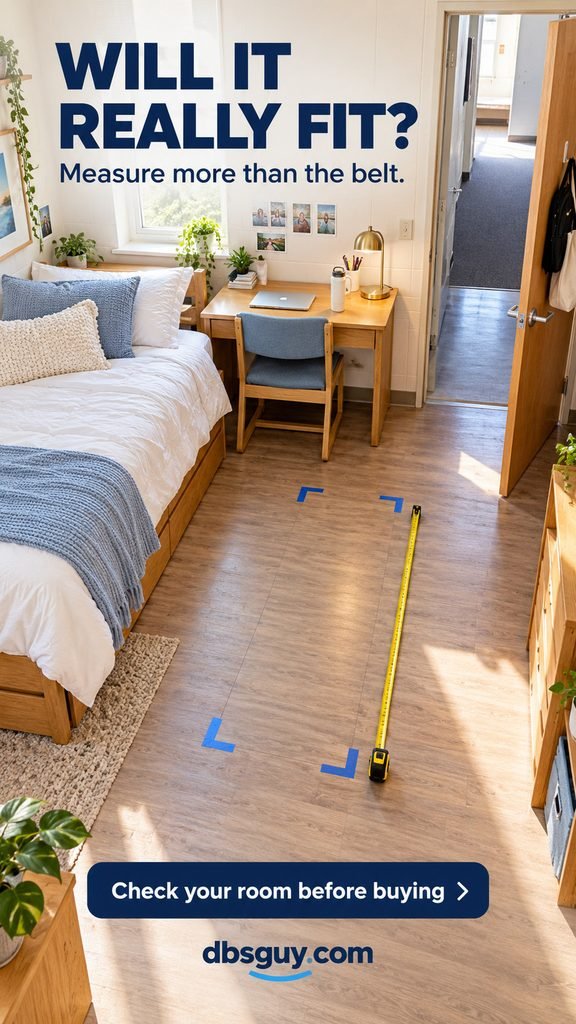
Make a floor mock-up before ordering
With housing-approved removable tape, mark the machine’s outside corners. Separately mark its required clearance zones. Then open the door fully, pull out your chair, and check access to the closet, bed, and exit. Ask your roommate to check their usual route too.
The taped rectangle is only the first measurement. If the required clear area overlaps a bed, dresser, or everyday walkway, choose another location or skip the machine. Plan where your desk chair will go while you walk; moving it into the doorway creates another problem.
For studying, check that the machine fits between the desk supports and that your work surface adjusts high enough after the deck raises your standing position. A fixed-height dorm desk may not work. Include a suitable desk or approved converter in the budget instead of improvising an unstable laptop platform.
Start by walking without another task. If you later combine walking with light reading or listening, slow down or stop whenever balance, attention, or screen comfort suffers. Detailed handwriting and demanding coursework may be better done sitting down.
Storage: check the whole trip under the bed
“Fits under a bed” needs three measurements: the machine’s stored height, its stored width, and the uninterrupted depth available beneath your bed. Use the folded dimensions only if the walking deck actually folds. A folding handrail alone does not shorten a rigid deck.

- Measure the lowest obstruction. Look beneath the side rail for center supports, crossbars, drawers, and anything else lower than the visible bed opening.
- Check the entrance and turning room. The machine must get into the opening, not merely fit in the empty space once there. Leave enough room to move it without scraping the frame or trapping the cord.
- Confirm the storage position. Store it upright only when the instructions explicitly permit that position and explain the required supports or locks. “Foldable” does not mean safe to lean against a wall.
- Account for the weight. Transport wheels can help on a clear floor, but they do not eliminate lifting at thresholds, turns, or stairs. Consider who will move it out at the end of the semester.
Finish each session with the belt fully stopped, then switch off and unplug the machine as instructed before moving or folding it. Follow any model-specific cooling and handling directions. Keep the cord out of the walkway, and never run the machine while it is under the bed.
Try the storage routine as soon as permitted by your return terms. If putting it away means emptying your under-bed bins every afternoon, count that inconvenience honestly. Storage that works only on move-in day is unlikely to work during finals.
Value: pay for a routine you can actually use
A walking pad makes the strongest case when indoor walking solves a real gap: bad weather keeps you inside, the campus gym is difficult to reach between classes, or you regularly have an agreed daytime window in your room. It offers less value if you already walk comfortably around campus and mainly want a machine because a room-setup video looked appealing.
Add up the complete cost
Include the machine, a compatible mat, any necessary desk adjustment, taxes, delivery, maintenance supplies, and potential return shipping. Check whether the seller accepts used returns and requires the original packaging. Decide where that packaging would live in a dorm.
Illustrative budget, not current pricing: a $300 machine, $40 mat, and $160 desk solution total $500 before tax or other costs. Across 100 sessions, that is $5 per session; across 20, it is $25. Replace those amounts with actual quotes and a realistic number of sessions before your next move.
Before spending, try putting a short walking break into your schedule for a week using a permitted campus route or fitness facility. This editorial suggestion checks whether the missing piece is indoor equipment, available time, or a routine you enjoy.
Check the exact model for safety warnings
Search by brand and model, especially for a used machine. On April 16, 2026, the U.S. Consumer Product Safety Commission issued a stop-use warning for Sperax walking pads and treadmills, including models Pro, Q1, RM-01, and RM-02, because of fall, burn, and fire hazards. The agency advises owners to stop using the affected products and not sell or give them away.
For any model you consider, check the stated user-weight limit, walking area, starting speed, stopping method, maintenance instructions, and seller support. If you need a handrail for steadiness, make that a requirement before considering a rail-free under-desk design.
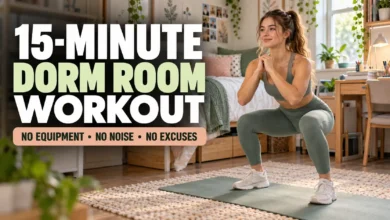
Also Read: 15-Minute Dorm Room Workout: No Equipment, No Noise, No Excuses for a movement option that avoids buying a motorized machine. Check its space needs and your hall’s noise rules too.
So, is a dorm walking pad worth it for you?
Consider buying only when all of these are true: housing permits it; the room accommodates the required operating clearance; the sound is acceptable to the people affected; storage is manageable; and you can afford the complete setup for a routine you expect to use.
Wait if you have not moved into the room, measured the bed, or spoken with your roommate. Those answers can change which machine fits—or whether any machine makes sense.
Skip it if the equipment is prohibited, your only walking time overlaps someone else’s sleep, or safe clearance would consume the room’s shared access. In those situations, a campus walking route or suitable fitness space solves more problems than a smaller treadmill.
Questions to settle before bringing one to campus
Can a walking pad go on dorm carpet?
Check the exact model’s instructions for carpet, mats, and ventilation requirements. Keep the machine supported on a level, stable surface with its required openings unobstructed. A soft carpet or rug is not automatically a suitable base, and carpet does not establish that downstairs noise will be acceptable.
Can I store any walking pad vertically?
No. Storage orientation is model-specific. For example, the A1 Pro manual reviewed here prohibits vertical and side placement, while WalkingPad identifies other models as designed for upright storage. Follow the instructions for the machine you actually own.
Will slow walking replace my workouts?
Slow desk walking can add movement, but it may not reach moderate aerobic intensity. CDC guidance calls for at least 150 minutes of moderate-intensity activity a week and muscle-strengthening activity on two days. Its talk-test guide describes moderate effort as being able to talk but not sing. A step total alone does not tell you the intensity.
What if my roommate changes their mind after I buy it?
Pause use and discuss what is disrupting them: timing, audible hum, floor thumps, or lost space. Ask housing staff to help resolve disagreements when needed. A shared-room purchase needs a workable shared-room routine; owning the equipment does not settle that conversation.