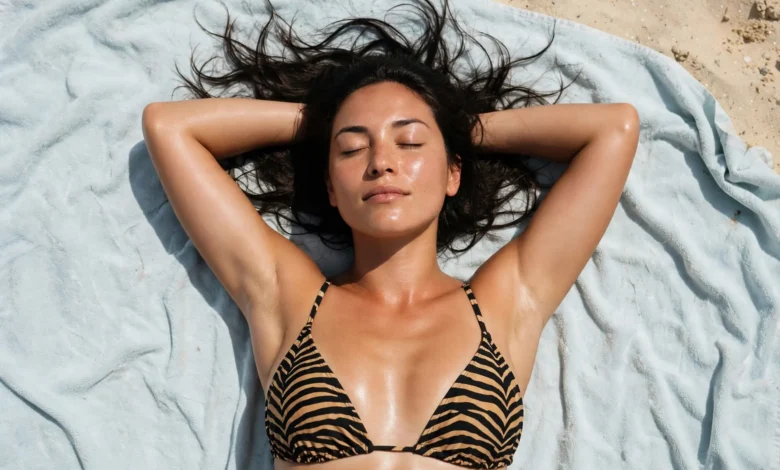
Every family seems to have its own old wives’ tale about getting a golden glow — baking in the sun for hours, or smoothing on cooking oil to “accelerate” the tan. If baby oil is a bottle you remember from your parents’ bathroom cabinet, you are not alone: it has been linked with tanning for decades. But before you reach for it, or before you try it for the first time, there are a few things worth knowing — starting with the spoiler that it does not protect your skin at all, and that using it this way is genuinely dangerous. Byrdie’s Beth Krietsch asked top dermatologists to weigh in on baby oil for tanning: whether it is safe, what the risks are, and how to get a tan safely instead.
Meet the Experts
The dermatologists behind the advice in this piece are Dr. Shari Sperling, DO, a board-certified dermatologist at Schweiger Dermatology Group in Florham Park, New Jersey; Dr. Joshua Zeichner, MD, a board-certified dermatologist and the director of cosmetic and clinical research at Mount Sinai Hospital; and Dr. Susan Massick, MD, a board-certified dermatologist and associate professor of dermatology at The Ohio State University Wexner Medical Center.
What Is Baby Oil?
Baby oil is made mostly of an odorless product called mineral oil, with a little fragrance mixed in. If you grew up around it, you could probably pick out its distinct scent and texture from a mile away. A gentle, fragrance-free baby oil is often recommended for people with sensitive skin — but as the name suggests, it is meant as a moisturizer for babies, not as a tanning aid. It contains no sunscreen and no SPF of any kind, so it offers no protection whatsoever from the sun’s harmful rays.
Why Is Baby Oil Used for Tanning?
According to the American Academy of Dermatology, tanning is your body’s way of responding to too much ultraviolet (UV) light. Step out into the sun and your body produces melanin, the pigment that gives skin its color and darkens to shield it from harmful rays. The darker your skin tone, the more melanin your body has and the less likely you are to burn; fair-skinned people produce less melanin and are more prone to burning.
Baby oil’s main ingredient, mineral oil, is used as an emollient in skincare products: it creates a barrier on the skin that locks in moisture, and it is a key ingredient in many tanning oils. Used for tanning, its job is to speed the process along by magnifying UV rays while keeping the skin moisturized in the sun. It is also a moisturizer, so it can make skin look shiny and dewy in photos — which can read as a glow — and it helps a tan develop faster because it acts as a magnifier for UV rays. As Dr. Shari Sperling, a board-certified dermatologist, puts it, the oil “can act like a magnifying glass” and intensify UV radiation, so the skin absorbs more UV rays.
It is often used alongside other tanning oils and lotions, or on its own as a standalone tanning product. It is also a cheaper alternative to tanning oils, which are often marketed as “tanning accelerators” and can be expensive. Baby oil is used as a tanning aid because people believe it helps you tan faster — but it is not a safe or effective way to tan.
Is It Safe to Use Baby Oil for Tanning?
No. Using baby oil for tanning is not safe — in fact, it is not safe to use as a tanning aid at all. “Baby oil is not safe for tanning,” says Dr. Shari Marchbein, a board-certified dermatologist in New York City. Baby oil contains mineral oil, which is a petroleum derivative — a byproduct of petroleum that is often used in skincare products as a moisturizer, but is not safe to use as a tanning aid.
“It’s important to note that there is no safe way to tan,” says Dr. Joshua Zeichner, a board-certified dermatologist in New York City. Any tan is a sign of skin damage, and tanning can lead to skin cancer and premature aging. Baby oil provides no sun protection, so it can actually increase your risk of sunburn and skin damage. Dr. Shari Sperling, a board-certified dermatologist, makes the same point plainly: baby oil is not a sunscreen, it gives no sun protection, and it can increase your risk of sunburn and skin damage.
There are no benefits to using baby oil for tanning, and there are many risks. It is not a safe or effective way to tan, and it should not be used as a tanning aid.
Key Takeaways
- Baby oil is not a safe tanning aid, and it provides no sun protection.
- Using baby oil for tanning can raise your risk of sunburn, skin damage and skin cancer.
- There is no safe way to tan — the safest way to get a tan is a self-tanner or a spray tan.
Risks of Tanning With Baby Oil
In short, the answer is no — baby oil is not a safe way to tan. If you are still considering it, here are the risks to know about before slathering it on.
Skin damage and pigment changes: Exposure to UV rays can lead to skin damage and pigment changes. The damage can be permanent, and can lead to premature aging and skin cancer, while the pigment changes can cause uneven skin tone and dark spots. “One of the biggest risks of using baby oil for tanning is that it can increase your risk of skin damage,” says Dr. Shari Marchbein. Baby oil is a moisturizer, but it contains no sunscreen, so it does not protect your skin from UV rays — and it can act like a magnifying glass and intensify them, leading to more skin damage. The pigment changes can also be permanent: dark spots are caused by an increase in melanin production, your body’s way of trying to protect skin from UV rays, and they can be difficult to treat and may require medical intervention.
Increased risk of skin cancer: Skin cancer is the most common type of cancer in the United States, and it is also one of the most preventable. The risk rises with UV exposure, and using baby oil for tanning can raise it further. Having fair skin, a family history of skin cancer, and a history of sunburns also increases the risk. “The risk of skin cancer is increased by exposure to UV rays,” says Dr. Joshua Zeichner. “Using baby oil for tanning can increase your risk of skin cancer, as it can intensify UV rays and cause more skin damage.” Dr. Shari Sperling adds that if you have any of these risk factors, you should be extra careful about sun exposure and use a broad-spectrum sunscreen with an SPF of 30 or higher. According to the Skin Cancer Foundation, just five or more sunburns can double your risk of developing melanoma, the deadliest form of skin cancer.
Premature aging: UV rays can cause premature aging, including wrinkles, fine lines and age spots. The damage can be permanent and can make you look older than you are. It is caused by the breakdown of collagen and elastin, the proteins that keep your skin firm and elastic. “UV rays can cause premature aging,” says Dr. Shari Marchbein. “The damage can be permanent and can make you look older than you are.” Dr. Joshua Zeichner explains that the damage comes from the breakdown of collagen and elastin, and that using baby oil for tanning can increase your risk of premature aging because it intensifies UV rays. “About 80% of skin aging is due to sun exposure,” says Dr. Shari Farber, a board-certified dermatologist — and baby oil only adds to that exposure.
A higher chance of getting a sunburn: Using baby oil for tanning can also increase your risk of getting a sunburn. A sunburn is a sign of skin damage, and it can be painful and uncomfortable — and it can also increase your risk of skin cancer and premature aging. “Using baby oil for tanning can increase your risk of getting a sunburn,” says Dr. Shari Sperling. “A sunburn is a sign of skin damage, and it can be painful and uncomfortable.” Dr. Joshua Zeichner adds that a sunburn can also increase your risk of skin cancer and premature aging, and that baby oil raises the chance of burning because it intensifies UV rays.
Baby Oil vs. Natural Oils for Tanning
Natural oils such as coconut oil, olive oil, jojoba oil, sesame oil, sunflower oil, almond oil, argan oil and avocado oil are often used as tanning aids because they are thought to help you tan faster. But natural oils are not safe to use as tanning aids either. “Natural oils are not safe to use as tanning aids,” says Dr. Shari Sperling. “They do not provide any sun protection, so they can actually increase your risk of sunburn and skin damage.” Dr. Joshua Zeichner adds that natural oils can also clog your pores and cause breakouts, and can cause allergic reactions in some people. “The only safe way to tan is to use a self-tanner or get a spray tan,” says Dr. Shari Marchbein. “Self-tanners and spray tans do not involve UV exposure, so they are a safe way to get a tan.”
Baby Oil vs. Tanning Oil
Tanning oil is marketed as a tanning aid and is often used in combination with baby oil. It is typically made with a combination of oils, such as coconut oil, olive oil and jojoba oil, and it often contains a low SPF, such as SPF 4. But tanning oil is not safe to use as a tanning aid either. “Tanning oil is not safe to use as a tanning aid,” says Dr. Shari Sperling. “It does not provide adequate sun protection, so it can actually increase your risk of sunburn and skin damage.” Dr. Joshua Zeichner points out that tanning oil often contains a low SPF, such as SPF 4, which is not enough to protect your skin from UV rays — you should use a broad-spectrum sunscreen with an SPF of 30 or higher. Dr. Shari Marchbein adds that tanning oil can also clog your pores and cause breakouts, and can cause allergic reactions in some people.
Byrdie Tip: Always wear a broad-spectrum sunscreen with at least SPF 30 when you’re in the sun, and reapply it every two hours — or after swimming or sweating.
Can You Wear Baby Oil Over Sunscreen?
“You should not wear baby oil over sunscreen,” says Dr. Shari Sperling. Baby oil can break down sunscreen and make it less effective, so it can actually increase your risk of sunburn and skin damage. Dr. Joshua Zeichner adds that baby oil can also clog your pores and cause breakouts, and can cause allergic reactions in some people. “The best way to protect your skin from UV rays is to use a broad-spectrum sunscreen with an SPF of 30 or higher,” says Dr. Shari Marchbein. “You should reapply sunscreen every two hours, or after swimming or sweating.” And if you are going to be in the sun for an extended period, Dr. Susan Massick, MD, a board-certified dermatologist and associate professor of dermatology at The Ohio State University Wexner Medical Center, advises wearing protective clothing such as a hat and sunglasses, seeking shade whenever possible, and avoiding the sun during peak hours, which are typically between 10 a.m. and 4 p.m.
The Takeaway
There is no such thing as a safe tan — even if you’re wearing SPF. Swapping your sunscreen for baby oil will only make matters worse. Baby oil does cause the skin to tan faster, but using it for tanning significantly increases your chances of premature skin aging and, more importantly, life-threatening skin cancers. There is absolutely no instance where anyone — of any skin tone — should use baby oil for tanning. Give up tanning altogether, and if you want the glow, reach for a self-tanner or a spray tan instead.
Why Trust Byrdie
Byrdie contributor Beth Krietsch has spent the past eight years writing about health, nutrition and beauty. She has interviewed many leading health and beauty experts, including dermatologists, and has written hundreds of health, beauty and wellness articles. She is a big fan of the sun — but only when wearing high SPF and a wide-brim hat.
Article Sources
American Academy of Dermatology Association, “Tanning” (last revised November 15, 2023; accessed March 11, 2026). Skin Cancer Foundation, “Sunburn & Your Skin” (last revised October 2023; accessed March 11, 2026). American Cancer Society, “Ultraviolet (UV) Radiation” (last revised November 4, 2025; accessed March 11, 2026).