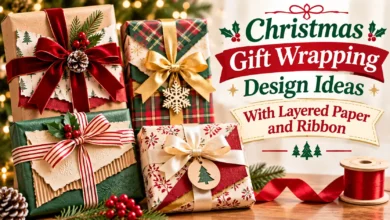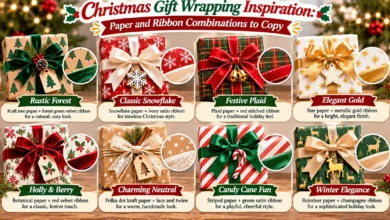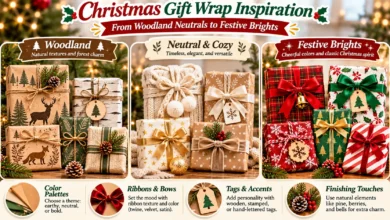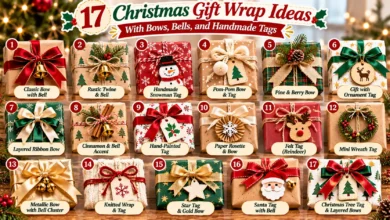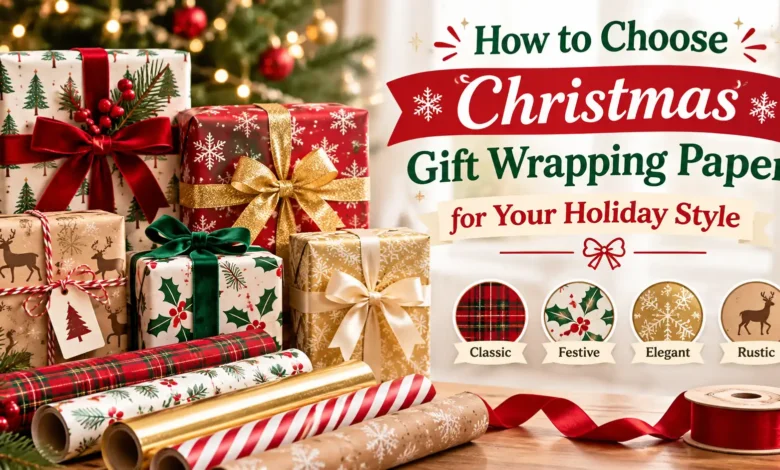
Choose Christmas gift wrapping paper in this order: a color you want to repeat, a print that suits the recipient, a finish you can fold neatly, and a sheet size that covers the box. For a coordinated pile under the tree, one patterned paper and one matching solid are a useful starting point. You can carry the same ribbon across both.
The prettiest roll in the store can still be too narrow, too see-through, or awkward on a tiny package. Here’s how to choose paper that fits your holiday style and the presents you actually need to wrap.

The visuals are AI-generated styling concepts, created to illustrate paper choices and proportions rather than document tested products.
Start With a Color You Already Want to Use
Look at the ribbon, ornaments, or gift tags you already own before choosing new paper. Pick one color worth repeating. It might be the cranberry in your stockings, the green in a favorite ribbon, or simply a blue the recipient loves.
Take a ribbon offcut shopping or hold it beside a paper sample at home. A photo is helpful, but a physical comparison makes differences between cream and bright white, or burgundy and scarlet, easier to judge. Check the combination in daylight and under the lights where the gifts will sit.
If the presents are leaving your house immediately, let the recipient’s taste guide the choice. A paper that makes someone smile has a good reason to be there, even if it does not match your tree.
Choose a Paper That Suits Your Holiday Mood
Use these four directions to narrow the shelves. Each starts with the paper; ribbon and tags finish the choice without requiring a whole new collection of supplies.
Classic: Tartan With a Solid Companion

Choose a cranberry-and-evergreen tartan if you enjoy familiar Christmas colors and a little pattern. Look at the actual checks: a plaid with plenty of dark green feels different from one dominated by bright red.
Pair the tartan with solid cranberry paper for the rest of the pile. Repeat plain cranberry grosgrain ribbon on both, and use cream tags so names stay easy to read. The solid parcel gives your eye a quieter place to land beside the checks.
When comparing plaids, picture the size of your smallest box. A very wide check can become a few disconnected stripes once folded. For ways to carry that ribbon elsewhere in the room, see Red Bow Christmas Decor: 25 Ideas for Trees, Garlands & Gifts.
Minimalist: Opaque Ivory With One Clear Accent
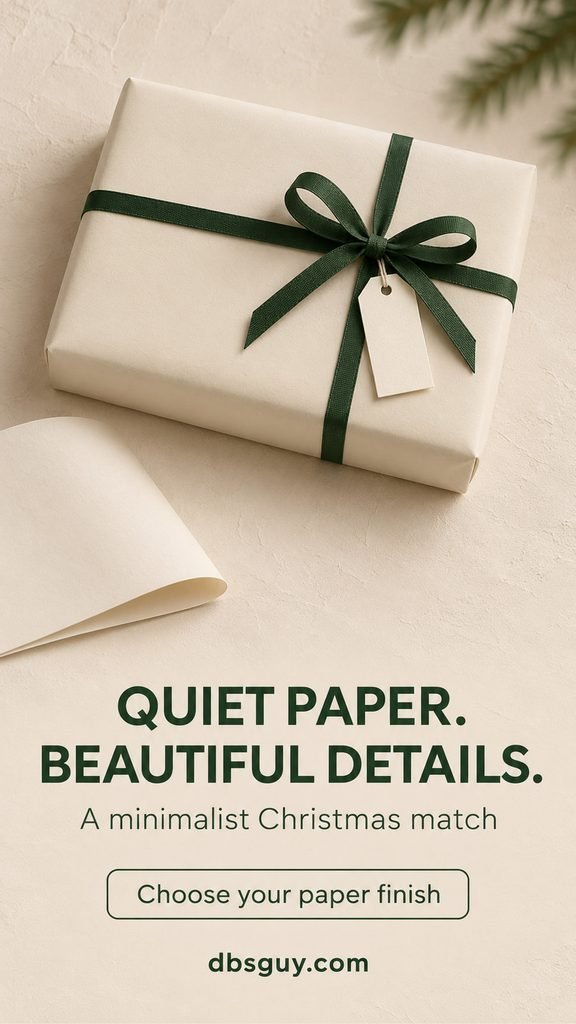
Plain matte ivory paper makes the shape of the package and the ribbon easy to see. It suits a small gift collection, a quiet holiday room, or someone who prefers very little decoration. Narrow forest-green ribbon gives it a Christmas reference without filling the lid.
Check opacity before committing to pale paper. If dark lettering on the box shows through, use a plain outer gift box or choose a more opaque wrap. Extra layers of thin paper add folds and use more material.
Keep the tag close to the paper color and let the green supply the contrast. The example uses an off-center bow, leaving a generous area of ivory visible.
Woodland: Kraft With a Fine Botanical Print
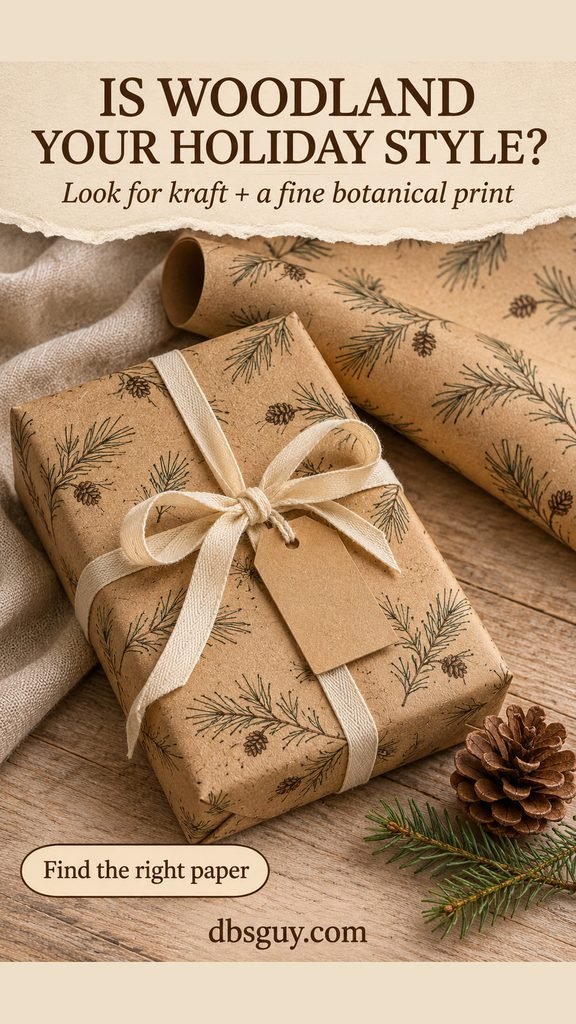
For a warm, natural look, choose brown kraft paper with a restrained pine-needle or pinecone print. A fine dark-green design leaves the brown background visible; dense, oversized foliage creates a busier effect.
Ivory cotton ribbon adds softness against the paper’s texture. This is a useful direction if your decorations include wood, woven baskets, or cream textiles. It also leaves room for a handwritten tag without another ornament tied on top.
Brown paper varies in stiffness. Choose wrapping paper that bends comfortably around your boxes, and test a small end fold when you have a sample. Heavy packing paper can feel bulky on a shallow book box.
Playful: A Favorite Motif in a Simple Palette
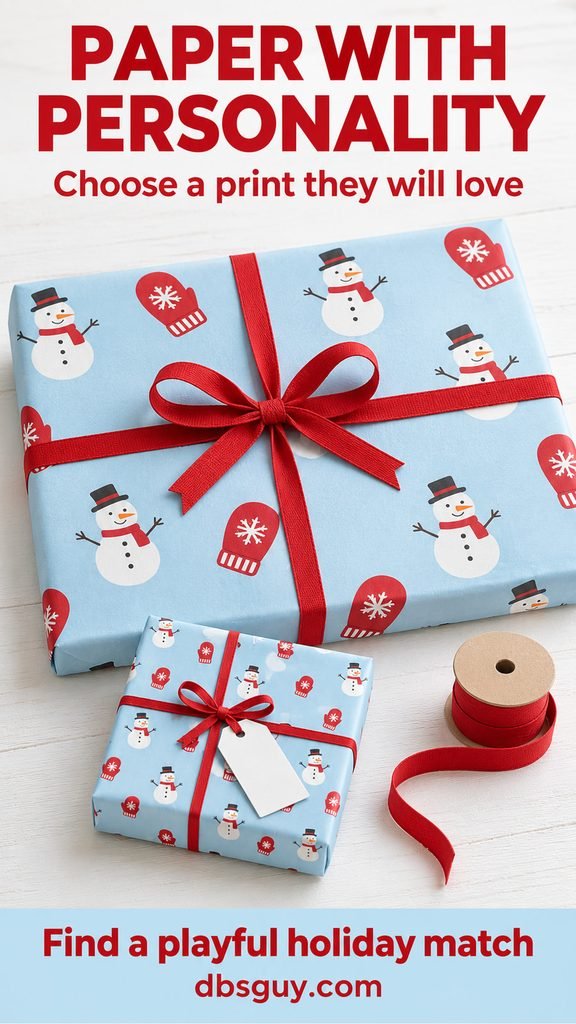
Snowmen, mittens, animals, or a favorite character can make the paper feel chosen for the person opening it. You do not need a separate color for every motif. The pictured blue paper uses red mittens, white snowmen, and plain red ribbon to keep the design easy to follow.
Look for open space between the illustrations so individual shapes remain visible after folding. Small repeat patterns suit little parcels; a larger repeat has more room to show on a broad box.
For a family pile, use the same ribbon across different papers and label every gift as you wrap. Personal choices can sit comfortably together without making everyone’s present identical.
Check the Print on the Size of Box You Will Wrap

Before buying a bold design, imagine the top face of your smallest gift. Can you see a complete tree, snowman, or other detail on it? Small scattered motifs offer more flexibility when you are wrapping jewelry boxes, books, and larger packages from the same roll.
A large motif can still be a deliberate graphic choice. In the comparison, the oversized tree fills the little box and continues beyond its edges. Choose that effect because you like the cropped shape; choose the small repeat if you want recognizable little trees across the lid.
Check direction, too. Words, upright characters, and village scenes may limit which way you can turn a sheet. A nondirectional print gives you more freedom to rotate the box and use an offcut. With stripes or plaid, decide whether keeping the lines straight matters more to you than using every scrap.
Choose a Finish You Can Fold and Secure
For ordinary rectangular gifts, look for paper that hides the box and creases without tearing or forming thick ridges. A heavier label alone does not tell you how a particular sheet will behave.
- Matte paper: Choose it when you want the color or print to stay visually quiet beside textured ribbon. Check pale colors for show-through.
- Glossy paper: Choose it for a reflective surface. Try a small offcut with your tape; visible tape can catch the light, and adhesion varies with the coating.
- Foil, glitter, or textured finishes: Inspect a sample for loose material and test the crease and seam. These details can complicate folding, taping, and disposal.
A cutting grid on the back helps with straight cuts. Reversible paper gives you two visible designs, but check the exact roll: a second decorative side and a cutting grid are different features.
If recycling matters to your choice, check the material and your local program before buying. Brown or matte appearance alone does not confirm acceptance. The EPA’s guidance on gift-wrap disposal explains that coatings can prevent recycling and recommends checking with your local provider. Recycled content describes what went into the paper; it does not guarantee that your finished wrap belongs in the curbside bin. Remove ribbon and other separate decorations, and follow local instructions.
Check the Sheet Size Before Buying the Roll
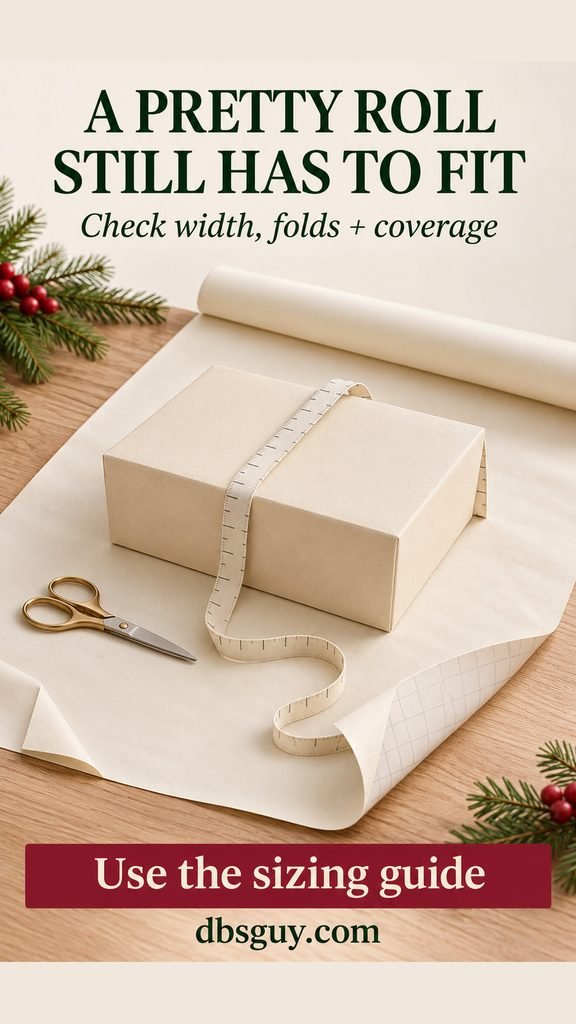
Start with your largest box. Total square footage tells you how much paper you are buying, but the roll’s width determines whether one unbroken piece will reach across a particular package. A long, narrow roll can have plenty of paper and still be the wrong shape.
For a standard rectangular box, measure its length, width, and height. A useful cutting estimate is:
- Around the box: twice the width plus twice the height, with about 1–2 extra inches for the seam.
- Along the box: the length plus the height, with about 1 extra inch for a little overlap at the end folds.
This assumes the paper wraps around the width-and-height cross-section, leaving the two short ends to fold closed. For a box 12 inches long, 8 inches wide, and 3 inches high, start with a piece about 24 by 16 inches: 24 inches goes around the box, and 16 inches runs along it.
Dry-fit before cutting a full batch. Center the box, bring the long sides together, and check that the paper at each end reaches slightly beyond halfway up that end face. Adjust for your seam fold and the actual box. Too much overhang produces bulky layers; too little leaves a gap.
You can rotate the piece if the print allows it. In the example, either side of the 24-by-16-inch piece could run across a sufficiently wide roll. Check both orientations before rejecting a roll, especially with a plain or scattered print.
Buy for Your Actual Pile of Presents
Rolls are convenient when you need several large pieces. Flat sheets can make sense for a few smaller gifts or one special print; check whether they arrive folded if you want an uninterrupted surface on top of the box.
To compare coverage, multiply roll width in inches by roll length in feet, then divide by 12. A hypothetical 30-inch-wide, 10-foot-long roll contains 25 square feet. Compare the total checkout price per square foot only after confirming that the paper has the width, finish, and opacity you need.
For a rough quantity estimate, add the areas of your planned cut pieces. A 24-by-16-inch piece uses about 2.67 square feet. Dividing a roll’s area by that figure gives an area-only estimate, not a reliable gift count: offcuts, print direction, and the way pieces fit across the roll all affect usable coverage. Sketch the cuts or wrap one representative box before buying for a large batch.
Use the paper already in your cupboard where it fits. A solid companion can connect leftover patterned rolls, while one new ribbon may be enough to bring the group together. Keep the pattern you love for the boxes on which it actually shows.
A Quick Check Before You Buy
- Does this color work with a ribbon or tag you already want to use?
- Will the print still make sense on your smallest package?
- Is the paper opaque and flexible enough for your boxes?
- Do the sheet dimensions fit your largest gift in a usable print direction?
- Have you checked the total coverage and the disposal guidance for the material?
Once those answers are clear, choose the design you enjoy. A well-sized sheet, a legible name tag, and a paper that suits the person are enough to make the outside feel considered.
Questions About Choosing Christmas Wrapping Paper
Should the wrapping paper match the Christmas tree?
It can if the gifts will be part of the display, but matching every ornament is unnecessary. Repeat one tree color in the paper or ribbon and leave the rest flexible. For gifts you are delivering elsewhere, the recipient’s favorite colors or interests may be a better starting point.
What paper is easiest for a beginner to use?
Start with smooth, opaque paper that folds easily and, if available, has cutting lines on the back. A scattered print or solid lets you turn the box without worrying about upside-down words. Avoid choosing solely by thickness: very stiff paper can be harder to manage at small corners.
How many different wrapping papers do I need?
One is enough. If you want variety, try one pattern and a solid that picks up a color from it. Buy another design when it serves a specific recipient, box size, or use for leftovers. There is no need to buy a set number of rolls for the display to look finished.