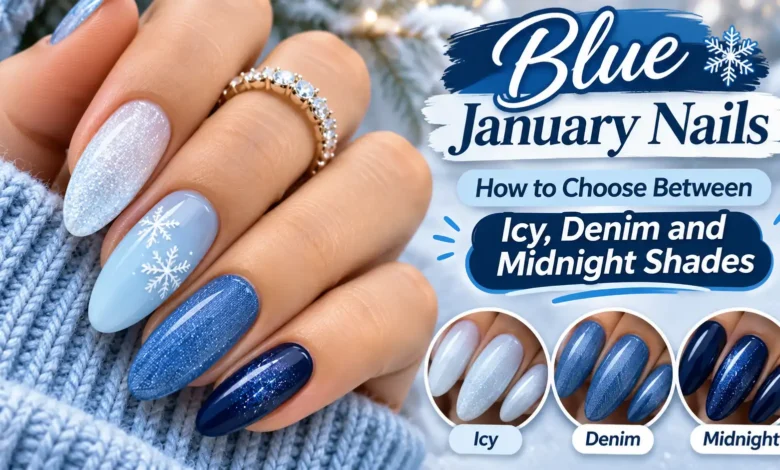
For blue January nails, choose icy blue when you want a pale, crisp manicure, denim blue when you want a muted everyday color, and midnight blue when you want a deep, almost-black finish. Start with how light or dark you want your nails to look, then choose the finish.
If you are stuck between the three, compare solid-color samples with the same glossy finish first. A pearly pale blue beside a matte navy changes two things at once, making it harder to tell which color you actually prefer.
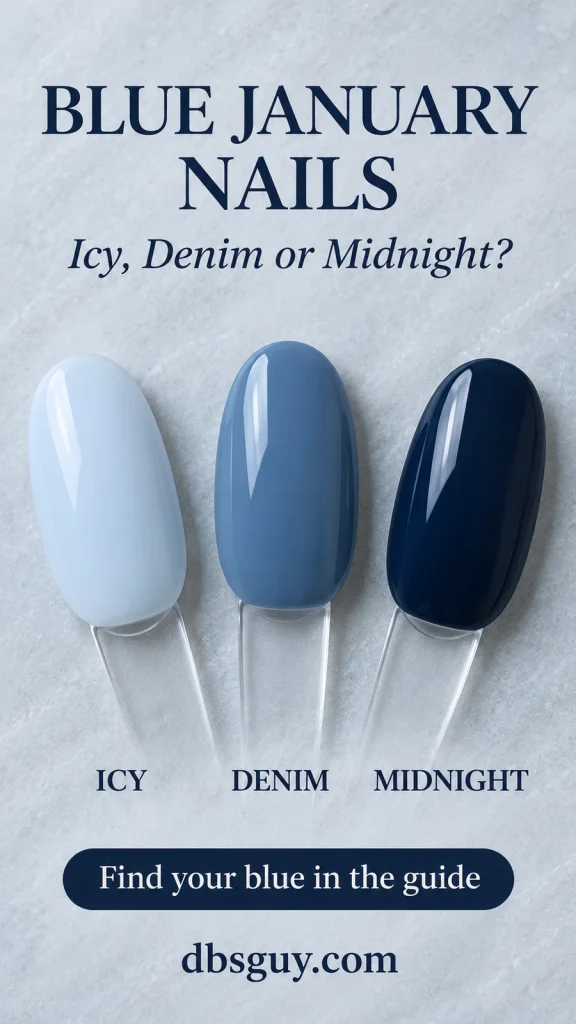
The images are AI-generated manicure concepts, not photographs of tested products or completed salon work. Use them to explain a color direction, then check a real polish sample.
Choose Your Blue by the Look You Want
- Icy: very light blue, often with a noticeable white base. Choose it for a bright spot against dark winter clothes.
- Denim: a medium, softened blue with a gray influence. Choose it when you want the blue to stay obvious without looking electric.
- Midnight: very dark navy that can read nearly black. Choose it for a strong outline and a simple, dressed-up manicure.
These are color descriptions, not standardized shade names. One brand’s “denim” may be another brand’s dusty blue. Use the words to narrow your search, then judge the actual polish sample.
Icy Blue: Choose It for a Light, Crisp January Manicure
The icy blue in this guide is a pale, white-based blue with a smooth glossy finish. “Icy” does not automatically mean glitter, chrome, or a pearly topper. A plain cream color can give you that cold-weather palette on its own.
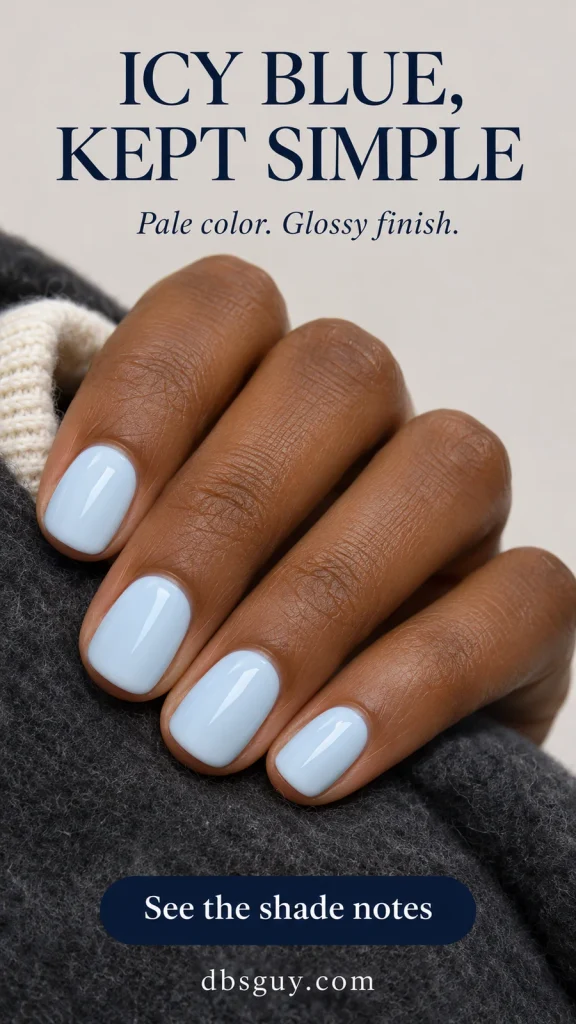
Choose this direction if your favorite winter outfits involve charcoal, black, or dark navy and you like a light manicure standing out against your sleeve. With an ivory sweater, the effect is quieter: the blue becomes a small color change within an otherwise light outfit.
Pay attention to whether you can still see enough blue. A very white-heavy sample may look closer to white polish than the shade you saved. If that is the problem, compare a slightly bluer pastel before adding a reflective finish. If the sample looks lavender, ask for one with less of a purple cast.
On short rounded nails, an all-over icy cream keeps the color easy to see without needing room for a design. You can keep your usual length; the pale shade supplies the change.
What to ask for: “A very pale blue cream with a glossy finish. I want it to look blue beside white, with no shimmer or purple shift.”
Also Read: 17 Light Blue January Nail Ideas for a Frosty, Airy Finish
Denim Blue: Choose It for a Muted Everyday Color
Denim sits between the pale pastel and the almost-black navy. Think of the softened blue in a pair of medium-wash jeans: clearly blue, with enough gray to take the edge off the brightness. The nail color is still smooth and uniform; “denim” describes the shade rather than a fabric pattern.
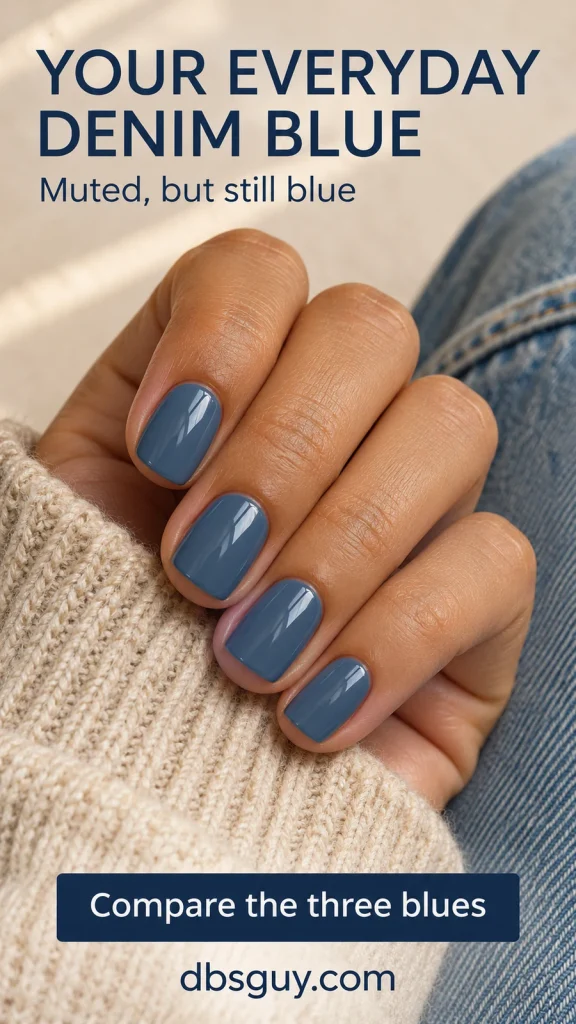
This is a useful starting point if icy blue feels too pale and midnight feels too dark. A glossy denim cream works well as the one visible color in an outfit of oatmeal, gray, white, or brown. Those are styling suggestions, so hold the sample beside the clothes you actually wear before deciding.
The main trap is choosing a vivid royal blue because the bottle looks similar online. Compare the samples side by side. The denim option should look softened rather than intensely saturated. If it seems too gray, move toward a clearer blue at roughly the same depth instead of jumping straight to navy.
Short squoval nails suit this straightforward, full-color approach. A softly squared edge gives the manicure a defined shape while the muted color keeps the overall effect relaxed.
What to ask for: “A medium denim blue cream with a gray undertone and a glossy finish. Clearly blue, but neither bright cobalt nor dark navy.”
Midnight Blue: Choose It for Depth and a Strong Outline
Midnight is the darkest option here. Look for a navy whose blue is visible in the lit areas, while the edges can appear nearly black. If you enjoy black polish but want a blue variation, that near-black quality may be exactly the appeal.
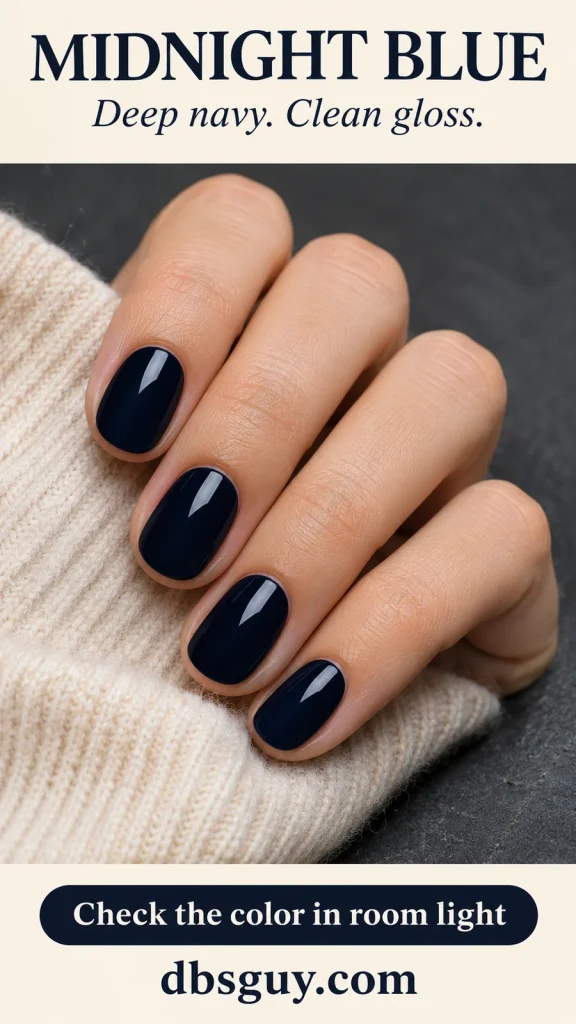
If you want everyone to recognize the color as blue indoors, be more selective. Check the finished sample in ordinary room light, away from the brightest lamp. If it reads black there and that bothers you, choose a slightly lighter navy. Extra gloss creates a reflection, but it cannot guarantee that a very dark pigment will look blue in dim light.
A plain glossy midnight cream makes the nail outline the feature. Short oval nails are enough to carry it; there is no need to add length for the color to work. With cream knitwear, the contrast is pronounced. Against a dark sleeve, the manicure blends into the outfit more closely.
Consider how you feel about visible wear, too. A pale exposed tip can stand out against a dark polish. If that small contrast tends to bother you, factor it into your choice rather than choosing midnight solely for an appointment photo.
What to ask for: “A very dark navy cream, glossy and without shimmer. Please show me a finished sample so I can check how blue it looks in room light.”
Check the Color Beside Your Hand, Your Sleeve, and Your Usual Lighting
A saved photo is useful for explaining a direction, but it is a poor place to make the final color decision. The image’s lighting, editing, and your screen can change what you see. A real sample beside your hand gives you a more useful comparison.
- Keep the finish consistent. Compare icy, denim, and midnight samples with similar coverage and the same kind of top coat. Decide on color before introducing a different finish.
- Look in two places. View the samples in indirect daylight and in the indoor lighting where you spend your time. Notice whether icy loses its blue, denim looks grayer than expected, or midnight becomes almost black.
- Bring in your clothes. Hold your usual coat cuff or sweater beside the sample. You do not need a perfect match; decide whether you enjoy the contrast.
- Step back. Check the color from a normal viewing distance as well as close up. Choose the one you like on your whole hand, not just the most interesting swatch under a lamp.
There is no need to rule out a shade because of a skin-tone chart. Pale blue can create a pronounced contrast on deeper skin, while dark navy can create a pronounced contrast on lighter skin. Either effect may be the one you want. Use your own hand to decide how much contrast feels right.
Keep Your Practical Nail Length
All three shade families work as a single color on short nails. Choose a length you can comfortably use for typing, fastening jewelry, and putting on gloves. Then make the seasonal change through color.
If you already like your rounded or squoval shape, keep it while you compare blues. Changing the shape, length, color, and finish together makes it harder to explain what you liked—or disliked—about the result. At an appointment, settle the outline first and ask to see the chosen color before it is repeated across the set.
Ask for the Shade and Finish Separately
“Icy blue” tells your nail artist about color; “glossy cream” tells them about the surface you want. A cream has no intentional sparkle, while shimmer or pearl adds a reflective effect. A glossy top coat over a cream does not turn it into a shimmer polish.
The same distinction matters with dark blue. For example, OPI describes Aquarius Renegade as a navy pearl lacquer. It belongs to the dark-blue family, but its reflective finish makes it a different choice from a plain midnight cream. Compare both color and finish when checking a bottle name or salon sample.
For an air-dry lacquer manicure, follow the instructions for your chosen products. OPI’s directions for that lacquer use a base coat, two thin color coats, and a top coat. Treat that as a product-specific routine, not a universal coat count for every blue polish. Regular lacquer, gel polish, and press-ons need their own application instructions.
Also Read: January Nail Art for 2027: Frosty Finishes and Details to Save Now
Questions About Blue January Nails
What is the difference between icy blue and baby blue?
The names overlap. In this guide, icy blue means a very pale, cool-looking blue, while baby blue can cover a wider range of light pastels. Ask to see the polish rather than relying on the name. Neither term guarantees shimmer or a particular level of coverage.
Is denim blue the same as navy?
Not in this comparison. Denim is the muted middle shade, and midnight navy is much darker. Because brands use names differently, look for a medium-depth blue with a gray influence if you want the denim effect described here.
Which blue should I choose for very short nails?
Choose by the contrast you enjoy. Icy gives you a pale color block, denim keeps the blue visible at a moderate depth, and midnight emphasizes the outline. None requires a long free edge when you wear it as an all-over color.
Do I need gel polish for a glossy blue manicure?
No. Regular nail lacquer with an appropriate glossy top coat can give you a shiny blue manicure. Select the polish system for the application and removal routine you want; the color alone does not determine which service you need.
Which shade is the easiest starting point if I cannot decide?
Start your comparison with denim. It sits between the other two in depth, so your reaction gives you a direction: move toward icy if you want lighter, or toward midnight if you want darker. Check the neighboring samples before committing.