Your Handwriting Could Reveal Signs Of Cognitive Decline, And This New Study Explains Why


Most of us think of handwriting as a habit we picked up in school and never really thought about again. We sign our names, we jot down a shopping list, we scribble a note on the fridge — and we do it all without thinking. But a new study from Portugal suggests that the way we write may carry quiet information about how our brains are doing, especially as we get older. The finding is not that your handwriting can diagnose anything on its own. It is something subtler and, in a way, more interesting: when a writing task asks the brain to do several things at once, small differences in how the pen moves start to show up.
The research was carried out by a team at the University of Évora and published in the journal Frontiers in Human Neuroscience. It is a small study, and the researchers themselves are the first to say so. But the pattern it found was clear enough to be worth paying attention to — and it opens up a hopeful possibility: a simple, low-cost writing exercise could one day help doctors keep an eye on cognitive health, long before problems become obvious.
The Study In Brief

Researchers in Portugal wanted to know whether handwriting could offer clues about cognitive health in later life. Their focus was on two qualities of writing that are easy to measure: how efficiently a person writes, and how well their hand movements stay coordinated. To test this, they worked with 58 adults between the ages of 62 and 92, all of whom were living in care homes. Of those, 38 had a diagnosed form of cognitive impairment, while the other 20 had not.
The idea behind the study is simple. Writing by hand is not one single skill. It is a chain of small jobs the brain has to run at the same time: remembering what to write, shaping letters, keeping the pen moving smoothly, and staying on track from one word to the next. If any part of that chain starts to struggle, the writing itself may show it — not in what the words say, but in how they are formed. The study’s senior author, Ana Rita Matias, an assistant professor at the University of Évora, put the central message plainly: handwriting starts to tell us something useful when the writing task itself asks the brain to work hard.
How The Writing Test Worked

Everyone in the study used inking pens on digitizing tablets, so the researchers could measure the writing in fine detail — not just what ended up on the page, but how the pen moved to get there. The participants were given two kinds of tasks. The first group of tasks tested basic pen control. The second group tested handwriting speed, and it was here that the real story emerged.
For the pen-control tasks, people were asked to draw ten horizontal lines within twenty seconds, and then to make at least ten dots within twenty seconds. These are deliberately simple exercises. They mostly test basic motor control — whether the hand can do a straightforward, repeated movement on demand. For the speed tasks, participants had to write down two sentences of different complexity. Sometimes the sentence was shown to them on a card to copy; sometimes it was read aloud and they had to write it from hearing alone. That second version — writing down something you have just heard — is the one that matters most in this study, and we will come back to why.
Simple Pen Tasks Showed No Real Difference
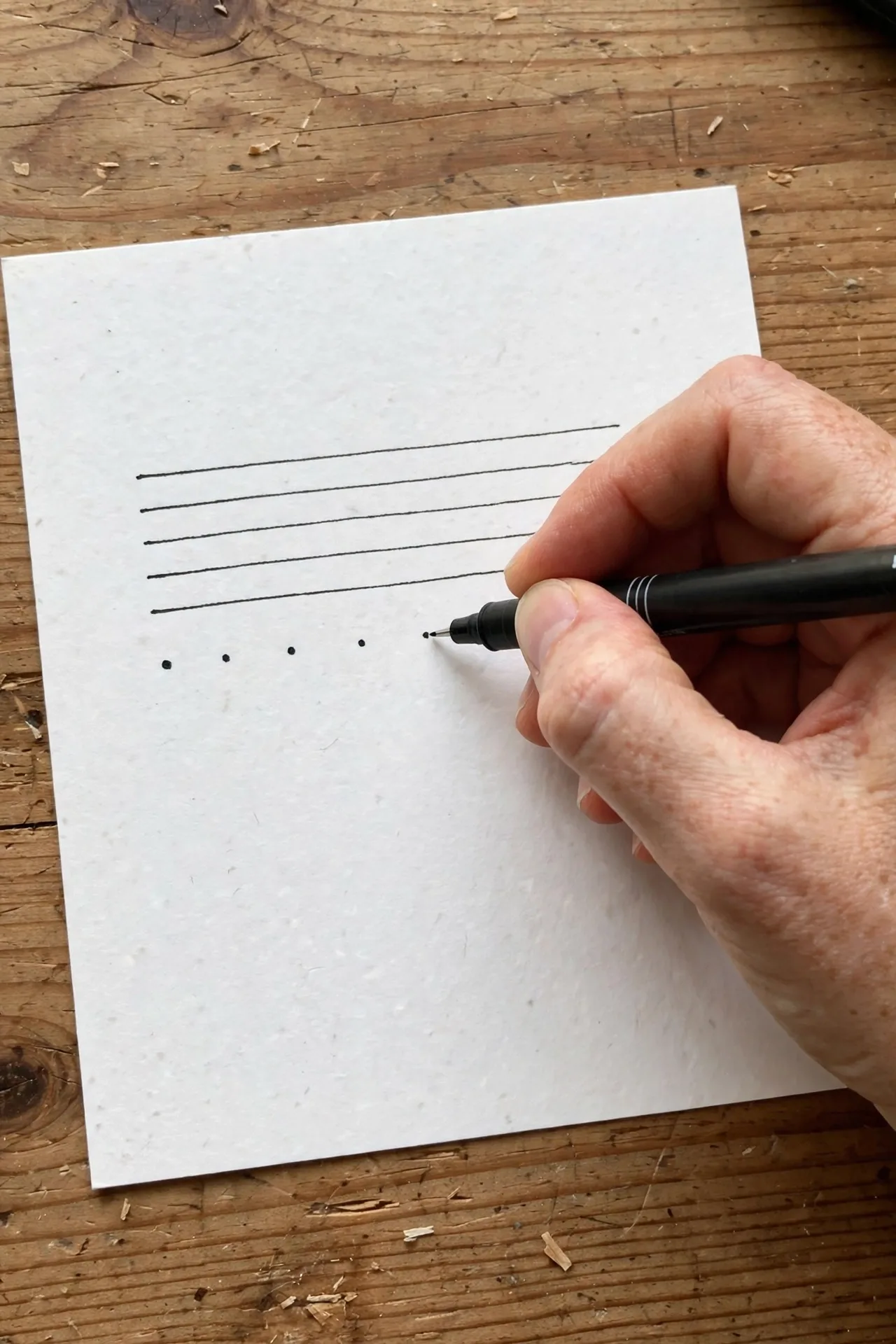
When it came to the simple exercises, the two groups performed about the same. People with cognitive impairment drew their lines and dots just as well as people without it. That result was expected, and it is important. Drawing lines and dots is a basic motor job, and it does not ask much of memory, language, or planning. So a person’s performance on those tasks says very little about how their thinking is doing.
Copying a sentence from a card showed only faint, hard-to-read differences between the groups. Copying is a little more demanding than drawing lines, because you have to read and reproduce words, but the sentence is right there in front of you the whole time. Your memory barely has to do any work. The researchers found that this, too, was not enough to separate the two groups in any meaningful way. If the goal is to spot early changes in cognitive health, simple tasks and straightforward copying do not seem to be sensitive enough.
Dictation Told A Different Story

The picture changed when participants had to write down sentences that were read aloud to them. In this dictation task, the group with cognitive impairment showed clearly reduced handwriting efficiency. Their movements became more constrained, more fragmented, and less smoothly organized than those of the other group. Writing that should flow in a steady rhythm instead came out in shorter, less connected bursts.
The reason, the researchers explain, is that dictation is a genuinely demanding job for the brain. To write down a sentence you have just heard, you have to listen carefully, hold the words in your mind, work out how they should be spelled and shaped, and guide your hand at the same time. It calls on language processing, working memory, and the brain’s ability to plan and control a sequence of steps — all at once. When any of those systems is under strain, the handwriting is where the strain shows. As Matias explained, the clearest differences appeared exactly when writing required language processing, working memory, and executive control. Her strongest message from the study is that handwriting becomes informative when the task is cognitively demanding — simple dots and lines are not enough, and dictation is much better at revealing where the brain’s control of movement starts to falter.
Why The Researchers Are Urging Caution

As promising as the finding is, the researchers are careful not to overstate it, and anyone reading about this study should be careful too. The study was small: just 58 people, all living in care homes. That means the results may not reflect what would be seen in the wider community, where people live in very different circumstances and have very different daily routines.
There are other limits as well. The participants’ use of medication was not systematically analyzed in the study, even though medicines can affect movement and thinking. The researchers did exclude people with major neurological or psychiatric conditions known to directly affect motor control, which helps keep the results cleaner — but it also means the group studied was narrower than the general population. Dr. Michael Richardson, a family medicine physician who was not involved in the research, made the same point: with only 58 institutionalized older adults in the study, the findings may not match what doctors would see across the broader population and in ordinary communities.
For those reasons, Matias is clear about what handwriting should — and should not — be used for. She argues that it should be explored as a low-cost way to screen and monitor cognitive health over time, not as a standalone tool for diagnosing anything. Before it could ever be used that way in a clinic, she says, much more research is needed: larger studies that follow people over time, careful control of medication effects, and samples drawn from people living independently in the community, not only in care homes.
What To Do If You Notice Changes In A Loved One

So what should you actually do with this information? The practical takeaway is refreshingly ordinary. If you notice that someone you care about is struggling to write down instructions, or seems to get confused more easily than they used to, it is worth booking an appointment with their doctor to talk about their cognitive health. That is the advice of Dr. Richardson, who notes that a family physician already knows the person’s health history and is in the best position to judge whether further evaluation is needed.
It is worth saying clearly: a change in handwriting, on its own, is not a diagnosis of anything. Handwriting can change for all sorts of reasons — tiredness, arthritis, a new medication, or simply writing less often than you used to. What matters is a new pattern, especially one that appears alongside other changes, and the right response to that is a conversation with a doctor, not quiet worry.
There is also a broader lesson in this research, and it has nothing to do with pens. Dr. Zaldy Tan, director of the Memory and Aging Program at Cedars-Sinai, has spoken about how important it is for brain health to stay socially connected. As social beings, our brains thrive on interacting with others, and when that interaction fades, memory and thinking can decline over time. Staying engaged — talking, meeting people, keeping up with friends and family — is one of the simplest and most powerful things any of us can do for our brains as we age. A notebook and a pen may one day help doctors watch for early changes, but the everyday habits of connection and conversation are the tools we already have.
Please note: this article shares findings from a research study for general information only. Handwriting is not a diagnostic tool, and changes in handwriting alone do not mean someone has cognitive decline. If you are worried about your own memory or thinking, or about a loved one, please speak to a doctor.