For your first time at the campus gym, check how to get in, ask for a quick orientation, and choose a few minutes of easy movement you already understand. Leave knowing where to go next time. You do not need a complicated routine to make that first visit useful.
Gymtimidation is that nervous, self-conscious feeling around an unfamiliar gym: Where do I put my bag? What if I use something wrong? What if I see someone from class? The plan below gives you a next step for each part of the visit, including words you can use when you need help.

The visuals are AI-generated concepts, not photographs of actual students or a specific campus. Follow your recreation center’s rules and staff guidance.
1. Check the Details That Could Stop You at the Door
Open your college’s official campus recreation website before packing. Confirm today’s building hours and whether the area you want to use has separate hours. Holiday schedules, semester breaks, and special events can change access.
Then check these practical details:
- Entry: Do you need a student ID, an app barcode, an activated membership, or a waiver? Do not assume every enrolled student has the same access.
- Cost: Find out what your access covers. Group classes, personal training, guests, or locker rentals may have separate fees.
- Storage and clothing: Check the shoe and clothing rules, where bags belong, and whether a day locker needs your own lock.
- A quieter starting point: Ask staff when the particular area you want to try is usually less busy. There is no universal quiet hour for every campus gym.
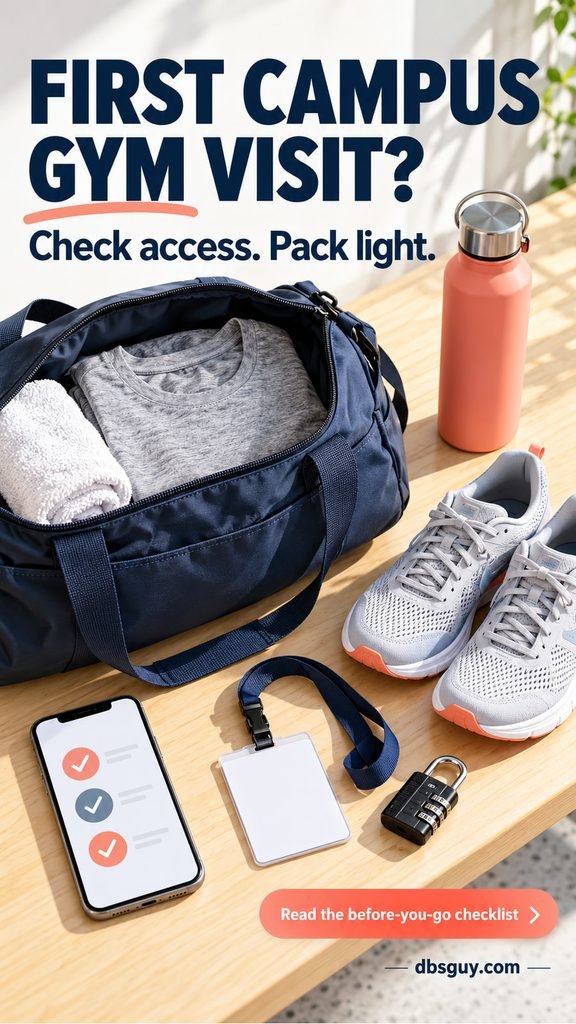
For a simple visit, bring your entry credential, water in an allowed bottle, comfortable workout clothes, and athletic shoes that meet the facility’s rules. Add a towel or lock if needed. You can arrive dressed to exercise if you would rather skip changing there.
If access or privacy is part of your worry, ask a specific question beforehand: “Is there a step-free route to the fitness floor?” or “What private changing options are available?” Ask about adaptive equipment or a quieter area if those would help; availability differs by campus.
Pick a time that leaves room to walk there, check in, and get to your next commitment. A short visit feels less manageable when you are also watching the clock for class.
2. Go to the Front Desk Before the Equipment
Your first task inside is finding someone who can explain the space. A short tour can show you the lockers, water refill station, restrooms, exercise areas, and where to ask for help.
Try this: “Hi, it’s my first visit. Could you show me where to put my bag and where a beginner can start? Do you offer equipment orientations?”

If the desk is busy, ask when a tour or orientation is available. You can use the visit to learn the check-in process and return for the introduction. Confirm whether an orientation needs a reservation or payment rather than assuming it is included.
A building tour and exercise instruction are different things. Before using an unfamiliar machine, ask who is qualified to explain its setup and controls. Do not assume the person checking IDs can coach your form.
For equipment help, say: “I haven’t used this before. Could someone show me how to adjust it, start and stop it, and choose a suitable starting setting?” If help is unavailable, leave that machine for another visit. You do not have to figure it out while someone waits behind you.
Going alone is fine. If you bring a friend, choose someone willing to follow your pace, and check that they have valid access. A buddy can help you feel less alone without turning the visit into their usual workout.
3. Keep the First Visit Small and Specific
Choose one manageable goal: take the tour, try the indoor walking track, or learn the controls of one piece of equipment with qualified help. A tour-only visit is a reasonable starting point if the building itself feels overwhelming.
UR Medicine’s guidance on gym anxiety recommends focusing on actions within your control and planning before you arrive. For this visit, “check in and ask one question” is a clearer goal than “feel confident.”

A Flexible 25-Minute First-Visit Plan
This is an editorial example for a generally healthy student who can walk comfortably, not a required workout or a complete exercise program. Allow longer for a tour, and shorten or skip the movement if needed.
- Minutes 0–5: Check in, store your belongings, and locate the area you plan to use.
- Minutes 5–10: Begin with slow, easy walking on a clear, level indoor track or another suitable route staff identifies.
- Minutes 10–15: Continue at a comfortable pace if you feel well. Keep the effort easy enough to talk comfortably.
- Minutes 15–20: Slow down gradually and finish the movement portion.
- Minutes 20–25: Collect your things and note one detail that will make your next visit easier.
No track? Ask about a suitable alternative. A stationary bike may be an option after staff show you the fit and controls. You do not need to add weights, unfamiliar exercises, or a calorie target to this first visit.
If you have an injury, a health condition that affects activity, or instructions to limit exercise, ask your healthcare professional what is appropriate. Stop if you develop pain, dizziness, nausea, or unusual breathlessness. Get staff help for concerning symptoms; do not assume they are just nerves.
Also read: For a separate movement break before class, try Morning Stretch Routine for Students: 10 Minutes Before Your First Class.
4. Use Simple Etiquette and Short Questions
Knowing a few shared-space habits removes another layer of uncertainty. Your campus’s posted rules come first, especially for equipment time limits, filming, bags, and restricted areas.
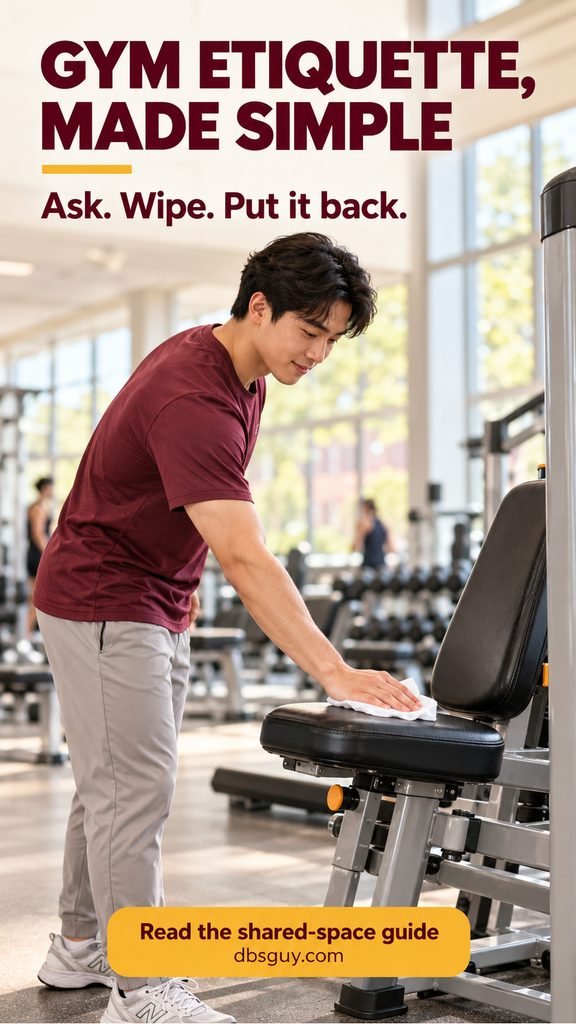
- Check whether equipment is in use. Someone may be resting between sets. Wait until they finish the movement, then ask, “Are you still using this?”
- Take one station at a time. Avoid leaving belongings on several machines to reserve them. If your planned spot is busy, use your familiar alternative or ask staff where else you can go.
- Clean up after use. Use the facility’s provided cleaning supplies as directed. Return borrowed equipment and any weights you used to their designated places.
- Keep paths clear. Store your bag where required, and step away from equipment and walkways to check your phone.
- Respect privacy. Check the photography policy. Never photograph or film in changing areas or include other people without permission.
You can also say, “How many sets do you have left?” A set is a group of repetitions; a rep is one repetition of a movement. You are asking how much of their exercise remains, not asking them to hurry.
If someone offers advice you did not request, a polite response is enough: “Thanks, I’m following the staff’s guidance today.” You do not owe anyone a discussion about your body, goals, or experience level.
If you are being filmed, harassed, or made to feel unsafe, move toward staff and report what happened. That is a real problem to address, not something you need to accept as part of being a beginner.
5. Make the Next Visit Easier Before You Leave
Write down what you learned: which entrance worked, where you stored your bag, and which area you would use again. These details are more useful for a second visit than comparing your session with someone else’s.

Choose a realistic next appointment around your actual classes, work, meals, and travel. For example: “After Tuesday’s lecture, I’ll return to the same track and ask about an equipment orientation.” That is a suggested next step, not a schedule you must meet.
If Nerves Rise While You Are There
Pause somewhere safe, away from moving equipment and other people’s paths. Breathe gently, let your shoulders settle, and choose one small next action: find the water station, ask a staff member a question, or finish the tour. You can decide whether to continue or end the visit.
You may notice people looking around, including in your direction. That does not tell you what they think. Bring your attention back to the task you chose. You are allowed to be new without explaining yourself.
If a structured setting would help, ask whether your campus offers a beginner class, a small-group introduction, or an equipment orientation. Check the level, registration process, cost, and any adaptations before attending. A class labeled “all levels” can still be worth discussing with the instructor.
If anxiety keeps you from activities you want to do, affects other parts of your life, or remains hard to manage, contact campus counseling or a healthcare professional. A first-visit plan can reduce practical uncertainty; it does not replace care for persistent anxiety.
Also read: If you would enjoy meeting people through a shared activity, How to Join Clubs in College: Find Your People Freshman Year explains how to find active groups and check whether beginners can attend.
Questions Before Your First Campus Gym Visit
Do I Need to Get Fit Before I Go?
You can start by learning the space and choosing activity that fits your current ability. There is no need to reach an appearance or performance goal before asking for an orientation. Tell qualified staff what you are comfortable doing and what you need help learning.
What If I See Someone From Class?
A nod or a quick hello is enough. You can say, “Hey! I’m trying the gym today,” then continue. You do not need to join their workout or explain why your visit is short.
Do I Need a Personal Trainer?
Not simply to learn the check-in process or take a tour. Qualified instruction is useful when learning unfamiliar exercises, equipment, or adaptations. Ask what orientations include and what requires a paid session before booking.
What If I Only Stay for Ten Minutes?
Use what you learned to choose the next step. Ten minutes might be enough to find the lockers, meet a staff member, or learn how to book an introduction. You can build from that without making every visit longer.
Before you leave, finish this sentence: “Next time, I know how to ______.” A concrete answer gives you something familiar to return to.
Also read: For days you want a quiet room-based option, Dorm Yoga for Beginners: Quiet Flows for Tiny Spaces offers seated, mat, and evening sequences.