People Are Tired Of Being Told To Buy More—25 “Underconsumption” Habits That Make Normal Life Feel Radical


Apparently, one of the internet’s newest rebellious acts is finishing the shampoo you already own.
For years, online life trained us to recognize a very specific kind of content.
The haul.
The unboxing.
The “things you need.”
The “things you didn’t know you needed.”
The backup bottle. The seasonal refresh. The viral cup. The new organizer for the products bought because the previous organizer made buying products look organized.
Then a quieter genre started pushing back.
People began posting worn shoes instead of new ones. Empty skincare bottles instead of restocks. Repaired clothes instead of replacement hauls. Old phones that still worked. Pantry dinners. Makeup with the metal pan showing through. Cabinets that were not color-coordinated because they contained the same plates the owner had been using for eleven years.
The internet gave some of this behavior a name: underconsumption.
The funny part is that much of it is not radical at all.
It is normal product use.
What changed is the backdrop.
When every scroll contains new arrivals, limited drops, affiliate links, “must-haves” and algorithmically perfect lifestyles, simply using something until it is genuinely done can begin to look almost countercultural.
TikTok’s own consumer-trend reporting has described a shift away from buying “just because,” arguing that purchases increasingly have to justify themselves through value, relevance, meaning or joy. Academic researchers are studying a related behavior called deinfluencing: creators explicitly telling audiences not to buy, to buy less, or to think more critically about consumption. One Journal of Business Research study based on in-depth TikTok-user interviews found that participants often perceived deinfluencing as more authentic and socially responsible, and as something that could encourage more informed—or reduced—consumption. TikTok trend report; Journal of Business Research.
There is a practical environmental argument too. The U.S. EPA puts reduction and reuse ahead of recycling because avoiding a new product in the first place avoids the materials and energy required to manufacture and transport it. The agency explicitly recommends repairing, borrowing, renting and sharing items that do not need to be purchased new. U.S. EPA.
But underconsumption gets more interesting when you stop treating it as an aesthetic.
Because the real challenge is not owning a beige capsule wardrobe, arranging three beautiful glass jars, and filming yourself solemnly refilling them.
It is noticing the moment when shopping is trying to solve a problem that shopping did not create.
Bored?
Buy something.
Feel behind?
Buy something.
Want to become a runner, baker, reader, traveler, “clean girl,” creative person or organized person?
Buy the uniform first.
Consumer research has long shown that products can become tied to identity—what we want to communicate to other people and to ourselves. More recent work even distinguishes identities that depend heavily on products from identities that can be lived without them. In other words, sometimes we are buying an object; sometimes we are buying evidence for a person we hope to become. Journal of Consumer Research: Products as Signals; Identities Without Products.
This is not a purity contest. Underconsumption should not mean keeping unsafe, broken or unusable things forever. Cosmetics can degrade or become contaminated; the FDA specifically warns that eye-area products often have shorter safe-use windows and that dried-out or contaminated mascara should be discarded. Food safety still matters. Electrical products still need to be safe. A repair that costs more resources than a sensible replacement may not be the right move. The goal is not “never throw anything away.” The goal is to stop treating replacement as the default before the current thing has actually finished its job. FDA cosmetic shelf-life guidance.
With that distinction in place, here are 25 underconsumption habits that look almost hilariously ordinary—and work precisely because they are.
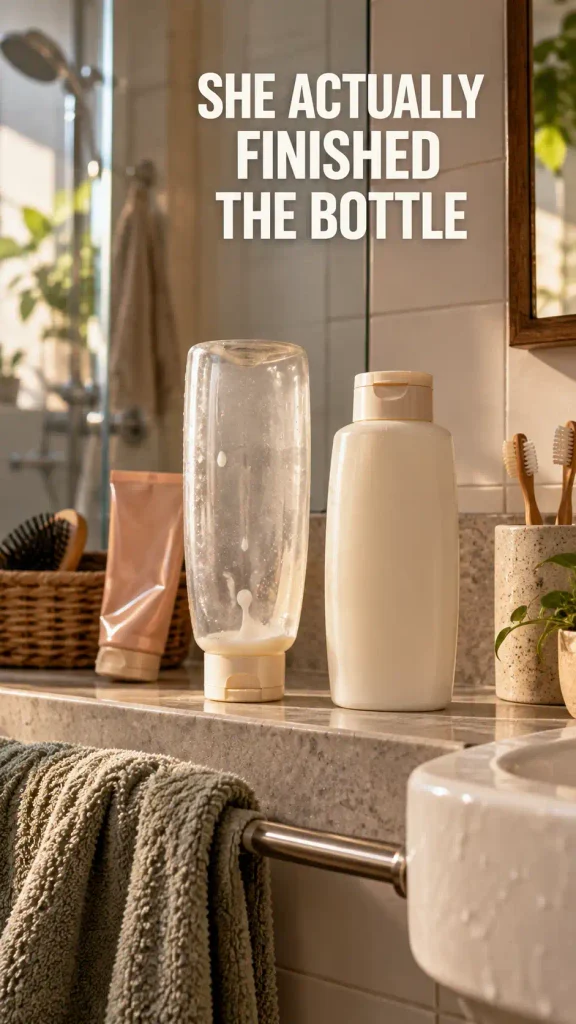
1. Finish The Bottle Before Buying Its Replacement
This sounds so obvious that it barely qualifies as advice.
Then open the average bathroom cabinet.
One shampoo in the shower.
Another under the sink.
A third “backup” bought on sale.
A fourth that somebody online said was better.
A replacement-only rule removes one of the easiest justifications for accumulation: I’ll need it eventually.
Maybe you will.
Eventually is not the same as today.
Make the current shampoo, cleanser, detergent, deodorant or household product reach an actual endpoint. Then replace it.
This is especially useful in categories where trends and reformulations create constant temptation. The less stock waiting in the cupboard, the less money is sitting there becoming clutter.
The habit: one open product + one replacement only when needed.
Best for: toiletries, cleaning products, staples and consumables.
Exception: true bulk-buy savings can make sense for products you reliably use and can safely store—just do the math rather than calling every multipack a bargain.
2. Do A “Project Pan” Without Turning It Into A Punishment
Beauty communities have a wonderfully literal phrase for using makeup:
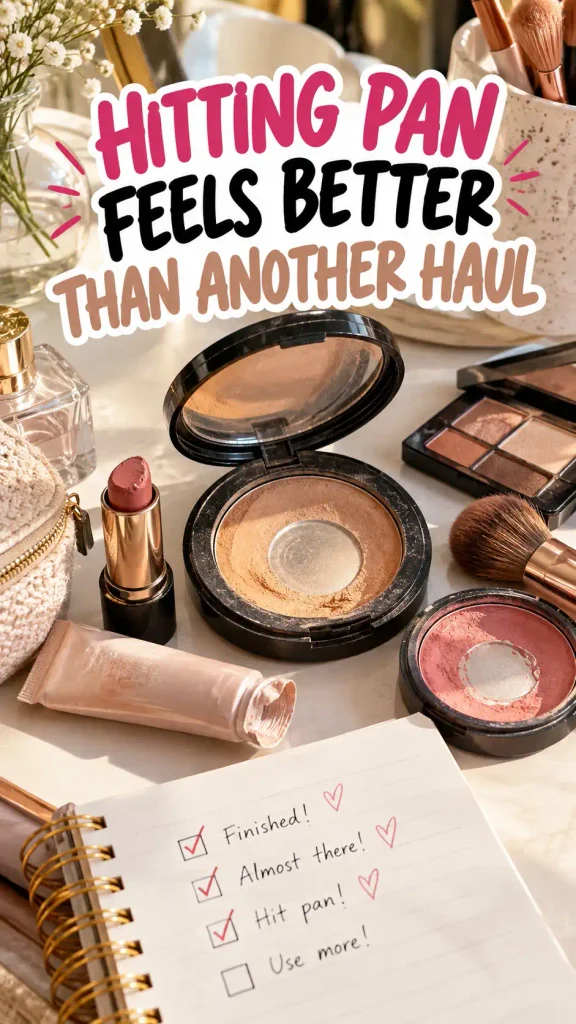
Hit pan.
Use a powder product long enough and the metal pan beneath it finally appears.
Project Pan communities turn that slow process into a challenge—tracking progress, rotating products and celebrating empties instead of new purchases. The trend has become a visible counterweight to beauty-haul culture.
The useful lesson is not “force yourself to finish every product you hate.”
It is learning how slowly many cosmetics actually disappear.
That realization can change shopping behavior faster than a lecture about minimalism.
A blush that takes years to finish suddenly makes the fifth nearly identical blush look less urgent.
Community discussions around Project Pan repeatedly describe inventory as a wake-up call: people often realize they own far more product than they can use before preferences or safety windows change.
But there is a safety boundary. FDA guidance notes that cosmetics can degrade or become contaminated, particularly eye products. Do not keep suspicious, changed, contaminated or unsafe products merely to “win” an empties challenge.
The habit: pick a few products you genuinely like and track real usage.
What it teaches: how long products last in real life.
Do not: use expired, contaminated or irritating cosmetics just to finish them.
3. Take Inventory Before You Shop
Humans are surprisingly bad at remembering what is inside opaque cupboards.
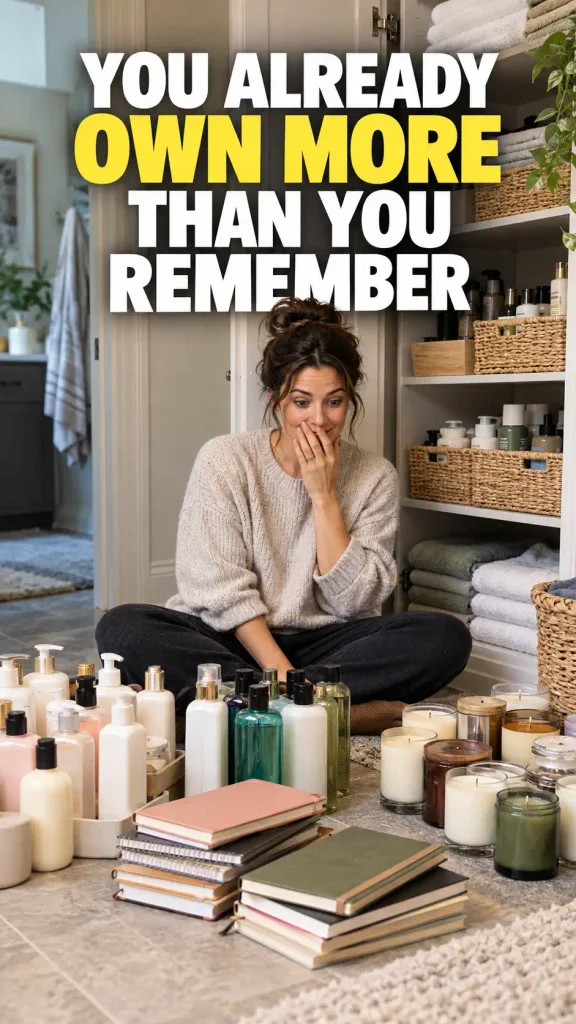
This is how homes acquire six candles, four black T-shirts, seventeen food-storage containers with no matching lids and enough hand cream to moisturize a small village.
Inventory removes the fantasy version of what you own and replaces it with evidence.
Before buying skincare, look at the skincare.
Before buying notebooks, count the notebooks.
Before grocery shopping, open the freezer.
Before ordering another white shirt, look at every white shirt you already have.
Reddit communities focused on no-buy and Project Pan challenges frequently describe this exact moment: gathering everything in one place and realizing the collection is much larger than it felt when scattered across drawers.
Nothing prevents a purchase quite like meeting all twelve of your existing versions at once.
The habit: make the invisible inventory visible.
Easy version: keep a phone note with categories you chronically overbuy.
Best question: “Do I need one, or do I need to remember where mine is?”
4. Shop Your Closet Before Shopping A Store
“I have nothing to wear” is sometimes accurate.
Sometimes it means, “I have nothing new to wear.”
Those are different problems.
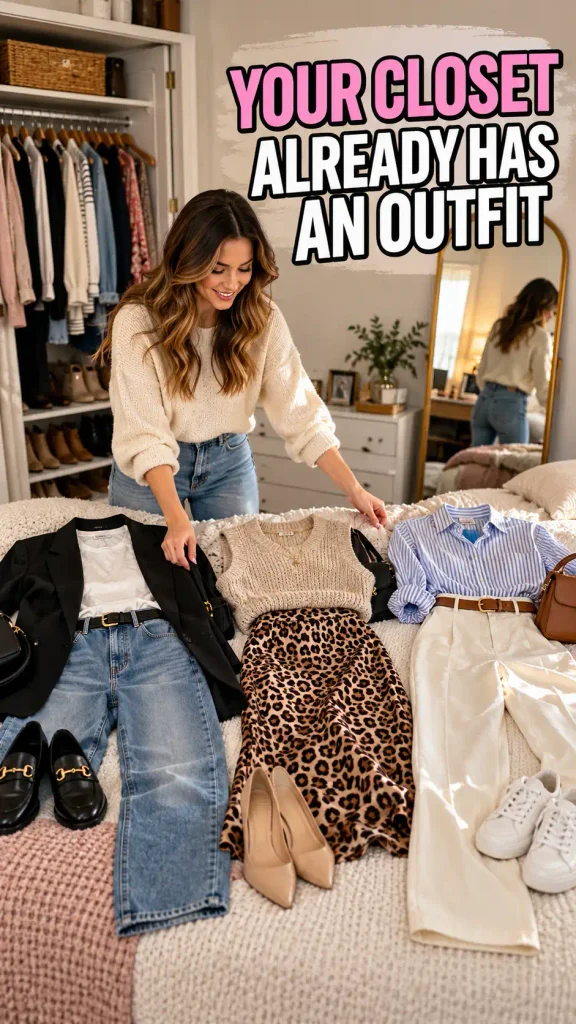
Shopping your closet means treating your existing wardrobe as inventory worth rediscovering. Pull out the neglected trousers. Style the dress with shoes you have never paired with it. Move the jacket from “special occasion” into ordinary rotation.
WRAP’s clothing-durability research argues that increasing garment lifetime is one of the most effective ways to reduce clothing’s environmental impact. The environmental value of a garment improves when it stays useful longer. WRAP.
The social-media version of fashion encourages novelty.
Real wardrobes become useful through repetition.
The habit: build three new outfits from what you already own before buying for an event.
Why it works: novelty can come from combinations, not just objects.
Useful test: if a new item only works with three other new items, it is not solving your wardrobe.
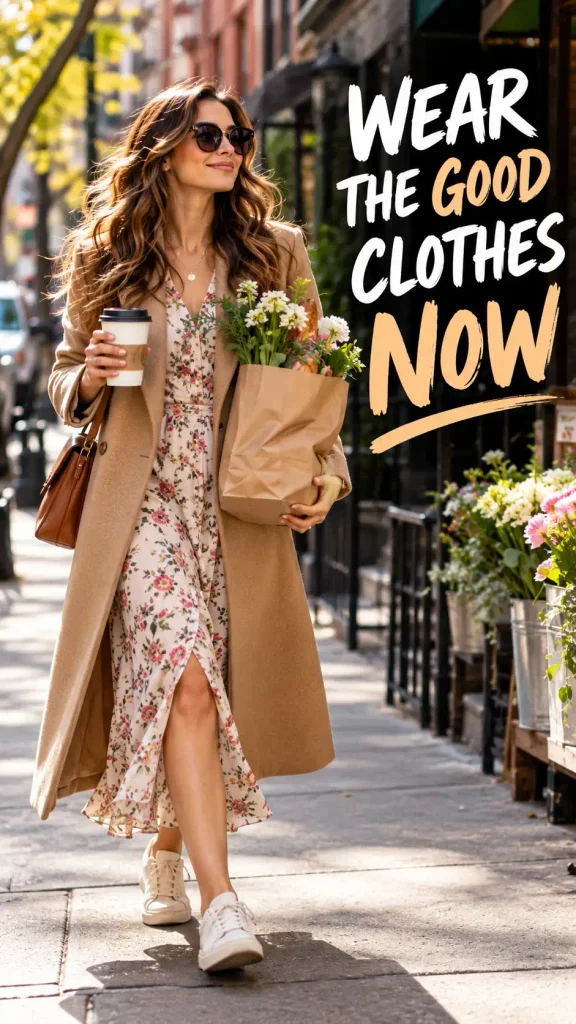
5. Wear The Good Clothes Now
There is a strange category of underconsumption that looks like saving but becomes waste.
The beautiful dress stays protected for a future occasion.
The expensive shirt stays folded because you do not want to “ruin it.”
The nice shoes are too nice for ordinary Tuesday.
Then taste changes. Size changes. Material deteriorates. Life moves on.
Consumer research has documented an “identity conservation” effect: people can be less willing to use nondurable products that feel strongly tied to identity because owning the product itself has value. That helps explain why some beloved objects are preserved instead of enjoyed. Journal of Consumer Research.
Underconsumption is not about turning your home into a museum of things too precious to touch.
Use the good mug.
Wear the jacket.
Burn the candle.
Consumption becomes wasteful when “saving it” means never receiving the value you bought it for.
The habit: move one “too nice” item into ordinary rotation.
Why it matters: unused value is still unused.
Exception: genuine archival or heirloom preservation is different from saving a normal sweater for a hypothetical perfect day.
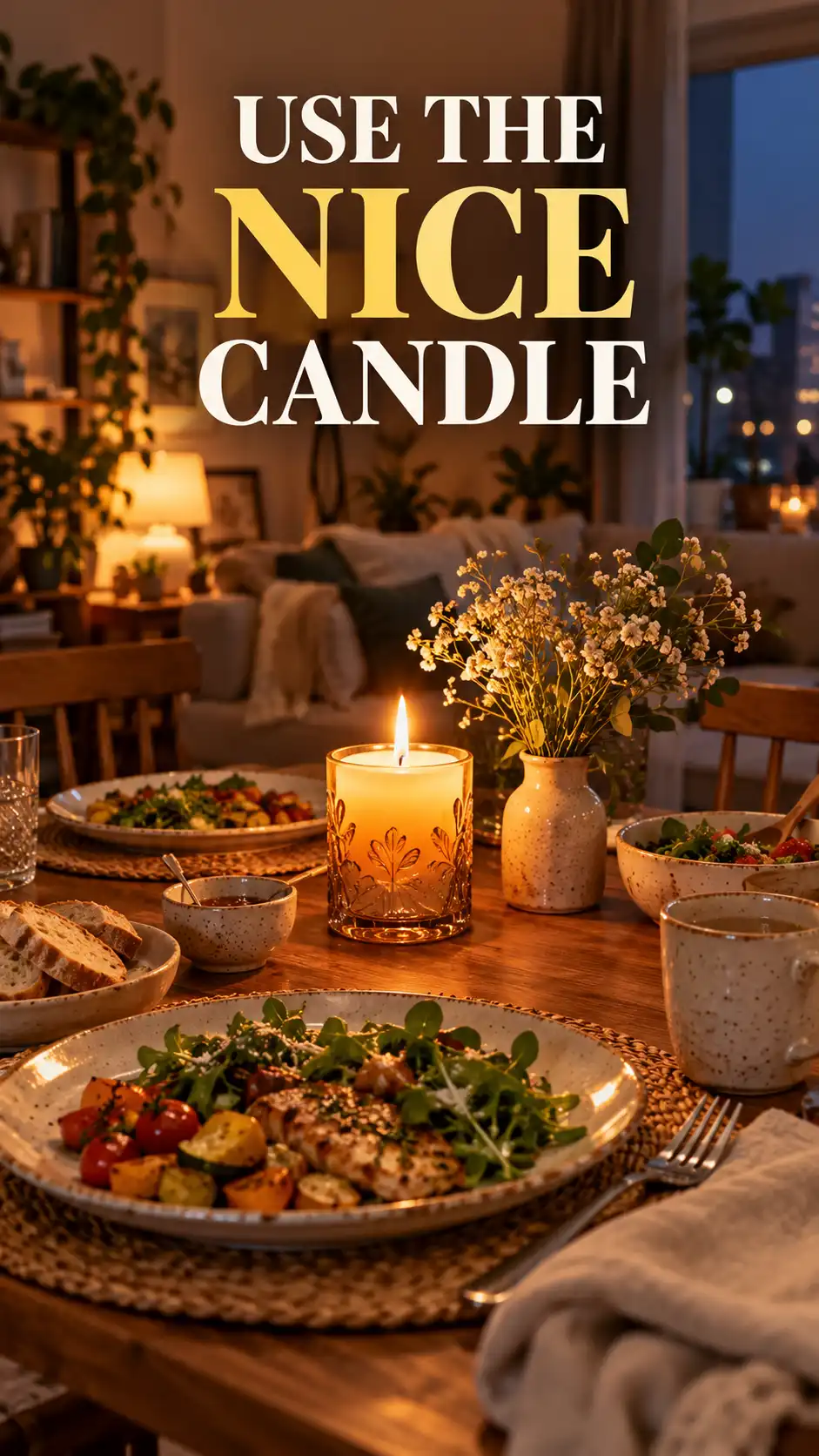
6. Use The Nice Candle
Yes, it gets its own section.
Because almost every home has one object that has somehow been promoted from “thing I purchased to enjoy” to “ceremonial artifact whose destruction must be prevented.”
Maybe it is a candle.
Fancy tea.
A notebook with paper too beautiful for your handwriting.
A bottle of perfume saved for special occasions.
A set of dishes waiting for guests who apparently outrank the people who live there.
Use them.
The product fulfilled its purpose when it created pleasure—not when it remained pristine long enough to be inherited by somebody who also felt guilty using it.
The habit: identify one “special” consumable and start consuming it.
Why it works: buying less feels easier when the things you own are actually delivering value.
Reminder: special occasions are allowed to include ordinary evenings.
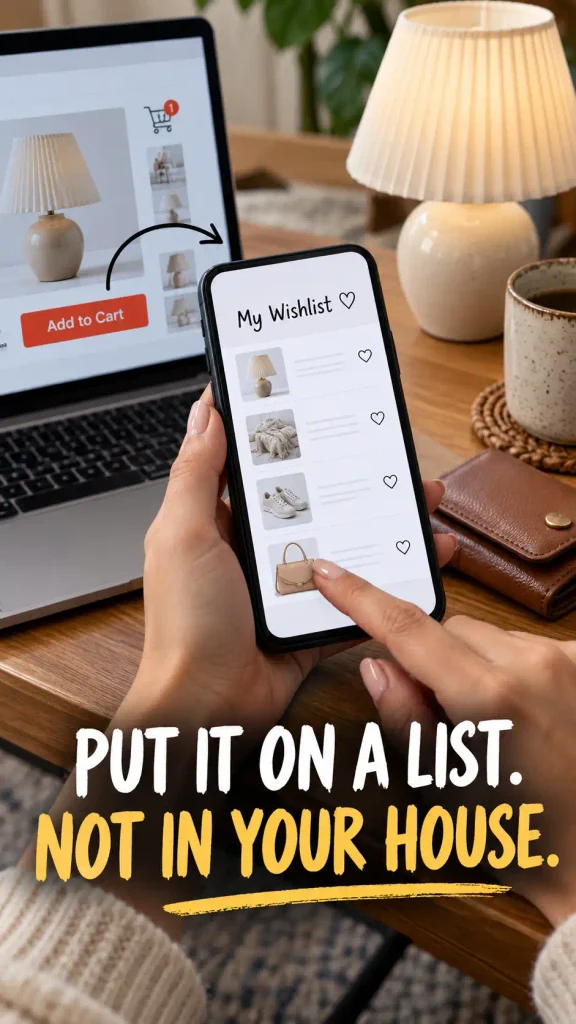
7. Make A Wishlist, Not A Checkout
Shopping sites are designed to turn curiosity into immediacy.
You saw it.
You liked it.
It is “almost gone.”
Checkout is two taps away.
A wishlist adds time back into the decision.
The goal is not to spend thirty days agonizing over a toaster.
It is to separate the dopamine of discovery from the financial action.
Save the item. Screenshot it. Write it down. Close the app.
If you still want it after the urgency evaporates, you can make the decision with a quieter brain.
The popular “slow buy” approach uses this kind of pause to examine what a purchase is trying to promise—status, identity, relief, belonging, convenience, beauty, or simply the item itself.
The habit: capture desire without immediately converting it into ownership.
Good waiting periods: 24 hours for small nonessentials; longer for expensive or duplicate purchases.
Question: “Do I want this object, or do I want the feeling in the ad?”
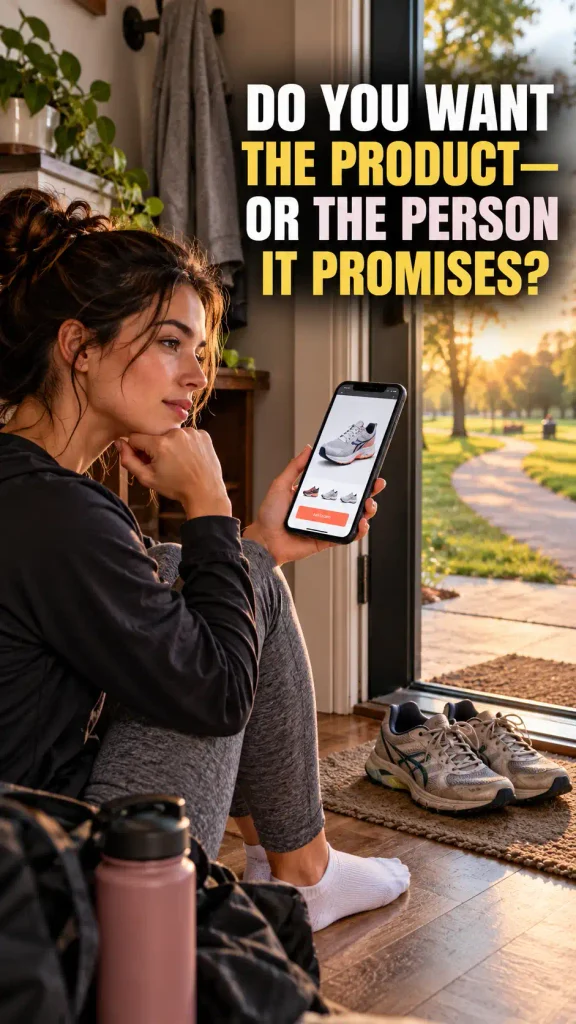
8. Ask Whether You Want The Thing—or The Identity
This is one of the most useful questions in modern shopping.
Do you want running shoes?
Or do you want to become someone who runs?
Do you want a sourdough kit?
Or do you want the warm, competent, bread-making life in the product photos?
Do you need a new notebook?
Or do you want to become organized?
Products genuinely can help activities happen. Good shoes matter if you actually run. A pan matters if you actually cook.
But consumer research has long shown that products are also used to construct and signal identity. Another line of research finds that when people are reminded their identities can exist independently of specific products, product preference can weaken.
Sometimes the cheaper way to become the person is to do the verb first.
Run.
Cook.
Write.
Then discover what equipment the activity actually requires.
The habit: do the activity with what you have before buying the identity kit.
Why it works: experience tells you what the fantasy cannot.
Best question: “What action would make me more like this person today without buying anything?”
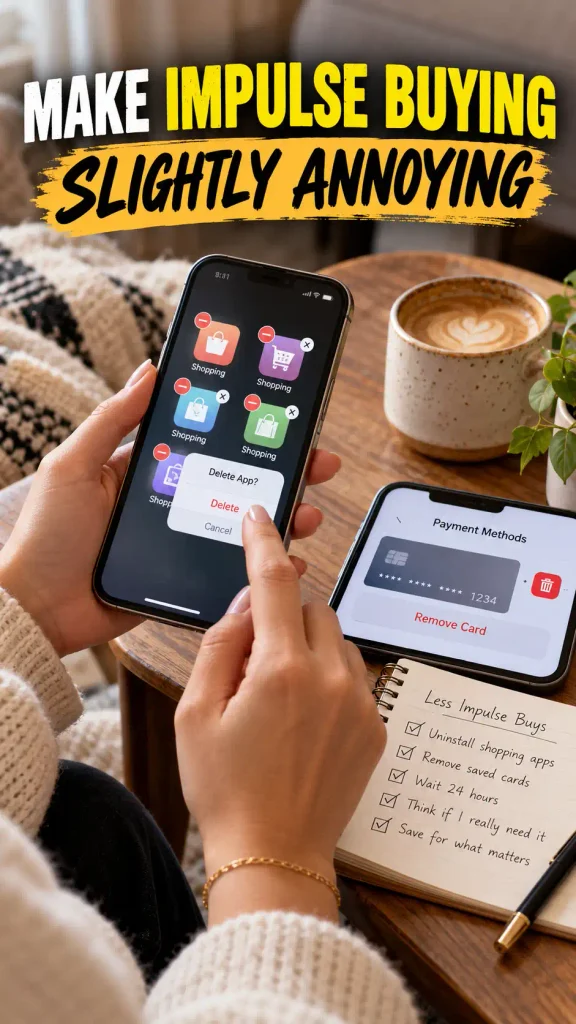
9. Delete The Shopping App That Knows You Too Well
Convenience is wonderful when you need batteries.
Convenience is less wonderful when boredom can become a package before you have stood up from the sofa.
Removing a shopping app, logging out, deleting saved cards or disabling promotional notifications creates friction.
Friction sounds inconvenient because it is.
That is the point.
Recent Project Pan and no-buy community discussions repeatedly recommend making spending slightly harder: unsubscribe, delete the app, remove stored payment details.
You can still purchase something you genuinely need.
You simply have to survive thirty extra seconds of intention first.
The habit: remove one-click access to your most tempting store.
Why it works: the purchase gets a pause between impulse and payment.
Try: browser-only shopping for one month.
10. Unsubscribe From The Sale That Keeps Inventing Emergencies
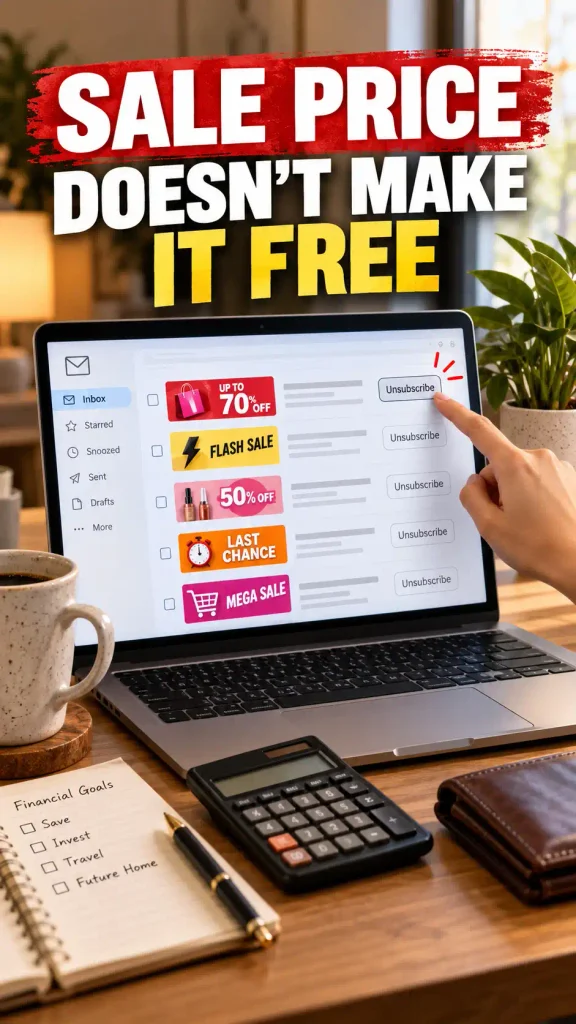
A sale email has one job:
Convince you that not purchasing something has become a missed opportunity.
Twenty percent off.
Final hours.
Members only.
You have been chosen by destiny to save $14 by spending $56.
If a store repeatedly creates desire you did not have before opening your inbox, remove the trigger.
You can still search for a discount when you already need something.
That reverses the order.
Need first.
Sale second.
Not sale first, invented need second.
The habit: unsubscribe from promotional email and text lists in your problem categories.
Why it works: fewer artificial shopping cues enter your day.
Useful sentence: “Saving money on something I was not buying is not saving money.”
11. Stop Buying Backups For Your Backups
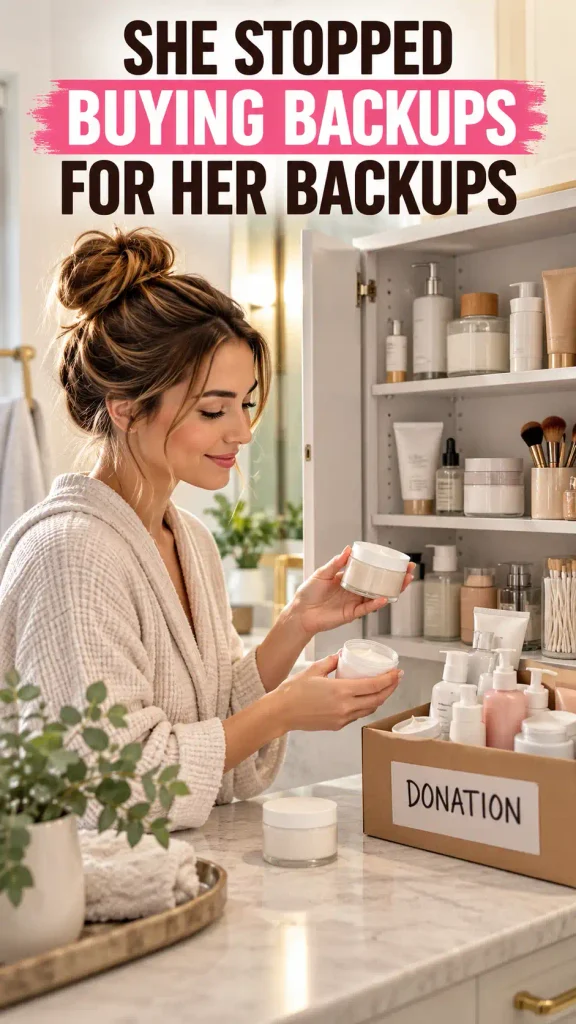
There is practical preparedness.
Then there is owning four unopened moisturizers because each was briefly “holy grail” status on your feed.
Backups feel responsible because the product will eventually be used.
But preferences change.
Formulas change.
Products expire.
People move.
And sometimes the first bottle lasts eight months, meaning the incredible deal on four backups was really a long-term storage contract.
A simple rule works better: replacement stock should reflect how quickly you actually consume the category.
The habit: limit backups to products with predictable use rates.
Good candidates: staples you finish reliably.
Bad candidates: trend-driven beauty, fragrances, hobby supplies and anything you constantly switch between.
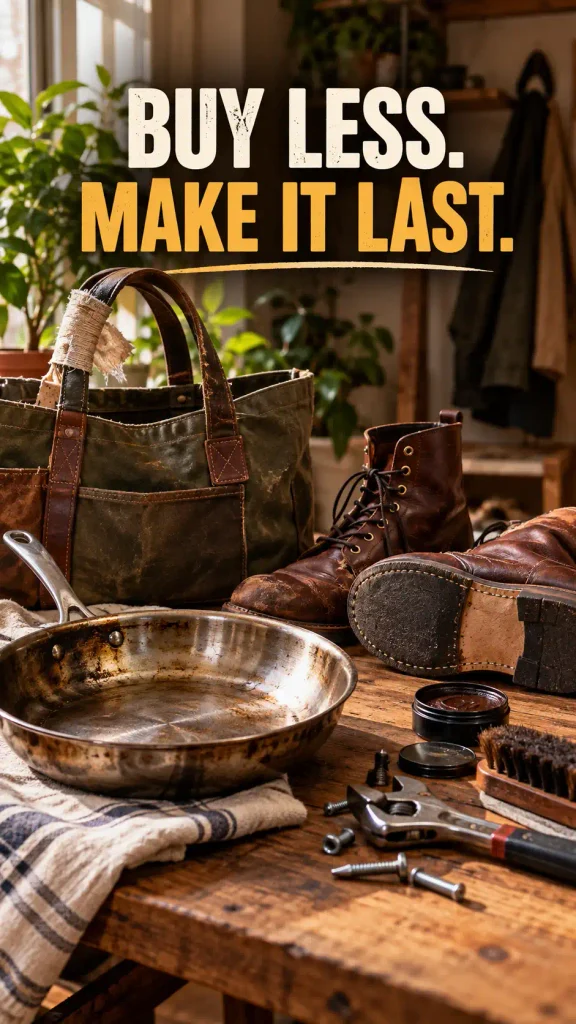
12. Repair Before You Replace
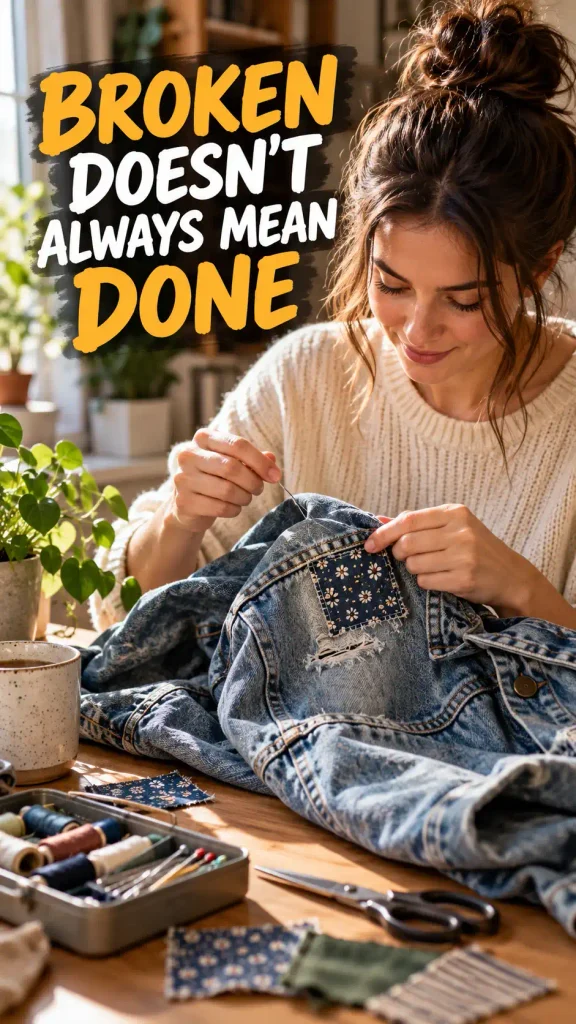
A loose button is not a dead shirt.
A scuffed table is not deceased furniture.
A torn tote is not a memorial service.
Repair used to be ordinary household behavior. Cheap replacement made it feel optional.
The EPA explicitly recommends maintaining and repairing clothing, electronics and furniture so they do not need to be discarded as frequently.
Start with the boring fixes.
Sew the button.
Patch the seam.
Replace the lamp cord through a qualified repair service.
Resole shoes worth resoling.
Tighten hardware.
Not everything should be repaired at any cost, and unsafe electrical or structural repairs belong with professionals.
But “broken” and “not brand-new” are not synonyms.
The habit: ask whether the failure is fixable before shopping for a replacement.
Start with: clothing, bags, shoes and simple furniture fixes.
Safety: use qualified repair professionals for hazardous electrical, gas or structural work.
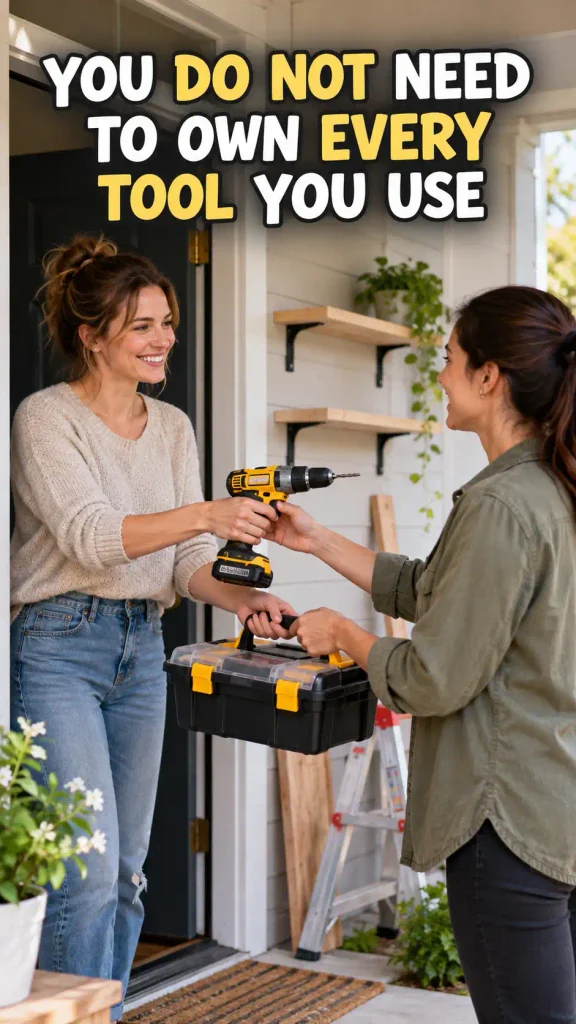
13. Borrow The Thing You Need Twice A Year
A power drill spends an extraordinary amount of its life not drilling.
So do carpet cleaners, party tables, specialty baking pans, ladders, camping gear and dozens of other objects people purchase for a specific weekend.
The EPA explicitly recommends borrowing, renting or sharing items that are used infrequently.
This may be the least glamorous form of underconsumption because there is no beautiful “after” photo.
You simply complete the task without acquiring another permanent resident for the garage.
That is the win.
The habit: borrow or rent low-frequency tools and equipment.
Where: friends, family, tool libraries, rental shops and community groups.
Buy when: repeated rental cost, availability or convenience clearly justifies ownership.
14. Check The Library Before The Bookstore
Books are dangerous because buying them feels suspiciously similar to reading them.
It is not.
A shelf of unread books is still a shelf of unread books, even if every purchase was intellectually aspirational.
Libraries turn curiosity into access without automatically turning it into ownership.
Borrow the novel.
Try the cookbook.
Listen to the audiobook.
Read the author you are not sure about.
Then buy the books you genuinely want to reread, annotate, collect or keep.
Underconsumption is easier when ownership becomes one option rather than the default ending to every interest.
The habit: borrow exploratory reading; buy keepers intentionally.
Bonus: many libraries also lend ebooks, audiobooks and sometimes tools, games or equipment depending on the system.
Useful distinction: liking books and liking buying books are two separate hobbies.

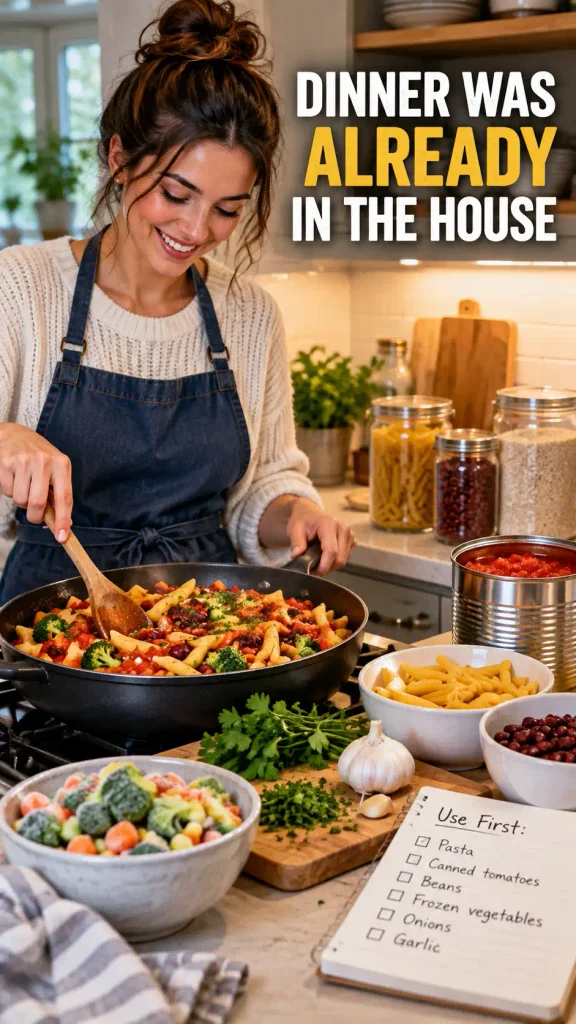
15. Eat The Pantry Before You “Restock” The Pantry
Pantries have a strange ability to contain both “nothing to eat” and eleven meals.
The EPA recommends checking refrigerator, freezer and pantry inventory before shopping, then planning meals around food that needs to be used. That reduces the chance of buying duplicates and helps prevent food waste. U.S. EPA.
A pantry challenge is simple:
Pick the forgotten rice.
The half-box of pasta.
The frozen vegetables.
The beans that have survived three reorganizations.
Build meals around them before another aspirational grocery haul enters the house.
This is not about avoiding fresh food or eating anything unsafe.
It is about remembering that stored food is not décor.
The habit: plan several meals from existing freezer/pantry food before a major shop.
Why it works: inventory becomes meals instead of waste.
Safety: follow food-storage guidance and discard unsafe or spoiled food.
16. Finish One Hobby Before Buying A New Hobby’s Personality
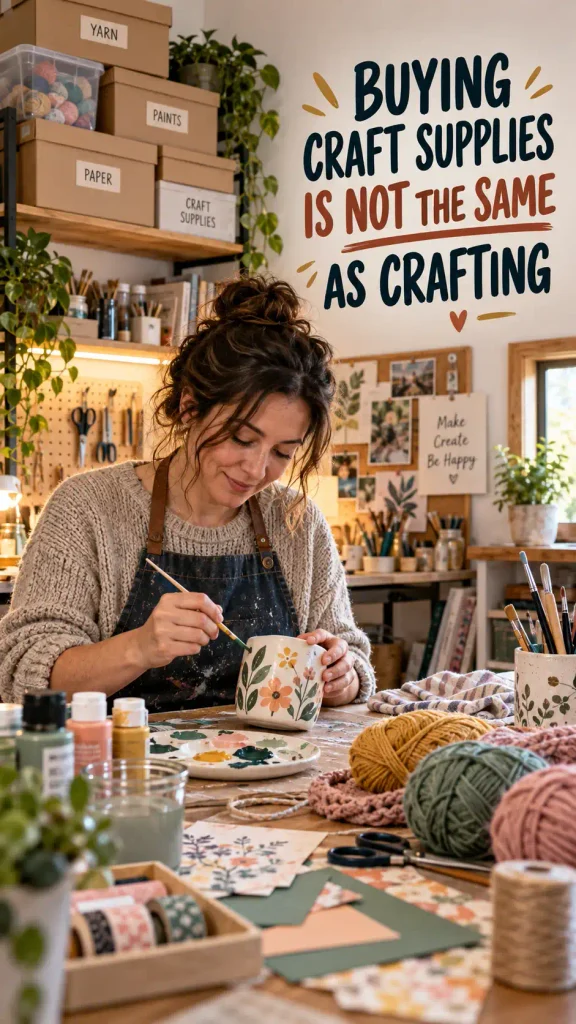
Craft stores are very good at selling the fantasy of future competence.
Watercolor set.
Embroidery kit.
Clay tools.
Calligraphy pens.
Yarn.
More yarn because the first yarn was apparently incorrect.
The danger is confusing hobby shopping with hobby doing.
An underconsumption rule can be as simple as requiring meaningful use of current supplies before opening a new category.
Finish the sketchbook.
Make something with the fabric.
Use the paint.
Then decide whether the next tool solves a real limitation you encountered.
The habit: let experience unlock new supplies.
Rule example: complete three projects before adding another craft category.
Question: “What project am I buying this for?” If the answer is “my future creative self,” wait.
17. Thrifting Still Counts As Shopping
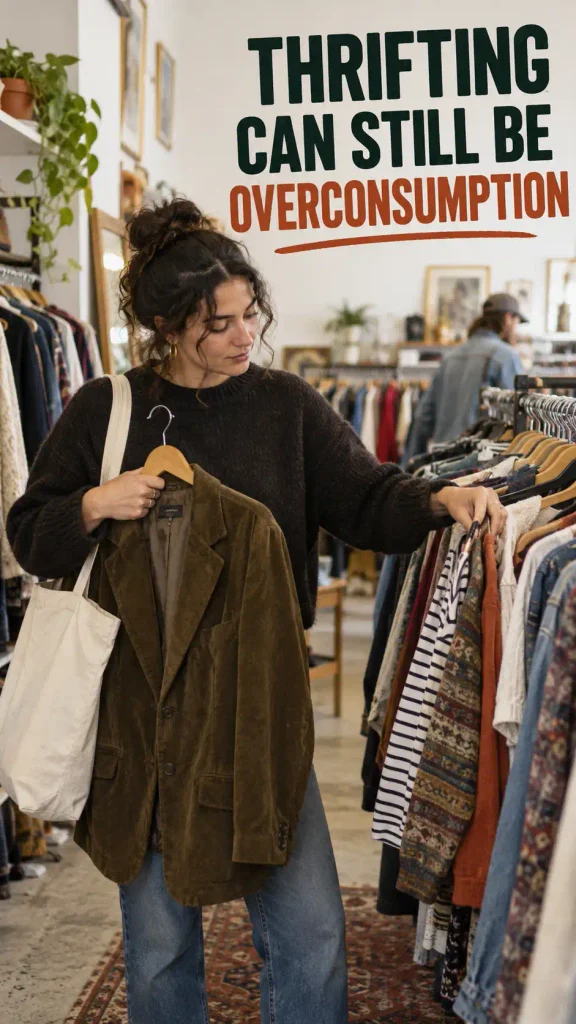
Secondhand is valuable.
It extends product life, can save money and can reduce demand for new production.
It can also become a moral permission slip to buy forty things you do not need.
“But it was thrifted” describes where an object came from.
It does not describe whether the purchase improved your life.
If a $6 shirt joins twenty other unworn shirts, the low price did not solve the consumption problem.
Underconsumption asks a more annoying question:
Would I still want this if the thrill of finding a bargain disappeared?
The habit: apply the same need/use test to secondhand shopping as new shopping.
Why it matters: low price can lower your decision threshold too far.
Good thrift buy: something useful, wanted and likely to be used—not merely something cheap.
18. Use Cost Per Wear Instead Of Sale Percentage
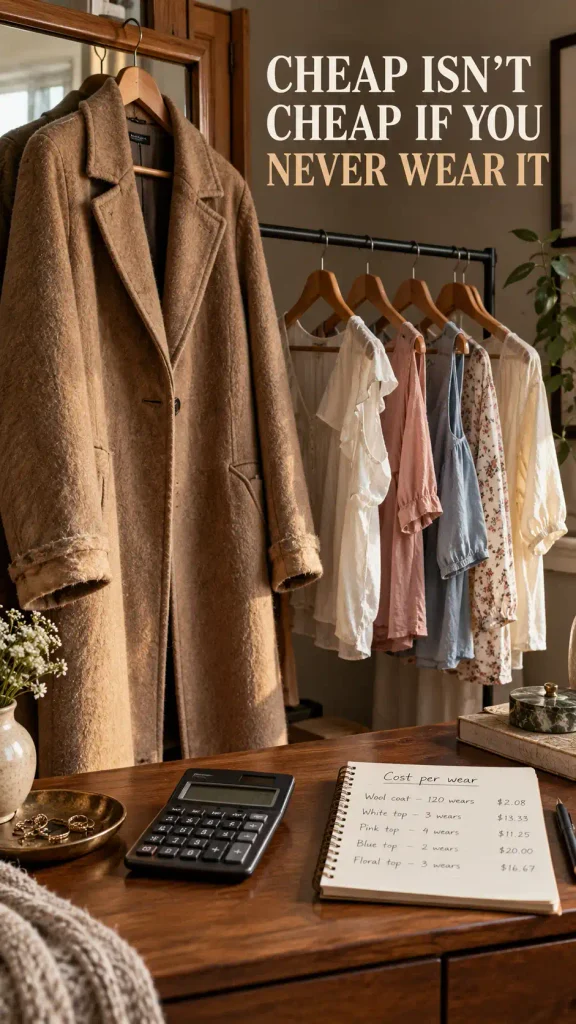
A $20 shirt worn once costs $20 per wear.
A $120 coat worn 120 times costs $1 per wear.
That does not automatically make expensive products better.
It changes the question.
Instead of asking, “How much am I saving?” ask, “How much will I use this?”
WRAP’s work on clothing durability makes the same broader point from an environmental perspective: extending active garment life matters.
The cheapest item can be expensive if it fails quickly or never leaves the closet.
The expensive item can also be a terrible purchase if “investment piece” is just a fancy phrase for wishful thinking.
The habit: estimate realistic use, not fantasy use.
Formula: purchase price ÷ actual number of uses.
Watch out: cost-per-wear is useful after honest behavior, not as a mathematical excuse to buy luxury items.
19. Try “One In, One Out” Where Space Is The Real Limit
One-in, one-out is not a law of morality.
It is a physical constraint.
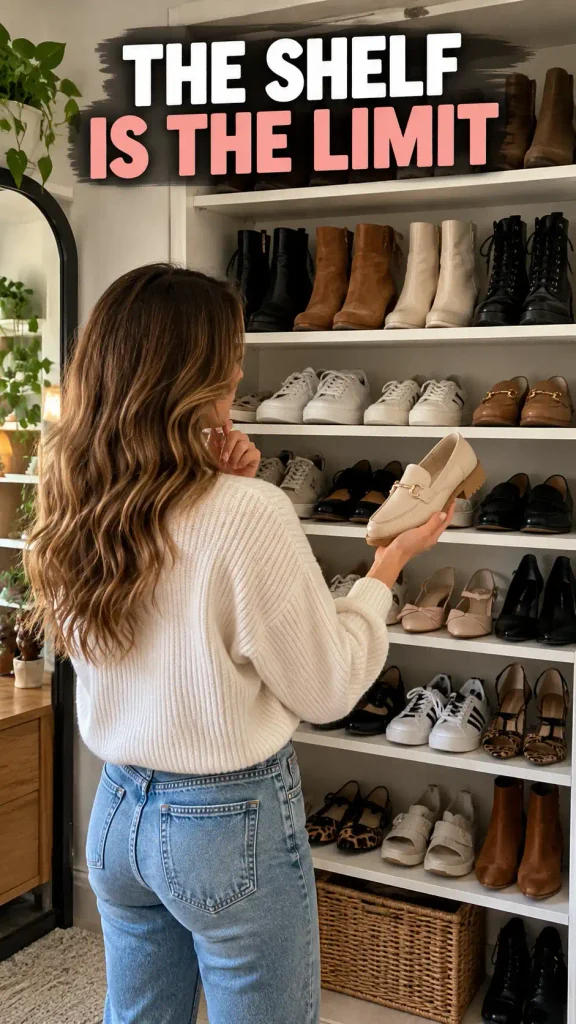
If the shoe rack holds twelve pairs comfortably, pair thirteen needs a plan.
If the mug shelf is full, the next mug is not entering a philosophical category called “just one more.”
Space can be a better limit than abstract minimalism because it is concrete.
You can see it.
You can open the drawer.
You can experience the fact that it no longer closes.
Use this rule in categories you habitually accumulate—not every category in the house.
The habit: define physical capacity before the next purchase.
Best for: shoes, mugs, bags, coats, toys, hobby equipment and décor.
Not necessary: consumables that naturally cycle out.
20. Buy It For Life—But Only When “Life” Makes Sense
Durability is one of underconsumption’s strongest ideas and easiest marketing opportunities.
Buy the better pan.
The repairable shoes.
The jacket with replaceable hardware.
The appliance with accessible parts.
TikTok trend reporting has explicitly highlighted “buy it for life” communities as shoppers push back against low-quality, one-and-done products. WRAP’s textile research likewise argues that durability is central to reducing clothing’s impact.
But “buy it for life” can become another shopping genre if applied to everything.
You do not need a $280 lifetime titanium version of an object you use twice.
Durability matters most where usage is high enough to earn it.
The habit: spend for longevity in high-use categories.
Look for: repairability, warranties, replaceable parts and proven construction.
Do not confuse: expensive with durable.
21. Stop “Restocking” Things That Are Not Actually Low
The word restock has become strangely generous.
Sometimes it means “I ran out.”
Sometimes it means “the drawer is only 70% full and this makes me uneasy.”
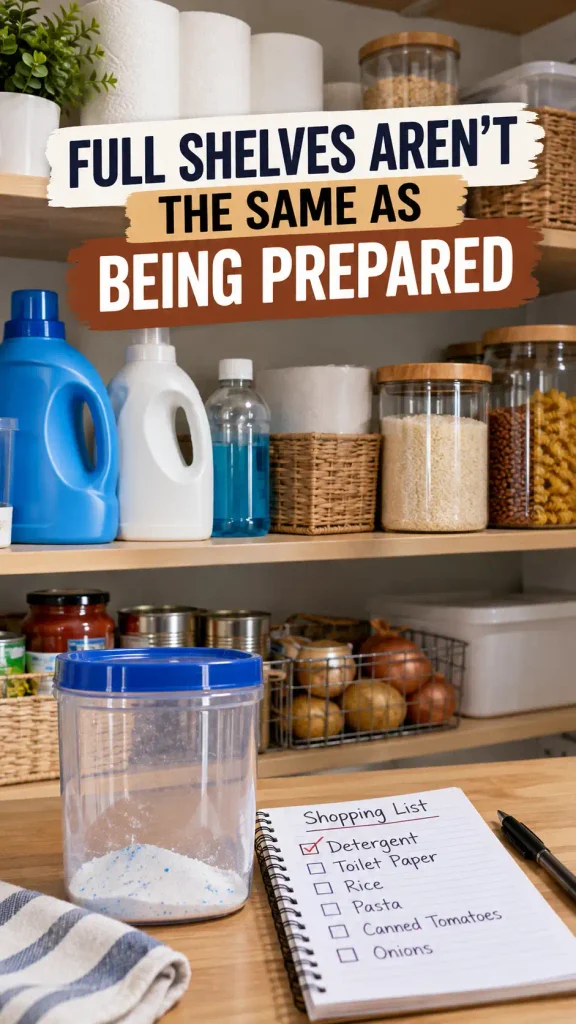
Social-media restocking content can make full shelves look like responsible household management even when they contain months or years of product.
Real restocking begins with a threshold.
How many dishwasher tablets trigger a purchase?
How much coffee?
How many rolls?
Without a threshold, “restock” can become shopping with a practical costume on.
The habit: define what “low” means for each staple.
Why it works: you separate actual household continuity from inventory anxiety.
Simple rule: replenish based on consumption rate and storage space, not visual fullness.
22. Make “Use What I Have” The Default For Small Problems
Need a container?
Check the cupboard.
Need gift wrap?
Check the drawer.
Need workout clothes?
Start with the T-shirt.
Need a bedside table?
Could the sturdy stool work for now?
This habit is not about permanently settling for bad solutions.
It is about testing whether the problem is real before purchasing the optimized solution.
Temporary improvisation provides information.
If the improvised version works for three months, maybe you never needed the product.
If it fails immediately, now you know exactly what to buy.
The habit: prototype with existing objects before purchasing a dedicated solution.
Why it works: you learn the actual requirement through use.
Best phrase: “What do I already own that can do 80% of this job?”
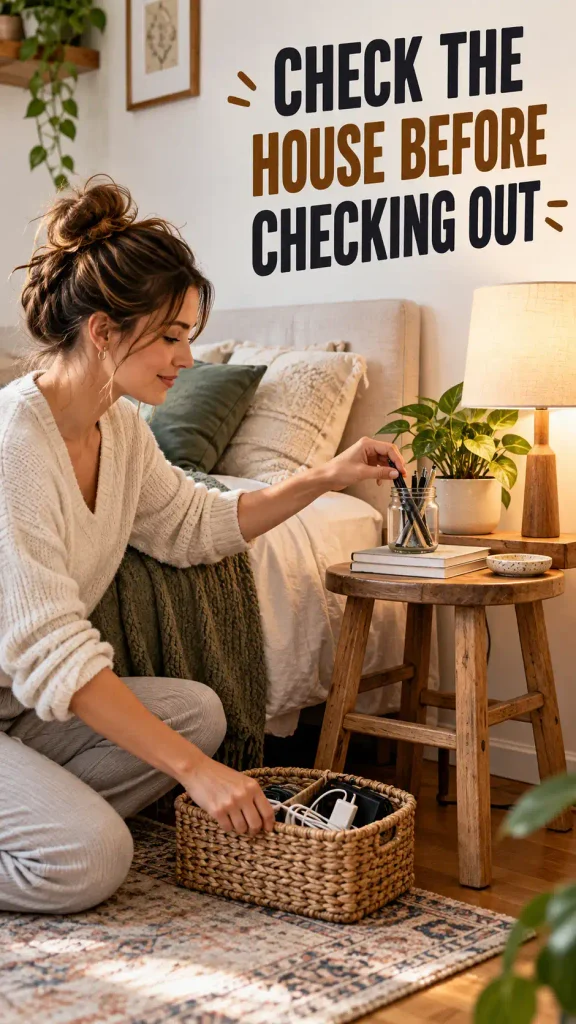
23. Create A No-Buy Category Instead Of Declaring War On Shopping
“I will buy nothing unnecessary ever again” has the energy of a plan made at 11:48 p.m.
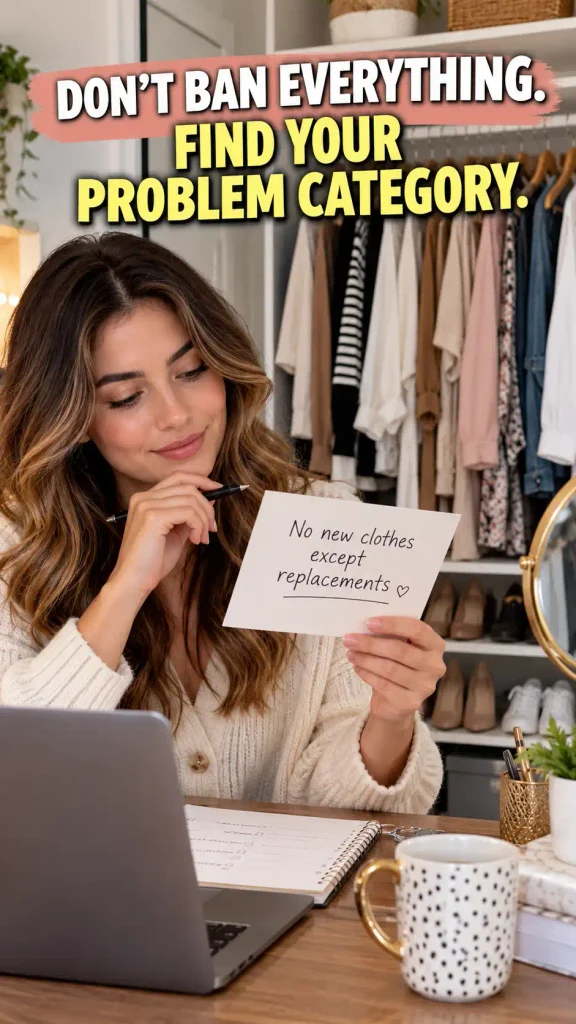
Category-specific rules are less dramatic and often more informative.
No new makeup until a category runs out.
No home décor for three months.
No clothes except true replacements.
No craft supplies until current projects are finished.
This isolates the category where shopping is actually causing stress without turning groceries, medicine and normal life into moral negotiations.
Online no-buy communities frequently use exactly this structure: explicit rules, exceptions and replacement categories rather than a blanket ban on all spending.
The goal is not suffering.
It is learning where your buying impulses live.
The habit: choose one problem category and write clear rules.
Include: replacements, emergencies and planned exceptions.
Better question than “Did I fail?”: “What triggered the purchase?”
24. Notice The Trigger Before You Judge The Purchase
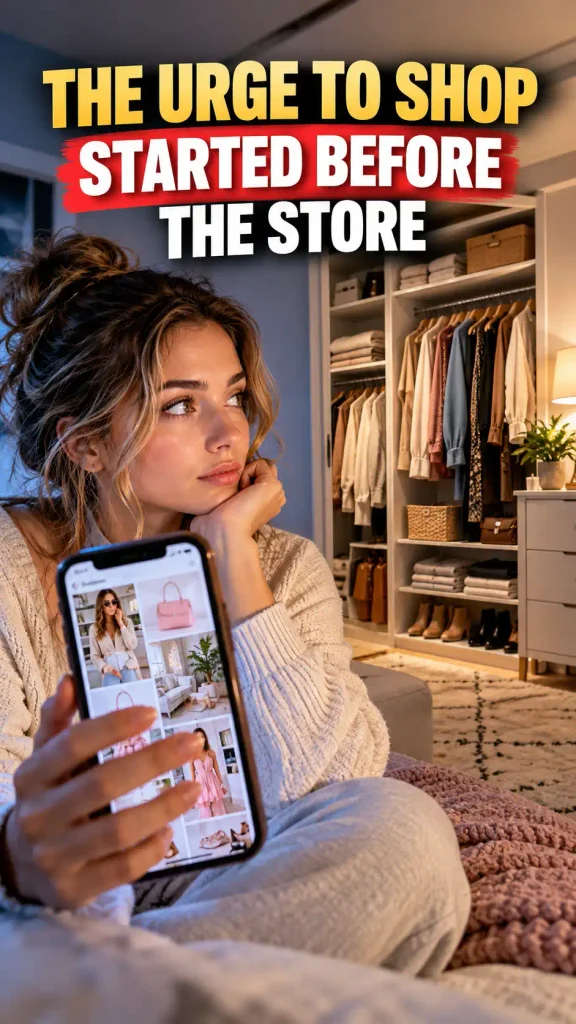
A shopping urge can begin long before the store.
You see someone wearing a perfect outfit.
Suddenly your wardrobe feels inadequate.
You watch a flawless home tour.
Suddenly your lamp has personally embarrassed you.
You see a productivity setup.
Your notebook becomes the reason your life is disorganized.
This is where deinfluencing becomes more useful than simple frugality.
The question is not only “Can I afford it?”
It is “What happened five minutes before I wanted it?”
Consumer research on identity signaling helps explain why products can feel emotionally relevant far beyond their function. A purchase can represent an attempt to reinforce a desired identity or repair a threatened one.
If the trigger is comparison, insecurity, boredom or aspiration, buying may provide relief without solving the original feeling.
The habit: identify the event or emotion that came before the urge.
Try: write one sentence—“I want this because…”—before nonessential purchases.
Important: wanting beautiful things is not a pathology. The point is understanding your own pattern.
25. Let “Enough” Be A Real Number
This may be the least photogenic habit on the list.
It is also the one that makes the others work.
How many everyday shoes are enough for your actual life?
How many water bottles?
How many black shirts?
How many blushes?
How many hobbies can you actively maintain?
Modern shopping rarely asks the question because there is no commercial advantage in giving it an answer.
Underconsumption does.
Not because everyone should own the same tiny number of things.
A chef needs more kitchen equipment than someone who hates cooking.
A makeup artist needs more makeup than someone who wears one product.
A family of six needs a different pantry from a person living alone.
Enough is personal.
But if the number is never defined, the default answer becomes “one more.”
That is why normal life starts to feel radical.
Not buying the new version.
Using the old phone case.
Repairing the jeans.
Finishing the moisturizer.
Borrowing the drill.
Reading the library book.
Cooking what is already in the freezer.
None of this is revolutionary behavior.
It only looks revolutionary inside a system that never stops asking what you want next.
The habit: define “enough” by use, space and real life—not somebody else’s minimalism.
Most useful shift: evaluate new purchases against what you already own.
The question: “What would make this category complete for me?”

Underconsumption becomes much less glamorous once you live with it.
There is no dramatic reveal when you do not buy a shirt.
Nobody applauds when the toothpaste finally runs out.
The repaired zipper does not arrive in beautiful packaging.
A library book cannot be displayed in an unboxing video because, inconveniently, it has to go back.
That may be why the movement feels refreshing.
It moves attention away from the moment of acquisition and back toward the much longer part of ownership:
using things.
Wearing them.
Finishing them.
Maintaining them.
Repairing them.
Enjoying them enough that the next purchase has to compete with something already doing its job.
Buying less does not need to become a personality.
It can simply become a little more difficult to convince you that your perfectly functional life requires another package at the door.
What is the most ordinary underconsumption habit you already do without thinking about it?
Sources & Further Reading
- TikTok Next — Consumer Intentionality and the “Why to Buy” Shift
- TikTok Shopping Trend Report — “Buy It for Life” Communities
- Journal of Business Research — Deinfluencing, Moral Responsibility and Anti-Consumption
- Journal of Business Research — Deinfluencers and the Contestation of Consumerism
- U.S. EPA — Refuse, Reduce, Reuse, Repair and Recycle
- U.S. EPA — Preventing Wasted Food at Home
- WRAP — Clothing Durability and Product Lifetime
- U.S. FDA — Shelf Life and Expiration Dating of Cosmetics
- U.S. FDA — Eye Cosmetic Safety
- Journal of Consumer Research — Products as Signals
- Journal of Consumer Research — Identities Without Products
- Journal of Consumer Research — Identity Relevance and Product Usage
- Journal of Consumer Research — Product Choice and Restoring Self-View Confidence
- The Washington Post — Project Pan and Using Beauty Products Fully
- People — The Slow Buy Method and Purchase Triggers
- Reddit r/ProjectPan — Inventory, No-Buy and Replacement Rules
- Reddit r/ProjectPan — Community Strategies for Adding Spending Friction
- Reddit r/ProjectPan — Shopping Overwhelm and “Shop Your Stash” Discussion
- Reddit r/MakeupRehab — Replacement-Only No-Buy Rules