Your Ultimate Guide to Types of Ear Piercings: What to Know About 20 Placements

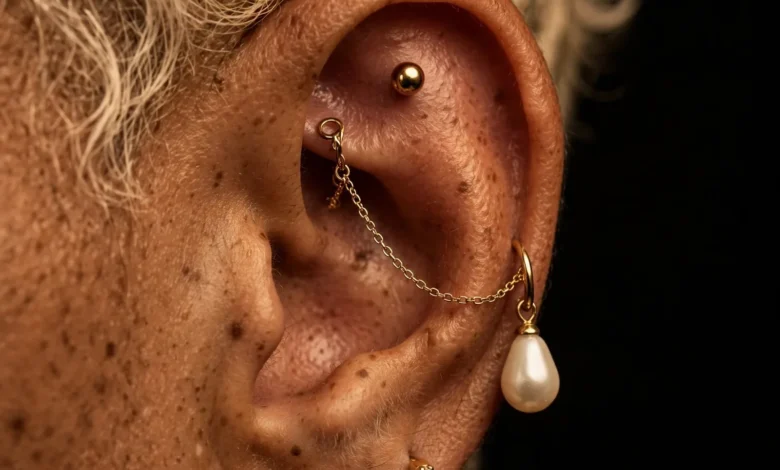
Ear piercings have been popular for centuries, but a full stack of beautifully curated jewellery has been on the rise over the past few years. Often called “earscaping,” this art has become more popular thanks to piercing studios such as Studs and Rowan. With all of the placement options out there, though, it can be difficult to decide which ear piercing is right for you — especially when the pain level and the aftercare can vary so drastically from one placement to another. Amy Lawrenson’s Byrdie guide, published February 21, 2026, updated May 1, 2026, and reviewed by professional piercer Cozmo Faris, has a piercer and a dermatologist break down 20 popular types of ear piercings, from standard lobes to daith piercings, faux rooks, and beyond. Here it is, in the same order, with the same facts they gave. I have not been pierced in any of these spots myself, and nothing here is my own experience; I am reporting what Lawrenson, piercer Janeese Brooks, and dermatologist Dr. Rachel Nazarian said.
Meet the experts: Janeese Brooks is the head of piercing at Stone and Strand, and she runs the Piercings Y’all pop-up events. Dr. Rachel Nazarian is a board-certified dermatologist with Schweiger Dermatology Group. Everything that follows comes from them, as reported by Lawrenson.
Types of Ear Piercings
Below are the 20 placements, in the order Byrdie lists them. Each one comes with its pain level out of 10 and its healing time, so you can compare them side by side before you book anything.

Standard Lobe
Pain level: 1/10 Healing time: 6–8 weeks

Ah, the classic, standard lobe piercing. Brooks says the lobe is the easiest part of the ear to heal, and the least painful part too — just a one or two on the pain scale. You can change the jewellery after three months of heal time, and there is generally enough space to do something unique with the placement as well. Design and aesthetics are a huge part of her work, so she spends a good deal of time helping clients get a creative look that suits them and their lifestyle.
Daith
Pain level: 5/10 Healing time: 6–9 months

The daith sits in a slightly awkward position — the hoop that hugs the cartilage on the inside of your ear — and it requires a skilled piercer. It is often sought after by people who have chronic headaches and migraines, although you can get it purely for aesthetic reasons as well. Dr. Nazarian says there are multiple reports of this type of piercing being useful and successful when other medical and non-medical therapies for migraines have failed, and that the daith is the only location that has shown potential real science for supporting a medical use: some studies have shown that it may modulate the pain receptors that send signals to the brain and relieve migraines and chronic headaches.
As it is placed on cartilage, you will feel a dull pressure when getting the daith pierced. It is not ideal to sleep on it until it is fully healed — although, compared with some outer ear piercings, sleeping on a daith within a couple of months is pretty common.
Helix
Pain level: 4/10 Healing time: 6 months to 1 year

Helix piercings sit anywhere on the upper outer cartilage of the ear, and they are often the first choice when moving from the lobe. Brooks confirms that the trending flat piercing has become even more popular now, and piercers and clients are experimenting with multiple helix piercings on one ear. She calls these cartilage piercings super cute, typically landing in the middle of the pain scale, and the one to get if you are considering a more permanent lifestyle and style change. The area allows for personalised placements and unique styles, and she tries to encourage people to go beyond just the little hoop.
Forward Helix
Pain level: 5/10 Healing time: 3–9 months

Another cartilage piercing, a forward helix is placed on the upper ear above the tragus. These piercings are a bit more tricky than a typical helix, as they must be lined up perfectly with your ear — and they will likely hurt more than a standard piercing. Your piercer will advise you on whether this one works for your anatomy, especially if you are considering two or three, which is popular for this placement.
Tragus
Pain level: 5/10 Healing time: 6–9 months

The tragus — that tiny flap partially covering the ear canal — can add detail to any curated ear, especially when it is adorned with a pretty stud or a snug hoop. Still, you will want to go in prepared for the complexities of the healing process. Brooks says these are hard to heal mostly because no one wants to give up earbuds during their commute: the tragus is there to protect the outer part of the ear canal, so piercing through it means the post sits where the earbuds go, and each time you take them in and out, it irritates the piercing. She warns her clients that if you are a picker or a fidgeter, it is going to take extra care and diligence to heal well.
Anti-Tragus
Pain level: 6/10 Healing time: 9 months to 1 year

Another piercing that is specific to your anatomy, an anti-tragus piercing sits directly opposite from the traditional tragus hump, above the earlobe. If your tragus is not prominent enough to be pierced, some piercers may decline to work against the shape of your ear — and this can be a cool alternative. In terms of jewellery, a curved barbell or a ball closure ring are the best options for this piercing.
Conch
Pain level: 4/10 Healing time: 3–9 months

The conch, located in the middle portion of your ear cartilage, gets its name from its resemblance to the spiral shell of the same name. It is pretty versatile: it can be pierced with a stud for a subtle effect, or a double stud if you are feeling brave. Once it is healed, you can swap it for a cuff that hugs around the edge of your ear.
Inner Conch
Pain level: 6/10 Healing time: 3–9 months

The inner conch is pierced through the middle shell of the ear, which is the thickest piece of cartilage on the ear. This piercing is the closest to the ear canal, so during the healing process, you will want to avoid wearing earbuds for quite some time, as they may irritate your new piercing.
Outer Conch
Pain level: 6/10 Healing time: 3–9 months

Similar to the inner conch, the outer conch is also pierced through the thickest piece of cartilage in your ear. Unlike the inner conch, though, the outer conch sits lower. If you are a side sleeper, sleep on the opposite side of your new piercing until it is fully healed.
Industrial
Pain level: 6/10 Healing time: 9 months to 1 year

The industrial piercing is a straight barbell connecting one cartilage piercing to another on the upper ear, and it is difficult to heal as a result of being two cartilage piercings instead of one. Since the two are also connected, they have a tendency to get irritated quickly — and often stay that way. You will also need to be especially careful with your aftercare. Brooks warns to be so careful of your hair and glasses resting on it, and says sleeping on it is always a big no-no. She typically steers clients away from this piercing for no other reason than most people do not keep them, because of how long they take to heal.
High-Lobe
Pain level: 2/10 Healing time: 6–8 weeks

The high-lobe piercing is a fun way to spice up the lobe, and it is especially good for making a feature out of a poorly placed piercing you may already have. Thanks to the lobe being so fleshy, the level of piercing pain is considerably low. While the healing time is relatively quick, that does not mean you should be lackadaisical when it comes to aftercare — you should always be following your piercer’s instructions for post-care and maintenance.
Rook
Pain level: 6/10 Healing time: 6–10 months

One of the more unusual inner-ear piercings, a rook piercing inserts in the inner cartilage, above the daith and between the inner conch and the forward helix. As a cartilage piercing, the rook does not pierce as easily as the lobe. Because of that, you may feel a sharp pain and pressure at first, followed by a more general throbbing — and because of how thick the rook cartilage is, it is a fold of cartilage after all, it may hurt more than a helix or tragus piercing.
Byrdie tip: a rook piercing is best suited for a hoop, although a bar is recommended for the initial healing period.
Faux Rook
Pain level: 5–6/10 Healing time: 6–10 months

If you love the look of a rook piercing but do not have the anatomy to make it work, a faux rook may be your best bet. Rather than travelling through that inner fold of cartilage vertically, this piercing goes through to the back at roughly the same spot as the top of a traditional rook piercing. Overall, the experience is similar because it is on the same part of the ear — but the resulting appearance is different.
Auricle / Mid-Helix
Pain level: 3/10 Healing time: 3–9 months

Located on the outer portion of the ear between the lobe and the helix, an auricle — also called a mid-helix piercing — is worn about halfway up the ear, across from the tragus. Hoops and studs work well for this type of piercing, and since the cartilage is relatively thin for the area, the pain is on the lower end of the scale.
Snakebite
Pain level: 4–6/10 Healing time: 6–9 months

While the snakebite is also a name for a facial piercing, in terms of ears, it refers to two piercings placed side by side. This type of piercing is especially popular along the mid-to-high helix, but many people get a set on other parts of their ear as well. The pain level and healing time should be similar, but they may both be a bit higher if you are getting both piercings at once.
Hidden Helix
Pain level: 5/10 Healing time: 6–9 months

A hidden helix piercing sits inside the top fold of the ear. Most often, the jewellery used features a curved bar tucked out of sight, allowing chains with gems and charms to dangle alluringly — seemingly out of nowhere.
Snug
Pain level: 9/10 Healing time: 4–6 months

Pierced horizontally through the inner rim of cartilage above the anti-tragus, the snug piercing gets its name from the hug in the folds of your ears. A snug piercing is also referred to as an anti-helix piercing, and it is considered the most painful of cartilage piercings. Only small jewellery, like a small hoop or curved barbells, will work here because of the tight placement.
Orbital
Pain level: 4/10 Healing time: eight to ten weeks

Orbital piercings have become a bit of a misnomer. To be technically accurate, an orbital uses a ring to connect two piercings, such as the first and second hole lobe piercings, or two cartilage piercings. However, orbital piercings have also come to mean a ring piercing through the conch piercing. The most popular placement is in the lobe or helix. This type of piercing is similar to an industrial piercing, as it connects two different piercings — but an orbital is pierced with a ring rather than a barbell, which gives the illusion that the piercing is, well, orbiting the ear.
Stacked Lobe
Pain level: 2/10 Healing time: 6–8 weeks

A stacked lobe piercing is pierced directly above a traditional lobe piercing, creating a vertical stack. Because it is still on the lobe, the pain and healing time are fairly minimal — so it is a great way to modernise your earscape without the pain and healing time of a cartilage piercing.
Transverse Lobe
Pain level: 6/10 Healing time: 2–10 months

If you are looking for something edgier than the traditional lobe piercing, you will find it in the transverse lobe piercing. With a transverse piercing, the jewellery is threaded from side to side rather than from front to back, as with traditional piercings. These are usually done with a barbell, which results in two balls appearing on either side of your lobe.
Aftercare
Before you book an appointment for a new ear accessory, be sure to research how to keep your piercing clean and minimise irritation as it heals. Proper piercing aftercare is so important — both to avoiding infection, and to the healed result looking as it should.
Brooks says not to twist, turn, rotate, or sleep on any of your piercings, as this can increase your risk of infection or irritation and extend the healing process. Try not to sleep on them, and clean them with saline one to two times a day. Generally speaking, you will want to steer clear of bodies of water — baths, pools, hot tubs, and the like — for six to eight weeks after getting pierced. Also avoid soap, peroxide, Neosporin, Bactine, rubbing alcohol, and other harsh chemicals from coming into contact with your new piercing.
FAQ
How should I clean an ear piercing?
According to the American Academy of Dermatologists Association, you should regularly clean your ear piercing with soap and water to avoid infection.
When can I change my ear piercing?
In general, you should wait about six to eight weeks to change your new piercing. Before this time, your piercing may not have healed completely, and you have a risk of infection.
How do I treat an infected ear piercing?
If you suspect your piercing is infected, you should clean your ears with sterile saline or gentle soap and water twice a day. Then, you can apply an antibiotic ointment or rubbing alcohol to the piercing.
Sources for the aftercare and FAQ guidance above: the American Academy of Dermatologists Association, “Caring for Pierced Ears,” and the Cleveland Clinic, “Infected ear piercings: causes, symptoms, treatment, prevention.”